Dealing with wrecked Fukushima nuclear reactors will take decades
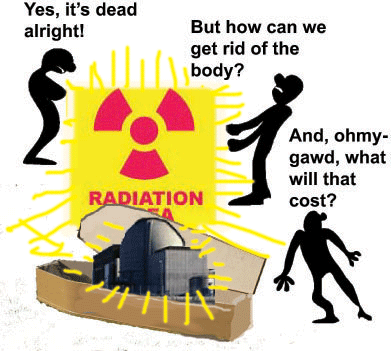
 Three decades needed to make Fukushima safe, ABC News, By North Asia correspondent, October 28, 2011 30 years to decommission: Inside the Fukushima nuclear plant A draft report by Japan’s nuclear agency says it will take more than 30 years to decommission the shattered Fukushima nuclear plant.
Authorities hope to have the stricken reactors in a state of cold shutdown by the end of the year. The draft report from the cabinet’s nuclear agency estimates that reactors number one through to four at the Fukushima plant will not be fully decommissioned until 2042.
As well as achieving cold shutdown of the reactors, each reactor building has to be decontaminated, and then fuel from the spent fuel pools has to be collected.
The final stage involves collecting nuclear fuel from inside the four reactors. Reactors one, two and three all suffered meltdowns after a tsunami slammed into the plant in March… http://www.abc.net.au/news/2011-10-28/fukushima-nuclear-decommission/3605094/?site=melbourne
TEPCO wants $12 billion from Japanese government to avoid bankruptcy
 Tepco to Ask for $12 Billion From Government, Nikkei Reports, October 27, 2011, By Tsuyoshi Inajima Oct. 28 (Bloomberg) –– Tokyo Electric Power Co. will ask the government for 900 billion yen ($12 billion) to avoid bankruptcy, the Nikkei newspaper said, the first state support since the Fukushima nuclear disaster almost eight months ago.
The aid will be the first disbursement from the Nuclear Damage Liability Facilitation Fund that was set up last month. Tepco and the fund have been drafting a business plan to pave the way for government support for the utility, which may have to pay 4.5 trillion yen in compensation to residents and businesses hurt by the disaster by March 2013.
Tokyo Electric’s Fukushima Dai-Ichi atomic plant has been discharging radiation since the March 11 earthquake and tsunami knocked out cooling systems, causing three meltdowns and explosions. The catastrophe forced 160,000 people to flee radiation and damaged fishing, farming and forestry businesses….Tepco may face 8.6 trillion yen in funding shortages during the next decade if none of its nuclear power plants come back online and electricity prices aren’t increased, a government panel said earlier this month after reviewing the company’s finances. ..http://www.businessweek.com/news/2011-10-27/tepco-to-ask-for-12-billion-from-government-nikkei-reports.html
Fukushima’s radiation pollution of the Pacific ocean
 Fukushima’s nuclear pollution of Pacific the world’s greatest: nuclear monitor, The Vancouver Sun, Agence France-Presse October 27, 2011 The IRSN cites deep-water fish, fish at the top of the marine food chain and molluscs and other filtrating organisms as “the species that are the most sensitive” to caesium pollution.
PARIS – France’s nuclear monitor said on Thursday that the amount of caesium 137 that leaked into the Pacific from the Fukushima disaster was the greatest single nuclear contamination of the sea ever seen….. Continue reading
Japan’s radioactive used cars
Radioactive second-hand cars dog Japan, BY:THE AUSTRALIAN, RICHARD LLOYD PARRY , October 26, 2011 RUSTING hulks disguised with new paint, and mileage clocks reset – the wiles of the second-hand car dealer are well known.
However, motorists in Japan are facing an unfamiliar peril. They are being offered used cars with low mileage, well-maintained engines and sound bodywork. The only flaw is that they are dangerously radioactive. Continue reading
Empowering Japanese people with knowledge about nuclear radiation
 Journalists must empower those who have to stay near Fukushima plant (Part 4), Mainichi Daily News, 25 Oct 11 Eight days after the nuclear disaster at the Fukushima No. 1 nuclear plant began to unfold, samples of spinach and raw milk were found to be contaminated with radioactive iodine in amounts exceeding the provisional permissible amount set by the Food Sanitation Act.
Government officials have tried to underplay the dangers with messages such as, “It’s all right as long as you’re not eating 4,200 servings of spinach,” and “Even drinking 1 liter of milk every day will not cause any problems.”
However, the problem boils down to how much radiation we’re exposed to at the dinner table. Continue reading
Duqu – a new computer worm hacking into classified nuclear information
 The Duqu worm was designed primarily to steal technical documents, especially to those relating to nuclear power plants and industrial controls systems by masquerading as an image file. Security experts have warned of a similar “Stuxnet 2” attack since Duqu was discovered.
Japanese military contractor hacked, Foreign Policy, By Kedar Pavgi , October 24, 2011 Mitsubishi Heavy Industries, a Japanese military contractor, confirmed today that a hacking incident from this past August released confidential information regarding classified warplanes and nuclear power plants. Continue reading
Citizens Forum in Japan challenges nuclear “experts”
there was widespread criticism after the Fukushima conference — which was organized by Shunichi Yamashita, the vice president of Fukushima Medical University and a “radiological health safety risk management advisor” for Fukushima prefectural government — that its participants assumed from the outset that radioactive contamination from the plant’s wrecked nuclear reactors is minimal.
Citizens’ forum queries nuclear ‘experts’, Japan Times, By TOMOKO OTAKE, 23 Oct 11 To whom does scientific debate belong? That was a central question raised by many of the 200-plus people who attended a citizens’ forum in Tokyo on Oct. 12, as they criticized the ways in which the Japanese government and radiation specialists working for it are assessing and monitoring the health effects of the ongoing nuclear disaster at the Fukushima No. 1 nuclear power plant. Continue reading
Japan’s radiation pollution wider and more serious than previously estimated
the contamination in the area is so severe that authorities need to remove not only the topsoil but also road surfaces, roofs and concrete walls….
“Radiation levels drop soon after decontamination work, but whenever it rains, contaminated soil flows into the area from surrounding mountain forests and the levels climb once again,” she said.
Experts and locals said woodlands that cover 71 per cent of Fukushima prefecture have been highly contaminated.

Concern grows over wider radiation contamination, Oman Daily Observer 22 October 2011 By Takehiko Kambayashi – Scientists, environmentalists and citizens’ groups have called for Japanese authorities to evacuate more areas in the wake of March’s nuclear accident after finding wider radiation contamination than officially reported. Continue reading
Japan might have to widen the radiation evacuation area
Seven months on, Japan yet to finalize nuclear evacuation plan, (Reuters), (Reporting by Yoko Kubota) 22 Oct 11, – Japanese nuclear experts are considering widening the evacuation zone in the event of a nuclear disaster, more than seven months after the world’s worst such disaster since Chernobyl…..
A committee under Japan’s Nuclear Safety Commission has been reviewing the country’s nuclear disaster prevention guidelines, trying to learn lessons from the worst nuclear disaster since 1986.
It is considering creating a 30-km (18-mile) radius around nuclear power plants where residents should be ready to take shelter or prepare to evacuate, a draft document compiled by the NSC secretariat and released by the NSC on Thursday showed.
This compares with a current zone of a radius up to 10 km. It is also considering recommending that local authorities in a 50-km radius from plants be prepared to provide iodine tablets that help prevent thyroid cancers from radiation exposure.
The committee is planning to revise the draft document and finalize recommendations on evacuation zones next month. It plans to come up with a mid-term review this year, while it may take years to fully revise the guidelines, an official at the NSC secretariat said.
About 80,000 residents were forced to evacuate from a 20-km radius from the Fukushima Daiichi plant after the radiation crisis and some 30,000 more left the 20-30-km radius zone, though some are starting to come back……
The United States and some other countries had advised its citizens to stay out of a 80-km radius of the Fukushima plant. http://www.reuters.com/article/2011/10/21/us-japan-nuclear-idUSTRE79K24420111021
$13 billion or more to decontaminate Japan’s radiation from Fukushima nuclear disaster
Japan: Radiation Cleanup Will Cost at Least $13 Billion, Premier Says, NYT, By REUTERS, October 21, 2011 Prime Minister Yoshihiko Noda, left, said the government would spend at least $13 billion to clean up vast areas contaminated by radiation from the world’s worst nuclear disaster since Chernobyl…..
How corporate America, the CIA and Walt Disney talked Japan into nuclear technology
 The plan had the advantage of making allies dependent on technology from corporate giants General Electric Co. and Westinghouse,
Tepco ‘Deal With Devil’ Signals End to Japan’s Postwar Era Bloomberg, October 21, 2011,“……….Hiroshima Bombing Japan’s development into the world’s third-biggest user of nuclear energy dates from the last days of the war. Yasuhiro Nakasone, who would later become Prime Minister and a powerful advocate of atomic energy, was serving as a naval officer in Japan when Hiroshima was bombed. After the war, he began the work of persuading the U.S. to sell Japan nuclear technology…..
Japan’s interest coincided with U.S. concern about what to do with its own surplus of weapons-grade plutonium, and the suspicion that created in the Soviet Union, Laura E. Hein wrote in “Fueling Growth — The Energy Revolution and Economic Policy in Postwar Japan.”
U.S. President Dwight Eisenhower’s solution was the “Atoms for Peace” program to use U.S. plutonium to provide nuclear fuel for its allies. Continue reading
Nuclear power as cure for climate change- the big con
 The Big Con Is Nuclear Power Really a Trump Card Against Global Warming?, CounterPunch, by TAKASHI HIROSE OCTOBER 19, 2011 In recent years there seemed to be a nuclear power renaissance. One reason for this has been the adoption by its promoters of the theme of global warming, and their claim that nuclear power is clean energy because it does not produce carbon emissions. But is nuclear power in fact the clean-energy solution its promoters claim? Continue reading
Breakthroughs in electric car design
 Charge a car in time it takes for a coffee, SMH, Stephen Ottley, October 22, 2011 ELECTRIC cars are a big step closer to mainstream acceptance thanks to two breakthroughs. Long battery recharging has been the biggest hurdle for the car industry to overcome. But a technology being developed by Nissan and Japan’s Kansai University could solve the problem.
It has reportedly created a charger that can replenish a car’s batteries in 10 minutes, without any adverse affect on the batteries. Currently it can take up to eight hours to recharge an electric car…..
At present so-called fast chargers require 30 minutes to restore batteries to just 80 per cent capacity and cost more than $30,000.
The industry has been struggling to come up with a solution to long charging times as electric cars fight to become a viable alternative to petrol cars….Another hurdle cleared by the industry is an agreed standard of recharging plugs.
The move is seen as crucial to the implementation of public charging infrastructure. Volkswagen, General Motors, Ford, Audi, BMW, Mercedes-Benz and Porsche have all agreed to work together on the universal system for plug outlets, voltage and cables….http://smh.drive.com.au/charge-a-car-in-time-it-takes-for-a-coffee-20111021-1mcaf.html
Nuclear corruption in Japan’s government, industry and universities

 Noda, tear down this ‘nuclear village’ -HOTLINE TO NAGATACHO – CHRIS ROWTHORN Japan Times , Kyoto Oct. 18, 2011
Dear Prime Minister Yoshihiko Noda,
The Great East Japan Earthquake was a catastrophe of apocalyptic proportions. While the quake and tsunami did tremendous damage to Tohoku, the triple meltdowns at the Fukushima No. 1 nuclear plant did even more harm to the country by threatening the health of the population, weakening Japan’s economy, and tarnishing Japan’s reputation as an efficient and safe country. Continue reading
Plutonium nuclear plant project stopped, – Japan
 Japan utility to freeze nuclear power project, Monsters and Critics, Oct 17, 2011, Tokyo – Hokkaido Electric Power Co said Monday it would postpone a plutonium-thermal power generation project at its nuclear power plant on Japan’s northern island, after the company was accused of manipulating public opinion.
A report filed by an independent panel said the utility had asked employees and residents supporting the project to express opinion in favour of the nuclear energy at symposiums and other events organized by the central and local governments.
Hokkaido Electric was planning to implement its so-called pluthermal power generation in spring of 2012 at reactor 3 at the Tomari Nuclear Power Plant on the island.
Hokkaido Electric president Yoshitaka Sato told a news conference that the utility would accept the findings by the panel set up by the company to investigate the scandal…..
The scandal reinforced public mistrust in the nuclear power industry and apparently made it difficult for the restart of idled nuclear reactors….. Plutonium-thermal generation uses fuel made from a mixed oxide of plutonium and uranium (MOX fuel)… http://www.monstersandcritics.com/news/business/news/article_1669319.php/Japan-utility-to-freeze-nuclear-power-project
1 This Month



Read the Public Inquiry Report, the Commissioners’ report, Surrendering Australia: The AUKUS Deception is available to download for free at aukuspublicinquiry.com. Or just watch the replay of the National Press Club Luncheon.

19 November – Webinar – The Reality of Reprocessing
Time: 11:00 AM Pacific Time (US & Canada) / 2:00 PM Eastern / 7:00 PM UK / 8:00 PM CET
Register for the Zoom Event Here


Shut down the radiation-damaged Heysham nuclear reactors now
To see nuclear-related stories in greater depth and intensity – go to https://nuclearinformation.wordpress.com

Say No to NASA’s Reckless Nuclear Reactor on the Moon
Say No to NASA’s Reckless Nuclear Reactor on the Moon
-
Archives
- November 2026 (119)
- October 2026 (302)
- September 2026 (339)
- August 2026 (330)
- July 2026 (355)
- June 2026 (287)
- May 2026 (306)
- April 2026 (356)
- March 2026 (251)
- February 2026 (267)
- January 2026 (308)
- December 2025 (358)
-
Categories
- 1
- 1 NUCLEAR ISSUES
- business and costs
- climate change
- culture and arts
- ENERGY
- environment
- health
- history
- indigenous issues
- Legal
- marketing of nuclear
- media
- opposition to nuclear
- PERSONAL STORIES
- politics
- politics international
- Religion and ethics
- safety
- secrets,lies and civil liberties
- spinbuster
- technology
- Uranium
- wastes
- weapons and war
- Women
- 2 WORLD
- ACTION
- AFRICA
- Atrocities
- AUSTRALIA
- Christina's notes
- Christina's themes
- culture and arts
- Events
- Fuk 2022
- Fuk 2023
- Fukushima 2017
- Fukushima 2018
- fukushima 2019
- Fukushima 2020
- Fukushima 2021
- general
- global warming
- Humour (God we need it)
- Nuclear
- RARE EARTHS
- Reference
- resources – print
- Resources -audiovicual
- Weekly Newsletter
- World
- World Nuclear
- YouTube
-
RSS
Entries RSS
Comments RSS

