Foolhardy action to drink radioactively contaminated water
“Oh God,” said John Large, a British nuclear expert who has helped assess disasters including the wreck of the Russian nuclear submarine Kursk, when told of Mr. Sonoda’s actions. “That is incredibly foolhardy and somewhat patronizing to members of the public,”
if you drink the water you’re potentially providing radioactive particles a pathway into your gut system. It’s then down to how your gut system deals with it. It might ignore it and urinate it out. Or it might say ‘that’s a nice piece of cesium, I’ll store that in muscle tissue’ which is not a goodthing.”….

 Japanese Official Drinks Water From Fukushima Reactor Buildings, NYT By ROBERT MACKEY and RAVI SOMAIYA, November 1, 2011, After insisting for weeks that water collected from reactor buildings at the stricken Fukushima Daiichi nuclear plant posed no threat to human health once it was decontaminated, a Japanese government official poured himself a glass of the liquid and drank it on livetelevision on Monday. Continue reading
Japan finds ways to have adequate power without nuclear energy
Japan winter power enough despite nuclear lack: government, By Risa Maeda,TOKYO Nov 1, 2011 (Reuters) – Japanese utilities will largely avoid power shortages this winter despite prolonged reactor shutdowns amid public concerns over nuclear safety, but hurdles remain for next summer, the government said on Tuesday.
It also unveiled ways to bridge the gap next summer, when peak-hour demand is expected to exceed supply by 16,560 megawatts, compared with the biggest gap this winter of 2,530 MW in one area, if no reactors restart by then. Continue reading
Not In My Backyard! – nuclear waste disposal problem in Japan
 Nuclear Cleanup Faces ‘NIMBY’ Challenge, WSJ By Yumiko Ono, 31 Oct 11, In handling the Fukushima Daiichi nuclear crisis, Japan has gotten help from American scientists and imported American robots. Now comes a popular American phrase: NIMBY….Japan is trying to get around the NIMBY problem by planning to move the contaminated waste from one place to another. The government has asked each municipality to store its own contaminated waste for now until it comes up with an “interim” storage facility. In the meantime, it will debate the more sensitive issue of where to store the waste permanently. Continue reading
Twice as much radiation released from Fukushima as previously estimated
the institute warned that a significant degree of pollution would remain in waters off the coast of Fukushima Prefecture as caesium-137 has a half-life of around 30 years….
 New Norwegian report says Fukushima radiation releases twice initial estimates, Two new European reports on the Fukushima Daiichi disaster released over the last week take large steps in proving that radioactive caesium-137 released after the nuclear power plant was slammed by 9.0 magnitude earthquake and tsunami last March was twice as much as initially thought. Bellona Charles Digges, 31/10-2011 Continue reading
Endless radioactive cleanup problems – Chernobyl, Hanford, Fukushima

Government guidelines provide scant detail about the $14-billion-plus effort. A new cleanup law doesn’t take effect until January. Cities across Fukushima prefecture are scraping contaminated topsoil off school grounds and parks, but Tokyo hasn’t yet decided where to store the tainted material. Frustrated residents of some towns have planted sunflowers in a fruitless effort to suck radioactive cesium out of the farmland. Continue reading
Japan planning to export nuclear technology to India, Vietnam
Japan Closer to Exporting Nuclear Technology to India, Vietnam, WSJ By TATSUO ITOTOKYO, 30 Oct 11 —Nearly eight months after the Fukushima Daiichi nuclear accident, Japan is resuming steps it hopes will lead to exports of commercial nuclear technology to India and Vietnam, even as Japan itself is scaling back the use of nuclear energy at home.
Meanwhile, Prime Minister Yoshihiko Noda and his Vietnamese counterpart, Nguyen Tan Dung, will likely discuss nuclear power cooperation when they meet Monday, a government official said. Japan has already signed off on talks toward a nuclear power pact with Vietnam, but the parliamentary approval needed to ratify the agreement has been put on hold…..The agreement with India may draw criticism, as it comes at a time when the Fukushima crisis isn’t yet resolved. Moreover, India isn’t a member of the Nuclear Nonproliferation Treaty, aimed at preventing the spread of nuclear weapons and technology, while promoting peaceful uses of nuclear energy…. http://online.wsj.com/article/SB10001424052970204528204577007712071441558.html?mod=googlenews_wsj
India and Japan planning a deal on rare earths
Japan, India to jointly develop rare earths, The Yomiuri Shimbun, 31 Oct 11 Japan and India agreed Saturday to promote at the private level joint development of rare earths, which are indispensable for automobiles and information technology products.
Foreign Minister Koichiro Gemba and Indian Foreign Minister Shri S.M. Krishna also agreed to step up negotiations toward conclusion of an India-Japan nuclear agreement during a meeting at the Foreign Ministry’s Iikura Guest House in Minato Ward, Tokyo, according to officials.
In addition, they agreed to enhance cooperation in security policies by carrying out joint exercises by the Maritime Self-Defense Force and Indian Navy and in other ways, they said.
The exercises are likely to focus on ensuring the safety of sea-lanes in the Indian Ocean, observers said….. India, which has nuclear weapons but does not participate in the Nuclear Nonproliferation Treaty, is cautious about Japan’s stance in promoting nuclear arms reduction and nonproliferation through conclusion of a bilateral nuclear pact.
Japan wants to hold negotiations with India on the export of nuclear technologies and nuclear-related equipment, but it may be some time before an agreement is reached, the observers said… http://www.yomiuri.co.jp/dy/national/T111029002574.htm
To avoid TEPCO bankruptcy, Japanese government will pay up
The government’s objective is to keep the company afloat. Without public funds, Tepco would have to report a capital deficit for the July-September quarter, results of which are due by Nov. 14. Even the slightest hint of bankruptcy of a company with ¥13 trillion in liabilities could trigger major financial turmoil. Public assistance is expected to sustain Tepco in a state of positive net worth of about ¥700 billion at the end of the current business year in March, even after booking an expected annual net loss of about ¥570 billion.
But if the bleeding continues at the current pace, much of the capital would be lost in the next business year. This makes it crucial for Tepco to secure either an electricity-rate increase or an early restart of idled nuclear reactors to deal with the cost increases resulting from the prolonged stoppage of nuclear power plants and greater reliance on expensive thermal power, a government official familiar with the matter said….Public funds will be provided via the Nuclear Damage Liability Facilitation Fund, an organization set up jointly by the government and power companies last month to provide insurance for nuclear accidents.
Under the interim plan, a supervisory committee comprising the top executives of the fund and Tepco will monitor cost-cutting progress. Tepco is required to produce a more comprehensive business plan in March, when there should be more clarity on rate hikes and reactor restarts…
Japan – protest by Fukushima women
 VIDEO http://www.greenpeace.org/international/en/news/Blogs/makingwaves/women-from-fukushima-gather-to-find-hope-in-t/blog/37555/ Women from Fukushima gather to ‘find hope in the despair’ of nuclear disaster by Laura Kenyon, Greenpeace International – October 28, 2011 Yesterday close to two hundred women from Fukushima began a three-day sit-in outside the Tokyo office of Japan’s Ministry of Economy calling for the evacuation of children from areas with high radiation levels and the permanent shut down of nuclear reactors in Japan currently switched off. Their peaceful protest is a powerful – almost radical – act in a country where standing up for something can often mean ostracism from one’s community. These are not women who regularly participate in civil protest. These are mothers who fear for their children’s safety and future. These are grandmothers separated from their families. The fact that they have put their own lives and families on hold for these three days reflects the harrowing situation these women and their families have found themselves in since the nuclear disaster. Continue reading
Japanese govt’s costly, desperate measures to save TEPCO from bankruptcy
Stopgap measures for TEPCO / Utility’s liabilities may exceed assets without government’s help, Kunihiko Yasue and Chiaki Toyoda / Yomiuri Shimbun Staff Writers, 29 oct 11, Tokyo Electric Power Co.’s application Friday for more than 1 trillion yen in government funds was meant to help the utility swiftly compensate people for damage caused by the crisis at its Fukushima No. 1 nuclear power plant.
TEPCO has already started making full-fledged compensation payments, and without the government’s assistance its liabilities could exceed its assets. Continue reading
Japan to decide on level for lifetime exposure to ionising radiation
 The report pointed out effects of radiation exposure on children are more serious than those on adults,
Govt to cap radiation limit / Report recommends lifetime exposure of no more than 100mSv, The Yomiuri Shimbun, 29 Oct 11, A report by the Cabinet Office’s Food Safety Commission has recommended a person’s cumulative lifetime radiation exposure from food should be limited to about 100 millisieverts.
The report compiled Thursday covers possible effects on health from internal exposure from food containing radioactive substances. Based on the report, the Health, Labor and Welfare Ministry will begin considering individual regulatory figures for foods.
It is likely the new limits will be stricter than interim limits, hurriedly implemented shortly after the crisis began at the Fukushima No. 1 nuclear power plant. Continue reading
Japan ceases policy of promoting nuclear energy
Japan drops nuclear promotion, Today, Oct 29, 2011 TOKYO – Japan’s government abandoned its policy of promoting atomic power, saying it will reduce reliance on the sector in its first annual review of energy since the Fukushima nuclear disaster. Continue reading
Dealing with wrecked Fukushima nuclear reactors will take decades
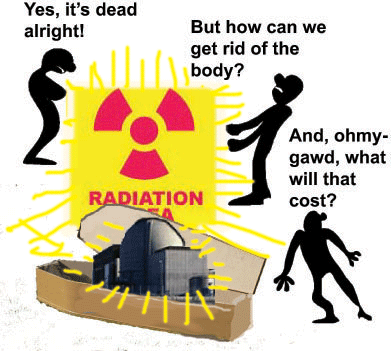 Three decades needed to make Fukushima safe, ABC News, By North Asia correspondent, October 28, 2011 30 years to decommission: Inside the Fukushima nuclear plant A draft report by Japan’s nuclear agency says it will take more than 30 years to decommission the shattered Fukushima nuclear plant.
Authorities hope to have the stricken reactors in a state of cold shutdown by the end of the year. The draft report from the cabinet’s nuclear agency estimates that reactors number one through to four at the Fukushima plant will not be fully decommissioned until 2042.
As well as achieving cold shutdown of the reactors, each reactor building has to be decontaminated, and then fuel from the spent fuel pools has to be collected.
The final stage involves collecting nuclear fuel from inside the four reactors. Reactors one, two and three all suffered meltdowns after a tsunami slammed into the plant in March… http://www.abc.net.au/news/2011-10-28/fukushima-nuclear-decommission/3605094/?site=melbourne
TEPCO wants $12 billion from Japanese government to avoid bankruptcy
 Tepco to Ask for $12 Billion From Government, Nikkei Reports, October 27, 2011, By Tsuyoshi Inajima Oct. 28 (Bloomberg) –– Tokyo Electric Power Co. will ask the government for 900 billion yen ($12 billion) to avoid bankruptcy, the Nikkei newspaper said, the first state support since the Fukushima nuclear disaster almost eight months ago.
The aid will be the first disbursement from the Nuclear Damage Liability Facilitation Fund that was set up last month. Tepco and the fund have been drafting a business plan to pave the way for government support for the utility, which may have to pay 4.5 trillion yen in compensation to residents and businesses hurt by the disaster by March 2013.
Tokyo Electric’s Fukushima Dai-Ichi atomic plant has been discharging radiation since the March 11 earthquake and tsunami knocked out cooling systems, causing three meltdowns and explosions. The catastrophe forced 160,000 people to flee radiation and damaged fishing, farming and forestry businesses….Tepco may face 8.6 trillion yen in funding shortages during the next decade if none of its nuclear power plants come back online and electricity prices aren’t increased, a government panel said earlier this month after reviewing the company’s finances. ..http://www.businessweek.com/news/2011-10-27/tepco-to-ask-for-12-billion-from-government-nikkei-reports.html
Fukushima’s radiation pollution of the Pacific ocean
 Fukushima’s nuclear pollution of Pacific the world’s greatest: nuclear monitor, The Vancouver Sun, Agence France-Presse October 27, 2011 The IRSN cites deep-water fish, fish at the top of the marine food chain and molluscs and other filtrating organisms as “the species that are the most sensitive” to caesium pollution.
PARIS – France’s nuclear monitor said on Thursday that the amount of caesium 137 that leaked into the Pacific from the Fukushima disaster was the greatest single nuclear contamination of the sea ever seen….. Continue reading
-
Archives
- October 2026 (101)
- September 2026 (339)
- August 2026 (330)
- July 2026 (355)
- June 2026 (287)
- May 2026 (306)
- April 2026 (356)
- March 2026 (251)
- February 2026 (267)
- January 2026 (308)
- December 2025 (358)
- November 2025 (359)
-
Categories
- 1
- 1 NUCLEAR ISSUES
- business and costs
- climate change
- culture and arts
- ENERGY
- environment
- health
- history
- indigenous issues
- Legal
- marketing of nuclear
- media
- opposition to nuclear
- PERSONAL STORIES
- politics
- politics international
- Religion and ethics
- safety
- secrets,lies and civil liberties
- spinbuster
- technology
- Uranium
- wastes
- weapons and war
- Women
- 2 WORLD
- ACTION
- AFRICA
- Atrocities
- AUSTRALIA
- Christina's notes
- Christina's themes
- culture and arts
- Events
- Fuk 2022
- Fuk 2023
- Fukushima 2017
- Fukushima 2018
- fukushima 2019
- Fukushima 2020
- Fukushima 2021
- general
- global warming
- Humour (God we need it)
- Nuclear
- RARE EARTHS
- Reference
- resources – print
- Resources -audiovicual
- Weekly Newsletter
- World
- World Nuclear
- YouTube
-
RSS
Entries RSS
Comments RSS

