Fukushima area – 5.9 magnitude earthquake
Magnitude-5.9 quake hits near Japan nuclear site, USA Today 24 Nov 11TOKYO (AP) – A strong earthquake struck Thursday morning near the Japan nuclear power plant hit by a powerful tsunami earlier this year. There were no immediate reports of damage or injuries.
The U.S. Geological Survey said the magnitude-5.9 quake struck shortly before 4:30 a.m. local time. It hit 62 miles (101 kilometers) east of the Fukushima Dai-ichi nuclear power plant. The quake struck at a depth of 23 miles (37 kilometers).
The quake struck 151 miles (244 kilometers) northeast of Tokyo. The Pacific Tsunami Warning Center did not immediately issue a tsunami alert. Similar quakes have struck in the region since a March 11 magnitude-9.0 earthquake…
The region lies on the “Ring of Fire” — an arc of earthquake and volcanic zones that stretches around thePacific Rim. About 90% of the world’s quakes occur in the region.http://www.usatoday.com/news/world/story/2011-11-23/japan-earthquake-1123/51372658/1
Japanese government pays up big to keep TEPCO nuclear utility afloat
TEPCO gets 120 bil. yen as government insurance over nuclear crisis Mainichi Daily News, 23 Nov 11 TOKYO (Kyodo) — Tokyo Electric Power Co., operator of the crisis-stricken Fukushima Daiichi power plant, said Tuesday it has received 120 billion yen from the government under an existing insurance program for nuclear accidents.
The funds will be used by the company to pay massive compensation to people and companies affected by the world’s worst nuclear accident in 25 years. The utility, known as TEPCO, has separately received 558.7 billion yen from a state-backed funding entity.
TEPCO submitted a request on Oct. 24 for the payment of 120 billion yen, the maximum compensation amount set by a contract between the government and TEPCO for an accident at one nuclear power plant…. http://mdn.mainichi.jp/mdnnews/news/20111123p2g00m0bu031000c.html
Radioactive caesium on nearly 10% of Japan’s land
 Nearly a tenth of Japan contaminated Almost eight per cent of Japan’s land area has been covered by radioactive caesium from the disaster at the Fukushima Daiichi nuclear plant. ABC Nes 22 Nov 2011 Mark Willacy, North Asia correspondent Japan’s Science Ministry says nearly 10 per cent of the country’s land has been contaminated by radiation from the crippled Fukushima nuclear plant.
It says more than 30,000km², or eight per cent of the country’s land area, has been blanketed by radioactive caesium.
The Ministry says most of the contamination was caused by four large plumes of radiation spewed out by the Fukushima nuclear plant in the first two weeks after meltdowns after the March earthquake and tsunami.
The Japanese Government says some of the radioactive material fell with rain and snow, leaving the affected areas with accumulations of more than 10,000 becquerels of caesium per square metre. http://abcasiapacificnews.com/stories/201111/3373127.htm
Continuing crisis of Fukushima, and of the global nuclear industry
 In particular, scientists believe the accident resulted in the atmospheric release of over 35,000 terabecquerels’ worth of caesium-137 – or some 42 percent of what was released during the 1986 catastrophe at Chernobyl. Caesium-137 is a radioactive isotope that has a half-life decay period of around 30 years and is capable of causing gene damage after prolonged exposure…..
Also contrary to government claims, researchers believe that a great amount of caesium-137 was discharged from the spent nuclear fuel storage ponds, which were in significant distress during the crisis as the cooling systems failed to supply water to the ponds, leading to heat accumulation and exposure of the fuel rods.

 A chronicle of nuclear decay: Over half a year later, what have we learnt from Fukushima? MOSCOW – Eight months since the fateful March of 2011, one of the world’s worst nuclear catastrophes that enflamed Japan’s Fukushima Daiichi Nuclear Power Plant has ceased to be the stuff of front-page frenzy. We will likely still see radioactive goods and food products popping up on the store shelves around the world, reminding us of the terrors of nuclear energy, but for many, the panic caused by the threat of contamination spreading silently in a far-off country has become yesterday’s news. But does it mean that the problems of Fukushima – and, indeed, of the global nuclear power industry – are soon to be over? Not by a long shot.
Bellona, Vladimir Slivyak, 22/11-2011 – Translated by Maria Kaminskaya
Clearly, even a cursory look at the latest developments will tell us it will be a very long time before the tragedy in Japan is safely forgotten. Continue reading
Japanese seismologist predicted nuclear earthquake disaster
Disregard for the science extended to a government panel started in 2001 to revise seismic engineering standards for Japan’s nuclear plants, said Ishibashi. He quit the panel after five years of debate that he called rigged and unscientific…..
an article on Hamaoka published in the October 1997 issue of Japan’s Science Journal that reads like a post-mortem of the Fukushima disaster: A major quake could knock out external power to the plant’s reactors and unleash a tsunami that could overrun its 6-meter
defenses, swamping backup diesel generators and leading to loss of cooling and meltdowns.
 Vindicated Seismologist Says Japan Still Underestimates Threat to Reactors, Bloomberg, By Jason Clenfield – Nov 21, 2011, Dismissed as a “nobody” by Japan’s nuclear industry, seismologist Katsuhiko Ishibashi spent two decades watching his predictions of disaster come true: First in the 1995 Kobe earthquake and then at Fukushima. He says the
government still doesn’t get it….
Haruki Madarame, now head of Japan’s Nuclear Safety Commission, from dismissing Ishibashi as an amateur when he warned of a “nuclear earthquake disaster,” a phrase the Kobe University professor coined in 1997. Ishibashi says Japan still underestimates the risk of operating reactors in a country that has about 10 percent of the world’s quakes. Continue reading
Fukushima: 11 evacuated cities and towns, but their people will vote in elections
All of the parties and groups involved in the Fukushima assembly election said last month that they wanted nuclear power to be phased out……
For as long as they remain uninhabitable and their residents dispersed, the future of the contaminated areas will be clouded by uncertainty. …
 Japan’s nuclear disaster towns hold remote local elections Guardian UK, 20 Nov 11 Evacuated residents from Okuma and Futaba in Fukushima plant exclusion zone ballot for regional assemblies from afar They have been deserted for eight months, and could stay that way for years, their former inhabitants now scattered around north-east Japan.
But the towns of Okuma and Futaba, located in the shadow of the Fukushima Daiichi nuclear power plant, have shown that civic life must go on, even in the wake of a major nuclear accident. In one of the more surreal episodes of world democracy, tens of thousands were eligible to vote on Sunday for regional assemblies and mayors in towns that have all but ceased to exist. Continue reading
The hidden nature of cancer caused by ionising radiation
Future cancers from Fukushima plant may be hidden, Google News, By MALCOLM RITTER, 21 Nov 11 “……The idea that Fukushima-related cancers may go undetected gives no comfort to Edwin Lyman, a physicist and senior scientist with the Union of Concerned Scientists, a group that advocates for nuclear safety. He said that even if cancers don’t turn up in population studies, that “doesn’t mean the cancers aren’t there, and it doesn’t mean it doesn’t matter.” Continue reading
Japan’s anti nuclear Occupy movement determined to make Japan nuclear free
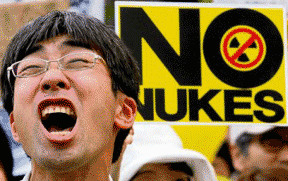 Anti-nuclear protestors sit tight at Japanese ministry, BUSINESS RECORDER NOVEMBER 18, 2011 TAKEHIKO KAMBAYASHA Anti-nuclear activist Tadao Eda says he and other citizens will continue their sit-in at the Industry Ministry for as long as Japan is running nuclear power stations despite the ongoing crisis at a damaged plant in the north-east.
“Japan needs drastic changes in energy policy by scrapping all the nuclear reactors,” Eda says from his tent erected in a corner of the ministry’s grounds two months ago. “We won’t allow the government to restart idled reactors” after they are shut down for maintenance, he says.
All of Japan’s 11 reactors still in operation, are scheduled to be shut down for servicing by April, he says. If the government withholds permission for them to restart, Japan would be free of nuclear power. Continue reading
For the first time, Japan bans radiation contaminated rice
Japan issues ban on Fukushima rice contaminated by radiation, Vancouver Sun, AFP November 17, 2011 TOKYO — Japan on Thursday announced its first ban on rice produced near the crippled Fukushima nuclear power plant after samples showed
radioactive contamination well above legal limits.
The findings will further worry nervous consumers, already fretting over the safety of domestic produce, despite its previous solid safety reputation. Authorities in Fukushima prefecture say rice produced near the stricken atomic power plant contained caesium they measured at 630 becquerels per kilogram (2.2 pounds). The government safety limit is
500 becquerels.
Chief Cabinet Secretary Osamu Fujimura ordered Fukushima Governor Yuhei Sato to restrict shipments of rice from Onami — from where the samples were sourced — according to an agricultural ministry
official…..
Environmental campaign group Greenpeace said Thursday it had detected radiation in fish sold at Japanese supermarkets, although radiation levels were still well below the government safety limit of 500 becquerels.
According to its own research carried out between October 12 and November 8 in eastern Japan, 47.3 becquerels of cesium per kilogramme were discovered in cod while traces of radiation were also found in other fish, including tuna. http://www.vancouversun.com/business/Japan+issues+Fukushima+rice+contaminated+radiation/5726394/story.html#ixzz1e6mhWM7x
TEPCO executives’ delusion that nuclear business will go on as before
the biggest policy threat to the nuclear industry is local. Since the disaster, Japanese mayors and governors have been blocking utilities from restarting reactors that have shut down
Anti-nuclear mood melts Tepco’s hopes of normality FT.com By Jonathan Soble in Tokyo, 16 Nov 11, Call it fortitude or fantasy, but executives at Tokyo Electric Power (Tepco), the owner of Fukushima Daiichi nuclear power station, still talk of the meltdowns at three of the facility’s reactors in March as a merely temporary setback for their business.
“The sooner we get back to normal, the better,” Toshio Nishizawa, Tepco’s president, recently told the Financial Times. “Whatever happens, our core business will not change.” Continue reading
iPhone radiation counter to go on sale in JapAn
Japanese firm makes iPhone radiation counter, SMH 16 Nov 11 A Japanese company has unveiled a cheap Geiger counter for the iPhone to enable people worried about the Fukushima nuclear accident to check their environment for radiation.
The probe, 14 centimetres long by 5cm wide, connects to the iPhone and the screen displays radiation readings in combination with a special app such as the Geiger Bot.
The device was developed on the initiative of a young researcher who wanted to make a cheap and easy-to-use Geiger counter available following the world’s worst nuclear disaster since Chernobyl…..
The first models for iPhones will go on sale in the next few days priced at Y9800 ($124).
…. http://www.smh.com.au/digital-life/smartphone-apps/japanese-firm-makes-iphone-radiation-counter-20111116-1ni5z.html#ixzz1dvFz1SO7
Escalating costs of Japan’s nuclear safety plans
Japan’s Nuclear Safety Steps May Cost 19 Billion Yen Per Reactor, Nov. 15 (Bloomberg) –– Additional safety measures required at Japan’s nuclear power plants in the wake of the Fukushima disaster may cost 19.4 billion yen ($252 million) per reactor, the government said.
Comparison of radiation levels before and after Fukushima nuclear catastrophe
when the accident struck, Konayashi and his colleagues were in a good position to measure exactly how things changed.
Japanese Physicist Publishes Fukushima Radiation Records, Technology Review, 14 Nov 11 The readings at the Fukushima Medical University, close to the damaged nuclear power plant, make for grim reading.
Today, an insight into the conditions in the region surrounding the Fukushima Nuclear Power plant soon after the magnitude 9 earthquake and resultant tsunami which caused the reactors to explode. Continue reading
Radiation checks being done in Tokyo schools
Tokyo schools checked for radiation, ABC News, By North Asia correspondent, November 14, 2011 Fears of nuclear fallout from the Fukushima disaster are increasing in
Japan, where local councils in Tokyo have begun checking schools and parks for radioactive contamination.
Tokyo’s metropolitan government has also announced spot checks of fresh and processed foods. In the playground of the Meguro Honcho Nursery School, young children
play in the dirt as officials test it for radiation from Fukushima. “There is no solution here,” said principal Michiko Ikeda, who has been hovering over a Geiger counter writing down readings. “We cannot say this is absolutely safe. Parents are worried about radiation, our staff too. “By taking these radiation measurements, we want to show that we care
for the children.”
Hiroshi Sato, from the local Meguro council, is also at the school to help test for radiation.
“Recently it became clear that radiation came further south than we thought, all the way to Tokyo,” he said. “So we are now checking dozens of schools in the Meguro area.”
In Tokyo, protesters marched past the offices of Fukushima’s owners TEPCO to demand protection for their children…. http://www.abc.net.au/news/2011-11-14/tokyo-schools-checked-for-radiation/3664228/?site=newcastle
Fukushima rescue squad volunteer dies from internal radiation
Dr. Sakiyama cunningly switched the subject to the Fukushima plant workers, but the issue here is not the plant workers. It’s the rescue squad members, it’s the volunteers, it’s the residents, who have been exposed, willing or not, to radiation that could kill over time, and who are without any shred of safeguard for their health. If they die, it is because of “stress”.
 Fukushima rescuer dies from internal radiation, 13 NOVEMBER 2011, THE CANADIAN A woman in a public forum asked a question to the two panelists: Why did my friend die? The event was held in Sapporo City on November 6, 2011.

- VIDEO Transcript On October 26, a friend of mine in Osaka passed away. He was a rescue squad member and had been sent to work in disaster-affected areas for a long time, such as Iwate or Fukushima.
- In July, he was found to have been internally exposed to radiation. All his team members had been, too. But their mission didn’t end. Rescue people are those who went through very hard training and have a strong will to do something for the sake of others. So they continued to carry out their mission, even though they knew they had been exposed to radiation.
-
Archives
- October 2026 (92)
- September 2026 (339)
- August 2026 (330)
- July 2026 (355)
- June 2026 (287)
- May 2026 (306)
- April 2026 (356)
- March 2026 (251)
- February 2026 (267)
- January 2026 (308)
- December 2025 (358)
- November 2025 (359)
-
Categories
- 1
- 1 NUCLEAR ISSUES
- business and costs
- climate change
- culture and arts
- ENERGY
- environment
- health
- history
- indigenous issues
- Legal
- marketing of nuclear
- media
- opposition to nuclear
- PERSONAL STORIES
- politics
- politics international
- Religion and ethics
- safety
- secrets,lies and civil liberties
- spinbuster
- technology
- Uranium
- wastes
- weapons and war
- Women
- 2 WORLD
- ACTION
- AFRICA
- Atrocities
- AUSTRALIA
- Christina's notes
- Christina's themes
- culture and arts
- Events
- Fuk 2022
- Fuk 2023
- Fukushima 2017
- Fukushima 2018
- fukushima 2019
- Fukushima 2020
- Fukushima 2021
- general
- global warming
- Humour (God we need it)
- Nuclear
- RARE EARTHS
- Reference
- resources – print
- Resources -audiovicual
- Weekly Newsletter
- World
- World Nuclear
- YouTube
-
RSS
Entries RSS
Comments RSS

