Japan sets radiation level limit for childrens’ school meals
The threshold is one-fifth of the current provisional limit on radioactive cesium for items of general consumption — 200 becquerels per kilogram for drinking water, milk and dairy products. The maximum allowable amount for rice, vegetables, meat and fish is set at 500 becquerels per kilogram.
The officials of the Ministry of Education, Culture, Sports, Science and Technology said they newly set the criteria for school meals as the government plans to lower the upper limit of annual internal exposure to radioactive cesium through food and drink consumption to 1 millisievert from the current provisional threshold of 5 millisieverts. The 17 prefectures include Fukushima, Iwate, Miyagi, Ibaraki, Tokyo, Niigata, Yamanashi, Nagano and Shizuoka.
The ministry has earmarked about ¥100 million in the third extra budget for the current fiscal year to cover part of the cost to purchase dosimeters to detect radiation amounts in meals at schools in the 17 prefectures, according to the officials.
Under the directive, municipal governments are requested to buy equipment that can detect radiation levels in food and drink below 40 becquerels and to stop serving items with radioactive substances that exceed the upper limit, the officials said. http://www.japantimes.co.jp/text/nn20111202a1.htm
Japan trying out a giant washing machine for radioactive cleanup
Japan looks to giant washer to clean Fukushima debris, MY sinchew.com,TOKYO, December 2, 2011 (AFP) – Japan is looking to launder tsunami debris in a giant washing machine to get rid of radiation from the Fukushima nuclear accident, a researcher said Friday.
In a scheme they hope will result in finally being able to dispose of contaminated waste left by the waves that crushed towns on the country’s northeast coast, a cleaning plant will be built near the Fukushima Daiichi power station. Shredded waste — including the remains of houses and cars destroyed by the tsunami — will be put inside a huge water-filled drum where steel attachments will scrub away radioactive particles, the researcher told AFP.
The plan is a joint scheme between Tokyo-based construction company Toda Corp. and the Japan Atomic Energy Agency…..Government planners have said radiation-contaminated debris could be stored in a facility in Fukushima prefecture for at least 30 years until its final destination is determined. http://www.mysinchew.com/node/67283
Governor calls for scrapping of all of Fukushima’s 10 nuclear reactors

 Scrap all 10 Fukushima nuclear reactors: Governor, Straits Times, Nov 30, 2011,TOKYO (AFP) – The governor of Japan’s Fukushima prefecture called on Wednesday for all 10 of the area’s reactors to be scrapped as it attempts to recover from an ongoing nuclear crisis.
Yuhei Sato said he would include the demand in the prefecture’s reconstruction plan to be compiled by the end of this year following the March 11 earthquake and tsunami that sparked the nuclear disaster.
The Fukushima prefectural assembly has already adopted a petition to seek the decommissioning of the 10 reactors housed at Fukushima’s Daiichi and Daini plants, both run by Tokyo Electric Power (Tepco).
‘I decided to stipulate the reactor decommissioning in the reconstruction plan so that young people can live here without worries,’ Mr Sato told a news conference. http://www.straitstimes.com/BreakingNews/Asia/Story/STIStory_739689.html
TEPCO admits complete meltdown of nuclear fuel rods in Fukushima reactor No.1
 Tepco Details Nuclear Fuel Damage, WSJ, By MITSURU OBE, 30 Nov 11 TOKYO—The stricken Fukushima Daiichi nuclear-power plant came a lot closer to a full “China Syndrome” meltdown than previous company analyses had indicated, though there is no danger of further damage now, plant operator Tokyo Electric Power Co. said Wednesday.
The nuclear-fuel rods in reactor No. 1 likely melted completely, Tepco and the Japanese government said for the first time—burning a hole through one surrounding vessel and eating through up to three-quarters of the concrete base at the bottom of a second containment vessel meant as a last barrier between the radioactive core and the outside
world. Continue reading
Political opposition to nuclear power in Japan
Nuclear Conflict: Utility, Mayor Face Off in Japan WSJ, By MARI IWATA, 29 Nov 11 TOKYO—Kansai Electric Power Co. is likely to come under more pressure to reduce its use of nuclear power under new Osaka Mayor Toru Hashimoto.
Mr. Hashimoto won Sunday’s election after a campaign in which he pledged to lower the use of nuclear power Continue reading
Japanese government underestimates radiation risks
Fukushima Radiation Risks “Severely Underestimated“: Greenpeace, November 29, 2011 Tokyo- (PanOrient News) Greenpeace today renewed its demand for the Japanese government to keep its nuclear reactors offline as simulation maps of potential accidents at Japan’s nuclear plants – used in the development of nuclear emergency response efforts – “are completely inadequate, and have not been updated since the Fukushima disaster.” Continue reading
Illness of Fukushima nuclear plant director – could be radiation caused?
Fukushima nuclear power plant director steps down suddenly due to ‘illness’ The director of Japan’s damaged Fukushima nuclear power plant is stepping down due to illness, with officials refusing to confirm whether his condition is radiation related. The Telegraph By Danielle Demetriou in Tokyo 28 Nov 2011 Masao Yoshida, 56, has been hospitalised for “treatment of illness” and will relinquish his director post at Fukushima Daiichi nuclear power plant in northeast Japan from Thursday.
His sudden departure without a specific medical explanation is likely to prompt speculation surrounding the possible connection between his medical condition and exposure to high radiation levels at the plant……
Mr Yoshida has been on site at Fukushima Daiichi plant for more than eight months, ever since the March 11 earthquake and tsunami knocked out crucial cooling systems and sparked the ongoing crisis…. http://www.telegraph.co.uk/news/worldnews/asia/japan/8919991/Fukushima-nuclear-power-plant-director-steps-down-suddenly-due-to-illness.html
Secrecy in Japan’s radiation studies
 Will the Government of Japan’s radiation studies on the
 people exposed to radiation include removing tissue and bone samples after they have died? Will they inform the public or keep it a secret? dedicated to the mystery surrounding the 2 tsunami dogs 26 Nov 11
The citizens that were exposed to radiation from the Fukushima Prefecture have a surprise coming to them. It won’t matter to them, actually, because this will happen to them after they die. It is justwhat has been happening with the animals that have been killed andtheir bodies examined for cesium levels. Don’t think that it won’t happen to the Fukushima citizens that have been exposed to radiation.
Those same scientists that are examining the animals will want to examine the people also. This is where the Government of Japan will either tell people or keep it a secret and just take the samples and hope that no one will notice. The scientists that are like vultures
waiting, will want those samples to see what the levels of cesium are in those people.
If they think that their participation of the research being done by the Government of Japan on their exposure to the radiation is limited to just being monitored, it is not. Continue reading
Japanese anti nuclear activists ignored by media
activists say they are being ignored by the domestic media and threatened by ultra-nationalist groups.
“The Japanese newspapers and TV stations all take so much advertising money from the power companies that they won’t report on the strength of the anti-nuclear movement or cover our protests,”
Anti-nuclear protesters have an unlikely ally in Masayoshi Son, Japan’s richest man.
 Japan’s anti-nuclear protesters find the going tough, despite Fukushima disaster Polls show the public turning against nuclear energy after Japan’s Fukushima disaster. But low coverage of protests and powerful business and political interests have complicated efforts to promote change. Christian Science Monitor, By Gavin Blair, Correspondent / November 23, 2011 Continue reading
Japan’s new nuclear watchdog – an unknown quantity
“Concrete steps will be taken only after actual health problems have come to light, and if such damage could be recognized as a pollution-caused disease like Minamata disease, the sources said.”
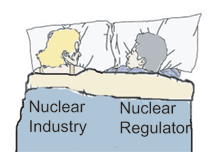 This item is a bit of a worry. Nothing in here to say that those made ill from radiation will get any help. And the suggestion is that it will be hard for them to prove it – so don’t expect any help? – Christina Macpherson
N-watchdog gets health role / New agency to handle residents’ well-being, not just reactors, The Yomiuri Shimbun, 25 Nov 11 A new nuclear safety agency to be established in April will deal with health problems caused by radioactive materials released from the Fukushima No. 1 nuclear power plant, it has been learned. Continue reading
How Japan rigged public opinion to support MOX plutonium nuclear reactor
 Rigging opinions on nuclear power, Japan Times, , Nov. 28, 2011, EDITORIAL A third-party committee of the Hokkaido government on Wednesday reported that the then chief of the regional government’s nuclear power safety measures section asked Hokkaido Electric Power Co. in July 2008 to collect opinions that favored the use of MOX (mixed oxide) nuclear fuel in the No. 3 reactor of its Tomari nuclear power plant.
The chief made the request because a majority of opinions collected by the Hokkaido government up to that point had been decidedly against the use of MOX fuel, which contains both plutonium and uranium, the committee said.
This is just the latest revelation of attempts to rig public opinions on nuclear power. Continue reading
Japanese soldiers to enter Fukushima radiation zone
Once More Into the Breach, TIME by Kirk Spitzer , November 25, 2011 TOKYO – Japanese troops are being sent once again into the heart of the Fukushima radiation zone to battle contamination from the stricken nuclear power plant. Specially trained troops will enter the 20-kilometer (12.4 miles) exclusion zone around the plant next month to decontaminate abandoned government buildings and facilities…..
About 400 troops from the Ground Self Defense Force’s Central Nuclear Biological Chemical Weapon Defense Unit will be sent to Fukushima. They’ve been there before: Four members of the unit were injured in a hydrogen explosion at the plant on March 12. Several helicopter pilots and crew received large doses of radiation while dumping seawater on one of the damaged reactors.
The soldiers are expected to finish their work in about a month. No word on when, or if, all the contamination will be gone…… http://battleland.blogs.time.com/2011/11/25/once-more-into-the-breach/#ixzz1eqfdOOoZ
Special radiation limit for infants food in Japan
Japan plans to set special radiation limit for infant food Mainichi Daily News, TOKYO (Kyodo) 26 Nov 11 — Japan’s health ministry on Thursday proposed categorizing food and drink products in four groups, including one for infant foods, in setting tougher radiation standard levels.
While the Ministry of Health, Labor and Welfare has been working to lower the upper limit on radioactive cesium exposure to 1 millisievert per year from the current provisional level of 5 millisieverts, it has decided to give special consideration to infants who are more vulnerable to radiation than older people.
The other three categories are ordinary food, milk and drinking water. Most foods will be categorized as ordinary food and be put under unified supervision, while milk, drinking water and infant foods, including powdered milk and baby foods, will be examined separately…. http://mdn.mainichi.jp/mdnnews/news/20111125p2g00m0dm020000c.html
Radiation lingering in homes in Fukushima district
 Decontamination work at homes in Fukushima not going well as radiation lingers Mainichi Daily News, 25 Nov 11 FUKUSHIMA — Work to decontaminate homes and yards in a district here is not proceeding as hoped, as radiation levels persist and decontamination workers worried about their health stay away.
The city began decontamination work in the Onami district on Oct. 18. Located in the mountains in the eastern part of the city, it has been heavily affected by the Fukushima nuclear disaster, with radiation in rice over the nation’s provisional limit of 500 becquerels per kilogram detected, leading to a ban on rice shipments.
Although monitoring of six homes where decontamination was carried out found an average drop of 70 percent in radiation in front of entrances and on gravel parking spots, there was only a 30 percent drop for roofs and a 25 percent drop for asphalt in the yard. Furthermore, there was only a 22 percent drop for second floor interiors.
The city has suggested that the low effect on the roofs may be due to radiation from the surrounding forests, where decontamination has not been carried out. As for the asphalt, radioactive material tends to stick to it and remain even after being washed, so the city has decided to try removing the top layer of the asphalt.
Originally, there was a plan to complete decontamination work on all 367 households in the district by the end of the year, but decontamination work is now expected to take much longer. Thirty-three companies were originally planned to take part, but due to fears about worker safety, most canceled and only two companies joined the work when it started in October. Since then contracts have been planned for 19 new companies, but the number is still 12 short of the original figure….
“Estimated costs for the decontamination work per home by companies differ from 800,000 yen to 1.7 million yen, so it has taken time to sort out contracts. Some companies have also shifted to reconstruction work,” explained a city official. http://mdn.mainichi.jp/mdnnews/news/20111124p2a00m0na014000c.html
Uncertainty on Japan’s nuclear power plants
Japan nuclear plant ops (Takahama No.2 to go offline) Nov 24, 2011 (Refiles to add year in table for Kyuchu Genkai No.4 reactor) Reuters – Kansai Electric Power Co said on Thursday it would start four months of regular maintenance on the 826 megawatt No.2 reactor at itTakahama nuclear plant in northwest Japan on Friday as planned.
    When the facility is shut, only 10 reactors will be online in Japan with a
capacity of 9,038 MW, leaving just 18 percent of the nation's total nuclear power
capacity in use.
    Public fears about nuclear safety sparked by the Fukushima radiation crisis have
prompted the nation's nuclear watchdog to require utilities to conduct stress tests as a precondition for restarting reactors stopped for routine maintenance.
    But it is unclear when the Nuclear and Industrial Safety Agency or the government will approve the stress test reports or when approval will be given by local
authorities for reactor restarts.
    Japan, the world's third-biggest nuclear power user, has 54 reactors for
commercial use, with a total generating capacity of 48,960 MW.
    In the table below, capacities are shown in megawatts. "P" represents a planned regular inspection shutdown and "U" an unplanned shutdown..... http://af.reuters.com/article/commoditiesNews/idAFL3E7L708120111124
-
Archives
- October 2026 (92)
- September 2026 (339)
- August 2026 (330)
- July 2026 (355)
- June 2026 (287)
- May 2026 (306)
- April 2026 (356)
- March 2026 (251)
- February 2026 (267)
- January 2026 (308)
- December 2025 (358)
- November 2025 (359)
-
Categories
- 1
- 1 NUCLEAR ISSUES
- business and costs
- climate change
- culture and arts
- ENERGY
- environment
- health
- history
- indigenous issues
- Legal
- marketing of nuclear
- media
- opposition to nuclear
- PERSONAL STORIES
- politics
- politics international
- Religion and ethics
- safety
- secrets,lies and civil liberties
- spinbuster
- technology
- Uranium
- wastes
- weapons and war
- Women
- 2 WORLD
- ACTION
- AFRICA
- Atrocities
- AUSTRALIA
- Christina's notes
- Christina's themes
- culture and arts
- Events
- Fuk 2022
- Fuk 2023
- Fukushima 2017
- Fukushima 2018
- fukushima 2019
- Fukushima 2020
- Fukushima 2021
- general
- global warming
- Humour (God we need it)
- Nuclear
- RARE EARTHS
- Reference
- resources – print
- Resources -audiovicual
- Weekly Newsletter
- World
- World Nuclear
- YouTube
-
RSS
Entries RSS
Comments RSS

