Japan moves toward renewable energy, as nuclear lobby’s influence wanes
“We have the technological know-how. Japan can do anything that Germany can.”
the heavy political influence once exerted by the country’s “nuclear village” of power companies and regulators is waning, experts say.
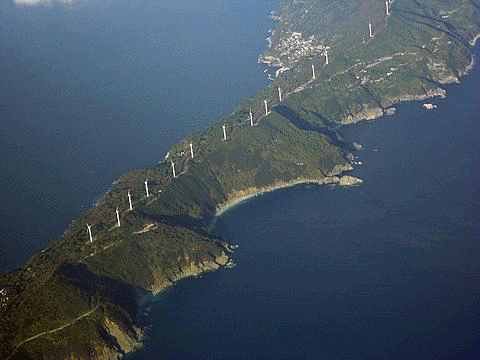
above – wind turbines, Japan
Crisis-hit Japan mulls shift to renewable energy, Knox News, By Elaine Kurtenbach and Mari Yamaguchi Associated Press May 6, 2012 “……..To offset the energy shortfall, utilities have ramped up oil- and gas-based generation, giving resource-poor Japan, the world’s third-largest economy, its biggest annual trade deficit ever last fiscal year. That $100 million-plus a day extra cost, worries over the risks of nuclear power and concern over carbon emissions are leading many decision-makers to view renewable energy sources such as solar, hydro and wind more positively. Continue reading
Japan is no further on in getting new nuclear regulator
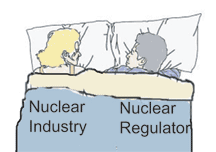 it would lead to problems in the future if the government rushes to restart Japan’s nuclear reactors without changing the current framework, in which the nuclear regulator is under the auspices of its promoter, the industry ministry.
New nuclear regulatory agency still up in air, Mainichi, 7 May 12 TOKYO (Kyodo) — Japan entered a rare period on Sunday of having no nuclear power supply following last year’s
Fukushima No. 1 Nuclear Power Plant disaster, without seeing much progress on shaping a new nuclear regulatory agency that could play a key role in addressing public concerns over the safety of atomic power.
The government plans to establish a new agency under the Environment Ministry amid criticism that the existing Nuclear and Industrial Safety Agency lacks teeth because it is under the umbrella of the Economy, Trade and Industry Ministry, a promoter of nuclear power.
But parliamentary deliberations on a bill submitted by the government to launch the new agency on April 1 have not yet started and the main opposition Liberal Democratic Party has complained that the organization’s independence would not be sufficiently secure under the government plan. Continue reading
Shutdown could mean the end of nuclear power in Japan
a ministry panel believes that Japan can still reduce its greenhouse-gas emissions by 25 percent by 2030 from 1990 levels without nuclear, provided it makes energy savings and speeds up the adoption of renewables, which currently account for just 10 percent of the energy mix.
Japan shuts down last nuclear reactor for tests. End of nuclear power? Christian Science Monitor, If Japan survives the summer without power blackouts, citizens may pressure the government to make the temporary nuclear shutdown permanent. By Justin McCurry, Correspondent / May 4, 2012 TOKYO
This weekend’s nuclear shutdown in Japan is being greeted with a mixture of anxiety and optimism, just over a year since the Fukushima Daiichi nuclear power plant accident signaled the beginning of the end of the country’s dependence on atomic energy. By May 6, the last of Japan’s 50 working reactors – another four were crippled in the disaster – will be offline when the Hokkaido Electric Power Companycloses the No. 3 unit at its Tomari plant in the far north, in the industry’s first enforced closure in Japan since 1965.
Debate is now swirling around the prospects for the economy and environment post-Fukushima, as Japan braces itself for a long, hot summer and the possibility of power cuts that could prove the most severe test of public resolve yet……… Continue reading
Japan’s leaders face the political crisis of public anti nuclear sentiment
In a direct snub to the central government, Mr. Hashimoto has appointed a panel of nuclear engineers and seismologists, who have faulted the stress tests for being conducted even before the government has finished its own inquiry into what went wrong at Fukushima. That criticism has resonated among many Japanese, who say the tests, conducted out of their view, were nothing more than a fig leaf..

 Japan’s Leaders Fret as Nuclear Shutdown Nears By MARTIN FACKLER Japan Times, May 3, 2012 OSAKA, Japan — Barring an unexpected turnaround, Japan on Saturday will become a nuclear-free nation for the first time in more than four decades, at least temporarily. Japan’s leaders have made increasingly desperate attempts in recent months to avoid just such a scenario, trying to restart plants shut for routine maintenance and kept that way while they tried to convince a skittish public that the reactors were safe in the wake of last year’s nuclear catastrophe.
But the government has run up against a crippling public distrust that recently found a powerful voice in local leaders who are orchestrating a rare challenge to Tokyo’s centralized power. Continue reading
Heroism of Japan’s saviour of Fukushima’s animals
 Man stays to help animals left to die in Japan nuclear zone, by Susan Wyatt King 5.com May 2, 2012 This is truly a heartbreaking story – a 52-year-old man who lives in the shadow of Japan’s Fukushima nuclear plant is struggling – all alone – to help the animals left behind after the earthquake, tsunami and subsequent nuclear disaster.
CNN reported in January that Naoto Matsumura, a life-long resident and fifth generation farmer, has refused to heed the mandatory evacuation since the nuclear meltdown. The government evacuated 78,000 residents around the exploding plant without a plan to rescue pets and livestock. As Matsumura began to feed his own animals, the neighborhood’s desperate cats and dogs started showing up. He started to feed them too and decided he couldn’t leave them behind to die. When Matsumura ran out of food, he slipped out of the exclusion zone and bought dog and cat food and then snuck back into town….. Matsumura has been tested for radiation and said his body is “completely contaminated.” But he said he will die in his hometown.
A ChipIn page has been set up to raise funds for Matsumura. Click here to help
You can get updates about Matsumura via a Facebook page http://www.king5.com/community/blogs/the-pet-dish/Man-stays-in–149917285.html?c=n
Consumers ultimately paid up for nuclear bribery in japan
 Consumers ultimately footed bill, Utilities gave nuclear plant hosts billions http://www.japantimes.co.jp/text/nn20120502x1.html Kyodo Electric utilities, their subsidiaries and related organizations provided at least ¥28.7 billion to local governments, mostly as donations, during the five years through to March 31, local government sources and data obtained by Kyodo News revealed.
The electric power companies incorporated most of the expenses into their electricity
charges for consumers and business clients as necessary costs for power generation. Such donations are not required to be made public and may amount to more than the latest finding revealed Tuesday, experts said. Continue reading
Costs and safety problems in Japan’s older nuclear reactors
Six reactors in Japan, including Tsuruga’s unit No. 1, have the same design as those that failed at Fukushima—a General Electric Co. model called Mark I originally designed based on tests from the late 1950s and early 1960s.
In 2009, Chubu Electric Power Co. based in central Japan, decommissioned the No. 1 and 2 reactors at its Hamaoka nuclear-power plant because they were too expensive to keep up to safety standards.
 Japan Assesses Older Nuclear Plants WSJ, By MARI IWATA and ELEANOR WARNOCK, May 2, 2012, TOKYO—Japan is grappling with the question of whether older nuclear reactors are more prone to spinning out of control when a disaster hits, as the nation pushes to restart units for the first time since last year’s accident in Fukushima. Continue reading
Fukushima: young women at 5 times greater cancer risk than general population
Nuclear Expert: Fukushima risk underestimated ENE News, — 5% of young girls will get cancer living in 20 milliSv/y for 5 years — “Actually worse than that” — Hot particles NOT included & only counts cancers, not other effects : Cancer Risk To Young Children Near Fukushima Daiichi Underestimated Source: Fairewinds Associates, Inc Author: Arnie Gundersen Transcript Excerpts That gets me to the issue of BIER, Biological Effects of Ionizing Radiation. […]
Now in Japan, the Japanese government is allowing people to go back into these radiation zones, when the radiation exposure is 2 rem. What that means is that they are willing to say that your chances of getting cancer are 1 in 500 if you go back into these areas that are presently off limits, and the exposure levels are 2 rem or 20 milisieverts in a year.
But it is worse than that. The number that we are using in the BIER Report is for the entire population, old people and young. And old people are going to die of something else before a cancer gets to them, whereas young people have rapidly dividing cells and they live a longer time, so they are more likely to get cancer. So if you go into the BIER Report and you look at Table 12-D, you will see that young women have a 5 times that number chance of getting cancer than the population as a whole. So young girls in the Fukushima Prefecture are going to get 5 times the exposure they would get from 2 rem. That means that about one in 100 young girls is going to get cancer as a result of the exposure in Fukushima Prefecture. And that is for every year they are in that radiation zone [at 20 milliSv/y]. If you are in there for 5 years, it is 5 out of 100 young girls will get cancer.
Now the BIER Report only addresses cancer, and of course, there are other effects of radiation that are not included in BIER, so it is actually worse than that.
Two more items: The first is that the BIER Report does not address hot particles. Now we have been over that extensively on the site, and you will see that imbibing it (a kid gets radioactive cesium on their hands and they swallow it, or breathing it in), is not included in the BIER Report.
And the last piece brings us over to Ian Goddard’s video, and that is this assumption by the Japanese and International Atomic Energy Agency, that at some point, this radiation is really so hard to measure that it does not count anymore. Well, the data indicates that just the opposite is happening…… http://enenews.com/gundersen-fukushima-cancer-risk-underestimated-5-of-young-girls-will-get-cancer-living-in-20-millisvy-for-5-years-actually-worse-than-that-hot-particles-not-included-only-counts-cance
Japan wants India to sign the Nuclear non Proliferation Treaty
Sign nuclear non-proliferation treaty, Japan tells India The Hindu, 30 April 12, SANDEEP DIKSHI Japan on Monday asked India to sign the Nuclear Non-Proliferation Treaty (NPT) even as the two sides decided to reopen talks on a bilateral civil nuclear agreement…..
“We have instructed our negotiators on the way forward,” Mr. Krishna said and added the two countries understood the “concerns” of each other which were related to their historic experiences. Officials explained this to mean that while India says its clean non-proliferation record was good enough to restart civil nuclear talks, Japan feels that since India is not a signatory to the NPT, it should demonstrate its commitment to a ban on testing in words…. http://www.thehindu.com/news/national/article3371546.ece
Revelations of the un-safety of Japan’s nuclear reactors
”All the samples would be considered nuclear waste if found here in the US.” – Arnie  Gundersen on soil samples taken recently from parks, playgrounds and rooftop gardens throughout Tokyo.
Fukushma the Japanese Chernobyl’…a year later and politics still ‘trump’ safety…UK Progressive, JEANINE MOLLOF | APRIL 29, 2012 The Japanese Prime Minister Declares Nuclear Plant Safe… Last week, Japanese Prime Minister Yoshihiko Noda declared that nuclear units 3 & 4 at the Ohi Nuclear Plant were safe for operation.
Prime Minister Noda based this declaration on ‘stress tests’ which were nothing more than computer simulations. The computer simulations merely estimate any given reactor’s ability to withstand large earthquakes and/or tsunamis, allegedly like last year’s Fukushima disaster. No other studies, expert testimony or other considerations were mentioned. Unfortunately, for Japan—and the world—Noda couldn’t be more wrong. Continue reading
The transition from nuclear energy, fossil fuels – to efficiency, renewables, and smart grids
The upshot of these events is an intensified focus on energy efficiency and renewables, two solutions that hold promise of bridging the supply-demand gap in the years ahead while simultaneously reducing the current heavy reliance on fossil fueled generation.
At the same time, new investments in smart grid technologies to manage demand and integrate renewable power supplies into the grid are increasing rapidly.

 Backfilling Nuclear Shutdowns With Efficiency And Renewables In Japan, Germany And California? Think Progress, Apr 29, 2012 by James Newcomb, via the Rocky Mountain Institute Electric utilities and policymakers in Japan and Germany have been scrambling for months to find ways to compensate for nuclear power plants shut down in the aftermath of Fukushima.
In both instances, fossil fuels are part of the stopgap solution to offset the declines in nuclear generation in the short term, but longer-term energy policies are shifting definitively toward efficiency and renewables. Now, the unexpected and indefinite shutdown of both units at the San Onofre Nuclear Generating Station in Southern California has raised questions about California’s short-term electricity supply options and long-term contingency plans. Continue reading
.TEPCO’s history of fraud
TEPCO’s ‘malpractices’ included:
• falsification of inspection records over many years;
• covering up data about cracks in water circulation pumps and pipes which are critical for reactor cooling;
• failure to report cracks in reactor core shrouds (stainless steel cylinders surrounding the reactor core), steam dryers, access hole covers, and components associated with jet pumps (which circulate cooling water inside the reactor);
• in 1991 and 1992, tests of the leak rate of a Fukushima reactor containment vessel were faked by surreptitiously injecting compressed air into the containment building;
• written records of cracks in neutron-measuring equipment at Fukushima were deleted by contractor Hitachi at TEPCO’s request; and
• eight TEPCO reactors were still operating although required repairs
had not been carried out.”
 Fukushma the Japanese Chernobyl’…a year later and politics still ‘trump’ safety…UK Progressive, JEANINE MOLLOF | APRIL 29, 2012 “……….TEPCO’s history of fraud…on top of a flawed Mark 1 design… The operator responsible for Fukushima Daiichi, namely TEPCO has a history of fraud allegations. In 2002, five TEPCO executives resigned over allegations they falsified nuclear plant safety records. Five reactors were shut down as a result.
In 2006 the Japanese government discovered false water coolant temperature readings at Fukushima Daiichi in 1985 and 1988 and ordered TEPCO to re-inspect past data. Continue reading
Excessive radiation levels received, but 16 Fukushima workers have to stay on
How’s this for injustice to workers? An illustration of three things: the heroism of Japan’s Fukushima “liquidators”, the nuclear industry’s ruthless lack of concern for its workers, and the desperate situation of the Fukushima nuclear plant.
 Workers with high radiation levels to stay at N-plant http://www.yomiuri.co.jp/dy/national/T120427006236.htm Jiji Press 28 April 12, Tokyo Electric Power Co. said Thursday that a total of 16 employees whose cumulative radiation doses have exceeded 100 millisieverts, a government-set limit, will continue to work at the crippled Fukushima No. 1 nuclear power plant. According to TEPCO, the 16 are engaged in equipment operation and radiation control and have advanced expertise and extensive experience at the nuclear plant crippled by the March 11 earthquake and tsunami last year.
Following the accident at the plant, the health ministry raised the cumulative dose limit to 250 millisieverts for workers there. But this measure will expire at the end of April. The cumulative limits revert back to 50 millisieverts per year and 100 millisieverts over a five-year period.
As the 16 people are vital for containing the plant’s nuclear crisis, the company will keep them at work and take steps to reduce radiation levels at the quake-proof building used for its disaster response team, it said. With TEPCO taking such measures as covering some ceilings and floors with lead in the quake-resistant building, radiation levels there have fallen to 0.7 microsievert per hour from 1.6 microsieverts, according to the utility.
A new anti nuclear demographic – mothers
 Often, mothers and women want to leave Fukushima and protect their kids, while men tend to accept the line, from the government and the utility, Tepco, that “all is safe.” This can lead to conflict in a culture where women are taught not to challenge their husbands or government, figures of authority.
How a Group of Japanese Mothers Are Saying No to Nuclear Power The Fukushima disaster has brought a powerful new demographic to Japan’s anti-nuclear movement: mothers. AlterNet April 25, 2012 |
On the one-year anniversary of the Fukushima nuclear disaster, Japanese women in New York City gathered for a rally they called Pregnant With Fear of Radiation. Protestors wore fake pregnant bellies, or carried posters with images of pregnant women wearing face masks. Well aware that fetuses, children under five, and women are at the greatest risk from radiation exposure, mothers have emerged as a powerful voice in Japan’s growing anti-nuclear movement. Continue reading
Earthquake fault underneath spells the end for Tsuruga nuclear plant
 Restart of Tsuruga nuclear reactors ‘almost impossible’: safety commission chief http://www.japantimes.co.jp/text/nn20120427b3.html Kyodo The chances of Japan Atomic Power Co. resuming operations at its Tsuruga nuclear plant in Fukui Prefecture are virtually nil now that an active fault is suspected to run directly beneath one of its reactors, the head of the Nuclear Safety Commission said Thursday. Continue reading
1 This Month





PLEASE OPPOSE HR 8255 AND S.3639 – bills would accelerate satellite deployment, with no environmental review or safeguards – https://ncstd5li.quorum.us/campaign/169331/
To see nuclear-related stories in greater depth and intensity – go to https://nuclearinformation.wordpress.com
-
Archives
- October 2026 (91)
- September 2026 (339)
- August 2026 (330)
- July 2026 (355)
- June 2026 (287)
- May 2026 (306)
- April 2026 (356)
- March 2026 (251)
- February 2026 (267)
- January 2026 (308)
- December 2025 (358)
- November 2025 (359)
-
Categories
- 1
- 1 NUCLEAR ISSUES
- business and costs
- climate change
- culture and arts
- ENERGY
- environment
- health
- history
- indigenous issues
- Legal
- marketing of nuclear
- media
- opposition to nuclear
- PERSONAL STORIES
- politics
- politics international
- Religion and ethics
- safety
- secrets,lies and civil liberties
- spinbuster
- technology
- Uranium
- wastes
- weapons and war
- Women
- 2 WORLD
- ACTION
- AFRICA
- Atrocities
- AUSTRALIA
- Christina's notes
- Christina's themes
- culture and arts
- Events
- Fuk 2022
- Fuk 2023
- Fukushima 2017
- Fukushima 2018
- fukushima 2019
- Fukushima 2020
- Fukushima 2021
- general
- global warming
- Humour (God we need it)
- Nuclear
- RARE EARTHS
- Reference
- resources – print
- Resources -audiovicual
- Weekly Newsletter
- World
- World Nuclear
- YouTube
-
RSS
Entries RSS
Comments RSS

