Japan now has to take its anti nuclear movement seriously
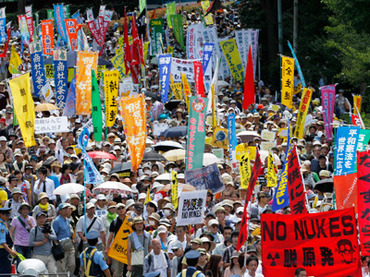
Hemmed in by police in the sweltering heat, the demonstrators are mostly
good-natured. But for how long?
Japan’s anti-nuclear protests The heat rises The restart of two nuclear reactors has belatedly lit a fuse under the Japanese, The Economist Jul 21st 2012 | TOKYO | PEOPLE power is not a phrase usually associated with Tokyo. A famously buttoned-up city, epitomised by its obedient ranks of identikit commuter salarymen, Tokyo rarely hosts serious protests…Suddenly, what had looked like the waning cause of a core of diehard liberals has become a protest movement. . … on July 16th tens of thousands braved 30-degree heat in a central Tokyo park to attend a “Sayonara Nukes” rally.
The generous sprinkling of ordinary families, as well as the 7.5m signatures that Mr Oe and company claim to have gathered, gave the protest more than nostalgic value. Its fuel was anger. Recent reports into last year’s triple Fukushima meltdown 210km (130 miles) away have shown that the world’s most crowded metropolis narrowly avoided
catastrophe.
Though many worry about the economic cost of scrapping nuclear power, others belatedly question the logic of having 54 commercial reactors in a country with one-fifth of the world’s strong earthquakes.
Even worse, people said, was that the government had restarted at least one nuclear reactor (a second was switched on again on July 18th) while questions still remain about the safety of nuclear power, and about a regulatory structure that took the threat of natural
disaster too lightly. Continue reading
Abnormal thyroid growths in 36% of Fukushima children

 36 Percent Of Fukushima Children Have Abnormal Growths From Radiation Exposure http://www.businessinsider.com/a-stunning-36-percent-of-fukushima-children-have-abnormal-growths-from-radiation-exposure-2012-7#ixzz21Cetabn4 Michael Kelley | Jul. 16, 2012, Of more than 38,000 children tested from the Fukushima Prefecture in Japan, 36 percent have abnormal growths – cysts or nodules – on their thyroids a year after the Fukushima nuclear disaster, as reported by ENENews.
The shocking numbers come from the thyroid examination section of the “Sixth Report of Fukushima Prefecture Health Management Survey,” published by Fukushima Radioactive Contamination Symptoms Research (FRCSR) and translated by the blog Fukushima Voice. Shunichi Yamashita, M.D., president of the Japan Thyroid Association, sent a letter to members in January with guidelines for treating thyroid abnormalities. In 2001 Yamashita co-authored a study that found normal children in Nagasaki to have 0 percent nodules and 0.8 percent cysts. Continue reading
Japan’s politicians starting to worry about (their jobs) and anti nuclear protests
as numbers swell there are indications the country’s usually inflexible politicians are getting worried and just might start paying attention.
they [protestors] are very ordered: protesters stick to the anti-nuclear message and go home in an orderly fashion at the appointed time.
But the demonstrations’ regularity and sheer size – – is giving the government pause for thought in a country where for decades the political elite has largely ignored popular opinion…..

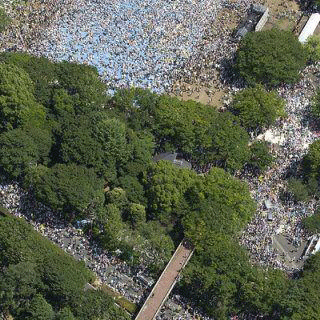 Nuclear fears galvanise Japan’s sedate society Channel News Asia: 20 July 2012 TOKYO: Japan’s usually sedate societyis angry and getting organised against nuclear power, with the kind of snowballing protest movement not seen for decades. Weekly demonstrations outside the prime minister’s residence attract tens of thousands of people and a rally in west Tokyo this week drew a crowd organisers claimed at 170,000, demanding an end to atomic power in post-Fukushima Japan.
And as numbers swell there are indications the country’s usually inflexible politicians are getting worried and just might start paying attention….. “No one used to care before (the disaster),” said
Masaki Yoshida, a mother-of-three who was forced from her Fukushima
home by the radiation-spewing plant. Continue reading
Lengthy and dangerous process to remove nuclear fuel rods
The pool at No. 4 was behind the secret worst-scenario mapped out by the government, which warned millions of people might have to flee from spewing radiation, including parts of the Tokyo area, which has a population of 35 million people. U.S. authorities have also repeatedly expressed worries about the spent-fuel pool at reactor No. 4.
“If we are asked whether things are completely safe, we cannot say that,” “If there is another major earthquake, we don’t know what may happen,
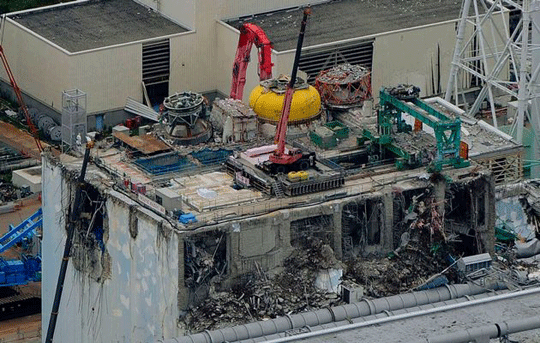
Japan removes two nuclear fuel rods from Fukushima plant Times Live Sapa | 18 July, 2012 A giant crane removed two rods packed with nuclear fuel from the Fukushima nuclear plant. This is the beginning of a delicate and long process to deal with a remaining risk of more radiation escaping from the disaster-struck plant.
All of the 1,535 rods next to reactor No. 4 at the crippled Fukushima Dai-ichi plant in northeastern Japan must eventually be removed from a spent-fuel pool to safer storage – an effort expected to take through the end of next year, according to the government. Continue reading
In last 24 hours – 3 earthquakes hit Fukushima
M4.5 quake hits Fukushima — Third M4 in last 24 hours July 19th, 2012 By ENENews Title: : Earthquake Information
Source: Japan Meteorological Agency Date: July 20, 2012 http://enenews.com/m4-5-quake-hits-fukushima-third-m4-in-last-24-hours
Earthquake fault line under Japan’s only operating nuclear reactor?
 Japan nuclear watchdog probes claims that country’s only working reactor sits on active fault line Warning comes just 18 months after tsunami wiped out Fukushima plant DAILY MAIL, 19 July 2012 Japan’s nuclear safety watchdog has ordered an investigation into claims the country’s only active nuclear power station is positioned above a tectonic fault line.
Geologists believe the Oi plant in Fukui Prefecture is at real risk of earthquake if the tectonic plates it sits on suddenly shift.
The news comes at a sensitive time for the Japanese nuclear industry – less than 18 months after a tsunami struck the nuclear power station at Fukushima, causing a meltdown…
The first reactor was fired up a few weeks ago and a second is planned to restart later in July. The power company insists it won’t alter its schedule, despite the order to examine the earth under the huge plant…. Experts reporting to the safety watchdog have also recommended tests are carried out at the nearby Shika plant, claiming both sites could be sitting on active fault lines. http://www.dailymail.co.uk/news/article-2176062/Japan-nuclear-watchdog-probes-claims-countrys-working-reactor-sits-active-fault-line.html#ixzz21C4tdqr4
High cesium levels in migratory fish in Pacific: Is Fukushima still leaking radiation?
 the persistently high cesium numbers may be a sign that the Fukushima plant is still leaking radiation into the ocean.
Lead scientist surprised by Japan data: Fukushima plant still leaking radiation into ocean? By ENENews Title: Post-Fukushima, Japan’s irradiated fish worry B.C. experts Source: Vancouver Free Press Author: Alex Roslin Date: July 19, 2012
The numbers show that far from dissipating with time, as government officials and scientists in Canada and elsewhere claimed they would, levels of radiation from Fukushima have stayed stubbornly high in fish. Continue reading
TEPCO covering seafloor with enormous amounts of concrete. Why?
Tepco completes covering seafloor with layers of cement mix — More coating used at Reactors 5 & 6 than for Reactors 1, 2, 3 & 4 combined (PHOTOS &  VIDEOS) July 19th, 2012 By ENENews http://enenews.com/tepco-completes-covering-seafloor-with-layers-of-cement-mix-more-coating-used-outside-reactors-5-6-than-for-reactors-1-2-3-4-combined-photos-videos
And all those funny looking black containers which were placed/dropped into the water..just COVER those things up with LAYERS of CONCRETE. Next generation can worry about it. Sadly, Mr. TEPCOman, one has to ask WHAT next generation will be healthy enough to work the problem?
One question to ask..what happened at Reactors 5 and 6 to require as much concrete or MORE than Reactors 1-4? Were more containers dumped into the ocean? More meltdown corium heading for the ocean..or is the ground so unstable..I hope its not the last. Subsidence(loss of ground HEIGHT) could be raising its ugly head. That is bad– almost as bad as Reactor 1-4 “payloads.”
Also note the non-concern of “radiation” going out into the OCEAN. What do they think the ocean is? An endless pit? Its not.
Japan’s government on shaky ground as it promotes nuclear power
In another development that could fan public concerns about nuclear safety, Trade and industry minister Yukio Edano said the government would review seismological data for nuclear plants to assess whether any are built on active fault lines.
He was responding to media reports that a review by the nuclear watchdog indicated Hokuriku Electric Power Co’s Shika station northwest of Tokyo sits atop a faultline……
Nuclear issue puts increasing pressure on Japan government By Linda Sieg, additional reporting by Osamu Tsukimori and Risa Maeda TOKYO Jul 18, 2012 (Reuters) – Japan’s government came under fire on Tuesday over its handling of public hearings on nuclear energy policy, threatening to dent already sagging support for the ruling party ahead of an election many expect to be this year.
The latest furor follows Monday’s massive rally in Tokyo against nuclear power in the wake of the Fukushima disaster, an issue now so contentious that lawmakers and analysts say it could trump taxes as the focus of lower house elections, which must be held by September 2013 but could come sooner.
“This gives the impression that they haven’t learned anything,” Continue reading
Can Japan’s government continue to ignore the growing anti nuclear protests?
“There’s something wrong in this country when even if thousands of people protest in front of the prime minister’s residence they still reactivate the plants,”
Tokyo Anti-Nuclear Rally Attracts Thousands As Protests Grow Bloomberg, By Aya Takada, Shunichi Ozasa and Scilla Alecci – Jul 16, 2012 Tens of thousands of people packed Tokyo’s Yoyogi Park yesterday for Japan’s biggest anti-nuclear rally since the Fukushima disaster last year in growing protests against government moves to restart atomic reactors. Continue reading
With no future in Japan, nuclear engineers move to other countries
 Japan the only country in the world equipped with the know-how to operate the two main types of nuclear power reactors — the pressurized water reactor (PWR) and the boiling water reactor (BWR)….
And it has been the engineers of Tepco and other power companies in Japan who have accumulated the know-how to operate nuclear power plants using nuclear power plant components that incorporate the most advanced technology……
Nuclear engineers ditching Japan for a bigger paycheck, SENTAKU MAGAZINE, July 16, 2012 Although Japan is reputed to be one of the most technologically advanced nations in nuclear power generation, it now faces a serious “brain drain” as some of its highly experienced nuclear engineers are lured to work in other countries for much better remuneration than they could hope to receive at home….
In Japan, public opinion has been increasingly against nuclear power generation since the March 11, 2011, accidents at Tokyo Electric Co.’s Fukushima No. 1 nuclear power plant. Continue reading
Safecast providing impartial information on Fukushima radiation
 visit Safecast at blog.safecast.org .
Local governments in Fukushima are linking up with Safecast to get additional readings, for example in schools, and are sharing data with residents. More volunteers are joining, including Europeans and Japanese as well as other nationalities.
U.S. group supplying radiation data Japan Times, 18 July 12By YURI KAGEYAMA People seeking information on radiation levels from the Fukushima crisis are turning to a volunteer group founded in the U.S. that has created a detailed and constantly updated visual database online. Continue reading
Study on cancer from Fukushima, but they didn’t count internal emitters of radiation

Christina Macpherson’s websites & blogs
Note that this study – like so many touted in the media – counts only “external emitters” – not the cancers caused by “internal emitters” . Internal emitters are the sources of radioactive material that lodge inside a person’s body – the lungs or the gut – and will cause cancer later on – perhaps years after they have been taken in by the body, through eating or breathing. They can be taken in long after the actual radioactive release, as they are the particles that have settled somewhere – on the ground, on plants, in water.
Japan’s Fukushima nuclear disaster may cause 1,300 deaths: report Radio Australia 18 July 2012 US researchers have released a study warning that radiation from the Fukushima nuclear disaster in Japan may eventually cause up to 1,300 deaths….. And they forecast anywhere between 24 and 2,500 thousand cases of cancer.
While the estimates have a large range, they do contrast with a UN prediction that the meltdowns would cause no severe health effects…. The study relied on a 3-D atmospheric model to predict the spread of radioactive material, and then calculated the estimated exposure to people in the path of the contamination…
http://www.radioaustralia.net.au/international/2012-07-18/japans-fukushima-nuclear-disaster-may-cause-1300-deaths-report/981808
Tokyo anti nuclear rally by 170,000
Thousands reject nuclear,http://www.theage.com.au/world/thousands-reject-nuclear-20120716-226gd.html#ixzz20xx3KSqt The Age, July 17, 2012, TOKYO. Tens of thousands of people have rallied in Tokyo demanding an end to nuclear power, the latest in a series of demonstrations following the disaster at Fukushima. As many as 170,000 demonstrators chanting ”Don’t resume nuclear power operation. Prime Minister (Yoshihiko) Noda should quit” marched in one of the biggest rallies since last year’s earthquake and tsunami disaster sparked one of the world’s worst atomic disasters. Participants included Nobel-winning author Kenzaburo Oe and Japanese musician and composer Ryuichi Sakamoto.
”We are so angry because no progress has been made in terms of compensation and decontamination,” said Noboru Shikatani, 71, who was evacuated from Fukushima following the disaster.
picture from http://www.facebook.com/internetocracy
Japan’s ruling party risks election defeat, due to anti nuclear feeling
 Nuclear issue puts increasing pressure on Japan government By Linda Sieg TOKYO Jul 17, 2012 (Reuters) – Japan’s government came under fire on Tuesday over its handling of public hearings on nuclear energy policy, threatening to dent already sagging support for the ruling party ahead of an election many expect to be this year.
The latest furor follows Monday’s massive rally in Tokyo against nuclear power in the wake of the Fukushima disaster, an issue now so contentious that lawmakers and analysts say it could trump taxes as the focus of lower house elections, which must be held by September 2013 but could come sooner. Continue reading
1 This Month





PLEASE OPPOSE HR 8255 AND S.3639 – bills would accelerate satellite deployment, with no environmental review or safeguards – https://ncstd5li.quorum.us/campaign/169331/
To see nuclear-related stories in greater depth and intensity – go to https://nuclearinformation.wordpress.com
-
Archives
- October 2026 (81)
- September 2026 (339)
- August 2026 (330)
- July 2026 (355)
- June 2026 (287)
- May 2026 (306)
- April 2026 (356)
- March 2026 (251)
- February 2026 (267)
- January 2026 (308)
- December 2025 (358)
- November 2025 (359)
-
Categories
- 1
- 1 NUCLEAR ISSUES
- business and costs
- climate change
- culture and arts
- ENERGY
- environment
- health
- history
- indigenous issues
- Legal
- marketing of nuclear
- media
- opposition to nuclear
- PERSONAL STORIES
- politics
- politics international
- Religion and ethics
- safety
- secrets,lies and civil liberties
- spinbuster
- technology
- Uranium
- wastes
- weapons and war
- Women
- 2 WORLD
- ACTION
- AFRICA
- Atrocities
- AUSTRALIA
- Christina's notes
- Christina's themes
- culture and arts
- Events
- Fuk 2022
- Fuk 2023
- Fukushima 2017
- Fukushima 2018
- fukushima 2019
- Fukushima 2020
- Fukushima 2021
- general
- global warming
- Humour (God we need it)
- Nuclear
- RARE EARTHS
- Reference
- resources – print
- Resources -audiovicual
- Weekly Newsletter
- World
- World Nuclear
- YouTube
-
RSS
Entries RSS
Comments RSS

