Japan’s religious leaders call for an end to nuclear power
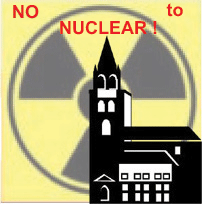
 Religious figures call for future free of atomic energy http://www.japan-press.co.jp/modules/news/index.php?id=3629July 14, 2012 Regardless of differences in faiths, 51 religious figures on July 13 jointly published a statement calling for an end to nuclear power generation.
Initiators of this statement, including the former president of the
Japan Buddhist Federation (JBF) and a reverend of the Anglican
Episcopal Church in Japan, met in Kyoto City to seek broader support
to the statement from other religious leaders.
Kono Taitsu, the former JBF president and now the chief priest of the Myoshinn-ji branch of the Rinzai Zen Denomination, said, “As a religious leader who speaks to the value of life, I came to feel obliged to say something” about the nuclear energy issue.
The statement asserts that the Fukushima accident has proven that all beings and creatures cannot coexist with atomic energy, and points out that as nuclear power plants “inevitably accumulate radioactive wastes, they will endanger ‘all living things’ and pass on a negative legacy to future generations.”
The statement requests that the government and nuclear establishment complete the earliest possible decontamination, provide long-term healthcare for victims, and sincerely fulfill compensation obligations.
Regarding the resumption of operations and export of nuclear power plants with the cause of the Fukushima accident still remaining unknown, the statement criticizes these moves as “giving preference on ‘making money’ over safeguarding ‘lives’.”
Japan Shifts from Nuclear Power to Renewable Power
International Support for Renewable Energy, Environmental Leader, Jeff Colton, 24 July 12, “……As a result of the vulnerability and global scrutiny of nuclear power following the March 2011 earthquake in Japan and the resulting Fukushima nuclear disaster, Japan recently approved incentives for renewable energy, which will help the country decrease its dependence on nuclear power and increase clean energy programs, such as offshore wind farms . These incentives could result in billions of dollars in clean energy investment, expanding revenue from renewable generation and equipment, including wind turbine components such as ultracapacitors, to more than $30 billion by 2016…….. Just 1 percent of Japan’s power supply comes from renewable energy sources, apart from hydro-electric dams which account for most of the rest of the electric power.
Despite the low starting point, Japan has the potential to generate cleaner and safer energy from renewable sources such as the sun, wind and geothermal. Over the past decade, Japan’s wind power capacity has multiplied to 2.5 million kilowatts, and the Japan Wind Power Association estimates the country can generate 740 million kilowatts of wind power on a commercial basis on land and offshore. With worldwide estimates suggesting 118,000 wind turbines installations through 2015 and nearly 75 percent of new turbines using electric pitch control systems, wind turbine design teams will turn to ultracapacitors as a reliable and cost-effective option. The newly approved incentives aim to spur growth in the renewable energy industry in Japan, just as subsidies have driven substantial renewable energy growth in Germany….. http://www.environmentalleader.com/2012/07/24/international-support-for-renewable-energy/
Solar energy panels designed specifically for Japanese roofs
Global Solar Energy Brings Powerful Building Integrated Solar to Japan’s Growing Renewable Energy Market, Clean Technica, JULY 24, 2012 BY NICHOLAS BROWN Global Solar Energy Incorporated, a manufacturer of flexible solar panels, has announced that it is entering the Japanese solar market with flexible solar panels that are designed specifically for Japanese roofs. Continue reading
Japan not able to find truly independent nuclear power regulators
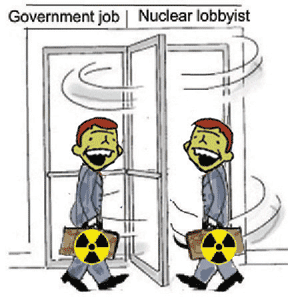 Japan Struggles to Find New Nuclear Regulators WSJ, By MARI IWATA TOKYO July 24, 2012,—Racing against a legislative deadline, the Japanese government
is trying to find regulators who understand nuclear technology—but aren’t close to the nuclear industry.
Cronyism has been widely blamed for contributing to the meltdowns at the Fukushima Daiichi nuclear plant operated by Tokyo Electric Power Co. following the huge earthquake and tsunami that struck northeastern Japan in March 2011. In a scathing investigation commissioned by parliament, a panel concluded: “The Tepco Fukushima nuclear-power-plant accident was the result of collusion between the government, the regulators and Tepco.” Continue reading
Children led into radioactive areas in Fukushima accident chaos
Nuclear plant chaos http://www.smh.com.au/world/nuclear-plant-chaos-20120724-22n74.html#ixzz21gCDQY2E Chaotic evacuations after the tsunami struck the Fukushima nuclear power plant left children in areas where radiation was dangerously high while causing unnecessary deaths among patients hastily removed from hospitals, an inquiry has found.
The 450-page report on the inquiry said the failure to act on computer-aided predictions of
radioactive releases as the disaster unfolded might have caused residents of at least two communities to be led straight into the radioactive plume.
Shortage of workers at Fukushima amid revelations of “doctored” radiation records

 Fukushima Watch: Doctoring Dosimeters — How Far Did It Go? WSJ, By Mitsuru Obe and Phred Dvorak, 23 July 12 Over the weekend, a subcontractor that worked at the devastated Fukushima Daiichi nuclear plant confessed to asking some of its employees to put lead covers on their dosimeters in order to keep their radiation exposure readings artificially low. Now, Japanese officials are trying to figure out whether the subcontractor, a small Fukushima Prefecture-based firm, was the only one to doctor dosimeters or whether other companies may have done the same…. Continue reading
Anti nuclear movement becoming a force in Japan’s elections
 Fukushima Watch: Anti-Nuclear Candidate Gains Ground in Yamaguchi Race WSJ. 23 July 12, By Yoree Koh Pro- and anti-nuclear candidates are again locked in battle in a Japanese local election. But while pro-nuclear candidates have had the upper hand in all post-Fukushima elections until now, a clean slate of newcomers has made the gubernatorial contest in Yamaguchi prefecture one of the most high-profile among the anti-nuclear camp as recent
polls indicate the candidate opposing nuclear power appears to have a fighting chance for the seat……
The Yamaguchi race is seen as the latest litmus test of voters’ opinions on the soul-searching issue of nuclear power — a controversial topic that has become even more divisive among members of the public than a contentious sales tax hike. Helping further focus attention on the nuclear issue in the upcoming poll is the pending issue of whether to unfreeze a planned nuclear power plant in the town of Kaminoseki…..
Perhaps the most significant figure to emerge from the two polls is that about 71% of respondents in the Asahi survey said they were against construction plans for the Kaminoseki nuclear plant. http://blogs.wsj.com/japanrealtime/2012/07/23/fukushima-watch-anti-nuclear-candidate-gains-ground-in-yamaguchi-race/
Widespread practice of underreporting radiation exposure of Fukushima workers
AP: Fukushima radiation cover-up http://enenews.com/ap-fukushima-radiation-cover-believed-be-part-widespread-practice-plant 22 July 12, “believed to be part of a widespread practice at the plant” Japanese authorities are investigating subcontractors on suspicion of forcing workers at the tsunami-hit nuclear plant to underreport the amount of radiation they were exposed to so they could stay on the job longer.
The investigation marks the first time the government has looked into the case, believed to be part of a widespread practice at the plant since it was hit by the worst atomic crisis since Chernobyl.
Health and Labor Ministry officials […] said TEPCO had several workers share a dosimeter not just early in the crisis when the equipment was in short supply due to tsunami damage, but even after a full stock had been regained.
Fukushima workers faked radiation doses, to keep their jobs
 Without faking the exposure level, the executive told the workers they would quickly reach the legally permissible annual exposure limit of 50 millisieverts,
Japan firm ‘told workers to lie about radiation dose’ News.com.au July 21, 2012 Workers at the crippled Fukushima nuclear plant in Japan were apparently told to lie about radiation.
A SUBCONTRACTOR at Japan’s crippled Fukushima nuclear plant reportedly told workers to lie about possible high radiation exposure. Continue reading
Falsified radiation doses for Fukushima workers
the executive instructed about four workers to make the [lead shield] covers…
Radiation dosages ‘falsified’ The Yomiuri Shimbun/Asia News Network Asia One News, Jul 23, 2012 The health ministry is investigating allegations that a construction company ordered its workers at the crippled Fukushima No. 1 nuclear power plant to cover their dosimeters with lead to indicate lower exposure levels, according to sources. Continue reading
New government inquiry finds that Japan’s nuclear reactors are still unsafe
Japan nuclear plants ‘still not safe’ Report from independent panel delivers damning assessment of country’s nuclear regulator and Fukushima plant operator. Aljazeera 23 Jul 2012 A government-appointed inquiry has delivered a damning assessment of Japanese nuclear regulators and the operator of the Fukushima nuclear power plant, raising further fears that despite new rules, the country’s nuclear sector still does not meet safety requirements.
The 450-page report by a 10-member panel of independent experts was released on Monday, and comes as anti-nuclear activists continue a vociferous campaign against the restarting of two nuclear reactors in the country.
The government is currently readying a new energy policy, due next month. Continue reading
Fukushima’s children: more than a third at risk of developing cancer
doctors are outraged that the results are not being sufficiently publicized.
The World Health Organization warns that young people are particularly prone to radiation poisoning in the thyroid gland. Infants face the direst consequences, as their cells divide at a higher rate.
Children who were under 18 when the nuclear disaster struck last year will be subject to continuous thyroid examinations every two years until they reach 20 years of age, and after that, every five years for the rest of their lives.
 Over a third of Fukushima children at risk of developing cancer http://www.rt.com/news/fukushima-children-radiation-exposure-abnormalities-632/ 20 July, 2012,Over a third of children in Japan’s Fukushima region could be prone to cancer if medics don’t apply more effort in treating their unusually overgrown thyroid glands and commit to international health aid and consultations, according to a new report.
The shocking new report shows that nearly 36 per cent of children in the nuclear disaster-affected Fukushima Prefecture have abnormal thyroid growths. This is an extremely large number of abnormalities – some of which, experts say, pose a risk of becoming cancerous.
After examining more than 38,000 children from the area, medics found that more than 13,000 have cysts or nodules as large as 5 millimeters on their thyroids, the Sixth Report of Fukushima Prefecture Health Management Survey states.
In comparison, a 2001 analysis by the Japan Thyroid Association found that fully zero per cent of children in the city of Nagasaki, which suffered a nuclear attack in August of 1945, had nodules, and only 0.8 per cent had cysts on their thyroids, reports the Telegraph.
Radiation enters the body and is distributed through soft tissue, especially in muscle, and then accumulates in the thyroid. It is this accumulation that can potentially lead to cancer. Continue reading
Japan’s ruling party ‘fracturing’ over nuclear power
Newspapers reported on Friday that the government had picked Shunichi Tanaka, 67, an expert in radiation physics and a former deputy head of the Cabinet Office’s Atomic Energy Commission, to head the new safety regulator.
some saying he represented Japan’s “nuclear village” — a nexus of politicians, utilities and regulators that experts say was a major factor in the failure to avert the Fukushima disaster. …..
Ex-Japan PM joins anti-nuclear demo outside PM’s office
* Ex-PM Hatoyama at anti-nuclear rally bad news for PM Noda
* Efforts to pick new atomic safety commission members snags after media leak
* Nuclear energy becoming bigger part of political debate (Recasts with ex-PM Hatoyama joining anti-nuclear demo near)
By Mari Saito and Tetsushi Kajimoto TOKYO, July 20 (Reuters) – In a rare move by a former Japanese prime minister, Yukio Hatoyama joined a boisterous anti-nuclear demonstration outside his old office on Friday, a fresh sign that the ruling party he once led is fracturing over energy and other policies. Continue reading
20,000 cleanup workers not counted, in estimating Fukushima cancer risks
 Thousands More Radiation-Related Deaths Expected From Fukushima, Asian Scientist, Study By Rebecca Lim July 20, 2012 Thousands of deaths could still be expected from the Fukushima nuclear fallout in the years to come, according to the first estimate of the disaster’s worldwide impact AsianScientist (Jul. 20, 2012) –
The research, published in the latest edition of the journal Energy & Environmental Science, found that inhalation exposure, external exposure, and ingestion exposure of the public to radioactivity may result in up to 1,300 cancer mortalities and up to 2,500 cancer morbidities worldwide, mostly in Japan.
Stanford University researchers John Ten Hoeve and Mark Jacobson feel that the risk of a meltdown is not small, given that “modest to major radionuclide releases (occurred) in almost 1.5 percent of all reactors ever built.”….
Estimates in the paper do not account for the increased radiation risk to the roughly 20,000 workers at the plant in the months following the accident.
Psychological effects such as depression, anxiety, fear, and unexplained physical symptoms which were seen post-Chernobyl, are likely to be repeated in evacuees after Fukushima, they say….
Media’s strange silence on thyroid abnormalities in Fukushima children
We also spoke with Dr. Bryan Haugen, president-elect of the American Thyroid Association and head of endocrinology at the University of Colorado School of Medicine, who hadn’t heard of the report before we contacted him.
Haugen agreed with the Caldicott’s assessment that it is surprising for kids to “have this many nodules and cysts seen, especially this soon after the accident,” and the fact that “this something that is not more widely known.”
The New York Academy of Sciences estimates that nearly one million people around the world have died from exposure to radiation released by the 1986 nuclear disaster at the Chernobyl reactor.
 CONFIRMED: 36 Percent Of Fukushima Kids Have Abnormal Thyroid Growths And Doctors Have Been Left In The Dark : http://www.businessinsider.com/fukushima-children-have-abnormal-thyroid-growths-2012-7#ixzz21CwegRH8 Michael Kelley | Jul. 19, 2012 A few days ago we reported that 36 percent of Fukushima children have abnormal thyroid growths likely from radiation exposure, based on the “Fukushima Prefecture Health Management Survey.”
We got in touch with Australian pediatrician Dr. Helen Caldicott, who has spoken about the growths, to ask her about the implications of the study.
After confirming the validity of the report, Caldicott reinforced the alarming nature of the findings:
1. “It is extremely rare to find cysts and thyroid nodules in children.”
2. “This is an extremely large number of abnormalities to find in children.”
3. “You would not expect abnormalities to appear so early — within the first year or so — therefore one can assume that they must have received a high dose of [radiation].”
4. “It is impossible to know, from what [officials in Japan] are saying, what these lesions are.”
Doctors worry about these abnormal growths because even though thyroid nodules are relatively common, they are not common in children and some of them could become cancerous. When asked why these results haven’t been widely reported, Calidcott noted that Japanese officials are not sharing ultrasound results with foremost experts of thyroid nodules in children and accused the media of “practicing psychic numbing,” saying that she doesn’t understand why media outlets are choosing to ignore the nuclear fallout. Continue reading
1 This Month





PLEASE OPPOSE HR 8255 AND S.3639 – bills would accelerate satellite deployment, with no environmental review or safeguards – https://ncstd5li.quorum.us/campaign/169331/
To see nuclear-related stories in greater depth and intensity – go to https://nuclearinformation.wordpress.com
-
Archives
- October 2026 (81)
- September 2026 (339)
- August 2026 (330)
- July 2026 (355)
- June 2026 (287)
- May 2026 (306)
- April 2026 (356)
- March 2026 (251)
- February 2026 (267)
- January 2026 (308)
- December 2025 (358)
- November 2025 (359)
-
Categories
- 1
- 1 NUCLEAR ISSUES
- business and costs
- climate change
- culture and arts
- ENERGY
- environment
- health
- history
- indigenous issues
- Legal
- marketing of nuclear
- media
- opposition to nuclear
- PERSONAL STORIES
- politics
- politics international
- Religion and ethics
- safety
- secrets,lies and civil liberties
- spinbuster
- technology
- Uranium
- wastes
- weapons and war
- Women
- 2 WORLD
- ACTION
- AFRICA
- Atrocities
- AUSTRALIA
- Christina's notes
- Christina's themes
- culture and arts
- Events
- Fuk 2022
- Fuk 2023
- Fukushima 2017
- Fukushima 2018
- fukushima 2019
- Fukushima 2020
- Fukushima 2021
- general
- global warming
- Humour (God we need it)
- Nuclear
- RARE EARTHS
- Reference
- resources – print
- Resources -audiovicual
- Weekly Newsletter
- World
- World Nuclear
- YouTube
-
RSS
Entries RSS
Comments RSS

