Russian scientists find high levels of cesium 137 in Pacific ocean near Fukushima
[The Voice of Russia] Cs137 in Pacific ocean 500~800km from Fukushima, “10 times higher than norm” http://fukushima-diary.com/2012/09/the-voice-of-russia-cesium137-detected-in-pacific-ocean-500800km-from-fukushima-10-times-higher-than-normal/#.UFOPru59MAQ.facebook by Mochizuki on September 14th, 2012
<Quote> [The voice of Russia]
Russian scientists find radiation off Fukushima coast
Russian scientists have detected radiation in the north-west of the
Pacific Ocean at a distance between 500-800 km to the east from
Japan’s troubled Fukushima-1 nuclear power plant.
The expedition of the Russian geographical society has detected that
the concentration of cesium-137 in that area exceeds the norm 10
times.
This is the first time when concentration of cesium 137 was found in
the local sea waters while the air is clean.
The level of radiation near the Russian coast is normal.
Deterioration in cooling system at Fukushima nuclear plant
Injecting water to reactor1 ~ 3 decreased again Fukushima Diary by Mochizuki September 14th, 2012 · The coolant system of Fukushima plant is getting deteriorated. Tepco has been struggling to control water injecting system since 8/30/2012. (cf.Tepco struggling to control the coolant system, “Adjusted the valves 7 times for 2 days”)
They announced that they solved the problem by eliminating the suspended materials on 9/13/2012, but on 9/14/2012, they had the problem of decreasing water amount to inject again.
In reactor1, water injection decreased by 10% from 21:00 of 9/13 to 1:00 of 9/14/2012.
In reactor2, it decreased from 1:00 to 7:00 of 9/14/2012.
They are trying to increase the water amount.
Tepco is still assuming it is due to the substances which flowed into the buffer tank and got stuck in the flow rate adjustment valves in the downstream side, narrowing the water flowing channel as a result.
The false report that Tepco reported the problem was solved in is below. [Link]….. http://fukushima-diary.com/2012/09/injecting-water-to-reactor1-3-decreased-again/#.UFOKy52ScB4.facebook
Radiation exposure to Fukushima workers before the March 11 catastrophe
 Journalist who covered Fukushima Daiichi: I heard stories that tens of people at plant may have died from radiation exposure before 3/11 (VIDEO) http://enenews.com/journalist-covered-fukushima-daiichi-heard-stories-tens-people-plant-died-radiation-exposure-before-311-video “TEPCO and the Fukushima Forbidden Zone”, by Matsumura & Onda Foreign Correspondents Club of Japan Feb 28, 2012
Katsunobu Onda, Journalist: As was explained earlier, I have a 35 year relationship with nuclear power plants.
My first opportunity I had to study nuclear power plants was 35 years ago when I visited the Daiichi Fukushima nuclear power plant that was run by Tepco.
And the reason that I went was that, as you may know inside the power plants facilities themselves there are many, many, many people that work at a the plant…
And I had heard stories that several people, or maybe several tens of people, had died from their exposure to radiation.
Workers reluctant to go to Fukushima nuclear plant, if no medical checkups
Anonymous Fukushima Worker: Nobody will want to come work at plant if there’s no more health checkups – Gov’t does not understand situation here (VIDEO) http://enenews.com/anonymous-fukushima-worker-one-will-work-plant-health-checkups-govt-understand-situation-video
September 12th, 2012 By ENENews Without medical examination cost assistance on site of the Fukushima nuclear high dose News 7 (Japanese TV)
Fukushima Daiichi Worker: The Health Ministry is busy with paperwork
and does not understand the situation at the plant. The Health Ministry must think the workers are dispensable. No one will want to start working at plant.
Groundwater with cesium at 9 times gov’t limit found in Fukushima
http://enenews.com/groundwater-cesium-9-times-govt-limit-found-fukushima
September 12th, 2012 By ENENews Mainichi report from Sept 12, 2012 with summary translation by Fukushima Diary:
Ministry of the environment announced they measured 88 Bq/Kg of cesium
from well water in Odaka Minamisoma City, Fukushima
The sample was taken in June and July of 2012
The safety limit is 10 Bq/Kg
They measured cesium more than 10 Bq/Kg at 2 of 436 locations
They also measured cesium less than 10Bq/Kg from 4 of 436 locations
They found something like mud in the well water that they measured 88
Bq/Kg of cesium
Radioactive food in kids lunches in Kawasaki City – it’s “educational”!

 “Don’t be a chicken” mayor tells parents concerned their children are eating radioactive lunches — “The pace of descending into deeper and deeper lunacy seems to be accelerating in Japan” http://enenews.com/dont-be-chicken-mayor-parents-concerned-children-eating-radioactive-lunches-pace-descending-deeper-deeper-lunacy-be-accelerating-japan
September 11th, 2012
By ENENews More from the Tokyo Shinbun report on Sept 5, 2012, translated by EXSKF:
Mayor Takao Abe said during the regular press conference on September 4 that it was important for children to learn that they were living in dangers, and that he would continue to use the frozen oranges from Kanagawa and canned apples from Yamagata that were found with radioactive cesium in the school lunches in the elementary schools in Kawasaki City, emphasizing the educational aspect of using food [known to be contaminated with radioactive cesium].
[…]
the city has been serving the frozen oranges in the school lunches since April this year. The city will start using the canned apple in September.
[…]
There are parents who are not convinced, but to them, the mayor said, “Don’t be a chicken.”
In the post — which cites several other similar situations that have occurred around Japan — EXSKF writes:
It is worse than the worst that Professor Kunihiko Takeda of Chubu
University feared exactly a year ago, with his short poetic prose titled
“A girl doesn’t talk“; he pleaded
with teachers and educators to do all they could to protect children.
His plea has fallen on totally deaf ears, and here we are. This has got
to be the end.
[…]
T he pace of descending into deeper and deeper lunacy seems to be accelerating in Japan. Maybe this is what people must have felt like in the 1930s, right before the last world war
Japan to aim for zero nuclear power by 2030
JAPAN will abandon nuclear power within the next three decades under new government policy on the post-Fukushima energy mix. Herald Sun 13 Sept 12, Prime Minister Yoshihiko Noda’s administration will declare its intention to permanently shut down reactors by the 2030s, the Mainichi Shimbun reported, citing unnamed government sources.
The move will bring resource-poor Japan into line with Germany, which has said it will wean itself off nuclear power by 2022, and comes as regular vocal protests against nuclear power continue. The government ”will formally decide at an energy and environment meeting this weekend” to stop the use of nuclear, the paper said….
. Last week, Mr Noda’s ruling Democratic Party of Japan (DPJ) issued a policy recommendation that Japan ”put every political resource to realise a situation where the number of nuclear plants operated be zero in the 2030s”.
The DPJ listed three principles to achieve this: not constructing new nuclear plants, stopping old nuclear plants after 40 years of operation, and only approving the restart of nuclear plants that passed safety checks by a regulator.
The policy paper recommended Japan make greater use of renewable energy and take further energy saving measures, including the use of smart metering.
It said Japan should develop resources in nearby waters and look to cheaper procurement of liquefied natural gas and other fossil fuels, including shale gas. http://www.smh.com.au/world/japan-moves-to-end-nuclear-energy-use-20120912-25so4.html#ixzz26OQ6u4qZ
High radiation makes removal of debris difficult, from Fukushima nuclera reactor 3
Yomiuri: Tepco having difficulty with ‘debris’ around Unit 3 due to high radiation — Years before spent fuel removal will begin http://enenews.com/yomiuri-tepco-having-difficulty-removing-debris-around-unit-3-due-to-high-radiation-years-before-spent-fuel-removal-will-begin
September 11th, 2012
By ENENews T itle: Debris removal inching along at Fukushima nuclear plant
Source: The Yomiuri Shimbun
Date: Sep. 12, 2012
Debris removal is progressing slowly at the crippled Fukushima No. 1 nuclear power plant, according to photos released by Tokyo Electric Power Co. 1-1/2 years after the nuclear crisis began.
[…]
TEPCO is having difficulty removing debris in and around the No. 3 reactor building, which was destroyed by a hydrogen explosion on March 14, 2011, due to high levels of radiation around the building.
Steel platforms, where unmanned heavy equipment for debris removal will be installed, have been mostly completed on the eastern and western sides of the No. 3 reactor building. TEPCO also plans to construct platforms on the building’s northern and southern sides.
TEPCO expects to finish debris removal within this fiscal year and start removing nuclear fuel from the fuel storage pool at the end of 2014.
Warning sign: poor development in Fukushima kids
Fukushima Pediatrician Warns: “Clear sign something abnormal is occurring” in young children http://enenews.com/fukushima-pediatrician-warns-clear-sign-something-abnormal-is-occurring-with-children
September 12th, 2012
By ENENews Title: Disaster-area kids under hard stress
Source: Jiji
Date: Sep. 12, 2012
[…]
In Koriyama, Fukushima, the weight of about 30 4-year-olds was recorded until they turned 5. It was found that their weight increased at an average annual rate of 2.4 kg before the disaster struck, but the annual rise shrank to 1.5 kg afterward.
Pediatrician Shintaro Kikuchi, 42, of Koriyama, who conducted the study, warned this is a clear sign something abnormal is occurring.
See also: Jiji: Many children appear “prone to sickness and weak” after 3/11 — Reuters: Many children with “immune system problems and listlessness” after Chernobyl
Hasty appointment by Japan’s PM of new nuclear safety agency
Noda’s appointment of nuclear watchdog chief inevitable The Yomiuri Shimbun, 13 Sept 12, A nuclear regulatory commission must be established as soon as possible to reconstruct the nation’s nuclear safety administration.
At a Cabinet meeting Tuesday, the government decided to establish the commission next Wednesday. The chairman and four other posts will be appointed by Prime Minister Yoshihiko Noda based on a law that allows for the appointment of the nuclear watchdog’s members without obtaining Diet approval.
Personnel appointment without Diet approval is not desirable. But considering that the legal deadline for establishing the agency is Sept. 26, the government will have no choice but to take this exceptional step.
There was no vote held on a personnel plan for the commission during the ordinary Diet session that ended last week because of differences within the Democratic Party of Japan.
Former Prime Minister Yukio Hatoyama and former Internal Affairs and Communications Minister Kazuhiro Haraguchi, a candidate in the forthcoming party presidential election, and some other DPJ members called for replacing the proposed personnel with people who do not belong to the so-called nuclear power village……
http://www.yomiuri.co.jp/dy/editorial/T120912003426.htm
The world’s most dangerous nuclear reactor – Monju, Japan
Problem plagued nuclear reactor called world’s most dangerous via ABC News, The Atomic Age, May 2012 http://lucian.uchicago.edu/blogs/atomicage/2012/09/10/problem-plagued-nuclear-reactor-called-worlds-most-dangerous-via-abc-news/
Japan’s Monju nuclear reactor was supposed to be a model of power generation in the future, but it’s had many problems and in two decades it’s only generated one hour’s worth of electricity.
EMMA ALBERICI, PRESENTER: It’s supposed to be the future of nuclear power generation, a reactor that produces its own fuel in a self-sustaining cycle. Known as Monju, the reactor on the country’s west coast is held up as the saviour of a nation without energy resources. But Monju has been plagued with problems and many call it the most dangerous reactor in the world. In part two of his series on Japan’s so-called nuclear alley, North Asia correspondent Mark Willacy was given an exclusive look inside Monju.
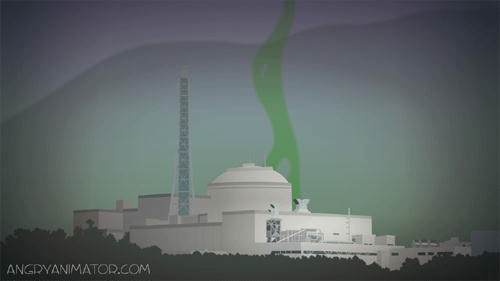
MARK WILLACY, REPORTER: People frolic in its shadow, a reactor its critics call the most dangerous in Japan. The name Monju comes from one of Buddha’s chief attendants, a purveyor of enlightenment depicted resting on the back of a lion, a beast whose phenomenal powers are controlled only by Monju’s wisdom.
But opponents of this prototype reactor fear its operators do not have the wisdom to harness its enormous energy.
KEIJI KOBAYASHI, FAST-BREEDER REACTOR EXPERT (voiceover translation): If a meltdown happens, it will get out of control very quickly. If the reactor core was to melt, the explosive energy would produce a blast like a nuclear bomb.
FUKIKO IKEJIMA, ‘STOP MONJU’ GROUP (voiceover translation): If a big accident were to happen, the impact would not stop in Japan, but spread around the world. It is our most dangerous reactor.
MARK WILLACY: And this is one of the reasons many Japanese fear Monju, because it uses sodium to cool a reactor, the substance that can ignite upon contact with oxygen. In 1995, a sodium leak at Monju caused a serious fire, one that resulted in the plant being out of operation for 15 years.
Lateline was given an exclusive tour of Monju, including an interview with the plant’s director-general, Satoru Kondo.
Continue reading at Problem plagued nuclear reactor called world’s most dangerous
Japan – no blackouts despite nuclear power almost completely shut down
 No summer blackouts: nuclear scaremongering in Japan proven false http://www.greenpeace.org/international/en/news/Blogs/nuclear-reaction/no-summer-blackouts-nuclear-scaremongering-in/blog/42057/
by Justin McKeating – September 10, 2012 Despite the dire warnings from the nuclear industry and its backers, Japan’s hot summer has passed with no power blackouts or shortages even though just two out of its 50 nuclear reactors were in operation. Continue reading
Nuclear industry says it will take 40 years to decommission Fukushima nuclear reactors
It will take 40 years, the nuclear industry says, to decommission the reactors. (Not the 6 months the industry claimed would be required to bring the “slightly damaged” reactors back online.)
Slow progress containing problems at Fukushima, new ones arise http://nuclearhistory.wordpress.com/2012/09/11/slow-progress-containing-problems-at-fukushima-new-ones-arise/ September 11, 2012 The Asahi Shimbun Japan By TAKASHI SUGIMOTO/ Staff Writer The operator is having difficulty pumping water into destroyed reactors at the Fukushima No. 1 plant, tanks are rapidly filling with radioactive water, and hundreds of potentially volatile uranium fuel assemblies remain in a precarious storage pool that some warn could collapse in another strong earthquake. Continue reading
Cesium found in deep subsea mud along West coast of Japan
 Asahi: “Significant quantity” of cesium detected along West Coast of Japan — Concentrations rise as it gets deeper http://enenews.com/asahi-significant-quantity-of-cesium-detected-along-west-coast-of-japan-concentrations-rise-as-it-gets-deeper
September 11th, 2012 By ENENews
Title: Radioactive fallout detected far from Fukushima
Source: Asahi Shimbun
Author: NOBUTARO KAJI
Date: September 11, 2012
A significant quantity of radioactive cesium, likely from the crippled Fukushima No. 1 nuclear power plant, has turned up in subsea mud about 200 kilometers away, near the mouth of the Shinanogawa River on Japan’s northwestern coast.
Scientists said samples taken in 2011 at Nagaoka, Niigata Prefecture, contained concentrations of up to 460 becquerels per kilogram of dry mud
[…]
The highest concentration was 2-3 cm below the mud surface at a water depth of 30 m. That reading of 460 becquerels per kg compares to samples of over 400 becquerels around the mouth of the Arakawa river in Tokyo Bay in August 2011.
Both readings are dozens of times higher than contamination detected after past atmospheric nuclear tests.
At a depth of 20 m the maximum concentration was 318 becquerels per kg, while at 15 m it was 255 becquerels.
[…]
Radiation load on Fukushima cleanup workers
Tepco admits it will run out of workers in 5 years unless a way is found to reduce radiation exposure (VIDEO) http://enenews.com/nhk-tepco-says-it-will-run-out-of-help-in-5-years-unless-it-finds-a-way-to-reduce-workers-radiation-exposure-video
September 11th, 2012 By ENENews
Title: One and half years after Fukushima accident
Source: NHK WORLD English
Date: Sep. 10, 2012
“Tepco managers have had a tough time attracting workers. They say they will run out of help in 5 years unless they can find a way to reduce workers’ exposure to radiation.” -NHK Transcript
One and a half years have passed since the accident at the Fukushima Daiichi nuclear power plant. Tokyo Electric Power Company has many problems to overcome before achieving its promise to decommission the crippled plant in about 40 years.
[…]
TEPCO also wonders if it can secure enough workers for the next 5 years. It said it will see a shortage of workers unless it finds ways for them to avoid exposure to radiation.
1 This Month





PLEASE OPPOSE HR 8255 AND S.3639 – bills would accelerate satellite deployment, with no environmental review or safeguards – https://ncstd5li.quorum.us/campaign/169331/
To see nuclear-related stories in greater depth and intensity – go to https://nuclearinformation.wordpress.com
-
Archives
- October 2026 (81)
- September 2026 (339)
- August 2026 (330)
- July 2026 (355)
- June 2026 (287)
- May 2026 (306)
- April 2026 (356)
- March 2026 (251)
- February 2026 (267)
- January 2026 (308)
- December 2025 (358)
- November 2025 (359)
-
Categories
- 1
- 1 NUCLEAR ISSUES
- business and costs
- climate change
- culture and arts
- ENERGY
- environment
- health
- history
- indigenous issues
- Legal
- marketing of nuclear
- media
- opposition to nuclear
- PERSONAL STORIES
- politics
- politics international
- Religion and ethics
- safety
- secrets,lies and civil liberties
- spinbuster
- technology
- Uranium
- wastes
- weapons and war
- Women
- 2 WORLD
- ACTION
- AFRICA
- Atrocities
- AUSTRALIA
- Christina's notes
- Christina's themes
- culture and arts
- Events
- Fuk 2022
- Fuk 2023
- Fukushima 2017
- Fukushima 2018
- fukushima 2019
- Fukushima 2020
- Fukushima 2021
- general
- global warming
- Humour (God we need it)
- Nuclear
- RARE EARTHS
- Reference
- resources – print
- Resources -audiovicual
- Weekly Newsletter
- World
- World Nuclear
- YouTube
-
RSS
Entries RSS
Comments RSS

