Loopholes in Japan’s “zero nukes” policy – can allow continuing nuclear power
Next Big Future 23 Sept The energy policy announced by Maehar’s boss, Prime Minister Noda, calls for reactors to operate to the end of their 40 year life, but it offers a loophole to operate them for another 20 years if it can be proven they can do so safely. That loophole would allow a reactor that loads fuel for the first time in 2015 to have a decommissioning date of 2075.

Reactors already under construction will be completed, says Yukio Edano, Japan’s Ministry of Economy, Trade and Industry trade minister. They are the No. 3 reactor at the Shimane plant (94- percent complete) in Matsue, capital of the Shimane Prefecture, which is operated by Chugoku Electric; a reactor at the Oma plant (38 percent complete) in Aomori Prefecture, which is operated by Electric Power Development; and, No. 1 reactor (10 percent complete) at the Higashidori plant also in Aomori Prefecture.
In Tamura, Fukushima, children play in radiation contaminated area
 Many children playing sports on field with radiation dose over 5 millisieverts per year (PHOTO) http://enenews.com/photo-many-children-playing-on-field-with-radiation-dose-over-5-millisieverts-per-year
September 23rd, 2012
By ENENews 0.581μSv/h at an athletic field in Tamura, Fukushima, where children run and breathe the contaminated air. twitter.com/GuciYama/statu…
0.581 microsieverts per hour * 24 hours in a day * 365 days in a year = 5089.56 microsieverts per year or 5.09 millisieverts per year. The Japanese government’s radiation dose limit for the public is set at 1 millisievert per year –Yomiuri
See the children paying near the radiation detector here
Fukushima study on cows shows how radioactive cesium collects in the kidneys
 New Japan Study: Kidneys accumulate most radioactive cesium by far — Highest levels of any tissue inside cows: http://enenews.com/study-kidneys-accumulated-most-radioactive-cesium-highest-levels-of-any-tissue-inside-japanese-cows September 21st, 2012 By ENENews
« 1 quadrillion becquerels of total strontium into Pacific via wastewater — Giant spike in levels offshore Fukushima many months after 3/11 Chemist: Dangerously elevated hydrocarbons in sinkhole sludge — Levels may be in flammable range »
New Japan Study: Kidneys accumulate most radioactive cesium by far — Highest levels of any tissue inside cows
September 21st, 2012
Title: Radiocesium distribution in the tissues of Japanese black beef heifers fed fallout-contaminated roughage due to the Fukushima Daiichi nuclear power station accident
Source: Biosci Biotechnol Biochem.
Authors: Sasaki K, Hayashi M, Narita T, Motoyama M, Oe M, Ojima K, Nakajima I, Muroya S, Chikuni K, Aikawa K, Ide Y, Nakanishi N, Suzuki N, Shioya S, Takenaka A. (National Institute of Livestock and Grassland Science, National Agriculture and Food Research Organization)
Date: 2012 Aug 7
Abstract
This study examined the accumulation and tissue distribution of radioactive cesium nuclides in Japanese Black beef heifers raised on roughage contaminated with radioactive fallout due to the accident at the Fukushima Daiichi Nuclear Power Station on March 2011. Radiocesium feeding increased both (134)Cs and (137)Cs levels in all tissues tested. The kidney had the highest level and subcutaneous adipose had the lowest of radioactive cesium in the tissues. Different radioactive cesium levels were not found among parts of the muscles. These results indicate that radiocesium accumulated highly in the kidney and homogenously in the skeletal muscles in the heifers.
See the full report here Title: Radiocesium distribution in the tissues of Japanese black beef heifers fed fallout-contaminated roughage due to the Fukushima Daiichi nuclear power station accident
Oops a 25 foot metal beam fell in nuclear fuel pool at Fukushima
Watch: 25-foot-long metal beam drops into Reactor No. 3 pool at Fukushima — Not clear if any fuel rods have broken — Could further complicate removal efforts (VIDEO) http://enenews.com/25-foot-long-metal-beam-falls-into-no-3-fuel-pool-at-fukushima-no-major-increase-in-radiation-levels-nearby-tepco-says-could-complicate-removal-efforts
September 22nd, 2012
By ENENews
UPDATE: Japan TV: “Grave mistake” that crane knocked beam into No. 3 fuel pool — Checking for fuel damage with camera soon (VIDEO) <<
Title: Day 560 Oops, dropped it Source: uhohjapan2 Date: Sept. 22, 2012
According to the Yomiuri Newspaper, up at FD1 reactor #3, a steel beam, 470kg (30cmX20cmX7m), fell into the spent fuel pool. […]
http://headlines.yahoo.co.jp/hl?a=20120922-00000555-yom-soci
Jiji Tsushin report from Sept. 22, 2012 translated by EXSKF:
TEPCO announced on September 22 that a steel frame weighing about 470 kilograms dropped into the Spent Fuel Pool of Reactor 3 during the debris removal operation of the Reactor 3 building […] So far, there is no major increase in radiation levels nearby, TEPCO says.
According to TEPCO, the accident happened at 11:05AM on September 22 when [EXSKF: the crane operator] tried to grab a piece of debris, an H steel lying next to the Spent Fuel Pool on the 5th floor of Reactor 3 building and failed. The H steel slid into the Spent Fuel Pool.
Source: RT News line
Date: Sept 23, 2012
A huge metal beam was dropped into a spent fuel pond at the Fukushima Daiichi nuclear plant. Workers were trying to extract cement wreckage […] The crane boom accidentally pushed a metal beam into the pool from its casing, reports ITAR-TASS news agency. [Tepco] says the metal construction, 7.3 meters [~25 feet] in length and weighing 470kg, did not cause any breach in the cooling system, but could complicate further retrieve of spent nuclear rods.
Title: Another accident at Fukushima plant
Source: Voice of Russia
Date: Sept 22, 2012
[…]
Reports say it was accidentally dislodged from its place by a crane.
Fortunately, no one was hurt in the incident. It is not yet clear whether any of the spent rods has been broken.
Watch video of the crane at 11:05a JST here http://www.youtube.com/watch?v=I4y0D4Wh2OU
Less than a quarter of Japan’s nuclear engineers think that the industry is trustworthy
Only 23.4 percent, down from 43.8 percent a year earlier, said they “can agree” with the view that “the safety awareness and efforts of those engaged in the use of nuclear energy are trustworthy.”
Atomic engineers feel less confident about nuke safety September 22, 2012 THE ASAHI SHIMBUN After watching one of the world’s worst nuclear disasters in their own backyard, members of the Atomic Energy Society of Japan, a pro-nuclear association of nuclear engineers, are not surprisingly feeling much less confident about the safety of their industry. Continue reading
Business ahead of safety, as Japan waters down its nuclear power phaseout
Business leaders praised the Cabinet’s perceived backpedaling

 Japan Nuclear Phase-Out Plan Falls Apart HUFFINGTON POST, By MARI YAMAGUCHI 09/19/12 TOKYO — Japan’s Cabinet stopped short of a commitment Wednesday to phase out nuclear power by 2040, backtracking from an advisory panel’s recommendation in the face of opposition from pro-nuclear businesses and groups.
The decision came on the same day that Japan launched a new nuclear regulatory body to replace an agency whose links to the nuclear industry reportedly contributed to last year’s disaster at the Fukushima Dai-ichi nuclear plant. Continue reading
Daunting tasks for Japan’s new Nuclear Regulation Authority
 Nuclear regulatory body faces
 mountain of urgent tasks http://www.yomiuri.co.jp/dy/national/T120920003922.htm Koichi Yasuda / Yomiuri Shimbun 21 Sept 12, Five members of the new nuclear regulatory commission, headed by Shunichi Tanaka, showed strong determination to ensure the safety of the nation’s nuclear facilities and restore public confidence, based on lessons learned from the crisis at the Fukushima No. 1 nuclear
power plant.
However, the Nuclear Regulation Authority faces a growing number of urgent tasks, including establishing new regulations for nuclear power generation.
The commission must first determine how to evaluate stress tests that have served as a tentative yardstick for restarting reactors in the aftermath of last year’s disaster.
It must also decide what requirements need to be met to allow nuclear reactors to operate more than 40 years–which would be an exception to the government’s new energy strategy announced earlier this month.
It remains to be seen how the commission will conduct research on active faults under nuclear power plants nationwide.
Lastly, it also needs to introduce mandatory countermeasures for severe accidents, including reactor meltdowns, as well as expand disaster preparedness zones around nuclear plants. The fact that the commission was launched with members who were not approved by the Diet has added to these concerns.
Former Nuclear Safety Commission Chairman Shojiro Matsuura, 76, said establishing the above rules is “essentially a job that would take years for specialists to accomplish.
“I’m worried whether [the commission] will be able to tackle the problems without support of both the ruling and opposition parties,” he said.
Considering the head of the new commission will be given greater command authority during emergencies, Matsuura’s concern is reasonable.
The new commission, which has been granted a high level of independence, must pursue safety improvements at nuclear power plants from scientific and technological viewpoints, and keep a distance from political and economic concerns. The public will closely watch its
every action.
Success for nuclear lobby, as Japan backs down on phasing out nuclear power
 Japan, Under Pressure, Backs Off Goal to Phase Out Nuclear Power by 2040 NYT, By HIROKO TABUCHI 19 Sept 12 TOKYO — In an abrupt turnabout, the Japanese government on Wednesday stopped short of formally adopting the momentous goal it announced just last week — to phase out nuclear power by 2040 — after the plan drew intense opposition from business groups and communities whose economies depend on local nuclear power plants
The cabinet of Prime Minister Yoshihiko Noda said it would “take into consideration” the 2040 goal, but formally endorsed only a vague promise to “engage in debate with local governments and international society and to gain public understanding” in deciding Japan ’s economic future in the wake of the 2011 nuclear disaster at Fukushima. Energy policy will be developed “with flexibility, based on tireless verification and re-examination,” the cabinet’s resolution read.
A day earlier, the chairmen of Japan’s most prominent business associations, including the influential Keidanren group, called a rare joint news conference to demand that Mr. Noda abandon the 2040 goal. On Wednesday, they praised the cabinet’s decision. Continue reading
Cattle with strange skin lesions near Fukushima Diiachi
Skin lesions, LIvestock, a few Kms from Fukushima Diiachi
http://nuclearhistory.wordpress.com/2012/09/18/skin-lesions-livestock-a-few-kms-from-fukushima-diiachi/
http://fukushima-farmsanctuary.blogzine.jp/blog/2012/09/post_1af1.html
Translation of salient text by KM (Japan):
“Spots in the hair of cattle appeared
“I have never seen like this symptoms before” Mr.Yoshizawa said. 10 of
380 cattle in the Ranch have similar to a little less symptoms.
Diagnosis by veterinarians is mycosis with no identification of
bacteria. While a year and half, cattle pasture in Namie have been
grazing and drinking from groundwater
We require strongly detailed examination of this disease.
Our ranch farm is 14km(about 9miles) from Fukushima Daiichi nukes
plants and cesium measured in the air is 3~4mS/h now at here.”
Screen captures from website:……
Japan’s govt to build two new nuclear power plants
 JP Gov to restart the construction of 2 nuclear plants by Iori Mochizuki September 15th, 2012 · Japanese government is not going to shut down nuclear plants.
They approved the construction of 2 more nuclear plants in Aomori and Shimane.
On 9/15/2012, Edano, Minister of Economy, Trade and Industry had a meeting with Aomori governor and headmen of local governments in Aomori city and approved the construction and restart of nuclear plants in Oma (Aomori) and Shimane nuclear plant.
It’s unit3 that they are going to restart the construction in Shimane nuclear plant. Oma nuclear plant belongs to J-power (construction progress 37.6%) , Shimane nuclear plant belongs to The Chugoku Electric Power Co.,Inc. (construction progress 93.6%)
Those constructions have been stopped since 311. This will be the first restart of construction of nuclear plants since Fukushima accident.
Japanese government decided on 9/14/2012 to phase out nuclear power completely sometime in the 2030s, approving a “massive” shift in national energy policy 18 months after the Fukushima Daiichi plant disaster spurred strong public opposition to nuclear power in the earthquake-prone nation…… because they are going to allow these newly constructed nuclear plants to run for 40 years, they will be generating power until 2050s, which contradicts 2030 policy.
The construction of Higashi dori nuclear plant in Aomori has also been stopped since 311 as well, which belongs to Tepco. Edano is pending the approval to restart the construction to comment Tepco is not ready to have a discussion about the restart.In total, there are 12 plans to build new nuclear plants in Japan….. http://fukushima-diary.com/2012/09/jp-gov-to-restart-the-construction-of-2-nuclear-plants/
Japan’s science panel calls for a curb on nuclear waste production
The recommendation said it is essential to set an upper limit on the total amount of radioactive waste and to implement controls to prevent it from increasing without limits.
Science panel recommends delaying burying radioactive waste http://ajw.asahi.com/article/behind_news/social_affairs/AJ201209120009 September 12, 2012 THE ASAHI SHIMBUN, Jin Nishikawa contributed to this article. Citing the country’s geologically unstable archipelago as a threat, the Science Council of Japan is recommending that the government build temporary storage facilities to hold more than 27,000 cylinders of high-level radioactive waste.
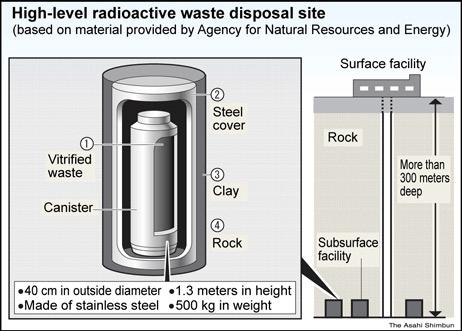
The council on Sept. 11 completed a report that calls for regulating the total amount of radioactive waste from nuclear power plants and storing it temporarily. Continue reading
Youtube video – fake worker documents at Fukushima
 Watch: Fukushima worker films at plant — I was asked to fake documents — Underage people employed (VIDEO)http://enenews.com/watch-fukushima-worker-films-plant-asked-fake-documents-underage-workers-employed-video September 14th, 2012 By ENENews Source: 8bitnews Translation: mina564da
Date Filmed: June 18, 2012(?) Date Published: Sept 11, 2012
I was employed by a subcontractor of Tepco.
I was asked to write a fake CV by the contracting company.
I was told my duty was to be logistical support. But the reality was to work at the highly radioactive area (over 1 milliSv/hr).
Most of the workers come from all over Japan as a day laborer.
Underage workers (18 & 19 years old) are also employed.
These are just ordinary people without good knowledge of radiation. The fake CV establishes them as an experienced worker and they are sent to the Fuksuhima Daiichi NPP.
Japan insurance company won’t cover damage caused by nuclear fuel material
Insurance company “no coverage for damage caused by nuclear fuel material” http://fukushima-diary.com/2012/09/insurance-company-no-coverage-for-damage-caused-by-nuclear-fuel-material/ by Mochizuki September 15th, 2012 ·
A Japanese posted tweeted like this below,
<Translate>
Recently insurance company adds this item on their instruction.
“We won’t pay insurance for the damage caused by nuclear fuel material.”
<End>
We need to verify how it was before 311.
Japan Times: “Alarming estimate of cancer fatalities… 1 million extra deaths” — Nobody mentions krypton and xenon that poured from Fukushima plant, says Gundersen — 2-3 times greater than Chernobyl http://enenews.com/japan-times-nobody-mentions-cancer-causing-krypton-and-xenon-that-poured-from-fukushima-plant-says-gundersen-2-3-times-greater-than-chernobyl
September 15th, 2012
By ENENews Title: ‘The government could still save lives’
Source: The Japan Times Online
Author: DAVID MCNEILL
Date: Sep. 16, 2012
[…]
Experts waved away fears about radiation, cabinet ministers scoffed at comparisons to Chernobyl, and the word “meltdown” itself was effectively scoured from the media.
Some observers, however, were quick to hit the panic button. One of the best known was U.S. antinuclear campaigner Arnie Gundersen, who predicted that the disaster would lead to 1 million extra deaths from cancer.
[…]
Gundersen, a nuclear engineer, says [the official release amount is] an underestimate. He puts the release of cesium at about half that of Chernobyl, and says little attention has been paid to radioactive gases, Xenon and Krypton, which poured out of the No. 1 plant in quantities “two to three times” greater than the 1986 Ukraine meltdown. He is sticking to his original alarming estimate of cancer fatalities.
[…]
Gundersen bases much of his assessment of Fukushima on what he learned from America’s worst nuclear accident, the 1979 partial meltdown at the Three Mile Island plant in Pennsylvania. As an expert witness during the probe that followed, Gundersen said the official estimate of radioactive releases there was also much too low. “You have to remember, we don’t know how much radiation was released. It’s guys like me who have to calculate it.” His assessment upped the official radiation figure for the accident by five times. “I’m dead sure that’s too low,” he says, adding that he believes the true figure could be 15 times higher than the industry estimate.
[…]
He cites the work of Steve Wing, an epidemiologist who says he has tracked 10,000 extra deaths from lung cancer in the first six to seven years after the accident.
“The same gases (Xenon and Krypton) that caused those cancers leaked out of the containment vessel at the Daiichi (No. 1) plant,” he says. “Nobody is talking about it.” He says the gases quickly disperse and are notoriously hard to measure. Other emissions are more straightforward. Plutonium is heavy and does not widely disperse. Cesium is relatively easy to track.
[…]
34% of Fukushima city people want to evacuate, local gov “Measures need to be taken” http://fukushima-diary.com/2012/09/34-of-fukushima-city-people-want-to-evacuate-local-gov-measures-need-to-be-taken/#.UFZI1IGM8Ng.facebook by Mochizuki September 16th, 2012
For the questionnaire, 34% of the people answered they want to evacuate Fukushima city, and local government staff is commenting they need to take measures about this situation.
In May, Fukushima city government sent questionnaires to 5,000 people
of over 20 years old living in Fukushima city and to 500 people who
evacuated to out of Fukushima city. The valid response rate was 55%.
The result showed 34% of them answered “They want to evacuate even
now.”. 31% of them answered “They used to want to evacuate.”.
Among people who evacuated to out of Fukushima city, 27% of them
answered “They don’t want to come back.”. 19% of them answered “They
don’t want to come back to Fukushima city if possible.”
However, 55% of them answered “They want to come back to Fukushima city.”
The city government staff comments, “The result is very severe. We
need to take some measures. “.
1 This Month

Read the Public Inquiry Report, the Commissioners’ report, Surrendering Australia: The AUKUS Deception is available to download for free at aukuspublicinquiry.com. Or just watch the replay of the National Press Club Luncheon.



19 November – Webinar – The Reality of Reprocessing
Time: 11:00 AM Pacific Time (US & Canada) / 2:00 PM Eastern / 7:00 PM UK / 8:00 PM CET
Register for the Zoom Event Here



Shut down the radiation-damaged Heysham nuclear reactors now
To see nuclear-related stories in greater depth and intensity – go to https://nuclearinformation.wordpress.com

Say No to NASA’s Reckless Nuclear Reactor on the Moon
Say No to NASA’s Reckless Nuclear Reactor on the Moon
-
Archives
- November 2026 (109)
- October 2026 (302)
- September 2026 (339)
- August 2026 (330)
- July 2026 (355)
- June 2026 (287)
- May 2026 (306)
- April 2026 (356)
- March 2026 (251)
- February 2026 (267)
- January 2026 (308)
- December 2025 (358)
-
Categories
- 1
- 1 NUCLEAR ISSUES
- business and costs
- climate change
- culture and arts
- ENERGY
- environment
- health
- history
- indigenous issues
- Legal
- marketing of nuclear
- media
- opposition to nuclear
- PERSONAL STORIES
- politics
- politics international
- Religion and ethics
- safety
- secrets,lies and civil liberties
- spinbuster
- technology
- Uranium
- wastes
- weapons and war
- Women
- 2 WORLD
- ACTION
- AFRICA
- Atrocities
- AUSTRALIA
- Christina's notes
- Christina's themes
- culture and arts
- Events
- Fuk 2022
- Fuk 2023
- Fukushima 2017
- Fukushima 2018
- fukushima 2019
- Fukushima 2020
- Fukushima 2021
- general
- global warming
- Humour (God we need it)
- Nuclear
- RARE EARTHS
- Reference
- resources – print
- Resources -audiovicual
- Weekly Newsletter
- World
- World Nuclear
- YouTube
-
RSS
Entries RSS
Comments RSS

