Nuclear money makes nuclear addicts of Japan’s towns
 Another example of a local community dependent on money related to nuclear facilities is in Rokkasho, Aomori Prefecture, formerly a poverty-stricken village where most of its 11,000 residents relied on agriculture and fisheries for their livelihood. The village is now called one of Japan’s wealthiest municipalities.
If the government’s plan to phase out nuclear power in Japan is to be implemented, the whole concept of a nuclear fuel cycle in this country would collapse, which in turn would deal a serious blow to Rokkasho’s fiscal foundation.
the system in which money flows from the nuclear community into host municipalities remains intact, and unless
the link is cut off, those municipalities will continue to rely on the nuclear industry.
 Municipal nuclear addiction, Japan Times, 26 Nov 12 Municipalities hosting nuclear power plants throughout Japan have received large amounts of central government subsidies, donations from utilities and lucrative business contracts Now, 1½ years after the Fukushima nuclear disaste rs, those municipalities realize how much their finances depend on the nuclear power-induced money.
“They’re like drug addicts cut off from supplies,” said a member of the assembly of Niigata Prefecture, which hosts Tokyo Electric Power Co.’s Kashiwazaki-Kariwa nuclear power plant on the Sea of Japan coast. All the  reactors at the plant remain shut down after its No. 5 and 6 reactors went offline earlier this year……
Host prefectures and municipalities receive central government grants based on laws designed to promote development of power generation facilities. …. Continue reading
Japan’s inadequate response to its Fukushima radiation victims
 U.N. envoy: Japan should do more for nuclear victims, Asahi Shimbun November 27, 2012 THE ASSOCIATED PRESS A United Nations rights investigator said Nov. 26 that Japan hasn’tdone enough to protect the health of residents and workers affected by the Fukushima nuclear accident.
Anand Grover, U.N. special rapporteur on the right to health, said the government has adopted overly optimistic views of radiation risks and has conducted only limited health checks after the partial meltdowns at several reactors at the Fukushima No.1 nuclear power plant caused by an earthquake and tsunami in 2011.
Several investigations, including one conducted by a parliament-appointed panel, have criticized the government for alleged cover-ups and delays in disclosing key radiation information, causing evacuees to be unnecessarily exposed to radiation. That has also
caused deep-rooted public distrust of the government and nuclear industry. Continue reading
Japan’s displaced people fear to ever return to radiation contaminated areas
In response to a questionnaire sent to Okuma’s evacuees by the town hall in September, only 11 percent of the 3,424 households that responded said they wanted to go back, while 45.6 percent said they had no intention of ever returning, mostly because of radiation fears.
Hopes of Home Fade Among Japan’s Displaced By MARTIN FACKLER NYT, : November 25, 2012 AIZU-WAKAMATSU, Japan — As cold northerly winds sprinkle the first snow on the mountains surrounding this medieval city, those who fled here after last year’s Fukushima nuclear disaster are losing hope that they will ever return to their old homes. Continue reading
Slow increase of radiation in Fukushima No 1 reactor’s water intake
 [Radiation leakage to the sea] Radiation level at water intake of
reactor1~4 is slowly increasinghttp://fukushima-diary.com/2012/11/radiation-leakage-to-the-sea-radiation-level-at-water-intake-of-reactor14-is-slowly-increasing/ by Mochizuki on November 26th, 2012 ·
According to Tepco’s report of “Radioactivity Density of the Seawaterat the South of Unit 1-4 Water Intake of Fukushima Daiichi NPS (Bq/L)” published on 11/26/2012, the radiation level at the water intake is slowly increasing since the first week of this October.
Understandably, Japan doesn’t like India’s Nuclear Liability Law
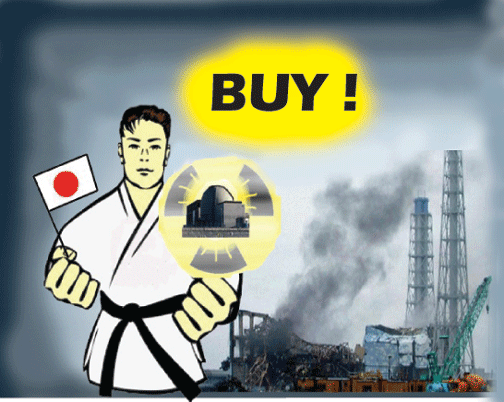 Japan also sought some clarifications about India’s nuclear liability law that prevents suppliers from making themselves immune to compensation claims in the event of an accident.
PM revives nuclear energy talks with Japan By Sachin Parashar, TNN | Nov 26, 2012 NEW DELHI: PM Manmohan Singh sought to revive with Japan negotiations for peaceful use of nuclear energy, which has remained stalled since the Fukushima nuclear accident in March, 2011, in a meeting with his counterpart Yoshihiko Noda in Phnom Penh last week.
Sources said Singh expressed hope before Noda that Japan would soon share its nuclear technology and expertise with India. Continue reading
World Health Organisation grudgingly admits that radiation raises cancer risk in children
 WHO forecasts no significant increase in cancer patients in Fukushima, Asahi Shimbun, By YURI OIWA, 25 Nov 12 “……..for children, who are deemed more susceptible to radiation exposure than adults, the increases varied sharply depending on the location.
The incidence rate for 1-year-old girls in Namie for developing thyroid cancer by the age of 16 grew 9.1 times from 0.004 percent before the accident to 0.037 percent, according to the WHO report. That means 3.7 1-year-old girls out of 10,000 living in the town will
develop thyroid cancer, compared with 0.4 girls before the accident.
For 1-year-old boys in Namie, the likelihood of developing leukemia was predicted to go up 1.8 times from 0.03 percent before the accident.
The thyroid cancer rate for 1-year-olds in Iitate, another town near the stricken nuclear plant, grew 5.9 times, while the rate in the prefectural capital of Fukushima increased 3.7 times.
The risks posed to fetuses were considered the same as those for 1-year-olds.
The report also said the chances of young people exposed to low-level radiation developing benign tumors or cysts will likely rise, and it urged continued monitoring of their health even though the tumors and cysts are unlikely to become cancerous…..
Some health experts hailed the WHO report for spelling out the health risks in numbers.
Residents in Fukushima Prefecture became skeptical of the repeated reassurances by the central government and the Fukushima prefectural government that their health would probably not be affected if their radiation exposure was 100 millisieverts or less.
Exploiting Japan’s university students as Fukushima cleanup workers
[Exploiting the youth] Fukushima university to give students credit
for decontamination work http://fukushima-diary.com/2012/11/exploiting-the-youth-fukushima-university-to-give-students-credit-for-decontamination-work/ by Mochizuki November 24th, 2012
 On 11/19/2012, Fukushima Diary wrote, “It’s likely that they make it a credit necessary to graduate from schools to go to Fukushima (plant).” in the column [Japan may seek solution of Fukushima in drifting to the right]. Fukushima university is going to do exactly what was written in the column.
Fukushima university is going to give students credit for decontamination work, which is supposed to be volunteer. 45 hours of decontamination is one credit, 90 hours of decontamination is two credits.
Fukushima had 3 nuclear meltdowns
Michio Kaku: 3 meltdowns in Fukushima, but uranium actually totally liquified… 1st time in history — “Reactor actually melted totally” (VIDEO) http://enenews.com/michio-kaku-3-meltdowns-fukushima-uranium-actually-totally-liquified-1st-time-history-reactor-actually-melted-totally-video November 22nd, 2012
Coast to Coast AM with George Noory, November 20, 2012: Previously Kaku has stated that one Fukushima reactor had “liquified Professor Michio Kaku, City College of New York:
We had three simultaneous core meltdowns in Fukushima, but the uranium actually liquified — liquified — we’ve never seen a totally liquified core before.
First time in history.
But the Fukushima reactor actually melted totally.
Michio Kaku: American theoretical physicist, the Henry Semat Professor of Theoretical Physics in the City College of New York of City University of New York, a co-founder of string field theory […] Kaku graduated summa cum laude from Harvard University in 1968 and was first in his physics class. He attended the Berkeley Radiation Laboratory at the University of California, Berkeley and received a Ph.D. in 1972.
Listen to the broadcast here
Japan’s solar feed in tariff boosting renewable energy
The Land of the Rising Sun Goes Solar http://financialconservation.blogspot.com/2012/11/the-land-of-rising-sun-goes-solar.html#ixzz2D4daQDH6 Business Insider, Michael E. Douroux, Financial Conservation | Nov. 22, 2012 “According to a new report from the Japan Photovoltaic Energy Association, domestic shipments of solar cells and modules have risen by 80% in the July-September quarter of this year.
 This is on the heels of the Japanese government enacting an ambitious solar energy incentive initiative, a feed-in tariff (known as net energy metering in California) that aims to help support the adoption of solar energy throughout the country.
The feed-in tariff was introduced in the wake of the Fukushima disaster of 2011, when a powerful earthquake and tsunami triggered a nuclear crisis in Northern Japan. After the disaster, the government made moves to abandon nuclear power. While moving away from nuclear energy has proven to be a slow and laborious process, the country has been keen to aggressively replace nuclear with other forms of alternative energy that are considered safer. Solar energy has, thus
far, become one of the country’s most favored forms of alternative energy for this purpose.”
Highest ever radiation in wild boar in Iwaki, japan
33,000 Bq/Kg from wild boar in Iwaki city, “The highest measurement ever” http://fukushima-diary.com/2012/11/33000-bqkg-from-wild-boar-in-iwaki-city-the-highest-measurement-ever/?utm_source=twitterfeed&utm_medium=twitter&utm_campaign=Feed%3A+FukushimaDiary+%28Fukushima+Diary%29
by Mochizuki November 21st, 2012 · On 11/20/2012, Fukushima prefecture announced they measured 33,000 Bq/kg of cesium from wild boar in Iwaki city. It was the highest
measurement ever.
Prefectural government commented they are not sure about the reason.
They measured higher than 100 Bq/Kg from 5 among 16 samples, which were wild boar (Sus scrofa), spot‐billed duck (Anas poecilorhyncha), mallard duck (Anas platyrhynchos) and Japanese deer (Cervus nippon).
Role of Fukushima insects in spreading radiation?
 Are radioactive insects spreading Fukushima contamination from lake bottoms across the land? Scientist: They grow underwater then fly out & die everywhere http://enenews.com/are-radioactive-insects-spreading-cesium-from-lake-bottoms-out-across-the-land-scientist-they-grow-underwater-then-fly-out-and-die-everywhere
November 21st, 2012
Title: Fukushima Update: Radioactive Fish, Conflicts of Interest, and Filtered Vents
Source: ScienceBlogs (A National Geographic partner)
Author: Greg Laden
Date: Nov. 21, 2012
Highly Radioactive Fish Have Been Found…
I have a hypothesis that explains many of these observations. Fish like trout, salmon, and char eat, among other things, insects on the surface, gorging on hatches. A hatch is a large number of insects flying around and spending time over water, or often, just falling into the water, after emerging from a body of water where they spent an aquatic phase. I’ve written before about the role that insects such as dragonflies and lake flies serve the role of moving nutrients from their “final” resting place at the bottom of ponds and lakes, out across the landscape. These animals start off as an egg, and then turn into their adult form underwater, accumulating nutrients …. and cesium? …. as they grow. Then they fly out of the water and die everywhere. Or, are eaten by selected species of fish. From clay-rich lake bottom, where radioactive cesium can accumulate in sufficient density to disqualify bottom feeders from human consumption, to the mouths of trout, salmon and char. I don’t know if the Japanese researchers are thinking about it this way, but I hope it is given some thought.
See also: Japan Times: Time bomb in Tokyo metropolitan area — Experts warn of accumulating Fukushima contamination — Potential disaster at Japan’s 2nd largest lake
Failure of Japan’s new Fukushima clean-up robot
 Japan’s new nuclear-proof robot gets stage fright http://ajw.asahi.com/article/economy/technology/AJ201211220024 November 22, 2012 REUTERS YOKOHAMA--A Japanese robot designed to withstand high levels of radiation and extreme heat at damaged nuclear plants such as Fukushima froze on its first public demonstration.
Despite being home to the largest number of industrial robots in the world, Japan did not have a device capable of entering the damaged Fukushima nuclear facility after last year’s devastating earthquake and tsunami.
Instead, Japan brought in U.S. robots to survey the extent of the damage inside the reactor buildings.
Toshiba Corp. unveiled Japan’s own nuclear-proof robot on Oct. 21, a four-legged device able to carry up to 20 kg of equipment and capable of lifting itself up if it falls over on uneven surfaces and amid debris.
During the demonstration, the robot experienced a case of stage fright. The shuffling Tetrapod locked up and suddenly froze after it tried to balance itself, forcing technicians to carry it away. It is the second time such Japanese robotic technology has experienced problems. Last October, a crawling robot developed by the Chiba Institute of Technology lost connection with operators and was abandoned inside Fukushima’s No. 2 reactor building.
Thyroid disorders in 42% of Fukushima’s children
German TV: 42% of Fukushima children now with thyroid disorders — Official blames too much seafood? (VIDEO) http://enenews.com/german-tv-42-of-fukushima-children-now-with-thyroid-disorders-official-blames-too-much-seafood-video German TV channel ZDF’s segment on the Fukushima Health Survey translated by SimplyInfo:
November 19th, 2012 More than 42% of 57,000 tested children have nodules or cyst, reports Dr. Suzuki who leads the examinations. In Chernobyl they found only 0.1 – 1%. nobody of the experts asks for the reasons. […] He explains the results mainly by improved diagnosis methods, but people don’t believe him. […] There are no refererence [sic] studies, Dr. Suzuki tells us, and maybe the children simply took too much iodine or seafood. He doesn’t know if this has something to do with radiation. “We are mainly here to inform the parents of the results of our study.” But what do such results mean to parents without proper explanations? The official handling of the disaster is more than questionable. Many people have completely lost trust in government and believe that the disaster is played down to protect the mighty nuclear industry of Japan.
Close to Tokyo, an increasingly radioactive lake
Japan Times: Time bomb in Tokyo metropolitan area — Experts warn of accumulating Fukushima contamination http://enenews.com/japan-times-time-bomb-tokyo-metropolitan-area-experts-warn-accumulating-fukushima-contamination
Title: The muddy issue of cesium in a lake
Source: Japan Times
Author: By TOMOKO OTAKE
Date: Nov 18, 2012
Lake Kasumigaura in Ibaraki Prefecture is facing an environmental threat that has essentially turned it into a time bomb ticking away 60 km northeast of Tokyo.
Experts warn that Japan’s second largest lake with a surface area of 220 sq. km is quietly but steadfastly accumulating radioactive cesium […]
[It] is not only rich with fishery resources but whose water is used for irrigation, industrial purposes, and even for consumption as drinking water for 960,000 people in Ibaraki Prefecture. Furthermore, no one knows how and by how much the problem has worsened over the months, except for one obvious thing: it hasn’t gone away. […]
[Atsunobu Hamada, former director of the government-affiliated Ibaraki Freshwater Fisheries Research Institute maintains] that the inevitable solution would be to release Kasumigaura’s cesium into the Pacific Ocean via the Tone River […]
“We have a potential disaster waiting to happen,” [Hiroshi Iijima, director general of the nonprofit organization Asaza Fund in Ushiku, Ibaraki Prefecture] said. “This is a lake in the Tokyo metropolitan area and the second-largest lake in Japan, and we are sitting idly by, letting it get contaminated.”
Katsuhiko Sato, official at the Environment Ministry’s water environment section: The current levels of contamination pose no health risk for the area’s residents, because radiation in the lake and the rivers is shielded by water – (Shielding? See above: “Water is used for irrigation, industrial purposes, and even for consumption as drinking water for 960,000 people in Ibaraki Prefecture”)
Asahi Source: Locations in Chiba came under heavy nuclear fallout; Borders Tokyo — Contamination has potential to affect ecosystems
Cesium levels in mushrooms have risen in several Japanese prefectures
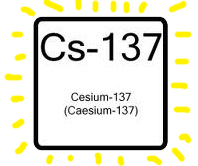 [Asahi] Cesium levels in mushroom have also risen in various areas compared with last year http://fukushima-diary.com/2012/11/asahi-cesium-levels-in-mushroom-have-also-risen-in-various-areas-compared-with-last-year/
by Mochizuki on November 21st, 2012 ·
<Quote> [Asahi]
・・・
As of Nov. 16, officials said 93 municipalities in 10 prefectures, including Fukushima, had a shipment restriction in place. For five prefectures–Aomori, Saitama, Yamanashi, Nagano and Shizuoka–wild mushrooms constitute the only produce for which a shipment ban is in effect.
Cesium levels have also risen in various areas compared with last year.
According to tests requested by the central government, the highest levels recorded this year were 120 becquerels in Aomori Prefecture, up from only 60 becquerels last year; 2,100 becquerels in Nagano Prefecture (1,320 becquerels last year); and 3,000 becquerels in Tochigi Prefecture (134 becquerels last year).
Yasuyuki Muramatsu, a chemistry professor at Gakushuin University who specializes in radiation effects on ecology, said, “While the detailed mechanism is still unclear, mushrooms can more easily absorb cesium in comparison to plants because they are fungi.” As for why cesium levels are higher this autumn, Muramatsu said, “There is the possibility that radioactive materials that were attached to the trunks and leaves of trees last year were washed away by the rain and entered the soil into which mushrooms extend their fungal filament.”
Muramatsu cautioned that some types of wild mushroom may have high cesium levels next year as well, which will require continued testing.
1 This Month





PLEASE OPPOSE HR 8255 AND S.3639 – bills would accelerate satellite deployment, with no environmental review or safeguards – https://ncstd5li.quorum.us/campaign/169331/
To see nuclear-related stories in greater depth and intensity – go to https://nuclearinformation.wordpress.com
-
Archives
- October 2026 (74)
- September 2026 (339)
- August 2026 (330)
- July 2026 (355)
- June 2026 (287)
- May 2026 (306)
- April 2026 (356)
- March 2026 (251)
- February 2026 (267)
- January 2026 (308)
- December 2025 (358)
- November 2025 (359)
-
Categories
- 1
- 1 NUCLEAR ISSUES
- business and costs
- climate change
- culture and arts
- ENERGY
- environment
- health
- history
- indigenous issues
- Legal
- marketing of nuclear
- media
- opposition to nuclear
- PERSONAL STORIES
- politics
- politics international
- Religion and ethics
- safety
- secrets,lies and civil liberties
- spinbuster
- technology
- Uranium
- wastes
- weapons and war
- Women
- 2 WORLD
- ACTION
- AFRICA
- Atrocities
- AUSTRALIA
- Christina's notes
- Christina's themes
- culture and arts
- Events
- Fuk 2022
- Fuk 2023
- Fukushima 2017
- Fukushima 2018
- fukushima 2019
- Fukushima 2020
- Fukushima 2021
- general
- global warming
- Humour (God we need it)
- Nuclear
- RARE EARTHS
- Reference
- resources – print
- Resources -audiovicual
- Weekly Newsletter
- World
- World Nuclear
- YouTube
-
RSS
Entries RSS
Comments RSS

