The Fukushima radiation clean up is failing
 Time: Fukushima nuclear struggles “would be the stuff of comedy” — “It’s not funny, not really” — “Not sure things could be much worse if Wile E. Coyote were Tepco’s CEO” http://enenews.com/time-fukushima-nuclear-struggles-would-be-the-stuff-of-comedy-its-not-funny-not-really-not-sure-things-could-be-much-worse-if-wile-e-coyote-were-tepcos-ceo
Title: Japan: Why the Fukushima Daiichi Nuclear Plant’s Cleanup Is Faltering
Source: Time.com
Author: Bryan Walsh
Date: May 01, 2013

Honestly, if the consequences weren’t potentially so dire, the ongoing struggles to clean up the Fukushima Daiichi nuclear plant in northern Japan would be the stuff of comedy. […] I’m not sure things could be much worse if Wile E. Coyote were TEPCO’s CEO.
But it’s not funny, not really, because the consequences of the meltdown and TEPCO’s mismanagement are very real. […] More than two years after the tsunami, TEPCO is still racing against time — and just barely staying ahead.
[…] the fact that the company is still running the Fukushima cleanup seems like a worse idea with each passing day.
[…] As the groundwater debacle demonstrates, TEPCO has been making things up as it goes along since the beginning — and the Japanese government has let them.
[…] And while Japan is unique, collusion between the tightly closed nuclear industry and the government elsewhere isn’t.
More from Time’s Bryan Walsh: Time.com: Fukushima dangers “may not be as grave as we first feared” — Only 10 people surveyed had high levels of radiation, says study — Only 10% of Chernobyl release
Fukushima nuclear power plant is very unstable
Nuclear Safety Expert: “Many experts are extremely concerned we could have additional releases” at Fukushima plant — “Very, very unstable facility” (AUDIO) http://enenews.com/nuclear-safety-expert-many-experts-are-extremely-concerned-we-could-have-additional-releases-at-fukushima-plant-very-very-unstable-facility-audio
Title: Workers at Fukushima nuclear plant struggle to contain rush of contaminated water
Source: FSRN
Date: May 1, 2013
Dan Hirsch, a nuclear safety expert, president of the Committee to Bridge the Gap, and lecturer at the University of California, Santa Cruz: Many experts are extremely concerned that we could have additional releases.
This is a very, very unstable facility.
Very, very damaged with people working in extraordinary high radiation fields trying to repair it.
Full broadcast here
 AUDIO Workers at Fukushima nuclear plant struggle to contain rush of contaminated water, 30 April 13 http://fsrn.org/audio/workers-fukushima-nuclear-plant-struggle-contain-rush-contaminated-water/11929
At the damaged Fukushima Daiichi nuclear plant in Japan, workers are struggling to contain a rush of highly radioactive wastewater. It’s flowing at the rate of 75 gallons per minute, according to the New York Times. Officials with the Tokyo Electric Power Company say they are considering clearing a nearby forest site in order to make more room for storage tanks. It’s the latest in a series of ongoing issues at the site. Earlier this month operators had to shut down the cooling of a spent fuel pool after rodents damaged an electrical line.
The International Atomic Energy Agency now estimates it will take more than 40 years to clean up the site. For more, we’re joined by Dan Hirsch, a nuclear safety expert and president of the Committee to Bridge the Gap, a nuclear policy group. He’s also a lecturer at the University of California, Santa Cruz.
Japan’s Prime Minister on nuclear selling spree in Dubai
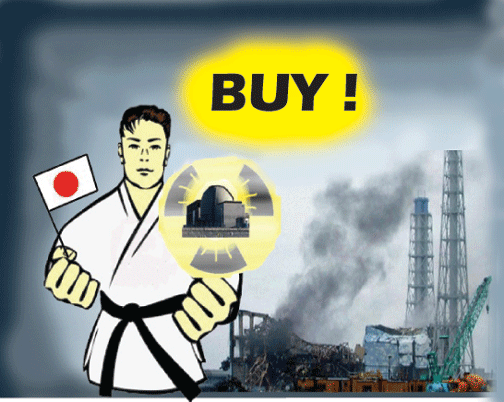 Japan, UAE set to sign nuclear agreement as Abe visits, Global Post, 2 May 13, Japan and the United Arab Emirates are set to sign a nuclear agreement on Thursday as Japanese Prime Minister Shinzo Abe, who is visiting the country, pushes his bid to sell Japanese nuclear technology overseas.
The two countries’ representatives will ink the deal following a meeting between Abe and UAE Vice President and Prime Minister Sheikh Mohammed bin Rashid Al Maktoum in Dubai.
Abe, since assuming his post last December, has promoted the exports of Japanese infrastructure, such as nuclear power plants, as a key pillar of the government’s growth strategies aimed at revitalizing the Japanese economy……. http://www.globalpost.com/dispatch/news/kyodo-news-international/130502/japan-uae-set-sign-nuclear-agreement-abe-visits
In last few days, high spike of radiation in air in Japan and West USA
 Fukushima pushes Japan over 26 times normal radiation http://www.agoracosmopolitan.com/news/headline_news/2013/05/02/5835.html 02 MAY 2013 BY : BY SADIA ARSHAD
- As of the sampling done four days ago, the radiation fallout level has spiked up to twenty six times its average level since the past year in Japan. The reading indicates 100.4 MBq/Km2. The average reading was at 3.85 MBq/Km2 until 26th April. The reason behind this sudden climb is not known as of yet.
The leak is suspected from the radioactive waste water from the water storage ponds at Fukushima I Nuclear Power Plant. The amount of radioactive material in the water sample taken from Pond No. 1 on 27th April has led to this discovery.
As per air samples taken by the United States Environmental Protection Agency at eighteen different collection points in the Pacific States, the average level of radioactivity in the air has also spiked to more than seven times the normal levels.
Monju nuclear reprocessing plant – black smoke and fire alarm
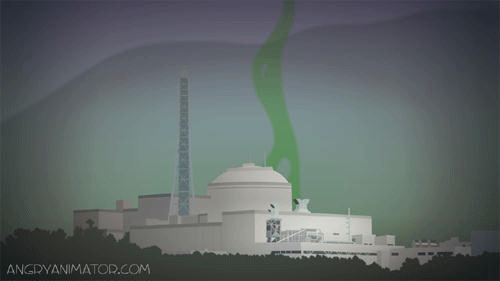 Fire at Japan’s Monju nuclear reprocessing plant? May 3, 2013 NHK: Black smoke at Japan nuclear plant — Fire alarm sounds after test http://enenews.com/nhk-black-smoke-at-japan-nuclear-plant-fire-alarm-sounds-after-testTitle: Black Smoke Detected From Nuclear Reactor ‘Monju’ During Test Operations |
Source: RocketNews24 via NHK
Author: Andrew Miller
Date: May 1, 2013
Black Smoke Detected From Nuclear Reactor ‘Monju’ During Test Operations
It as been reported that engineers at Japan’s fast breeder reactor plant Monju made a mistake during testing of the plant’s emergency power generator, which subsequently resulted in the release of black smoke and the ringing of the plant’s fire alarm. […]
JAERI [Japan Atomic Energy Research Institute] reported this latest incident to the country’s Nuclear Regulation Authority, claiming that the conduct of the staff at the plant is clearly in breach of security regulations. It also made the following statement:
“In order to prevent a recurrence of the same problems, it is necessary to pay meticulous attention to the way in which personnel at the plant carry out their work.”
Full report here
Japanese media hides the truth about Fukushima
Bad news Has the media hidden the truth about Fukushima? Number 1 Shimbun 2 May 13, David McNeill, Two years after the Fukushima nuclear crisis began, two media experts dissect how it has been covered by the media. Takashi Uesugi is a freelance journalist and author of several books on the Fukushima crisis, including Terebi Wa Naze Heiki De Uso Wo Tsukunoka? (“Why does television tell so many lies?”). He is also one of the founders of The Free Press Association of Japan (www.fpaj.jp), an attempt to offer an alternative to Japan’s press club system. Mamoru Ito is professor of media and cultural studies at Waseda University and author of Terebi Wa Genpatsu Jiko Dou Tsutaetenoka? (“How did television cover the nuclear accident?). Both are highly critical of the media’s performance.
Uesugi-san, is it true that you have been banned from the media because of your comments on Fukushima?
Until two years ago, I had regular programs on television and radio. Now the only regular radio that I do is Tokyo FM. I don’t do TBS radio [where he had a regular slot]. I have no hope of appearing on NHK or on the commercial networks. I used to be a regular or semi-regular on several shows but now not even once. I was also a regular guest on radio shows, but not anymore.
I found out two years ago that the electric utilities in Japan are major TV sponsors. That year, they spent ¥70~88.8 billion on advertising, more than Panasonic’s ¥70 billion and Toyota’s ¥50 billion. When I started claiming that this amounted to bribery of the media by Tepco, I no longer was asked to appear on radio shows……… http://no1.fccj.ne.jp/index.php?option=com_content&view=article&id=870
Fukushima nuclear buildings getting flooded with radioactive water
 Radioactive water floods Fukushima buildings http://www.globalpost.com/dispatch/news/regions/asia-pacific/japan/130430/radioactive-water-floods-fukushima-buildings 1 May 13,
Workers have been struggling to contain radioactive wastewater left over from the Fukushima disaster. Radioactive groundwater is pouring into the buildings of the Fukushima Daiichi nuclear power plant at the rate of 75 gallons a minute, the New York Times reported. Worse, the flooding is not new. It’s been a constant headache since the nuclear disaster two years ago, forcing a small army of workers to continuously struggle to contain the endless flow of water.
“The water keeps increasing every minute, no matter whether we eat, sleep or work,” Masayuki Ono, a general manager with the Tokyo Electric Power Company, told the Times. “It feels like we are constantly being chased, but we are doing our best to stay a step in front.”
More from GlobalPost: On Location Video: The dirty work of cleaning up Fukushima
According to the Times, the workers use massive tanks sprawling over 42 acres to hold the water, and even that isn’t enough.
In an interview with the Associated Press, Ono’s description of the tanks was not exactly reassuring: “We admit that the underground tanks are not reliable. But we must keep using some of them that are relatively in good shape while monitoring them closely.”Earlier this month, TEPCO admitted that one of those holding tanks may have leaked up to 120 tons of contaminated water.
Huge jump in Fukushima radiation OUTSIDE of reservoir No1
 [Leakage] Radiation level jumped up over 10 times much as 2 days before OUTSIDE of reservoir No.1 http://fukushima-diary.com/2013/04/leakage-radiation-level-jumped-up-over-10-times-much-as-2-days-before-outside-of-reservoir-no-1/ by Mochizuki April 28th, 2013
It’s on the South West side of the reservoir. The sample is drain hole water.
At 12:05 of 4/26/2013 (JST), they measured 41,000 Bq/Kg of the total β nuclide.
At 12:05 of 4/28/2013, it jumped up to be 1,100,000 Bq/Kg, which is over 10 times much as the previous reading.
Tepco hasn’t verified the reason yet. http://www.tepco.co.jp/nu/fukushima-np/f1/smp/2013/images/chosui_13042706-j.pdf
http://www.tepco.co.jp/nu/fukushima-np/f1/smp/2013/images/chosui_13042601-j.pdf
A community based approach for renewable energy in Japan
One possible way for Japan to approach the NIMBY problems on renewables, Aldrich said, would be to go bottom up — by trying to find communities that are excited about green energy and renewables, to start from the community side and use that initiative to find the locations for wind turbines and solar energy farms.
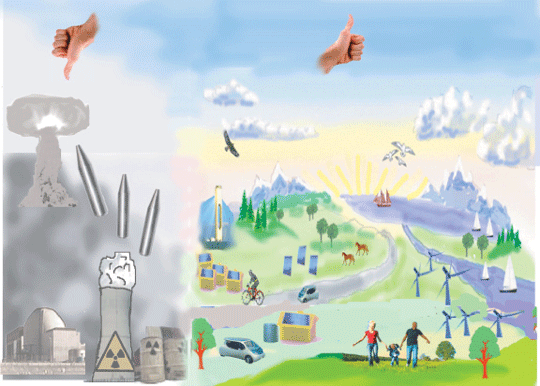
 Siting for renewables needs bottom-up approach http://www.japantimes.co.jp/news/2013/04/30/business/siting-for-renewables-needs-bottom-up-approach/#.UYGdFqJwpLs APR 30, 2013 If post-Fukushima nuclear disaster crisis Japan chooses to fill its energy needs with renewable energy sources, the nation will still face the same NIMBY (not-in-my-backyard) resistance to building large numbers of new facilities in the densely-populated country, an American expert said at a recent energy seminar in Tokyo.
The government is advised to take a bottom-up approach to find communities that are willing to accept wind turbines and solar power generation farms, rather than the top-down process that it used to convince farmers and fishermen into agreeing to the construction of nuclear power plants in their neighborhood over the past five decades, said Daniel P. Aldrich, an associate professor of political science at Purdue University and a Fulbright research fellow at the University of Tokyo. Continue reading
Media and Advertising Stifle the Truth on Japan’s Nuclear Industry
 Japan’s Media, Mega-Ad Agencies, & Nuclear Industry: A Lethal Combination? BY NATHALIE-KYOKO STUCKY AND JAKE ADELSTEIN , NOVEMBER 17, 2012 ·
Ryu Honma, author of Dentsu and the Nuclear Coverage (電通と原発の報道) spoke at the FCCJ a few weeks ago and his explanation of how Japan’s powerful advertising agencies, “the fifth estate”, stifled unfavorable coverage of nuclear power was eye-opening.
The collusive role between Japan’s major advertising agencies, the media, and Tokyo Electric Power Company (TEPCO)–one of the largest advertisers in Kanto while having a monopoly on electric power—has been blamed for allowing TEPCO to get away with unsafe practices and malfeasance for years. Some have argued that Japan’s major media, bloated on a diet of TEPCO advertising dollars, failed to fulfill their role as monitor and critic of the nuclear industry. A recently published book about Dentsu (電通)Japan’s largest advertising agency and their impact on Japan’s reporting on nuclear power was released this year and stirred up controversy. However, except for one or two magazines, just like the book, TEPCO/The Dark Empire東京電力:帝国の暗黒–the book has been ignored by the major media outlets it criticizes…..
In his book “Dentsu and the Nuclear Coverage,” Ryu Honma offers a clear insight about the great influence Dentsu and Hakuhodo have had on the media coverage of Japan’s nuclear power plant safety issues. Continue reading
Japanese power companies post $16 billion loss
Electricity companies post $16 billion loss as nuclear reactors remain offline HTTP://JAPANDAILYPRESS.COM/ELECTRICITY-COMPANIES-POST-16-BILLION-LOSS-AS-NUCLEAR-REACTORS-REMAIN-OFFLINE-0128034 MAY 1, 2013 by IDA TORRE THEY ONCE WERE THE MIGHTIEST ENTITIES IN JAPAN, BUT NOW POWER UTILITY COMPANIES ARE FACING A SECOND STRAIGHT YEAR OF COMBINED LOSSES OF 16 BILLION DOLLARS, AMIDST THE DELAYS IN THE RESTART OF THEIR NUCLEAR REACTORS, PLUS THE RISING COSTS OF IMPORTING FOSSIL FUEL DUE TO THE WEAKER YEN. NOW THEY WOULD HAVE TO EITHER RAISE CONSUMER PRICES OR SEEK FURTHER GOVERNMENT ASSISTANCE JUST TO KEEP AFLOAT. Continue reading
Radioactive water accumulating daily at stricken Fukushima nuclear plant
NYTimes: Alarming reality at Fukushima Daiichi — Plant faced with new crisis — “Tepco is clearly just hanging on day by day” http://enenews.com/nytimes-alarming-reality-at-fukushima-daiichi-plant-faced-with-new-crisis-tepco-is-clearly-just-hanging-on-day-by-day
Title: Radioactive Water Imperils Fukushima Plant
Author: MARTIN FACKLER (Makiko Inoue and Matthew L. Wald)
Date: April 29, 2013
[…] the Fukushima Daiichi nuclear power plant is faced with a new crisis: a flood of highly radioactive wastewater that workers are struggling to contain. Groundwater is pouring into the plant’s ravaged reactor buildings at a rate of almost 75 gallons a minute. It becomes highly contaminated there, before being pumped out to keep from swamping a critical cooling system. […]
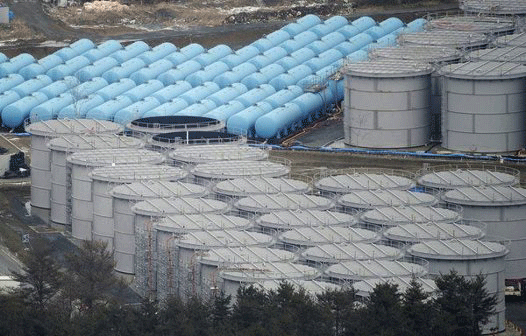
That quandary along with an embarrassing string of mishaps — including a 29-hour power failure affecting another, less vital cooling system — have underscored an alarming reality: two years after the meltdowns, the plant remains vulnerable to the same sort of large earthquake and tsunami that set the original calamity in motion. […]
“Tepco is clearly just hanging on day by day, with no time to think about tomorrow, much less next year,” said Tadashi Inoue, an expert in nuclear power who served on a committee that drew up the road map for cleaning up the plant. […]
See also: NYTimes: Fukushima plant unstable says official, concern another accident can’t be prevented — “Vulnerable… Very dangerous”
Huge underground wall for Fukushima?
‘Great wall of Fukushima’ to be built underground? — Structure around reactors proposed http://enenews.com/great-wall-fukushima-be-built-underground-structure-around-reactors-proposed
Source: Kyodo
Date: April 27, 2013
Great wall of Fukushima?
A government panel has begun studying ways to prevent more radioactive water from accumulating at the Fukushima No. 1 power plant, including a plan to build underground walls around the damaged reactor buildings to stop groundwater from entering. […]
Proposals made by Taisei Corp. and Kajima Corp. Friday included building a subterranean wall around the reactor buildings using a claylike material.
Tepco considered building a wall on the mountain side of the plant after the March 2011 earthquake and tsunami, but abandoned the plan because of the risk that radioactive water flooding the buildings might be leaking into the soil. […]
See also: Japanese professor: Melted fuel has gone through containers and is on concrete foundations sinking into ground below, as far as I can tell — Underground dam was being prepared, but TEPCO resisting
Fukushima radiation- accumulating exposure is the worry
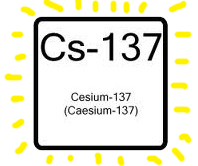 Experts are most worried about three radioactive substances iodine-131, caesium-134 and caesium-137-all of which can cause various types of cancer years later.
Although the radioactivity in iodine-131 fully disintegrates in 80 days, it can find its way rapidly into people through the air and through milk and leafy vegetables, lodging quickly in the thyroid gland, where it can cause DNA damage and raise cancer risk, particularly in young children. Among the people who were exposed to the Chernobyl accident as children, at least 1,800 have gone on to develop thyroid cancer, a study has found.
Cumulative radiation from Japan’s plant sparks health worries http://www.brecorder.com/top-stories/0/1179391/ April 18, 2011 RECORDER REPORT Japan’s crippled Fukushima Daiichi nuclear plant has so far leaked around a tenth of the amount of radiation released in the Chernobyl disaster, data showed on April 12, leading some experts to warn of serious long-term health risks.
“If that is the total radiation so far from the time of first leakage, that amount is very serious. It’s undoubtedly very bad. That is close to one-tenth of Chernobyl’s radiation in a month,” said Lam Ching-wan, a chemical pathologist at the University of Hong Kong and member of the American Board of Toxicology.
“It means there is damage to soil, ecosystem, water, food and people. People receive this radiation. You can’t escape it by just shutting the window.”With Japan widening the evacuation zone beyond the initial 20-km exclusion zone and encouraging children, pregnant women and hospitalised patients to stay out of some areas 20-30 km from the nuclear complex, Lam said he feared the radiation leakage may still be far from under control. Continue reading
International Atomic Energy Agency not facing up to the facts on Fukushima
IAEA Gives Little Insight To Fukushima Disaster Cleanup http://www.simplyinfo.org/?p=10267 April 24th, 2013 The IAEA visited the Fukushima Daiichi disaster site after multiple failures ended up in the news. They made very few comments from the trip and reaffirmed they think TEPCO can handle the disaster.
 What they did mention:
- It will take more than 40 years to clean up the disaster
- Technology still needs to be created to deal with the task of removing the melted fuel
- Problems and failures at the plant will continue to be an issue
- TEPCO should replace temporary systems with something more permanent and safer
- Contaminated water is expected to seep outside the plant after “decades”
The Japanese government is still intent on sending everyone back to the area as soon as possible.
Sources:
1 This Month





PLEASE OPPOSE HR 8255 AND S.3639 – bills would accelerate satellite deployment, with no environmental review or safeguards – https://ncstd5li.quorum.us/campaign/169331/
To see nuclear-related stories in greater depth and intensity – go to https://nuclearinformation.wordpress.com
-
Archives
- October 2026 (74)
- September 2026 (339)
- August 2026 (330)
- July 2026 (355)
- June 2026 (287)
- May 2026 (306)
- April 2026 (356)
- March 2026 (251)
- February 2026 (267)
- January 2026 (308)
- December 2025 (358)
- November 2025 (359)
-
Categories
- 1
- 1 NUCLEAR ISSUES
- business and costs
- climate change
- culture and arts
- ENERGY
- environment
- health
- history
- indigenous issues
- Legal
- marketing of nuclear
- media
- opposition to nuclear
- PERSONAL STORIES
- politics
- politics international
- Religion and ethics
- safety
- secrets,lies and civil liberties
- spinbuster
- technology
- Uranium
- wastes
- weapons and war
- Women
- 2 WORLD
- ACTION
- AFRICA
- Atrocities
- AUSTRALIA
- Christina's notes
- Christina's themes
- culture and arts
- Events
- Fuk 2022
- Fuk 2023
- Fukushima 2017
- Fukushima 2018
- fukushima 2019
- Fukushima 2020
- Fukushima 2021
- general
- global warming
- Humour (God we need it)
- Nuclear
- RARE EARTHS
- Reference
- resources – print
- Resources -audiovicual
- Weekly Newsletter
- World
- World Nuclear
- YouTube
-
RSS
Entries RSS
Comments RSS

