Japan’s Nuclear Regulation Authority wants Monju reprocessing plant to stay shut
NRA wants Monju to remain shut downhttp://www.japantimes.co.jp/news/2013/05/14/national/nra-wants-monju-to-remain-shut-down/#.UZQmBqJwpLt Lapses seen in JAEA checks of key reactor components KYODO, STAFF REPORT MAY 14, 2013 The Japan Atomic Energy Agency committed grave safety errors in managing the troubled Monju prototype fast-breeder reactor in Fukui Prefecture, and top officials at the Nuclear Regulation Authority said Monday they plan to make sure it stays closed.
The closure order to the government-linked JAEA will effectively dash any hope of trying to restart the reactor by year’s end, dealing another setback to Japan’s long-stalled plan to set up a nuclear fuel recycling system.
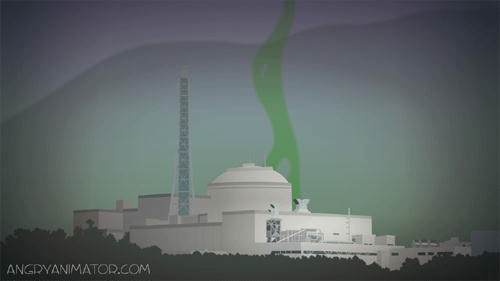
In September, the now-defunct Nuclear and Industrial Safety Agency carried out surprise inspections and determined that JAEA failed to regularly check key components of the experimental 280,000-kw reactor, as required by internal rules. Continue reading
Fukushima remains critically dangerous: Japan markets its nuclear technology
The Nuclear Regulation Authority has just started studying how the 3/11 quake affected the Fukushima nuclear power plant. Mr. Abe is pushing the export of nuclear power plants before the effect of quakes is fully understood. Such a policy is irresponsible.
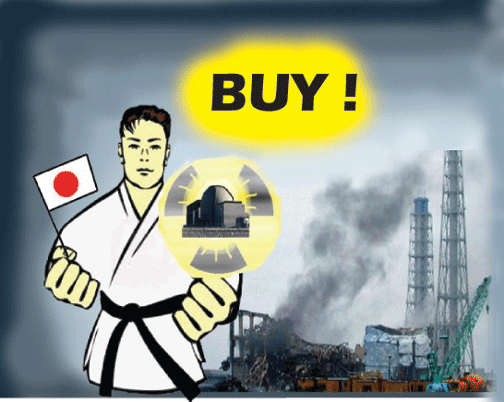 Export of nuclear technology http://www.japantimes.co.jp/opinion/2013/05/14/editorials/export-of-nuclear-technology/#.UZL05qJwpLs Editorial, MAY 14, 2013 In his recent visits abroad, Prime Minister Shinzo Abe signed agreements with the United Arab Emirates and Turkey that will enable the export of Japanese nuclear power plant technology to them. The Abe administration is also pushing talks to facilitate the conclusion of similar agreements with Saudi Arabia and Brazil.
Mr. Abe is trying to promote the export of nuclear technology at a time when the nuclear crisis at Tokyo Electric Power Co.’s Fukushima No. 1 nuclear power plant remains ongoing and many Fukushima residents still live in fear of exposure to radioactive substances released by the plant. Some 150,000 of them still cannot return to their homes and communities due to radioactive contamination. In addition, important questions concerning the cause of the Fukushima nuclear crisis have yet to be resolved despite the studies by investigation committees set up by the government and the Diet. Continue reading
Highly radioactive material accumulating in areas in Fukushima City
 ‘Emergency decontamination’ needed in places used by Fukushima kids — Highly radioactive material accumulating — City Official: Many times higher than previous record for urban areas http://enenews.com/emergency-decontamination-needed-places-childrens-activities-highly-radioactive-material-accumulating-official-many-times-higher-anything-previously-found-urban-area-fukushima Title: Fukushima closes 2 parking lots for emergency decontamination work
Source: Asahi
Author: MASAKAZU HONDA
Date: May 08, 2013
Two parking lots in the city of Fukushima were declared off-limits to the public on May 7 after high concentrations of radioactive cesium were detected […]
“It’s the first time that soil with cesium levels exceeding 100,000 becquerels was found on the grounds of an urban area, not in sludge accumulated in ditches,” said a city official in charge of decontamination work. […]
The exposed soil had accumulated to a height of 1 to 3 centimeters around the edges of the parking lots or in sunken parts of the surface, mixed with fragments of dead leaves and other material.
The survey at the Matsuki parking lot found radioactive cesium concentrations of 220,000 or more becquerels per kilogram of soil, with the highest level at 433,772 becquerels. […]
In addition to visitors to the facilities, local residents, including students, usually enter the sites for walking and extracurricular activities. […]
See also: Nuclear material in pools at Fukushima schools exceed 100,000 Bq/kg — Level nearly doubled since last year
Dumping of Fukushima radioactive water into Pacific Ocean
 Report: Tepco now dumping contaminated water from Fukushima plant into ocean — 200 tons of radioactive groundwater “pumped out” http://enenews.com/report-tepco-begins-dumping-contaminated-water-into-ocean-200-tons-of-radioactive-groundwater-pumped-out
Kyodo News: Tokyo Electric Power Co. plans to discharge some groundwater that has flowed into the premises of the crippled Fukushima Daiichi nuclear power plant […] As a trial, TEPCO has pumped out about 200 tons of groundwater using the wells. Its density of radioactive substances was “the same as rivers in surrounding areas,” according to company officials. […] The utility hopes to hold a meeting with local fishermen Monday to seek approval of the groundwater release […]
SimplyInfo: TEPCO B Begins Dumping Contaminated Water Into The Sea […] TEPCO has begun dumping groundwater pumped out of a set of wells inland from the reactors into the Pacific. TEPCO dumped 200 tons of groundwater yesterday as a test. […]
From Yesterday: Asahi: Tepco to dump groundwater from Fukushima nuclear plant into Pacific Ocean — Trying to “avoid a total collapse” of system for handling radioactive water (PHOTO)
Fukushima nuclear reactor 1 to have its cover removed
 Cover over Reactor No. 1 to be removed at Fukushima plant — Radiation levels expected to rise http://enenews.com/cover-reactor-1-be-removed-fukushima-plant-radiation-levels-expected-rise
Title: TEPCO to take off cover of No. 1 reactor building for fuel removal
Source: Kyodo News
Date: May 9, 2013
The operator of the crippled Fukushima Daiichi nuclear power plant said Thursday it plans to temporarily take off a cover placed around the damaged No. 1 reactor building to prepare for the removal of fuel in the spent fuel pool.
Tokyo Electric Power Co. installed the cover in October 2011 to prevent the further release of radioactive substances into the air […]
A TEPCO official said that dismantling the cover — work which will start in the fall — is expected to lead to a “slight rise” in the radiation level but the impact will be “little.” […]
UPDATE: Tepco to demolish makeshift cover at Fukushima Reactor No. 1 — Trying to remove “radioactive material” — Will take 4 years for new one (PHOTO)
Japan refuses to sign international statement against use of nuclear weapons

 Preventing use of nuclear weapons, Japan Times Editorial 10 May 13 Japan recently refused to support an international joint statement which stressed that “It is in the interest of the very survival of humanity that nuclear weapons are never used again, under any circumstances.”
The Japanese government’s failure to sign the statement is regrettable in view of the simple fact that Japan became the first nation in history to suffer from the use of nuclear weapons through the U.S. atomic bombings of Hiroshima and Nagasaki in August 1945. In addition, a nuclear catastrophe happened at Tokyo Electric Power Co.’s Fukushima No. 1 nuclear power plant, causing great hardship to residents of Fukushima Prefecture.
Some 150,000 people from the prefecture are still forced to live away from their homes because the homes are located in areas contaminated by radioactive substances from the plant.
The Japanese are among the few on Earth who have experienced the dread of exposure to radiation whether it is from a nuclear weapon or from a nuclear power plant accident. Many Japanese citizens will not accept the government’s decision not to sign the statement, which was supported on April 24 by 74 countries at the second session of the Preparatory Committee for the 2015 Review Conference of the Parties to the Treaty on the Non-Proliferation of Nuclear Weapons in Geneva.
The joint statement said in part, “It is a shared responsibility of all States to prevent the use of nuclear weapons.” It also said, “The only way to guarantee that nuclear weapons will never be used again is through their total elimination.” It would not be far-fetched to say that by not supporting it, Japan has negated its own hard experience it could use to accelerate moves toward the elimination of nuclear weapons…… http://www.japantimes.co.jp/opinion/2013/05/11/editorials/preventing-use-of-nuclear-weapons/#.UY68JqJwpLs
Criminals continue to sustain Japan’s nuclear industry
the dirty secret that yakuza-linked workers and companies have long sustained Japan’s nuclear industry —  along with yakuza members themselves, ex-convicts, wanted criminals, and drug addicts working there — is now public knowledge.
most of their members are sociopathic felons who would commit theft, assault or murder to make a little money. And if you consider the black-market value of a little plutonium, you may feel a tad uneasy knowing such people have long had access to it — and can still get their hands on nuclear materials.
Of course, why take action when you can spend more time debating about taking action?
it seems more and more likely that criminals have been running the plants for a very long time — they just don’t all have tattoos
Yakuza links put nation at added nuclear risk JAPAN TIMES, BY JAKE ADELSTEIN, 5 MAY 13 On April 15, two alleged terrorists in Boston killed three people, injured more than 170 others and terrified a nation — for about $100 it cost them to modify pressure cookers into bombs. We should be glad they didn’t come to Japan, where they may have been able to explode a ready-made nuclear dirty bomb, kill untold thousands, render huge swaths of the country uninhabitable — and get paid by Tokyo Electric Power Co. (Tepco) in the process.
I wish I were kidding. Japan has more than 50 gigantic nuclear “pressure cookers” ripe for exploitation by terrorists. And they wouldn’t even have to lay siege to the facilities. Instead, they could just walk into a nuclear plant and leave with enough weapons-grade plutonium for a small atomic device — which later could be detonated wherever they chose. How?
In Japan, getting access to a nuclear power plant is very simple: fill out a job application. Continue reading
Discrimination as well as radiation, for Fukushima’s children
Fukushima activist fights fear and discrimination based on radiation, Japan Times, BY MIZUHO AOKI MAY 9, 2013 Sachiko Banba aches for children in Fukushima Prefecture, who worry whether they can lead a normal life.
“Three frequently asked questions from children are whether they are OK to live in Fukushima after they get married, whether they can give birth to a baby, and whether their baby will be healthy,” said Banba, 52, who runs a cram school in Minamisoma, Fukushima, less than 30 km from the Fukushima No. 1 nuclear plant.
Although tens of thousands of people fled their homes in Fukushima Prefecture following the March 2011 reactor meltdowns, many, including children, still remain. Most heartbreaking to Banba is the discrimination they face based on ignorance, and the likelihood it will follow them the rest of their lives.
Children catch snatches of the adult debates over the health risks of radiation exposure, and sense something bad might happen.“It’s due to people’s ignorance. There are still people who think radiation is something contagious,” Banba said. “By gaining correct knowledge, I hope children in Fukushima will be able to talk about radiation (exposure) when they are asked about it.”
Since last year, Banba and Dr. Masaharu Tsubokura have hosted more than 40 radiation study sessions for 1,500 children and adults, supplying people with the necessary information to counter the arguments of those who would discriminate against them.
Many locals have tales to tell, such as the Fukushima woman whose engagement was broken off due to the strong opposition of her fiance’s family.
Banba herself has felt the sting of intolerance many times outside the prefecture…..
citizens and medical experts like Tsubokura, who has been checking Minamisoma residents’ internal radiation exposure levels at Minamisoma Municipal General Hospital for nearly two years, are also holding study sessions in Fukushima and other prefectures to pass on basic knowledge as well as the latest findings.
Tsubokura said people outside Fukushima know little about radioactive materials. About half his audience at a lecture in Nagoya didn’t know that radioactive substances from Fukushima No. 1 fell to Earth in rain.
“Many thought a beam was emitted directly from the power plant,” Tsubokura said.
Similar discrimination was seen after the 1945 atomic bombings of Hiroshima and Nagasaki. Many people believed survivors were contagious and that marrying hibakusha or their descendants would produce babies with birth defects.
According to a 2008 survey of about 27,000 A-bomb survivors conducted by the city of Hiroshima, the main source of their emotional suffering after their exposure to radioactive “black rain” was discrimination, prejudice and anxiety over long-term health effects.
Even more than 60 years later, they are still haunted by discrimination, said Terumi Tanaka, secretary general of Nihon Hidankyo, an atomic bomb victims’ organization. Speaking at the Japan National Press Club in August 2011, he said the issue of radiation exposure is raised even today when their grandchildren try to marry…… http://www.japantimes.co.jp/news/2013/05/09/national/fukushima-activist-fights-fear-and-discrimination-based-on-radiation/#.UYwbmKJwpLs
Rokkasho nuclear reprocessing plant could lead to nuclear weapons for Japan
 Is Japan Developing a Nuclear Weapons Program? By Peter Symonds Global Research, May 07, 2013 Huge reprocessing plant could be used to stockpile plutonium for the future manufacture of nuclear weapons.The Wall Street Journal published an article on May 1 entitled “Japan’s nuclear plan unsettles US.” It indicated concerns in Washington that the opening of a huge reprocessing plant could be used to stockpile plutonium for the future manufacture of nuclear weapons.
The Rokkasho reprocessing facility in northern Honshu can produce nine tonnes of weapons-grade plutonium annually, or enough to construct up to 2,000 bombs. Continue reading
Youtube: ground under Fukushima Unit 4 is sinking
 http://www.youtube.com/watch?feature=player_detailpage&v=-LCTv65aqgA#t=101s Japan Diplomat: Ground underneath Fukushima Unit 4 is sinking — More than 30 inches in some areas — Now in danger of collapse (VIDEO)
Tweet from former Fukushima worker @Happy11311 translated by Fukushima Diary:
[…] the plant area may have a land subsidence depending on the volume of water to pump up. I think Tepco knows that…
More from @Happy11311: Fukushima worker concerned about ground settlement at plant — What will happen when Tepco starts pumping up 100s of tons of groundwater?
See also: Japan Diplomat: Ground underneath Fukushima Unit 4 is sinking — More than 30 inches in some areas — Now in danger of collapse (VIDEO)
See also: Japan Diplomat: Ground underneath Fukushima Unit 4 is sinking — More than 30 inches in some areas — Now in danger of collapse (VIDEO)
Japan’s “transition towns” go for renewable energy, not nuclear
Energy transition: no longer why but how
Since the Fukushima nuclear disaster in 2011, Fujino’s popularity as a transition town has grown. Hide Enomoto, co-founder of the Fujino transition town initiative says people around Japan are realizing just how important it is to switch towards cleaner sources of energy. “The people are no longer asking ‘why do we need an energy transition?,” Enomoto said. “Rather ‘how are we going to do it?”……
Huge alternative energy potential
If some studies are to be believed, Japan could in future completely turn its back on fossil fuels and meets its entire energy needs through renewable energy by 2050
‘Transition Towns’ lead the way in low-carbon living, DW, 7 May 13 Following the Fukushima nuclear disaster in 2011, many in Japan are talking about switching to renewable energy for a cleaner future. The “Transition town” of Fujino has already made that a reality……. Following the catastrophe, the Japanese government led by Naoto Kan initially decided to phase out nuclear energy in Japan by 2040. Since summer 2012, all Japanese reactors – with the exception of two – have been taken off the grid. Instead, Tokyo plans to set up the world’s biggest offshore wind park along the Fukushima coast by 2020. The plan foresees installing 143 wind turbines with a total capacity of 1 gigawatts. Construction is expected to begin in July 2013……. Continue reading
Continued flooding will damage Fukushima reactors’ structures
NBC News: Fears that Fukushima plant could “break apart” during cleanup process http://enenews.com/nbc-news-fears-that-fukushima-plant-could-break-apart-during-cleanup-process

Title: ‘A very fragile situation’: Leaks from Japan’s wrecked nuke plant raise fears
Source: NBC News
Author: Arata Yamamoto and Ian Johnston
Date: May 1, 2013
Like the persistent tapping of a desperate SOS message, the updates keep coming. Day after day, the operators of the wrecked Fukushima Dai-ichi nuclear power plant have been detailing their struggles to contain leaks of radioactive water.
The leaks, power outages and other glitches have raised fears that the plant — devastated by a tsunami in March 2011 — could even start to break apart during a cleanup process expected to take years. […]
“Until you can stop that transfer, you will not contain the radioactivity. That will go on for years and years until they contain it,” [Independent nuclear expert John Large] said. “The structures of containment start breaking down. Engineered structures don’t last long when they are put in adverse conditions.” […]
See also: Fears have also emerged that the Dai-ichi plant could break apart during cleaning, NBC News reports –
NY Daily News
Tomatoes, deformed by Fukushima radiation, on sale in Japan
 Fukushima: Japan sells radiation-mutated tomatoes http://www.agoracosmopolitan.com/news/headline_news/2013/05/04/5858.html# 04 MAY 2013 BY RAYMOND Lori Mochizuki, who edits Fukushima-Diary.com, reports that capitalists in Japan are now selling clearly discernible radiation contaminated and genetically mutated tomatoes. Mr. Mochizuki reports that such mutated plants are being increasingly found all over Japan, as the capitalist try to draw our attention elsewhere.
“I didn’t buy them.” They look like the mutated tomato on this article. The labels of origin read “Kumamoto”, in Kyushu.
Capitalists in Japan have apparently become so bold that they now seek to make money from tomatoes not fit to be eaten by human or animal alike, as their achon confederates in America and elsewhere seek to cover-up their negligent response to the on-going and worsening Fukushima crisis.
Prme Minister Abe signing Turkey up to buy Japanese nuclear technology

it’s a bit dodgy to buy from Mitsubishi Heavy Industries, who built the Fukushima nuclear reactors
Japan signs Turkey nuclear deal, BBC News 4 May 13, Shinzo Abe signed the deal in Turkey with Prime Minister Recep Tayyip Erdogan The Turkish government has signed a deal with a Japanese-French consortium to build a new nuclear power station.
The $22bn (£14bn) contract is Japan’s first successful bid for an overseas nuclear project since a tsunami wrecked the Fukushima power station.
The deal was signed by visiting Japanese Prime Minister Shinzo Abe.
Turkish Prime Minister Recep Tayyip Erdogan said it would transform relations with Japan into a “strategic partnership”.
“What happened at Fukushima upset all of us. But these things can happen. Life goes on. Successful steps are being taken now with the use of improved technology,” the Turkish prime minister added.
The deal comes as part of renewed efforts to promote Japanese nuclear technologies abroad, despite concerns over safety. One of the Japanese firms included in the consortium is Mitsubishi Heavy Industries, one of the companies behind the Fukushima plant damaged in the 2011 earthquake and tsunami.
Turkey is also prone to earthquakes, and the government cited Japan’s expertise in earthquake protection as one of the factors in signing the deal……http://www.bbc.co.uk/news/business-22398356
Getting ready for nuclear disasters – radiation-proof vehicles
Japan Launches Radiation-proof Vehicles To Deal With Nuclear Disasters http://www.rttnews.com/2109025/japan-launches-radiation-proof-vehicles-to-deal-with-nuclear-disasters.aspx?type=gn&utm_source=google&utm_campaign=sitemap 5/3/2013 Japan’s National Police Agency has launched radiation-proof vehicles at its headquarters in Tokyo and the nuke accident-hit Fukushima prefecture to better prepare for nuclear-related trouble.
The vehicles have lead on their bodies and windows, air-pressurized, and can monitor atmospheric radiation levels. The 10.5-meter-long vehicle weighing 21 tons costs more than $1.5 million, Japanese media reported on Friday citing the Agency.
It said the vehicles would be mobilized in the event of terror attacks on nuclear facilities or nuclear accidents.
Since the September, 2001 terror strikes on the United States, Japan has been deploying police units at 22 of its nuclear facilities. Police stepped up their alert for possible attacks on nuke facilities after the Fukushima nuclear disaster that contaminated food and water after radiation leak from the tsunami-crippled nuclear power plant of the Tokyo Electrical Power Company.
The Agency said one of the vehicles would be used at the Fukushima plant, while one in Tokyo would be put on standby for use in emergencies across Japan.
1 This Month





PLEASE OPPOSE HR 8255 AND S.3639 – bills would accelerate satellite deployment, with no environmental review or safeguards – https://ncstd5li.quorum.us/campaign/169331/
To see nuclear-related stories in greater depth and intensity – go to https://nuclearinformation.wordpress.com
-
Archives
- October 2026 (74)
- September 2026 (339)
- August 2026 (330)
- July 2026 (355)
- June 2026 (287)
- May 2026 (306)
- April 2026 (356)
- March 2026 (251)
- February 2026 (267)
- January 2026 (308)
- December 2025 (358)
- November 2025 (359)
-
Categories
- 1
- 1 NUCLEAR ISSUES
- business and costs
- climate change
- culture and arts
- ENERGY
- environment
- health
- history
- indigenous issues
- Legal
- marketing of nuclear
- media
- opposition to nuclear
- PERSONAL STORIES
- politics
- politics international
- Religion and ethics
- safety
- secrets,lies and civil liberties
- spinbuster
- technology
- Uranium
- wastes
- weapons and war
- Women
- 2 WORLD
- ACTION
- AFRICA
- Atrocities
- AUSTRALIA
- Christina's notes
- Christina's themes
- culture and arts
- Events
- Fuk 2022
- Fuk 2023
- Fukushima 2017
- Fukushima 2018
- fukushima 2019
- Fukushima 2020
- Fukushima 2021
- general
- global warming
- Humour (God we need it)
- Nuclear
- RARE EARTHS
- Reference
- resources – print
- Resources -audiovicual
- Weekly Newsletter
- World
- World Nuclear
- YouTube
-
RSS
Entries RSS
Comments RSS

