M5.0 quake shakes Japan’s Fukushima, no damage reported
https://english.kyodonews.net/news/2022/10/a43d370b386a-m51-quake-shakes-japans-fukushima-no-tsunami-warning-issued.html KYODO NEWS – 21 Oct 22,
An earthquake with a preliminary magnitude of 5.0 struck northeastern Japan, including Fukushima Prefecture, on Friday afternoon, the weather agency said, though no tsunami warning was issued and no damage was reported.
The quake occurred at around 3:19 p.m. off Fukushima and registered a lower 5 on the Japanese seismic intensity scale of 7 in Naraha, a town in the prefecture’s coastal area, the Japan Meteorological Agency said.
No new abnormalities were found following the quake at the crippled Fukushima Daiichi and nearby Daini nuclear power plants, which are set to be decommissioned in the aftermath of the 2011 killer quake and tsunami, according to the nuclear regulator. Naraha hosts the Daini power station.
An area fire department said it had received no reports of injuries or damage.
The quake’s focus was in the Pacific at a depth of about 29 kilometers.
Elsewhere in the prefecture, the quake registered 3 in the coastal city of Iwaki and 2 in the inland Aizu region. The quake was also felt in parts of the surrounding prefectures of Ibaraki, Tochigi and Miyagi, as well as in Chiba Prefecture.
Editorial: Japan’s push to extend nuke reactor life past 40 yrs doesn’t add up

October 13, 2022 (Mainichi Japan)
The administration of Prime Minister Fumio Kishida has begun considering eliminating the “40-year rule,” or the principle that nuclear reactors should be decommissioned after four decades in service.
Japan’s Nuclear Regulation Authority (NRA), which is responsible for the law enforcing the 40-year principle, has given its blessing to this new policy. The Ministry of Economy, Trade and Industry, in charge of the stable supply of electricity, will now decide how a reactor’s operating life should be determined.
The 40-year rule was introduced after the meltdowns at Tokyo Electric Power Co. Holdings (TEPCO)’s Fukushima Daiichi Nuclear Power Station in March 2011. And since then, the idea that nuclear reactors will run for 40 years and no more has become firmly entrenched.
The rule was also Japan’s declaration that it was committed to moving away from nuclear dependence by decommissioning aging reactors one by one, reflecting upon the seriousness of the disaster.
A policy shift from the 40-year rule would require national consensus. It is unacceptable for the administration to leave legal revisions regarding safety up to the industry ministry — which spent decades promoting nuclear power — and essentially dictate a return to atomic power. It is also inconsistent with the government’s own Basic Energy Plan, which clearly states that Japan’s dependence on nuclear power will be reduced.
In August this year, Prime Minister Kishida abruptly announced a policy of building new nuclear power plants and restarting existing reactors. This was based on the belief that atomic power is indispensable for both a stable electricity supply and to decarbonize Japan’s energy system.
One obstacle to this is those existing reactors’ service time. Most of them have been in operation for 30 years, and should the 40-year rule be strictly applied, more than 10 reactors will have to be decommissioned by 2030.
The electricity sector and the industry ministry hope to extend those reactors’ operational life to save money, arguing that “40 years is just a guideline with no clear scientific basis.” However, data on accident risks at aging atomic power plants is limited. After the Fukushima Daiichi meltdowns, it was decided that 11 reactors in Japan would be decommissioned because it would cost too much to implement the safety measures needed to keep them running.
NRA head Shinsuke Yamanaka stated, “We will establish a system that enables strict regulation no matter what the operational life may be.” But is there enough knowhow, and a sufficiently robust review system, to maintain effective regulation?
Even if the rules are changed to allow nuclear reactors to stay online regardless of how long they’ve been in service, this does not guarantee that restarts will go smoothly. In addition to potential nuclear accidents, municipalities hosting the plants have deep-seated concerns about information disclosure and evacuating residents in case of a disaster.
What is needed is an energy policy that makes use of the lessons learned from Fukushima Daiichi. Forcing through political decisions without convincing the Japanese public will only stoke their distrust of nuclear power.
https://mainichi.jp/english/articles/20221013/p2a/00m/0op/009000c
[Nuclear Waste] Two Years After Applying for the Literature Review, the Divide Remains Unresolved in Suttsu Town, Hokkaido, Japan

High-level radioactive waste, or “nuclear waste.
Two years have passed since the town of Suttsu, Hokkaido, applied to participate in a study for the construction of a final repository for this waste.
The first phase of the literature review has reached its climax, but the focus is on whether or not to proceed to the next phase of the survey.
We covered the current situation in Machi.
Salmon landings are at their peak in Sutou Town.
Strong winds blow all year round.
In the fall of last year, when the wind began to turn cold, the town attracted nationwide attention.
(Mayor Kataoka said, “I want to put this nuclear waste on the table.
Mayor Haruo Kataoka decided to apply, so to speak, on his own initiative to the national government’s survey for the construction of a final disposal site for nuclear waste from nuclear power plants.
Nuclear waste has no place to go and cannot even be touched by humans.
After it is mixed with glass and hardened, it is buried in a stratum deeper than 300 meters underground.
It will take 100,000 years for the waste to reach a safe state.
However, for each of the three levels of investigation accepted, the municipality is given a large subsidy.
This was Mayor Kataoka’s goal.
(Mayor Kataoka said, “I heard about this in a study group on the final disposal of nuclear power plants, and I thought it was a pretty tasty grant.
The grant obtained from the literature review was 1.85 billion yen over two years.
Part of the grant is used for personnel expenses for nursery staff, and the rest is set aside as a fund.
For a small town, this is a valuable financial resource.
Kazuyuki Tsuchiya runs a pension in the town.
He has consistently opposed the survey.
(Kazuyuki Tsuchiya) “The gap between those in favor and those opposed is deepening. Those who are in favor of the project have talked to me.
I try not to mention it as much as possible. I try not to mention it.”
The literature survey will soon reach the two-year mark, with the pros and cons remaining divided.
However, with the exception of Kamieuchi Village, where the survey is also underway, no local government has raised its hand.
In the town of Sutto, a referendum will be held to decide whether or not to conduct the next survey, but Mayor Kataoka has not found the right time to do so.
(Mayor Kataoka (last month): “The residents are still anxious. They are anxious in the absence of knowledge.
I frankly feel that things are not progressing very smoothly.
(Mr. Kazuyuki Tsuchiya) “I think that those who are complying with the town’s way of doing things have stopped thinking about it.
(Is the future bright?
(Kazuyuki Tsuchiya) “It is not bright. The darkness is getting deeper and deeper.
There is an expert at Hokkaido University who has been advising NUMO, which is conducting the survey, for many years.
(Professor Tsutomu Sato, Hokkaido University Graduate School) “The literature survey has already started, and I have given advice before that.
The next time the overview survey starts, I will advise them on how they should proceed in this way.”
Discussions with local residents have not progressed well in the town of Sutou.
Professor Sato points out that the reason for this is also on NUMO’s side.
(Professor Tsutomu Sato, Hokkaido University Graduate School) “Right now, NUMO is investigating what they want to investigate for their own purposes.
They may want to know why we can get good oysters here, or why it may have something to do with geology or geological strata.
It is difficult to say whether the research is being conducted in such a way that the residents would want to know about it.
The purpose of a literature review is to compile information for a dialogue that is beneficial to both parties.
If we can do that well, I think we can overcome the hurdle of the literature review.
The debate over nuclear waste has created a deep divide within the town.
Concrete solutions to bridge that divide remain shrouded in darkness.
https://www.stv.jp/news/stvnews/cs3pdu00000022ym.html?fbclid=IwAR3ShIsHhdE6kSOtkO5grcv1gxg2Dbs-PKkbnX8vB1LKocXNYtFZ2qow7XA
Japan preparing the way for continued extension of the operating lifetime of its nuclear reactors

Amid an energy crunch that served a severe blow to Japan’s economy, the
government in Tokyo is considering extending the lives of the country’s
nuclear power plant fleet beyond the maximum current lifespan of 60 years.
According to local reports cited by Reuters, the plan is to remove the
limits on nuclear power plants’ lifetimes as a whole, which would open the
door to serial extensions of these lifetimes. The changes will need to be
approved by the Nuclear Regulation Authority.
Japan has 33 nuclearreactors, of which four have received approval to operate for a period of
60 years. This represents an extension on their original 40-year lifespans,
as stipulated in the current nuclear power regulation that was implemented
after the Fukushima tragedy. Currently, the regulations only allow one
20-year extension after the original 40-year period.
Oil Price 14th Oct 2022
Japan set to extend maximum lifespan of nuclear plants beyond 60 yrs
Nuclear I love you forever. Despite of the still ongoing Fukushima nuclear disaster, the Japanese government is still in love with nuclear….

Oct 5, 2022
The head of Japan’s nuclear regulator said Wednesday a rule that limits the operating life of nuclear power plants to a maximum of 60 years is expected to be removed from the country’s regulations.
The possible change is in line with Prime Minister Fumio Kishida’s goal of extending the lifespan to reduce carbon emissions and provide a stable electricity supply. Still, public concern over the safety of nuclear facilities is deep-seated in Japan following the 2011 Fukushima disaster.
“We can assure you that strict regulations will never be compromised,” Shinsuke Yamanaka, chairman of the Nuclear Regulation Authority, said at a press conference.
Following the nuclear crisis triggered by a massive earthquake and tsunami, Japan introduced stringent safety standards limiting nuclear reactors’ service period to 40 years in principle.
However, that period can be extended once by 20 years if safety upgrades are made and a reactor passes the regulation authority’s screening.
The Ministry of Economy, Trade and Industry said Wednesday it would determine the plants’ operational service per a regulation under its jurisdiction, and its plan was approved by the regulatory body.
The NRA plans to create a system to ensure each aging nuclear power plant’s safety.
Evidence of Second-Generation Atomic Bomb Survivors Suffering Lasting Effects
October 1, 2022
A tremendous investigative reporting article written by Ms. Misa Koyama of Mainichi Newspaper regarding second-generation A-bomb survivors’ issues focusing on hereditary effects of radiation and the necessity of support measures for second-generation survivors. This article was published on June 4,2022, in the nationwide edition of Mainichi Newspaper.
Mitsubishi Heavy, Hitachi to develop new nuclear reactor for 2030s use
September 29, 2022
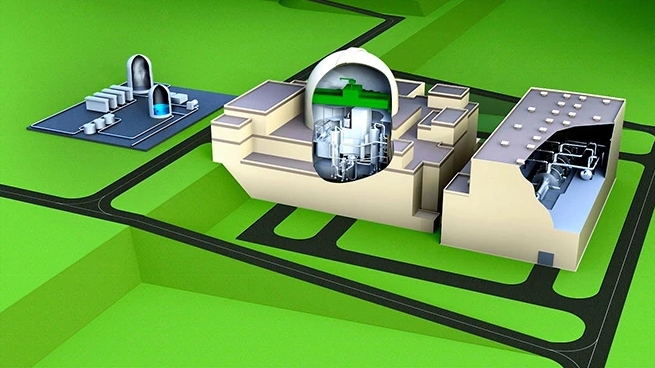
TOKYO (Kyodo) — Mitsubishi Heavy Industries Ltd. and a subsidiary of Hitachi Ltd. will separately develop next-generation nuclear reactors in what could be the first two projects in the government’s recent policy shift to push nuclear energy.
Mitsubishi Heavy said Thursday it will develop with four major Japanese utilities an advanced light-water reactor, a new type of pressurized water reactor, or PWR, deemed safer than existing models, and plan to put it into use in the mid-2030s.
The four power companies — Kansai Electric Power Co., Hokkaido Electric Power Co., Shikoku Electric Power Co. and Kyushu Electric Power Co. — all operate Mitsubishi Heavy reactors at their nuclear plants.
The new reactor, called SRZ-1200, is designed to be more resilient to natural disasters, such as tsunamis and earthquakes, as well as terrorist attacks, Mitsubishi said.
The facility, with an output of about 1.2 million kilowatts, will also enhance equipment to seal off melted nuclear fuel in a containment vessel and prevent or limit radiation leaks in the event of an accident.
Hitachi-GE Nuclear Energy Ltd., a Hitachi subsidiary, will also develop an advanced nuclear reactor based on light-water reactor technology for use in the mid-2030s, a person familiar with the matter said Thursday. Hitachi has an 80.01 percent stake in the subsidiary, with the rest owned by General Electric Co.
These plans come as the Japanese government announced in August that it would promote the construction of next-generation nuclear power plants to ensure a stable electricity supply without producing carbon dioxide emissions, in a major reversal from its policy of no new nuclear energy.
Among a variety of next-generation nuclear reactor types, the government plans to prioritize developing advanced light-water reactors as it could utilize existing supply chains, given the technological similarities to PWRs.
Chief Cabinet Secretary Hirokazu Matsuno welcomed the news of Mitsubishi Heavy’s project, saying at a press conference, “I hope relevant ministries will consider (helping the development of) next-generation reactors based on research and development activities like this.”
Concerns over the safety of nuclear power generation remain strong in Japan after a massive earthquake and tsunami caused the nuclear crisis at the Fukushima Daiichi plant in 2011 — the world’s worst nuclear disaster since Chernobyl in 1986.
Such safety concerns prompted the government to shelve the construction of new nuclear reactors, even as Japanese nuclear regulators set stricter safety regulations after the Fukushima disaster.
https://mainichi.jp/english/articles/20220929/p2g/00m/0bu/053000c
Mitsubishi Heavy to develop new nuke reactor with 4 utilities
September 30, 2022
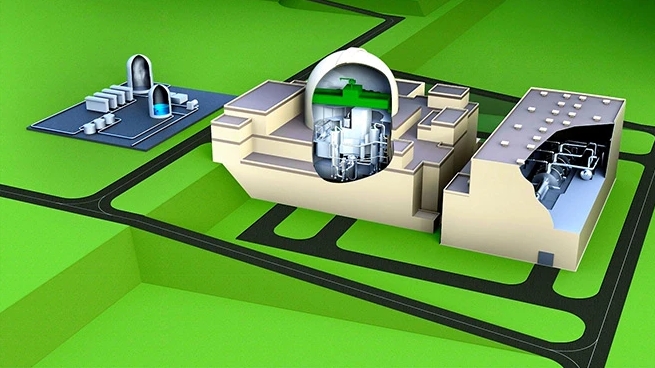
Mitsubishi Heavy Industries Ltd. and four major Japanese power utilities will work together to develop a next-generation nuclear reactor that will go online in the 2030s, the company announced on Sept. 29.
The announcement comes as the central government reverses course from its cautious nuclear energy policies set in the aftermath of the 2011 Fukushima nuclear disaster.
Mitsubishi Heavy Industries plans to develop an advanced light water reactor, an improved version of conventional pressurized water reactors. It will do so jointly with Kansai Electric Power Co., Kyushu Electric Power Co., Shikoku Electric Power Co. and Hokkaido Electric Power Co.
It will be one of the next-generation reactors that the administration of Prime Minister Fumio Kishida is considering promoting, along with other next-generation reactors, alongside rebuilding existing ones.
Mitsubishi Heavy Industries has been working with the four utilities, which operate pressurized water reactors, to develop new technology to enhance the safety of the reactors.
A Mitsubishi Heavy Industries official said the new reactor will be safer than conventional ones since it will be equipped with a “core catcher,” designed to cool melted reactor cores in the event of a reactor meltdown like the ones at the Fukushima No. 1 nuclear plant in March 2011.
The new reactor could also generate 1.2 gigawatts of electricity, equivalent to the capacity of a large nuclear reactor in Japan, according to the official.
But the company has yet to decide which utility will build the planned reactor and where it will be built because of difficulties finding a new construction site amid a strong public distrust toward nuclear reactors.
One potential candidate site is KEPCO’s Mihama nuclear plant in Fukui Prefecture, according to a source. The utility is decommissioning the plant’s No. 1 and No. 2 reactors, while more than 40 years have passed since the No. 3 reactor first went online.
Mitsubishi Heavy Industries has not disclosed the cost to build the new reactor, either.
One estimate suggests the construction of a new nuclear reactor will require 1 trillion yen ($6.91 billion), nearly double the amount spent on building an existing one, due to additional expenses required to comply with stricter safety regulations.
The central government plans to include nuclear reactors in its new support measures to encourage the construction of power plants amid calls from major utilities for financial support.
The government had long maintained that it had no plans to push for the construction of new nuclear reactors or the rebuilding of existing ones in the wake of the 2011 nuclear disaster.
But the Kishida administration changed that policy after energy costs began to soar and the country faced the prospect of a severe power shortage. Kishida said in August that he will consider promoting the development and construction of next-generation rectors with new safety mechanisms.
New head of nuclear regulator vows to maintain ‘transparency’.
September 27, 2022
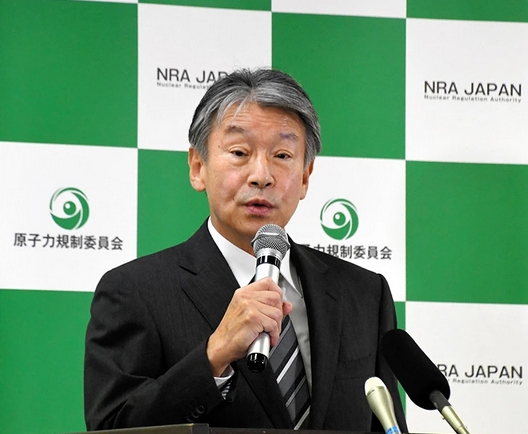
The new chairman of the Nuclear Regulation Authority vowed to maintain “independence and transparency” as the government agency performs its watchdog role over Japan’s nuclear industry.
Shinsuke Yamanaka, 66, an expert on nuclear material science, took the helm of the NRA on Sept. 26.
“I will never forget the Fukushima nuclear disaster at Tokyo Electric Power Co.’s Fukushima No. 1 nuclear plant,” he said at a news conference. “With this resolve, I remain committed to the NRA’s policy to regulate the nuclear industry while steadfastly maintaining independence and transparency.”
The appointment of Yamanaka, who has been an NRA commissioner since 2017, comes as the administration of Prime Minister Fumio Kishida seeks a return to more reliance on nuclear energy. It is the first such move since the 2011 triple meltdown at the Fukushima plant.
The administration is considering building nuclear plants and new reactors to replace aged ones, something the industry ministry and nuclear industry have pushed for years.
Yamanaka pledged that the NRA will continue to remain neutral.
“The NRA should sincerely carry out its duties while keeping in mind that the safety of nuclear energy is never a guarantee,” he said.
On the NRA’s prolonged examinations of reactors to assess if they meet the new reactor safety regulations, Yamanaka said his agency will be open to measures to help speed the process.
“Our basic stance is to conduct strict inspections, but we are willing to take measures to expedite the regulation procedures and improve communications between us and nuclear plant operators,” he said.
Japan hosted 54 commercial reactors before the Fukushima nuclear accident. Of these, 27 reactor operators had applied for restarts under the more stringent reactor regulations that went into force in 2013. Only 10 have gone back online so far, however, as the NRA examinations continue.
Yamanaka also cited three things he wants to focus on in the coming years: strengthening the NRA’s ability to disseminate information, having a field-oriented approach and developing human resources.
Before joining the NRA, he did fuel safety research related to severe nuclear reactor accident at Osaka University.
Yamanaka’s term will run until September 2027. He replaced Toyoshi Fuketa, who finished his term as the second chairman of the NRA, which was established in 2012.
The same day, Tomoyuki Sugiyama, who specializes in reactor safety, joined the NRA as one of four commissioners.
Sugiyama had researched reactor safety at the Japan Atomic Energy Agency’s Nuclear Safety Research Center.
TEPCO to Decide on Price Hike Based on Resumption of Nuclear Power Plant Operations, Kashiwazaki-Kariwa Unit 7, for Businesses from FY2023

September 16, 2022
On September 16, Tomoaki Kobayakawa, president of TEPCO Holdings, announced that the company is considering raising electricity rates for businesses on the assumption that the Kashiwazaki-Kariwa Unit 7 nuclear power plant (in Niigata Prefecture) will be restarted in fiscal 2023. President Tomoaki Kobayakawa of TEPCO Holdings announced on September 16 that the company plans to calculate the range of the price increase based on the assumption that the Kashiwazaki-Kariwa Unit 7 nuclear power plant (Niigata Prefecture) will be restarted in 2023. The company aims to reduce the burden on contracted companies by about 200 billion yen. He also explained, “We aim to resume operations as soon as possible, but we have no concrete timetable for this.
The target is the “high-voltage” and “special high-voltage” rate plans used by commercial facilities and factories, with approximately 170,000 contracts. The company plans to raise the rates so that the market price of electricity can be reflected in the rates. At the same time, a system will be introduced to calculate the cost of nuclear power plants, which have lower generation costs, on the assumption that they will operate for nine months a year, thereby curbing the size of the price increase.
At the press conference, President Kobayakawa explained, “We are not specifying the timing of the restart. Even if we are not able to restart operations, we will curb the price increase. Although this will cause TEPCO’s bottom line to deteriorate, he said, “We will make efforts to reduce (costs). (Kyodo)
https://www.tokyo-np.co.jp/article/202684?rct=economics&fbclid=IwAR17rA9cf0QQpGSjwSqXtnT9tdA5N8yYfWXgZBY6x25EXh-jxN9GLE8Lva8
Fukushima: Japan attempts to safely remove nuclear fuel from crippled reactors
DW 22.09.2022, Julian Ryall (Tokyo)
More than a decade after the second-worst nuclear disaster in history, engineers want to construct a huge water-filled tank around one of the damaged reactors and carry out underwater dismantling work.
Nuclear experts pondering the safest way to decommission the three crippled reactors at the Fukushima Daiichi atomic energy plant have devised a new plan to recover highly radioactive debris at the site, with even anti-nuclear campaigners giving the proposal their qualified support.
They warn, however, that the situation at the plant — on the northeast coast of Japan— remains precarious more than a decade since three of the six reactors suffered meltdowns after an offshore earthquake of magnitude 9 triggered a series of powerful tsunamis.
In their latest annual strategy report on progress at the plant, experts at the Nuclear Damage Compensation and Decommissioning Facilitation Office (NDF) have proposed the construction and filling with water of a massive concrete tank to completely enclose one of the reactor buildings. ………………………………………. more https://www.dw.com/en/fukushima-japan-attempts-to-safely-remove-nuclear-fuel-from-crippled-reactors/a-63200659
40% of Japan’s nuclear plant staff lack experiences of reactivation
By Takashi Maemura and Ayaka Matsuo / Yomiuri Shimbun Staff Writers, September 18, 2022
Nearly 40% of the operations staff at the seven electric power companies that have not yet restarted their nuclear power plants since 2011 have no experience with reactors, a Yomiuri Shimbun survey found.
That group includes Tokyo Electric Power Company Holdings, Inc., the operator of the Fukushima No. 1 nuclear power plant that had an accident during the March 11, 2011, earthquake and tsunami.
Because progress to restart their reactors has been slow, these power companies have sought to maintain their personnel’s skills by dispatching staff to nuclear power plants and thermal power plants operated by other companies.
Currently, only Kansai Electric Power Co., Kyushu Electric Power Co. and Shikoku Electric Power Co. have been able to restart some reactors…………………………………..
Chugoku Electric Power Co.’s Shimane nuclear power plant Reactor No. 2, which is currently shut down, has passed the Nuclear Regulation Authority’s safety examinations, which took about seven years and eight months to complete.
However, the Shimane nuclear power plant has been shut down for more than 10 years, and 41 out of its 107 operators, or 38%, have no experience operating a nuclear power plant. In light of this, Chugoku Electric Power has begun training them this fiscal year, asking Makino, a former operator with more than 30 years of experience, to serve as an instructor.
Sendai and Genkai nuclear power stations in the path of powerful Typhoon Nanmadol

Strong Typhoon Nanmadol feared to hit southwest Japan’s Kyushu on Sept. 18
Close to Sendai and Genkai nuclear power stations
Record-breaking rainfall+violent winds – peak gusts at 270kph
FUKUOKA https://mainichi.jp/english/articles/20220917/p2a/00m/0na/010000c
Large and powerful Typhoon Nanmadol is predicted to approach southwestern Japan’s Kyushu region and make landfall there between Sept. 18 and 19.
According to the Japan Meteorological Agency (JMA), the 14th typhoon of the year was moving northwestward at a speed of about 20 kilometers per hour over the sea some 190 kilometers east of Minamidaito Island at 9 a.m. on Sept. 17. The tropical storm had a central atmospheric pressure of 910 hectopascals. The maximum sustained wind speed near its center was 198 kph, with peak gusts at 270 kph. Violent winds at a speed of 90 kph or more were recorded within a 185-km radius on the east and a 150-km radius on the west of the storm’s center.
Many parts of Japan may be affected by the typhoon for extended periods of time as it is moving slowly while maintaining its strength. It is feared that the storm could cause record-breaking rainfall and violent winds through Sept. 19, the last day of the three-day weekend, primarily in west Japan and along the Pacific coast of east Japan. The JMA is calling on people to refrain from unnecessary outings.
(Japanese original by Azusa Yamazaki, Kyushu News Department)
Tepco to revise power prices for industry, factoring in nuclear restart
TOKYO, Sept 16 (Reuters) – Tokyo Electric Power Company (Tepco) (9501.T) said on Friday it will revise its pricing for high-voltage industry customers next year to reflect soaring costs, but will take into account the assumed restart of the No.7 unit of its Kashiwazaki-Kariwa nuclear power plant.
Tepco President Tomoaki Kobayakawa told a news conference of the new pricing policy, including the impact of an assumed restart, although Japan’s nuclear regulator is continuing inspections after barring Tepco, operator of the wrecked Fukushima Daiichi nuclear plant, from restarting its only operable atomic power station last year due to safety breaches.
“We plan to revise the pricing scheme next business year as we can’t reflect soaring power procurement cost in the electricity price,” Kobayakawa said.
“But we are factoring in that the No.7 unit will be 75% operational next year, or operating nine months out of 12, in calculating the new electricity price to reduce the burden on customers,” he said, adding that the company itself is not forecasting the unit’s resumption next year.
“We do hope to restart the Kashiwazaki-Kariwa as soon as possible, but we can’t say when it will happen,” he said.
Tepco plans to announce details of the new price scheme for industry customers by the end of this month……..
Tepco had been hoping to restart the world’s biggest atomic power plant, with capacity of 8,212 megawatts, in a quest to slash the utility’s operating costs.
But it drew criticism last year when failings at the plant came to light, including security breaches that led to an unauthorised staff member accessing sensitive areas of the plant.
Japan’s industry minister said at the time the plant would not be restarted any time soon.
https://www.reuters.com/business/energy/tepco-revise-power-prices-industry-factoring-nuclear-restart-2022-09-16/
A series of defective products at a French MOX fuel plant Abnormal nuclear reaction at a nuclear power plant

September 3, 2022
A series of defective products have been found at the Mellox plant in southeastern France, which manufactures fuel for plutonium thermal power generation, in which plutonium is burned in nuclear power plants. In addition, an abnormal increase in nuclear reactions has also been observed at some nuclear power plants that are conducting plu-thermal power generation. What in the world is going on?
The plant also manufactures fuel for the Japanese market. No problems have been found so far with the fuel for the Japanese market, but production has been delayed, and future product deliveries are now unpredictable.
Plutonium is extracted from spent nuclear fuel from nuclear power plants through chemical processing (reprocessing). Plutonium is mixed with uranium in the case of pressurized-water nuclear power plants that conduct plutonium thermal power generation, and baked into pellets, cylindrical grains about 8 mm in diameter. This is called mixed uranium-plutonium oxide fuel (MOX fuel). In the case of a pressurized-water nuclear power plant that conducts plutonium thermal power generation, approximately 320 pellets are stacked inside fuel rods, and another 260 fuel rods are bundled together to form a fuel assembly (approximately 4.1 meters in height).
Highly Difficult Homogenization
It is difficult to uniformly mix plutonium and uranium. According to ASN data and other sources, “plutonium spots,” dense clumps of plutonium, were found in the fuel pellets produced at the MELOX plant. Plutonium spots were found in the fuel pellets manufactured at the MELOX plant.
On the other hand, a phenomenon in which the amount of neutrons, which indicate a nuclear reaction, increases more than expected near the upper and lower ends of MOX fuel rods was confirmed at a French nuclear power plant conducting a plutonium thermal operation.
According to ASN, the combination of this plutonium mass problem and the two anomalies of partially elevated nuclear reactions was predicted to “raise questions about the integrity of the fuel, depending on the circumstances of the accident.
According to Chihiro Uesawa, 56, an engineering specialist at the NPO Nuclear Information and Data Center (Nakano Ward, Tokyo), concerns are that the fuel could melt or the tubes covering the fuel could break. When plutonium is used as fuel, it has been pointed out that there is a possibility of a localized increase in nuclear reactions. This has become apparent,” Uesawa said.
1 This Month

of the week – Shut Down Drone Warfare!


Tell the Ukrainian Government to Drop Prosecution of Peace Activist Yurii Sheliazhenko

Petition to revoke the licensing of the Near Surface Nuclear Disposal Facility (NSDF) at Chalk River. https://www.ourcommons.ca/petitions/en/Petition/Details?Petition=e-7247
To see nuclear-related stories in greater depth and intensity – go to https://nuclearinformation.wordpress.com
-
Archives
- April 2026 (103)
- March 2026 (251)
- February 2026 (268)
- January 2026 (308)
- December 2025 (358)
- November 2025 (359)
- October 2025 (376)
- September 2025 (257)
- August 2025 (319)
- July 2025 (230)
- June 2025 (348)
- May 2025 (261)
-
Categories
- 1
- 1 NUCLEAR ISSUES
- business and costs
- climate change
- culture and arts
- ENERGY
- environment
- health
- history
- indigenous issues
- Legal
- marketing of nuclear
- media
- opposition to nuclear
- PERSONAL STORIES
- politics
- politics international
- Religion and ethics
- safety
- secrets,lies and civil liberties
- spinbuster
- technology
- Uranium
- wastes
- weapons and war
- Women
- 2 WORLD
- ACTION
- AFRICA
- Atrocities
- AUSTRALIA
- Christina's notes
- Christina's themes
- culture and arts
- Events
- Fuk 2022
- Fuk 2023
- Fukushima 2017
- Fukushima 2018
- fukushima 2019
- Fukushima 2020
- Fukushima 2021
- general
- global warming
- Humour (God we need it)
- Nuclear
- RARE EARTHS
- Reference
- resources – print
- Resources -audiovicual
- Weekly Newsletter
- World
- World Nuclear
- YouTube
-
RSS
Entries RSS
Comments RSS
 nuclear-news