Each week, OLympic swimming pool sized highy radioactive leak from Fukushima
 An official from the newly created nuclear watchdog told Reuters on Monday that the highly radioactive water seeping into the ocean from Fukushima was creating an “emergency” that Tepco was not containing on its own.
 Highly radioactive water pouring out of Japan’s Fukushima nuclear plant http://www.ndtv.com/article/world/highly-radioactive-water-pouring-out-of-japan-s-fukushima-nuclear-plant-402630 Reuters August 07, 2013 Tokyo: Highly radioactive water from Japan’s crippled Fukushima nuclear plant is pouring out at a rate of 300 tonnes a day, officials said today, as Prime Minister Shinzo Abe ordered the government to step in and help in the clean-up.
The revelation amounted to an acknowledgement that plant operator Tokyo Electric Power Corporation (Tepco) has yet to come to grips with the scale of the catastrophe, 2 1/2 years after the plant was hit by a huge earthquake and tsunami. Tepco only recently admitted water had leaked at all.
Calling water containment at the Fukushima Daiichi station an “urgent issue,” Abe ordered the government for the first time to get involved to help struggling Tepco handle the crisis.
The leak from the plant 220 km northeast of Tokyo is enough to fill an Olympic swimming pool in a week. Continue reading
Fukushima reactor buildings risk collapse as water accumulates underground
The Fukushima plant sits smack in the middle of an underground aquifer. Deep beneath the ground, the site is rapidly being overwhelmed by water.
What happens when you pour hundreds of thousands of tons of water (400 metric tons each day times 2.5 years times 365 days in a year equals 365,000 metric tons of water) onto soil which sits above a massive aquifer?
The spent fuel pool at Fukushima Unit 4 is the top short-term threat to humanity, and is a national security issue for America.
As such, it is disturbing news that the ground beneath unit 4 is sinking.
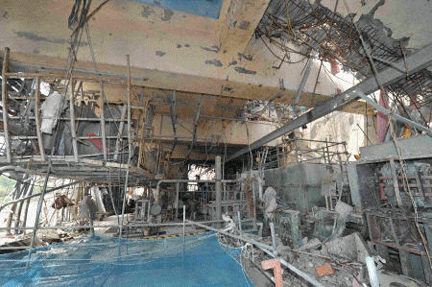
Fukushima: Japan’s Nuclear Accident Response Director Warns that Tepco’s Actions Might Cause Reactor BuIldings to Collapse http://www.globalresearch.ca/fukushima-japans-nuclear-accident-response-director-warns-that-tepcos-actions-might-cause-reactor-buildings-to-collapse/5345279?utm_source=rss&utm_medium=rss&utm_campaign=fukushima-japans-nuclear-accident-response-director-warns-that-tepcos-actions-might-cause-reactor-buildings-to-collapse By Washington’s Blog Global Research, August 07, 2013 Tepco’s ill-considered efforts to change soil permeability and water flow have caused severe problems at the site … including highly radioactive groundwater bubbling up to the surface.
NHK notes:
The vice governor of Fukushima Prefecture has asked the government to take the lead in handling the matter and stop the leakage. Masao Uchibori told an official from the Nuclear Regulation Authority that some of Tepco’s measures have increased the risk of further leaks. Continue reading
Abe better focus on Fukushima radiation crisis, not on nuclear power restart
The first thing Abe must do is shift the Nuclear Regulation Authority’s focus away from evaluating the safety of atomic plants for restart, back to the fast-growing crisis of toxic sludge flowing into the sea around Fukushima. Really folks, first things first. Let’s first make sure children living within a 100 mile radius won’t develop cancer 10 years from now.
Japan’s Nuclear Nightmare Bloomberg By William Pesek Aug 7, 2013 “………It also would have been great if Abe himself had cared more about nuclear safety than dollars when he assumed the premiership in December. His focus was on restarting the 52 reactors taken offline out of an abundance of caution after the earthquake. Never mind that most Japanese want them to remain mothballed. Japan’s potent “nuclear village,” the nexus of power companies and pro-nuclear regulators, bureaucrats and researchers, packs way too much political firepower.

This nuclear-industrial complex is one of the nation’s biggest advertisers, which keeps the Japanese media in line. That’s partly why international campaigners like Greenpeace received so few column inches as they presented report after report showing radiation levels far above what Tepco would admit. (Tepco was eventually forced to come clean.)
So, is Abe’s sudden interest in Fukushima’s radiation mess for real? Well, it has to be at this point. Aside from the risk to his approval ratings, Tokyo is actively vying for the 2020 Summer Olympics. International Olympic Committee officials might find the threat of protests in Istanbul preferable to jokes about Tokyo hosting the Chernobyl Games. Continue reading
Tepco General Manager – “this radioactive discharge is beyond our control”
Tepco Press Conference: The situation at Fukushima is bleak — “This discharge is beyond our control” (VIDEO) http://enenews.com/tepco-situation-fukushima-bleak-discharge-beyond-control-video
Title: Japan’s nuclear body says radioactive groundwater at Fukushima an ‘emergency’
Source: Arirang News
Date: Aug. 6, 2013
Transcript Excerpts
Two and a half years may have passed since the Fukushima nuclear disaster, but problems there are as serious now as they’ve ever been […]
The head of the country’s Nuclear Regulatory Authority task force Shinji Kinjo told Reuters on Monday that the leak was an emergency, but he was worried the plant’s operator, TEPCO, had no sense of how to deal with it. […]
In a recent news conference, TEPCO General manager Masayuki Ono said the situation was bleak.
“We understand that this discharge is beyond our control and we do not think the current situation is good.” […]
Japan’s desperate battle to contain Fukushima’s radioactive water
Japan Nuclear Plant’s Battle to Contain Radioactive Water Tepco Builds Sunken Barrier to Ring-Fence Site, but Water May Have Already Overtopped Wall WSJ, 6 Aug 13, by MARI IWATA and PHRED DVORAK
To stem the advance of radioactive water to the sea, the operator of the stricken Fukushima Daiichi nuclear power plant has tried plugs, walls, pumps and chemicals that harden the ground into a solid barrier.
But as Tokyo Electric Power Co. 9501.TO +3.26% prepares this week to start work on a new set of measures that would ring off and cap the area where the most highly contaminated water has been found, some experts and regulators are saying that the battle to completely contain radioactivity to the site of one of the world’s worst nuclear accidents may be a losing one.
In the most recent example of Tepco’s Sisyphean struggle, the company said late last week that rising levels of contaminated groundwater may have already overtopped a sunken barrier that the utility started only a month ago, and wasn’t even expecting to complete until late this week. Tepco’s water-control measures, such as pumping out contaminated water and putting it in storage, are “merely a temporary solution,” said Shunichi Tanaka, chairman of Japan’s Nuclear Regulation Authority, at a news conference last week. Eventually, “it will be necessary to discharge water” that’s still contaminated into the sea, he said…..
Controlling contaminated water has been a struggle at Fukushima Daiichi ever since the March 2011 earthquake and tsunami knocked out the power at the plant and sent its three active reactors spiraling out of control. Some 400 metric tons of water a day is still being used to cool the melted fuel cores—though much of that water is now recycled. More troubling is another 400 tons a day of groundwater that flows down from hills and mountains into the compound, and toward the sea.
For the past two years, Tepco has been trying to keep the contamination contained by pumping accumulated water out of the highly radioactive reactor buildings, and storing it in tanks on the plant grounds. But the company’s efforts went into overdrive a few months ago, when it found that groundwater sampled near the crippled reactors was showing spiking levels of radioactive elements. It was unclear why. What’s more, Tepco said that the water was likely leaking into the sea.
The continuing problems at the reactor site, including the company’s lack of transparency over the radioactive leaks, have drawn criticism from Japanese regulators….http://online.wsj.com/article/SB10001424127887323420604578651713545887032.html
Hiroshima remembers. Mayor rebukes Abe government
 Hiroshima marks atom-bomb anniversary as Japan unveils warship (+video) Hiroshima marked the 68th anniversary Tuesday of the dropping of ‘Little Boy’ on the city. Sixty-eight years later, citizens of Hiroshima and the nation of Japan are considering revising its war-renouncing Constitution. By Gavin Blair, CSM, Correspondent / August 6, 2013 TOKYO
As 50,000 people marked the 68th anniversary of the atomic bombing of Hiroshima, the mayor of the city used his speech at the somber annual ceremony to criticize Tokyo‘s plans to both restart the country’s nuclear reactors and export the technology. A peace bell was struck at 8:15 a.m. on Tuesday, the moment the ‘Little Boy’ bomb was dropped on Hiroshima from a Boeing B-29 Superfortress on Aug. 6, 1945. ……
Hiroshima’s mayor is critical
In the traditional peace declaration speech delivered every year by the mayor of Hiroshima, however, Mayor Kazumi Matsui rebuked the Abe administration over its intention to sell Japanese nuclear power technology to India, one of four countries that have not signed the Treaty on the Non-Proliferationof Nuclear Weapons. Continue reading
Japan’s emergency experimental methods to stem flow of radioactive water
Japan Nuclear Plant’s Battle to Contain Radioactive Water Tepco Builds Sunken Barrier to Ring-Fence Site, but Water May Have Already Overtopped Wall WSJ, 6 Aug 13, by MARI IWATA and PHRED DVORAK “…………As an emergency measure, Tepco last month started to inject the ground near the coast with chemicals that hardened it into an underground barrier. But since then, groundwater levels in the area have risen faster, as they hit the barrier. Recently, Tepco has found that the groundwater has risen to around a meter below the surface—already above the level of the underground barrier, which starts 1.8 meters down.Now, Tepco is planning to pump out some of the water that’s built up behind the barrier, and store it as well. It’s preparing to extend the underground hardened-earth barrier in a ring around the most heavily contaminated section of coastline, in hopes of heading groundwater off before it can flood in. Tepco is also proposing to cap that ringed section with gravel and asphalt, so nothing gets out. The operator is hoping to get an initial ring of hardened ground done by October.
The company has some other more experimental ideas on the table as well. One involves surrounding the contaminated reactor buildings with a shield of frozen soil.
But there’s a risk to changing the flow of groundwater in the ways that Tepco is considering, said Tatsuya Shinkawa, nuclear accident response director of the Ministry of Economy, Trade and Industry, at a news conference last month. The water could pool dangerously underground, softening the earth and potentially toppling the reactor buildings, he said. Tepco should also try things like using robots to fix cracks in the reactor buildings where the water is likely seeping through.
Freezing soil has its own problems, said Kunio Watanabe, a geology professor at Saitama University. The technology, which is used in civil engineering to dig tunnels, may be able to cut down the amount of groundwater entering the contaminated site, but it is expensive. “You’ll need hundreds of millions of yen to build a system,” Mr. Watanabe said. “You’ll also need a large amount of electricity to maintain the ice walls.”….. http://online.wsj.com/article/SB10001424127887323420604578651713545887032.html
Fukushima’s radioactive leak now reaches emergency stage

Contaminated water could rise to the ground’s surface within three weeks, national newspaper Asahi Shimbun said on Saturday. Mr. Kinjo said the three-week timeline was not based on NRA’s calculations but acknowledged that if the water reaches the surface, “it would flow extremely fast.”
A Tepco official said on Monday the company plans to start pumping out a further 100 tonnes of groundwater a day around the end of the week.
Radioactive leak from crippled Japanese nuclear plant creating ‘emergency’ http://www.theglobeandmail.com/news/world/radioactive-leak-from-crippled-japanese-nuclear-plant-creating-emergency/article13602630/ ANTONI SLODKOWSKI AND MARI SAITO TOKYO — Reuters Monday, Aug. 05 2013 Highly radioactive water seeping into the ocean from Japan’s crippled Fukushima nuclear plant is creating an “emergency” that the operator is struggling to contain, an official from the country’s nuclear watchdog said on Monday.
This contaminated groundwater has breached an underground barrier, is rising toward the surface and is exceeding legal limits of radioactive discharge, Shinji Kinjo, head of a Nuclear Regulatory Authority (NRA) task force, told Reuters.
Countermeasures planned by Tokyo Electric Power Co. (Tepco), the utility that runs Fukushima, are only a temporary solution, he said.
Tepco’s “sense of crisis is weak,” Mr. Kinjo said. “This is why you can’t just leave it up to Tepco alone” to grapple with the ongoing disaster.
“Right now, we have an emergency,” Continue reading
Nearly 1000 Fukushima workers have increased risk of getting leukaemia
 9,640 Fukushima plant workers reach radiation level for leukemia compensation http://ajw.asahi.com/article/0311disaster/fukushima/AJ201308050104 August 05, 2013 By MIKI AOKI/ Staff Writer Nearly 10,000 people who worked at the stricken Fukushima No. 1 nuclear plant are eligible for workers’ compensation if they develop leukemia, but few are aware of this and other cancer redress programs. Continue reading
Discovery of medical records of world’s first nuclear bomb radiation victim
“The records are invaluable as those reporting in detail on changes in her health condition after she was exposed to a fatal level of radiation.”
Medical records of world’s first radiation victim from A-bomb recovered Asahi Shimbun, By YURI OIWA/ Staff Writer, 4 August 13,
Long-lost medical records detailing the sharply deteriorating health of the world’s first recognized radiation sickness patient have been
recovered 68 years after the victim died within weeks of being exposed to the atomic bomb in Hiroshima.
The patient, Midori Naka, a stage actress, died 18 days after she was injured in the nuclear blast on Aug. 6, 1945. She was staying in Hiroshima as part of a traveling theater troupe. After returning to Tokyo a few days later, Naka died while undergoing treatment, which included blood transfusions, at the University of Tokyo Hospital. She was 36.
The discovery came after decades of efforts by researchers to locate her missing records.The hospital kept updates of her condition leading up to her death and the results of her autopsy. But other vital records have been missing until their recent recovery.
Kazuhiko Maekawa, professor emeritus with the University of Tokyo who is expert in treating patients suffering from radiation exposure, hailed the discovery of Naka’s medical records. Continue reading
Up to 40 trillion becquerels of tritium in the sea, from Fukushima
Japan learns extent of nuclear leakage, news.com.au AAP August 04, 2013 THE operator of Japan’s crippled Fukushima nuclear plant has given its first public estimate of the size of the leakage of radioactive tritium into the Pacific Ocean since the disaster.
Between 20 trillion to 40 trillion becquerels of the substance is estimated to have leaked into the sea since May 2011, said Tokyo Electric Power Co (TEPCO). It was the first such figure TEPCO has released since a massive tsunami led to the accident in March 2011, a spokesman said Sunday…..
http://www.news.com.au/breaking-news/world/japan-learns-extent-of-nuclear-leakage/story-e6frfkui-1226691042588#ixzz2b7p2HHZg
Japanese island resisted nuclear bribery for 31 years
 it is unfair to push the islanders against their will into something they have strived so hard all these years to steer well clear of.
Japanese island that has refused nuclear money for 31 years pushed into a  compromising situation http://en.rocketnews24.com/2013/08/03/japanese-island-that-has-refused-nuclear-money-for-31-years-pushed-into-a-compromising-situation/ After the explosion at Fukushima Daiichi Nuclear Power Plant back in 2011, the subject of nuclear power has become a very delicate and complicated issue for the Japanese. While there is an element of danger associated with the creation of nuclear energy, many towns have also benefited from the large sums of compensation, known as “nuclear money”, that have gone into creating jobs and strengthening the prosperity of areas that have agreed to home such power plants.
Despite pressure from surrounding groups and the mainland, a small island off the coast of Yamaguchi Prefecture has for years refused to have anything to do with nuclear money, and has firmly opposed plans to build nuclear power stations in the area. But all that may be about to change.
Iwai island is a Japanese island that lies out to sea opposite the site where Kaminoseki Nuclear Power Plant is expected to be built in the Yamaguchi Prefecture, and home to around 500 people. What makes this island markedly different from mainland Yamaguchi Prefecture is the determination with which the islanders have fought off “nuclear money” for over 31 years in attempt to preserve a safe, clean environment. While the prefecture’s local government has been accepting nuclear money for many years and pushing for the completion of Kaminoseki power plant, a staggering 90 percent of Iwai islanders are against plans for the power plant being built so close to where they live. Continue reading
40 feet below Fukushima nuclear reactor, radioactivity becomes greater
 Revealed: The deeper they check underneath Fukushima plant, the higher contamination levels get http://enenews.com/revealed-the-deeper-they-check-underneath-fukushima-plant-the-higher-contamination-levels-get-now-sampling-over-40-feet-below-surface
gets, Tepco revealsitle: Cesium levels in water under Fukushima No. 1 plant soar the deeper it gets, Tepco revealsSource: JIJI, Kyodo
Date: Aug 1, 2013
Cesium levels in water under Fukushima No. 1 plant soar the deeper it gets, Tepco reveals […]
Tepco found 950 million becquerels of cesium and 520 million becquerels of beta ray-emitting radioactive substances, including strontium, in the water from 13 meters [~43 feet] underground.Water from 1 meter down contained 340 million becquerels, and a sample from 7 meters down contained 350 million becquerels.
[…] Cesium, a metallic element, is subject to gravity. […] also: Official reveals contamination levels at Fukushima plant are likely higher outside reactor units than inside
Strange highly radioactive objects found on Fukushima coast
 TEPCO sources said they were considering asking an outside agency to conduct a detailed analysis, citing limitations on what the utility could investigate
Mystery objects with high radiation found on Fukushima coast Asahi Shimbun, By SHUNSUKE  KIMURA/ Staff Writer August 03, 2013 In a coastal area long silent due to the Fukushima nuclear accident, the only sounds of human activity on June 18 were from workers removing rubble and continuing their decontamination efforts. But soon, their supervisor discovered something that broke up the monotony of the work and added to the eeriness of the atmosphere.
After a call to the Environment Ministry, Takeshi Kato, 55, a ministry specialist, immediately headed to the location about 15 kilometers south of the crippled Fukushima No. 1 nuclear power plant.
As he slowly walked around with a dosimeter, he reached a hot spot where radiation levels nearly doubled those of the surrounding areas. Using a fallen branch to clear away dirt, Kato uncovered a grayish pile about 3 centimeters long, about 1.5 cm wide and about 0.5 cm thick.
The surface of the pile, which looked like soil, had gamma ray readings of about 85 microsieverts per hour. The total reading, including beta rays, came to 1 millisievert per hour.
It was the first of four mysterious objects with high radiation levels found near the mouth of the Idegawa river in Naraha, Fukushima Prefecture. Continue reading
Uranium glut pile rises, with doubts over Japan’s much-touted nuclear restart
.All but two of Japan’s 50 reactors remain idle due to the Fukushima disaster and must meet stricter safety standards set by the NRA before they can be restarted………The reactor review process is likely to take six months for each one, Deutsche Bank said in a July 15 note, citing NRA Chairman Shunichi Tanaka. An evaluation of all of Japan’s reactors may take more than three years
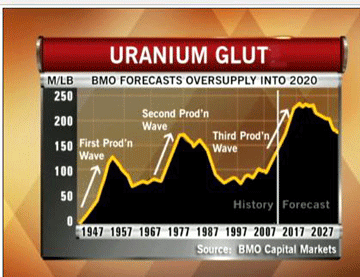
Slow reactor restart process rattles energy markets as uranium piles up, Japan Times, BLOOMBERG AUG 2, 2013 MELBOURNE – Uranium prices are showing little sign of recovery after sinking to their lowest levels in more than seven years amid a glut of the radioactive metal and speculation Japan will delay restarting its reactors……….. Uranium has averaged $40.94 so far in 2013 after sliding to $34.50 in July, the lowest price since November 2005.
While Japanese power producers including Tokyo Electric Power Co. are seeking to restart reactors as soon as possible as the cost of other fuels escalates, operations may not resume until next year, according to Deutsche Bank AG.
That’s threatening to delay a rebound in demand for uranium, hurting miners such as Australia’s Paladin Energy Ltd. as supplies outstrip demand. There is about 60 million pounds of surplus uranium around the world, according to Cantor Fitzgerald LP.
“The process for restarts is clearly going to take some time,” said Jonathan Hinze, a senior vice president at Ux, which provides research on the nuclear industry. “Japanese utilities are unlikely to require any new fuel until 2014 at the earliest. There is a realization that the uranium demand from Japan is unlikely to dramatically change anytime soon, especially this year.”
Uranium for immediate delivery has dropped as much as 21 percent this year, extending a 17 percent decline in 2012, according to data from Ux. Prices slumped 12 percent in July, the biggest monthly loss since March 2011. They climbed as high as $152 in June 2007.
“The weakness in uranium prices is partially attributable to uncertainty surrounding the timetable for reactor restarts in Japan,” John Borshoff, the chief executive officer of Australia-based Paladin Energy, said in the company’s quarterly production report July 16…..All but two of Japan’s 50 reactors remain idle due to the Fukushima disaster and must meet stricter safety standards set by the NRA before they can be restarted………The reactor review process is likely to take six months for each one, Deutsche Bank said in a July 15 note, citing NRA Chairman Shunichi Tanaka. An evaluation of all of Japan’s reactors may take more than three years…..Deutsche said.http://www.japantimes.co.jp/news/2013/08/02/business/slow-reactor-restart-process-rattles-energy-markets-as-uranium-piles-up/#.Uf2iE9Jwo6I
1 This Month

Read the Public Inquiry Report, the Commissioners’ report, Surrendering Australia: The AUKUS Deception is available to download for free at aukuspublicinquiry.com. Or just watch the replay of the National Press Club Luncheon.



19 November – Webinar – The Reality of Reprocessing
Time: 11:00 AM Pacific Time (US & Canada) / 2:00 PM Eastern / 7:00 PM UK / 8:00 PM CET
Register for the Zoom Event Here



Shut down the radiation-damaged Heysham nuclear reactors now
To see nuclear-related stories in greater depth and intensity – go to https://nuclearinformation.wordpress.com

Say No to NASA’s Reckless Nuclear Reactor on the Moon
Say No to NASA’s Reckless Nuclear Reactor on the Moon
-
Archives
- November 2026 (109)
- October 2026 (302)
- September 2026 (339)
- August 2026 (330)
- July 2026 (355)
- June 2026 (287)
- May 2026 (306)
- April 2026 (356)
- March 2026 (251)
- February 2026 (267)
- January 2026 (308)
- December 2025 (358)
-
Categories
- 1
- 1 NUCLEAR ISSUES
- business and costs
- climate change
- culture and arts
- ENERGY
- environment
- health
- history
- indigenous issues
- Legal
- marketing of nuclear
- media
- opposition to nuclear
- PERSONAL STORIES
- politics
- politics international
- Religion and ethics
- safety
- secrets,lies and civil liberties
- spinbuster
- technology
- Uranium
- wastes
- weapons and war
- Women
- 2 WORLD
- ACTION
- AFRICA
- Atrocities
- AUSTRALIA
- Christina's notes
- Christina's themes
- culture and arts
- Events
- Fuk 2022
- Fuk 2023
- Fukushima 2017
- Fukushima 2018
- fukushima 2019
- Fukushima 2020
- Fukushima 2021
- general
- global warming
- Humour (God we need it)
- Nuclear
- RARE EARTHS
- Reference
- resources – print
- Resources -audiovicual
- Weekly Newsletter
- World
- World Nuclear
- YouTube
-
RSS
Entries RSS
Comments RSS

