Confusion and deception over Fukushima radiation
Fukushima Farmer: Plutonium was detected “all over” village 25 miles from plant — Professor: “Something terrible, dreadful happening” — Mayor: Please don’t tell this to the residents (VIDEO) http://enenews.com/fukushima-farmer-plutonium-detected-all-village-professor-terrible-dreadful-happening-radiation-levels-high-mayor-please-dont-residents-video
Kenichi Hasegawa, Farmer from Iitate Village in Fukushima Prefecture, Canberra Forum, March 13, 2013 After the nuclear accident, all over Iitate village, plutonium and strontium were detected [40km from nuclear plant]. […] And then something unbelievable happened. Authorities started bringing many [hygienists or dentists?] to the village […] these doctors started doing this local safety campaign. They kept telling us, “It’s OK, it’s safe, there’s nothing to worry about.” […] The day before the evacuation order was announced, the professor from Kyoto University called Professor Imanaka came to the village and did a thorough research monitoring of the radiation levels.
And Professor Imanaka, he was just astonished, “Something terrible, dreadful is happening. The radiation level was so high; I can’t believe people are still living here.” […] So Professor Imanaka brought his data to the mayor and said, “You guys should evacuate immediately.” But the mayor’s response was, “Please do not disclose this data to the public.” Instead he said, “Is there any way to live with this radiation?” The village authorities only were interested in protecting the village itself, not the people.
We wanted to protect the children and we suggested to evacuate the children, but they didn’t listen. And the day before the evacuation order, exclusion zone, was announced, the day before, a different professor from ??? University visited the village and he called all the parents to the town hall, and then gave a safety lecture, “Your kids can go out and play, your kids don’t have to wear masks just to play outside.” But the very next day the evacuation order was announced.
Japan physician who volunteered at a Minamisoma evacuation center soon after 3/11Feb. 19, 2013 (at 54:00 in): What happened at that time was systematic effort by the prefecture government, […] as well as the Japanese central government, tried to minimize the amount of radiation. […] Primary concern […] for Fukushima Minpo [newspaper] was losing business […] For the prefecture government, losing the people means less revenue, less positions.
‘Emergency transfer’ of Fukushima radioactive water, following typhoon
‘Emergency measures’ used at Fukushima site during typhoon — Contaminated water dumped in ocean — 9 barriers were on verge of overflowing, then released into environment with NO radiation test — CNN: Workers were “on vigil” (VIDEO) http://enenews.com/emergency-measures-taken-at-fukushima-plant-during-typhoon-tv-contaminated-water-dumped-in-ocean-many-barriers-were-on-verge-of-overflowing-then-were-drained-into-environment-with-no-radia
Asahi, Oct. 16, 2013: Heavy rain from Typhoon No. 26 forced [TEPCO] to discharge rainwater Oct. 16 that was threatening to swamp the barriers that surround the radioactive water storage tanks […] According to the utility, workers drained about 40 tons of water from within barriers in areas called C-West and C-East at around 5:40 a.m. The water was transferred to a temporary storage tank to check its radiation levels before it was released, TEPCO officials said. But water levels continued to rise inside the barriers, threatening to spill over. Plant workers were eventually forced to open drainage valves on a total of nine storage areas starting around 7 a.m. to allow the water to escape, according to officials. Earlier, TEPCO had said it would discharge water that accumulated behind the barriers only after transferring it to a temporary storage tank where it would confirm it complied with safety standards. TEPCO officials said circumstances forced it to take “emergency measures” because the water rose at a faster rate than it could transfer to the holding tank.
NHK WORLD, Oct. 16, 2013: [TEPCO] has released rainwater that had accumulated in the compound from typhoon Wipha. The water has reportedly cleared tests for radioactivity. […] It began releasing the water from 9 locations on Wednesday morning. […] The level of tritium, which takes longer to measure, is also likely to be safe. In a separate move, TEPCO made an emergency transfer of highly radioactive water that had pooled at 2 other locations. The water was transferred to an adjacent underground storage pool. TEPCO had not stored water underground since a leak in April […] because rainwater from the typhoon was rising fast, the utility decided to store the radioactive water temporarily in an underground pool […] TEPCO has built additional storage tanks and increased personnel and patrols to control contaminated water after a storm earlier this month. Radioactive water flowed over barriers at that time, and seeped out of an overfilled tank. […] The authority asked TEPCO to tighten monitoring for possible leaks.
CNN,, Oct. 16, 2013: Typhoon Wipha hits Tokyo area, killing at least 17 […] TEPCO, which has been struggling to deal with a series of leaks at its Fukushima Daiichi nuclear plant, said workers at the plant were “on vigil” and accumulated rainwater had been released from storage tanks.
NHK Newsline, , Oct. 16, 2013: The water accumulated around the compound. Some of it became contaminated with radioactive substances. Managers at Fukushima Daiichi instructed workers to release it into the ocean after tetsts showed the radiation levels met safety standards. […] Workers made an ‘emergency transfer’ of rain water at two other locations because they suspected it was highly radioactive.
Watch the NHK broadcast here
Radioactive cesium found at Tokyo’s Olympic venues
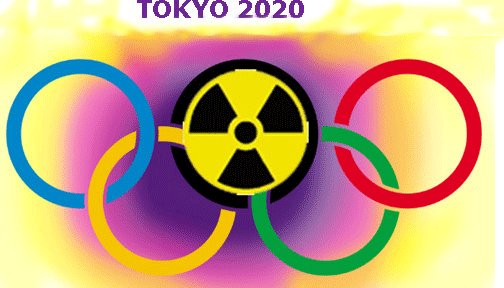 Report: Olympic athletes and tourists warned they will be in danger from Tokyo’s elevated radiation levels — Cesium found at almost every venue tested http://enenews.com/report-olympic-athletes-and-tourists-warned-they-will-be-in-danger-from-tokyos-elevated-radiation-levels-cesium-found-at-almost-every-venue-tested
Title: Elevated radiation claimed at Tokyo 2020 Olympic venues
Source: South China Morning Post
Author: Julian Ryall in Tokyo
Date: Oct. 12, 2013
A citizens’ group in Tokyo has found elevated levels of radioactivity at sporting facilities that will be used in the 2020 Olympic Games and is warning that competitors and the hundreds of thousands of people expected to flock to the city for the event will be putting themselves in danger.
The Citizens’ Group for Measuring Radioactive Environment at Facilities for the 2020 Tokyo Olympics claims wind-borne radiation from the four crippled reactors at the Fukushima nuclear plant has contaminated a number of future venues.
Measurements were taken at 39 sporting venues that have been earmarked to stage events in seven years’ time […]
“We found caesium-137 at almost every place we carried out tests, and there was no caesium here before the accident at Fukushima,” Mitsuo Tanaka, a member of the group, told the South China Morning Post. […]
Fukushima’s children and cleanup workers at cancer risk
Fukushima Doctor: Cancer found in over 40 children… We believe it’s related to the nuclear disaster — Physician: Leukemia cases to increase in next few months?(AUDIO) http://enenews.com/fukushima-doctor-thyroid-cancer-found-in-over-40-children-this-is-related-to-the-nuclear-disaster-physician-leukemia-cases-to-increase-in-next-few-months-audio October 11th, 2013
 TVR, Oct. 10, 2013: Belarusian therapists help Japanese colleagues to fight radiation […] Japanese doctors continue to struggle with radiation and the consequences of the Fukushima accident with the help of their Belarusian colleagues. Brest endocrinologists are among the best diagnosticians in Belarus. The first and mobile laboratory for thyroid cancer detection appeared in this region. […] Yuko Yanagisawa, therapist, Fukushima Prefecture (Japan): “The Fukushima accident took place two and a half years ago. But we have found thyroid cancer in more than forty children. The official medical community believes that this situation is not related to the radiation effects from the accident, but we disagree with this. Therefore, we came to Belarus to consult local specialists”.
See also: Japan Professor: Fukushima crisis is leading to surge in thyroid cancers… First signs of health catastrophe — NHK: Trend seen in new cancer tests is ‘suspicious’ (VIDEO)
Journal Tribune,, Oct. 1, 2013: [Yuki N. Karakawa, International Association of Emergency Managers] said the disaster at Fukushima will be felt in Japan for a  longtime, and that there will be long-term medical effects – something he claims the country hadn’t put into their planning systems.
Underestimation of radiation exposure to Fukushima workers
Radiation estimates for No. 1 workers likely 20% too low: U.N .Japan Times 13 Oct 13 KYODO NEW YORK – THE RADIATION DOSES WORKERS RECEIVED IN THE INITIAL PHASE OF THE FUKUSHIMA DISASTER MAY HAVE UNDERESTIMATED BY 20 PERCENT, A REPORT BY A U.N. PANEL SAYS.
The U.N. Scientific Committee on the Effects of Atomic Radiation said in a summary report on its website that the Japanese government and Tokyo Electric Power Co., known as Tepco, used tests that failed to take into account some types of radiation released by the three meltdowns at the Fukushima No. 1 power plant in March 2011……http://www.japantimes.co.jp/news/2013/10/13/national/radiation-estimates-for-no-1-workers-likely-20-too-low-u-n/#.UlxMO9JJMgs
Higher radiation levels in sea near Fukushima
 Radiation levels in harbour off Fukushima hit two-year high Australia Network News 10 Oct 2013 Radiation levels in harbour seawater beside one of the damaged Fukushima reactors spiked this week to the highest level in two years.
The operator of the crippled Japanese nuclear plant, TEPCO, says Cesium-134 and Cesium-137 readings on Wednesday jumped 13 times the previous day’s reading.
The readings were taken in the harbour right next to the Fukushima plant, hundreds of meters from the port entrance that connects to the Pacific Ocean.
Radiation from water leaking from the facility is mostly confined to the harbour around the plant, officials have said……http://www.abc.net.au/news/2013-10-10/an-radiation-levels-in-harbour-off-fukushima-hit-two-year-high/5015082
High radiation levels remain in parts of Fukushima’s evacuated areas
 Greenpeace critical of Japan radiation Sky News, 10 Oct 13 Japan’s efforts to scour areas around Fukushima have been insufficient, pressure group Greenpeace said Thursday, as the government considers letting some residents return to homes near the crippled nuclear plant.
The environmental group said tests it had carried out inside the original 20-kilometre no-go zone around the plant showed that high levels of radiation remain.
Local and national officials are mulling lifting the exclusion order in parts of Tamura city, allowing people to return to homes they abandoned more than two and a half years ago. They cite lowered pollution levels in the wake of large cleaning operations.
A recent Greenpeace survey found that decontamination programmes have been effective for houses and many parts of major routes in the city.
But some lesser-used public roads, large areas of farmland and mountain areas still have high contamination levels, said Jan Vande Putte, Greenpeace radiation protection adviser.
He said the cleaned houses and roads were like ‘islands’ and ‘corridors’ in an otherwise polluted region.
It would be ‘unrealistic’ to ask residents to stay off contaminated roads and farmland, he said.
‘They can be exposed to high levels of radiation’ if they returned home, he said.
Decontamination ‘is a sticky problem. It is very difficult’, he told a press briefing……. http://www.skynews.com.au/world/article.aspx?id=913978
2 holes leaked radioactive water from bottom of Fukushima tank
[Photo] 2 holes found in the bottom of 300m3 leakage tank / Entirely deteriorated http://fukushima-diary.com/2013/10/photo-2-holes-found-in-the-bottom-of-300m3-leakage-tank-entirely-deteriorated/ by Mochizuki on October 8th, 2013
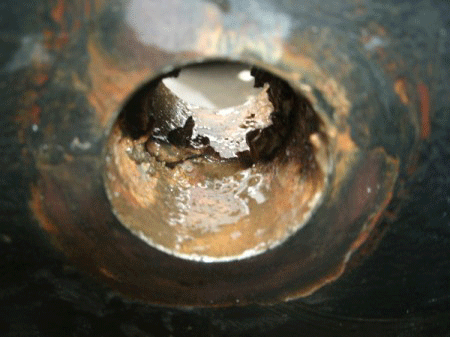
Tepco has been dismantling the tank since yesterday that experienced the 300m3 of leakage. The structural flaw may cause other tanks of the same type to leak commonly. Tepco is investigating the potential leaking points.
From their inspection, they found 2 holes around the bolt parts, which are 3mm × 11mm and 3mm × 22mm.
The flange parts were rusting inside and outside. The bottom parts of the tank were found severely deteriorated.
http://www.tepco.co.jp/nu/fukushima-np/handouts/2013/images/handouts_131008_03-j.pdf
http://photo.tepco.co.jp/date/2013/201310-j/131008-01j.html
News is not the truth. It’s a virtual reality that the sponsor wants us to live in.
Yuki Karakawa speaks on radiation emergency management
Japan Expert: Second explosion was “more like a bomb” at Fukushima — Spent nuclear fuel flew 30 kilometers away, pellets collected by military — Very strange materials like europium were found — Should have evacuated out to 300 kilometers (VIDEO) http://enenews.com/japan-expert-second-explosion-more-like-a-bomb-at-fukushima-nuclear-fuel-flew-30-kilometers-away-pellets-collected-by-japan-military-should-have-evacuated-300-kilometer-zone-150-years-t
October 7th, 2013
Title: Lessons from Fukushima
Source: Journal Tribune
Author: Tammy Wells
Date: Oct. 1, 2013
An ambassador to an international emergency management organization and a former minister of defense in Japan stopped by the York County Emergency Management Agency Monday […]
Yuki N. Karakawa, of the Karakawa Foundation and ambassador to the International Association of Emergency Managers, along with Kazuo Aichi, Japan’s defense minister in the 1990s, are both members of the Japan Resilience Initiative. […]
He said the disaster at Fukushima will be felt in Japan for a long time, and that there will be long-term medical effects – something he claims the country hadn’t put into their planning systems. […]
He estimated it will take 150 years for decontamination around Fukushima to be complete.
Yuki Karakawa – Lessons from Japan
Former York County Emergency Management Agency Director Bob Bohlmann said he’d known Karakawa for 15 years, and that he’s done a lot to spread the word about emergency management globally. […]
Yuki Karakawa’s presentation to InfraGard (“a partnership between U.S. businesses and the Federal Bureau of Investigation… dedicated to prevent hostile acts against the United States”), Published February 2013 (At 7:30 in): “300 kilometers should be evacuated, but we did not, Japan did not evacuate. […] In some areas, we can find very strange material like europium and so on. Now Self Defense Forces is collecting all materials. Also spent fuel flew because of a second explosion; it’s more like a bomb, exploded and flew like 30 kilometers. So government, or Self Defense, is now collecting all spent fuel pellets.” Watch Karakawa’s presentation here
See also: New Book: Nuclear explosion may have occurred at Fukushima Unit 3 after ‘supercritical condition’ — Sudden increase in plutonium, uranium recorded by U.S. at several EPA stations
PHOTOS: broken support braces on 400-foot tower near Fukushima reactors
New report shows support braces completely severed on 400-foot tower near Fukushima reactors (PHOTOS) http://enenews.com/new-report-shows-support-braces-completely-severed-on-400-foot-tower-near-fukushima-reactors-photos
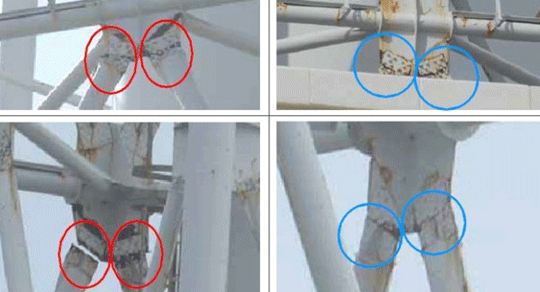
Title: (Systran Translation) Fukushima No. 1 nuclear power plant — Safety appraisal for the component damage of the machine chimney
Source: Tepco
Date: Oct. 7, 2013
h/t Fukushima Diary
Possible Olympics site in Tokyo has high radiation levels
 “Saying there is no problem without even measuring for radiation is the same response as the Democratic Party of Japan government immediately after the Fukushima nuclear accident”
“As host nation for the Olympics, it is imperative that radiation levels at the venues be released to the world”
Asahi: High radiation levels found at possible Olympic sites — Japan Professor: Radioactive materials have spread throughout greater Tokyo; Region remains in “emergency situation”? http://enenews.com/asahi-high-radiation-levels-found-at-possible-olympic-sites-japan-professor-radioactive-materials-have-spread-throughout-greater-tokyo-region-remains-in-emergency-situation
Title: High radiation levels found at possible Olympic sites; Tokyo dismisses data
Source: Asahi Shimbun (Weekly Aera)
Author: Shoji Nomura
Date: October 8, 2013
A citizens group said it measured high radiation levels at candidate venues for the 2020 Tokyo Olympics, but the metropolitan government disputes the data and the International Olympic Committee has shown little interest. […]
The group said some of the potential venues for the Summer Games had radiation levels exceeding the Tokyo metropolitan government’s standards for decontamination […] Continue reading
Radiation exposure to 6 Fukushima workers following pipe incident
6 Fukushima workers exposed to radiation after pipe incident Rt.com October 09, 2013 Six people working at the site of crippled Fukushima power plant have been exposed to radiation after one of them mistakenly removed a pipe connected to a contaminated water treatment system. It’s the second incident at Fukushima in three days.
The accidental pipe detachment on Wednesday resulted in the leak of several tons of water, which Fukushima operator TEPCO uses to cool the reactors. ……http://rt.com/news/fukushima-leak-radiation-workers-919/
Japan’s secrecy over health consequences of Fukushima radiation
International Scientists: Japan experts must be allowed to report health consequences of Fukushima — “The official data is all denial” — Pressured to downplay true impact of disaster http://enenews.com/international-scientists-japan-experts-must-be-allowed-to-report-health-consequences-of-fukushima-the-official-data-is-all-denial-pressured-to-downplay-true-impact-of-disaster October 6th, 2013
Georgia Straight (Canada), Oct. 2, 2013: “The official data is all denial,” [Eiichiro Ochiai, a retired chemistry professor in Vancouver who taught at University of British Columbia and the University of Tokyo] said. “The nuclear industry tries to suppress the truth.”
Fukushima News 10/1/13: Thousands in Japan Suffering Massive And Recurring Nosebleeds In Recent Days
Letter to United Nations Secretary-General Ban Ki-Moon from 17 international scientists and experts urging international action on Fukushima crisis, Sept. 13, 2013: […] it is clear that the situation at the Fukushima Daiichi reactor site is progressively deteriorating, not stabilizing. […] It is clear now that the Fukushima Daiichi nuclear disaster is far from over, and that there can be no credible estimate of total environmental or human health impacts because the radiological release has not ceased and the outcomes from exposing large populations to low doses over long time frames is unclear. A final estimation of the radiological release from the Fukushima Daiichi site, of necessity lies in the future; perhaps the distant future. […] Japanese physicians and scientists in Japan must be allowed and supported to treat and report Fukushima related health consequences. Nuclear calamities to date result in institutional pressure to under report and even distort patient health data and other evidence […] Such institutional pressure is now contributing to a downplaying of the true impact of the Fukushima accident.
Scientists don’t buy Japan’s claims that Fukushima radiation is “contained”
 ”Once strontium gets into fish, it stays in them for months and years and it’s going to be an additional reason why they won’t be able to open up their fisheries.”
“The credibility problem is as great as the engineering solution,”
Scientists dismiss claims that radiation in Japan is contained TEPCO’S radiation claims called ‘silly’ The Columbian, By Jonathan Tirone, Bloomberg News October 7, 2013, VIENNA — Tokyo Electric Power Co.’s claim that radioactive water leaking into the sea from the wrecked Fukushima nuclear plant is confined to the coast doesn’t make scientific sense, according to a U.S. researcher who surveyed waters off the site last month.
Japan’s government has supported the utility’s statement that the irradiated groundwater flowing into the Pacific Ocean at a rate of some 400 tons a day remains in an area of 0.3 square kilometers (0.12 square miles) within the bay fronting the atomic station. Continue reading
Final curtain staying down for nuclear energy in Japan?
“Some people may say it is irresponsible to call for zero nuclear plants,” he said, “but I think it is even more irresponsible not to have a disposal site for the waste or even any prospect of constructing such a facility.”
He now doubted the claims by experts in the industry that nuclear energy was “safe, clean, and inexpensive” and wondered “if human beings can really control nuclear energy” 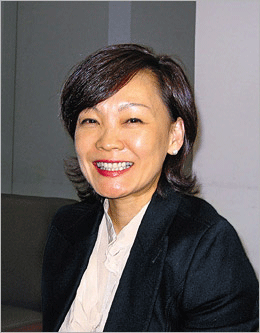
Koizumi has an accomplice: Abe’s wife. She has been whispering into her husband’s ear at night – and making anti-nuclear speeches during the day
The End Of Nuclear Energy In Japan? Zero Hedge by testosteronepit 10/04/2013 Wolf Richter www.testosteronepit.com www.amazon.com/author/wolfrichter
“I’m calling for zero nuclear power,” said Junichiro Koizumi, the hugely popular former prime minister of Japan, on Tuesday at a lecture in Nagoya. He’d served from 2001 to 2006. In 2005, he’d led the Liberal Democratic Party to win an extraordinarily large parliamentary majority. Then he groomed Shinzo Abe to become his successor. By September 2006, Abe was PM – only to get kicked out a year later. Now that Abe is PM again and is trying to restore the scandal-plagued nuclear industry to its former glory, Koizumi’s words ripped into his policies at the perfect moment…..
Though retired from politics since 2009, Koizumi remains influential. He was pro-nuclear throughout his career. But on Tuesday, he said that the earthquake and tsunami in March 2011 and the subsequent nuclear fiasco in Fukushima should be used as an opportunity to build a resource-recycling society. And he called on his former protégé to abandon nuclear power…….
If he were an active politician, he’d want “to convince lawmakers to move in the direction of zero nuclear plants,” he said. Now would be the ideal time to move that direction. All 50 nuclear reactors were off line. All opposition parties favored zero nuclear power. It could be done “as long as the prime minister made the decision” – putting the onus squarely on his former protégé. And nuclear politics in Japan haven’t been the same since. Continue reading
1 This Month

Read the Public Inquiry Report, the Commissioners’ report, Surrendering Australia: The AUKUS Deception is available to download for free at aukuspublicinquiry.com. Or just watch the replay of the National Press Club Luncheon.


19 November – Webinar – The Reality of Reprocessing
Time: 11:00 AM Pacific Time (US & Canada) / 2:00 PM Eastern / 7:00 PM UK / 8:00 PM CET
Register for the Zoom Event Here



Shut down the radiation-damaged Heysham nuclear reactors now
To see nuclear-related stories in greater depth and intensity – go to https://nuclearinformation.wordpress.com

Say No to NASA’s Reckless Nuclear Reactor on the Moon
Say No to NASA’s Reckless Nuclear Reactor on the Moon
-
Archives
- November 2026 (103)
- October 2026 (302)
- September 2026 (339)
- August 2026 (330)
- July 2026 (355)
- June 2026 (287)
- May 2026 (306)
- April 2026 (356)
- March 2026 (251)
- February 2026 (267)
- January 2026 (308)
- December 2025 (358)
-
Categories
- 1
- 1 NUCLEAR ISSUES
- business and costs
- climate change
- culture and arts
- ENERGY
- environment
- health
- history
- indigenous issues
- Legal
- marketing of nuclear
- media
- opposition to nuclear
- PERSONAL STORIES
- politics
- politics international
- Religion and ethics
- safety
- secrets,lies and civil liberties
- spinbuster
- technology
- Uranium
- wastes
- weapons and war
- Women
- 2 WORLD
- ACTION
- AFRICA
- Atrocities
- AUSTRALIA
- Christina's notes
- Christina's themes
- culture and arts
- Events
- Fuk 2022
- Fuk 2023
- Fukushima 2017
- Fukushima 2018
- fukushima 2019
- Fukushima 2020
- Fukushima 2021
- general
- global warming
- Humour (God we need it)
- Nuclear
- RARE EARTHS
- Reference
- resources – print
- Resources -audiovicual
- Weekly Newsletter
- World
- World Nuclear
- YouTube
-
RSS
Entries RSS
Comments RSS

