Japanese govt considering putting all nuclear reactors into one company
Nuclear industry amalgamation mulled LDP examining idea to bring all reactors under one company, Japan Times, 23 Oct 2013. BLOOMBERG The government is discussing a radical overhaul of the nuclear power sector that would combine the nation’s 50 operating reactors into a single company to rebuild an industry that’s been effectively halted by the Fukushima disaster that started in March 2011.
The company would be owned by the nine regional utilities, along with wholesalers Japan Atomic Power Co. and Electric Power Development Co., while the government and reactor makers would give financial and technical support, Taku Yamamoto, who chairs the Liberal Democratic Party’s energy committee, said in an interview.
Part of the profit from sales of the new company’s electricity would be funneled toward the cleanup of the Fukushima No. 1 power plant and victim compensation, which combined may cost more than ¥11 trillion. The plan would keep Tokyo Electric Power Co. alive to shoulder Fukushima costs……
None of the idled reactors may be restarted by the end of March 31, as preparations by power companies for the Nuclear Regulation Authority’s safety review are behind schedule, the Sankei Shimbun reported Monday.
LDP lawmakers have discussed other options to restructure Tepco. Tadamori Oshima, head of the party’s 2011 quake reconstruction task force, proposed to Prime Minister Shinzo Abe that Tepco form a separate company to deal with decommissioning Fukushima No. 1 and the government provide financial aid, Kyodo News reported Sept. 21.
The Abe administration is seeking the Diet’s endorsementthis month for a bill designed to end the 60-year-old monopolies of the regional utilities, led by Tepco.
The other entities — which like Tepco dominate electricity generation and transmission in their respective regions — are Hokkaido Electric Power Co., Tohoku Electric Power Co., Chubu Electric Power Co., Kansai Electric, Hokuriku Electric Power Co., Chugoku Electric Power Co., Shikoku Electric Power Co. and Kyushu Electric Power Co.
The draft bill would unbundle generation and transmission operations and allow households to choose power suppliers for the first time. In theory, 60 percent of the electricity market has been deregulated, though in practice the dominance of the regional utilities stands in the way…… http://www.japantimes.co.jp/news/2013/10/23/business/ldp-mulls-amalgamating-all-nuclear-plants-under-one-firm/#.UmnhNnBwo7o
Fukushima workers tweeted about their safety worries
Fukushima Workers: There was a collapse at plant due to typhoon — Not revealed by Tepco — Worry that upcoming storm to cause more damage Two Fukushima workers commented on Twitter that the previous Typhoon Wipha caused a slope in Fukushima plant area to collapse. The slope faces the main street, and the earth and sand blockaded the street. Also, there was a part to have had a subsidence. […] The worker added there are more slopes in the area and they may collapse due to the next Typhoon […]
Specific Tweets translated by Google:
- @sunnysunnynismo, Oct. 19, 2013: Pattern collapse due to typhoon at the Fukushima Daiichi premises has not been press releases
- @Happy11311, Oct. 19, 2013: Uh-oh? I did not press! It was learned for the first time to see tweets of Sunny’s. I’ve had also place the road much would have been blocked, was depressed (> _ <) after law could face there had collapsed …. Next week, I wonder if the public? Typhoon No. 27 is also a worry about next week, and slope is likely to collapse still, and I wonder … I’m worried about.
- @Happy11311, Oct. 19, 2013: […] I think restoration work is dangerous’ s rain today where it left mudslides after, that it is not doing, but disciple no choice but to pray that the damage is not expanded
Japan’s radiation cleanup not going to schedule
Japan Delaying Cleanup of Towns Near Nuclear Plant abc news, TOKYO October 21, 2013 (AP) By MARI YAMAGUCHI Associated Press Radiation cleanup in some of the most contaminated towns around Fukushima’s damaged nuclear power plant is behind schedule, so some residents will have to wait a few more years before returning, Japanese officials said Monday.
Environment Ministry officials said they are revising the cleanup schedule for six of 11 municipalities in an exclusion zone from which residents were evacuated after three reactors at the Fukushima Dai-ichi nuclear power plant went into meltdown following the March 2011 earthquake and tsunami. The original plan called for completing all decontamination by next March.
Nobody has been allowed to live in the zone again yet, though the government has allowed day visits to homes and businesses in some places after initial decontamination, said Shigeyoshi Sato, an Environment Ministry official in charge of decontamination……http://abcnews.go.com/International/wireStory/japan-delaying-cleanup-towns-nuclear-plant-20630619
Fukushima nuclear reactors leaking directly into sea?
 Alert: Top Japan nuclear official suggests Fukushima reactors “leaking directly into sea”… not mixing with groundwater and getting diluted — Expert: Contamination flowing from plant will be carried away to North America’s west coast
Jiji Press, http://enenews.com/alert-top-level-japan-official-publicly-suggests-multiple-fukushima-reactors-are-leaking-directly-into-the-sea-its-not-mixing-with-groundwater-and-getting-diluted-expert-contamination-f Oct. 16, 2013: Tepco’s toxic water failures pitiful: NRA[…] Tepco is pumping up groundwater and has injected a water-stopping agent into the ground near the plant’s port in order to curb the flow of radioactive groundwater into the sea. Despite such efforts, the levels of cesium-137 in seawater samples collected between the water intakes for reactors 1 and 2 inside the port rose to around 100 becquerels per liter this month from around 10 becquerels between late June and early July. […] Radioactive water from the damaged reactors “may be leaking directly into the sea instead of mixing with groundwater before making its way into the sea,” [Nuclear Regulation Authority Commissioner Toyoshi] Fuketa said. […]
Vladimir Kovbasyuk, Russian Hydrometeorological Expert, Oct. . 16, 2013: “We analyzed the problems several years ago, when the 2011 earthquake and tornado hit the Fukushima nuclear plant. Radioactive waters will first be carried away to the west coast of North America and only then, on intermingling with other ocean waters, may they return to the Russian coast. Currently, we are measuring radiation levels, and we’ve registered no excess radiation thus far.” […]
It appears Fuketa has provided the answer to the ‘mystery’ discussed on NHK’s ‘Nuclear Watch’ earlier thisyear: Fukushima Mystery? TV: Japan expert says radiation levels in ocean too high to be explained by groundwater flow alone — Must be coming from “other contamination routes” entering Pacific — “Devastating impact” to come? (VIDEO)
Huge spike in groundwater radiation under Fukushima nuclear reactor No 1
 Strontium readings spike 6,500-fold in one day Water radiation soars at Fukushima No. 1 Japan Times JIJI, AFP-JIJI 18 Oct 13 FUKUSHIMA – Radiation levels in groundwater under Tokyo Electric Power Co.’s Fukushima No. 1 nuclear plant are soaring, Tepco said Friday after taking samples from an observation well.
Tepco said 400,000 becquerels per liter of beta ray-emitting substances such as strontium were detected in water sampled Thursday from the well located some 15 meters from a storage tank that leaked about 300 tons of highly radioactive water in August.
The level of becquerels, a record high for water in that well, was up 6,500-fold from the 61 becquerels found Wednesday.
Tepco was planning to pump groundwater up from different wells about 100 meters from the leaky tank for release into the Pacific before the water flows into the damaged reactor buildings and becomes heavily contaminated with radioactive materials.
But that plan appears in jeopardy because the sharp increase in the levels of radioactive materials in the observation well suggest the radioactive groundwater is spreading.
By law, water containing beta particle-emitting substances exceeding certain levels cannot be released into the sea. The upper limit is set at 30 becquerels per liter for strontium-90 and 60 becquerels for cesium-134.
Tepco also said water collected Thursday from a drainage ditch near the leaky tank contained 34,000 becquerels of beta particle-emitting substances per liter, compared with 2,300 becquerels the day before……Officials said Thursday they will solicit proposals from both domestic and overseas nuclear experts and firms on how best to scrap the ruined reactors at Fukushima No. 1…….http://www.japantimes.co.jp/news/2013/10/18/national/water-radiation-soars-at-fukushima-no-1/?utm_source=feedburner&utm_medium=feed&utm_campaign=Feed%3A+ja
Slow progress on decontamination of Fukushima, most of the budget still unused
Ministry fails to use 77% of Fukushima decontamination budget; TEPCO refuses to pay Asahi Shimbun, 18 Oct 13, By TAKUYA KITAZAWA/ Staff Writer The Environment Ministry has failed to use 76.6 percent, or 247.2 billion yen, of its budget to decontaminate radioactive areas around the Fukushima No. 1 nuclear plant, the Board of Audit said.
Progress has been slow because opposition from local residents is making it difficult for the ministry to secure places to temporarily store the contaminated soil and debris collected in the work.
The ministry faces another problem: Tokyo Electric Power Co., the operator of the stricken Fukushima plant, refuses to cover all the costs of the decontamination work as required under law.
The Board of Audit investigated the ministry’s budget of about 322.8 billion yen ($3.2 billion) for decontamination work for the period until March 2013, the end of fiscal 2012.
The results were released on Oct. 16………http://ajw.asahi.com/article/0311disaster/fukushima/AJ201310170058
Record high radiation in Fukushima No 1 drainage ditch
Radiation level in Fukushima No. 1 ditch hits record high, Japan Times, 17 Oct 13,FUKUSHIMA – The highest level yet of beta ray-emitting radioactive substances, including strontium, has been detected at one point in a drainage ditch at the crippled Fukushima No. 1 nuclear plant where measurements are regularly taken, Tokyo Electric Power Co. said Thursday.
According to Tepco, a water sample taken Wednesday at a point in the ditch some 300 meters from the ocean was found to contain 1,400 becquerels per liter of beta ray-emitting radioactive substances, the highest level ever detected at that location……
Radiation levels also hit record highs in water samples collected Wednesday at three upstream points in the drainage ditch, which passes close to the storage tank from which highly radioactive water spilled in August, with the amount of beta ray-emitting radioactive substances ranging from 2,000 to 2,300 becquerels per liter.
Tepco said it was unable to take seawater samples near the exit of the ditch because of bad weather.http://www.japantimes.co.jp/news/2013/10/17/national/radiation-level-in-fukushima-no-1-ditch-hits-record-high/#.UmGNJdJJMgs
Former Prime Minister Kan’s campaign to rid the world of nuclear power
he [Kan] noted that already a new energy prospect is visible off the Fukushima coast, where a floating wind turbine is being tested. It has been dubbed “Fukushima mirai,” which means “Fukushima future” in Japanese. “In Japan,” Kan said, “we see that even without nuclear power plants we can actually supply energy to meet our demands.”
The Nuclear Odyssey of Naoto Kan, Japan’s Prime Minister during Fukushima Having led Japan through the 2011 nuclear crisis, the elder statesman is now campaigning for a world without nuclear power, Scientific American, By David Biello, 17 Oct 13, (“……………Kan could not help but wondering how much worse the Fukushima meltdowns might get on the dark nights spent in his office after March 11, 2011. “What was going through my mind at the time?” Kan said through a translator during a public event at the 92nd Street YMCA in New York City on October 8. “How much worse is this going to get, and how can we stop this from getting even worse?”
Typhoon results in more radiation leaks at Fukushima nuclear plant
Japan: Typhoon Wipha causes more nuclear contamination at Fukushima Euro News 17 Oct 13, A typhoon that swept through Japan has caused more radioactive leaks at the troubledFukushima plant.
Workers there say they have detected high levels of radiation in a ditch leading to the Pacific Ocean and suspect heavy rains lifted contaminated soil…….http://www.euronews.com/2013/10/17/japan-typhoon-wipha-causes-more-nuclear-contamination-at-fukishima/
‘Criminal situation’ as Japan hides seriousness of Fukushima radiation
Japan Journalist: Plutonium and uranium escaped Fukushima reactors as gas, it was a colossal 9,000ºF inside — Can’t be detected by a Geiger counter — Terrible things are looming for the children, they must be evacuated yet nothing’s done… This is a “criminal nation” — I am worried (VIDEO) http://enenews.com/japan-journalist-plutonium-and-uranium-escaped-from-fukushima-reactors-as-a-gas-temperature-was-9000of-cant-be-detected-by-a-geiger-counter-children-must-be-evacuated-yet-nothing-is-d
Title: Takashi HIROSE
Source: Yonaoshi 3.11
Date: Mar. 8, 2013
Transcript Excerpts
Hirose Takashi, journalist/former engineer: As we speak, radioactive material is seeping through Fukushima’s ground. It makes its way underground, reaches the ocean, to finally end up in the sky.
This kind of fact does not make the news, so everyone forgets about it. If that was talked about every day in the news, the Japanese population couldn’t ignore it. […] In my opinion mass media bear most of the responsibility for it. […] Incidents happen because mass media never take the problem seriously.
The problem with contamination is that we can only measure it within items surrounding us, in the soil, the ground. A lot of people today own a Geiger counter, but it can only report airborne particles, it only measures Gamma rays. In fact, when researching the radioactive content out from the reactors, and its dispersion, we do not find everything.
It was about 5,000ºC [~9,000ºF] inside the reactors. This was a temperature of colossal magnitude. The uranium and plutonium took on a gas form to escape. I can find all that based on my calculations, but none of this can be detected using a Geiger counter […]
No one even measures the strontium level. The strontium is the scariest of all. It penetrates and stays resident in bones, causing leukemia. This is particularly dangerous for the growth phase of children exposed today.
For children living near contaminated areas like Fukushima, we have to immediately set up a plan for their evacuation. […]
Before Japan lost the war, we organized group evacuations. We managed the escape of children from dangerous areas […]
This is something that must be done now. But the country does not do anything about it. For that I am calling this country a criminal nation. If we do not act, terrible things are looming for those children. I am worried.
Watch the clip of Hirose here
Concerns over radioactivity in Fukushima rice
Rice grown nearby Fukushima plant cleared for sale — Farmer: “I would not dare eat it… We feel guilty about growing it and selling it” (VIDEO)http://enenews.com/rice-grown-near-fukushima-plant-cleared-for-sale-farmer-i-would-not-dare-eat-it-myself-we-farmers-know-better-we-feel-guilt-about-growing-it-and-selling-it-video
Fukushima farmers negotiate with Japanese Government
The Chosun Ilbo (English Edition),, Oct. 10, 2013: Rice Grown Near Fukushima Cleared for Sale […] Rice grown in some areas within a 30 km radius of the stricken Fukushima nuclear power plant will be cleared for sale this year, but concerns remain. Some samples have tested positive for radiation well above the permitted level. So far only test farming of rice in the region was allowed. Fukushima Prefecture on Wednesday said 44 out of 52 sacks of 30-kg rice harvested in Minamisoma, 20 to 30 km from the power plant, likely exceeded the permissible levels of radioactive materials when tested with a conveyer-belt detector. The prefecture carried out thorough test of the 44 sacks, and detected 120 becquerels of cesium per kilogram, way over the permissible level of 100 becquerels. “It is possible to sell rice that does not exceed the level,” said a prefecture official. […]
Fukushima Farmers Negotiate with Japanese Government,Published August 31, 2013 – Farmer from Sukagawa, 60 km west of Fukushima Daiichi (at 1:45 in): Do you understand the meaning of ‘de’ in the word decontamination? We are just tilling deeply and spreading the radiation thinly. We are not removing the contamination. No wonder that the radiation level has not gone down. We measured the radioactivity in the air. It has not gone down at all. We have not removed the contaminated soil. Of course not! The environment has not changed at all 2 years after the explosions. […] In Fukushima, all farm produce must be checked for the cesium level prior to shipping. The current government limit is 100 becquerels. The farmers know how many becquerels of cesium their produce contains. We can ship them if the reading is lower than 100. But I would not dare eat them myself. The consumers assume there is no radiation in the food they buy. […] We farmers know better. We feel guilty about growing it and selling it. We won’t eat it ourselves, but we sell it.
Confusion and deception over Fukushima radiation
Fukushima Farmer: Plutonium was detected “all over” village 25 miles from plant — Professor: “Something terrible, dreadful happening” — Mayor: Please don’t tell this to the residents (VIDEO) http://enenews.com/fukushima-farmer-plutonium-detected-all-village-professor-terrible-dreadful-happening-radiation-levels-high-mayor-please-dont-residents-video
Kenichi Hasegawa, Farmer from Iitate Village in Fukushima Prefecture, Canberra Forum, March 13, 2013 After the nuclear accident, all over Iitate village, plutonium and strontium were detected [40km from nuclear plant]. […] And then something unbelievable happened. Authorities started bringing many [hygienists or dentists?] to the village […] these doctors started doing this local safety campaign. They kept telling us, “It’s OK, it’s safe, there’s nothing to worry about.” […] The day before the evacuation order was announced, the professor from Kyoto University called Professor Imanaka came to the village and did a thorough research monitoring of the radiation levels.
And Professor Imanaka, he was just astonished, “Something terrible, dreadful is happening. The radiation level was so high; I can’t believe people are still living here.” […] So Professor Imanaka brought his data to the mayor and said, “You guys should evacuate immediately.” But the mayor’s response was, “Please do not disclose this data to the public.” Instead he said, “Is there any way to live with this radiation?” The village authorities only were interested in protecting the village itself, not the people.
We wanted to protect the children and we suggested to evacuate the children, but they didn’t listen. And the day before the evacuation order, exclusion zone, was announced, the day before, a different professor from ??? University visited the village and he called all the parents to the town hall, and then gave a safety lecture, “Your kids can go out and play, your kids don’t have to wear masks just to play outside.” But the very next day the evacuation order was announced.
Japan physician who volunteered at a Minamisoma evacuation center soon after 3/11Feb. 19, 2013 (at 54:00 in): What happened at that time was systematic effort by the prefecture government, […] as well as the Japanese central government, tried to minimize the amount of radiation. […] Primary concern […] for Fukushima Minpo [newspaper] was losing business […] For the prefecture government, losing the people means less revenue, less positions.
‘Emergency transfer’ of Fukushima radioactive water, following typhoon
‘Emergency measures’ used at Fukushima site during typhoon — Contaminated water dumped in ocean — 9 barriers were on verge of overflowing, then released into environment with NO radiation test — CNN: Workers were “on vigil” (VIDEO) http://enenews.com/emergency-measures-taken-at-fukushima-plant-during-typhoon-tv-contaminated-water-dumped-in-ocean-many-barriers-were-on-verge-of-overflowing-then-were-drained-into-environment-with-no-radia
Asahi, Oct. 16, 2013: Heavy rain from Typhoon No. 26 forced [TEPCO] to discharge rainwater Oct. 16 that was threatening to swamp the barriers that surround the radioactive water storage tanks […] According to the utility, workers drained about 40 tons of water from within barriers in areas called C-West and C-East at around 5:40 a.m. The water was transferred to a temporary storage tank to check its radiation levels before it was released, TEPCO officials said. But water levels continued to rise inside the barriers, threatening to spill over. Plant workers were eventually forced to open drainage valves on a total of nine storage areas starting around 7 a.m. to allow the water to escape, according to officials. Earlier, TEPCO had said it would discharge water that accumulated behind the barriers only after transferring it to a temporary storage tank where it would confirm it complied with safety standards. TEPCO officials said circumstances forced it to take “emergency measures” because the water rose at a faster rate than it could transfer to the holding tank.
NHK WORLD, Oct. 16, 2013: [TEPCO] has released rainwater that had accumulated in the compound from typhoon Wipha. The water has reportedly cleared tests for radioactivity. […] It began releasing the water from 9 locations on Wednesday morning. […] The level of tritium, which takes longer to measure, is also likely to be safe. In a separate move, TEPCO made an emergency transfer of highly radioactive water that had pooled at 2 other locations. The water was transferred to an adjacent underground storage pool. TEPCO had not stored water underground since a leak in April […] because rainwater from the typhoon was rising fast, the utility decided to store the radioactive water temporarily in an underground pool […] TEPCO has built additional storage tanks and increased personnel and patrols to control contaminated water after a storm earlier this month. Radioactive water flowed over barriers at that time, and seeped out of an overfilled tank. […] The authority asked TEPCO to tighten monitoring for possible leaks.
CNN,, Oct. 16, 2013: Typhoon Wipha hits Tokyo area, killing at least 17 […] TEPCO, which has been struggling to deal with a series of leaks at its Fukushima Daiichi nuclear plant, said workers at the plant were “on vigil” and accumulated rainwater had been released from storage tanks.
NHK Newsline, , Oct. 16, 2013: The water accumulated around the compound. Some of it became contaminated with radioactive substances. Managers at Fukushima Daiichi instructed workers to release it into the ocean after tetsts showed the radiation levels met safety standards. […] Workers made an ‘emergency transfer’ of rain water at two other locations because they suspected it was highly radioactive.
Watch the NHK broadcast here
Radioactive cesium found at Tokyo’s Olympic venues
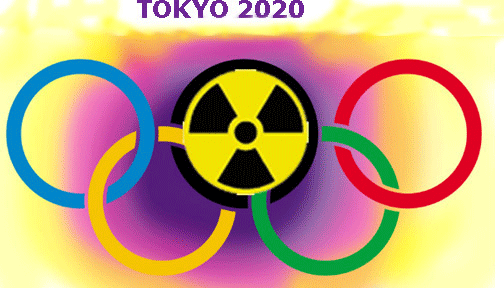 Report: Olympic athletes and tourists warned they will be in danger from Tokyo’s elevated radiation levels — Cesium found at almost every venue tested http://enenews.com/report-olympic-athletes-and-tourists-warned-they-will-be-in-danger-from-tokyos-elevated-radiation-levels-cesium-found-at-almost-every-venue-tested
Title: Elevated radiation claimed at Tokyo 2020 Olympic venues
Source: South China Morning Post
Author: Julian Ryall in Tokyo
Date: Oct. 12, 2013
A citizens’ group in Tokyo has found elevated levels of radioactivity at sporting facilities that will be used in the 2020 Olympic Games and is warning that competitors and the hundreds of thousands of people expected to flock to the city for the event will be putting themselves in danger.
The Citizens’ Group for Measuring Radioactive Environment at Facilities for the 2020 Tokyo Olympics claims wind-borne radiation from the four crippled reactors at the Fukushima nuclear plant has contaminated a number of future venues.
Measurements were taken at 39 sporting venues that have been earmarked to stage events in seven years’ time […]
“We found caesium-137 at almost every place we carried out tests, and there was no caesium here before the accident at Fukushima,” Mitsuo Tanaka, a member of the group, told the South China Morning Post. […]
Fukushima’s children and cleanup workers at cancer risk
Fukushima Doctor: Cancer found in over 40 children… We believe it’s related to the nuclear disaster — Physician: Leukemia cases to increase in next few months?(AUDIO) http://enenews.com/fukushima-doctor-thyroid-cancer-found-in-over-40-children-this-is-related-to-the-nuclear-disaster-physician-leukemia-cases-to-increase-in-next-few-months-audio October 11th, 2013
 TVR, Oct. 10, 2013: Belarusian therapists help Japanese colleagues to fight radiation […] Japanese doctors continue to struggle with radiation and the consequences of the Fukushima accident with the help of their Belarusian colleagues. Brest endocrinologists are among the best diagnosticians in Belarus. The first and mobile laboratory for thyroid cancer detection appeared in this region. […] Yuko Yanagisawa, therapist, Fukushima Prefecture (Japan): “The Fukushima accident took place two and a half years ago. But we have found thyroid cancer in more than forty children. The official medical community believes that this situation is not related to the radiation effects from the accident, but we disagree with this. Therefore, we came to Belarus to consult local specialists”.
See also: Japan Professor: Fukushima crisis is leading to surge in thyroid cancers… First signs of health catastrophe — NHK: Trend seen in new cancer tests is ‘suspicious’ (VIDEO)
Journal Tribune,, Oct. 1, 2013: [Yuki N. Karakawa, International Association of Emergency Managers] said the disaster at Fukushima will be felt in Japan for a  longtime, and that there will be long-term medical effects – something he claims the country hadn’t put into their planning systems.
1 This Month





PLEASE OPPOSE HR 8255 AND S.3639 – bills would accelerate satellite deployment, with no environmental review or safeguards – https://ncstd5li.quorum.us/campaign/169331/
To see nuclear-related stories in greater depth and intensity – go to https://nuclearinformation.wordpress.com
-
Archives
- October 2026 (67)
- September 2026 (339)
- August 2026 (330)
- July 2026 (355)
- June 2026 (287)
- May 2026 (306)
- April 2026 (356)
- March 2026 (251)
- February 2026 (267)
- January 2026 (308)
- December 2025 (358)
- November 2025 (359)
-
Categories
- 1
- 1 NUCLEAR ISSUES
- business and costs
- climate change
- culture and arts
- ENERGY
- environment
- health
- history
- indigenous issues
- Legal
- marketing of nuclear
- media
- opposition to nuclear
- PERSONAL STORIES
- politics
- politics international
- Religion and ethics
- safety
- secrets,lies and civil liberties
- spinbuster
- technology
- Uranium
- wastes
- weapons and war
- Women
- 2 WORLD
- ACTION
- AFRICA
- Atrocities
- AUSTRALIA
- Christina's notes
- Christina's themes
- culture and arts
- Events
- Fuk 2022
- Fuk 2023
- Fukushima 2017
- Fukushima 2018
- fukushima 2019
- Fukushima 2020
- Fukushima 2021
- general
- global warming
- Humour (God we need it)
- Nuclear
- RARE EARTHS
- Reference
- resources – print
- Resources -audiovicual
- Weekly Newsletter
- World
- World Nuclear
- YouTube
-
RSS
Entries RSS
Comments RSS

