Japan: Deeply enmeshed in the global nuclear industrial complex
The key is that the nuclear village retains veto power over national energy policy and citizens will not get to decide the outcome even if an overwhelming majority support phasing out nuclear energy. In addition, Washington is leaning on the Japanese government to not pull the plug on nuclear energy.

Japan: Deeply enmeshed in the global nuclear industrial complex Abe’s Nuclear Energy Policy and Japan’s Future 安倍首相の原子力政策と日本の未来 Jeff Kingston : http://www.japanfocus.org/-Jeff-Kingston/3986#sthash.CV9q1CUY.dpufhttp://www.japanfocus.org/-Jeff-Kingston/3986“……..Why has Fukushima not been a game changing event? The institutions of Japan’s nuclear village (principally the utilities, bureaucracy and Diet) enjoy considerable advantages in terms of energy policymaking and have enormous investments at stake. The nuclear village has openly lobbied the government and actively promoted its case in the media while also working the corridors of power and backrooms where energy policy is decided. Here the nuclear village enjoys tremendous advantages that explain why it has prevailed over public opinion concerning national energy policy.
Impaired visibility due to particles in spent fuel pond at Fukushima no 4 reactor
 NHK: ‘Particles’ impairing visibility in Fukushima pool — Will try to remove spent fuel Tuesday, said to be “one of most dangerous operations ever attempted in nuclear history” — Tepco concerned about sabotage, warns media about filming http://enenews.com/nhk-particles-impairing-visibility-in-unit-4-pool-attempted-removal-of-spent-fuel-starts-tuesday-described-as-one-of-most-dangerous-operations-ever-attempted-in-nuclear-history-tepco-c
NHK, , Nov. 25, 2013: [TEPCO] says it will begin removing highly radioactive spent nuclear fuel from one of its reactor buildings on Tuesday. […] TEPCO says […] sand and fine particles in the storage pool impaired visibility. The utility says it will use a pump to clear the pool of particles for the next round of transfers. […] The spent fuel assemblies are highly radioactive so the operation will require extra caution. This will be the first removal of spent nuclear fuel […]
Bangkok Post, Nov. 24, 2013: World community needed at Fukushima […] Last week workers at Fukushima successfully removed the [unused] nuclear fuel rod assemblies from a cooling pool suspended high above ground at Reactor No 4 in what has been described as one of the most dangerous operations ever attempted in nuclear history. […] Experts say that if the fuel rods come too close to each other during the operation there is a chance of a nuclear chain reaction that could spread to all the fissile material. […]
TEPCO, Nov. 21, 2013: […] we have noticed that some news media released videos, taken from the air, of the on-premise transportation from the Unit 4 Reactor Building to the Common Pool Building […] Some of those videos contain information (such as the transportation schedule, a route of the transportation, and activities of security guards) the disclosure of which conflicts with “Measures To Be Taken for Physical Protection of Specific Nuclear Fuel Material” stipulated in the Nuclear Reactor Regulation Law. The regulatory agency is also aware of this matter, and instructed us to request the media to act with attention to physical protection. As we have already requested the media members on many occasions, in view of physical protection, please refrain from taking pictures and videos of the physical protection facilities such as the building entrances and exits, fences, sensors, and cameras as well as the cask transportation currently conducted. [*Physical protection: To protect nuclear materials and facilities against the theft or unauthorized diversion of nuclear materials and against the sabotage of nuclear facilities]
More: CNN: Tepco only wanted to show us Unit 4, strict rules about what we could film (VIDEO)
Japan opposition parties fail [fulfill?] their duty
Uncertainty over the location of Fukushima’s 3 molten nuclear cores
 Scientist back from Japan: Melt-through of Fukushima containment vessels being discussed — They can’t locate any of the 3 molten reactor cores — “It’s bad, it’s definitely not over” http://enenews.com/scientist-back-from-japan-they-cant-locate-any-of-the-molten-reactor-cores-melt-through-of-containment-vessels-being-discussed-its-bad-its-definitely-not-over-yet-at-fukushima
Cape Cod Times,, Nov. 24, 2013: [Woods Hole Oceanographic Institution Senior Scientist Ken] Buesseler, along with a team from WHOI, made the first of his three visits to the Fukushima area in June 2011 […] the Japanese are not able to locate three molten reactor cores. There is ongoing discussion of whether the cores have undergone a meltdown or a melt-through of the containment vessels, Buesseler said. “You can’t send humans in there. It takes decades to come up with a plan,” he said. “It’s bad. It’s definitely not over yet.”
Asia Times, Nov. 18, 2013: At least some of the reactor cores are believed to have melted through the containment vessels, and possibly into the ground, contaminating groundwater with unprecedented levels of hot particles.
Kyodo, Nov. 20, 2013: The Nos. 5 and 6 reactors […] will not actually be dismantled and instead will be used as a research facility to develop technologies for achieving the unprecedented task of removing melted fuel from the Nos. 1 to 3 crippled reactors […]
Time for Japan to come clean about the issues at Fukushima
The Global Threat of Fukushima, counterpunch A Global Response is Needed WEEKEND EDITION OCTOBER 25-27, 2013 by KEVIN ZEESE AND MARGARET FLOWERS ”………… The Solutions The three major problems at Fukushima are all unprecedented, each unique in their own way and each has the potential for major damage to humans and the environment. There are no clear solutions but there are steps that need to be taken urgently to get the Fukushima clean-up and de-commissioning on track and minimize the risks.
The first thing that is needed is to end the media blackout. The global public needs to be informed about the issues the world faces from Fukushima. The impacts of Fukushima could affect almost everyone on the planet, so we all have a stake in the outcome. If the public is informed about this problem, the political will to resolve it will rapidly develop.

The nuclear industry, which wants to continue to expand, fears Fukushima being widely discussed because it undermines their already weak economic potential. But, the profits of the nuclear industry are of minor concern compared to the risks of the triple Fukushima challenges.
The second thing that must be faced is the incompetence of TEPCO. They are not capable of handling this triple complex crisis. TEPCO “is already Japan’s most distrusted firm” and has been exposed as “dangerously incompetent.” A poll foundthat 91 percent of the Japanese public wants the government to intervene at Fukushima.
Tepco’s management of the stricken power plant has been described as a comedy of errors. The constant stream of mistakes has been made worse by constant false denials and efforts to minimize major problems. Indeed the entire Fukushima catastrophe could have been avoided:
“Tepco at first blamed the accident on ‘an unforeseen massive tsunami’ triggered by the Great East Japan Earthquake on March 11, 2011. Then it admitted it had in fact foreseen just such a scenario but hadn’t done anything about it.”
The reality is Fukushima was plagued by human error from the outset. An official Japanese government investigation concluded that the Fukushima accident was a “man-made” disaster, caused by “collusion” between government and Tepco and bad reactor design. On this point, TEPCO is not alone, this is an industry-wide problem. Many US nuclear plants have serious problems, are being operated beyond their life span, have the same design problems and are near earthquake faults. Regulatory officials in both the US and Japan are too corruptly tied to the industry.
Then, the meltdown itself was denied for months, with TEPCO claiming it had not been confirmed. Japan Times reports that “in December 2011, the government announced that the plant had reached ‘a state of cold shutdown.’ Normally, that means radiation releases are under control and the temperature of its nuclear fuel is consistently below boiling point.” Unfortunately, the statement was false – the reactors continue to need water to keep them cool, the fuel rods need to be kept cool – there has been no cold shutdown. http://www.counterpunch.org/2013/10/25/the-global-threat-of-fukushima/
Kevin Zeese JD and Margaret Flowers MD co-host ClearingtheFOGRadio.org on We Act Radio 1480 AM Washington, DC and onEconomic Democracy Media, co-direct It’s Our Economy and are organizers of the Occupation of Washington, DC. Their twitters are @KBZeese and @MFlowers8.
What is really going on in the high risk operation at Fukushima Nuclear reactor No 4?
Why TEPCO is Risking the Removal of Fukushima Fuel Rods. The Dangers of Uncontrolled Global Nuclear Radiation, Global Research, 24 Nov 13 By Yoichi Shimatsu After repeated delays since the summer of 2011, the Tokyo Electric Power Company has launched a high-risk operation to empty the spent-fuel pool atop Reactor 4 at the Dai-ichi (No.1) Fukushima Nuclear Power Plant.
The urgency attached to this particular site, as compared with reactors damaged in meltdowns, arises from several factors:
– over 400 tons of nuclear material in the pool could reignite
– the fire-damaged tank is tilting badly and may topple over sooner than later
– collapse of the structure could trigger a chain reaction and nuclear blast, and
– consequent radioactive releases would heavily contaminate much of the world.
The potential for disaster at the Unit 4 SFP is probably of a higher magnitude than suspected due to the presence of fresh fuel rods, which were delivered during the technical upgrade of Reactor 4 under completion at the time of the March 11, 2011 earthquake and tsunami. The details of that reactor overhaul by GE and Hitachi have yet to be disclosed by TEPCO and the Economy Ministry and continue to be treated as a national-security matter. Here, the few clues from whistleblowers will be pieced together to decipher the nature of the clandestine activity at Fukushima No.1. Continue reading
Fukushima’s radioactive water problem does not go away
The Global Threat of Fukushima, counterpunch A Global Response is Needed WEEKEND EDITION OCTOBER 25-27, 2013 by KEVIN ZEESE AND MARGARET FLOWERS”………As bad as the ongoing leakage of radioactive water is into the Pacific, that is not the largest part of the water problem. The Asia-Pacific Journal reported last month that TEPCO has 330,000 tons of water stored in 1,000 above-ground tanks and an undetermined amount in underground storage tanks. Every day, 400 tons of water comes to the site from the mountains, 300 tons of that is the source for the contaminated water leaking into the Pacific daily. It is not clear where the rest of this water goes.
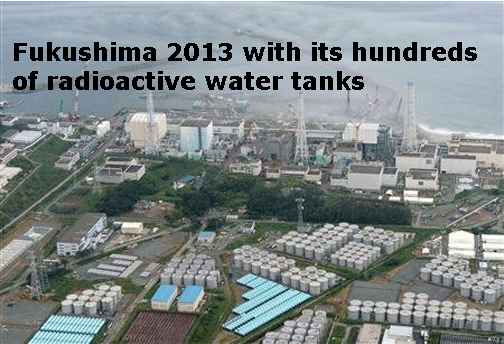
Each day TEPCO injects 400 tons of water into the destroyed facilities to keep them cool; about half is recycled, and the rest goes into the above-ground tanks. They are constantly building new storage tanks for this radioactive water. The tanks being used for storage were put together rapidly and are already leaking. They expect to have 800,000 tons of radioactive water stored on the site by 2016. Harvey Wasserman warns that these unstable tanks are at risk of rupture if there is another earthquake or storm that hits Fukushima. The Asia-Pacific Journal concludes: “So at present there is no real solution to the water problem.”
The most recent news on the water problem at Fukushima adds to the concerns. On October 11, 2013, TEPCO disclosed that the radioactivity level spiked 6,500 times at a Fukushima well. “TEPCO said the findings show that radioactive substances like strontium have reached the groundwater. High levels of tritium, which transfers much easier in water than strontium, had already been detected………”http://www.counterpunch.org/2013/10/25/the-global-threat-of-fukushima/
How much radioactive water is leaking into the ocean?
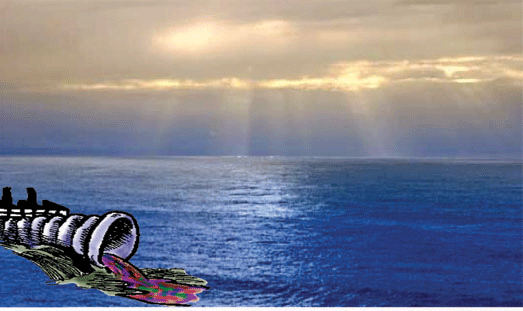 The Global Threat of Fukushima, counterpunch A Global Response is Needed WEEKEND EDITION OCTOBER 25-27, 2013 by KEVIN ZEESE AND MARGARET FLOWERS “………….An estimated 300 tons (71,895 gallons/272,152 liters) of contaminated water is flowing into the ocean every day. The first radioactive ocean plume released by the Fukushima nuclear power plant disaster will take three years to reach the shores of the United States. This means, according to a new study from the University of New South Wales, the United States will experience the first radioactive water coming to its shores sometime in early 2014.
One month after Fukushima, the FDA announced it was going to stop testing fish in the Pacific Ocean for radiation. But, independent research is showing that every bluefin tuna tested in the waters off California has been contaminated with radiation that originated in Fukushima. Daniel Madigan, the marine ecologist who led the Stanford University study from May of 2012 was quoted in the Wall Street Journalsaying, “The tuna packaged it up (the radiation) and brought it across the world’s largest ocean. We were definitely surprised to see it at all and even more surprised to see it in every one we measured.” Marine biologist Nicholas Fisher of Stony Brook University in New York State, another member of the study group, said: “We found that absolutely every one of them had comparable concentrations of cesium 134 and cesium 137.”
In addition, Science reports that fish near Fukushima are being found to have high levels of the radioactive isotope, cesium-134. The levels found in these fish are not decreasing, which indicates that radiation-polluted water continues to leak into the ocean. At least 42 fish species from the area around the plant are considered unsafe. South Korea has banned Japanese fish as a result of the ongoing leaks.
The half-life (time it takes for half of the element to decay) of cesium 134 is 2.0652 years. For cesium 137, the half-life is 30.17 years. Cesium does not sink to the ocean floor, so fish swim through it. What are the human impacts of cesium?……..
There is no end in sight from the leakage of radioactive water into the Pacific from Fukushima. Harvey Wasserman is questioning whether fishing in the Pacific Ocean will be safe after years of leakage from Fukushima. The World Health Organization (WHO) is claiming that this will have limited effect on human health, with concentrations predicted to be below WHO safety levels. However, experts seriously question the WHO’s claims……… http://www.counterpunch.org/2013/10/25/the-global-threat-of-fukushima/
Tepco stops media from releasing aerial photography of Fukushima operation
 Tepco prohibited media from releasing aerial photo about fuel removal of reactor4 pool http://fukushima-diary.com/2013/11/tepco-prohibited-media-from-releasing-aerial-photo-about-fuel-removal-of-reactor4-pool/ by Mochizuki on November 24th, 2013 Tepco requested media not to release the aerial photography to disclose the route of the transportation and activities of security guards etc for fuel removal of reactor4 pool.
Tepco states it is for the Physical Protection of Specific Nuclear Fuel Material.
Their press release is below,,
“…Some of those videos contain information (such as the transportation schedule, a route of the transportation, and activities of security guards) the disclosure of which conflicts with “Measures To Be Taken for Physical Protection of Specific Nuclear Fuel Material” stipulated in the Nuclear Reactor Regulation Law. The regulatory agency is also aware of this matter, and instructed us to request the media to act with attention to physical protection.
As we have already requested the media members on many occasions, in view of physical protection, please refrain from taking pictures and videos of the physical protection facilities such as the building entrances and exits, fences, sensors, and cameras as well as the cask transportation currently conducted.…”
http://www.tepco.co.jp/en/press/corp-com/release/2013/1232348_5130.html
http://www.tepco.co.jp/cc/press/2013/1232336_5117.html
I reject the international mass media to read this site without taking a contact with me.I know some of the mass media corporations read Fukushima Diary to understand the trend so they know when to report about Fukushima as if they were independently following it for a long time.
In short, they make you individual readers pay for this site while they pay nothing, and when they publish the “authorized news”, you pay for the “secondhand news”, which is nothing new for us.
This site is free for the individual readers, but not for corporations.In the world, this site is nearly the only source about Fukushima. I came here alone without any supporting organizations, background or anything. I’m not pleased to be exploited by the corporations that didn’t even properly report about Fukushima when 311 took place.
I demand them to take a contact with me BEFORE reading this site whatever the purpose is.
Fukushima fish – Radioactive Cesium 1,100 times higher than safety limit
110,000 Bq/Kg of Cs-134/137 from spotbelly rockfish of Fukushima plant port by Mochizuki on November 24th, 2013 ·
Cs-134 : 34,000 Bq/Kg
Cs-137 : 76,000 Bq/Kg
The sampling date was 10/10/2013.
101,000 Bq/kg of Cs-134/137 was also measured from marbled rockfish collected on 10/29/2013. This sample was from the port too.
Radiation level of marine products is still significantly high.http://www.tepco.co.jp/nu/fukushima-np/f1/smp/2013/images/fish01_131120-j.pdf
Japan’s mafia gangs exploiting homeless people in Fukushima nuclear cleanup
TV: Mentally disabled are working at Fukushima Daiichi, says journalist — Many men forced to go to plant — Homeless treated like ‘disposable people’ (VIDEO) http://enenews.com/tv-journalist-says-theres-mentally-disabled-workers-at-fukushima-many-men-forced-to-work-at-plant-homeless-treated-like-disposable-people-video
Atomic Mafia? Yakuza cleans up Fukushima, neglects basic worker
RT News, , Nov. 20, 2013: Homeless men employed cleaning up the stricken Fukushima nuclear plant, including those brought in by Japan’s yakuza gangsters, were not aware of the health risks they were taking and say their bosses treated them like “disposable people.” […] While some workers voluntarily agreed to take jobs on the nuclear clean-up project, many others simply didn’t have a choice […] many of the workers were brought into the nuclear plant by Japan’s organized crime syndicates, the yakuza. […] Although a special task force to keep organized crime out of the nuclear clean-up project has been set up, investigators say they need first-hand reports from those forced to work by the yakuza […]
Anonymous former Fukushima worker: We were given no insurance for health risks, no radiation meters even. We were treated like nothing, like disposable people — promised things, and then kicked us out when we received a large radiation dose.
Tomohiko Suzuki, journalist who worked at Fukushima plant: The government called Tepco to take urgent action, Tepco relayed it to subcontractors — and they, eventually, as they had a shortage of available workers, called the Yakuza for help. […] They were given very general information about radiation and most were not even given radiation meters. They could have exposed themselves to large doses without even knowing it. Even the so-called Fukushima 50 […] at least three of them were enrolled by the yakuza.
Aleksey Yaroshevsky, RT: : There are 25% more openings for jobs at Fukushima plant than applicants, according to government data. Gaps filled, says Suzuki, by the homeless, the desperately unemployed and even those with mental disabilities. Watch the broadcast here
TEPCO’s plan to restart 4 nuclear reactors by 2015
 TEPCO eyes restarting 4 reactors by 2015 November 23, 2013 THE ASAHI SHIMBUN by Mari Fujisaki and Takashi Ebuchi.) Tokyo Electric Power Co. hopes to have four nuclear reactors in Niigata Prefecture back online by 2015, including two planned for next summer, despite the crisis at its hobbled Fukushima nuclear plant.
The company intends to reactivate the No. 1 and No. 5 reactors at the Kashiwazaki-Kariwa nuclear plant during the first half of 2015 after restarting the No. 6 and No. 7 reactors as early as July 2014, sources said. Both plans will be included in the utility’s rehabilitation program when it is revised toward the end of this year.
The Kashiwazaki-Kariwa plant has seven reactors. TEPCO estimates that for each reactor restart its annual profit will increase by about 100 billion yen ($1 billion)……
it remains unclear whether TEPCO can restart the reactors under its proposed time frame. NRA screenings could drag on if regulators demand detailed investigations to confirm that no active faults run immediately under the reactors.
Consent of local communities is also essential, but Niigata Governor Hirohiko Izumida remains cautious. He has criticized plans to restart the two reactors next summer as a pipe dream.
Meanwhile, TEPCO will speed up streamlining its operations while expanding investments, the sources said……http://ajw.asahi.com/article/0311disaster/fukushima/AJ201311230052
So far so good – first batch of nuclear fuel rods moved from Fukushima reactor 4
First batch of fuel from Fukushima reactor 4 pool now in different storage site, Japan Times, KYODO NOV 22, 2013 Tokyo Electric Power Co. said Friday that it has finished transferring the first batch of fuel rod assemblies from the Fukushima No. 1 plants reactor 4 spent fuel pool to another building with more stable storage conditions.
“All of the fuel assemblies have been placed in the storage rack (inside the common pool), meaning the first fuel transfer work effectively ended,” Tepco official Noriyuki Imaizumi told a press conference.
Common Pool Fukushima Daiichi Unloading Unit 4 Fuel Unloading
After reviewing the work flow that started Monday, the utility will move on to retrieve the next batch of fuel assemblies from the spent fuel pool of the damaged reactor 4 building.
The pool contains over 1,000 fuel assemblies and the process is expected to continue through the end of next year. To get used to the operation, workers commenced with the removal of unused fuel assemblies, but they will also have to take out spent fuel, which is more difficult to handle because it is highly radioactive and emits heat as radioactive elements in the fuel decay.
The process starts with the transfer of fuel assemblies inside the water-filled spent fuel pool one by one into a transport container also placed inside the pool.
Once the container is filled with 22 fuel assemblies, workers lower it by crane from the fifth floor of the building where the pool is located so that it can be taken to the common pool about 100 meters away…… http://www.japantimes.co.jp/news/2013/11/22/national/first-batch-of-fuel-from-fukushima-reactor-4-pool-now-in-different-storage-site/#.UpJtYdJwo7o
Radioactive soil storage needing 15-sq.-km track around Fukushima No. 1 plant
 Fukushima land grab eyed State wants to purchase 15-sq.-km track around No. 1 plant for waste storage sites JAPAN TIMES, KYODO NOV 23, 2013 The state plans to buy 15 sq. km of land around the Fukushima No. 1 nuclear plant to build facilities to store radioactive soil and other waste generated by decontamination operations, government sources said….. (registered readers only) http://www.japantimes.co.jp/news/2013/11/23/national/fukushima-land-grab-eyed/#.UpJz29Jwo7p
Melted nuclear cores eating their way through concrete foundations at Fukushima

 AP: Melted Fukushima fuel is 12 inches from entering ground after eating through concrete, says simulation — Study: Molten core suspected of eroding through concrete foundation — Gov’t Expert: We just can’t be sure until actually seeing inside http://enenews.com/study-fukushima-molten-fuel-suspected-of-melting-containment-shell-then-eroding-through-concrete-foundation-ap-fukushima-melted-fuel-12-inches-from-entering-ground-after-eating-through-concrete
Associated Press,, Nov. 19, 2013: […] the real challenge: removing melted or partially melted fuel from the three reactors that had meltdowns, and figuring out how to treat and store it so it won’t heat up and start a nuclear reaction again. “This is an unprecedented task that nobody in the world has achieved. We still face challenges that must be overcome,” said Hajimu Yamana, a Kyoto University nuclear engineer who heads a government-affiliated agency that is overseeing technological research and development for the cleanup. […] Computer simulations show the melted fuel in Unit 1, whose core damage was the most extensive, has breached the bottom of the primary containment vessel and even partially eaten into its concrete foundation, coming within about 30 centimeters (one foot) of leaking into the ground. “We just can’t be sure until we actually see the inside of the reactors,” Yamana said.
Atomic Energy‘ Volume 114 Issue 3, July 2013 (Emphasis Added): [If there’s no safety system to cool Fukushima melted fuel from Units 1-3], the accident developed rapidly: the second safety barrier (fuel element cladding) failed 2 hours after the initial event, the third one (reactor vessel) at 13 hours, and the fourth one 7 days after the easing of the dry box of the containment shell melted and through erosion of the concrete foundation occurred. These data were transmitted to the operational headquarters of Rosatom and the crisis center at the IBRAE RAN in order to estimate the possibility that the population of our country in the regions bordering with Japan would be exposed to radiation. […] According to the computed picture. in all power units of the Fukushima-I NPP flooding with water stopped the downward flow of melt, but because energy continued to be released in the melt it was necessary to feed water into the reactors continually.It is known that the operation of the active safety systems, with whose help the core could be cooled reliably in a closed cycle, could not be restored for another several weeks.
1 This Month





PLEASE OPPOSE HR 8255 AND S.3639 – bills would accelerate satellite deployment, with no environmental review or safeguards – https://ncstd5li.quorum.us/campaign/169331/
To see nuclear-related stories in greater depth and intensity – go to https://nuclearinformation.wordpress.com
-
Archives
- October 2026 (67)
- September 2026 (339)
- August 2026 (330)
- July 2026 (355)
- June 2026 (287)
- May 2026 (306)
- April 2026 (356)
- March 2026 (251)
- February 2026 (267)
- January 2026 (308)
- December 2025 (358)
- November 2025 (359)
-
Categories
- 1
- 1 NUCLEAR ISSUES
- business and costs
- climate change
- culture and arts
- ENERGY
- environment
- health
- history
- indigenous issues
- Legal
- marketing of nuclear
- media
- opposition to nuclear
- PERSONAL STORIES
- politics
- politics international
- Religion and ethics
- safety
- secrets,lies and civil liberties
- spinbuster
- technology
- Uranium
- wastes
- weapons and war
- Women
- 2 WORLD
- ACTION
- AFRICA
- Atrocities
- AUSTRALIA
- Christina's notes
- Christina's themes
- culture and arts
- Events
- Fuk 2022
- Fuk 2023
- Fukushima 2017
- Fukushima 2018
- fukushima 2019
- Fukushima 2020
- Fukushima 2021
- general
- global warming
- Humour (God we need it)
- Nuclear
- RARE EARTHS
- Reference
- resources – print
- Resources -audiovicual
- Weekly Newsletter
- World
- World Nuclear
- YouTube
-
RSS
Entries RSS
Comments RSS

