Trying to cut costs, TEPCO to sell uranium stockpile
Tepco looking to sell some uranium stockpiles to cut costs Japan Times, 19 May 15 Tokyo Electric Power Co. is planning to sell part of its uranium stockpiles for nuclear power generation in the current business year to cut costs amid uncertainty over the restart of idled nuclear plants, a company document obtained by Kyodo News showed Monday.
Tepco has not consumed uranium since the 2011 nuclear crisis started at its Fukushima No. 1 complex that eventually resulted in all of Japan’s nuclear reactors being taken offline amid safety concerns. By reducing the stockpiles, the utility is seeking to slash costs for managing them as it faces funding difficulties stemming from the nuclear crisis.
According to the document, Tepco aims to reduce the amount of uranium to levels prior to the Fukushima disaster by the end of fiscal 2015 through March. The company estimated in the paper it can secure ¥12.3 billion ($103.13 million) by selling around half of the planned amount……..
Major utilities including Tepco procure uranium, which could be diverted to military use, under long-term contracts from overseas suppliers in Canada and elsewhere.
As of the end of March, Tepco had a total of 17,570 tons of uranium (tU), equivalent to the amount used at the Kashiwazaki-Kariwa plant for 10 years, compared with 16,805 tU at the time of the nuclear disaster in March 2011.
The amount would increase to 19,317 tU in fiscal 2015 if the company does not sell some of the stockpile.The utility will likely return it to the suppliers or pay for the costs of uranium enrichment in kind, while it will also consider terminating uranium purchase contracts and reducing purchase volumes to streamline its business, according to the document.
Japan Atomic Power Co. has also taken the rare step of selling some of its uranium, apparently to raise money to repay loans amid its faltering business conditions. http://www.japantimes.co.jp/news/2015/05/19/business/corporate-business/tepco-looking-sell-uranium-stockpiles-cut-costs/#.VVv7z7mqpHw
Ministry plans to end TEPCO compensation to 55,000 Fukushima evacuees in 2018

The government will instruct Tokyo Electric Power Co. to terminate compensation payments to 54,800 evacuees from the Fukushima nuclear disaster in March 2018, regardless of radiation levels in their hometowns, sources said.
The new compensation plan of the Ministry of Economy, Trade and Industry is based on the assumption that decontamination work will lower radiation levels and enable the government to lift evacuation orders in those areas, the sources said May 18.
Currently, the homes of about 80,000 evacuees are located in three zones designated by the government in terms of severity of radiation contamination.
Around 31,800 evacuees’ homes are in “zones being prepared for the lifting of evacuation order,” while 23,000 people have fled their homes in what are now “no-residence zones.”
TEPCO currently pays each of these 54,800 evacuees 100,000 yen(about $834) in compensation a month.
The new plan will affect evacuees from these two zones.
The remaining 24,400 people have homes located in“difficult-to-return zones,” where there are no prospects of lifting the evacuation orders. TEPCO has paid a total of 14.5 million yen to each of these evacuees.
The government’s current guidelines on compensation stipulate that payments should end one year after evacuation orders are lifted.
Under the new plan, the government and ruling parties assume that the evacuation period for people in the first two zones will end “six years after the March 2011 nuclear accident.” That assumption is based on another assumption that decontamination work will be completed by March 2017 and evacuation orders can be called off by that time.
As a result, compensation payments for people from the two zones will end in March 2018. Each of the evacuees will have received atotal of 8.4 million yen during the seven years since the accident started at the Fukushima No. 1 nuclear plant.
The current compensation system allows evacuees to receive additional compensation payments if their evacuation periods are extended. Some critics say evacuees are hoping for a continuation of evacuation orders so that they can receive more money.
But the new plan will terminate compensation payments for the two zones in 2018 without exception. If the evacuation order is lifted five years after the nuclear accident, the evacuees from the area can still receive compensation for two more years, even though they are qualified for only one additional year under the current system.
Adoption of the new plan will make it easier for the government to work out support measures for people who return to their hometowns in the two zones, the sources said.
“The lifting of evacuation orders will proceed,” a government official said. “We will be able to construct houses and attract plants and firms (to the areas) more positively.”
However, it is not clear whether radiation levels will drop as expected by March 2018.
Even if evacuation orders remain in place because of delays in decontamination work, the compensation payments will still end in 2018 for the two zones, the sources said.
Source: Asahi Shimbun
http://ajw.asahi.com/article/0311disaster/fukushima/AJ201505190055
Survey:Large majority of Fukushima evacuees have family members with healthproblems

Nearly 70 percent of evacuees from areas around the damaged Fukushima No. 1 nuclear power plant have family members complaining of physical or mental problems, a recent survey showed.
Released by the Fukushima prefectural government, the survey covering fiscal 2014 revealed that 66.3 percent of households that fled the disaster area–after the nuclear crisis triggered by the March 2011 Great East Japan Earthquake and tsunami–have at least one member suffering health problems. The figure was 67.5 percent in the previous survey covering fiscal 2013.
In February, the prefecture sent questionnaires to all 59,746 households that evacuated for the latest study–the second of its kind–and received responses from 18,767 households, or 33.6 percent.
Of the respondents, 13,703 households, or 73 percent, said they were forced to evacuate, while 5,054, or 27 percent, said they voluntarily evacuated.
The survey covered about 20 categories, such as the state of the lives of the evacuees, their health conditions and their intent to return to their homes.
Asked about what bothers them, 57.9 percent said they cannot sleep well. While 56.6 percent said they are unable to enjoy their daily lives as they did before the disaster, 49.3 percent said they tire more easily.
Households that are still in temporary housing or rented apartments for evacuees accounted for 62.1 percent, a 10-percentage-point decrease from the previous survey. Meanwhile,19.7 percent–10 points higher than the first study–said they live in their own homes.
Although in the fiscal 2013 survey, 40.4 percent hoped they would be allowed to continue living in temporary housing longer than originally planned, 48.7 percent hope so in the latest findings.
In the latest study, 55.8 percent said they hope to continue living in temporary housing because the evacuation order has yet to be lifted for their hometowns. While 42.1 percent said they are currently unable to rebuild their homes on their own, 40.0 percent said they do not have sufficient funds to leave temporary housing.
In March, the central government released results of its survey of nine municipalities ordered to evacuate since the onset of the Fukushima crisis. The prefectural survey asked evacuees from areas other than the nine municipalities where they hoped to reside in the future. The latest findings show 37.3 percent of households that are evacuees living within Fukushima Prefecture said they hope eventually to return to their homes. Those who want to settle where they currently reside accounted for 16.5 percent, and 11.7 percent said they have yet to decide where to live in the future.
In contrast, 31.6 percent of households that evacuated outside the prefecture said they have not determined where to live in the future, whereas respondents who want to settle where they now live or return to their hometowns accounted for 24.2 percent and 19.8 percent, respectively.
Source: Asahi Shimbun
http://ajw.asahi.com/article/0311disaster/fukushima/AJ201505190054
Fukushima finds 16 new cases of thyroid cancer in young people – “unlikely” a direct result of the nuclear accident

Sixteen young people who lived near the crippled Fukushima No. 1 nuclear power plant have been diagnosed with thyroid cancer, prefectural authorities said May 18, although they added it is “unlikely” a direct result of the nuclear accident.
Fukushima Prefecture has been conducting thyroid tests on about 385,000 residents and others who were 18 years old or younger at the time of the onset of the March 2011 nuclear disaster caused by the Great East Japan Earthquake and tsunami.
A prefectural panel said the results of the first round of tests that concluded in March 2014 revealed the ratio of those diagnosed orsuspected of having thyroid cancer who live near the Fukushima plant was no different than the ratio of the same age group from elsewherein Japan.
The 16 new cases were detected between January and March, and bring the total number of young people diagnosed with the disease in the testing program to 103. Thyroid cancer can be confirmed only after surgery.
The prefecture is currently conducting its second survey of test subjects, which will be concluded in March 2016.
The latest 16 include 12 individuals who were suspected of having the disease during the first study, and four who were believed to have the disease during the second study.
According to prefectural officials, 112 young people were diagnosed or suspected of having thyroid cancer during the first study, with the figure at 15, thus far, in the second survey, bringing the total to date to 127 people.
Because babies and small children are particularly susceptible to the effects of radiation, many cases of thyroid cancer in infants were reported after the 1986 Chernobyl disaster. However, this has not proven to be the case so far with regard to the Fukushima nuclear crisis.
The prefectural panel will further study the impact of radiation exposure on the frequency of thyroid cancer cases by comparing the findings of the first survey with results of the second study and future check-ups.
http://ajw.asahi.com/article/0311disaster/fukushima/AJ201505190041
Fukushima Contamination Found In Tap Water Around Japan
Testing conducted in February and March of 2015 found cesium in many tap water samples collected around Japan. In the readings, Tokyo had higher tap water contamination levels than Fukushima City.
One reading that may cause confusion is the reading for Ichihara Chiba. It indicated iodine 131 was found in that tap water sample. The reading is isolated, no other cities found iodine 131 in their water. This same problem was encountered in the US soon after the disaster were iodine 131 was being found in some east coast municipal water supplies. What may be happening is linked to medical treatments.
People receiving iodine 131 radiation therapy treatments, used for certain thyroid disorders excrete the substance in their urine. This is intended to allow any iodine 131 in the waste water to decay away. If a containment system is not used or not properly operating, iodine 131 can flow into waste treatment plants and eventually to the waterways. This directly adds contamination to waste water.
If that treated waste water is released into a water way and picked up soon enough downstream it could then contaminate public drinking water supplies.
Source: http://radioactivity.nsr.go.jp/en/contents/10000/9766/24/194_20150512.pdf
Fukushima may end free housing for voluntary nuclear evacuees in 2017

FUKUSHIMA – The Fukushima Prefectural Government may stop providing free accommodations at the end of March 2017 for people who voluntarily left areas in the prefecture not subject to nuclear evacuation advisories, sources said.
Officials hope to encourage people who evacuated on their own to return home, but the proposed end to the assistance will certainty draw objections from them.
There have been calls in some Fukushima municipalities that are worried about the lack of progress in the return home of evacuees for an end to the support program.
The prefecture will decide after listening to the opinions of local officials later this month, the sources said.
Of about 115,000 people who have taken refuge in and outside the prefecture, some 36,000 are believed to be from areas that are not covered by the central government’s evacuation advisories for radiation from the nuclear crisis that started in 2011.
Many voluntary evacuees are people with children as well as former residents of such areas as the town of Hirono, the village of Kawauchi and the city of Minamisoma, all geographically close to the government-designated evacuation zones.
They sought refuge outside their hometowns mainly due to concerns over exposure to radiation from the reactor meltdowns at Tokyo Electric Power Co.’s Fukushima No. 1 plant.
Under the Disaster Relief Act, the prefectural government provides prefabricated temporary housing for nuclear evacuees for free and fully finances their rent for private apartments.
The aid program was originally supposed to run two years, but it was extended by a year twice, with the current version set to expire at the end of next March. For voluntary evacuees, the prefecture hopes to terminate the assistance after another one-year extension, the sources said.
It is looking at continuing the free accommodations for people who fled the designated evacuation areas, the sources said.
http://www.japantimes.co.jp/news/2015/05/18/national/fukushima-may-end-free-accommodations-voluntary-nuclear-evacuees-2017/#.VVoO40ZZNBR
Crowdfunding and recuperation programs for Fukushima children
 Fukushima c’est eux Fukushima c’est nous
A group of parents who has been hosting children from Fukushima since summer 2012 are now organizing another round of crowd funding for summer 2015.
Details on their crown funding site.
http://fr.ulule.com/fukushima-nous/
Here is the information about the previous year’s achievement.
http://fr.ulule.com/fukushima/
JCSシドニーレインボープロジェクト JCS Sydney Rainbow Project
2015年夏、東北の震災孤児・遺児を10人、シドニーに保養に呼ぶ計画です
Summer camp 2015 for children who lost parents/family members
詳細はこちら For donation details https://readyfor.jp/projects/sydney
FUKUSHIMA KIDS DOLPHIN CAMP 2015 フクシマドルフィンキャンプ2015 御蔵島
“Dear eARThist family,
Oak to all relations Tokyo would like to present 2015 Fukushima Kids Dolphin Camp in Mikura Island this summer for children to release their stress from radiation fear caused by 2011 Tohoku earthquake and tsunami and give them an opportunity to play in the mother nature. And WE ARE COLLECTING DONATIONS!
See more at http://www.oak-to-all-relations.org/fukushima-kids-dolphin-camp2015/
Source: Save Children From Radiation
http://www.save-children-from-radiation.org/events/

Ma: Japanese food ban only for short term
Taiwanese President Ma Ying-jeou says Taiwan’s tightened controls on food imports from Japan will only be temporary.
Taiwanese health authorities had banned food imports from Fukushima and 4 nearby prefectures in the wake of the March 2011 nuclear accident.
But it was revealed in March that some food from the prefectures was being imported to Taiwan. This prompted calls by consumer groups for stricter regulations.
The authorities further tightened their rules on food imports from Japan last Friday. The measures include requiring that all Japanese food products bound for Taiwan carry certificates proving the prefecture of origin.
President Ma stressed to reporters on Monday that priority lies on dispelling consumer fears over the labeling of food products in Japan. He described the measure as being temporary, and added that health authorities are eager to resolve the issue.
Ma expressed his readiness to ease the restrictions after authorities determine how the banned products reached Taiwanese consumers and steps are taken to prevent similar reoccurrences.
The Japanese side has been urging Taiwan to lift the tougher regulations, calling the steps scientifically groundless. Japanese food exporters have expressed the fear that the revised regulations may increase export costs and make them less competitive in Taiwan.
Taiwanese supermarkets have also voiced concern over a possible decline in the volume of Japanese food they sell.
Source: NHK
http://www3.nhk.or.jp/nhkworld/english/news/20150518_29.html
Links between Alaskan seal deaths and Fukushima fallout
Scientists present links between unusual Alaska seal deaths and Fukushima fallout — Skin lesions, hair loss, lethargy — ‘Pulsed release’ when built-up radionuclides were set free as ice melted — “Wildlife health implications” due to radiation exposure discussed (PHOTOS & MAP) http://enenews.com/scientists-link-unusual-alaska-seal-deaths-fukushima-fallout-skin-lesions-hair-loss-lethargy-pulsed-release-built-radionuclides-set-free-ice-melted-discussion-wildlife-health-implications-due January 25th, 2014
Alaska Marine Science Symposium (pdf), Jan. 20-24, 2014 (emphasis added): 2011 Fukushima Fall Out: Aerial Deposition On To Sea Ice Scenario And Wildlife Health Implications To Ice-Associated Seals (Dr. Doug Dasher, John Kelley, Gay Sheffield, Raphaela Stimmelmayr) — On March 11, 2011 off Japan’s west coast, an earthquake-generated tsunami struck the Fukushima Daiichi nuclear power plant resulting in a major nuclear accident that included a large release of airborne radionuclides into the environment. Within five days of the accident atmospheric air masses carrying Fukushima radiation were transiting into the northern Bering and Chukchi seas.During summer 2011 it became evident to coastal communities and wildlife management agencies that there was a novel disease outbreak occurring in several species of Arctic ice-associated seals.
Gross symptoms associated with the disease included lethargy, no new hair growth, and skin lesions, with the majority of the outbreak reports occurring between the Nome and Barrow region. NOAA and USFWS declared an Alaska Northern Pinnipeds Usual Mortality Event (UME) in late winter of 2011. The ongoing Alaska 2011 Northern Pinnipeds UME investigation continues to explore a mix of potential etiologies (infectious, endocrine, toxins, nutritious etc.),including radioactivity. Currently, the underlying etiology remains undetermined. We present results on gamma analysis (cesium 134 and 137) of muscle tissue from control and diseased seals, anddiscuss wildlife health implications from different possible routes of exposure to Fukushima fallout to ice seals. Since the Fukushima fallout period occurred during the annual sea ice cover period from Nome to Barrow, a sea ice based fallout scenario in addition to amarine food web based one is of particular relevance for the Fukushima accident. Under a proposed sea ice fallout deposition scenario, radionuclides would have been settled onto sea ice. Sea ice and snow would have acted as a temporary refuge for deposited radionuclides; thus radionuclides would have only become available for migration during the melting season and would not have entered the regional food web in any appreciable manner until breakup (pulsed release). The cumulative on-ice exposure for ice seals would have occurred through external, inhalation, and non-equilibrium dietary pathwaysduring the ice-based seasonal spring haulout period for molting/pupping/breeding activities. Additionally, ice seals would have been under dietary/metabolic constraints and experiencing hormonal changes associated with reproduction and molting.
Radiation from Fukushima, APRN (Alaska Public Radio Network), Jan. 24, 2014: They’re having trouble sealing up the leaking nuclear power plants in Japan and they’re also having trouble disclosing what is going on there. Is this a reason to distrust Alaska seafood? […] GUESTS: Professor Doug Dasher, Environmental Oceanographer, University of Alaska Fairbanks School of Fisheries and Ocean Science — Dr. John Kelley, Professor Emeritus, University of Alaska Fairbanks, former Director, Naval Arctic Research Laboratory — Post your comment before, during or after the live broadcast (comments may be read on air). […] LIVE Broadcast: Tuesday, January 28, 2014 at 10:00 a.m. […]
Risks in Decision n to Dismantle Cover Over Damaged Fukushima Reactor
Decision to Dismantle Cover Over Damaged Fukushima Reactor ‘Questionable’ Sputnik News 16 May 15 A decision of the Tokyo Electric Power Company (TEPCO) to begin Friday preparatory work to dismantle the protective cover over the Reactor 1 building at the damaged Fukushima nuclear power plant raises questions, an expert in the nuclear energy told Sputnik.
“It [the cover] was … meant to protect the environment from the dispersion of radioactive particles. Of course, these risks continue beyond the taking off of the cover: rainwater washing out radioactivity that enters the ocean, heavy storms impacting water and nitrogen injection systems,” Mycle Schneider, an independent analyst on Energy and Nuclear Policy, said.
He cited the International Atomic Energy Agency, that has stated in its latest report that this decision may lead to “higher radiological and conventional safety risks to the work force.”……..http://sputniknews.com/analysis/20150516/1022209934.html
‘Kantei Santa’ makes himself heard over the din of the election vans Is crime justified in the service of good?

It’s an ancient question. “Thou shalt not kill,” says the Bible — war in God’s service being an implicit exception. Then there’s Don Quixote, lover of justice, upholder of virtue, who founders on the impossibility of doing good without committing outrages. His name became an adjective — quixotic — for a certain kind of activism that fails to allow for the practical limits life imposes on ideals.
“Quixotic” is a word Shukan Bunshun magazine applies to the self-described “Kantei Santa” — kantei meaning the prime minister’s official residence, Santa needing no introduction, surprising though it is to see him at work so far from Christmas. “Kantei Santa” was the signature on a warning note attached to a miniature drone found in late April on the roof of the prime minister’s residence. “Radioactive,” said the note. The stunt, it explained, was a protest against the government’s drive to restart nuclear power stations idled in the wake of the meltdown catastrophe in Fukushima in March 2011. A quantity of earth in a container attached to the drone was in fact found to be mildly radioactive. “Santa” reportedly told police he dug it up in Fukushima.
The “Santa” police have in custody is 40-year-old Yasuo Yamamoto of Obama, Fukui Prefecture. In Shukan Bunshun’s profile, Yamamoto comes across as sufficiently idiosyncratic to beg the question: Is the crime attributed to him explicable simply as the work of one emotionally unstable individual, or is there a broader significance?
Many people are against the nuclear restarts; Yamamoto is not alone there. Japan is a democracy. Democracy means the government is responsive to the popular will, as freely expressed via the media, demonstrations, elections. In undemocratic societies, citizens must resort to crime to make themselves heard. Insisting on being heard is itself a crime.
Japan is a democracy but, as many observers have been noting lately, a flawed one. It comes perilously close, for one thing, to being a one-party state, the Liberal Democratic Party having held power for all but three of the past 60 years. Gerrymandered electoral districts are unrepresentative to the point that the Supreme Court last November, following numerous lower courts, cast doubt on their constitutionality.
Seemingly undemocratic government initiatives lately are growing increasingly bold, conspicuous among them a new state secrets Law that potentially criminalizes a key aspect of a journalist’s job — namely, the pursuit of public information.
Proposed revisions to the 68-year-old Constitution seem to weaken its protection of democratic rights while strengthening the national military. Some at least among those old enough to remember Japan’s undemocratic and militarist past, and some younger people attentive enough to listen to them, are not reassured by the benign official phrase “proactive pacifism.” Should they be?
Elections are the lifeblood of democracy, and Japan has just been through two of them — one national, the other a nationwide series of local ones. The first, in December 2014, gave Prime Minister Shinzo Abe a resounding victory in spite of widespread unease, consistently surfacing in opinion polls, over the course he is charting. The second, in April, was marred by a curious fact unworthy of a vigorous and healthy democracy — 22 percent of incumbents ran unopposed. No wonder voter turnout sank to record lows — less than half on average. Turnout for the national election in December was little better — 52.66 percent, also a record low.
Can democracy survive public apathy? Japan is not the only developed nation facing that question. Democracy prolonged is democracy taken for granted. Infant democracies do better in that regard. Voters take courage from situations that demand courage, streaming en masse to the polls in defiance of army thugs, terrorist threats, even terrorist bombs.
“Sato! Sato! Sato!” Anyone who has lived through a Japanese election campaign will know what that refers to — the incessant screeching of candidates’ names into loudspeakers mounted on campaign vans that roll through your neighborhood and mine, turning daily life into a nightmare of cacophony. Again: No wonder people don’t vote; they feel belittled and insulted. In 70 years of democracy, can campaigning have failed to mature beyond this?
Don’t blame the candidates, said the Asahi Shimbun in a pre-election report. The rules that bind them are strict, minute and seemingly meaningless. “No other country has campaign rules as strict as Japan’s,” Waseda University professor Minoru Tsubogo tells the newspaper. No door-to-door campaigning. No ad balloons. No candidates’ speeches from moving vehicles. No posters larger than 40×30 cm. Each individual poster must bear a certifying seal. Internet campaigning was finally permitted in 2013 but seems not to have caught on. So it’s “Sato-Sato-Sato,” rookie candidates being the worst offenders because the incumbents are already known. The system doesn’t change because the incumbents who can change it are its beneficiaries — which may have something to do with Japan’s virtual one-party statehood.
A society so rigid in some respects can be curiously lax in others. If drones were regulated half as closely as election campaigning, Kantei Santa would never have got off the ground. Granted, technological progress this rapid is bound to outpace legislation; still, Japan, having received a sharp lesson in vulnerability from the Islamic State terrorist group last winter, appears curiously inattentive to the security risks involved.
A former Air Self-Defense Forces enlistee with special skills in electronics, Yamamoto had ample opportunity to ponder the implications of nuclear power — his native Fukui hosts more reactors than any other prefecture. On his blog he named Ernesto “Che” Guevara — not Don Quixote — as his inspiration. Che’s personality and revolutionary zeal were magnetically charismatic. They still are, nearly 50 years after his death. Did pretending to be Che fill a void in Yamamoto’s apparently humdrum, lonely life? Or was he, in his own mind, offering himself, Che-like, as a sacrificial victim to a nation he saw going astray?
Democracy. The Asahi, apropos the April “Sato-Sato” elections, offered its own reflections on the subject. Its exemplar of living democracy was the county council of Cornwall, England, where citizen participation is frequent and impassioned. When local libraries were being closed last year due to budget deficits, the council heard an earful — with respectful attention — from a 10-year-old boy defending his right to read. An Internet campaign was launched to save the libraries.
Imagine that happening in Japan! And yet why shouldn’t it? They’re closing libraries here too.
Source: Japan Times
Video shot by robot inside damaged reactor May 16, 2015
The operator of the Fukushima Daiichi nuclear power plant on Friday released hundreds of hours of video footage showing the inside of the containment vessel of one reactor.
The footage was shot in April by 2 remote-controlled robots sent inside the No. 1 reactor’s vessel where radiation levels are very high.
Footage first captured shows fallen rubble in front of the robot.
The probe’s camera also captured what might be lead sheets that fell when meltdown occurred. Rubble can be seen piling up around them. All this testifies to the severity of the accident.
Meanwhile, no major damage was found in areas near the route leading to the bottom of the containment vessel.
Tokyo Electric Power Company plans to carry out further searches by sending robots to the lower levels of the vessel to look for nuclear fuel that melted down.
It also plans to send them into the containment vessel of the No. 2 reactor as early as August.
A survey using robots at the No. 3 reactor is expected to start as early as autumn this year.
The operator’s effort using robots to look into the reactor vessels will go into full swing in preparation for removing nuclear fuel. That should be the most difficult part of the work in the reactors’ decommissioning.
Source: NHK
Nuclear Watch: Robot Gives Glimpse
http://www3.nhk.or.jp/nhkworld/english/news/features/201504152112.html
10,000 lawsuits against TEPCO, operator of Fukushima nuclear power plant
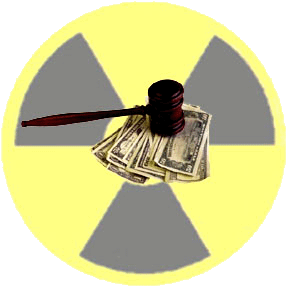 Fukushima n-plant operator faces 10,000 lawsuits http://www.newkerala.com/news/2015/fullnews-54069.html Tokyo, May 6 Nearly 10,000 people have filed lawsuits against the operator of the Fukushima nuclear plant, following the 2011 accident at the plant, according to data released by a group of Japanese lawyers. Currently 9,992 people, among them home-owners unable to return to houses near the plant because of high radiation levels, have filed 25 joint lawsuits against Tokyo Electric Power (TEPCO) in 20 different courts, Efe news agency cited the group as telling Asahi newspaper on Wednesday.
Since then thousands of people, including 900 more so far in 2015, have filed new lawsuits or joined existing ones.
The plaintiffs are dissatisfied with the government’s financial compensation scheme, launched after an earthquake and tsunami on March 11, 2011, triggered the nuclear accident.
Under the compensation scheme, TEPCO has been paying compensation to people who had to abandon their homes and to business owners in the affected region for the losses suffered because of the accident.
However, the plaintiffs claim the payments are insufficient and are asking for TEPCO to pay an additional indemnity until radiation levels around the plant return to the levels of prior to the accident.
They are also claiming financial compensation for the destruction of their communities. Most are also seeking compensation under Japan’s rehabilitation law. Fukushima is the world’s worst nuclear accident since Chernobyl, Ukraine, in 1986, forced the evacuation of thousands of people from the area and seriously affected agriculture, fisheries and local livestock.
Japan: Expert panel says 3 faults beneath Shika nuclear power plant may be active
Shika N-plant faults not ‘inactive’ / Power firm to challenge findings of NRA expert panel The Yomiuri Shimbun 15 May 15, An expert panel of the Nuclear Regulation Authority said Wednesday three faults running beneath the No. 1 reactor and other facilities of Hokuriku Electric Power Co.’s Shika nuclear power plant in Shika, Ishikawa Prefecture, may be active.
Members of the panel agreed on the view that “the possibility that the faults are active cannot be denied.”
The NRA’s new safety standards prohibit the construction of key nuclear facilities such as reactor buildings over active faults.
The No. 1 reactor may have to be decommissioned if the NRA concludes the faults are active. In addition, it also will become difficult to reactivate the No. 2 reactor.
There are eight faults under the nuclear facility site. Among them, it is said that three faults — one called S-1 running beneath the No. 1 reactor and others called S-2 and S-6 located beneath the plumbing system to deliver cooling seawater, which is a key facility — may be active……..
The panel has concluded so far that the No. 2 reactor at Japan Atomic Power Co.’s Tsuruga nuclear power plant in Fukui Prefecture sits on an active fault, while it has denied possibilities that faults located beneath Kansai Electric Power Co.’s Oi nuclear power plant and Mihama nuclear power plant, both in the same prefecture, are active……..http://the-japan-news.com/news/article/0002149236
1 This Month





PLEASE OPPOSE HR 8255 AND S.3639 – bills would accelerate satellite deployment, with no environmental review or safeguards – https://ncstd5li.quorum.us/campaign/169331/
To see nuclear-related stories in greater depth and intensity – go to https://nuclearinformation.wordpress.com
-
Archives
- October 2026 (49)
- September 2026 (339)
- August 2026 (330)
- July 2026 (355)
- June 2026 (287)
- May 2026 (306)
- April 2026 (356)
- March 2026 (251)
- February 2026 (267)
- January 2026 (308)
- December 2025 (358)
- November 2025 (359)
-
Categories
- 1
- 1 NUCLEAR ISSUES
- business and costs
- climate change
- culture and arts
- ENERGY
- environment
- health
- history
- indigenous issues
- Legal
- marketing of nuclear
- media
- opposition to nuclear
- PERSONAL STORIES
- politics
- politics international
- Religion and ethics
- safety
- secrets,lies and civil liberties
- spinbuster
- technology
- Uranium
- wastes
- weapons and war
- Women
- 2 WORLD
- ACTION
- AFRICA
- Atrocities
- AUSTRALIA
- Christina's notes
- Christina's themes
- culture and arts
- Events
- Fuk 2022
- Fuk 2023
- Fukushima 2017
- Fukushima 2018
- fukushima 2019
- Fukushima 2020
- Fukushima 2021
- general
- global warming
- Humour (God we need it)
- Nuclear
- RARE EARTHS
- Reference
- resources – print
- Resources -audiovicual
- Weekly Newsletter
- World
- World Nuclear
- YouTube
-
RSS
Entries RSS
Comments RSS

