Japanese volcano alert issued just miles from newly reopened nuclear reactor

Officials have raised their alert to its second highest level after it detected a spike in seismic activity in a volcano on Saturday near the offshore volcano Sakurajima, Agency France Presse reported.
They have warned an evacuation of the city of just over 600,000 people may be necessary.
The Japanese Meteorological Agency said: “The possibility for a large-scale eruption has become extremely high for Sakurajima.”
It warned residents to exercise “strict caution” and prepare for evacuation.
An official told Sky News: “There is the danger that stones could rain down on areas near the mountain’s base, so we are warning residents of those areas to be ready to evacuate if needed.”
It comes as a nuclear reactor 50 kilometres (31 miles) away was switched back on for the very first time on Tuesday after it was closed in the wake of the Fukushima disaster in 2011.
Critics had warned that the reopening of the Sendai plant, the first in Japan’s renewed nuclear programme, was premature and Japan’s nuclear reactors are still vulnerable to natural disaster.
In October last year, the meterological agency warned that another volcano, Ioyama, near to Sendai plant was at risk of an eruption.
Japan is on the so called “Ring of Fire” along the Earth’s tectonic plates where earthquakes and volcanos are thought to be more common.
According to the agency there are more than 100 active volcanoes in Japan making it one of the most seismological volatile places on earth.
The last major eruption of Sakurajima was in 2013 where an estimated 63 people were killed.
Source: The Independent


Japanese environment groups protest against Restart of Sendai Nuclear Power

 Joint Statement to Protest Restart of Sendai Nuclear Power http://www.foejapan.org/en/energy/doc/150811.html
Government does half-hearted review, downplays risks, pretends Fukushima accident never happened
Today, the Sendai No. 1 nuclear reactor was restarted.
We strongly protest the restart of the Sendai nuclear power plant, which has been done as if the Fukushima nuclear accident never occurred.
The problems with the Fukushima accident have still not been resolved. More than 100,000 people lost their communities and are being forced to live in long-term shelters. Contaminated water is still being discharged, and radiation concentrations continue at high levels in seawater inside and outside of the bay. In Fukushima Prefecture, more than 100 children have been diagnosed with thyroid cancer, and even the prefecture’s thyroid assessment committee has had to admit that there are many cases.
The review by the Nuclear Regulation Authority is merely a facade to produce the desired result. It is no guarantee of the safety of the Sendai power plant.
The volcanic risk assessment went ahead without a volcano expert. Kyushu Electric Power. The Authority blindly accepted Kyushu Electric Power’s monitoring guidelines that pretend they can predict a major eruption. Earthquake-related reviews were done based on the Irikura method, which has been pointed out to underestimate earthquakes, and NRA’s “ aging management implementation guideline for nuclear power generation equipment ” were circumvented at the last minute in order to rush the restart of the reactors .
Evacuation plans are riddled with problems, and no one has verified their feasibility.
The problem of nuclear waste remains completely unresolved.
In public opinion surveys, nearly 60% of the public both in Kagoshima Prefecture and nationwide are opposed to the restart of the reactors. Many people demanded that Kyushu Electric Power and the national government hold briefings and public hearings, but their voices were ignored.
Many people are aware of the deceptive actions of the government and Nuclear Regulation Authority, and are raising their voices in protest.
Once again, we call on the government to acknowledge the seriousness of the Fukushima nuclear accident, to listen to the many voices demanding an end to nuclear power in Japan, and to change course toward nuclear-free policy.

Earthquake M5.0 offshore of Fukushima prefecture
 M5.0 hit Fukushima offshore / No announcement on plant status from Tepco http://fukushima-diary.com/2015/08/m5-0-hit-fukushima-offshore-no-announcement-on-plant-status-from-tepco/ by Mochizuki , August 14, 2015 According to JMA (Japan Meteorological Agency), M5.0 occurred offshore of Fukushima prefecture at 5:13 of 8/14/2015 (JST).
The depth of epicenter was 40km. They observed 4 of seismic intensity in Iwaki city.
The earthquake affected the large area from Shizuoka to Aomori prefecture.
The latest status of Fukushima plant has not been announced by Tepco http://www.jma.go.jp/en/quake/20150814051743395-140513.htm

Japan exposing hundreds of young men to radiation – in the cause of promoting the nuclear industry
the level of radiation is so high that my biggest humanitarian concern is that – if the Japanese push to get these plants dismantled quickly – they will burn out hundreds and hundreds of young men. It’s usually young men because that’s how the construction trade is, needlessly. My point is, walk away for a hundred years, then come back in a hundred. By waiting a hundred years you’re reducing the radiation exposure to a significant, young virile gene pool that in my opinion doesn’t deserve to be exposed right now.
There’s a very real human cost to thousands of construction workers who are being exposed and will be exposed. But they have to show the Japanese that they’re dismantling that site because if the Japanese don’t believe it can be cleaned up they won’t let the other plants start back up.
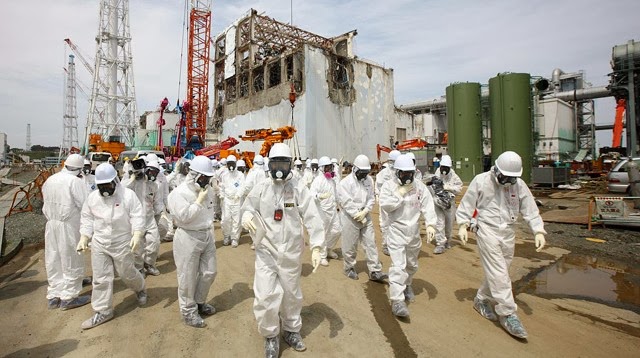
It’s a show. This is all about showing the Japanese that it’s not too bad, and we can run our other forty or so plants fine, trust us. It’s definitely symbolic for the Japanese, but the real reason is the banks want their money back.
This Expert Claims the Japanese Government’s Fukushima Clean Up Is Just “a Show” http://linkis.com/www.vice.com/en_uk/r/5UnqS August 12, 2015 by Thomas Marsh The past couple of weeks have seen two stories draw our attention back to the Fukushima Daiichi nuclear disaster of March 2011, in which three nuclear reactors melted down after the plant was hit by a tsunami. Radioactive material was released in what was the biggest and most disastrous nuclear incident since Chernobyl in 1986.
One story concerned some pictures of deformed daisies near the Fukushima Daiichi site, which trended online for a while and got everyone all hot under the collar about radiation, until it was established that they occur all the time in nature. So no need to worry about that.
The other was a video released by Arnie Gundersen, a former nuclear industry executive and engineer who’s declared Fukushima “the biggest industrial catastrophe in the history of mankind”. In it, he claimed that 23,000-tankers of water contaminated with radioactive isotopes have leaked into the Pacific from the Fukushima Daiichi site since 2011 and will continue to do so for decades – at a rate of three hundred tonnes a day. So maybe start worrying again.
Sure enough, a recent report by the Tokyo Electric Power Company (TEPCO) claimed that concentrations of radioactive isotope Strontium-90 have reached record highs in certain areas of the Pacific Ocean around Fukushima, with levels spiking by about 1,000 percent in three months. Continue reading
Sendai plant begins producing electricity after nearly 2 years of nuke-free nation
 Plant workers applaud as the No. 1 reactor at the Sendai nuclear plant starts
electricity generation and transmission on Aug. 14.
SATSUMA-SENDAI, Kagoshima Prefecture–Marking the end of 23 months of a nuclear power-free Japan, the Sendai nuclear power plant began generating and transmitting electricity on Aug. 14.
Kyushu Electric Power Co. activated the No. 1 reactor at the Sendai plant on Aug. 11, to become the first nuclear reactor brought back online under new safety regulations instituted by the Nuclear Regulation Authority after the 2011 Fukushima nuclear disaster. The nation had been without nuclear power since September 2013.
At 9 a.m. on Aug. 14, utility workers connected an electrical generator with power cables from the plant’s central control room. The workers applauded when it was confirmed that the reactor began power generation and transmission for the first time in more than four years.
In a statement released the same day, Yoichi Miyazawa, the minister of trade and industry, said the start of generating and transmitting power at the plant “represents an important step forward to achieving a well-balanced energy mix and a more stable supply of electricity.”
The output from the reactor was expected to reach 30 percent of its full capacity of 890,000 kilowatts on Aug. 14, and will be raised gradually to reach full power generation in about 10 days.
The reactor is expected to begin commercial operations in early September unless the NRA detects safety problems during its final inspection.
Michiaki Uriu, Kyushu Electric Power president, said in a statement that the company will continue its efforts to improve safety at the plant with “determination to prevent an accident similar to the one at the Fukushima No. 1 nuclear power plant from occurring.”
“We will gradually increase the output while closely monitoring the condition of the plant,” he said.
Kyushu Electric officials said the utility will proceed cautiously with operation of the No. 1 reactor as its operations had been suspended for a periodic inspection in May 2011.
It will be the first time that electricity generated at a nuclear plant will be supplied to households and businesses since the No. 4 reactor at Kansai Electric Power Co.’s Oi nuclear power plant in Fukui Prefecture went offline in September 2013.
Kyushu Electric, which relied on nuclear energy for about 40 percent of its power supply before the Fukushima disaster unfurled, plans to restart the No. 2 reactor at the Sendai plant in mid-October.
It has also applied for NRA safety screening to resume operations of the No. 3 and No. 4 reactors at its Genkai plant in Saga Prefecture.
Preparations for restarts are progressing at the No. 3 and No. 4 reactors of Kansai Electric’s Takahama nuclear power plant in Fukui Prefecture and the No. 3 reactor of Shikoku Electric Power Co.’s Ikata nuclear power plant in Ehime Prefecture.
The restart of the Sendai plant is likely to give momentum to efforts by the electric power industry and Prime Minister Shinzo Abe’s government to restart idle nuclear reactors nationwide.
But municipalities located near nuclear power plants have yet to map out effective evacuation plans for people in local medical and welfare facilities in the event of nuclear accidents.
A shortage of buses and other transportation modes to evacuate residents remains unsolved, while it also is unclear if utility companies can effectively shut down reactors when a Fukushima-level accident takes place at a nuclear plant.
Opinion polls have shown that more Japanese are opposed to the reactor restarts than those who support them.
Source: Asahi Shimbun
http://ajw.asahi.com/article/behind_news/social_affairs/AJ201508140058
Fukushima evacuees return home during Bon to visit ancestors’ graves
 Kuniyuki and Reiko Sakuma, along with their daughter Rie Hosoya, right, clean the graves of their ancestors in Okuma, 500 meters from the crippled Fukushima No. 1 nuclear power plant, in Fukushima Prefecture on Aug. 13.
OKUMA, Fukushima Prefecture–Clad in masks, caps and other protective gear, a handful of evacuees from the Fukushima nuclear disaster returned to their hometown here to pay their respects at the graves of their ancestors.
Kuniyuki Sakuma, 65, and his wife, Reiko, 66, visited the tomb of Sakuma’s father on Aug. 13, located just 500 meters from the embattled Fukushima No. 1 nuclear power plant. Their visit coincided with the traditional Bon festival in which people stop by their ancestors’ graves.
Sakuma and his wife remain evacuated in Iwaki, also in the prefecture, due to the lingering high levels of radiation in Okuma. About 110,000 people remain evacuated from their homes in Fukushima Prefecture.
A year after the onset of the 2011 nuclear disaster, Sakuma’s father, Kunimaru, died of a ruptured aneurysm while living in temporary housing as an evacuee. Kunimaru had taken great pride in running a successful pear farm in Okuma and often expressed his desire to return to his farm.
Although his tomb is currently in Okuma, Kunimaru’s final resting place remains unknown as the grave site is marked for the construction of an interim facility to store contaminated soil and material from cleanup efforts at localities surrounding the nuclear plant.
Sakuma said the Environment Ministry has provided no information on what will become of his father’s tomb.
On Aug. 13, airborne radiation levels at the grave site measured more than 100 times the levels in Iwaki.
Sakuma said he understands that returning to Okuma to live is unrealistic. But he added that he cannot readily abandon the land where his parents once resided.
During their one-hour visit, Sakuma and his wife also stopped by their Okuma home to find their garden overrun with weeds.
“I wonder if my father would be upset if I move the grave somewhere else,” Sakuma said. “I would not have to be worried about this kind of thing if the nuclear disaster had not occurred in the first place.”
Source: Asahi Shimbun
http://ajw.asahi.com/article/0311disaster/fukushima/AJ201508140038
Tepco readies to install unit 3 cover
From World Nuclear News, a pro-nuclear website

The installation of a protective cover over unit 3 of the damaged Fukushima Daiichi plant in Japan can start as soon as the removal of rubble from the reactor building is completed, Tokyo Electric Power Company (Tepco) said.
Plans were announced in November 2012 for a cover to be constructed to encase the unit’s damaged reactor building, protecting it from the weather and preventing any release of radioactive particles during decommissioning work.
The section of the reactor building that sheltered the service floor of unit 3 was wrecked by a hydrogen explosion three days after the tsunami of March 2011 – leaving the fuel pond exposed and covered by debris including many twisted steel beams.
The fabrication of the cover has been under way since November 2013 at the Onahama works in Iwaki city. It has been made in sections so that once it is transported to Fukushima Daiichi, the time to assemble it can be shortened and the radiation exposure to the workers on site can be significantly reduced, Tepco said.
A separate structure will be built to facilitate the removal by crane of used fuel from the storage pool. This 54-metre-tall structure will include a steel frame, filtered ventilation and an arched section at its top to accommodate the crane. Measuring 57 metres long and 19 metres wide, it will not be fixed to the reactor building itself, but will be supported on the ground on one side, and against the turbine building on the other.
On 2 August, Tepco announced that it had removed the fuel handling machine, the largest remaining piece of rubble, from the unit’s used fuel pool at the top of its reactor building. Its removal followed months of preparation and clears the way for the remaining rubble and the used fuel in the storage pool to be removed.
The assembly of the protective cover over unit 3 will start once all the rubble is removed.
Tepco said there are a total of 566 fuel assemblies inside the unit’s pool and the cover will prevent radioactive substances from scattering during their removal.
The fuel removed from unit 3 will be packaged for transport the short distance to the site’s communal fuel storage pool, although it will need to be inspected and flushed clean of dust and debris.
Source: World Nuclear News
http://www.world-nuclear-news.org/RS-Tepco-readies-to-install-unit-3-cover-1308155.html
VOX POPULI: Trickery ensures nobody gets blamed if nuclear restart goes wrong
The Bay of Pigs Invasion of April 1961, undertaken by the United States to overthrow the Fidel Castro regime in Cuba, ended in dismal failure. It left a stain on the administration of President John F. Kennedy, which was still only in its third month.
Kennedy is said to have been reluctant to go ahead with this campaign. But he accepted responsibility for the failure and said at a news conference, “Victory has a thousand fathers, but defeat is an orphan.”
This famous Kennedy quote drips with sarcasm. When something goes right, everyone wants to claim credit. But when something goes wrong, nobody comes forward to assume responsibility.
I am probably not the only person who was reminded of this quote by the appalling irresponsibility of the people involved in the new National Stadium project.
And there is also the matter of the reactivation of the No. 1 reactor at the Sendai nuclear power plant operated by Kyushu Electric Power Co. In taking the first step back to nuclear power generation, the parties concerned left their own responsibilities completely vague, perhaps in order to dodge criticism from people opposed to nuclear power generation, or as a precaution just in case something goes wrong later.
Kyushu Electric Power is primarily responsible for restarting the reactor, but it was the government that gave the green light.
The government stresses that Japan has “the most stringent safety requirements (for nuclear reactor operation) in the world.” But the Nuclear Regulation Authority, the nation’s nuclear watchdog, says that “accidents can happen even if the safety requirements are met,” and that it withholds “judgment on whether reactors should be restarted or not.”
There are just too many questions that remain unanswered.
In a collusive relationship, it is easy for everyone to practice obfuscation to escape responsibility. The Fukushima disaster of March 2011 was evidence of the government’s failed energy policy. It also destroyed the “safety myth” of nuclear power generation. The grave responsibility of the political, bureaucratic and academic communities should have been thoroughly scrutinized then, but the matter was never really pursued.
As a result, many of the helpless and innocent residents who had to leave their hometowns are still living in “exile” today.
After one year and 11 months of zero nuclear power generation nationwide, electricity generated by nuclear energy will start reaching consumers again Aug. 14. Electricity is electricity, no matter what the source. Where it comes from is irrelevant so long as it delivers cool air from the air-conditioning unit and turns lights on.
But if we unthinkingly go back to a society where nuclear power generation is simply taken for granted, we would be wasting the bitter lessons we learned from the Fukushima disaster.
Source: Asahi Shimbun
Is the Pacific Ocean Japan’s private dumpyard?

An article coming from the Yomiuri Shimbun, a pro-government media, its director and Prime Minister Abe are very best friends.
Read between the lines, funny enough the title says it all: the most important part of the Tepco Fukushima Daiichi decommissioning plan is to be able to dump as much contaminated water as possible into the Pacific Ocean.
Mind you Tepco has been already doing that all along since the beginning, but in a sneaky manner. With the now obtained approval of the Fukushima Prefectural Federation of Fisheries Cooperative Associations, Tepco will be able to do it in the open and in a grand manner.
Mind you, what Tepco calls decontaminated water, is contaminated water which has been only partially decontaminated, as the two decontamination systems Alps and Kurion can only filter, remove, 62 radionuclides out of the 1270 radionuclides present in that contaminated water.
This confirms what we already knew of Tepco’s intentions, somehow Tepco and the Japanese Government since day one have been considering our Pacific Ocean to be their contaminated water private dumpyard.
Why other countries of the Pacific region are not protesting against this constant radioactive water duumping which has been ongoing now for more than 4 years?
Release of treated water into sea a step toward Fukushima decommissioning
A solid step has been taken toward the decommissioning of the reactors at Tokyo Electric Power Co.’s Fukushima No. 1 nuclear power plant.
The Fukushima Prefectural Federation of Fisheries Cooperative Associations has approved TEPCO’s plan to release water into the ocean after it has been decontaminated.
Under the plan, TEPCO will pump up water from wells, called subdrains, around reactor buildings at the plant. This water will then be treated and discharged into the sea. There are expectations that this will reduce the volume of contaminated water generated when groundwater accumulates inside buildings wrecked by the March 11, 2011, earthquake and tsunami.
As preconditions for accepting the subdrain plan, the prefectural fisheries federation listed five demands, including improving public channels of information regarding the plan’s stringent water management and safety. These conditions were set out of the federation’s concern about groundless rumors surrounding the plan. TEPCO must sincerely handle these demands and ensure the water release plan is translated into action soon.
Regarding water quality management, TEPCO plans to set a stringent goal of cleaning the water to a level that exceeds international standards for drinking water. It is conducting water purification tests using a special-purpose treatment system. We hope the utility will release this data and carefully explain the system to clear up any anxiety felt by the public.
Initially, the volume of groundwater seeping into the buildings at the nuclear plant reached about 400 tons a day.
Since May 2014, TEPCO has been pumping up groundwater from other wells on the hill near the plant and releasing it into the sea before it flows into the buildings and becomes contaminated. This process has reduced the daily volume of water entering the buildings to about 300 tons a day.
TEPCO believes realization of the plan to pump water from the subdrains and discharging it into the sea after treatment could halve the volume of water entering the wrecked buildings to about 150 tons per day.
Undoubtedly, this will significantly reduce the labor required for managing contaminated water at the plant.
A boost for ‘ice wall’
The fisheries federation stated that the reduced risk of ocean contamination was one reason for its decision to give the green light to the plan.
An impermeable wall has been built along the port in front of the wrecked plant to prevent contaminated water from reaching the sea. The wall contains an opening about 10 meters wide, so it is not completely closed off. The federation viewed the flow of contaminated water through this opening into the port as a problem.
This opening was left because completely blocking off the groundwater would have the effect of a dam, and the water level behind it would rise. There were fears this would increase the volume of water entering the buildings.
By pumping up groundwater through the subdrains, the impermeable wall can be sealed off and any rise in the water level can be prevented. This should help to dispel groundless rumors.
There are also expectations that pumping up groundwater and reducing the water level will enable greater progress in TEPCO’s construction of an “ice wall,” in which soil around the reactor buildings will be frozen to stop groundwater from entering the buildings.
However, even after treated water is discharged into the sea, contaminated water will continue to accumulate. A veritable forest of about 950 large tanks, which combined hold about 690,000 tons of water, already stands within the plant’s premises. Sooner or later, it will become difficult to secure space to install any more tanks.
Purification of the water stored in these tanks is progressing steadily. At some point, discharging this water into the sea also will need to be considered.
Source: Yomiuri Shimbun
Why was the Sendai nuclear power plant restarted?
Two of Japan’s reactors—Units 1 and 2 of the Kyushu Electric Power Company’s Sendai nuclear power plant—have just restarted, and Unit 1 should begin generating electricity on August 14. Like all other Japanese nuclear power plants, Sendai was shut down after the events at Fukushima Daiichi in 2011, in which an earthquake, a tsunami, egregious design mistakes, and a poor safety culture combined to form “a cascade of stupid errors” that led to a triple meltdown.
This is the first restart of any of Japan’s 43 operable commercial reactors since Fukushima, and it is happening despite many unresolved questions concerning nuclear safety regulations. When it comes to safety, the Sendai nuclear power plant is definitely not at the head of the class: The utility owning the power plant was given a pass despite a very problematic history. (At one point, a regulatory commissioner called the plan to restart Sendai “wishful thinking”.)
There is certainly no nationwide re-emergence of nuclear power in Japan. Indeed, there have been vocal public protests against the Sendai restart. One of the protestors even included a former prime minister of Japan.
So, why is it happening? What are the ostensible reasons for a restart? Were they valid?
A three-pointed rationalization. The justification for a restart was based upon three key points: the type of reactors to be used at Sendai were considered inherently “safer;” the chance of a similar natural disaster(s) was considered to be minimal; and the concerns of the local communities were dismissed as inconsequential.
Let us look at each of these items in turn.
Pressurized water reactors are considered inherently safe. Because strict new standards for the regulation of nuclear power plants were imposed in July 2012—the result of the belated adoption of a tougher global standard—Japan’s newly formed Nuclear Regulation Authority deemed that pressurized water reactors (PWRs) such as those used at Sendai were safer than the boiling water reactor technology used at the ill-fated Fukushima Daiichi nuclear plant. Consequently, facilities with PWRs were given a longer time span—five years—to introduce severe accident countermeasures when the new regulation standards come into force.
For example, a nuclear power plant using a pressurized water reactor is not required to immediately install a filtered containment venting system to prevent large-scale radioactive contamination to the environment if the containment vessel inside is damaged. The Nuclear Regulation Authority’s reasoning is that the risk of containment vessel damage is low in a pressurized water reactor because it is so much larger than in a boiling water reactor, thus allowing considerably more time before any accident measures must be put into effect. Building on this logic, the agency then gave a temporary exemption to the requirement to install the venting system to any facility using PWRs. This relieved the plant operators of heavy burdens in terms of both finances and preparatory work. All 10 of the nuclear power plants (representing six different electric companies) that applied for the waiver use pressurized water reactors.
But PWRs are not inherently safe at all; for example, their steam generators are a serious concern. In 1991, the steam generator in the pressurized water reactor at Mihama Unit 2 of Kansai Electric Power in Japan was damaged, and the emergency core cooling system had to activated. Though caused by something as simple as the failure of the mount of a metal fitting, the resulting accident was rated at Level 3, or “serious incident,” on the seven levels of the International Nuclear Event Scale. Similarly, in 2013, Unit 2 and Unit 3 of the San Onofre nuclear power plant in California had to be closed due to a radiation leak from the plant’s virtually new steam generators; the two units subsequently had to be retired and the plant is now in the process of a costly decommissioning, predicted to cost $3 billion. And San Onofre used pressurized water reactor technology.
Natural disasters can be predicted. There are many glaring problems with this argument, not the least of which is the tendency of, say, volcanoes to behave in ways we don’t foresee. This is of major concern in Japan, which sits on the Pacific Ring of Fire, where tectonic plates interact and a large chunk of the planet’s volcanic eruptions and earthquakes takes place. Kyushu Electric Power claims that volcanic eruptions can be readily predicted, and the Nuclear Regulation Authority accepted this argument. But many volcanologists insist that it is scientifically impossible to predict the eruption of a volcano—and there are many volcanoes and calderas near the Sendai nuclear power plant. According to a survey conducted by Kyushu Electric Power, catastrophic eruptions have been occurring on a 90,000-year cycle at the Aira Caldera, located 53 kilometers, or about 33 miles, from the Sendai site, with the latest eruption about 30,000 years ago. (There have been many smaller, near-continuous eruptions in the caldera since 1955.) Furthermore, sediment from the pyroclastic flow of a volcano has been discovered only 5 kilometers, or roughly 3 miles, from the reactors at Sendai.
Another problem comes from trying to determine the maximum acceleration likely to occur at the time of an earthquake. This is an issue of tremendous concern, because there are about 1,500 earthquakes of varying sizes in Japan every year. In the words of the World Nuclear Association: “Because of the frequency and magnitude of earthquakes in Japan, extra attention is paid to seismic activity in the siting, design, and construction of nuclear power plants. The seismic design of such plants is based on criteria far more stringent than those applying to non-nuclear facilities.”
Yet one of the reasons that the authority announced fast-track approval for Sendai was based upon a recalculation of the largest earthquake that could reasonably be expected to occur at the site of this nuclear power plant—which was found to be larger and more devastating than before, based upon the known seismicity of the area and local active faults. Known as “peak ground acceleration,” this figure is expressed in the number of centimeters per second squared, also known as “Galileo units” or Gal. Setting the value of a specific region’s peak ground acceleration is difficult scientifically; guessing just how bad an earthquake can get is the cause of many safety design revisions and much expense. In the case of the Kyushu Electric Power Company, however, the company not only said on its restart application that an earthquake was likely to be worse than previously expected (620 Gal rather than the earlier estimate of 540 Gal), it cavalierly said that its current reactor would be able to handle the higher figure. The NRA apparently considered this platitude about the resiliency of the company’s Sendai plant to be a statement of scientific fact and sufficient in terms of safety.
And some seismologists insist that an earthquake at Sendai is likely to be even more severe—they say that the earth could shake much more than 620 centimeters (about 20 feet) per second squared. For example, Katsuhiko Ishibashi, a Kobe University professor and seismologist, has been warning about the problem of nuclear power plant accidents caused by earthquakes since his first book on the topic in 1994—17 years before what happened at Fukushima Daiichi. (Ishibashi even coined a term in the Japanese language to describe the problem: “gempatsu shinsai,” or “nuclear earthquake disaster.”) He insists that the intensity of a more severe earthquake is underestimated because the current value does not take into consideration other phenomena, such as an interplate earthquake.
And in any case, the 620 Gal figure comes from earthquake data collected from the north end of Japan, while the Sendai nuclear power plant is located at the south end, where conditions may be different. So, we don’t precisely know just how severe the peak ground acceleration will be at Sendai.
There is no available scientific literature on the influence of a major earthquake on delicate devices such as the steam generators used in pressurized water reactors.
Concerns of the local communities were dismissed. After the Nuclear Regulation Authority granted its approval in regards to the safety requirements, the final hurdle was to secure approval from two of the local governments: Kagoshima prefecture and Satsumasendai city. If they agreed, then the Sendai facility could restart.
Other neighboring communities, including six cities and two towns, had asked that the prefecture and the city include them in the list of “local governments of the nuclear power plant site.” They based their request on the fact that they would likely be affected by any radioactive contamination—after all, the plume caused by the Fukushima accident spread over 250 kilometers (155 miles) from the reactor site. But only those communities within 8 to 10 kilometers (about 5 to 6 miles) from the Sendai nuclear power plant were allowed to participate.
And even those within that radius were sometimes barred from having their concerns heard. A neighboring city, Ichikikushikino, is located just 5 kilometers (about 3 miles) from the Sendai plant, but that city’s request to be heard was denied by the governor of Kagoshima prefecture governor, Yuichi Ito, and by the mayor of Satsumasendai city, Hideo Iwakiri. This refusal is assumed to be based on two reasons: In addition to the difficulty of summarizing the different opinions on the nuclear restart, prefecture and city officials were concerned about having to decrease their own constituents’ share of the subsidy benefits that are to be provided by the plant to local governments. In the end, only Kagoshima prefecture and Satsumasendai city approved the restart in November 2014.
Other actions by the prefecture governor caused problems, as well. The prefecture’s disaster prevention plan was supposed to include an evacuation program for people requiring special assistance in any medical or welfare facilities located within 30 kilometers (about 20 miles) from the Sendai nuclear power plant. The prefectural governor, however, declared that an area within 10 kilometers (roughly 6 miles) from the power plant was more than sufficient as the target area for this program. Therefore, the number of applicable facilities was reduced from 244 facilities to to only 17 facilities, or less than one-tenth the original number. Furthermore, an evacuation facility that had been constructed by repairing an old elementary school, Yorita Elementary, turned out to have insufficient protective measures against radiation, even though the total construction cost for the facility was the equivalent of $760,000.
The real reasons for the restart. The decision to restart the reactor at Sendai is probably based upon the “dismal science:” economics.
It seems that financial considerations and worries about the health of the national and local economies triumphed over safety concerns; an article in the Japan Times says that when Kyushu Electric tried to turn to other means of generating electricity—such as thermal power—its costs more than doubled. “The huge costs have weighed heavily on its earnings. The company is aiming to shore up its earnings by reactivating idled nuclear power reactors. Kyushu Electric expects that the restart of the Sendai Number 1 reactor will save the company about 7.5 billion yen (over $60 million) per month.”
Kyushu Electric Power had previously tried raising the price of electricity after their nuclear power plant was stopped, but that still was not enough—their deficit continued. The best hope of profitability comes from restarting nuclear power plants.
This concern for their bottom line may be understandable, but it seems to come at the expense of public safety and open, democratic, rational decision-making. Kyushu Electric Power has used questionable means to promote its agenda. For example, at an informational meeting for local residents about nuclear power plant operation only three months after the Fukushima accident, Kyushu Electric Power sent in undercover employees pretending to be ordinary citizens, who then stood up and spoke in favor of nuclear power. The company also tried to manipulate public opinion by sending in “fake e-mails” in support of the restart of nuclear power plants to a television broadcaster. The president of Kyushu Electric Power resigned after the ruses were discovered.
Meanwhile, Kyushu Electric Power still refuses to hold talks with citizen groups and neighboring local governments, even after the plant has been cleared to restart. They also refused an offer from nearly 100 citizen groups this March to hold a discussion, and did not accept a petition containing more than 100,000 signatures. The company continues to refuse the requests of many local governments within the 30 kilometer (20 miles) radius of the Sendai site.
Economics also played a role in another way: The prefecture and the nearest city are financially dependent on nuclear energy. For a long time, the prefecture governor has been clearly stating that he endorses the restart. After the prefectural assembly election this April, he revealed that the reason the restart was approved in November 2014 was to avoid having it become an election issue.
Satsumasendai city receives more than $12 million in grants annually from the nuclear industry, which it uses to pay for its public and educational facilities, receiving about $270 million over the years. According to the Satsumasendai Chamber of Commerce and Industry, the overall economic benefit of the restart of the Sendai nuclear power plant is approximately $25 million to the local economy yearly.
There are also questions of transparency in the dealings of local government authorities with Kyushu Electric Power. According to an article published this January by the Asahi Shimbun newspaper, construction companies run by members of the Kagoshima prefectural assembly received 26 orders for construction work at Sendai, representing $2.5 million of work, in the three years since the Fukushima accident. Not surprisingly, these members of the prefectural assembly endorsed the restart of the Sendai nuclear power plant.
According to a survey conducted this May by a major local newspaper, Minami–Nippon Shimbun, 59.9 percent of those polled were against a restart of the Sendai nuclear power plant. But their opinions may not be regarded as important because they have no economic significance. In this way, strict regulations are not being applied to nuclear decisions, even after the Fukushima accident. Economics was considered more important than human life: That is why the Sendai nuclear power plant was able to restart.
Source: Bulletin of the Atomic Scientists
http://thebulletin.org/why-was-sendai-nuclear-power-plant-restarted8644
Sendai nuclear station restarted because economics are ‘more important’ than human life
The real reasons for the restart. The decision to restart the reactor at Sendai is probably based upon the “dismal science:” economics. It seems that financial considerations and worries about the health of the national and local economies triumphed over safety concerns.
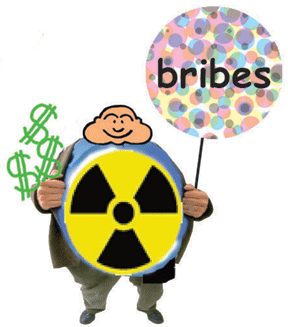 The prefecture and the nearest city are financially dependent on nuclear energy.
Satsumasendai city receives more than $12 million in grants annually from the nuclear industry, which it uses to pay for its public and educational facilities, receiving about $270 million over the years.
There are also questions of transparency in the dealings of local government authorities with Kyushu Electric Power.
Economics was considered more important than human life: That is why the Sendai nuclear power plant was able to restart.
Why was the Sendai nuclear power plant restarted? http://thebulletin.org/why-was-sendai-nuclear-power-plant-restarted8644 Tadahiro Katsuta 13 Aug 15 Two of Japan’s reactors—Units 1 and 2 of the Kyushu Electric Power Company’s Sendai nuclear power plant—have just restarted, and Unit 1 should begin generating electricity on August 14. Like all other Japanese nuclear power plants, Sendai was shut down after the events at Fukushima Daiichi in 2011, in which an earthquake, a tsunami, egregious design mistakes, and a poor safety culture combined to form “a cascade of stupid errors” that led to a triple meltdown.This is the first restart of any of Japan’s 43 operable commercial reactors since Fukushima, and it is happening despite many unresolved questions concerning nuclear safety regulations. When it comes to safety, the Sendai nuclear power plant is definitely not at the head of the class: The utility owning the power plant was given a pass despite a very problematic history. (At one point, a regulatory commissioner called the plan to restart Sendai “wishful thinking”.)
There is certainly no nationwide re-emergence of nuclear power in Japan. Indeed, there have been vocal public protests against the Sendai restart. One of the protestors even included a former prime minister of Japan.
So, why is it happening? What are the ostensible reasons for a restart? Were they valid?
A three-pointed rationalization. The justification for a restart was based upon three key points: the type of reactors to be used at Sendai were considered inherently “safer;” the chance of a similar natural disaster(s) was considered to be minimal; and the concerns of the local communities were dismissed as inconsequential.
Let us look at each of these items in turn. Continue reading
“Trillions of becquerels of radioactive material still flowing into sea” at Fukushima
 Officials: “Trillions of becquerels of radioactive material still flowing into sea” at Fukushima — Map shows nuclear waste coming up from bottom of ocean far offshore — Japan TV Journalist: “Contaminated seawater will circulate around globe… disaster like a huge cloth expanding everyday” (VIDEO) http://enenews.com/officials-trillions-becquerels-radioactive-material-flowing-sea-fukushima-map-shows-nuclear-waste-flowing-bottom-ocean-offshore-japan-tv-journalist-contaminated-seawater-will-circulate-around-gl?utm_source=feedburner&utm_medium=email&utm_campaign=Feed%3A+ENENews+%28Energy+News%29
Interview with NHK journalist Morley Robertson, by the Center for Remembering 3.11, published Jun 30, 2012 (emphasis added): I begin with the radiation leakage. Radiation leakage exerts a long term effect on the environment. It contaminates our food chain, the groundwaterand the ocean. And the contaminated seawater will circulate around the globe. We never know how much this will impact on the environment… We’ll never able to study such issues with empirical certainty… [Due to nuclear testing] we have already accumulated “hidden losses” of radiation damage… how much is the [Fukushima] cesium in relation to that?… I believe we should enjoy delicious food rather than worrying about the food. I enjoyed the town’s delicacy… I didn’t mind about how the beef was produced or where it came from. As long as it is tasty, it is no problem for me. With regard to radiation, I have become more optimistic. My hypothesis is that it’s no use worrying about radiation. For people in Fukushima, they have a lot to worry about their future, like damaged reputation… One reason why we have relied on nuclear plants is because we didn’t know about the facts… We need to face the facts… Rad-waste from the nuclear cycle is said to be unsolvable even after 2.5 million years.
Part II of Robertson’s Interview, published Jun 30, 2012: In 1974, then PM Tanaka declared, “Let ‘s go nuclear!”… we were issued credit cards to buy electric goods to consume the extra electricity… It is OK to say that everything was just a lie… and 3/11 happened. So we must study everything. It isno longer about what to do with Onagawa nuclear power plant, Miyagi or Tohoku. This is about what to do with Japan. This has been revealed by our vulnerability to the accident… So when we talk about “disaster“, it’s like a huge wrapping cloth expanding everyday.
- NHK: Morley is a journalist… working in the fields of television, radio, and lecture meetings… he studied at the University of Tokyo and Harvard University.
- Robertson’s Wikipedia entry (translated from Japanese by Microsoft): In 1968, because of father’s job moved to… Hiroshima [to work] on Atomic Bomb Casualty Commission [and] undertook study of atomic bomb patients.
TEPCO, updated Mar 10, 2015: Fukushima Daiichi Contaminated Water Issue FAQ — Q1Please explain the impact of the leaked radioactive materials on the sea. [Answer:] TEPCO announced that underground water including radioactive materials had leaked into the port… It has been implied that trillions of becquerels of radioactive materials are still flowing into the sea; however, the concentration of radioactive materials in the sea is at a level that meets the Guidelines for Drinking-water Quality, except for some areas…
TEPCO, Apr 28, 2015: Comprehensive risk review was implemented, considering all the possible risks that might have an impact outside the Fukushima Daiichi NPS site… Thepaths through which water could leak outside the site: …
- Sources of risk — Trenches… Pits… Tanks… Accumulated water inside reactor buildings… Contamination inside the port
- Leakage routes — Ground surface… Drainage channels… Underground (groundwater)
- Destination of the contaminated material… The Sea: Unit 1-4 water intake channel… Inside the port… Outside the port
 Hajime Anbe says he cannot abide the reactivation of the Sendai Nuclear Power Plant’s No. 1 reactor as an evacuee of the ongoing Fukushima nuclear disaster, in Shimotsuke, Tochigi Prefecture.
The tone of Hajime Anbe’s voice, usually soft, becomes forceful when asked about the reactivation of the No. 1 reactor at Sendai Nuclear Power Plant in Kagoshima Prefecture.
“I cannot believe that a nuclear reactor has been restarted when the prospects of decommissioning the stricken Fukushima plant are still unclear,” he says. “It’s absurd, and rattles the nerves of those of us who have had to evacuate.” As a result of the Fukushima crisis, the 79-year-old Anbe has been forced to flee his home in the prefectural town of Namie and is temporarily living in Shimotsuke, Tochigi Prefecture. He is among the 110,000 people still evacuated, four years and five months since the disaster broke out.
Anbe has a bitter past. In the latter half of the 1960s, Tohoku Electric Power Co. announced the possibility of building a nuclear power plant in Namie and neighboring areas. The planned site was approximately one kilometer east of Anbe’s home. Convinced that such a plant would bring more jobs to his town, Anbe agreed to allow the road behind his home to be used as a route to the plant. He worked to obtain the support of other local residents and took care of the road, cutting the grass that grew on it.
Ultimately, due to residents’ objections and other factors, the plan fell through. Looking back, Anbe says, “I completely believed in nuclear power’s ‘safety myth.’ I should’ve done more research.”
His love for his hometown goes back 70 years, to the end of World War II. When his two older brothers returned from the battlefield, they expressed relief that even though Japan had lost the war, they had a hometown to return to. They told him that now that peace had arrived, they should work to make their hometown into a great place. With that ambition in his heart, Anbe took over the family’s farming business, expanded their farmland to six hectares, and devoted himself to growing rice.
His home in Namie is in a zone designated as preparing for the lifting of an evacuation directive. Because he believes his hometown will cease to exist unless its residents return, Anbe is planning to go back as soon as the evacuation order is lifted. An increasing number of residents are giving up any hopes of returning, however, disappointed that the crisis is far from being brought under control.
“Our hometown survived the war, but this time it might really disappear,” Anbe laments. And that fear is what pushes him to object to the reactivation of nuclear reactors, which feels to him like pretending the Fukushima disaster never happened.
Source: Mainichi
http://mainichi.jp/english/english/newsselect/news/20150812p2a00m0na007000c.html
Japan resumes nuclear reactor operation for 1st time in 2 years

Kyushu Electric Power Co. on Aug. 11 restarted the No. 1 reactor at its Sendai Nuclear Power Plant in Satsumasendai, Kagoshima Prefecture, making it the first reactor to be reactivated under new safety regulations established in the wake of the Fukushima nuclear disaster.
It was the first time in about two years for a nuclear reactor to operate in Japan, after the No. 3 and No. 4 reactors at the Oi Nuclear Power Plant in Fukui Prefecture were shut down in September 2013. The Kagoshima plant’s 890 megawatt No. 1 reactor had been inactive for around four years, three months.
At 10:30 a.m. on Aug. 11, a lever in the Sendai Nuclear Power Plant’s central control room was operated to remove rods controlling nuclear fission from the reactor. The reactor is expected to reach criticality at about 11 p.m. the same day.
After the reactor reaches criticality, Kyushu Electric Power Co. will check that it can be safely shut down, and if there are no problems, power generation and transmission will begin on Aug. 14. The power company will bring the reactor to full operating capacity in stages while checking the temperature and pressure inside the reactor.
If Japan’s Nuclear Regulation Authority (NRA) finds no problems with the reactor during an inspection, commercial operation will resume in early September.
Operation of the No. 1 reactor at the Sendai Nuclear Power Plant was suspended in May 2011 for a regular inspection. Since the reactor has been offline for a long time, possible trouble caused by deterioration of pipes and other equipment has been feared. It is rare globally for a reactor to be restarted after being offline for more than four years.
NRA Chairman Shunichi Tanaka has commented that various problems are envisaged, and the nuclear watchdog is therefore seeking solid safety precautions. The power company has said it will quickly release information if there is any trouble or if equipment malfunctions.
Kyushu Electric Power Co. has also had the nuclear plant’s No. 2 reactor undergo preoperational checks, and if there are no problems, the reactor is expected to be restarted in mid-October.
Japan has a total of 54 nuclear reactors. In the wake of the meltdowns at the Fukushima No. 1 Nuclear Power Plant triggered by a massive earthquake and tsunami in March 2011, reactors were gradually shut down, and in May 2012 no reactors were in operation. In July that year, the government restarted the No. 3 and 4 reactors at the Oi Nuclear Power Plant in Fukui Prefecture as a special measure, but they were shut down in September 2013 for regular inspections, again leaving Japan with no reactors in operation.
Applications have been filed with the NRA to screen 25 reactors at 15 nuclear power plants in Japan. In addition to the No. 1 and 2 reactors at the Sendai plant, other reactors to have received safety approval from the regulator are the No. 3 and 4 reactors at Kansai Electric Power Co.’s Takahama plant in Fukui Prefecture, and the No. 3 reactor at Shikoku Electric Power Co.’s Ikata plant in Ehime Prefecture. All of these reactors are pressurized water reactors, different from those at the Fukushima plant.
The Fukui District Court has issued a temporary injunction halting activation of reactors at the Takahama plant, and there are no immediate prospects of the plant’s reactors being restarted.
It is unclear whether local consent can be obtained for restarting the Ikata plant reactor, and it is unlikely that it will be reactivated this year.
Source: Mainichi
http://mainichi.jp/english/english/newsselect/news/20150811p2a00m0na017000c.html
Why are Radioactive Emissions Increasing at Fukushima Daiichi?
Fukushima Daiichi continues to contaminate the atmosphere with radionuclides. TEPCO acknowledged in July of 2012 that units 1 through 4 at the plant were emitting approximately 10,000,000 Bq per hour.[i]
It appears as if emission levels have increased since 2012. According to documents interpreted by Fukushima Diary, TEPCO asserted May 25, 2015 that ongoing emissions were estimated at a rate of 2,336,000,000 Bq per hour of noble gas and 960,000 Bq per hour of of Cs-134/137.[ii]
Fukushima Diary pointed out that Reactor 3 emissions increased over 2014. Reactor 4’s emissions were reported as 95,000 Bq/hour of Cesium134/137 despite TEPCO’s reported success in removing rods from unit 4.Why?
Why are atmospheric emissions rising and what does it mean for climate change? Please see discussion here: http://majiasblog.blogspot.com/2015/07/strangely-missing-radionuclides-effects.html
[i] T. Sugimoto (24 July 2012) ‘After 500 Days, Fukushima No. 1 Plant Still Not Out of The Woods’, The Asahi Shimbun, http://ajw.asahi.com/article/0311disaster/fukushima/AJ201207240087, date accessed 24 July 2012.
[ii] Lori Mochizuki, “Still 960,000Bq Cs-134/137 and 2,336,000,000Bq noble gas discharged from reactors to the air every single hour,” Fukushima Diary (June 6, 2015), http://fukushima-diary.com/2015/06/still-960000bq-of-cs-134137-and-2336000000bq-of-noble-gas-discharged-from-reactors-to-the-air-every-single-hour/
TEPCO documents: http://www.tepco.co.jp/nu/fukushima-np/f1/smp/2015/images/additional_amount_150525-j.pdf http://www.tepco.co.jp/life/custom/faq/images/d150430_08-j.pdf.
Source: Majia’s Blog
http://majiasblog.blogspot.fr/2015/08/why-are-radioactive-emissions.html
1 This Month





PLEASE OPPOSE HR 8255 AND S.3639 – bills would accelerate satellite deployment, with no environmental review or safeguards – https://ncstd5li.quorum.us/campaign/169331/
To see nuclear-related stories in greater depth and intensity – go to https://nuclearinformation.wordpress.com
-
Archives
- September 2026 (339)
- August 2026 (330)
- July 2026 (355)
- June 2026 (287)
- May 2026 (306)
- April 2026 (356)
- March 2026 (251)
- February 2026 (267)
- January 2026 (308)
- December 2025 (358)
- November 2025 (359)
- October 2025 (375)
-
Categories
- 1
- 1 NUCLEAR ISSUES
- business and costs
- climate change
- culture and arts
- ENERGY
- environment
- health
- history
- indigenous issues
- Legal
- marketing of nuclear
- media
- opposition to nuclear
- PERSONAL STORIES
- politics
- politics international
- Religion and ethics
- safety
- secrets,lies and civil liberties
- spinbuster
- technology
- Uranium
- wastes
- weapons and war
- Women
- 2 WORLD
- ACTION
- AFRICA
- Atrocities
- AUSTRALIA
- Christina's notes
- Christina's themes
- culture and arts
- Events
- Fuk 2022
- Fuk 2023
- Fukushima 2017
- Fukushima 2018
- fukushima 2019
- Fukushima 2020
- Fukushima 2021
- general
- global warming
- Humour (God we need it)
- Nuclear
- RARE EARTHS
- Reference
- resources – print
- Resources -audiovicual
- Weekly Newsletter
- World
- World Nuclear
- YouTube
-
RSS
Entries RSS
Comments RSS

