WASHINGTON – Former Prime Minister Naoto Kan said Tuesday the nuclear disaster at the Fukushima No. 1 power plant is not over five years since a massive earthquake and tsunami triggered the meltdowns.
“There is no doubt” radioactive materials have been seeping into the sea after mixing with groundwater, Kan, who has been a vocal critic of nuclear energy since the crisis started, told the National Press Club in Washington.
Prime Minister Shinzo Abe has repeatedly said the issue of water contaminated with radioactive substances at the Fukushima plant is “under control,” including when he was making a pitch for Tokyo as host of the 2020 Olympic Games.
Kan disputes this. “The accident is still unfolding,” he said.
Kan was prime minister when the world’s worst nuclear crisis since Chernobyl occurred following the massive earthquake and tsunami on March 11, 2011.
Kan, a lawmaker of the Democratic Party of Japan, also criticized Abe’s decision to raise the ratio of electricity produced by atomic energy to 20-22 percent of the nation’s total output by 2030.
“The goal is not achievable” unless Japan extends the maximum legal period of reactor operations or builds a new nuclear plant, Kan said.
Most nuclear reactors remain off line in Japan, but various operators are seeking restarts.
Kansai Electric Power Co. is set to reactivate a reactor at its Takahama plant in Fukui Prefecture on Friday, in what would be the third restart since new safety standards were put in place.
Japan begins work on ‘world’s largest’ floating solar farm, Guardian, Adam Vaughan, 28 Jan 16
Electronics firm builds floating solar farm on a reservoir due to a scarcity of land for utility-scale solar in Japan. The Japanese electronics multinational Kyocera has begun work on what it says will be the world’s biggest floating solar farm.
The power plant is being built on a reservoir in Japan’s Chiba prefecture and is anticipated to supply enough electricity for nearly 5,000 households when it is completed in early 2018.
Space-starved Japan has already seen several floating solar farms built as part of the country’s drive to exploit more renewable energy in the wake of the 2011 Fukushima disaster……..
FUKUSHIMA – Fishermen in Fukushima Prefecture said Wednesday they plan to scale down their self-imposed fishing ban in waters off the damaged nuclear power plant due mainly to a substantial decline in radioactive cesium levels.
The Fukushima Prefectural Federation of Fisheries Cooperative Associations is considering narrowing the area subject to the ban to a 10-kilometer radius from the Fukushima No. 1 nuclear power plant from the current 20-kilometer radius.
The move comes as plant operator Tokyo Electric Power Co. last autumn completed the construction of a shielding wall to prevent leaks of contaminated groundwater into the sea. Since the completion, radiation levels in sea waters at the plant’s port have been declining.
In addition, prefectural research shows the radioactive cesium levels of marine products caught in coastal areas have dropped substantially.
The proportion of marine products with cesium levels exceeding the state standards of 100 becquerels per kilogram fell to less than 0.1 percent last year from some 40 percent between April and December 2011, soon after the nuclear accident at the plant in March that year. No products have surpassed the level in checks since last April.
The federation is scheduled to make a final decision late next month. “The environment of the seas of Fukushima has improved, and conditions for reviving fisheries are being laid out,” federation leader Tetsu Nozaki told reporters.
After the tsunami-triggered triple meltdown at the nuclear plant, the federation voluntarily halted all of its coastal fishing. In June 2012, it started trial operations in a limited area, which has since expanded in steps. http://www.japantimes.co.jp/news/2016/01/27/national/fukushima-fishermen-to-expand-operations-off-crippled-nuclear-plant/#.VqmtzVLzN_m
Government agencies are discussing the plan as a ‘long-term solution’ while environmentalists have dismissed it as an expensive ‘pipe dream’.
A team of experts from Japan’s Nuclear Waste Management Organisation is examining the possibility of storing thousands of tonnes of highly radioactive nuclear waste in tunnels deep beneath the Pacific Ocean.
Japan already has a stockpile of some 40,000 units of vitrified nuclear waste, with each of the stainless steel containers containing around 500kg of radioactive material, with more waste being produced.
Two of Japan’s 55 nuclear reactors resumed operations last year, after their operations were subjected to detailed scrutiny as a result of the disaster at the Fukushima nuclear plant, caused by the 2011 earthquake and tsunami.
A number of additional reactors have applied to restart operations, while dozens of the older plants will now have to be decommissioned as they have reached the end of their operational lives. Japan has never before decommissioned a reactor and does not have a dedicated storage facility for high-level nuclear waste.
“We are presently looking for a site and one of the options being considered is for tunnels beneath the seabed,” Kenichi Kaku, a spokesman for the agency, told the South China Morning Post.
“We are looking for a long-term solution to the issue that also meets the terms of the law on the storage of high-level waste,” Kaku explained.
A preliminary report suggests that tunnels could be excavated from the land to a distance of several kilometres offshore. The final disposal chamber would need to be in bed rock at a depth of at least 300 metres below the seabed.
The tunnels would need to be within 20km of a port, which would be required to transport vitrified waste over long distances, and the containers would be taken to the sub-seabed storage chamber by remote-controlled vehicle.
As well as being more secure from human interference, storage chambers beneath the seabed are less affected by the movement of groundwater and fluctuation in sea levels.
The experts, appointed to complete a full study by the ministry of industry, will now carry out a study of the technical issues that will need to be overcome. They will start by examining geographical features to identify possible seismic fault zones.
Kaku admitted that one result of the 2011 disaster at Fukushima is that “the Japanese public has lost confidence in science and we need to rebuild our credibility”.
Key considerations will be ensuring security in the transportation phase of highly radioactive waste, he said, while a great deal of work needs to be done to ensure that the storage chamber cannot be breached after the tunnel has been closed off.
“We need to identify active faults and volcanic regions so the waste is not affected in any way and we are looking to the experience of other countries for our plans,” Kaku said.
Environmental organisations have been quick to condemn the plan, however, with Aileen Mioko-Smith, an activist with Kyoto-based Green Action Japan, telling the Post that the proposal is “a pipe dream”.
“They talked about an ‘ice wall’ that was meant to stop ground water at the Fukushima plant becoming contaminated with radiation, but that was a pipe dream,” she said. “This is another one. It may look good on paper but how could it ever be achieved at a reasonable cost?
“And that’s before we even consider the safety of putting high-level nuclear waste beneath the seismically active seabed off Japan. It just doesn’t make sense.” http://www.scmp.com/news/asia/east-asia/article/1906306/japan-considering-building-network-tunnels-beneath-seabed-store
According to NRA (Nuclear Regulation Authority), Cs-134/137 density in Tokyo tap water is 24% higher than Fukushima.
The report was released on 10/30/2015, titled as “Readings of radioactivity level in drinking water by prefecture” to cover from July to September in 2015.
From this report, only 0.0015 Bq/Kg of Cs-137 was detected in Fukushima drinking water. Cs-134 was not supposed to be detected. On the other hand, 0.00036 Bq/Kg of Cs-134 and 0.0015 of Bq/Kg were detected from Tokyo drinking water.
The measurement of Cs-134 is due to Fukushima accident.
NRA comments each data is based on the reports from prefectures.
It is not mentioned by Fukushima prefectural government why Cs-134 was not detected in their drinking water.
From left, Ruiko Muto, Kazuyoshi Sato and Takashi Soeda hold a news conference in Fukushima on Jan. 19 to announce a planned group that will monitor the trial of three former executives of Tokyo Electric Power Co.
Lawyers, journalists and scientists will form a group to help expose the truth and spread details about the Fukushima nuclear disaster during the criminal trial of three former executives of Tokyo Electric Power Co.
“We will encourage the court to hold a fair trial while transmitting information regarding the trial across the nation,” said an official of the planned organization, whose name is translated as “support group for the criminal procedure on the Fukushima No. 1 nuclear power plant.”
Tsunehisa Katsumata, former chairman of TEPCO, the operator of the crippled plant, and two former vice presidents, Sakae Muto and Ichiro Takekuro, face mandatory charges of professional negligence resulting in death and injury.
Although the trial is still months away, 33 people are now setting up the group, including Ruiko Muto, who heads an organization pursuing the criminal responsibility of TEPCO and government officials for the Fukushima nuclear disaster.
Tetsuji Imanaka, an assistant professor of nuclear engineering at the Kyoto University Research Reactor Institute, and Norma Field, a professor emeritus of East Asian Studies at the University of Chicago, have also joined.
Three reactors melted down at the Fukushima No. 1 nuclear plant after the Great East Japan Earthquake and tsunami struck on March 11, 2011. A number of hospital patients died in the chaotic evacuation.
About 14,000 residents of Fukushima Prefecture filed a criminal complaint against TEPCO executives, government officials and scientists in 2012, saying they were aware of the dangers to the Fukushima nuclear plant from a tsunami, but they failed in their responsibility to take proper countermeasures.
Tokyo prosecutors twice decided not to indict the three former TEPCO executives. However, the Tokyo No. 5 Committee for the Inquest of Prosecution, a panel of citizens, decided to forcibly indict the three in July last year.
“It has been almost five years since the disaster, but many details, including their foreseeability of the tsunami, remain unclear,” said science writer Takashi Soeda, one of the group’s co-founders. “As TEPCO has not unveiled a sufficient amount of information even in inquiries conducted by the Diet and the government or in civil lawsuits, the truth must be uncovered through the legal force of a criminal trial.”
Five lawyers appointed by the Tokyo District Court will act as prosecutors in the trial.
Legal experts expect the lawyers will indict the former TEPCO executives and release a statement naming the victims around March 11, the fifth anniversary of the triple disaster that still haunts the Tohoku region. http://ajw.asahi.com/article/0311disaster/fukushima/AJ201601270055
NARAHA, Fukushima Prefecture–A life-size model of a section of the crippled Fukushima No. 1 nuclear power plant that will be used in developing decommissioning technology is almost complete.
The mockup of the lower part of a reactor containment vessel will be used to develop remote-control technology used to locate the section from where radioactive water is leaking in order to repair damage, the Japan Atomic Energy Agency said.
A group of reporters from the Japan National Press Club were allowed to enter the test building of the JAEA’s Naraha Remote Technology Development Center in the town of Naraha.
The model is being built at the center by a consortium comprised of electric utilities and nuclear plant manufacturers. It is scheduled to be completed in mid-March.
Radiation levels near the reactors that went in meltdown in the aftermath of the 2011 earthquake and tsunami disaster remain too high for workers to approach. The development of remote-control technology is key to smoothly conducting the decommissioning work, which is estimated to take 30 to 40 years.
The report was released on 10/30/2015, titled as “Readings of radioactivity level in drinking water by prefecture” to cover from July to September in 2015.
From this report, only 0.0015 Bq/Kg of Cs-137 was detected in Fukushima drinking water. Cs-134 was not supposed to be detected. On the other hand, 0.00036 Bq/Kg of Cs-134 and 0.0015 of Bq/Kg were detected from Tokyo drinking water.
The measurement of Cs-134 is due to Fukushima accident.
NRA comments each data is based on the reports from prefectures.
It is not mentioned by Fukushima prefectural government why Cs-134 was not detected in their drinking water.
Struggling Toshiba may spin off ailing Japan nuclear power business, Japan Times, 28 Jan 16, KYODOScandal-hit Toshiba Corp. will consider splitting off its flagging nuclear power business in Japan and rebuilding it as a separate company as part of a sweeping restructure following an accounting scandal, sources said.
The 2011 Fukushima No. 1 nuclear plant disaster has made it difficult to build reactors in Japan amid safety concerns.
Toshiba’s subsidiary, Westinghouse Electric Co., which is in charge of its overseas nuclear power business, will seek to secure orders in emerging markets, the sources said Tuesday.
The move could trigger a realignment of the country’s nuclear power industry at a time when the government is aware of the need to bolster the competitiveness of domestic players, observers said…….
Toshiba said in November that Westinghouse had written down its assets by $1.3 billion in fiscal 2012 and 2013, revealing the difficulties facing the subsidiary in achieving profitability at the level anticipated by Toshiba.
Former Prime Minister of Japan Naoto Kan says the nuclear accident at the Fukushima Daiichi power plant is not over, despite nearly five years having passed since a massive earthquake and tsunami triggered the disaster.
“There is no doubt” radioactive materials have been seeping into the sea after mixing with underground water, Kan, who has been a vocal critic of nuclear energy since the accident, told the National Press Club in Washington on Tuesday.
Prime Minister Shinzo Abe has said the issue of water contaminated with radioactive substances at the Fukushima plant is “under control” on various occasions including his presentation to pitch Tokyo as host of the 2020 Olympic Games.
“The accident is still unfolding” at the nuclear plant operated by Tokyo Electric Power Co., Kan said.
Kan was prime minister when the world’s worst nuclear crisis after Chernobyl occurred following the massive earthquake and tsunami on March 11, 2011.
Kan, a lawmaker of the opposition Democratic Party of Japan, also criticized Abe’s decision to raise the ratio of electricity produced by atomic energy to 20-22 percent of the total output in 2030.
“The goal is not achievable” unless Japan extends the maximum legal period of nuclear plant operation or build a new nuclear plant, Kan said.Japan has halted most nuclear reactors since the Fukushima disaster out of concerns about the safety.
Kansai Electric Power Co. is set to reactivate a nuclear reactor at its Takahama plant on the Sea of Japan coast Friday in what would be the third restart since new safety standards were put in place after the quake.
The government has used taxpayer money to provide over ¥16.2 billion in subsidies to local governments for promoting so-called pluthermal power generation using mixed oxide fuel (MOX), a survey has shown.
The subsidies, financed with revenue from a tax for power-resources development imposed on electricity users, have been distributed to local governments that accepted pluthermal power generation at facilities in their regions.
The Jiji Press survey released Saturday illustrates that a large amount of taxpayers’ money has been spent on the pluthermal project in order to win support from local governments.
The project, a key part of the country’s nuclear fuel cycle policy, uses MOX fuel, a mixture of uranium and plutonium extracted from spent nuclear fuel.
So far, just four reactors in Japan have used MOX fuel, including reactor 2 at Tokyo Electric Power Co.’s Fukushima No. 1 nuclear power plant. The reactor, set to be decommissioned, experienced a core meltdown after the March 2011 earthquake and tsunami.
The Federation of Electric Power Companies of Japan hopes to eventually raise the nation’s total number of reactors carrying out pluthermal generation to somewhere between 16 and 18.
However, pluthermal projects have failed to progress as expected, prompting critics to urge the central government to conduct an immediate review of its policy.
The other three reactors that have run on MOX fuel are the No. 3 reactor at Kyushu Electric Power Co.’s Genkai plant in Saga Prefecture, the No. 3 reactor at Shikoku Electric Power Co.’s Ikata plant in Ehime Prefecture and the No. 3 reactor at Kansai Electric Power Co.’s Takahama plant in Fukui Prefecture. The Takahama plant reactor is set to be rebooted later this month using MOX fuel.
The survey found that seven of the nine prefectural governments and all of the 10 other municipalities entitled to the subsidies — one to promote the fuel-cycle policy and the other to support host municipalities — have actually received the payments.
The exceptions, Hokkaido and Shizuoka prefecture, have refrained from applying for the subsidies. While the Fukushima disaster has spurred safety concerns among citizens, a series of scandals — including attempts to influence public opinion — in favor of pluthermal projects — have eroded trust in the plan, sources said.
In Hokkaido, the No. 3 reactor at Hokkaido Electric Co.’s Tomari plant has been designated for pluthermal power generation. In Shizuoka Prefecture, the No. 4 reactor at Chubu Electric Power Co.’s Hamaoka plant has also been tapped for the pluthermal project.
Of the four prefectures where pluthermal generation has been carried out, Saga received ¥6.097 billion in state subsidies and Ehime was given a total of ¥6.059 billion by the end of fiscal 2014.
Fukui, meanwhile, has received ¥2.486 billion as of the end of 2013 and is expected to get more subsidies through fiscal 2015.
Currently, nuclear plant operators in Japan bear unlimited liability for compensation, but some experts demand that a ceiling be set for their responsibility.
The discussions are expected to be difficult, as limiting the liability would raise the problem of how to compensate affected people and businesses for the damage in excess of the limit.
For the March 2011 triple meltdown accident at Tokyo Electric Power Co.’s disaster-stricken Fukushima No. 1 plant, Tepco shoulders full liability for compensation under the nuclear compensation law.
But as Tepco alone cannot finance all the costs for compensation payments and decontamination work, the government set aside ¥9 trillion in assistance, which has been provided to the company through Nuclear Damage Compensation and Decommissioning Facilitation Corp., a public-private organization. Tepco repays the aid little by little.
Electric power industry people have been pushing for a cap on nuclear plant operators’ liability for compensation. “If the sky’s the limit for compensation, we cannot project an outlook for our nuclear energy business,” a senior official of a major power utility said.
In line with the government’s policy of continuing to use nuclear energy, an expert panel of the Japan Atomic Energy Commission started debate last year on any problems with the current compensation regime.
Some panel members argued for a limited liability system. “Shouldering risks that go beyond the limit of the private sector will impede fund procurement by electric power companies,” one member said.
On the other hand, a separate member said, “Limited liability is not an option, considering the current situation of Fukushima.”
There are also concerns that a narrower scope of responsibility for power companies could be detrimental to their commitment to safety.
With the panel divided sharply, a government official said no conclusion is expected at an early date.
The expert panel plans to produce a report on their discussions next year, and the government will subsequently start working on any necessary amendments to the nuclear compensation law.
Even if the nuclear compensation system is revised, past nuclear accidents will not be covered by a limited liability system.
Among countries that impose limits on an electric power company’s liability of compensation for a nuclear accident, the United States sets the maximum liability at $12.6 billion and Britain has a ceiling of £140 million ($199.7 million), according to the Japan Atomic Energy Commission. Under the U.S. system, if the scale of nuclear damage exceeds the limit, the president proposes a supplementary compensation program to the Congress.
A Japanese organization called “declaration of safety in Fukushima” (福島 安全 宣言) or something like that launched a campaign for the “decontamination of minds” (心 の 除 染) to convince that radioactivity is safe.
In a video taken in the twenty kilometers zone, sill evacuated, a person takes radiation readings and states that it is safe as it is well below 100 mSv. But the video avoids the most contaminated areas and confuses microsieverts and microsieverts / hour. When the Japanese authorities say there is no risk below 100 mSv, it is on the whole life span. To compare that value to microsieverts per hour or millisieverts per year is meaningless.
There are also videos of pseudo-scientific conferences to affirm that radiation in Fukushima is safe. The audience seems very small.
The group calls for the lifting of the evacuation orders and the return of inhabitants, and also for the restart of the declared safe nuclear reactors.
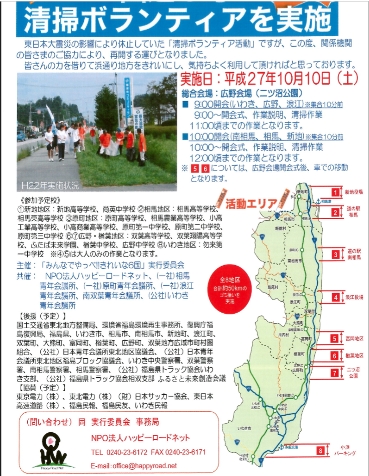
Another similar initiative, already presented by the Blog of Fukushima, has been to make children to pick up garbage along the highway 6 that passes thru the forbidden zone. This time, it was an organization called “Happy Road Net” which was the organizer. http://happyroad.net/wordpress/wp-content/uploads/2015/09/Image150915145225.pdf
Let us remember that it is internationally recognized that there is no safe limit for radiation and that each radiation dose has an impact that is proportional to it. In such a context, it is recommended that the radiation exposure should be justified by a benefit. What was the benefit for these children?
An example of bio-accumulation of radioactive material in Fukushima:
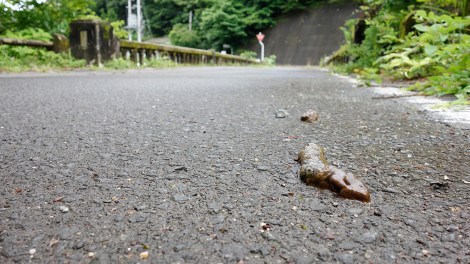
According to the following post, wild monkey poops from Namie-city, Fukushima had more than 150,000Bq/kg in terms of radioactive Cs137 & Cs134.
Cs137: 133987 Bq/kg
Cs134: 25186 Bq/kg
K40: 225 Bq/kg
The surrounding ground surface was about 500~600cpm.
Japan has improved its nuclear safety regulation since the 2011 Fukushima disaster, but it still needs to strengthen inspections and staff competency, a team of experts from the International Atomic Energy Agency said Friday.
It was the first IAEA review for Japan’s Nuclear Regulation Authority since it was established in 2012. Japan adopted stricter safety requirements for plant operators, but a law regulating on-site inspections remained mostly unchanged.
The 17-member team, which concluded a 12-day inspection that included the wrecked Fukushima plant, said the Nuclear Regulation Authority demonstrated independence and transparency — crucial elements lacking before the disaster, when an earlier agency was in charge.
The Fukushima Dai-ichi nuclear power plant was hit by a massive earthquake and tsunami in March 2011, triggering triple meltdowns. Government, parliamentary and private investigations have blamed complacency about safety, inadequate crisis management skills, a failure to keep up with international safety standards, and collusion between regulators and the nuclear industry.
The IAEA inspection team urged the Nuclear Regulation Authority to enhance inspection competence and the government to amend its nuclear safety law to make on-site safety checks more effective and flexible.
Mission leader Philippe Jamet, a French regulatory commissioner, said Japan’s inflexible inspection rules do not allow inspectors to move freely at nuclear facilities or respond quickly when there is a problem.
“What we found is that the system that is regulating, that is defining the framework of inspection is very complex and very rigid,” Jamet said at a news conference.
Japan has a comprehensive framework but “it doesn’t give enough freedom for the inspectors to react immediately and to provide results,” he said. “At any time and for any plant, inspectors should be allowed to go where they want.”
A final report by the team is expected in about three months.
Japan’s top nuclear commissioner, Shunichi Tanaka, acknowledged the shortcomings and said, “We have to focus on tackling the challenges of inspection system and human resources.”
Masakazu Shima, a Japanese regulator who assisted the inspection team, said the inspection issue was also raised by an earlier IAEA mission in 2007 but Japan never took action.


 NARAHA, Fukushima Prefecture–A life-size model of a section of the crippled Fukushima No. 1 nuclear power plant that will be used in developing decommissioning technology is almost complete.