Gov’t, TEPCO should take Niigata gubernatorial election results seriously
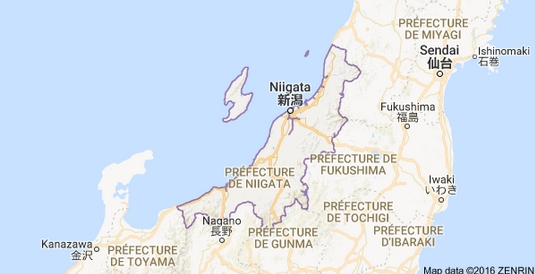
A candidate who is cautious about restarting idled nuclear power plants won the Oct. 16 Niigata gubernatorial election, defeating a rival backed by the ruling coalition. The government of Prime Minister Shinzo Abe and Tokyo Electric Power Co. (TEPCO) should take seriously the outcome of the election, in which the pros and cons of reactivating the utility’s atomic power station in the prefecture was a key point of contention.
Ryuichi Yoneyama, 49, supported by the opposition Japanese Communist Party, Liberal Party and Social Democratic Party, beat former Nagaoka Mayor Tamio Mori, 67, backed by the ruling Liberal Democratic Party (LDP) and its coalition partner Komeito.
Mori had been expected to score an easy victory as the approval rating of the Abe Cabinet has been high and both the ruling coalition parties enjoy support from the business community and related organizations. Therefore, the results highlight prefectural residents’ deep-rooted distrust in TEPCO, the operator of the tsunami-ravaged Fukushima No. 1 Nuclear Power Plant.
The governing bloc’s loss in the Niigata election follows its defeat in the July Kagoshima gubernatorial race, in which journalist Satoshi Mitazono, who called on Kyushu Electric Power Co. to stop operations at its Sendai Nuclear Power Plant in the prefecture during his campaigning, scored a victory.
The outcome of the Niigata race also apparently shows local residents’ displeasure toward Mori, who failed to clarify his stance toward whether the Kashiwazaki-Kariwa Nuclear Power Plant in the prefecture should be restarted, as well as their criticism of the Abe administration that is proactively trying to reactivate atomic power plants.
Close attention was focused on the latest election because incumbent Hirohiko Izumida abandoned seeking a fourth four-year term as governor.
The reason why Izumida gave up on running in the race remains unclear. However, Izumida has continued to demand TEPCO clarify the cause of the Fukushima nuclear crisis as a precondition for sitting at the negotiation table to discuss whether the Kashiwazaki-Kariwa plant should be reactivated. As such, TEPCO and the Abe government had expected that the retirement of Izumida would help facilitate the resumption of operations at nuclear plants.
As the election campaign went on, however, Yoneyama, who declared that he would take over Izumida’s policy line, garnered growing support from local voters. Alarmed by the situation, LDP heavyweights, including Secretary-General Toshihiro Nikai, delivered campaign speeches and urged the local business community and industry organizations to vote for Mori.
Numerous voters in Niigata, who saw the LDP’s desperate efforts to persuade local voters to vote for Mori, probably felt the old-fashioned culture of the LDP. During his campaigning, Mori emphasized his experience of serving as president of the Japan Association of City Mayors to demonstrate his close relations with the national government. However, he gave local voters the impression that he was hesitant to clarify his position on reactivation of atomic power plants.
Many challenges have been left unaddressed by Izumida, such as whether the evacuation plan for local residents in case of an accident at the Kashiwazaki-Kariwa plant is appropriate. Yoneyama must address these challenges as he pledged during his campaigning.
The manner in which the largest opposition Democratic Party (DP) approached the election was poor. The DP did not officially support Yoneyama although the party had initially planned to field him in the next House of Representatives election because the TEPCO union has strong influence within the Japanese Trade Union Confederation (Rengo), which is a major supporting organization for the party. However, DP leader Renho did an about-face and delivered campaign speeches for Yoneyama in the final phase of the campaign apparently after being convinced that he would win.
The DP cannot win support from voters unless the party discusses its nuclear power policy and clarifies its stance on the issue.
http://mainichi.jp/english/articles/20161017/p2a/00m/0na/009000c
Niigata Newly Elected Governor Says No Restart for Kashiwazaki-Kariwa NPP, Tepco’s World Biggest Nuclear Power Plant
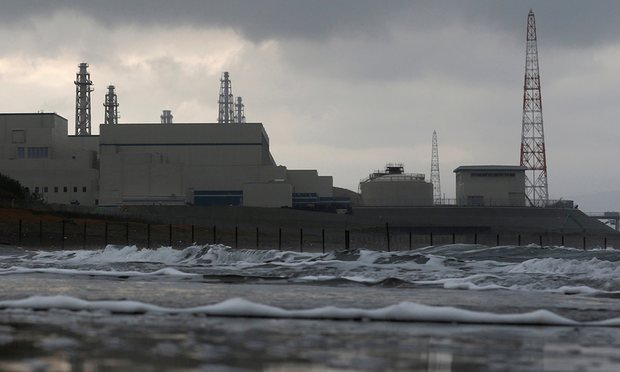
Japanese anti-nuclear candidate wins election at site of world’s biggest atomic power station
Ryuichi Yoneyama, the newly elected governor of Niigata, says he will not restart Kashiwazaki-Kariwa power station shut down after Fukushima
An anti-nuclear candidate has been elected in a region of Japan that houses the world’s biggest atomic power station, striking a blow to Tokyo Electric Power’s attempts to restart the plant in the wake of the Fukushima disaster.
Ryuichi Yoneyama, a doctor-lawyer who has never held office and is backed mostly by leftwing parties, won the race for governor of Niigata, north of Tokyo, Japanese media projected on Sunday. Shares in Tokyo Electric Power fell 8% on Monday after the news broke.
The vote was dominated by concerns about the future of the Kashiwazaki-Kariwa power station and nuclear safety more than five years after the Fukushima catastrophe. The result represents a challenge to the government’s energy policy.
“As I have promised all of you, under current circumstances where we can’t protect your lives and your way of life, I declare clearly that I can’t approve a restart,” the 49-year-old told supporters at his campaign headquarters.
Cheers of “Banzai!” erupted as media began projecting him the winner over former mayor Tamio Mori, 67, backed by prime minister Shinzo Abe’s pro-nuclear Liberal Democratic party (LDP).
Yoneyama had more than 500,000 votes to about 430,000 for Mori with 93% of the vote counted, public broadcaster NHK said. Voters opposed restarting the plant by 73% to 27%, according to an exit poll by the broadcaster.
Mori, a former construction ministry bureaucrat, apologised to his supporters for failing to win the election.
Yoneyama, who has run unsuccessfully for office four times, promised to continue the policy of the outgoing governor who had long thwarted the ambitions of Tepco, as the company supplying about a third of Japan’s electricity is known, to restart the plant.
Reviving the seven-reactor site, which has a capacity of 8 gigawatts, is key to saving the utility, which was brought low by the Fukushima explosions and meltdowns, and then the repeated admissions of cover-ups and safety lapses after the world’s worst nuclear disaster since Chernobyl in 1986.
Tepco, put under government control in 2012, is vital to Abe’s energy policy, which relies on rebooting more of the reactors that once met about 30% of the nation’s needs.
The election became a litmus test for nuclear safety and put Abe’s energy policy and Tepco’s handling of Fukushima back under the spotlight.
The government wants to restart units that pass safety checks, also promoting renewables and burning more coal and natural gas.
Only two of Japan’s 42 reactors are running, more than five years after Fukushima, but the Niigata plant’s troubles go back further.
Several reactors at Kashiwazaki-Kariwa have been out of action since an earthquake in 2007 caused radiation leaks and fires in a disaster that prefigured the Fukushima calamity and Tepco’s bungled response.
Yoneyama, who has worked as a radiological researcher, said on the campaign trail that Tepco didn’t have the means to prevent Niigata children from getting thyroid cancer in a nuclear accident, as he said had happened in Fukushima. He said the company didn’t have a solid evacuation plan.
The LDP’s Mori, meanwhile, was forced to tone down his support for restarting the plant as the race tightened, media said, insisting safety was the priority for Kashiwazaki-Kariwa, while promoting the use of natural gas and solar power in Niigata.
Setback for operator of world’s largest atomic plant as anti-nuclear doctor elected Niigata governor
NIIGATA – Sunday’s victory of an anti-nuclear activist in the Niigata gubernatorial election is a setback for Prime Minister Shinzo Abe’s energy policy.
Doctor-lawyer Ryuichi Yoneyama, 49, defeated the candidate endorsed by Abe’s Liberal Democratic Party. Former construction ministry bureaucrat Tamio Mori, 67, was expected until the last moment to cruise to victory.
Yoneyama has never held office.
Campaigning for Sunday’s vote was dominated by concerns over the future of the world’s biggest atomic power station, the seven-reactor Kashiwazaki-Kariwa complex. Nationwide, all but two reactors are shut down in the wake of the Fukushima nuclear disaster, and Abe has pushed hard for restarts.
“Under current circumstances where we can’t protect the lives and the way of life of citizens in the prefecture, I can’t approve a restart,” Yoneyama told reporters on Monday.
Supported by the Japanese Communist Party and two other small parties, Yoneyama secured close to 530,000 votes. Mori trailed with 465,000.
The focus will now be how Yoneyama will be able to cooperate with local municipalities and the central government in creating evacuation plans for nuclear disasters. These will be key before restarts can take place.
Abe, meanwhile, told a Diet committee that he will respect the choice of Niigata and that he will cooperate with the new governor.
Shares in Tokyo Electric Power Company Holdings Inc., which operates the Kashiwazaki-Kariwa reactors, fell 8 percent on Monday.
The complex has a capacity of 8 gigawatts. Its revival is key to saving Tepco, which was brought low by the Fukushima meltdowns and hydrogen explosions, and then repeated admissions of cover-ups and safety lapses after the world’s worst nuclear disaster since Chernobyl in 1986.
“Senior management at Tepco have made it clear that restarting the Kashiwazaki reactors is fundamentally important to restoring their finances,” Tom O’Sullivan, founder of Tokyo-based consultant Mathyos, said by email. “There now has to be significant uncertainty over restarting those reactors.”
Yoneyama’s victory came after Tepco President Naomi Hirose highlighted the utility’s financial vulnerability this month. He said it may face insolvency if it were to recognize the cost of decommissioning the crippled Fukushima nuclear plant.
Resumption of operations at just one of Kashiwazaki Kariwa’s reactors would boost the utility’s profit by about ¥10 billion a month, the company has said.
Yoneyama previously tried to run for office four times. He was unsuccessful.
In this election, he promised to continue the policy of the outgoing governor who had long thwarted the ambitions of Tepco to restart the plant. Tepco supplies about a third of Japan’s electricity.
As the race tightened, the election became a litmus test for nuclear safety and put Abe’s energy policy and Tepco’s handling of Fukushima back under the spotlight.
“The talk was of Kashiwazaki-Kariwa, but I think the result will affect nuclear restarts across the country,” said Shigeaki Koga, a former trade and industry ministry official who is a critic of nuclear restarts and the Abe administration.
Koga said it was important that Yoneyama join forces with another newly elected governor skeptical of nuclear restarts, Satoshi Mitazono of Kagoshima Prefecture.
“Without strong support from others, it won’t be easy to take on Tepco,” he said.
The government wants to restart units that pass safety checks, also promoting renewables and burning more coal and natural gas.
Only two of Japan’s 42 reactors are running more than five years after Fukushima, but the Niigata plant’s troubles go back further.
Several reactors at Kashiwazaki-Kariwa have been out of action since an earthquake in 2007 caused radiation leaks and fires in a disaster that prefigured the Fukushima calamity and Tepco’s bungled response.
Yoneyama, who has worked as a radiological researcher, said on the campaign trail that Tepco lacks the means to prevent Niigata children from getting thyroid cancer in a nuclear accident, as he said happened in Fukushima. He said the company did not have a solid evacuation plan.
The LDP’s Mori, meanwhile, was forced to tone down his support for restarting the plant as the race tightened, media said, insisting safety was the top priority for Kashiwazaki-Kariwa, while promoting the use of natural gas and solar power in Niigata.
Tepco Tumbles 7% After Anti-Nuclear Candidate’s Surprise Governor Election Win

Japan’s public is not ready to restart nuclear power generation.
Ryuichi Yoneyama, a doctor-lawyer who has never previously held office, won the race for governor of Niigata on Sunday. He ran on the platform that he would not allow the Kashiwazaki-Kariwa power station, owned by Tokyo Electric Power Company, or TEPCO (9501.Japan), to restart operations.
Yoneyama had more than 500,000 votes versus rival candidate’s 430,000 votes with 93% of the votes counted.
TEPCO was put under government control the year after the traumatic Fukushima catastrophe in March 2011 and is vital to Prime Minister Shinzo Abe‘s energy policy. Abe hopes to revive nuclear power generation to provide for 30% of Japan’s energy needs.
TEPCO tumbled 6.7% in Tokyo.
Anti-nuclear Candidate wins Japan Regional Election, Blow to Nuclear Restarts
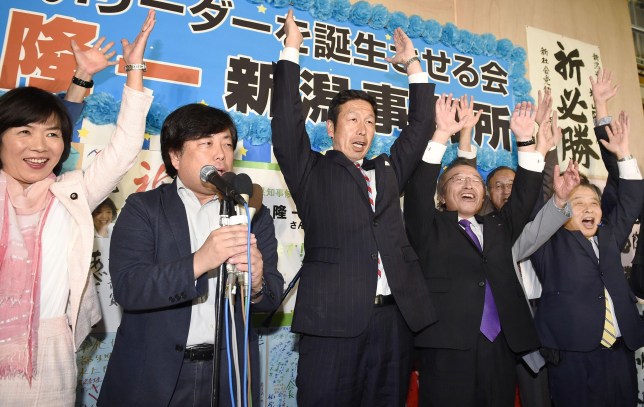
Nuclear foe Ryuichi Yoneyama wins Niigata gubernatorial poll, threatening Tepco reactor restart hopes
NIIGATA – An anti-nuclear candidate won Niigata’s gubernatorial election Sunday, dealing a potential blow to Tokyo Electric Power Co.’s attempts to restart the world’s biggest atomic power station.
Ryuichi Yoneyama, 49, a doctor-lawyer who has never held office and was backed mostly by left-wing parties, won the race for governor, an election dominated by concerns over the future of the Kashiwazaki-Kariwa nuclear power station and nuclear safety more than five years after the Fukushima catastrophe of March 2011.
Final results show Yoneyama beat former Nagaoka Mayor Tamio Mori, 67, who was backed by Prime Minister Shinzo Abe’s ruling pro-nuclear Liberal Democratic Party.
Yoneyama gathered more than 528,000 votes, about 60,000 more than Mori. Voter turnout was 53.05 percent, up significantly from the 43.95 percent in the previous gubernatorial poll, held in 2012.
“It’s really regrettable. We will take the judgment of voters very seriously,”said Keiji Furuya, a Lower House member who served as head of Mori’s election campaign office.
Yoneyama promised to continue the policy of the departing governor, who had long thwarted the ambitions of Tepco, the company supplying about a third of Japan’s electricity, to restart the plant.
Reviving the seven-reactor giant, with capacity of 8 gigawatts, is key to saving the utility, which was battered by the Fukushima explosions and meltdowns, and then the repeated admissions of coverups and safety lapses after the world’s worst nuclear disaster since Chernobyl in 1986.
Tepco is vital to Abe’s energy policy, which relies on rebooting more of the reactors that once provided about 30 percent of the nation’s electricity needs.
Anti-nuclear novice wins Japan election, blow to nuclear restarts
An anti-nuclear candidate won an upset victory in a Japanese regional election on Sunday, a blow to Tokyo Electric Power’s attempts to restart the world’s biggest atomic power station and a challenge to the government’s energy policy.
Ryuichi Yoneyama, 49, a doctor-lawyer who has never held office and is backed mostly by left-wing parties, won the race for governor of Niigata north of Tokyo, Japanese media projected, in a vote dominated by concerns over the future of the Kashiwazaki-Kariwa power station and nuclear safety more than five years after the Fukushima catastrophe of March 2011.
“As I have promised all of you, under current circumstances where we can’t protect your lives and your way of life, I declare clearly that I can’t approve a restart,” Yoneyama told supporters at his campaign headquarters.
Cheers of “Banzai!” erupted as media began projecting him the winner over former mayor Tamio Mori, 67, backed by Prime Minister Shinzo Abe’s pro-nuclear Liberal Democratic Party (LDP) and initially favored for an easy victory.
Yoneyama had more than 500,000 votes to about 430,000 for Mori with 93 percent of the vote counted in the region on the Japan Sea coast, public broadcaster NHK said.
Mori, a former construction ministry bureaucrat, apologized to his supporters for failing to win the election.
Yoneyama, who had run unsuccessfully for office four times, promised to continue the policy of the outgoing governor who had long thwarted the ambitions of Tepco, as the company supplying about a third of Japan’s electricity is known, to restart the plant.
Reviving the seven-reactor giant, with capacity of 8 gigawatts, is key to saving the utility, which was brought low by the Fukushima explosions and meltdowns, and then the repeated admissions of cover-ups and safety lapses after the world’s worst nuclear disaster since Chernobyl in 1986.
Tepco, put under government control in 2012, is vital to Abe’s energy policy, which relies on rebooting more of the reactors that once met about 30 percent of the nation’s needs.
As the race tightened, the election became a litmus test for nuclear safety and put Abe’s energy policy and Tepco’s handling of Fukushima back under the spotlight.
“The talk was of Kashiwazaki-Kariwa, but I think the result will affect nuclear restarts across the country,” said Shigeaki Koga, a former trade and industry ministry official turned critic of nuclear restarts and the Abe administration.
Koga told Reuters it was important that Yoneyama join forces with another newly elected governor skeptical of nuclear restarts, Satoshi Mitazono of Kagoshima Prefecture in southern Japan. “Without strong support from others, it won’t be easy to take on Tepco,” he said.
Tepco spokesman Tatsuhiro Yamagishi said the company couldn’t comment on the choice of Niigata governor but respected the vote and would strive to apply the lessons of the Fukushima disaster to its management of Kashiwazaki-Kariwa.
The government wants to restart units that pass safety checks, also promoting renewables and burning more coal and natural gas.
Only two of Japan’s 42 reactors are running more than five years after Fukushima, but the Niigata plant’s troubles go back further.
Several reactors at Kashiwazaki-Kariwa have been out of action since an earthquake in 2007 caused radiation leaks and fires in a disaster that prefigured the Fukushima calamity and Tepco’s bungled response.
Niigata voters opposed restarting the plant by 73 percent to 27 percent, according to an NHK exit poll.
Yoneyama, who has worked as a radiological researcher, said on the campaign trail that Tepco didn’t have the means to prevent Niigata children from getting thyroid cancer in a nuclear accident, as he said had happened in Fukushima. He said the company didn’t have a solid evacuation plan.
The LDP’s Mori, meanwhile, was forced to tone down his support for restarting the plant as the race tightened, media said, insisting safety was the top priority for Kashiwazaki-Kariwa, while promoting the use of natural gas and solar power in Niigata.
http://www.reuters.com/article/us-japan-nuclear-election-idUSKBN12G0HM
Yoneyama, backed by opposition, wins in Niigata
NIIGATA–Ryuichi Yoneyama, a doctor backed by the opposition parties, including the Japanese Communist Party and the Social Democratic Party, was set to win the Niigata gubernatorial election on Oct. 16, defeating three independent rookie candidates, including Tamio Mori, who was supported by the ruling coalition.
The main issue of the election was Tokyo Electric Power Co.’s plan to restart the Kashiwazaki-Kariwa nuclear power plant in the prefecture, the world’s largest facility. The Nuclear Regulation Authority’s safety inspections of the offline reactors are in their final stages.
Yoneyama, 49, was also an independent rookie. He has expressed his intention to continue the stance of Governor Hirohiko Izumida, saying that he would not approve the restart of the reactors unless the 2011 disaster at TEPCO’s Fukushima No. 1 plant is fully scrutinized. In addition, he called for a workable evacuation plan to secure the safety of local residents in the event of a serious accident.
Izumida, who is in his third term as Niigata governor, didn’t seek re-election.
Mori, 67, was backed by the the ruling Liberal Democratic Party and its junior coalition partner, Komeito. Although the LDP promotes nuclear energy, Mori showed cautiousness during the campaign, saying that he would say no to a restart if the prefectural government finds a problem with it even after the NRA gives the green light to TEPCO.
http://www.asahi.com/ajw/articles/AJ201610160047.html
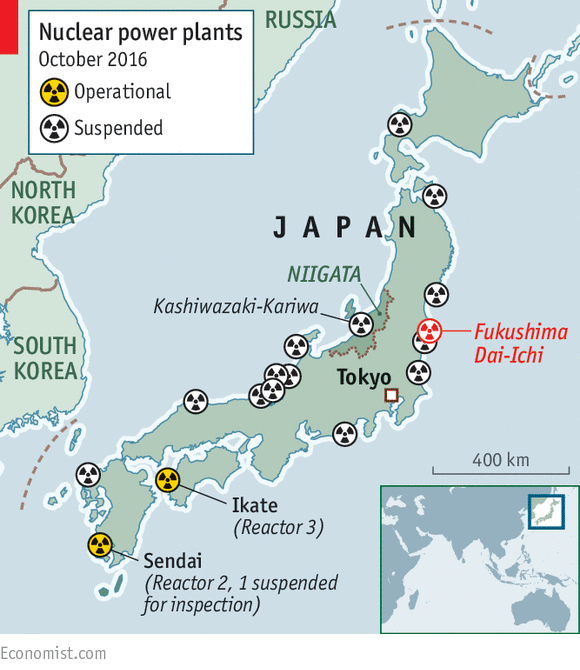
Strong quake rattles Tohoku region
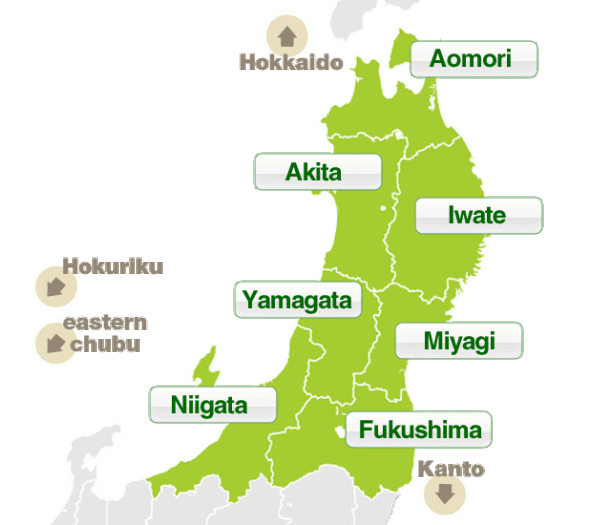
Tohoku region
An earthquake with a preliminary magnitude of 5.3 jolted northeastern Japan on Sunday, the Meteorological Agency agency said. No tsunami warning was issued.
There were no immediate reports of casualties or damage from the 4:37 p.m. quake. The focus of the quake was about 20 km (12 miles) underground in the Pacific Ocean off Miyagi Prefecture, the agency said.
Tohoku Electric Power Co. reported no abnormalities at the Onagawa nuclear power plant in Miyagi Prefecture.
The quake measured 4 on the Japanese seismic intensity scale of 7 in some areas of Miyagi, including the city of Ishinomaki, and a 3 in areas including neighboring Iwate and Yamagata prefectures.
http://www.japantimes.co.jp/news/2016/10/16/national/strong-quake-rattles-tohoku-region/
High-school Students Continuously Put at Risk for Propaganda Use
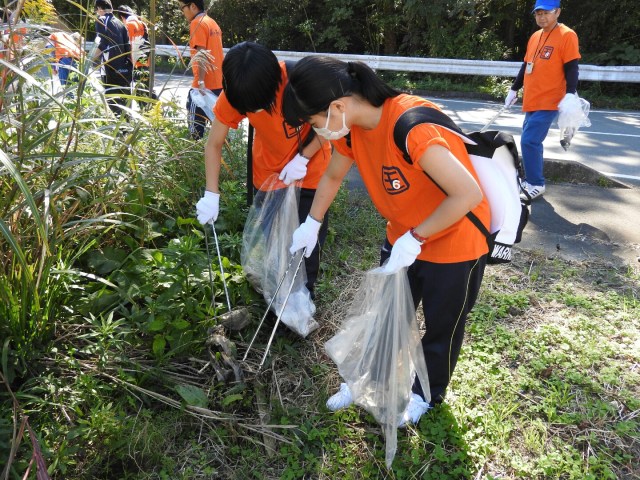
National route 6 which runs only a few km parallel to the coast where stands what is left of Daiichi Nuclear power plant, high-school students are cleaning up radiation.
14 high school students were picking up trash. 0.7μSv / h radiation measured by some citizens’ group at some of the places. With dust being blown, many high school students were walking still without a mask.
The criticism that it could endanger the children, was ignored by Yumiko Nishimoto, president of the NPO “Happy load net” which organized that acttion, answering “we are living here every day.” .
Clean-up activities with an eye to the torch relay of the Tokyo Olympics. The priority is the “reconstruction”, and the health of children is secondary, completely neglected.
The NPO responsible for such insanity argues that it helps them studying about radiation, that they do that every year.
Children are continuously being used to help the propaganda that everything is back to normal. But it’s a lie and it is borderline criminal. Shame on you Japan.
http://taminokoeshimbun.blog.fc2.com/blog-entry-61.html
Tokyo governor visits alternative site in Miyagi Prefecture for 2020 Games’ rowing and canoe sprint
We are many to think that it is shocking, disgusting and very sad that after over5 & a half years they are still putting their greed above the health of those people who would participate and go to watch these games, not to mention their own people. They should have relinquished as soon as they knew that the Fukushima Daiichi nuclear disaster had contaminated a good third of the country.

Tokyo Gov. Yuriko Koike (left front) and Miyagi Gov. Yoshihiro Murai (left back) wave to the press as they inspect the Naganuma rowing course in the city of Tome, Miyagi Prefecture, on Saturday.
Tokyo Gov. Yuriko Koike on Saturday visited a boat race course in Miyagi Prefecture, a facility emerging as an alternative venue for the rowing and canoe sprint events at the 2020 Tokyo Olympic games.
“Based on this visit, I will start considering venues,” Koike told reporters after inspecting facilities at the Naganuma rowing course in the city of Tome, more than 400 kilometers from Tokyo. Miyagi is one of the prefectures in northeastern Japan hit hardest by the March 2011 earthquake and tsunami.
Games organizers and the International Rowing Federation had already approved the Sea Forest Waterway venue to be constructed on Tokyo Bay, but a metropolitan government cost review panel recommended last month that plan be reconsidered.
The Tokyo Olympic and Paralympic organizing committee has raised concerns that costs could top ¥35.1 billion ($337 million) even if the rowing and canoe sprint events were held at the Naganuma rowing course. But Miyagi Prefecture Gov. Yoshihiro Murai argued Saturday in a television appearance that the overall cost is “estimated at around ¥15 to ¥20 billion.”
On the TV program, Murai also emphasized that most of the costs will be for “permanent facilities” after the Olympic Games, and that the prefectural government would shoulder the cost to remove temporary housing.
Last Wednesday, Murai visited Koike in Tokyo to convey his wish to hold the rowing and canoe events in Miyagi to show the world the recovery Japan has made since the 2011 quake and tsunami disaster.
Koike had told Murai that the Naganuma boat course was an option and she would “make a comprehensive decision” after visiting the site.
The organizing committee, however, has questioned the feasibility of holding those events at the Miyagi site, raising what they said are “nine problems,” including transportation, infrastructure and costs.
Saitama Gov. Kiyoshi Ueda has also said his prefecture is ready to host the rowing and canoe sprint events at Saiko Doman Green Park in the city of Toda.
Fukushima Untreated Bypass Groundwater Dumped into the sea

Up to October 14, 2016, Tepco has discarded 137 times Fukushima Daiichi untreated groundwater from the bypass into the sea, all totalling now 222,816 tons (58,861,760 gallons).
That not including the 300+ tons a day of untreated groundwater flowing through the plant and into the ocean 24/7 for 5.6 years now.
http://www.tepco.co.jp/nu/fukushima-np/info/baypassold-j.html
Fukui poised to benefit from decision to scrap Monju
Big money pull a million strings
Big money weave a mighty web
Big money draw the flies
— Rush, “The Big Money”
Last month’s announcement that the Monju experimental fast-breeder reactor in Tsuruga, Fukui Prefecture, would likely be decommissioned was an acknowledgement of what had been obvious for decades. Namely, that Monju was too fraught with technical and political problems to have ever stood a chance of success.
For Kansai, the decision brought a feeling of relief among those concerned about a plutonium-producing plant in their backyard, but a feeling of “now what?” among everyone else. No political leader in Osaka, Kyoto, Nara or Kobe either wistfully eulogized or passionately protested the recommendation that Monju, which has cost more than ¥1 trillion, be scrapped. In Fukui, however, it was a different story.
For more than four decades, Fukui’s leaders have finessed the art of extracting (extorting?) as much money from Tokyo as possible in exchange for cooperation in continuing not only Monju but also 13 commercial nuclear reactors, a concentration of nuclear power plants said to be the densest in the world.
Massive amounts of tax money were funneled into the prefecture by the Liberal Democratic Party for all sorts of uses. Some were noble (construction of modern train stations, schools, hospitals and social welfare facilities). Some were corrupt (propaganda museums that played down the risks of nuclear power, all expense-paid “study” tours to Europe’s nuclear reactor towns for local residents that included sightseeing trips to Paris).
Nobody really knows how much money, directly and indirectly, went to Fukui and Tsuruga over the decades for “bearing the burden of Monju.” Unofficial guesses put the figure in the billions of yen. But what has residents in Kansai, and elsewhere, concerned is how much it will cost them, in the form of future government payoffs to Fukui, to be rid of Monju.
The prefecture certainly has friends in high places looking out for its interests. Defense Minister Tomomi Inada, a favorite of Shinzo Abe, represents Fukui’s 1st district. That’s the one without nuclear power plants, but she’s very close to those in Fukui who support them. Then there’s Tsuyoshi Takagi, who served as reconstruction minister. He’s from Tsuruga and represents Fukui’s 2nd district in the Lower House, an area that hosts those 13 commercial nuclear reactors. In short, Fukui has powerful allies who will work hard to ensure all manner of new funding flows to the prefecture and to Tsuruga over the coming decades.
Making matters better for Fukui but worse for taxpayers elsewhere, three commercial reactors will be decommissioned over the next few decades. You can be sure Fukui politicians from the governor on down are drawing up a long wish-list of pork barrel projects they will demand the central government, as well operator Kansai Electric Power Co., fork out in exchange for consenting to each reactor’s decommissioning plans — plans that might include disposing high-level radioactive waste generated by decommissioning in Fukui, over the objections of residents.
In short, decommissioning means big money for Fukui in the years ahead in the form of subsidies, jobs and service-industry income. And not just at Monju, where the basic cost was recently estimated at ¥540 billion.
With predictions it might cost ¥8 trillion to scrap the crippled Fukushima No. 1 nuclear power plant, and perhaps a dozen commercial reactors probably heading for the scrap heap in the next decade, Japan has entered the “age of nuclear power decommissioning.”
There’s big money involved that will draw a swarm of flies, especially in towns and prefectures hosting the power plants. Taxpayers elsewhere, therefore, will need to be especially vigilant and handy with the flyswatters and insect repellent.
Cost of pulling plug on reactors

In its latest discussions on electricity market reform, the Ministry of Economy, Trade and Industry is reportedly considering a measure to financially help major power companies with decommissioning their nuclear plants. METI is reportedly weighing having new entrants to the liberalized power retail market shoulder part of the decommissioning cost, which would be added to the electricity bills of their customers. That would be nothing less than welfare for the major suppliers that are seeing nuclear power lose its cost advantages in the face of power retail deregulation since April. The government should avoid policies that could distort the principles of electricity business liberalization.
In its discussions launched in late September, the ministry says the committee will weigh establishing a system that would have power suppliers respond to “issues of public interest,” such as investments to prepare for decommissioning nuclear plants and severe nuclear accidents amid market liberalization. That sounds like a legitimate question to consider, but the measures contemplated by the ministry pose many problems.
One is a change to the accounting system for decommissioning nuclear power plants. Tokyo Electric Power faces massive financial problems in dealing with its Fukushima No. 1 plant, which suffered triple meltdowns after it was hit by the March 2011 Great East Japan Earthquake and tsunami. The cost to decommission the crippled plant is certain to far exceed the estimated ¥2 trillion — in fact it is impossible to grasp the total cost at this stage since the technology to remove molten nuclear fuel from its reactors has not yet been established. Compensation for victims of the nuclear disaster, which was estimated in 2014 at ¥4.9 trillion, has already topped ¥6 trillion. The cost to decontaminate areas polluted with radioactive fallout from the plant is likely to top ¥2.5 trillion in the government’s plan.
Even in the absence of a major disaster like the Fukushima catastrophe, the major utilities operating nuclear power plants face a shortage in financial reserves to pay for decommissioning as they needed to scrap the plants earlier than scheduled in response to the tightened plant regulations following the Fukushima disaster, along with the overshooting of the cost of decommissioning from earlier forecasts. Besides Tokyo Electric, five major power firms have made decisions to decommission six of their reactors — one each for Kyushu Electric, Chugoku Electric, Shikoku Electric and Japan Atomic Power and two for Kansai Electric.
To cover the bloated expenses of decommissioning, the ministry is thinking of having all electricity suppliers — including new entrants to the market that do not run nuclear power plants — share the cost in the form of surcharges to the fees that they pay for accessing power transmission lines to service their customers. The cost will then be added to customers’ electricity bills.
Under the current system, the major suppliers operating nuclear power plants can include the cost of decommissioning them in the future — along with all other expenses in their power generation — in their electricity charges. But that system will be abolished in 2020, when their power transmission and distribution sections are to be separated from the power generation operations in the final phase of the reform. The idea of having all suppliers — and consequently all consumers — pay for the cost of decommissioning nuclear plants is intended to cope with this change. However, such a measure will blur the responsibility of major power companies that have relied heavily on nuclear power generation and miscalculated the related costs.
That will also have the effect of denying consumers the right to refuse to pay for electricity generated by nuclear power. The retail market liberalization in April enabled consumers to choose power suppliers, instead of being tied to regional monopolies. Some suppliers offer electricity mainly generated by renewable sources such as solar and wind. But applying the surcharge to all suppliers will result in forcing all consumers — including those who may not want to buy electricity from the former monopolies that run nuclear plants — to shoulder the cost of decommissioning.
The ministry’s committee is also reportedly weighing a scheme to enable suppliers that operate large-scale thermal power plants to receive a certain amount of revenue for keeping the plants even without running them — based on their power-generation capacity. The idea represents another relief measure for major power companies whose thermal power plants saw their operating ratio fall with the sharp rise in renewable sources in recent years. The scheme is touted as necessary to maintain thermal power capacity as a buffer in case the supply from renewable sources decreases. But experience in other countries indicates that such a mechanism is not essential to managing possible fluctuations in the supply of renewable energy.
The government has long based its energy policy on the argument that nuclear power is cheaper than most other forms of power generation. But the fact that it is seeking to introduce a relief measure for major suppliers that run nuclear plants indicates that argument is no longer tenable. The government needs to reflect on the real meaning of the measures it is contemplating.
http://www.japantimes.co.jp/opinion/2016/10/15/editorials/cost-pulling-plug-reactors/#.WAJK0yQzYU0
Industry minister Seko inspects Ikata nuclear plant
Ikata Nuclear Power Plant is located in Ehime Prefecture in Shikoku, across from the Bungo Channel that separates Kyushu and Shikoku.
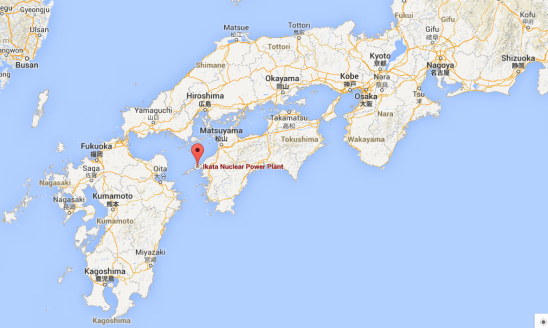
Ikata Nuclear Power Plant with pressurized water reactors by Mitsubishi Heavy Electric sits extremely close to Japan’s Median Tectonic Line, the largest fault in Japan, part of which is active.


MATSUYAMA (Kyodo) — Economy, Trade and Industry Minister Hiroshige Seko on Saturday inspected a recently restarted reactor at the Ikata nuclear power plant in western Japan to assess the safety measures there.
Seko visited an observation deck that overlooks the entire complex of Shikoku Electric Power Co.’s plant in Ehime Prefecture, as well as a facility to store spent nuclear fuel in the radiation-controlled area and other locations.
Seko was briefed on a system to provide electricity in the event of earthquakes and other emergencies by Seizo Masuda, the chief of the plant, and expressed satisfaction at the multiple backups available.
The No. 3 reactor at the Ikata plant was reactivated on Aug. 12, having cleared a set of safety requirements imposed in the wake of the Fukushima Daiichi nuclear power plant disaster in 2011.
The 890-megawatt reactor shifted to commercial operation on Sept. 7 following final checks by the Nuclear Regulation Authority. The unit had not operated since it was taken off-line in April 2011 for regular checks.
Some snags occurred around the time of its reactivation, including a problem with a pump for the reactor’s primary cooling water and a leakage in a drainage pipe in related equipment.
The reactor is currently the sole unit in operation in Japan running on plutonium-uranium mixed oxide fuel, which contains plutonium extracted from reprocessing spent fuel.
http://mainichi.jp/english/articles/20161015/p2g/00m/0dm/070000c
Judges may order gov’t to submit redacted report in lawsuit over Fukushima disaster

A judge presiding at a trial over the Fukushima nuclear crisis said the judges in charge will decide by the end of this year on whether to order the government to submit some of its investigation committee’s reports on the disaster that have been withheld.
Presiding Judge Akihiko Otake at the Tokyo District Court made the remark on Oct. 13 during an oral proceeding of the suit filed by shareholders of Tokyo Electric Power Co. (TEPCO), the operator of the crippled nuclear plant, to clarify the responsibility of former TEPCO board members over the disaster.
Otake also said the judges in charge will conduct an in camera review on other documents, part of which has been blacked out before they were disclosed, to deem whether the measure is appropriate.
Specifically, the judges will examine documents recording statements by the now deceased Masao Yoshida, who headed the Fukushima No. 1 Nuclear Power Plant at the time of the outbreak of the disaster in March 2011, and those by two officials of the then Nuclear and Industrial Safety Agency.
The documents were disclosed after the names of individuals and some other information were blacked out. The court said it has already ordered the Cabinet Office to submit the documents with the blacked-out parts unveiled. The Cabinet Office has reportedly responded that it intends to comply with the order by the end of this week.
http://mainichi.jp/english/articles/20161014/p2a/00m/0na/005000c
An obscure election race in Japan may decide the fate of the world’s biggest nuclear plant
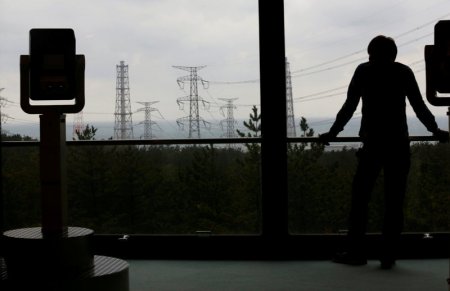
A visitor is silhouetted next to binoculars as he looks at Tokyo Electric Power Co.’s Kashiwazaki Kariwa nuclear power plant, which is the world’s biggest, at an observatory of its exhibition hall in Kashiwazaki
NIIGATA, Japan (Reuters) – A regional election north of Tokyo between candidates most Japanese have never heard of may decide the fate of the world’s biggest nuclear plant and mark a turning point for an industry all but shut down after the Fukushima disaster.
The campaign for governor of Niigata Prefecture has boiled down to two men and one issue: whether to restart the seven-reactor Kashiwazaki-Kariwa Nuclear Power Station.
Reviving the seven-reactor giant, with capacity of 8 gigawatts, is key to saving Tokyo Electric Power, which was brought low by the 2011 Fukushima explosions and meltdowns, and then the repeated admissions of cover-ups and safety lapses after the world’s worst nuclear disaster since Chernobyl in 1986.
Tepco, as the company supplying about a third of Japan’s electricity is known, is in turn vital to Prime Minister Shinzo Abe’s energy policy, which relies on rebooting more of the reactors that once met about 30 percent of the nation’s needs.
But Ryuichi Yoneyama, 49, an anti-nuclear doctor-lawyer who has never held office and is backed by mostly left-wing parties, has made a tight race for governor of Niigata against an initially favored veteran politician from Prime Minister Shinzo Abe’s pro-nuclear party, Japanese media say.
In a sign that Abe’s Liberal Democratic Party also sees a tough contest, party heavyweights were dispatched to campaign for Tamio Mori, 67. The former mayor and construction ministry bureaucrat is seen more likely to allow Kashiwazaki-Kariwa to restart.
Distrust of Tepco, put under government control in 2012, is so high in Niigata that this election has become a litmus test for nuclear safety and put Abe’s energy policy and Tepco’s handling of Fukushima back under the spotlight.
The government wants to restart units that pass safety checks, also promoting renewables and burning more coal and natural gas.
Radiation leaks
Only two of Japan’s 42 reactors are running more than five years after Fukushima, but the Niigata plant’s troubles go back further.
Several reactors at Kashiwazaki-Kariwa have been out of action since an earthquake in 2007 caused radiation leaks and fires in a disaster that prefigured the Fukushima calamity and Tepco’s bungled response.
A Tepco spokeswoman said the company could not comment on the election and was committed to boosting safety at the plant.
On the campaign trail in Niigata, help for Tepco is in short supply.
Yoneyama has promised to continue the outgoing governor’s policy of refusing to allow a restart unless Tepco provides a fuller explanation of the Fukushima disaster.
He has run for local office unsuccessfully four times but says this time he feels different, as the public supports his anti-nuclear, anti-Tepco message.
Yoneyama, who has worked as a radiological researcher, says Tepco doesn’t have the means to prevent Niigata children from getting thyroid cancer in a nuclear accident, as he says has happened in Fukushima. And he says the company doesn’t have a solid evacuation plan.
“As I go from town to town and village to village, I hear the same thing: ‘We want you to protect this town. We want you to protect our hometown, our lives and our children’s future,'” he told a crowd in Nagaoka this week.
The LDP’s Mori has toned down his support for restarting the plant as the race tightens, media say, and now insists that safety is the top priority for Kashiwazaki-Kariwa, while promoting the use of natural gas and solar power in Niigata.
LDP heavyweight Shigeru Ishiba, a former cabinet minister and party secretary-general, told Reuters the party sent him to Niigata to campaign for Mori because “we can’t take anything for granted”.
“Mr. Mori is not a person who just acquiesces to what the national government says,” Ishiba said. “He has courage and will stand up to the government if he thinks our policies are wrong.”
Sharp Increase in Autism Rate Among California Kindergartners: Could Increase be Linked to Fukushima Fallout?
To reiterate, the article is reporting that autism cases grew 17% in kindergartners in 2015.

I was searching for the new autism diagnostic rate and discovered that California has a significant increase in autism incidents among kindergartners:
Reese, Phillip. July 18 2016. Autism rates in California public schools jumped 7 percent in 2016. Sacramento Bee, http://www.sacbee.com/site-services/databases/article90300877.html#storylink=cpy
The increase was especially sharp among kindergartners, where autism cases grew by 17 percent last year [2015]. More than one of every 65 kindergartners in California public schools is classified as autistic
To reiterate, the article is reporting that autism cases grew 17% in kindergartners in 2015.
Wow! While some experts will attribute the increase to more screening, I wonder whether the increase is linked to Fukushima fallout.
Ernest J. Sternglass and Steven Bell argued in 1983 that radioactive iodine from nuclear fallout could impact cognitive development in the womb and early infancy:
Ernest J. Sternglass and Steven Bell. 1983. Fallout and SAT Scores: Evidence for Cognitive Damage during Early Infancy. The Phi Delta Kappan, Vol. 64, No. 8 (Apr., 1983), pp. 539-545. Stable URL: http://www.jstor.org/stable/20386800 Accessed: 12-10-2016 17:25 UTC
[exceroted] This fallout acts on the thyroid of the developing fetus in the mother’s womb and during infancy, when the thyroid is known to control the development of cognitive functions. In this article we will present the most recent evidence sup porting this hypothesis, as contained in newly available state-by-state data on SAT scores and data collected by the U.S. Public Health Service on radioactive fission products in pasteurized milk (p. 539)
In 1962, Harold Knapp described how radioiodine from a single deposition in pasture-land bioaccumulates and biomagnifies, producing substantial and injurious radiation doses for children consuming milk.[i]
Declassified NRC transcripts of conference calls that occurred on 17 March 2011 concerning Fukushima fallout reveal that the agency had projections of a 40 millisievert (annualized) dose to the thyroid from radioactive iodine for a one-year old child in California:
‘The DITTRA result was four rem [40,000 microsieverts or 40 millisieverts] to the thyroid of a one year-old child based on one year integration of uptake.’[ii]
Parents in North America were not warned about the dangers of radioactive iodine in dairy products.
California children born in 2010 would have been exposed to Fukushima fallout of radioiodine (I-29, I-131, I-133) and other radionuclides in early infancy. According to Wikipedia there are 37 known isotopes of iodine and all are radioactive except for 127 (Isotopoes of Iodine Wikipedia).
Radioiodine wasn’t the only radioactive element that came down in Fukushima’s black rain. Strontium, in particular, can be accumulated in the brain as a substitute for calcium.
Hence, it is possible that the uptick in autism diagnoses could be explained in part by Fukushima fallout.
Fukushima impacts could be investigated in two ways:
1. Thyroid screening of California children diagnosed with autism or PDD
2. Baby teeth screening for radiostrontium, which bioaccumulates in teeth and bones
Of course, thyroid anomalies cannot be proven to have been caused by Fukushima (see Japan as the case example on this matter).
But higher rates of thyroid anomalies when correlated with evidence of radiostrontium in baby teeth would provide enough circumstantial evidence to force public attention to potentially catastrophic health (and environmental) effects from our increasingly radioactive and toxic environment.
It is imperative that potential Fukushima fallout effects be investigated by impartial actors who will conduct impartial science (to the extent possible) to investigate health and reproductive effects across generations.
I am not convinced that this happening in Japan (via the Fukushima Health Management Survey) and it is most definitely not happening in the US despite evidence collected by the US Geological Survey of Fukushima fallout throughout the western US.
[i] S. Kirsch (2004) ‘Harold Knapp and the Geography of Normal Controversy: Radioiodine in the Historical Environment’, Osiris, 19, 167-181.
[ii] U.S Nuclear Regulatory Commission (17 March 2011) ‘Official Transcript of Proceedings of Japan’s Fukushima Daiichi ET Audio File’, http://pbadupws.nrc.gov/docs/ML1205/ML12052A109.pdf, p. 187, date accessed November 5, 2012.
http://majiasblog.blogspot.fr/2016/10/sharp-increase-in-autism-rate-among.html
Autoradiograph – visualizing radiation – Satoshi Mori / Masamichi Kagaya
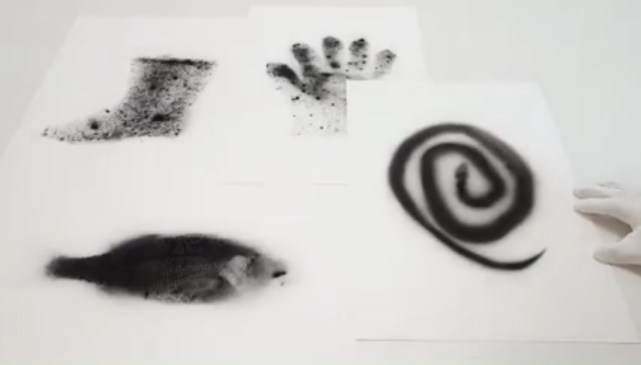
Whether in Tokyo, Fukushima, or even in front of the destroyed nuclear reactor buildings, we are exposed to radiation that we are unaware of. It is too small to see, it cannot be heard and it is odorless. Therefore, despite living in a region contaminated with radioactive particles, to this day, we are not consciously aware of the radiation. NaI (TI) scintillation detectors and germanium semiconductor detectors are used to measure the amount of radioactive contamination in soil, food, and water in units called Becquerels (Bq). Radioactivity is further measured in Sieverts (Sv), which is an index of the effects of radioactive levels in the air, doses of exposure, and so on.
Nevertheless, from such values, it is impossible to know how the radioactive particles are distributed or where they are concentrating in our cities, lakes, forests, and in living creatures. These values do not enable us to “see” the radioactivity. Thus, radioactive contamination has to be perceived visibly, something that can be done with the cooperation of Satoshi Mori, Professor emeritus at Tokyo University. Professor Mori is using autoradiography to make radioactive contamination visible.
Today, dozens of radiographic images of plants created by Professor emeritus Mori since 2011 are on display together with radiographic images of everyday items and animals.
This collection of radiographic images (autoradiographs) is the first in history to be created for objects exposed to radiation resulting from a nuclear accident. It is with hope that visitors will come away with a sense of the extent of contamination in all regions subject to the fallout — not just those in and around Fukushima.
At the same time, It is hoped that this exhibition will remind visitors of the large region extending from the Fukushima Nuclear Plant to Namie Town, Iitate Village and the dense forests of the Abukuma Mountain Area that, to this day, remain restricted areas. The radiation affects animals that continue to live in these areas and be exposed to heavy radiation, as well as the 140,000 people that had to evacuate and who lost personal assets (homes, property, work, interpersonal relationships). These people are in addition to the victims who directly breathed in the radioactive materials, subjecting them to internal exposure — victims that include anyone from the residents near the plant to people in Tokyo and the Kanto Region.
Although what can be done is limited, new progress has made it possible to record the otherwise invisible radioactivity and make it visible. The history of needless nuclear accidents occurring in the United States, the Soviet Union (Russia) and Japan over the last several decades may still potentially be repeated elsewhere in the world, but hopefully future generations will see the cycle be broken. Through exhibitions and other means of disseminating knowledge about radioactivity, future generations may learn to leave behind dependence on nuclear power and be free from the dangers of nuclear accidents and nuclear waste.
http://www.autoradiograph.org/en/app/
https://itunes.apple.com/fr/app/autoradiograph-visualizing/id1074077814?mt=8
1 This Month

22 June – Virtual Event –Climate Change: New Data, New Debate

Monday, June 22, 2026 2:30 p.m. – 3:15 p.m. CT
YouTube. Register here

Protect Sazan Island from the Trump family! https://secure.avaaz.org/campaign/en/protect_sazan_island_from_the_trump_family_loc/?bqFCVab&v=174511&cl=22707147157&_checksum=5e9dde668860e8231c33699735e16a1fbf22ab2cb01da50c999fe8732b9775ef&utm_source=email&utm_medium=blast_email&utm_campaign=174511

25 June- THE PUKE ON NUKES
Thursday, June 25, 2026
7pm Central Time (8pm ET, 6pm MT, 5pm PT) UTC – 5
From NRC & DOE Deregulation to Techno-Fascist Billionaires Going Nuclear, Plus a Few Songs from Atomic Cabaret REGISTER
26 June – Radiation Trainwreck at the NRC / Join the Protect Better Campaign – https://us02web.zoom.us/meeting/register/4ZlZ5_qLSHGiLSCg8FF6Bg#/registration


Cuba Is Not a Failed State – It Is a Besieged State
PETITION: “Global Appeal to Endorse Palestinian Right of Return of Refugees”
To see nuclear-related stories in greater depth and intensity – go to https://nuclearinformation.wordpress.com
-
Archives
- June 2026 (193)
- May 2026 (306)
- April 2026 (356)
- March 2026 (251)
- February 2026 (268)
- January 2026 (308)
- December 2025 (358)
- November 2025 (359)
- October 2025 (376)
- September 2025 (257)
- August 2025 (319)
- July 2025 (230)
-
Categories
- 1
- 1 NUCLEAR ISSUES
- business and costs
- climate change
- culture and arts
- ENERGY
- environment
- health
- history
- indigenous issues
- Legal
- marketing of nuclear
- media
- opposition to nuclear
- PERSONAL STORIES
- politics
- politics international
- Religion and ethics
- safety
- secrets,lies and civil liberties
- spinbuster
- technology
- Uranium
- wastes
- weapons and war
- Women
- 2 WORLD
- ACTION
- AFRICA
- Atrocities
- AUSTRALIA
- Christina's notes
- Christina's themes
- culture and arts
- Events
- Fuk 2022
- Fuk 2023
- Fukushima 2017
- Fukushima 2018
- fukushima 2019
- Fukushima 2020
- Fukushima 2021
- general
- global warming
- Humour (God we need it)
- Nuclear
- RARE EARTHS
- Reference
- resources – print
- Resources -audiovicual
- Weekly Newsletter
- World
- World Nuclear
- YouTube
-
RSS
Entries RSS
Comments RSS
 nuclear-news