Over the past few weeks, the Japanese have attempted to send their Scorpion robot into the damaged containment vessel areas. These attempts have resulted in the rapid destruction of these specially designed radiation-detecting robots — but not before measurements were made… reliable measurements, that indicate radiation leaking at 530 seiverts per hour. Such readings were described as “unimaginable.” Why? Because human death is likely at just 10 seiverts per hour of radiation exposure.
This is all current news — yet our national media and federal government will not investigate it, talk about it, or help in developing a strategy to defeat the problem.
There is no greater clear and present danger to the future of humanity and other life on this earth than the out-of-control Fukushima disaster.
If we get to work on the problem, I am absolutely confident that our human ingenuity and resourcefulness will defeat it. We are, in our human potentiality, that good — if we will only do it.
The Ongoing Fukushima Disaster http://pagosadailypost.com/2017/02/23/essay-the-ongoing-fukushima-disaster/ BY JOHN CORDERMAN · FEBRUARY 23, 2017
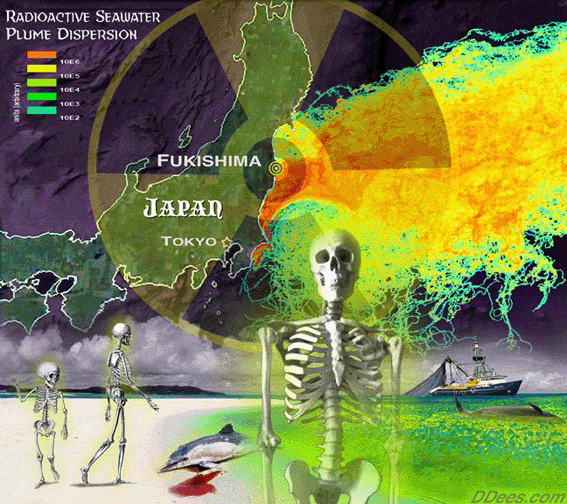
On March 11, 2017, we will hit the 6th anniversary of the Fukushima nuclear disaster in Japan which featured the complete meltdown of three nuclear reactor cores due to these facilities being inundated by a 45-foot high tsunami wave caused by an earthquake. Sadly, the engineers and scientists trying to mitigate the ongoing damage have been unsuccessful at stopping the daily flow of radiation into the Pacific Ocean, which is simply one piece of the interconnected body of water I call the Earth Ocean.
The material of the melted cores, called corium, has sunk down into the earth below their shattered former containment vessels, and resides within the shallow water table below — which results in an ongoing flow of radioactive material pouring into the ocean. Apparently, there is no existing technological solution to this issue, and there are increasing measurements of radioactive material within the vast Pacific Ocean and all along the western coasts of the North and South American continents.
The Federal Government of the United States does not (publicly) monitor such radiation inflows, and therefore, any information about the contamination comes from various activities funded by crowd-source financing of various private and public-good organizations, etc.
This I find somewhat odd — in that the United States has, in recent days, deployed their radiation-sniffing jet to fly about over Europe in the hopes of identifying the source of highly abnormal radioactive particles of Iodine-131 that have been wafting about upon the winds since (apparently) early January 2017. At this moment, there is no explanation. So… we’ll deploy United States taxpayer resources to help track down the source of a European Iodine-131 leak — which, incidentally, has a half-life of about eight days — and will discuss the problem publicly … but we won’t (publicly) monitor our western coasts and air for an ongoing radiation catastrophe now six years old, emitting radioactive particles with half-lives of thousands of years. The Federal Government of the United States won’t even talk about it.
Is the idea (or attitude) then that since we have no ability to arrest or fix the unrelenting Fukushima poisoning of our planetary environment, that we will just not talk about or acknowledge it in a public way? Are we going to continue to buy the demonstrably false notion put forth by the U.S. government that the vast waters of the Pacific ocean will act to “dilute” the radioactive poison over time — when it is a scientific fact that radioactive particles are not “dilutable” and are, instead, cumulative?
Are we going to continue to disassociate the massive die-offs and poisoning of ocean life from the obvious source, the cumulative effects of Fukushima radiation? Are we going to continue to enjoy our seafood because the Federal Government says that the radioactive levels within it are “within safe limits”? Are we going to continue to label people like myself (of which there are many) as “conspiracy theorists” and uneducated alarmists who have been expressing concern over the Fukushima catastrophe since it occurred — people like me who know from objective observed and scientific fact that all is not well with what is going on (or not going on) at Fukushima?
Over the past few weeks, the Japanese have attempted to send their Scorpion robot into the damaged containment vessel areas. These attempts have resulted in the rapid destruction of these specially designed radiation-detecting robots — but not before measurements were made… reliable measurements, that indicate radiation leaking at 530 seiverts per hour. Such readings were described as “unimaginable.” Why? Because human death is likely at just 10 seiverts per hour of radiation exposure.
This is all current news — yet our national media and federal government will not investigate it, talk about it, or help in developing a strategy to defeat the problem. I would submit that the ongoing Fukushima environmental catastrophe is — by far — the most urgent danger to humanity that we face. This is not a localized Japanese problem — it is a world-wide environmental emergency that is getting worse every day.
If humanity does not have the current technology to defeat this problem, then we need to get our best and brightest minds together from across the world and develop technology to defeat it, immediately. It is absolutely unacceptable and irresponsible for the world to simply ignore what it going on — indeed, it is eventually suicidal. If President Trump does not begin to openly talk about the ongoing global emergency threat of Fukushima and advocate for a solution, then I, for one, will publicly part ways with him — on this issue alone.
There is no greater clear and present danger to the future of humanity and other life on this earth than the out-of-control Fukushima disaster. All other issues of debate and controversy are small potatoes in comparison. President Trump needs to rally support for an effective response on this—indeed, the sheer gravity of the destruction being done to the world provides a superb opportunity to bring together a truly unified global response to an issue that threatens humanity. Japan does not have the resources or technological ability to solve this problem by itself — and no individual nation does, or could. Just as if humanity found itself mortally in danger from a source beyond the Earth and would therefore unify to defeat it, so too must it view the Fukushima situation as a mortal danger to humanity from within.
If we get to work on the problem, I am absolutely confident that our human ingenuity and resourcefulness will defeat it. We are, in our human potentiality, that good — if we will only do it.
February 25, 2017
Posted by Christina Macpherson |
2 WORLD, environment, Fukushima continuing |
Leave a comment

 HELEN CALDICOTT: The Fukushima nuclear meltdown continues unabated https://independentaustralia.net/politics/politics-display/helen-caldicott-the-fukushima-nuclear-meltdown-continues-unabated,10019 3 February 2017, Dr Helen Caldicott, explains recent robot photos taken of Fukushima’s Daiichi nuclear reactors: radiation levels have not peaked, but have continued to spill toxic waste into the Pacific Ocean — but it’s only now the damage has been photographed.
RECENT reporting of a huge radiation measurement at Unit 2 in the Fukushima Daichi reactor complex does not signify that there is a peak in radiation in the reactor building.
All that it indicates is that, for the first time, the Japanese have been able to measure the intense radiation given off by the molten fuel, as each previous attempt has led to failure because the radiation is so intense the robotic parts were functionally destroyed.
The radiation measurement was 530 sieverts, or 53,000 rems (Roentgen Equivalent for Man). The dose at which half an exposed population would die is 250 to 500 rems, so this is a massive measurement. It is quite likely had the robot been able to penetrate deeper into the inner cavern containing the molten corium, the measurement would have been much greater.
These facts illustrate why it will be almost impossible to “decommission” units 1, 2 and 3 as no human could ever be exposed to such extreme radiation. This fact means that Fukushima Daichi will remain a diabolical blot upon Japan and the world for the rest of time, sitting as it does on active earthquake zones.
What the photos taken by the robot did reveal was that some of the structural supports of Unit 2 have been damaged. It is also true that all four buildings were structurally damaged by the original earthquake some five years ago and by the subsequent hydrogen explosions so, should there be an earthquake greater than seven on the Richter scale, it is very possible that one or more of these structures could collapse, leading to a massive release of radiation as the building fell on the molten core beneath. But units 1, 2 and 3 also contain cooling pools with very radioactive fuel rods — numbering 392 in Unit 1, 615 in Unit 2, and 566 in Unit 3; if an earthquake were to breach a pool, the gamma rays would be so intense that the site would have to be permanently evacuated. The fuel from Unit 4 and its cooling pool has been removed.
But there is more to fear.
The reactor complex was built adjacent to a mountain range and millions of gallons of water emanate from the mountains daily beneath the reactor complex, causing some of the earth below the reactor buildings to partially liquefy. As the water flows beneath the damaged reactors, it immerses the three molten cores and becomes extremely radioactive as it continues its journey into the adjacent Pacific Ocean.
Every day since the accident began, 300 to 400 tons of water has poured into the Pacific where numerous isotopes – including cesium 137, 134, strontium 90, tritium, plutonium, americium and up to 100 more – enter the ocean and bio-concentrate by orders of magnitude at each step of the food chain — algae, crustaceans, little fish, big fish then us.
Fish swim thousands of miles and tuna, salmon and other species found on the American west coast now contain some of these radioactive elements, which are tasteless, odourless and invisible. Entering the human body by ingestion they concentrate in various organs, irradiating adjacent cells for many years. The cancer cycle is initiated by a single mutation in a single regulatory gene in a single cell and the incubation time for cancer is any time from 2 to 90 years. And no cancer defines its origin.
We could be catching radioactive fish in Australia or the fish that are imported could contain radioactive isotopes, but unless they are consistently tested we will never know.
As well as the mountain water reaching the Pacific Ocean, since the accident, TEPCO has daily pumped over 300 tons of sea water into the damaged reactors to keep them cool. It becomes intensely radioactive and is pumped out again and stored in over 1,200 huge storage tanks scattered over the Daichi site. These tanks could not withstand a large earthquake and could rupture releasing their contents into the ocean.
But even if that does not happen, TEPCO is rapidly running out of storage space and is trying to convince the local fishermen that it would be okay to empty the tanks into the sea. The Bremsstrahlung radiation like x-rays given off by these tanks is quite high – measuring 10 milirems – presenting a danger to the workers. There are over 4,000 workers on site each day, many recruited by the Yakuza (the Japanese Mafia) and include men who are homeless, drug addicts and those who are mentally unstable.
There’s another problem. Because the molten cores are continuously generating hydrogen, which is explosive, TEPCO has been pumping nitrogen into the reactors to dilute the hydrogen dangers.
Vast areas of Japan are now contaminated, including some areas of Tokyo, which are so radioactive that roadside soil measuring 7,000 becquerels (bc) per kilo would qualify to be buried in a radioactive waste facility in the U.S..
As previously explained, these radioactive elements concentrate in the food chain. The Fukushima Prefecture has always been a food bowl for Japan and, although much of the rice, vegetables and fruit now grown here is radioactive, there is a big push to sell this food both in the Japanese market and overseas. Taiwan has banned the sale of Japanese food, but Australia and the U.S. have not.
Prime Minister Abe recently passed a law that any reporter who told the truth about the situation could be gaoled for ten years. In addition, doctors who tell their patients their disease could be radiation related will not be paid, so there is an immense cover-up in Japan as well as the global media.
The Prefectural Oversite Committee for Fukushima Health is only looking at thyroid cancer among the population and by June 2016, 172 people who were under the age of 18 at the time of the accident have developed, or have suspected, thyroid cancer; the normal incidence in this population is 1 to 2 per million.
However, other cancers and leukemia that are caused by radiation are not being routinely documented, nor are congenital malformations, which were, and are, still rife among the exposed Chernobyl population.
Bottom line, these reactors will never be cleaned up nor decommissioned because such a task is not humanly possible. Hence, they will continue to pour water into the Pacific for the rest of time and threaten Japan and the northern hemisphere with massive releases of radiation should there be another large earthquake.
February 22, 2017
Posted by Christina Macpherson |
Fukushima continuing, Reference |
Leave a comment
Fukushima: a Lurking Global Catastrophe? http://nation.com.pk/international/21-Feb-2017/fukushima-a-lurking-global-catastrophe Robert Hunziker – Year over year, ever since 2011, the Fukushima Daiichi nuclear meltdown grows worse and worse, an ugly testimonial to the inherent danger of generating electricity via nuclear fission, which produces isotopes, some of the most deadly poisonous elements on the face of the planet.
Fukushima Diiachi has been, and remains, one of the world’s largest experiments, i.e., what to do when all hell breaks loose aka The China Syndrome. “Scientists still don’t have all the information they need for a cleanup that the government estimates will take four decades and cost ¥8 trillion. It is not yet known if the fuel melted into or through the containment vessel’s concrete floor, and determining the fuel’s radioactivity and location is crucial to inventing the technology to remove the melted fuel,” (Emi Urabe, Fukushima Fuel-Removal Quest Leaves Trail of Dead Robots, The Japan Times, Feb. 17, 2017).
As it happens, “”inventing technology” is experimental stage stuff. Still, there are several knowledgeable sources that believe the corium, or melted core, will never be recovered. Then what?
According to a recent article, “Potential Global Catastrophe of the Reactor No. 2 at Fukushima Daiichi,” d/d Feb. 11, 2017 by Dr. Shuzo Takemoto, professor, Department of Geophysics, Graduate School of Science, Kyoto University: The Fukushima nuclear facility is a global threat on level of a major catastrophe.
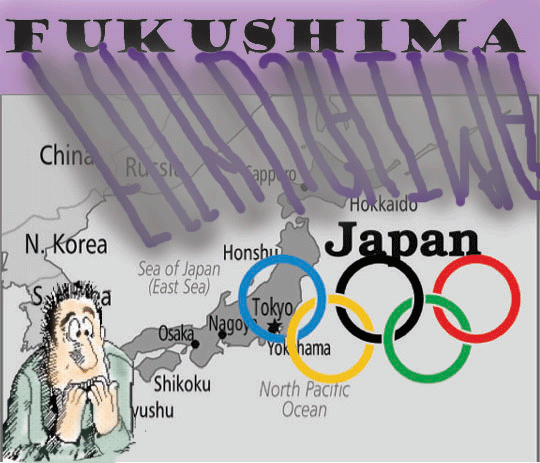
Meanwhile, the Abe administration dresses up Fukushima Prefecture for the Tokyo 2020 Olympics, necessitating a big fat question: Who in their right mind would hold Olympics in the neighborhood of three out-of-control nuclear meltdowns that could get worse, worse, and still worse? After all, that’s the pattern over the past 5 years; it gets worse and worse. Dismally, nobody can possibly know how much worse by 2020. Not knowing is the main concern about holding Olympics in the backyard of a nuclear disaster zone, especially as nobody knows what’s happening. Nevertheless and resolutely, according to PM Abe and the IOC, the games go on.
Along the way, it’s taken Tokyo Electric Power Company (TEPCO) nearly six years to finally get an official reading of radiation levels of the meltdown but in only one unit. Analysis of Unit #2 shows radiation levels off-the-charts at 530 Sieverts, or enough to kill within minutes, illustrative of why it is likely impossible to decommission units 1, 2, and 3. No human can withstand that exposure and given enough time, frizzled robots are as dead as a doornail.
“A short-term, whole-body dose of over 10 sieverts would cause immediate illness and subsequent death within a few weeks, according to the World Nuclear Association” (Emi Urabe, Fukushima Fuel-Removal Quest Leaves Trail of Dead Robots, The Japan Times, Feb. 17, 2017).
Although Fukushima’s similar to Chernobyl Exclusion Zone in some respects, where 1,000 square miles has been permanently sealed off, Fukushima’s different, as the Abe administration is already repopulating portions of Fukushima. If they don’t repopulate, how can the Olympics be held with food served from Fukushima and including events like baseball held in Fukushima Prefecture?
Without question, an old saw – what goes around comes around – rings true when it comes to radiation, and it should admonish (but it doesn’t phase ‘em) strident nuclear proponents, claiming Fukushima is an example of how safe nuclear power is “because there are so few, if any, deaths” (not true). As Chernobyl clearly demonstrates: Over time, radiation cumulates in bodily organs. For a real life example of how radiation devastates human bodies, consider this fact: 453,391 children with bodies ravaged, none born at the time of the Chernobyl meltdown in 1986, today receive special healthcare because of Chernobyl radiation-related medical problems like cancer, digestive, respiratory, musculoskeletal, eye disease, blood disease, congenital malformation, and genetic abnormalities. Their parents were children in the Chernobyl zone in 1986 (Source: Chernobyl’s Legacy: Kids With Bodies Ravaged by Disaster, USA Today, April 17, 2016).
Making matters worse yet, Fukushima Diiachi sets smack dab in the middle of earthquake country, which defines the boundaries of Japan. In that regard, according to Dr. Shuzo Takemoto, professor, Department of Geophysics, Graduate School of Science, Kyoto University: “The problem of Unit 2… If it should encounter a big earth tremor, it will be destroyed and scatter the remaining nuclear fuel and its debris, making the Tokyo metropolitan area uninhabitable. The Tokyo Olympics in 2020 will then be utterly out of the question,” (Shuzo Takemoto, Potential Global Catastrophe of the Reactor No. 2 at Fukushima Daiichi, February 11, 2017).
Accordingly, the greater Tokyo metropolitan area remains threatened for as long as Fukushima Diiachi is out of control, which could be for generations, not years. Not only that, Gee-Whiz, what if the big one hits during the Olympics? After all, earthquakes come unannounced. Regrettably, Japan has had 564 earthquakes the past 365 days. It’s an earthquake-ridden country. Japan sits at the boundary of 4 tectonic plates shot through with faults in zigzag patterns, very lively and of even more concern, the Nankai Trough, the candidate for the big one, sits nearly directly below Tokyo. On a geological time scale, it may be due for action anytime within the next couple of decades. Fukushima Prefecture’s not that far away.
Furthermore, the Fukushima Diiachi nuclear complex is tenuous, at best: “All four buildings were structurally damaged by the original earthquake some five years ago and by the subsequent hydrogen explosions so should there be an earthquake greater than seven on the Richter scale, it is very possible that one or more of these structures could collapse, leading to a massive release of radiation as the building falls on the molten core beneath.” (Helen Caldicott: The Fukushima Nuclear Meltdown Continues Unabated, Independent Australia, February 13, 2017).
Complicating matters further, the nuclear site is located at the base of a mountain range. Almost daily, water flows from the mountain range beneath the nuclear plant, liquefying the ground, a sure-fire setup for cascading buildings when the next big one hits. For over five years now, radioactive water flowing out of the power plant into the Pacific carries isotopes like cesium 134 and cesium 137, strontium 90, tritium, plutonium americium and up to 100 more isotopes, none of which are healthy for marine or human life, quite the opposite in fact as those isotopes slowly cumulate, and similar to the Daleks of Doctor Who fame (BBC science fiction series, 1963-present) “Exterminate! Exterminate! Exterminate!”
Isotopes bio-concentrate up the food chain from algae to crustaceans to small fish to big fish to bigger humans. Resultant cancer cells incubate anytime from two years to old age, leading to death. That’s what cancer does; it kills.
Still, the fact remains nobody really knows for sure how directly Fukushima Diiachi radiation affects marine life, but how could it be anything other than bad? After all, it’s a recognized fact that radiation cumulates over time; it’s tasteless, colorless, and odorless as it cumulates in the body, whether in fish or further up the food chain in humans. It travels!
An example is Cesium 137 one of the most poisonous elements on the planet. One gram of Cesium 137 the size of a dime will poison one square mile of land for hundreds of years. That’s what’s at stake at the world’s most rickety nuclear plant, and nobody can do anything about it. In fact, nobody knows what to do. They really don’t.
When faced with the prospect of not knowing what to do, why not bring on the Olympics? That’s pretty good cover for a messy situation, making it appear to hundreds of thousands of attendees, as well as the world community “all is well.” But, is it? Honestly….
The Fukushima nuclear meltdown presents a special problem for the world community. Who knows what to believe after PM Abe lied to the IOC to get the Olympics; see the following headline from Reuters News: “Abe’s Fukushima ‘Under Control’ Pledge to Secure Olympics Was a Lie: Former PM,” Reuters, Sept. 7, 2016.– COUNTERPUNCH
“Abe gave the assurances about safety at the Fukushima plant in his September 2013 speech to the International Olympic Committee to allay concerns about awarding the Games to Tokyo. The comment met with considerable criticism at the time… Mr. Abe’s ‘under control remark, that was a lie,’ Koizumi (former PM) now 74 and his unruly mane of hair turned white, told a news conference where he repeated his opposition to nuclear power,” Ibid.
As such, a very big conundrum precedes the 2020 games: How can the world community, as well as Olympians, believe anything the Abe administration says about the safety and integrity of Fukushima?
Still, the world embraces nuclear power more so than ever before as it continues to expand and grow. Sixty reactors are currently under construction in fifteen countries. In all, 160 power reactors are in the planning stage and 300 more have been proposed. Pro-Nuke-Heads claim Fukushima proves how safe nuclear power is because there are so few, if any, deaths, as to be inconsequential. That’s a boldfaced lie.
Here’s one of several independent testimonials on deaths because of Fukushima Diiachi radiation exposure (many, many, many more testimonials are highlighted in prior articles, including USS Ronald Reagan sailors on humanitarian rescue missions at the time): “It’s a real shame that the authorities hide the truth from the whole world, from the UN. We need to admit that actually many people are dying. We are not allowed to say that, but TEPCO employees also are dying. But they keep mum about it,” Katsutaka Idogawa, former mayor of Futaba (Fukushima Prefecture), Fukushima Disaster: Tokyo Hides Truth as Children Die, Become Ill from Radiation – Ex-Mayor, RT News, April 21, 2014.
February 22, 2017
Posted by Christina Macpherson |
Fukushima continuing |
Leave a comment
 Greenpeace exposes high radiation risks in Fukushima village as govt prepares to lift evacuation order http://www.newkerala.com/news/fullnews-228867.html Tokyo/ New Delhi, Feb 21 : The Japanese government will soon lift evacuation orders for 6,000 citizens of Iitate village in Fukushima prefecture where radiation levels in nearby forests are comparable to the current levels within the Chernobyl 30km exclusion zone – an area that more than 30 years after the accident remains formally closed to habitation.
Seventy-five percent of Iitate is contaminated forested mountains, a Greenpeace statement claimed..
A survey team led by Greenpeace Japan recently found radiation dose rates at houses in the village of Iitate well above long-term government targets, with annual and lifetime exposure levels posing a long-term risk to citizens who may return. Evacuation orders will be lifted for Iitate no later than March 31, 2017, to be followed one year later by the termination of compensation payments.
The relatively high radiation values, both inside and outside houses, show an unacceptable radiation risk for citizens if they were to return to Iitate. Citizens returning to their irradiated homes are at risk of receiving radiation equivalent to one chest X-ray every week. This is not normal or acceptable, said Ai Kashiwagi, energy campaigner with Greenpeace Japan .
As Japan nears the six year anniversary of the nuclear disaster, the Japanese government last week confirmed that it has not yet conducted any assessments of lifetime exposure risks for citizens if they were to return to Iitate.
Recent reports suggest that the cost of cleaning up of Fukushima plant would cost more than 12lakh crores. If a developed country like Japan, known for its processes and systems, is finding it too difficult to handle the disaster, it makes little sense for India to go ahead and sign up for four more reactors at Kudankulam and elsewhere. In the words of George Santania Those who cannot remember the past are condemned to repeat it, says G. Sundarrajan of Poovulagin Nanbargal.
Life can never go back to normal for people living near nuclear power plants. But clearly, the world has failed to learn its lessons from nuclear accidents like those in Chernobyl and Fukushima. India, for instance, seems determined to add on to its nuclear power capacity despite putting the lives of millions of people at risk, says Nandikesh Sivalingam, climate and energy campaigner, Greenpeace India.
The fact remains that nuclear power is neither safe nor economical, and that India is grossly ill-prepared to handle a nuclear disaster. This was pointed out by Red Alert, a Greenpeace India report that released last year.
Last years Indo-Japan nuclear deal also negated the lessons learnt from Fukushima.
The deal to buy six AP1000 reactors was more of a last ditch effort to save Westinghouse/Toshiba from imminent meltdown. Now, after the meltdown, the future of the six nuclear reactors has put a question mark on the economic viability of nuclear power. Its reported that the cost of building these six reactors will be three to six times greater than the cost of building a solar photovoltaic plant of the same capacity.
It should also be noted that India is currently in a situation of surplus power witnessing massive installed overcapacity in the electricity sector. With the solar tariffs going down to record low levels, Indias energy needs for the next ten years can be fulfilled by cleaner and safer sources of energy in the form of solar and wind.
Greenpeace India stand by the victims of Fukushima who are being forced to return to the accident site for economic reasons. India must learn from the Fukushima disaster and its long lasting impacts on peoples lives and livelihoods and move away permanently from highly risky and economically unviable nuclear energy to safer, greener and cheaper energy sources like solar and wind.
Greenpeace has launched a public petition in solidarity with the Fukushima survivors campaigning for the restitution/protection of their human rights.
February 22, 2017
Posted by Christina Macpherson |
environment, Fukushima continuing, Japan |
Leave a comment
 Radiation levels at Fukushima reactor puzzle nuclear experts, THE ASAHI SHIMBUN, February 19, 2017 A robot was expected to solidify ways to clean up the No. 2 reactor at the Fukushima No. 1 nuclear plant, but its short-lived mission raised puzzling questions that could derail existing decommissioning plans.
The robot, Sasori, was abandoned in the melted-down reactor after it became stuck in deposits and other debris that are believed to have interfered with its drive system.
But it did take radiation measurements that indicate Tokyo Electric Power Co., operator of the plant, was too optimistic about the state and location of the melted fuel within the reactor. The melted fuel, in fact, may be spread out all over the reactor’s containment vessel.
Scientists had believed the melted nuclear fuel fell through the reactor’s pressure vessel and landed on metal grating and the floor of the containment vessel.
The results of Sasori’s investigation, coupled with previous data taken from possible images of the melted fuel, show the situation within the reactor is much worse than expected. And a fresh investigation into the reactor is now nowhere in sight.
A remote-controlled video camera inserted into the reactor on Jan. 30 took what are believed to be the first images of melted fuel at the plant, which suffered a triple meltdown after the March 2011 Great East Japan Earthquake and tsunami.
Based on the images, TEPCO estimated 530 sieverts per hour at a point almost halfway between the metal grating directly beneath the pressure vessel and the wall of the containment vessel. Black lumps on the grating are believed to be melted fuel.
A different robot sent in on Feb. 9 to take pictures and prepare for Sasori’s mission estimated 650 sieverts per hour near the same spot.
Both 530 and 650 sieverts per hour can kill a person within a minute.
Sasori, equipped with a dosimeter and two cameras, on Feb. 16 recorded a reading of 210 sieverts per hour near the same location, the highest figure measured with instruments in the aftermath of the disaster.
Sasori was supposed to travel along a rail connecting the outer wall of the containment vessel with the metal grating to measure radiation doses and shoot pictures inside, essential parts of work toward decommissioning the reactor.
After traveling only 2 meters, the robot became stuck before it could reach the metal grating.
TEPCO at a news conference repeatedly said that Sasori’s investigation was not a “failure” but had produced “meaningful” results.
However, an official close to TEPCO said, “I had great expectations for Sasori, so I was shocked by how it turned out.”……(This article was compiled from reports by Kohei Tomida, Masanobu Higashiyama and Takashi Sugimoto) http://www.asahi.com/ajw/articles/AJ201702190042.html
February 20, 2017
Posted by Christina Macpherson |
Fukushima continuing |
Leave a comment
 Radiation levels inside Fukushima too high for robot http://www.cbc.ca/news/technology/fukushima-nuclear-robot-radiation-1.3973908 , The robot was to inspect and clean a passage before another robot does a fuller examination The Associated Press Feb 09, 2017 A remote-controlled cleaning robot sent into a damaged reactor at Japan’s Fukushima nuclear plant had to be removed Thursday before it completed its work because of camera problems most likely caused by high radiation levels.
It was the first time a robot has entered the chamber inside the Unit 2 reactor since a March 2011 earthquake and tsunami critically damaged the Fukushima Da-ichi nuclear plant.
Tokyo Electric Power Co. (TEPCO) said it was trying to inspect and clean a passage before another robot does a fuller examination to assess damage to the structure and its fuel. The second robot, known as the “scorpion,” will also measure radiation and temperatures.
Thursday’s problem underscores the challenges in decommissioning the wrecked nuclear plant. Inadequate cleaning, high radiation and structural damage could limit subsequent probes, and may require more radiation-resistant cameras and other equipment, TEPCO spokesman Takahiro Kimoto said.
“We will further study (Thursday’s) outcome before deciding on the deployment of the scorpion,” he said.
TEPCO needs to know the melted fuel’s exact location and condition and other structural damage in each of the three wrecked reactors to figure out the best and safest ways to remove the fuel. It is part of the decommissioning work, which is expected to take decades.
During Thursday’s cleaning mission, the robot went only part way into a space under the core that TEPCO wants to inspect closely. It crawled down the passage while peeling debris with a scraper and using water spray to blow some debris away. The dark brown deposits grew thicker and harder to remove as the robot went further.
More obstacles for second mission
After about two hours, the two cameras on the robot suddenly developed a lot of noise and their images quickly darkened — a sign of a problem caused by high radiation. Operators of the robot pulled it out of the chamber before completely losing control of it.
The outcome means the second robot will encounter more obstacles and have less time than expected for examination on its mission, currently planned for later this month, though Thursday’s results may cause a delay.
Both of the robots are designed to withstand up to 1,000 Sieverts of radiation. The cleaner’s two-hour endurance roughly matches an estimated radiation of 650 Sieverts per hour based on noise analysis of the images transmitted by the robot-mounted cameras. That’s less than one-tenth of the radiation levels inside a running reactor, but still would kill a person almost instantly.
Kimoto said the noise-based radiation analysis of the Unit 2’s condition showed a spike in radioactivity along a connecting bridge used to slide control rods in and out, a sign of a nearby source of high radioactivity, while levels were much lower in areas underneath the core, the opposite of what would normally be the case. He said the results are puzzling and require further analysis.
TEPCO officials said that despite the dangerously high figures, radiation is not leaking outside of the reactor.
Images recently captured from inside the chamber showed damage and structures coated with molten material, possibly mixed with melted nuclear fuel, and part of a disc platform hanging below the core that had been melted through.
February 10, 2017
Posted by Christina Macpherson |
Fukushima continuing |
Leave a comment
The Worst Disaster That You’ll Never Hear Anything About, Criticl, 2 Aug 15 The Fukushima Daiichi nuclear disaster embodies one of the worst man-made calamities in human history that day-by-day receives a dearth of coverage. Three nuclear reactors melting down on March 11th, 2011 ushered in the beginning of one of the most effective and insidious works of misinformation and obfuscation of reality that has been seen in recent memory.
The impetus for the disaster arose from the 2011 Tohoku earthquake, which was estimated to be the most powerful earthquake to ever hit the island in recorded history. The magnitude of the 869 Jogan Sanriku quake (the previous record holder) is only an approximation due to the lack of seismograph technology, nonetheless the Tohoku earthquake was more powerful than the plant was designed to withstand.
Nuclear reactors are designed to shutdown at the slightest event, quickly reducing the amount of heat produced; yet any heat inside the reactor (comprised of the radioactive decay of short lived fission products) is still a magnanimous amount. Backup diesel generators were quickly ushered into action at Fukushima after outside power was destroyed by the quake in order to keep the reactors cool to prevent a meltdown.
However, standard operation procedures for the plant flew out the window when tsunami waves of 14-20 meters struck the Fukushima prefecture shortly after the earthquake, rendering the 5.7-meter seawall beyond useless and knocking out the generators. Interestingly enough, the nearby Onagawa plant was saved by a 14.8-meter seawall despite being struck by a more powerful wave. Yanosuki Hirai fought bureaucracy for years that clamored for the same 5.7-meter seawall at Onagawa, and got his higher wall, remarking, “Corporate ethics is different from compliance, just being ‘not guilty’ is not enough.” The wall was remarkably effective to the point that local residents sought shelter in the plant’s gymnasium after their homes were destroyed by the wave.
The resulting influx of water into the Fukushima reactor led to a station blackout, meaning the operators lost all monitors and the ability to remotely control the reactor. Isolation condensers can cool the reactor with no electricity as long as the condenser is filled with water. Regrettably, operators had no idea that the reactor was quickly running out of water and that the valves opening the condensers were not working, rendering the first line of defence against a potential meltdown useless.
Authorities decided next to depressurize the reactors and inject water from fire engines to flood the reactors, yet unseen diversions to steam condensers via small bypasses meant injected water was not sufficient to prevent an overheating of the core. Reactor 1 saw a hydrogen explosion resulting from molten fuel cladding three hours after the tsunami. Vents and piping intended to filter hydrogen were either severely damaged by the earthquake or unable to operate due to a lack of power.
Unit 2 and the Unit 3 Reactor Core had steam-powered turbines that would circulate cooling water, but suffered a hydrogen explosion due to the pressure in the reactor becoming too low for the turbines to operate. Operators were too inexperienced to properly inject water via the fire engines, which again resulted in a meltdown of both reactors. Leading the cleanup efforts several days later, Japanese authorities quickly created a temporary cover over Unit 1 and begin to filter out contaminated water and repair the other components of the reactors, while devising a plan to contain exposed radioactive material from the damaged reactors……………. Like what you see? https://thefirsttruth.wordpress.com/
https://criticl.me/post/worst-disaster-youll-never-hear-anything-about-3562
August 5, 2015
Posted by Christina Macpherson |
Fukushima continuing, Reference |
Leave a comment
 METI changes tactics after search for nuclear waste host proves futile http://www.japantimes.co.jp/news/2015/05/22/national/meti-changes-tactics-search-nuclear-waste-host-proves-futile/#.VV-6ZdKeAXB
KYODO The government will select potential areas to host nuclear dump sites instead of waiting for communities to volunteer, according to the revised policy on permanent disposal of high-level radioactive waste that was adopted by the Cabinet on Friday.
The revision, the first in seven years, was prompted after towns, villages and cities throughout Japan snubbed requests to host nuclear waste dumps. The government has been soliciting offers since 2002.
The move is seen as a sign that the government wants to address the matter as it proceeds with its pursuit of reactor restarts. All commercial units have largely sat idle since the triple meltdown at the Fukushima No. 1 plant in 2011.
It remains unclear when a final depository could be built, because the policy mentions no time frame. The government also plans to expand its storage capacity for spent fuel by building new interim facilities as a short-term fix.
“We will steadily proceed with the process as (resolving the problem is) the current generation’s responsibility,” minister of economy, trade and industry Yoichi Miyazawa told reporters, adding there will be “quite a few” candidate sites.
They will be chosen on scientific grounds, the policy says.
Prime Minister Shinzo Abe’s administration is seeking to revive atomic power, although the majority of the public remains opposed in light of the Fukushima disaster, which left tens of thousands homeless. Critics have attacked the government for promoting atomic power without resolving where all the waste will end up.
Permanent disposal of high-level nuclear waste requires that a depository be built more than 300 meters underground, where the materials must lie for up to 100,000 years until radiation levels fall to the point where there is no harm to humans or the environment.
About 17,000 tons of spent fuel is stored on the premises of nuclear plants and elsewhere in Japan, but some would run out of space in three years if all the reactors got back online.
Under the revision, the government said it will allow future generations to retrieve high-level waste from such facilities should policy changes or new technologies emerge.
Worldwide, only Finland and Sweden have been able to pick final depository sites. Finland is building the world’s first permanent disposal site for high-level waste in Olkiluoto, aiming to put it into operation around 2020.
But many other countries with nuclear plants are struggling to find a site for such a facility. In the United States, President Barack Obama decided in 2009 to call off a plan to build a disposal site in Nevada’s Yucca Mountain due to local opposition.
May 23, 2015
Posted by Christina Macpherson |
Fukushima continuing, politics, wastes |
1 Comment
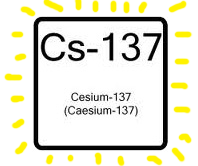 Gov’t report reveals Fukushima radioactive release much larger than Chernobyl — Japan reactors could have emitted nearly four times as much cesium-137 http://enenews.com/govt-report-reveals-fukushima-radioactive-release-larger-chernobyl-japan-reactors-could-emitted-four-times-cesium-137?utm_source=feedburner&utm_medium=email&utm_campaign=Feed%3A+ENENews+%28Energy+News%29
- The Fukushima accident [led to a] release of huge radioactivity
- It is reported… 4 times more radioactivity was released to the sea than to the atmosphere
- Best-estimate source term of 137Cs… released into the atmosphere, is about 4%
- Best-estimate release fraction of the 137Cs inventory that flowed into the sea…about 16%
- Of the 4% inventory of 137Cs released into the atmosphere, only 0.8% was deposited in the Japanese land and the other 3.2% was transported to the sea or other areas
- The inventory… available for release in the units 1-3… the time of accident [was] 7.6 – 8.2 x 10^17 [760 – 820 quadrillion] Bq for 137Cs
- Because of the geographic location of the nuclear power plant — at the beach of the Pacific Ocean… more than 80% of the radioactivity released from the crippled reactors flowed into the sea
To determine the best estimate of the total 137Cs that was released into the environment from Fukushima, the 137Cs release fraction (4% atmosphere, 16% ocean) is multiplied by the 137Cs inventory for the 3 melted reactor cores (760 to 820 quadrillion Bq):
- Ocean Release of 137Cs from Fukushima: 121.6 to 131.2 quadrillion Bq (16% x 760 to 820 quadrillion Bq)
- Atmospheric Release of 137Cs from Fukushima: 30.4 to 32.8 quadrillion Bq (4% x 760 to 820 quadrillion Bq)
- Total Release of 137Cs into the Environment from Fukushima: 152 to 164 quadrillion Bq
- Total Release of 137Cs into the Environment from Chernobyl: 70 to 85 quadrillion Bq
However, the 137Cs inventory of 760 to 820 quadrillion Bq used by the Korea Atomic Energy Research Institute is significantly lower than the U.S. Department of Energy calculated:
- DOE’s Total 137Cs Inventory in Reactors 1-3: 1.3E+18 Bq (1,300 quadrillion Bq)
- Ocean 137Cs Release from Fukushima: 208 quadrillion Bq (16% x 1,300 quadrillion)
- Atmospheric 137Cs Release from Fukushima: 52 quadrillion Bq (4% x 1,300 quadrillion)
- Total 137Cs Release into the Environment from Fukushima: 260 quadrillion Bq
- Total 137Cs Release into the Environment from Chernobyl: 70 to 85 quadrillion Bq
See also: Fukushima has released 80 Quadrillion Bq of cesium-137 — “The radioactive plume itself has actually arrived… it’s already here” on west coast of N. America (AUDIO)
October 23, 2014
Posted by Christina Macpherson |
Fukushima continuing |
Leave a comment
Leader of Fukushima plant “started staggering… mumbling ‘It’s all over’” before last reactor melted — Appears to collapse, has visions while motionless on floor — Top official “bursts into tears” at meeting — No way to prevent ‘utter catastrophe’ — ‘Chilling’ sound soon heard, ‘gaping hole’ in reactor suspected http://enenews.com/leader-fukushima-plant-started-staggering-around-mumbling-all-before-last-reactor-melted-appears-collapse-begins-having-visions-motionless-floor-senior-official-bursts-tears-around-same-time?utm_source=feedburner&utm_medium=email&utm_campaign=Feed%3A+ENENews+%28Energy+News%29
Kyodo News (Part 9), Sep 23, 2014 (emphasis added) : Reactor 2′s cooling system finally stopped functioning at 1:25 p.m. on March 14… [In 5 hours]… the water level had drained to 3.7 meters below the top of the nuclear fuel… leaving it fully exposed. There was also no signthe seawater was entering the reactor… firetrucks that were supposed to be injecting water into the reactor had run out of fuel… [Fukushima chief Masao] Yoshida would later recall that this felt like a “turning point,” beyond which “we had run out of all options and I thought I might really die.”… Yoshida went up to [the many workers on the 2nd floor] and said: “Thank you for dealing with the situation until now. It is OK to go home.”… 8:30 p.m… Yoshida then asked [if] there was any place people could evacuate to… Yoshida [was told] that the No. 2 plant was ready… With workers unable to operate the venting valves, the pressure continued to build… an experienced leader… felt that the reactor’s containment vessel could break at any time…
Kyodo News (Part 10), Sep 23, 2014:: A [Tepco] senior official broke down and wept in the prime minister’s office when the utility felt it had exhausted all options to prevent an utter catastrophe... bursting into tears… Shortly after 4 a.m. on March 15 [Japan was] facing a potential rupture of the reactor 2 containment vessel… [Prime Minister Naoto] Kan soonrealized it was too late to rein in the crisis… a chilling sound swept through the response office at 6:14 a.m, albeit duller than that of the two previous hydrogen blasts. Those present felt their blood freeze as they were told by reactor operators that the pressure inside the reactor 2 suppression chamber, connected to the containment vessel, had dropped to zero… radioactive steam could pour out into the external environment, leaving no safe place inside the plant or in the surrounding area. “The suppression chamber might have a gapping hole… [Yoshida] instantly decided it was time to evacuate the site.
Testimony reveals odd behavior just before ‘chilling sound’ and pressure dropping to zero at Unit 2: Early on March 15, silence engulfed the emergency response office as the point of no return neared. Yoshida stood up and started staggering around, mumbling to himself, “It’s all over.”… Yoshida was searching for the right time to allow Tepco employees to leave the plant, except for a skeleton crew… As he returned to his seat, he leaned back in his chair, crossed his arms and closed his eyes… he was thinking about what might happen if the reactor 2 containment vessel failed, discharging a catastrophic amount of radioactive materials… He could not think of a way to avoid such a scenario. [Shiro] Hikita… sawYoshida’s body slide from the chair onto the floor. At first he thought Yoshida had collapsed but then realized he was sitting cross-legged as if meditating. With his eyes closed,Yoshida did not move for several minutes. Yoshida later said he was calling to mind the faces of his longest-serving colleagues: “There were about 10 or so. I thought those guys might be willing to die with me.”
See also: Secret Fukushima Testimony: Plant boss considered disemboweling himself after blasts… “I should kill myself” — “I was in despair… panicking… I could not afford to logically think” — Saw smoke at Unit 3 before it exploded, and “figured this was the end”
September 26, 2014
Posted by Christina Macpherson |
Fukushima continuing |
Leave a comment
 VIDEO: Gov’t experts highly suspicious of Japan’s claim that nobody suffered acute radiation syndrome after Fukushima — So many workers were ill they had to lay on cardboard after running out of beds — Officials “repeatedly talked of death” — CBS: There were reports of people with radiation sickness http://enenews.com/video-foreign-govt-very-suspicious-japans-claim-suffered-acute-radiation-syndrome-after-fukushima-many-workers-ill-lay-cardboard-after-running-beds-officials-repeatedly-talked-death-video?utm_source=feedburner&utm_medium=email&utm_campaign=Feed%3A+ENENews+%28Energy+News%29
Japan Times, Sept. 17, 2014 (emphasis added): [Deceased Fukushima Daiichi chief Masao Yoshida] repeatedly talks of “death” in the initial days of the crisis as the realization sinks in that the nuclear fuel had already started to melt.
Mainichi, Sept 12, 2014: “Nobody came to help us. I am still full of resentment and bitterness,” Yoshida said… heaping scorn on [the] TEPCO President… and calling him ”that man.”
Xinhua, Sept 11, 2014: Masao Yoshida [revealed] the government had utterly failed to understand the gravity of the workers’ situation at the plant… three days into the crisis the chief had lost hope and was losing his grip on the situation… politicians and TEPCO officials at the headquarters were clueless as to the dire predicament he and his workers were in, including those who had been exposed to potentially lethal levels of radiation.
Kyodo News, Sept 14, 2014: [Satoru] Hayashizaki and his coworker opened the door to the [No. 3] suppression chamber’s room… “My hands, covered by rubber gloves, instantly got hot”…Hayashizaki felt groggy… he put his right foot down on it only to see the rubber sole of his shoe melt instantly, leaving a black smear… He was alarmed to see [his dosimeter number] rising rapidly, even though he was [back] in the control room… everyone else’s dosimeters were rising… [He] thought he might die… and started writing a farewell letter.
Kyodo News, Sept. 14, 2014: Mitsuhiro Matsumoto, 47, was outside during both explosions… he [became] unable to believe anyone or any of the information he received. “I completely lost my will to fight”… Many [workers] had already absorbed more than 100 millisieverts… A man injured by the rubble was soon brought in on a stretcher… there were no doctors… Another man [was] in a state of panic… Those feeling ill were taken to a meeting room… Tepco quickly ran out of mattresses and had to put down cardboard for them to lie on… the door closed behind [Yumiko Kato and a reactor operator] shouted: “Is that an explosion? Again?” He then clasped his arms around his knees and trembled, muttering “I am afraid, afraid, afraid.”… “I want to go home,” a young female Tepco employee said as she started to cry…[Kato] said, “Let’s believe in our people, because they are working very hard.” The situation, however, only got worse, cornering everyone at the plant.
IRSN, France’s Institute for Radiological Protection and Nuclear Safety (at 11:00 in): “At first sight there was no acute radiation syndrome observed in the weeks following the accident, , as was the case of the first rescue workers during the Chernobyl accident. These figures are to be taken with great caution because of severe degradations due to the tsunami… Medical checkups are now implemented by the Japanese authorities.” >> Watch the video here
Contrary to IRSN’s claim about medical checkups, NHK recently reported, “Screening of workers is left up to the contractors […] they’re not obliged to submit data. [A gov’t adviser says they need] a centralized system to collect health data right away.” And according to the Asahi Shimbun, “Many companies involved have failed to conduct medical examinations.. [It’s now] impossible to check whether workers have suffered health problems.”
CBS News discussed radiation sickness after the explosions: Prof. Cham Dallas, a nuclear energy expert, you’ve been in contact with both the Japanese and the US government throughout this process… Let’s talk about radiation exposure… Dallas: “There’s some disconnects here. We’re being told by the Japanese government that the radiation levels are very low… We have reports of people with radiation sickness. That’s the disconnect, usually it takes days for radiation [sickness]” >> Watch the broadcast here
September 20, 2014 Posted by Christina MacPherson | Uncategorized | Leave a comment | Edit
DORC rort: The art of getting energy infrastructure paid for twice, SMH, September 19, 2014 Michael West Business columnist “……..you will hear how you have been paying for something, on a quarterly basis for the past 10 years, which you have already paid for. We are all victims of a high-brow rort by governments and energy companies.
While the consulting industry thrives on selling so-called expert valuations to justify this rort, Sydney University finance professor David Johnstone says it should end…….
energy companies are valuing old assets such as gas pipelines – things that consumers have already paid for – as if they were brand-spanking new. We, the mug punters, are lumbered with the cost on our power bills.
This is the DORC rort (depreciated optimised replacement cost), its moniker alone sufficient to discourage further inquiry.
Suffice to say that a reasonable thing for regulators to do might simply be to value assets at their cost, or to recognise only what their owners actually spend. Suffice to say that in Singapore and Hong Kong they would not be silly enough to use DORC, yet large corporations from these places are here enjoying riskless 10 per cent returns by stinging we mug Aussies twice for access to old gas pipelines, things that were paid for, and privatised, years ago……
why are assets that are already in private hands given the same favourable regulatory treatment? “I think it comes down to ideology as well as vested interests,” Johnstone says. “Economists fall in love their own models and crave the authority of being scientists.” http://www.smh.com.au/business/dorc-rort-the-art-of-getting-energy-infrastructure-paid-for-twice-20140919-10jega.html#ixzz3DuqE0nIm
September 20, 2014
Posted by Christina Macpherson |
Fukushima continuing |
Leave a comment
Secret Fukushima Testimony Revealed: Plant chief considered “disemboweling himself” after explosions… “I should kill myself” — Smoke seen at No. 3 reactor before blast, “I figured this was the end of plant” — At start of crisis “I was in despair… panicking… I could not afford to logically think”http://enenews.com/secret-testimony-reveals-fukushima-plant-chief-contemplated-ritually-disembowelling-after-reactors-exploded-kill-despair-honestly-panicking-could-afford-logically?utm_source=feedburner&utm_medium=email&utm_campaign=Feed%3A+ENENews+%28Energy+News%29
The Times (UK), Sept. 11 2014: Hero of Fukushima nuclear disaster considered hara-kiri … [Masao] Yoshida describes his horror on realising the reactors faced meltdown… [He] contemplated ritually disembowelling himself after an explosion that appeared to have killed dozens of his men… the manager of the Fukushima Daiichi nuclear power plant, made the admission in recently released secret testimony…
Former Fukushima Daiichi plant manager Masao Yoshida’s interview with gov’t investigation committee, Yomiuri Shimbun, published Sept. 10, 2014:
No. 1 Reactor — “I was in despair… I was panicking… I could not afford to logically think”
- YOSHIDA: “To be honest, I was stunned [the plant lost all AC power]. I thought the situation was grave… My first thought was, ‘It’s a calamity.’… I was in despair… The No. 1 reactor fell into a state of crisis first, and then the No. 3 reactor. A crisis [like an explosion] could have erupted at any time… honestly, I was panicking… the No. 1 reactor exploded… Everything was in turmoil, and I could not afford to logically think.”
No. 3 Reactor Explosion — “I thought I should kill myself… I should commit harakiri”
- Q: TEPCO’s records show radiation levels registered 300 millisieverts within the consecutive doors leading into the [No. 3] reactor building, and also that there was whitish smoke nearby… YOSHIDA: “Yes… before an explosion took place there… I assumed that the No. 3 reactor’s fuel had been damaged… and that steam and other leaks from its container were starting to fill its building… I figured this was the end of the plant. That is to say, I wanted to inject water sooner, but in the end, a range of circumstances piled up and conspired against us… I explained that the No. 3 reactor also had its fuel rod damaged and that, based on the pressure in the containment vessel, it was approaching the same condition the No. 1 reactor had been in. There was a risk of another explosion at 9:30 a.m. or 10 a.m. on March 14, so I called for an evacuation of all personnel at that time… However, when discussing this with headquarters, I was told, “Just how long are you evacuating?” I told them that there was a risk of an explosion, and there was no way we could put personnel on the ground… The pressure on the containment vessel had dropped a bit… I issued the order to go back, and almost as we were doing so, it exploded. They said there were about 40-plus people missing… I thought I should kill myself at that point. If that report were true, and some 40-plus people were really dead, I thought I should commit harakiri.”
No. 2 Reactor — “The containment vessel might have been destroyed”
- YOSHIDA: “That morning [of March 15]… we got word that the [pressure in the No. 2 reactor’s suppression chamber] had reached zero… the containment vessel might have broken. Thinking conservatively, this meant the vessel might have been destroyed, and that popping sound would suggest some sort of breakage… I decided to treat this as an emergency and issued an evacuation order, leaving only core [personnel]… I gave an order for all other personnel to temporarily evacuate from the site… the prime minister came at, I think, a bit after 5 a.m… I stated that I was evacuating personnel. There was pushback that the containment vessel would surely not explode because there was still pressure, but I countered that the pressure gauges could not be trusted.”
See also: Deceased Fukushima Chief: “I thought we were really dead” — Fear of “nuclear doom for eastern Japan” — “A total failure in which the fuel melts and breaches… containment vessel”
September 13, 2014
Posted by Christina Macpherson |
Fukushima continuing |
Leave a comment
Fukushima No. 2 scrambled to avoid same fate as sister site Fukushima No. 1 Fukushima Emergency – what can we do? by dunrenard Sep 10, 2014
FUKUSHIMA – This is the fifth in a series on the Fukushima nuclear catastrophe based on the accounts of people who struggled to contain the crisis in its early stages. Job titles and ages are as of March 2011.
Fukushima No. 1 wasn’t the only nuclear complex facing a critical situation after the magnitude-9.0 earthquake of March 11, 2011, unleashed a monster tsunami on the coast of Tohoku.
Tokyo Electric Power Co.’s Fukushima No. 2 plant, located about 12 km south of the No. 1 plant, also saw seawater pumps and electrical equipment flooded by the tsunami, which led three of its four reactors to lose key cooling functions.
Still, the extent of the damage was less devastating than that at its sister plant and one off-site power source that remained operable provided more leeway for workers to deal with the emergency.
For No. 2 plant chief Naohiro Masuda, 53, the worst situation imaginable was to lose control of both plants at the same time.
So when he watched on television as an explosion rocked the No. 1 reactor building at the other complex on March 12, Masuda issued an order that could be seen by some as coldhearted.
“Don’t allow anyone (from Fukushima No. 1) to enter our emergency response office building,” the plant chief said.
The building houses the emergency first-aid station.
Masuda’s decision reflected his determination to keep the developments at the other site from hampering stabilization efforts at his plant.
Workers exposed to radiation or injured by the explosion were certain to be transported to Fukushima No. 2.
Masuda believed that he had to limit the radiation contamination inside his complex so as not to affect the workers’ efforts.
He told his subordinates to prepare a place away from the office building for the No. 1 workers. His decision was later criticized by some No. 1 workers, who said they felt they were treated “like garbage.”
An area to scrub away radiation contamination and an aid center were set up inside a facility next to the main gate. The plant’s gymnasium was also readied as a shelter for workers from No. 1.
By the night of March 12, everything was ready to receive the No. 1 workers. But Masuda noticed many of his own workers appeared anxious. To reassure them, he gathered them together and told them he would “make sure that you won’t end up with any health problems. Don’t worry……….
September 11, 2014
Posted by Christina Macpherson |
- Fukushima 2011, Fukushima continuing |
Leave a comment