Dismay in the region over Japan’s plan for nuclear waste water
Nuclear Waste in Pacific Ocean: Japan’s Plan Triggers Controversy
Japan plans to discharge millions of metric tonnes of nuclear wastewater into the Pacific Ocean. This wastewater has been accumulating since disaster struck the Fukushima nuclear power plant in 2011. Japan is running out of storage space for this wastewater, which is why it is desperately trying to dump the waste in the ocean. But Tokyo’s plan is marred with controversy, with physical protests being arranged against it as well. Watch this Vantage report to know more.
TEPCO faces new crisis over pedestal blow at Fukushima plant

May 30, 2023 https://www.asahi.com/ajw/articles/14920197
Damage to a pedestal inside the No. 1 reactor at the crippled Fukushima No. 1 nuclear power plant is more critical than previously believed, triggering a more intricate assessment of its resistance to a major earthquake.
Plant operator Tokyo Electric Power Co. (TEPCO) has no time to waste in confronting the issue. It must swiftly assess the damage and take effective action to prevent an accident or leak of radioactive materials.
An underwater robotic probe detected the damage in late March. It found that the metal framework lies exposed along the inner side of the pedestal’s wall for about 1 meter from its bottom and for the entire inner circumference as concrete in these areas has been lost.
There are fears the containment vessel that houses the pressure vessel could crack if the pedestal collapses in a severe earthquake. That could cause radioactive materials to leak.
Referring to the structure’s current earthquake resistance, TEPCO stressed that the pedestal has managed to support the reactor vessel even though the plant “has experienced strong earthquakes.” The utility cited one last year that registered lower 6 on the Japanese seismic intensity scale of 7.
Although the possibility of the pressure vessel tilting or sinking cannot be ruled out, the company asserts the impact will be limited with no risk of radioactive material leaking to the outside.
the Nuclear Regulation Authority (NRA) said last week it could not decide whether the assumptions underlying TEPCO’s risk assessment are accurate as the extent of damage and condition of the structural materials are not yet fully understood. The nuclear safety watchdog also said it would be difficult to reinforce the pedestal because of high radiation levels inside the containment vessel.
For this reason, the NRA called on the utility to evaluate the impact of a possible release of radioactive material into the environment and consider steps to deal with such an emergency.
As one NRA official put it, “I should say (TEPCO’s evaluation) is too optimistic, and it is difficult to say that is very reassuring.”
NRA Chairman Shinsuke Yamanaka said at a news conference, “It is TEPCO’s responsibility to swiftly assess what risks could impact the surrounding environment and its residents.”
Conditions surrounding the reactors that suffered core meltdowns in the nuclear disaster 12 years ago are only now finally being clarified. This has led to the discovery of additional problems that are already difficult to deal with, making the outlook of progress toward decommissioning the reactors even more uncertain.
The degradation of plant parts and materials will continue in the coming years. There is always the risk of a major earthquake striking the plant. Each time it is hit by a strong quake, the damage accumulates and the danger increases. If a radioactive leak occurs, it will seriously compromise the safety of residents, the reconstruction of the local communities and the local fishing industry.
The NRA this month decided not to lift a ban on the movement of nuclear fuel within TEPCO’s Kashiwazaki-Kariwa nuclear power plant in Niigata Prefecture, citing flawed measures to protect the facility against terrorist attacks. There are growing concerns about whether TEPCO is equipped to operate nuclear power plants.
There is absolutely no room for complacency when it comes to the consequences of the Fukushima nuclear disaster. TEPCO must always remain vigilant to a worst-case scenario in tackling related challenges.
IAEA team in Japan for final review before planned discharge of Fukushima nuclear plant water.

abc news, 29 May 23
An International Atomic Energy Agency team has arrived in Tokyo for a final review before Japan begins releasing massive amounts of treated radioactive water into the sea from the wrecked Fukushima nuclear plant, a plan that has been strongly opposed b…
By MARI YAMAGUCHI Associated Press, May 29, 2023
TOKYO — An International Atomic Energy Agency team arrived in Tokyo on Monday for a final review before Japan begins releasing massive amounts of treated radioactive water into the sea from the wrecked Fukushima nuclear plant, a plan that has been strongly opposed by local fishing communities and neighboring countries.
The team, which includes experts from 11 countries, will meet with officials from the government and the plant operator, Tokyo Electric Power Company Holdings, and visit the Fukushima Daiichi nuclear power plant during their five-day visit, the economy and industry ministry said………………………………
Some scientists say the impact of long-term, low-dose exposure to radionuclides is unknown and the release should be delayed.
Japan’s government has stepped up campaigns in Japanese media and at food fairs to promote the safety of seafood from Fukushima, while providing regular briefings to foreign governments including South Korea and members of the Pacific Islands Forum.
…………………. Japanese officials say the water stored in the tanks needs to be removed to prevent accidental leaks in case of another disaster and to make room for the plant’s decommissioning. https://abcnews.go.com/Technology/wireStory/iaea-team-japan-final-review-planned-discharge-fukushima-99669696
Fukushima reactor 1 found to have damaged pedestal supporting nuclear core
(Picture above is of the same structure one year previously)
A nuclear watchdog has asked the operator of Japan’s wrecked Fukushima
nuclear power station to assess potential risks from damage found in a key
supporting structure inside the worst-hit of the three melted reactors. A
robotic probe inside the Fukushima Daiichi nuclear power plant’s Unit 1
primary containment chamber found its pedestal — a main supporting
structure right underneath the core — was largely damaged. The thick
concrete exterior was missing almost all the way around, exposing the
internal steel reinforcement. About 800 tonnes of highly radioactive melted
nuclear fuel remain inside the plant’s three reactors.
LBC 25th May 2023
https://www.lbc.co.uk/world-news/8af57263389e457aa47b8846ede3d7b0/
Japan Nuclear Watchdog Asks Fukushima Plant Operator to Assess Reactor Risk
Photo May 22– damaged pedestal supporting reactor core, Unit 1
By Mari Yamaguchi | May 26, 2023
TOKYO (AP) – A nuclear watchdog has asked the operator of Japan’s wrecked Fukushima nuclear power plant to assess possible risks resulting from damage that was found in a key supporting structure inside one of the three melted reactors.
A robotic probe sent inside the Fukushima Daiichi plant’s Unit 1 primary containment chamber found that its pedestal – the main supporting structure directly under its core – was extensively damaged. Most of its thick concrete exterior was missing, exposing the internal steel reinforcement.
About 880 tons of highly radioactive melted nuclear fuel remain inside the plant’s three damaged reactors. Robotic probes have provided some information, but the status of the melted debris is still largely unknown.
Based on data collected from earlier probes and simulations, experts have said most of the melted fuel inside Unit 1, believed to be the worst hit, fell to the bottom of the primary containment chamber, but some might have fallen through to the concrete foundation – a situation that makes the already daunting task of decommissioning extremely difficult.
At a meeting Wednesday of the Nuclear Regulation Authority, its commissioners agreed to order operator Tokyo Electric Power Company Holdings to urgently assess the risks from the pedestal damage, including the possible leak of radioactive substances from cracks and holes caused by the meltdown. The authority also requested that TEPCO assess potential risks if, in the event of another disaster, the pedestal fails to support the reactor.
”We need to think about responses in case of an accident,” commissioner Shinsuke Yamanaka told reporters. “TEPCO has a responsibility to make the risk assessment as soon as possible.”…………………………………………………….
The damage is believed to be from the initial earthquake in 2011, but might have happened more recently. The images of the exposed steel reinforcement have triggered concerns among local residents about the reactor’s safety.
A plan to release treated, but still slightly radioactive, water from the Fukushima Daiichi plant into the sea has also triggered concerns and protests from the local fishing community and neighboring countries, including South Korea.
A South Korean delegation of government experts visited the plant for two days this week to see the facilities related to the planned water release. The team members were to meet with Japanese officials on Thursday in Tokyo, where they said they plan to follow the review of the International Atomic Energy Agency, which has been assisting Japan to improve transparency and credibility…………………. https://www.claimsjournal.com/news/international/2023/05/26/317199.htm—
Japan hopes to start discharging Fukushima nuclear wastewater in July
Gong Zhe https://news.cgtn.com/news/2023-04-23/Japan-hopes-to-start-discharging-Fukushima-nuclear-wastewater-in-July-1jfbTfpbNvy/index.html
Japan is hoping to start discharging radioactive waste water from its destroyed Fukushima nuclear plant into the ocean in July.
Tokyo Electric Power Company (TEPCO) told Kyoto News on Saturday that the excavator is near the exit of the tunnel located one-kilometer offshore. The 1,030-meter tunnel is used to discharge the treated water stored in the Fukushima Daiichi Nuclear Power Plant into the sea. As long as 1,017 meters of the tunnel have been excavated.
TEPCO is trying to complete the tunnel and other facilities related to water discharging before the end of June, and the possibility of starting discharge operations as early as July has increased.
The Japanese government and TEPCO are trying to start discharging around this summer, but fishermen and others continue to oppose it. The plan faces opposition at home and has raised “grave concern” in neighboring countries, including but not limited to China and South Korea.
TEPCO plans to use a large amount of seawater for dilution to make the activity of tritium in treated water less than one-fortieth of national standards, and then discharge it through a seabed tunnel. It is expected to be discharged for several decades.
Fukushima’s fishing industry survived a nuclear disaster. 12 years on, it fears Tokyo’s next move may finish it off.
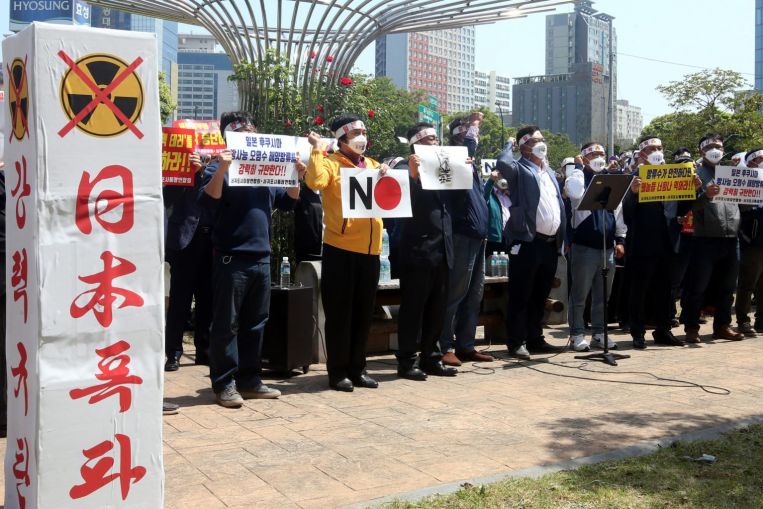
By Emiko Jozuka, Krystina Shveda, Junko Ogura, Marc Stewart and Daniel Campisi, CNN, April 19, 2023
It is still morning when Kinzaburo Shiga, 77, returns to Onahama port after catching a trawler full of fish off Japan’s eastern coast.
But the third-generation fisherman won’t head straight to market. First, he’ll test his catch for radiation.
It’s a ritual he’s repeated for more than a decade since a devastating earthquake and tsunami triggered a nuclear meltdown at the Fukushima Daiichi power plant in 2011, spewing deadly radioactive particles into the surrounding area.
Radiation from the damaged nuclear plant leaked into the sea, prompting authorities to suspend fishing operations off the coast of three prefectures that had previously provided Japan with half of its catch.
That ban lasted over a year and even after it was lifted, Fukushima-based fishermen like Shiga were for years mostly limited to collecting samples for radioactivity tests on behalf of the state-owned electricity firm Tokyo Electric Power Company, or TEPCO, rather than taking their catches to market.
Ocean currents have since dispersed the contaminated water enough that radioactive Cesium is nearly undetectable in fish from Fukushima prefecture. Japan lifted its last remaining restrictions on fish from the area in 2021, and most countries have eased import restrictions.
Shiga and others in the industry thought they’d put the nightmare of the past years behind them.
So when Japan followed through on plans to gradually release more than 1 million metric tons of filtered wastewater into the Pacific Ocean from the summer of 2023 – an action the government says is necessary to decommission the plant safely – the industry reeled.
The Japanese government and the International Atomic Energy Agency (IAEA), a United Nations body promoting the peaceful use of nuclear energy, say the controlled release, which is expected to take decades, will meet international safety regulations and not harm the environment, as the water will be treated to remove radioactive elements – with the exception of tritium – and diluted more than 100 times.
But with the deadline for the planned water release looming this summer, Fukushima’s fishermen fear that – whether the release is safe or not – the move will undermine consumer confidence in their catches and once again threaten the way of life they have fought so hard to recover…………………………………………………………………..
While radioactive wastewater contains dangerous elements including Cesium and Strontium, TEPCO says the majority of those particles can be separated from the water and removed. TEPCO claims its filtering system, called advanced liquid processing (ALPS), can bring down the amount of those elements far below regulatory standards.
But one hydrogen isotope cannot be taken away, as there is currently no technology available to do so. This isotope is radioactive tritium, and the scientific community is divided on the risk its dissemination carries………………………………………………………
“For decades, nuclear power plants worldwide – including in the United States, Canada, Britain, France, China and South Korea – have been releasing waste contaminated with tritium, each under its own national quota,” said Tim Mousseau, an environmental scientist at the University of South Carolina.
But Mousseau argues tritium is overlooked because many countries are invested in nuclear energy, and “there’s no way to produce it without also generating vast amounts of tritium.”
“If people started picking on TEPCO in Fukushima, then the practice of releasing tritium to the environment in all of these other nuclear power plants would need to be examined as well. So, it opens up a can of worms,” he said, adding the biological consequences of exposure to tritium have not been studied sufficiently.
In 2012, a French literature review study said tritium can be toxic to the DNA and reproductive processes of aquatic animals, particularly invertebrates, and the sensitivity of different species to various levels of tritium needs to be further investigated.
Currently, countries set different standards for the concentration of tritium allowed in drinking water. For example. Australia, which has no nuclear power plants, allows more than 76,000 becquerel per liter, a measure used to gauge radioactivity, while the WHO’s limit is 10,000. Meanwhile, the US and the European Union have much more conservative limits – 740 and 100 becquerel per liter respectively.
Ian Fairlie, an independent consultant on radioactivity in the environment, told CNN that “two wrongs don’t make a right” when it comes to Japan’s decision to release tritiated water. He argues TEPCO should build more storage tanks to allow for the decay of the radioactive tritium, which has a half-life of 12.3 years.
Lack of trust for the ‘nuclear village’
In Japan, the Fukushima wastewater issue has become highly contentious due to a lack of trust among influential advocates of nuclear energy, or what’s locally known as the “nuclear village.”
The informal group includes members of Japan’s ruling party (the Liberal Democratic Party), the Ministry of Economy Trade and Industry and the nuclear industry.
“(The nuclear village) used to tell us that nuclear energy is 100% safe – but it wasn’t, as the Fukushima Daiichi plant accident revealed,” said Koichi Nakano, a political scientist at Sophia University, in Tokyo.
A series of missteps after the disaster further eroded public trust, according to a 2016 report written by Kohta Juraku, a researcher at Tokyo Denki University.
For instance, in 2012, the government and TEPCO presented a proposed action plan to local fishing representatives that involved pumping up groundwater before it flooded into the nuclear reactor buildings and releasing it into the sea. Fishing bodies were on board but the plan was it postponed until 2014 after 300 tons of radioactive water leaked from the plant into the sea, infuriating fishers……………………………………… https://edition.cnn.com/2023/04/19/asia/japan-fukushima-disaster-wastewater-fishing-concerns-hnk-dst-dg-intl/index.html
Ignoring science, environmental protection and international law – G7 endorses Japan’s Fukushima water discharge plans

Greenpeace International, 16 April 2023 https://www.greenpeace.org/international/press-release/59193/science-environmental-protection-international-law-g7-japans-fukushima-water-discharge/
Legacy of Fukushima disaster shows nuclear energy is no solution to energy and climate crisis.
Sapporo, Japan – The nations of the G7 have chosen politics over science and the protection of the marine environment with their decision today to support the Japanese government’s plans to discharge Fukushima radioactive waste water into the Pacific Ocean.
The 1.3 million cubic meters/tons of radioactive waste water at the Fukushima Daiichi plant, currently in tanks, is scheduled to be discharged into the Pacific Ocean this year. Nations in the Asia Pacific region, led by the Pacific Island Forum, have strongly voiced their opposition to the plans.[1] Some of the world’s leading oceanographic institutes and marine scientists have criticised the weakness of the scientific justification applied by TEPCO, the owner of the nuclear plant, warned against using the Pacific Ocean as a dumping ground for radioactive contaminated water, and called for alternatives to discharge to be applied.[2]
“The Japanese government is desperate for international endorsement for its Pacific Ocean radioactive water dump plans. It has failed to protect its own citizens, including the vulnerable fishing communities of Fukushima, as well as nations across the wider Asia Pacific region. The aftermath of the nuclear disaster at Fukushima is still strongly felt, and the Japanese government has failed to fully investigate the effects of discharging multiple radionuclides on marine life. The government is obligated under international law to conduct a comprehensive environmental impact assessment, including the impact of transboundary marine pollution, but has failed to do so. Its plans are a violation of the UN Convention Law of the Sea.
The marine environment is under extreme pressure from climate change, overfishing and resource extraction. Yet, the G7 thinks it’s acceptable to endorse plans to deliberately dump nuclear waste into the ocean. Politics inside the G7 at Sapporo just trumped science, environmental protection, and international law,” said Shaun Burnie, Senior Nuclear Specialist at Greenpeace East Asia.
Greenpeace East Asia analysis has detailed the failures of liquid waste processing technology at the Fukushima Daiichi plant and the environmental threats posed by the releases.[3] There is no prospect of an end to the nuclear crisis at the plant as current decommissioning plans are not feasible. Furthermore, the report finds the nuclear fuel debris in the reactors cannot be completely removed and will continue to contaminate the ground water over many decades.[4] Claims that the discharges will take 30 years is inaccurate as in reality, it will continue into the next century. Viable alternatives to discharge, specifically long term storage and processing, have been ignored by the Japanese government.[3]
The Japanese government’s attempt to normalise the Fukushima nuclear disaster is directly linked to its overall energy policy objective of increasing the operation of nuclear reactors again after the 2011 disaster. 54 reactors were available in 2011 compared to only ten reactors in 2022, generating 7.9% of the nation’s electricity in FY21 compared to 29% in 2010.[5] Meanwhile, five of the other six G7 governments led by France, the US and the UK are also aggressively promoting nuclear power development.
The idea that the nuclear industry is capable of delivering a safe and sustainable energy future is delusional and a dangerous distraction from the only viable energy solution to the climate emergency which is 100% renewable energy. The global growth of low cost renewable energy has been phenomenal – but it has to be much faster and at an even greater scale if carbon emissions are to be reduced by 2030. Approval for nuclear waste dumping and nuclear energy expansion sound like the 1970’s but we have no time for such distractions. We are in a race to save the climate in the 21st century, and only renewables can deliver this,” said Shaun Burnie.
34,200 tons of radioactive sewage sludge kept in Kanto area 12 yrs after Fukushima disaster.
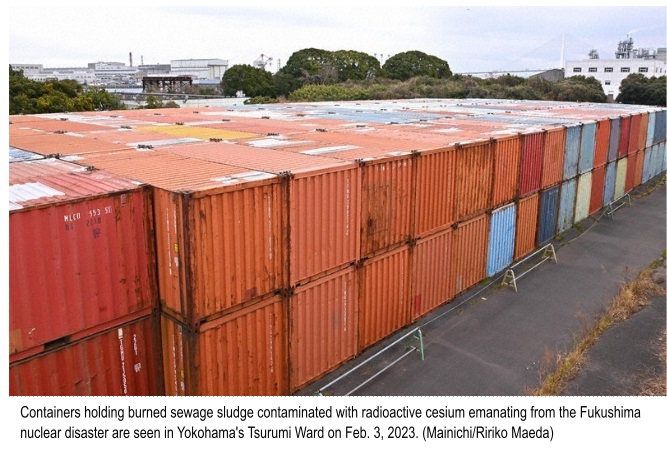
April 10, 2023 (Mainichi Japan)
TOKYO — A total of some 34,200 metric tons of sewage sludge contaminated with radioactive substances emanating from the Fukushima nuclear disaster is still kept in temporary storage by major local bodies in the Kanto region, the Mainichi Shimbun has learned.
The massive tainted waste — a year’s worth of ordinary burned sludge ash generated in Tokyo’s 23 wards — has partially been kept as incinerated ash. Due to difficulties in obtaining local understanding for landfill disposal of radioactive waste in harbors, forests and mountains, some of the waste has nowhere to go even 12 years on since the onset of the disaster.
The finding came after the Mainichi queried major local governments in five prefectures in the Kanto region and other sources about radioactively contaminated sewage sludge accumulated in the wake of the March 2011 Fukushima Daiichi Nuclear Power Station meltdown.
In May 2011, two months after the disaster, radioactive cesium was detected in the sewage sludge in Fukushima Prefecture. This prompted inspections of sewage in other local bodies in the Kanto region, and authorities took measures, such as keeping highly contaminated sludge within their local sewage facilities.
Of these, the Mainichi Shimbun interviewed 15 local bodies — Tokyo and six other Kanto region prefectures, their capital cities, and government-designated major cities in the region — between December 2022 and March 2023, regarding the status of their treatment of sewage sludge in which radioactive substances were detected.
It emerged that the Yokohama Municipal Government, south of Tokyo, had kept approximately 26,600 tons of radioactively contaminated waste within its sewage facilities as incinerated sludge ash as of the end of February 2023, while the Kawasaki Municipal Government, also in Kanagawa Prefecture, had kept 3,435 tons of such waste inside its port areas in the same form…………………………………………..
In the Kanto region alone, a total of some 4,180 tons of radioactive sewage requiring the central government’s treatment remains in Ibaraki, Tochigi, Gunma and Chiba prefectures, according to the Ministry of the Environment and other sources. The national government plans to place this waste under long-term management by setting up treatment facilities in state-owned forests and other sites in accordance with the special measures law on radioactive contamination response. However, the plan remains up in the air as the candidate sites have not been finalized due to protests from local residents and other factors.
Meanwhile, Tokyo, Saitama and Kanagawa prefectures responded to the survey that they have finished disposing of all radioactive sewage sludge under their control. The cities of Mito, Saitama and Chiba also answered the same. Based on the peak amount of radioactive sludge kept by these local bodies, it is estimated that they had disposed of at least some 120,000 tons of such waste.
(Japanese original by Kazuhiro Igarashi and Kaoru Watanabe, Tokyo Regional News Department)https://mainichi.jp/english/articles/20230408/p2a/00m/0na/013000c
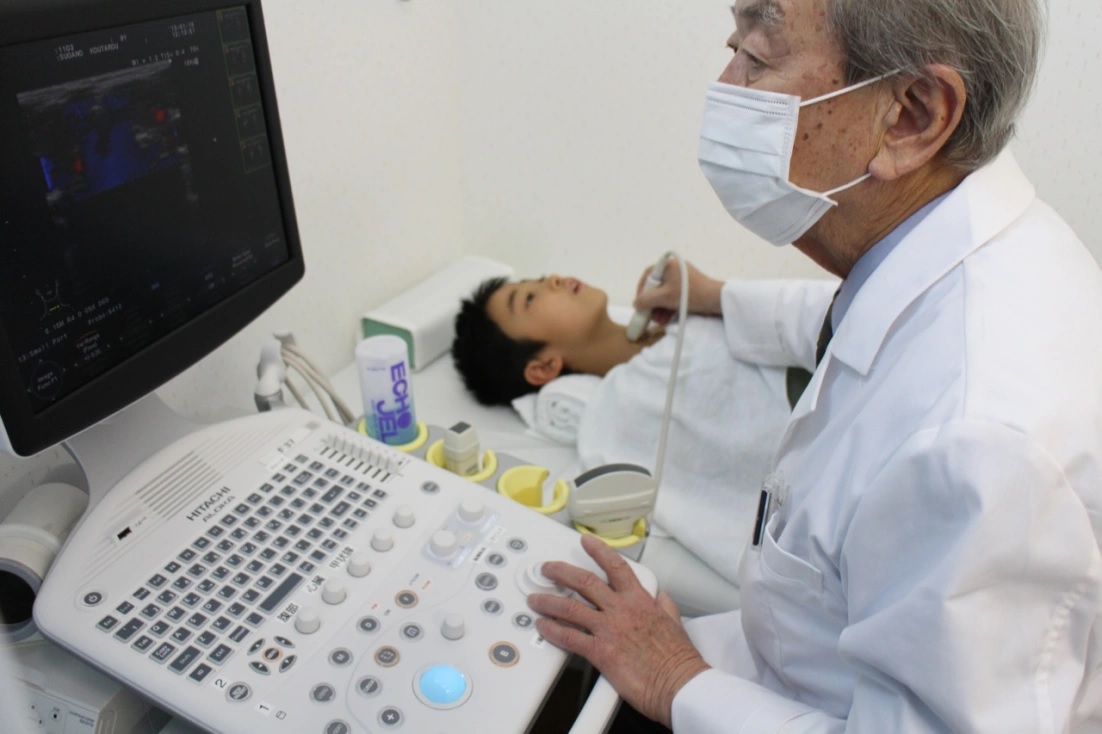
Childhood thyroid cancer cases confirmed in the Fukushima Health Management Survey and others
BY CITIZENS’ NUCLEAR INFORMATION CENTER · APRIL 5, 2023 https://cnic.jp/english/?p=6551
Fukushima Prefecture has been implementing thyroid gland examinations for children (born between April 2, 1992 and April 1, 2012) who were living in the prefecture at the time of the earthquake and nuclear disaster. The results are summarized in the table below: [on original]
In addition to the 295 children with thyroid cancer confirmed in the survey (excluding one with benign nodules), 43 other patients were identified outside of the tally in the cancer registry, bringing the total number of children aged 18 or younger with malignant or suspected malignant thyroid cancer who were living in Fukushima Prefecture at the time of the accident to 338. Note that the screening uptake rate at the age of 25 is low.
Surveys have found thyroid cancer in children at a rate dozens of times higher than normal.
Current State of Post-Accident Operations at Fukushima Daiichi Nuclear Power Station (Jun. to Dec. 2022)

State of the Plant Fukushima Now – Part 2, BY CITIZENS’ NUCLEAR INFORMATION CENTER APRIL 5, 2023 · By Matsukubo Hajime (CNIC)
The water temperature in the containment vessels and the spent fuel pools (SFPs) shows no great variation despite seasonal temperature changes. The state of releases of Xenon-135 (half-life roughly nine hours), released when uranium fuel undergoes fission, is also unchanged and it can therefore be estimated that the state of the reactors is stable. Further, according to an assessment by TEPCO in December 2022, around 10,000 becquerels per hour (Bq/h) of radioactive materials were being released to the atmosphere from the buildings (Fig.1 on original).
At the same time, decay heat has fallen greatly with the passage of time, and thus the volume of cooling water injected into the reactors has been reduced (falling from 7-10m3 per hour in May 2011 to 1.6-4m3 per hour as of December 2022).
The state of removal of spent nuclear fuel from the SFPs is summarized in Table 1 [0n original]. Spent nuclear fuel removal from Units 3 and 4 has been completed. However, as it has not been possible to remove control rods and other high-dose equipment stored in the SFPs, preparatory work has been underway for removal of this equipment from Unit 3 in the second half of FY2022 and removal from Unit 4 will commence in the second half of FY2024. Further, the removal of this equipment from Unit 3 was due to start from late October 2022, but this has now been rescheduled for early March 2023.
Preparations for the removal of fuel debris are also under way…………………………………..
The Unit 2 reactor core isolation cooling (RCIC) system was operating after the accident and for a further three days, including the time when the tsunami arrived at the plant. Uncovering the reason why it ceased functioning has been an issue, but it is inaccessible even now, after approximately 12 years underground………………………………………..
The changes in the average number of workers onsite per day is shown in Fig. 2 [on original] . As of December 2022, the number of workers was 4,410, about half the number it was at its peak. …………………………………
Contaminated water countermeasures at Fukushima Daiichi Nuclear Power Station (FDNPS) can be broadly divided into three areas: 1) Reduction of groundwater flowing into buildings, 2) Reduction of contaminated water flowing into the sea, and 3) Reduction of the toxicity of contaminated water. The main countermeasures to reduce water inflow into the buildings are, from higher elevations downward, ………………………………………………………
In the reduction of the toxicity of contaminated water, cesium and strontium are removed, and after the removal of impurities using a reverse osmosis (RO) membrane, radionuclides other than tritium are removed by the multi-radionuclide removal equipment…………………………………………
The frozen earth barrier consists of about 1600 30-meter freeze pipes buried in the ground, through which coolant at -30°C is circulated to freeze the surrounding soil. The effectiveness of the frozen earth barrier has been questioned since it was first installed, but since 2019 there have been several coolant leakage incidents.
Concerning the issue of releasing contaminated water into the ocean after ALPS treatment, TEPCO’s policy to release the water was authorized at the 25th Meeting of the Nuclear Regulatory Authority on July 22, and the construction was approved by the governor or Fukushima Prefecture and the mayors of both Okuma Town and Futaba Town in August. At present, construction of the release tunnel is ongoing, and the plan is to complete the construction during the first quarter of 2023. ………………………….. A fund of 30 billion yen has already been established as a measure against “adverse publicity.” Additionally, TV commercials, etc. are also being employed as “actions to foster understanding.” On the same day Chairman Masanobu Sakamoto of the National Federation of Fisheries Cooperative Associations released a statement saying, “We have not altered one little bit our opposition to the oceanic release.”
Meanwhile, Secretary General Henry Puna of the Pacific Islands Forum (PIF), an inter-governmental organization that aims to enhance cooperation among 15 countries and two regions of Oceania, announced in a statement on January 18 that PIF will demand a postponement of releases until it has become possible to confirm the safety of all involved [timetable of events shown on original] more https://cnic.jp/english/?p=6553
Fukushima Now Part 1: Railroading the Contaminated Water Release is Unacceptable!
BY CITIZENS’ NUCLEAR INFORMATION CENTER · APRIL 5, 2023, By Ban Hideyuki (CNIC Co-Director)
The Ministry of Economy, Trade and Industry (METI) and Tokyo Electric Power Holdings (TEPH) had decided on a policy of oceanic release of the contaminated water, which continues to build up at Fukushima Daiichi NPS, from an early stage and have been steadily proceeding with preparatory construction work for the release. This work has been proceeding despite written commitments to the National Federation of Fisheries Cooperative Associations and Fukushima Prefecture Federation of Fisheries Cooperative Associations in August 2015 that “(contaminated water) would not be released into the ocean without their agreement.”
This is the plan for how the release work will proceed. …………………………………………………………………..
This resulted in construction costs of 43 billion yen for the first four years and a release period of 30 years or more, a significant increase from the initial estimate of 3.4 billion yen and 88 months. However, the cost is based on an assessment of 800,000 tons, which differs from the current volume, but nevertheless the assessment that the oceanic release method is “cheap and fast” has been destroyed. Fishermen’s groups passed a special resolution at their general meeting in FY2022 to oppose oceanic releases, and their opposition remains unchanged.
………………………………………………………………….. Securing storage space for high integrity containers is a challenge
Wastewater collected during the ALPS treatment and its pre-treatment stage is stored in polyethylene high integrity containers (HICs). As of December 2022, there were 4,192 containers in storage. To prepare for an increase in wastewater, TEPH plans to expand the storage space by 192 units by June 2025 and a further 192 units by about the middle of 2026………………………………………………
As of June 2021, the Nuclear Regulation Authority had pointed out that there were 31 HICs with absorbed doses that had reached the limit of five mega-grays. That means the limit has been reached sooner than TEPCO had predicted, because, unlike TEPH, TEPCO evaluated absorbed doses from the sludge accumulated at the bottom of the waste effluent HIC. ………………………. Given that contaminated water will continue to be generated in the future, it is likely that securing storage space will become even more difficult. https://cnic.jp/english/?p=6562
Foundation in Fukushima nuclear plant reactor likely badly damaged
The internal wall of a cylindrical foundation supporting the reactor
pressure vessel of the No. 1 unit of the crippled Fukushima Daiichi nuclear
power plant may be badly damaged across its entire circumference, its
operator said Tuesday. Some of the damage was revealed in videos taken
during a survey of the No. 1 unit’s containment vessel by operator Tokyo
Electric Power Company Holdings Inc., which said it would further analyze
the footage and assess the seismic resistance of the pedestal. The survey,
conducted from March 28 through March 31 using an underwater robot, found
the concrete wall missing in over half of the pedestal measuring 5 meters
in internal diameter, leaving the reinforcing bar exposed.
Mainichi 4th April 2023
https://mainichi.jp/english/articles/20230404/p2g/00m/0bu/040000c
New images from inside Fukushima reactor spark safety worry
Images captured by a robotic probe inside one of the three melted reactors
at Japan’s wrecked Fukushima nuclear power plant showed exposed steel bars
in the main supporting structure and parts of its thick external concrete
wall missing, triggering concerns about its earthquake resistance in case
of another major disaster.
The plant’s operator, Tokyo Electric Power
Company Holdings, has been sending robotic probes inside the Unit 1 primary
containment chamber since last year. The new findings released Tuesday were
from the latest probe conducted at the end of March. An underwater remotely
operated vehicle named ROV-A2 was sent inside the Unit 1 pedestal, a
supporting structure right under the core.
It came back with images seen
for the first time since an earthquake and tsunami crippled the plant 12
years ago. The area inside the pedestal is where traces of the melted fuel
can most likely be found. An approximately five-minute video – part of
39-hour-long images captured by the robot – showed that the 120-centimeter
(3.9-foot) -thick concrete exterior of the pedestal was significantly
damaged near its bottom, exposing the steel reinforcement inside. TEPCO
spokesperson Keisuke Matsuo told reporters Tuesday that the steel
reinforcement is largely intact but the company plans to further analyze
data and images over the next couple of months to find out if and how the
reactor’s earthquake resistance can be improved.
The images of the exposed
steel reinforcement have triggered concerns about the reactor’s safety.
Daily Mail 4th April 2023
Mental illness plagues Japan’s nuclear disaster survivors
Some 37 percent of the survivors of Japan’s Fukushima Daiichi nuclear
power plant disaster of 2011 still suffer from mental illness due to
financial crisis, isolation, and drastic changes in living conditions, says
a survey.
The survey results indicated that the victims suffer from
post-traumatic stress disorder or PTSD due to “anxieties about
compensation and indemnification,” “unemployment” and “nuisances
just by being an evacuee.” The survey was conducted by the Waseda
Institute of Medical Anthropology on Disaster Reconstruction and the
Disaster Relief Assistance Network Saitama, a citizens group, between
January to April 2022 among 5,350 households, the Asahi Shimbun reported on
April 3.
Union of Catholic Asian News 4th April 2023
https://www.ucanews.com/news/mental-illness-plagues-japans-nuclear-disaster-survivors/100894
1 This Month


Shut down the radiation-damaged Heysham nuclear reactors now
To see nuclear-related stories in greater depth and intensity – go to https://nuclearinformation.wordpress.com

Say No to NASA’s Reckless Nuclear Reactor on the Moon
Say No to NASA’s Reckless Nuclear Reactor on the Moon
-
Archives
- October 2026 (247)
- September 2026 (339)
- August 2026 (330)
- July 2026 (355)
- June 2026 (287)
- May 2026 (306)
- April 2026 (356)
- March 2026 (251)
- February 2026 (267)
- January 2026 (308)
- December 2025 (358)
- November 2025 (359)
-
Categories
- 1
- 1 NUCLEAR ISSUES
- business and costs
- climate change
- culture and arts
- ENERGY
- environment
- health
- history
- indigenous issues
- Legal
- marketing of nuclear
- media
- opposition to nuclear
- PERSONAL STORIES
- politics
- politics international
- Religion and ethics
- safety
- secrets,lies and civil liberties
- spinbuster
- technology
- Uranium
- wastes
- weapons and war
- Women
- 2 WORLD
- ACTION
- AFRICA
- Atrocities
- AUSTRALIA
- Christina's notes
- Christina's themes
- culture and arts
- Events
- Fuk 2022
- Fuk 2023
- Fukushima 2017
- Fukushima 2018
- fukushima 2019
- Fukushima 2020
- Fukushima 2021
- general
- global warming
- Humour (God we need it)
- Nuclear
- RARE EARTHS
- Reference
- resources – print
- Resources -audiovicual
- Weekly Newsletter
- World
- World Nuclear
- YouTube
-
RSS
Entries RSS
Comments RSS

