Nov 12, 2016 (5 years & 8 months after the Fukushima Daiichi nuclear disaster)
Radiation was monitored around Oguraji-Terasaka of Fukushima city, Fukushima Prefecture, Japan.
Oguraji-Terasaka is a name of the place. Oguraji-Terasaka litaraly means a slope to the Oguraji temple. People of Fukushima respect the Oguraji-temple, and come there to pray for Senju Kannon statue, thousand-armed goddess who rescues all people.
Rain water from the previous night was flowing down the slope, accumulating at the slope road side, radioactive materials also accumulating there.
The air dose rate of the place was 0.5 micro Sv/h
The measuring instrument that was used in this video, is Ukraine made, ECOTEST’s MKS-05.
Fukusima city has a population of 284 000 people, it is located 94,9 km North-East from the Tepco Fukushima Daiichi nuclear power plant.
Fukushima Evacuees Still Unable to Go Home Over 5 Years after Earthquake, Nuclear Accident
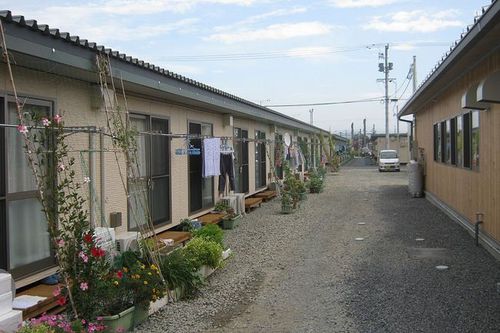
Over five-and-a-half years have passed since the Great East Japan Earthquake in March 2011 and the subsequent nuclear accident at Tokyo Electric Power Co.’s (TEPCO) Fukushima Daiichi nuclear power plant. Since then, big disasters have occurred in several other areas around the world, and in Japan the 2016 Kumamoto earthquakes also caused great damage. So, the term “disaster area” does not always evoke specific images of Tohoku or Fukushima for many of us in Japan today. However, a large number of disaster victims continues to suffer from the disaster in Tohoku, especially by the nuclear accident in Fukushima. The hard times for disaster victims haven’t ended yet. We report here on the latest situation in the Tohoku and Fukushima districts so as not to forget their ongoing suffering.
The losses from the Great East Japan Earthquake as of March 10, 2016, were officially reported as follows: 18,455 people dead or still missing (not including deaths related to injuries after the earthquake); 400,326 houses or buildings either completely destroyed or half destroyed. By prefecture in the most seriously affected areas in the Tohoku region, the death tolls are 4,673, 9,541, and 1,613, in Iwate, Miyagi, and Fukushima, respectively.
The estimated number of evacuees was approximately 470,000 at the peak, but 144,471 people were still living as refugees as of February 12, 2016.
Looking at the data of estimated populations of communities in the disaster-hit areas, comparing the population as of March 1, 2011 (before the disaster) and the most recent population, we see that the severely affected communities in Iwate and Miyagi have lost about one third of their populations. In Fukushima, several communities show “minus 100%” as the change of their population. Those ones are communities in the areas affected by the nuclear accident at TEPCO’s Fukushima Daiichi nuclear plant, where the evacuation order has not yet been lifted even today.
On a chart showing the timeline of evacuation orders issued right after the disaster, we see that areas ordered to evacuate were rapidly increasing one by one, while in the middle of all this, another explosion occurred at the reactor No.3. The timeline shows how the evacuation-ordered areas expanded.
Later, the government designated three evacuation zones based on international basic safety standards on radiation exposure. We can see on a map two significant evacuation zones: the Evacuation Order Zone (Warning Zone) — within a 20-kilometer radius from Fukushima Daiichi — and the Emergency Evacuation Preparation Zone — within a 20-30 kilometer radius. And we also see one more evacuation zone on the map, the Planned Evacuation Zone — a large zone including part of the 20-30-kilometer radius zone and extending to areas outside of a 30-kilometer radius, which is the area into which the wind was blowing when the plant exploded — meaning large amounts of radioactive materials were carried into the area by wind.
At the same time, Emergency Evacuation Preparation Zones were also designated where the cumulative dose during the year after the nuclear accident was predicted to exceed 20 millisieverts (mSv) depending on wind direction and geography. The zones were also called “hot spots,” and an evacuation advisory was issued to their residents.
Later on, the categories of evacuation zones were revised as follows:
- Zones where evacuation orders were ready to be lifted (where it was confirmed that the annual cumulative dose of radiation will definitely be 20 mSv or less). People could go home temporarily (staying overnight prohibited) to prepare to return completely, and resume some operations such as hospitals, welfare facilities, shops, and farming.
- Zones in which the residents were not permitted to live (where the annual cumulative dose of radiation was expected to be 20 mSv or more and where residents were ordered to remain evacuated in order to reduce the risk of radiation exposure). People could temporarily return home and pass through the areas along main roads to repair infrastructure.
- Zones where it was expected that the residents would have difficulties in returning for a long time (where the annual cumulative dose of radiation was expected not to be less than 20 mSv in five years and the current cumulative dose of radiation per year was 50 mSv or more). People were legally required to evacuate from the area.
As seen in the zone map showing evacuation orders, many areas are still designated today as “difficult-to-return” zones.
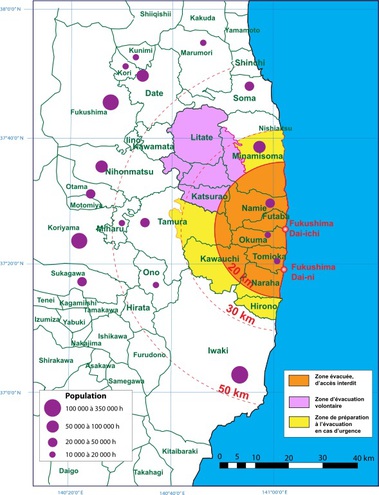
Let’s look specifically at the status of Fukushima Prefecture. Before May 2012, the total number of evacuees was 164,655. As of March 2013, the number from zones with evacuation orders and other areas was about 109,000. Looking at the updates in July 2016, 89,319 people in Fukushima are still living as evacuees . Also, Tomioka, Futaba, and some other Fukushima towns and local governments located in evacuation zones have moved their administrative functions both inside and outside of the prefecture.
Besides the number of deaths related directly to disaster-caused injuries in Fukushima Prefecture, the number of disaster-related deaths is still increasing, due to mental shock and physical conditions at shelters, such as poor hygiene and cold. Japan’s Reconstruction Agency recognized 459 people in Iwate Prefecture, 920 in Miyagi, and 2,038 in Fukushima as qualifying for payment of condolence money for disaster-related deaths. These numbers surpass the deaths directly caused by the earthquakes and tsunami.
The Tokyo Shimbun, a regional newspaper covering eastern Japan, gathered statistics on the deaths tied to the nuclear accident by asking municipalities in Fukushima to read through application forms for condolence money to find out the number of people that died from worsened physical conditions due to the stress of evacuation from the nuclear accident. The company wrote in its newspaper on March 6, 2016, “We interviewed municipal governments in Fukushima Prefecture and found that at least 1,368 people had died in connection with the nuclear accident, just from the numbers that could be confirmed.” The disaster-related death toll confirmed by each municipal government amounted to 2,028 as of March 4, 2016. It states that 67% of the disaster-related deaths are considered to be nuclear-related deaths.
According to statistics gathered by the Cabinet Office on the number of annual suicides related to the Great East Japan Earthquake and Fukushima nuclear plant accident, the number in Miyagi and Iwate prefectures is approaching zero, while it is still increasing in Fukushima.
Victims of nuclear accident face multiple difficulties, as shown below.
- Loss of daily living
- Loss of ways to earn a living
- Loss of community
- Forced to make own decisions whether to evacuate or not, and personally accept all risks that entail (people whose homes are outside of designated mandatory evacuation zones)
- Divorce, family breakdown, and separation of generations due to differences of opinion among family members
- A second mortgage to pay at the place of temporary evacuation
- Discrimination or bullying at place of temporary evacuation
- Not knowing when they can return home
- Uncertain about safety of returning home even after evacuation order is lifted
- Unable to rebuild community because many people have rebuilt their own lives (employment, human relations) at their place of temporary evacuation, and leaving mainly the elderly to return home.
Before the disaster, the nuclear power plants in Fukushima were generating power to send the electricity mainly to the Tokyo metropolitan area, not for local use. The nuclear accident forced people to leave their hometowns, and they are still not allowed to return to some areas. Even if the evacuation directive is lifted, evacuees will be unable to escape their anxieties about whether or not their homes are safe, and this situation continues to bring sorrow and hardship to the evacuees.
Even in this situation, Japan continues to approve the restart of nuclear power plants, some with operating permits for more than 40 years, despite the fact that the ruined plants have not yet been cleaned up, compensation for the accident is still not complete, and many people are still forced to live away from their hometowns. Each of us needs to think about the seriousness of nuclear accidents and the responsibilities that come with using nuclear power.
http://www.japanfs.org/sp/en/news/archives/news_id035681.html
Fukushima Radiation is not safe
A repost of a December 2011 video from Goddard’s Journal
Studies cited in order presented:
National Academy of Sciences Low-Dose Radiation Report
http://www.nap.edu/openbook.php?record_id=11340&page=R1
Data tables used, 12D-1 and 12D-2:
http://www.nap.edu/openbook.php?record_id=11340&page=311
http://www.nap.edu/openbook/030909156X/gifmid/311.gif
How to scale that data to unique exposure scenarios, Annex 12D, Example 1:
http://www.nap.edu/openbook.php?record_id=11340&page=310
15-country study of nuclear-worker cancer risk
http://www.ncbi.nlm.nih.gov/pubmed/17388693
Table 5 shown is from Part II of the study
http://www.ncbi.nlm.nih.gov/pubmed/17388694
http://iangoddard.com/15countries_Part2_Table5.png
Jacob et al. (2009) meta-analysis of nuclear-worker studies
http://oem.bmj.com/content/66/12/789.full.pdf
Editorial on Jacob et al. quoted
http://oem.bmj.com/content/66/12/785.extract
Chromosomal translocations are associated with cancer
http://www.ncbi.nlm.nih.gov/pmc/articles/PMC3152359/
Boffetta et al. (2007) more chromoHarm entails more cancer
http://www.ncbi.nlm.nih.gov/pubmed/17071846
Bhatti et al. (2010) meta-analysis of chromosomal damage
http://www.ncbi.nlm.nih.gov/pmc/articles/PMC3075914/
# Addendum #
Since I posted this video, the ‘Bulletin of the Atomic Scientists’ published a special edition on low-dose radiation, the lead article of which matches and thereby corroborates the case I present in this video. It also covers additional research and nuclear-industry efforts to derail scientific investigation of radiation risks http://bos.sagepub.com/content/68/3/10.full.pdf
Some friends created PDF files of this video available here
In English
https://docs.google.com/file/d/0B5qUOl0_hAfneW9rWmJ0akNMZEk/edit
In Japanese
Puddles Found in Reactor Buildings at Fukushima Daini Plant

Fukushima Daini
Following a powerful quake that hit northeastern Japan in the early morning on Nov. 22, 2016. The utility said Nov. 24 that puddles in three of the four reactor buildings at the idled Fukushima Daini nuclear power plant may have formed from water that splashed out of spent-fuel pools during the quake.
http://english.kyodonews.jp/photos/2016/11/445699.html
Crisis averted, but is N-plant operator Tepco prepared for a bigger quake?

An aerial view of the Fukushima Daiichi nuclear power plant after a strong earthquake hit off the coast of Fukushima on Tuesday. The operator of the plant said there were no abnormalities observed at the plant.
TOKYO — There was no avoiding fearful memories of the Japanese nuclear disaster of 2011 on Tuesday morning after a powerful earthquake off the coast of Fukushima caused a cooling system in a nuclear plant to stop, leaving more than 2,500 spent uranium fuel rods at risk of overheating.
But this time, the Tokyo Electric Power Company (Tepco), the utility that operates three nuclear plants, restored the cooling pump at the Fukushima Daini plant in about 90 minutes. The Daini plant is about 11km south of Fukushima Daiichi, the ruined plant where three reactors melted down five years ago after tsunami waves inundated the power station and knocked out backup generators.
Tepco reported that it never lost power at either the Daini plant or its neighbour to the north after the Tuesday quake, which had a magnitude of 7.4, according to the Japanese weather service.
“We took the regular actions that we should take when handling troubles,” Mr Yuichi Okamura, acting general manager of the nuclear power division at Tepco, said at a news conference on Tuesday.
The company was prepared for big tsunamis, having built sea walls rising to almost 15m at the Fukushima plants and enclosing backup generators in waterproof facilities, Mr Okamura said.
Critics of Tepco, which struggled to keep on top of a crisis that followed the 2011 calamity, said they were relieved that there had been no immediate damage. However, they remained sceptical that the company had done enough to prepare for a disaster on the scale of the earthquake five years ago.
That quake, which had a magnitude of 8.9, set off tsunami waves as high as 40m in some places. In contrast, the highest waves on Tuesday reached only about 1.4m.
“It looks like the right things have been done,” said Mr Azby Brown, director of the Future Design Institute at the Kanazawa Institute of Technology and a volunteer researcher with SafeCast, an independent radiation-monitoring group.
“But you never know until something happens. As far as this morning goes, they did a decent job, but mainly because it wasn’t that big of an earthquake or that big of a tsunami.”
Building higher sea walls, for example, “is all good, but that is like fighting the last war”, Mr Brown said.
“It remains to be seen how well prepared they would be for some other unusual combination of disasters.”
Compared to five years ago, Tepco has improved its communication with the public, reporting information about the cooling pump at Daini almost as it happened on Tuesday morning.
The company also quickly said that it had suspended the treatment and transfer of contaminated water from the Daiichi plant, where an extensive clean-up and decommissioning process is underway. By the evening, those operations had been restored.
“What I can say is today’s response was decent and they seemed to be confident,” said Mr Tatsujiro Suzuki, director of the Research Center for Nuclear Weapons Abolition at Nagasaki University. However, it would be difficult to independently verify Tepco’s claims because the Japanese Nuclear Regulation Authority depends on the company to release information.
He added that he was not convinced that Tepco was being fully transparent about its decisions, particularly about the clean-up at the Daiichi plant.
“We should be informed fully whether this operation is reasonably done with cost-effectiveness and safety and making sure that the best technology is being used,” Mr Suzuki said.
Mr Daisuke Maeda, a spokesman for the Nuclear Regulation Authority, said the agency had offices on the sites of the nuclear plants and worked with Tepco and other utility companies on Tuesday to confirm that the power stations were safe after the earthquake.
Regarding the longer-term situation, nuclear experts expressed concern about the safety of the clean-up operation at the Daiichi plant. The melted cores of three reactors have yet to be removed as they are still too radioactive for workers to approach.
Since the 2011 disaster, groundwater seeps into the reactors daily. The water, contaminated by the melted fuel rods, needs to be treated and stored on site. So far, Tepco has built more than 880 tanks of about 1,000 tonnes each.
The tanks are inspected four times a day to confirm that they do not leak, said Mr Okamura of Tepco.
And in an effort to halt the flood of groundwater into the damaged buildings, the company has built an underground wall of frozen dirt nearly 1.6km long encircling the reactors. The wall is not yet fully frozen, though, and groundwater continues to flow into the reactors.
Critics worry that the sea walls or storage tanks might not withstand a more powerful earthquake or tsunami. And Tuesday’s incident at the Daini reactor showed that quakes can set off problems even at plants that are not operating.
Most of the country’s 54 plants remain closed since the 2011 disaster, but the administration of Prime Minister Shinzo Abe wants to restart most of them.
A majority of the Japanese public is opposed to such a move. Candidates for governor who ran campaigns opposed to the revival have won elections in recent months in two prefectures that host nuclear plants.
According to Japanese daily Nikkei Shimbun, Mr Fumio Sudo, the chairman of Tepco, and Mr Naomi Hirose, the company’s president, were planning to meet on Tuesday with one of those governors, Ryuichi Yoneyama of Niigata, to try to persuade him to support a restart of the Kashiwazaki-Kariwa plant there.
Mr Sudo and Mr Hirose returned to Tokyo after the earthquake.
Mr Kiyoshi Kurokawa, who oversaw an independent investigation of the Fukushima nuclear accident for the Japanese Parliament, said that building walls and storage tanks failed to solve the underlying problem of an earthquake-prone country relying on nuclear power. Instead, he said, both the government and utility companies should invest in developing alternative sources of power like solar or wind technology.
“I think we expect more of such readjusting plate movements and that has been reasonably predicted, and many volcanic activity and earthquakes have been rampant over the last five years,” said Mr Kurokawa, an adjunct professor at the National Graduate Institute for Policy Studies. “So why are we continuing to restart nuclear plants?”
http://www.todayonline.com/world/asia/crisis-averted-n-plant-operator-tepco-prepared-bigger-quake
An aerial view of the Fukushima Daiichi nuclear power plant after a strong earthquake hit off the coast of Fukushima on Tuesday. The operator of the plant said there were no abnormalities observed at the plant.
Japan Earthquake: Social Aftershocks of Fukushima Disaster are Still Being Felt
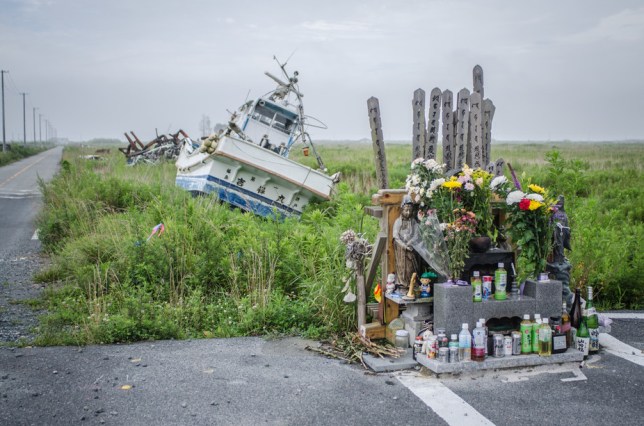
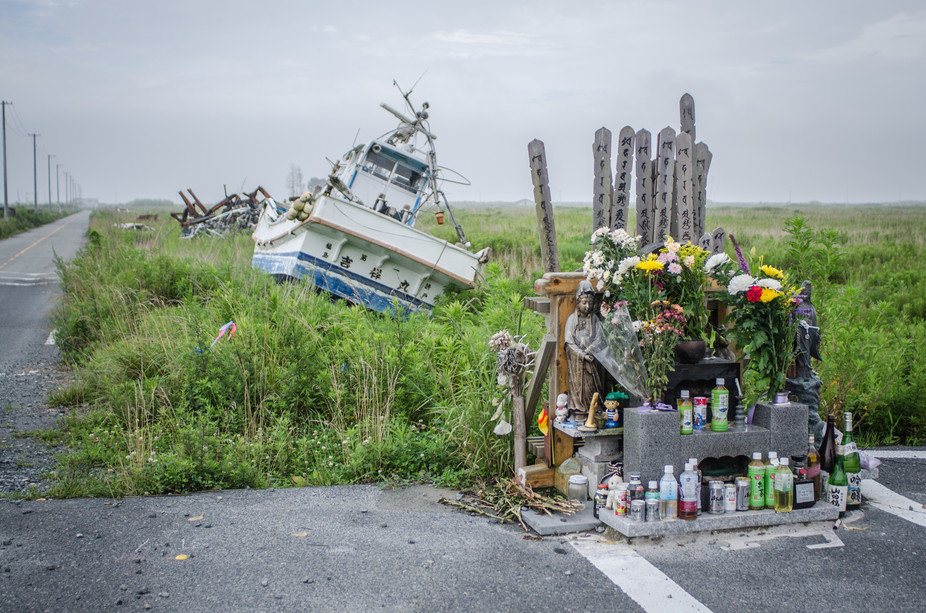
A fishing boat washed inland by the 2011 Tsunami next to a shrine inside the Fukushima nuclear exclusion zone.
At 5.59am local time on November 22, Fukushima was hit by a 7.4 magnitude earthquake, triggering a tsunami warning. For residents in the same region of Japan devastated by the major 2011 Tōhoku earthquake and its tsunami, the threat of a renewed disaster was very real.
The tsunami warning was lifted a few hours later, and the earthquake was later declared a long-term aftershock from the larger quake five years ago. But for people still coming to terms with that disaster and its aftermath, this new earthquake will severely test their resilience once again.
On March 11 2011, the 9.0 magnitude earthquake created a 15-metre tsunami that inundated the Fukushima Daiichi (Fukushima I) nuclear power station. Power was disabled to three reactors, which caused a serious nuclear accident as cooling systems failed. Large quantities of radiation were immediately released into the environment and approximately 100,000 people were evacuated.
The long-term social consequences of the original Fukushima Daiichi accident have been broad and far-reaching. Perception of risk, the likelihood of exposure to danger, has been at the heart of social controversy after the 2011 disaster. Radiation is invisible, and it is challenging to understand or percieve a threat that can only be detected by specialist scientific equipment. Often women and children are hit the hardest by this, regardless of socioeconomic status.
The concept of Fūhyōhigai, or the “harmful rumour”, was initially used by the media and local government to dismiss local women’s concerns about radiation exposure as weak and unscientific. However, this led to a cultural shift by women known as Fukushima’s “radiation brain moms”, who purchased monitoring equipment and took matters into their own hands, forming citizen radiation monitoring organisations (CRMOs).
By forming these groups of resistance, self-help and support, women rejected their culture’s social norms of obedience and subservience, that could have suppressed them from cultivating outrage over injustice and inequality. Participation in CRMOs has decreased over time, as the social memory of Fukushima Daiichi fades, but citizen science initiatives such as Safecast still provide useful information to many.
The recent earthquake temporarily halted the cooling system at the nearby Fukushima Daini (Fukushima II) reactor, and so there is likely to be a resurgence in monitoring, and a reunion of these support networks. Regardless of what happens now, there has already been a positive seismic shift in attitudes by both the government and scientists toward concerned mothers and community monitoring.
Living in ‘temporary’ permanence
Many impacts of the 2011 disaster have been hidden away in the private spaces of everyday life, with the tragedy putting enormous strain on family relations. Not only were thousands of families displaced from their homes, evacuation has meant the separation of family groups.
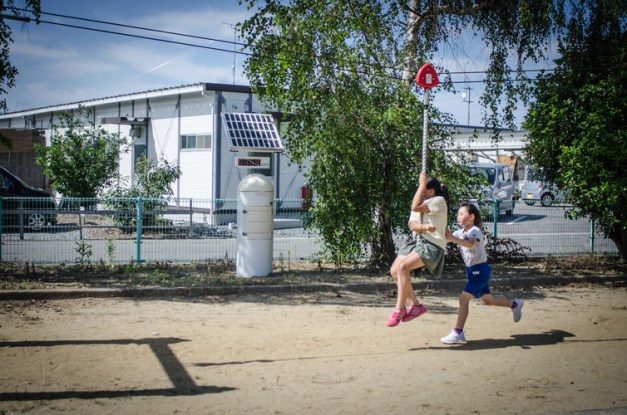
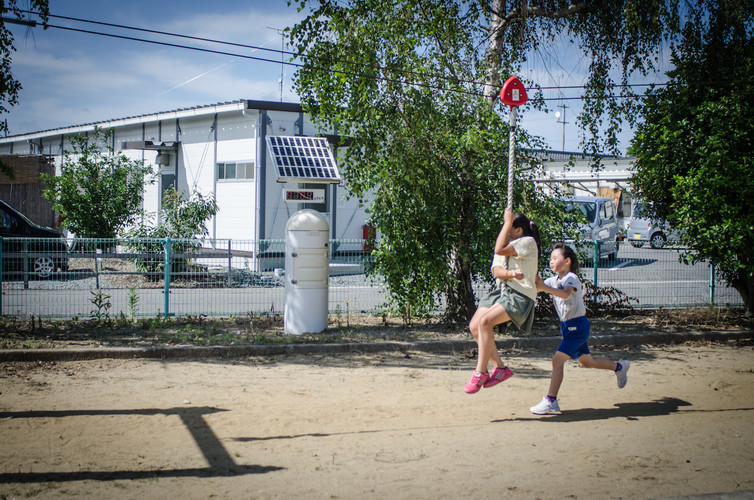
Two girls play on a swing next to a radiation monitor and their temporary housing in Minamisōma, Fukushima prefecture.
Where once three generations could live together in Fukushima’s close-knit rural villages, relocation to cramped prefabricated temporary housing has meant many are forced to live apart. Today, five years after the disaster, 174,000 people are still displaced in a state of “temporary” permanence. Disconnection from the familiarity of place and family, as well as the constant worry about radiation risk, even threatens marital relationships. “Atomic divorce” (Genpatsu rikon) is on the rise, with disagreements on radiation safety, or whether to relocate back to territory now deemed “decontaminated”. News of the recent earthquake will doubtless have jogged memories and resurfaced hidden tensions.
The Japanese government is gradually declaring sections of the 20km nuclear exclusion zone safe and habitable. Despite this, the desire to move back to previously contaminated land has been underwhelming. For example, four months after Naraha Town was declared safe in September last year, only 6% of former inhabitants decided to move home to one of Fukushima’s many atomic “ghost towns”.
In the town of Minamisōma, on the northern edge of the exclusion zone, thousands of mothers and children have refused to return, despite societal pressure not to “betray” their home communities.
Nuclear uncertainty
While Japan’s tsunami warning system worked well, there is still considerable uncertainty surrounding the consequences and likelihood of a further natural hazard causing a nuclear accident in Japan.
The 2011 Fukushima Daiichi accident had already permanently changed the Japanese nuclear landscape. The government has undergone a process of gradual nuclear decommissioning since October 2011, and Fukushima Daaichi and Dai-ni no longer produce energy. Yet, Japan is still heavily reliant on nuclear energy and since 2015 has restarted two of its nuclear reactors, with 24 other reactors in the process of restart approvals.
While social resilience to emergencies has improved since 2011 in Japan, the social aftershocks of Fukushima Daaichi are ongoing. Though many advances have been made that emancipate vulnerable populations and provide increased connectivity, it remains to be seen how much these new technologies and attitudes have improved social resilience and reduced the likelihood of anxiety within the community of Fukushima.
Tax Breaks Mulled to Aid Reconstruction in Fukushima No-Go Zone
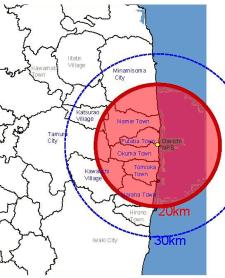
The Abe government and ruling coalition are considering giving tax breaks to companies that do business in reconstruction footholds to be set up in the no-go zone heavily contaminated by the 2011 nuclear accident in Fukushima Prefecture, according to informed sources.
Officials believe such measures will help advance industrial recovery in the prefecture hurt by the reactor meltdowns at the Fukushima No. 1 power plant in March 2011, the sources said Tuesday.
Under consideration are corporate tax cuts to promote capital investment and employment of people affected by the crisis by firms damaged by the nuclear accident and companies that newly expand into the area.
The special reconstruction areas will be created starting in fiscal 2017. Priority will be given to decontamination work and infrastructure development in the footholds, so that evacuation orders for local residents can be lifted around the end of March 2022.
The tax measures will be included in the fiscal 2017 tax system reform package that the Liberal Democratic Party-led ruling coalition plans to draw up Dec. 8.
Similar tax breaks are provided in evacuation areas outside the no-go zone. Through the planned measures, the government hopes to encourage the opening of businesses necessary for residents to live in the area, such as convenience stores and gas stations, as well as promoting job creation.
The government and the ruling camp are considering the options of allowing companies to deduct from their corporate taxes 15 percent of the amounts of their capital investment made in the footholds and granting lump-sum depreciation of new equipment and facilities so they can reduce their taxable incomes by larger margins than under regular depreciation rules.
Another possible measure is giving a corporate tax cut equivalent to 20 percent of salaries for employees in the footholds that companies hire from among those affected by the nuclear accident.
Also under consideration extending by four years a corporate tax cut granted to the owners of housing for disaster victims in special economic zones on condition the buildings meet fire resistance and other requirements and that the owners give priority to disaster-affected people in choosing tenants.
Tepco’s Nov. 22 Post-Earthquake Information Release

Tepco released some post-earthquake informations about the situation of the Fukushima Daiichi Nuclear Power Station after the earthquake off the coast of Fukushima Prefecture that occurred around 5:59 am today, November 22.
“At Fukushima Daiichi Nuclear Power Station, at 6:06 am after the earthquake occurred. As a precaution, contaminated water transfer from the reactor building basements was stopped after the quake. It was restarted at 3:19pm.
Similarly, the Reverse Osmosis desalination system was stopped at 6:17 am, and restarted at 3:44 pm. The cesium adsorption system was stopped at 6:23 am, and restarted at 4:47 pm. Other water treatment systems were stopped at 6:12 am and restarted at 4:20 pm.
Since we confirmed that there was no abnormality after the earthquake, we resumed operation.
Also, we patrolled each Unit 1 to 6 equipments, our patrol was completed by 4:06 pm and we confirmed the following troubles:
– Damages to the south side silt fences of Units 1 to 4 and the north side silt fences of 5 and 6 units on the port, these are used to try to keep small radioactive debris from leaving the port.
– A puddle (about 2 m × 3 m) was found near the common spent fuel pool, thought to be caused by sloshing of the pool during the quake.
We will carry out the restoration work as soon as preparations are completed.”
Tepco did not mention anything about the storage tanks up on the hill. Those aging bolt together tanks, still partially in use, containing contaminated water, are a major concern, being the most vulnerable to be damaged by an earthquake.
According to JMA (Japan Meteorological Agency), they observed over 85 aftershocks by 11:00 AM (JST) of 11/23/2016, out of which 7 quakes of seismic intensity over 3. They warn the same level of the earthquake (M7.4) may happen again this week, with possible Tsunami.
Sources:
Tepco 2016年11月22日地震情報(福島第一・福島第二原子力発電所関連) (続報5)
http://www.jma.go.jp/en/quake/quake_local_index.html
http://2ch-news.co/newsplus/1479879660/
Tsunami Evacuation Hindered by Traffic in Iwaki
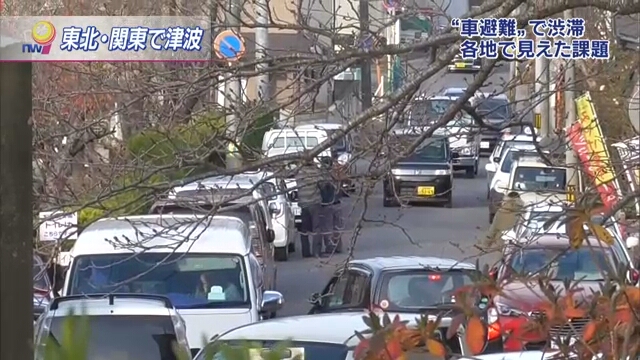
Some residents who attempted to drive to higher ground after tsunami warnings in northeastern Japan early Tuesday found themselves caught in traffic.
An official of Iwaki City, Fukushima Prefecture, says a main road from the coastal district to inland areas was filled with cars apparently trying to evacuate.
The official says he saw many cars carrying entire families and that the traffic congestion was unusual for that time of day. He says the atmosphere was tense, as the residents were apparently reminded of the March 2011 tsunami.
He called on residents not to use their cars if they are able to evacuate on foot, as part of the road is designated as an area that could be submerged in the event of a tsunami.
In Ishinomaki City, Miyagi Prefecture, more than 100 people evacuated to a park on higher ground.
But a narrow road leading to the park soon became jammed.
Some drivers parked their cars on the roadside, hindering others from getting by. Traffic was backed up for a long way as a result.
The city has been asking residents to evacuate on foot in principle.
Ice Wall at Fukushima Plant Examined

A Natural Resources and Energy Agency official explains the state of the ice wall meant to surround the reactor buildings at the Fukushima No. 1 Nuclear Power Plant, on Nov, 21, 2016.
Ice wall at Fukushima plant examined
Government officials have examined an underground ice wall built around Japan’s crippled Fukushima Daiichi nuclear plant to confirm whether the soil has frozen.
Work is ongoing to build a 1.5 kilometer barrier of frozen soil encircling reactor buildings. The goal is to prevent underground water from seeping into the plant premises, resulting in more tainted water.
Coolants are being circulated from pipes buried around the reactor site.
Work to build an ice wall began in March, and is almost completed.
State minister for industry, Yosuke Takagi and others on Monday looked at an exposed section of the ice wall.
They said the ice wall had hardened enough to withstand being hit with a hammer.
Officials say prior to construction of the ice wall, workers collected some 350 tons of underground water on a daily basis. The amount has shrunk to about 200 tons.
Japan’s nuclear regulator is also planning to assess the effectiveness of the ice wall installment.
http://www3.nhk.or.jp/nhkworld/en/news/20161121_22/
Ice wall at Fukushima nuclear plant revealed for first time
FUKUSHIMA — The Economy, Trade and Industry Ministry on Nov. 21 showed the media for the first time the visual inspections conducted on the condition of the subterranean ice wall around the nuclear reactors at the stricken Fukushima No. 1 Nuclear Power Plant to block groundwater from flowing into the plant buildings.
The ice wall project calls for freezing the soil around the No. 1 to No. 4 reactor buildings that stretches some 1.5 kilometers to a depth of about 30 meters to create a solid barrier by hammering in equidistant cooling pipes and circulating coolant chilled to minus 30 degrees Celsius.
The industry ministry on Nov. 21 dug a part of the ice wall to approximately 1.2 meters in depth on the mountain side of the No. 4 reactor building. The soil temperature around the cooling pipes 40 centimeters deep was about minus 10.3 degrees, while an area of 1.5 meters in radius around the cooling pipes was frozen at a depth of 1.2 meters.
While plant operator Tokyo Electric Power Co. claims that the ice wall could reduce the amount of groundwater flowing into the reactor buildings from some 400 metric tons a day to 100 tons or less, the Nuclear Regulation Authority cast doubt on the project during an August meeting, with a member saying that the plan was a failure.
http://mainichi.jp/english/articles/20161122/p2a/00m/0na/014000c
Leaks Unlikely, “presumes” Tepco
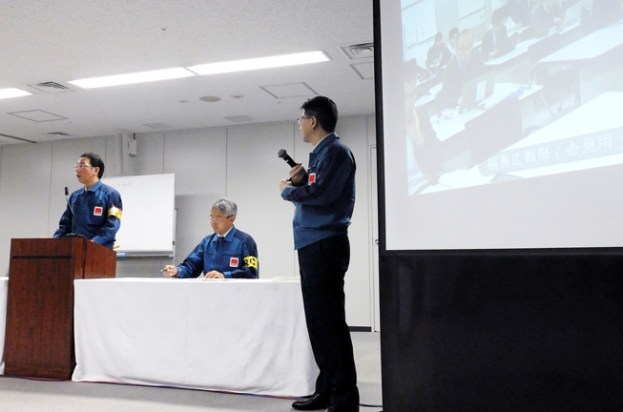
Naohiro Masuda, left, president of Fukushima Daiichi Decontamination & Decommissioning Engineering Co., speaks at the podium in a news conference at the Tokyo Electric Power Co.’s head office on Nov. 22.
Tokyo Electric Power Co. said radioactive water likely did not leak from its stricken Fukushima No. 1 nuclear plant following the morning earthquake that spawned a tsunami on Nov. 22. TEPCO declared that everything was ok at Fukushima Daiichi before even to be able to go inspect the facilities.
TEPCO officials said the company manually shut down equipment that was transferring contaminated water from reactor buildings after the magnitude-7.4 earthquake struck off the coast of Fukushima Prefecture. The measure was taken because water being transferred could have spilled out if a pipe in the system was fractured in the quake, and because they would be unable to check the system for leaks.
Naohiro Masuda, president of Fukushima Daiichi Decontamination & Decommissioning Engineering Co., TEPCO’s in-house organization, explained during a news conference at the utility’s head office in Tokyo why the company halted operations of the water transfer facility: “The biggest risk is a tsunami causing contaminated water that has accumulated (in the reactor buildings) to leak and pollute the environment.”
After the Japan Meteorological Agency issued a tsunami warning at 6:02 a.m., the company ordered workers in lower areas of the plant to evacuate to higher ground. The workers stayed out of the lower areas as the tsunami warning lasted for hours. They have been unable to check for possible leaks around the reactor buildings and the turbine buildings near the sea.
“It is a bit inappropriate that we’ve been unable to do so,” Masuda said. “That’s why we suspended the transfer facility. We think that no water will leak now.”
Groundwater mixing with contaminated water in damaged reactor buildings has been a serious problem at the plant since the nuclear disaster unfolded in 2011.
TEPCO also reported that pumps to cool water in the spent nuclear fuel pool at the No. 3 reactor building of the Fukushima No. 2 nuclear power plant shut down after the quake. The company said this was an automatic mechanism that kicked in after the water level changed in the tank that adjusts water conditions in the pool. “It is a result of the fact that the automatic suspension device worked normally,” Masuda said. The pumps were later restarted.
In the evening of 11/22/2016, Tepco announced the radiation monitoring post in the sea has been suspended due to the quake. The post is situated at the end of the breakwater of Fukushima plant port. They cannot monitor the radioactive substance spreading to the Pacific with this monitoring post out of order.
TEPCO declared “everything is safe” soon after the quake. They may have visually confirmed nothing large and significant happened such as a vent tower collapsing or larger building damage, but they were unable to go in to inspect to actually confirm nothing was damaged, to check for damage in more detail and to check every system now in place at the plant could easily take an entire day.
TEPCO’s prompt claim of no damage after the earthquake at the disaster site, as always was not done after inspections would have confirmed no damage.
465 suspected of working illegally at Fukushima nuke plant in 2015
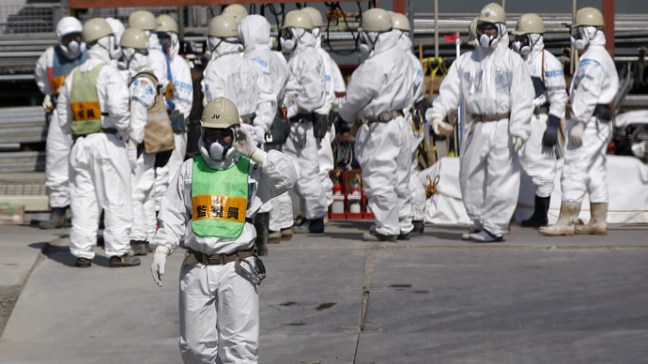
A total of 465 workers at the disaster-stricken Fukushima No. 1 nuclear plant may have been employed under “disguised contracts,” according to the results of a 2015 Tokyo Electric Power Co. (TEPCO) questionnaire.
Under a “disguised contract,” people are given work without official employment or are made to work under the instruction of parties other than those who place the original orders, obscuring the party responsible for their safety. The revelation comes after the Mainichi Shimbun reported that seven foreign nationals worked at the plant in 2014 under suspected illegal contracts. TEPCO had subsequently concluded that it had identified no problems over the issue based on its questionnaires.
The utility recognized that 118 of the 465 workers — whose employers TEPCO says it could identify and whom it checked with by way of the original contractors — were “all in appropriate employment statuses.”
In response to the TEPCO announcement, however, a former Japanese worker at the plant testified to the Mainichi that he “couldn’t write about the truth” in those surveys. Furthermore, at least one subcontractor related to work at the plant has admitted to the existence of disguised contract work.
The Employment Security Act and other regulations ban “disguised contract work” in which workers receive instructions from companies other than those they have employment or business contracts with as it obscures the party responsible for safety management. The seven foreign nationals — mostly Japanese-Brazilians — who worked at the Fukushima No. 1 nuclear plant in 2014 received work instructions from a subcontractor, but they were in fact sole proprietors with business contracts.
TEPCO started handing out surveys in fiscal 2011 to all non-regular workers engaged in the decommissioning of reactors at the plant in a bid to improve their work environment. The utility has released the results of the past surveys on its website.
A questionnaire conducted between August and October last year, whose results were recently released, received responses from 86.4 percent of all workers at the Fukushima No. 1 plant, or 6,527 individuals, most of whom are believed to be Japanese. Among them, 465 workers (14.2 percent) of 3,268 workers (excluding supervisors and managers) answered that “the company that gives me work instructions and the one that pays me are different.” Of them, TEPCO asked the original contractors to conduct a survey on 118 workers and concluded that their employment statuses were appropriate based on their reports.
A former male Japanese worker for a second-tier subcontractor that undertook work to build storage tanks for radiation contaminated water at the plant between 2014 and 2015 revealed to the Mainichi that when he responded to a TEPCO survey, he enclosed his answer sheet in an envelope and handed it over to a first-tier subcontractor without sealing it. The answer sheets submitted by workers were ultimately collected by the original contractor before being submitted to TEPCO.
“Although the surveys were anonymous, they could tell who wrote the answers by the handwriting. I couldn’t write about working under harsh conditions, in which many people collapsed due to heatstroke. The way the surveys are conducted now wouldn’t lead to uncovering the realities at the job sites,” he said.
The president of a construction company in Fukushima Prefecture that undertakes decommissioning work at the Fukushima No. 1 plant told the Mainichi in February that the company was making workers dispatched by another firm work at the plant by disguising them as its own regular employees. “I’m aware it constitutes disguised contract work, which is illegal. But it’s a common practice.”
Meanwhile, TEPCO’s public relations section, when asked whether its questionnaires can uncover the realities of work conditions for those engaged in decommissioning work at the plant, said, “We see no problems with them.”
http://mainichi.jp/english/articles/20161122/p2a/00m/0na/012000c
Fukushima Radiation Measuring on Nov. 22, After the 6.9 Magnitude Earthquake

Following the November 22, 2016 earthquake striking at 5:59am, the Tarachine Mothers’ Radiation Lab in Iwaki city Fukushima kept measuring ambiant radiation every hour for the sake of precaution.
According to TEPCO, cooling to the spent nuclear fuel pool for the No. 3 reactor at the Fukushima Daini nuclear plant resumed at 7:47 am. It had stopped after the earthquakes this morning.
Radiation measurement 6:30 am on November 22nd, Izumigaoka, Iwaki city, Fukushima Prefecture, Japan, indoor 0.05µSv/h measured by PA-1000 Environmental Radiation Monitor Radi.
Radiation measurement 7:00 am on November 22nd, Izumigaoka, Iwaki city, Fukushima Prefecture, Japan, indoor 0.05µSv/h measured by PA-1000 Environmental Radiation Monitor Radi.
Radiation measurement 7:30 am on November 22nd, Izumigaoka, Iwaki city, Fukushima Prefecture, Japan, indoor 0.05µSv/h measured by PA-1000 Environmental Radiation Monitor Radi.
Radiation measurement 8:00 am on November 22nd, Izumigaoka, Iwaki City, Fukushima Prefecture, Japan, indoor 0.05 μSv/h, outdoor 0.08μSv/h measured by PA-1000 Environmental Radiation Monitor Radi.
Radiation measurement 8:30 am on November 22nd, Izumigaoka, Iwaki City, Fukushima Prefecture, Japan, indoor 0.05 μSv/h, outdoor 0.09μSv/h measured by PA-1000 Environmental Radiation Monitor Radi.
Radiation measurement 9:00 am on November 22nd, Izumigaoka, Iwaki City, Fukushima Prefecture, Japan, indoor 0.05 μSv/h, outdoor 0.09μSv/h measured by PA-1000 Environmental Radiation Monitor Radi.
Radiation measurement 10:00 am on November 22nd, Hanabatake-cho,Onahama, Iwaki City, Fukushima Prefecture, Japan, indoor 0.06 μSv/h, outdoor 0.08μSv/h measured by ALOKA γSURVEY METER TCS-172
Radiation measurement 11:00am on November 22nd, Hanabatake-cho,Onahama, Iwaki City, Fukushima Prefecture, Japan, indoor 0.06 μSv/h, outdoor 0.08μSv/h measured by ALOKA γSURVEY METER TCS-172
Radiation measurement 12:00am on November 22nd, Hanabatake-cho,Onahama, Iwaki City, Fukushima Prefecture, Japan, indoor 0.06 μSv/h, outdoor 0.08μSv/h measured by ALOKA γSURVEY METER TCS-172
Radiation measurement 15:00am on November 22nd, Hanabatake-cho,Onahama, Iwaki City, Fukushima Prefecture, Japan, indoor 0.06 μSv/h, outdoor 0.07μSv/h measured by ALOKA γSURVEY METER TCS-172
Radiation measurement 23:15pm on November 22nd, Izumigaoka, Iwaki City, Fukushima Prefecture, Japan, indoor 0.05 μSv/h measured by PA-1000 Environmental Radiation Monitor Radi.
Source : Tarachine, Mothers’ Radiation Lab, Iwaki city, Fukushima Prefecture
Fuel removal unlikely by March 2018
566 fuel assemblies, 514 spent fuel assemblies and 52 unused ones, Tepco has always said so. But since the fuel pool was cleaned up, Tepco only released partial photos of the fuel pool, never any photo of the whole fuel pool. So as of now it is just impossible to verify Tepco’s claim by counting the assemblies. Since the fuel pool also exploded some fuel assemblies must be missing. How many are gone how many remain is still a non answered question, especially as Tepco is not well known for being straightforward.
Will Tepco dare to start decommissioning the reactor 3 fuel pool before the 2020 Tokyo Olympics? I doubt so. In my opinion, Tepco will keep postponing it for after the Olympics, to avoid difficulties and critics

Fuel removal unlikely by March 2018
A government official has suggested that fuel removal from a reactor at the crippled Fukushima Daiichi nuclear plant will not start by March 2018, as planned.
566 nuclear fuel units remain in the No. 3 reactor’s fuel pool. To reach their target period, plant operator Tokyo Electric Power Company must begin placing a cover over the damaged reactor building by this April.
It’s now expected the cover installation will not start until January next year or later. It was determined that stronger measures are needed to protect workers from radiation exposure.
An official with the industry ministry overseeing reactor decommissioning inspected the plant on Monday. He said starting fuel removal within the next fiscal year is difficult.
Tokyo Electric says the cover installation has been slow, but the company will continue decommissioning work with safety as their highest priority.
Magnitude 6.9 Earthquake Strikes Off Japanese Coast, Tsunami Warning

An earthquake with a preliminary magnitude of 7.3 hit northern Japan on Tuesday, the Japan Meteorological Agency said, generating a tsunami that hit the nation’s northern Pacific coast.
The U.S. Geological Survey initially put Tuesday’s quake at a magnitude of 7.3 but down graded it to 6.9.
The earthquake, which was felt in Tokyo, was centered off the coast of Fukushima prefecture at a depth of about 10 km (6 miles) and struck at 5:59 a.m. (2059 GMT) the agency said.
USGS said that it was a shallow quake, at about 10 kilometers, which tended to cause more shaking damage and had greater potential to cause a tsunami.
“The good news here is that the direction the fault was moving is a slight lateral slip. When the faults move laterally they do not create the vertical movement associated with large tsunamis,” the U.S. agency said.
A 60 cm (2 foot) tsunami had been observed at Iwaki city’s Onahama Port and a 90 cm (3 foot) tsunami at Soma Port soon after, public broadcaster NHK said. The region is the same that was devastated by a tsunami following a massive earthquake in 2011. A tsunami warning of up to 3 meters (10 feet) has been issued.

Japan’s chief government spokesman Yoshihide Suga said that a government taskforce had been established to deal with the quake and tsunami, and called on people in affected areas to evacuate, according to media outlet NHK.
NHK also reported that water could be seen moving bath and forth in Onahama Port and that tide levels were rising in some areas on Japan’s eastern coast. Television footage showed ships moving out to sea from Fukushima harbors as tsunami warning signals wailed.
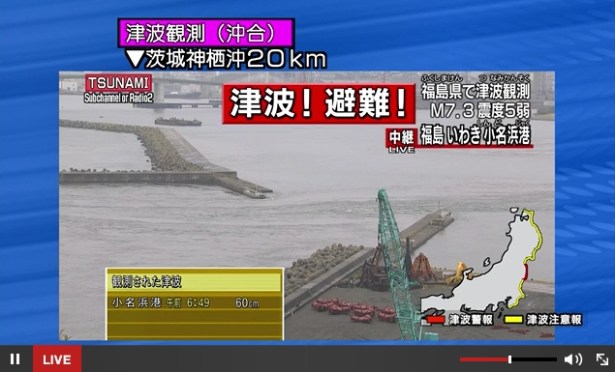
Tokyo Electric Power, known as Tepco, said on its website that no damage from the quake has been confirmed at any of its power plants, although there have been blackouts in some areas. Tepco’s Fukushima Daiichi nuclear plant caused Japan’s worst nuclear disaster when it was knocked out by the 2011 tsunami.
Tohoku Electric Power said there was no damage to its Onagawa nuclear plant, while the Kyodo news agency reported there were no irregularities at the Tokai Daini nuclear plant in Ibaraki Prefecture.
Earthquakes are common in Japan, one of the world’s most seismically active areas. Japan accounts for about 20 percent of the world’s earthquakes of magnitude 6 or greater.
The March 11, 2011, quake was magnitude 9, the strongest quake in Japan on record. The massive tsunami it triggered caused world’s worst nuclear crisis since Chernobyl a quarter of a century earlier.
An Iwaki city fire dept official said there was smoke or fire at Kureha’s research center in a petrochemical complex in Iwaki city at 6:17 a.m., but it was extinguished at 6:40 a.m. Other details were not clear, he said, adding that no other major damage in the city has been reported at the moment.
One hotel in Ofunato, badly hit by the 2011 quake, told guests to stay in the facility, which is on high ground.
All nuclear plants on the coast threatened by the tsunami are shut down in the wake of the 2011 Fukushima disaster. Only two reactors are operating in Japan, both in the southwest of the country. Even when in shutdown nuclear plants need cooling systems operating to keep spent fuel cool.
At Fukushima Daiichi, the plant workers are reporting they felt shaken even in the seismic isolation building. Most of the workers have not come to the plant for today yet. The situation is still under investigation. No further information yet.
At Fukushima Daini, Tepco said that its water-cooling system for spent fuel at reactor 3 had stopped working at 6:10AM but that there was enough water in the pool to keep the fuel cool, posing no immediate danger. Tepco rebooted the coolant system of SFP 3 of Fukushima DAINI at 7:47AM (JST).
http://www.jma.go.jp/en/quake/20161122061144495-220559.html
http://www.cnbc.com/2016/11/21/magnitude-73-earthquake-hits-japan-usgs-says.html
https://twitter.com/nhk_seikatsu/status/800825947507212288
https://www.pref.fukushima.lg.jp/sec/16025c/genan10.html
http://www3.nhk.or.jp/news/html/20161122/k10010779181000.html
1 This Month
10 March A LIVE WEBINAR THE REAL EFFECTS OF NUCLEAR POWER
What the Industry Isn’t Telling Us
1:00 PM Mountain, 2 pm Central, 3 pm Eastern. Live on the Keepers of the Water Facebook page



18 March Webinar @ 1 PM EST: An Assessment of SMR Projects: The Case of Canada
register for the zoom:
https://us02web.zoom.us/webinar/register/WN_o8BIIOUvQ2ONJR1nta65DQ#/registration


of the week – STOP SMALL MODULAR REACTORS IN CANADA
To see nuclear-related stories in greater depth and intensity – go to https://nuclearinformation.wordpress.com
-
Archives
- March 2026 (99)
- February 2026 (268)
- January 2026 (308)
- December 2025 (358)
- November 2025 (359)
- October 2025 (376)
- September 2025 (258)
- August 2025 (319)
- July 2025 (230)
- June 2025 (348)
- May 2025 (261)
- April 2025 (305)
-
Categories
- 1
- 1 NUCLEAR ISSUES
- business and costs
- climate change
- culture and arts
- ENERGY
- environment
- health
- history
- indigenous issues
- Legal
- marketing of nuclear
- media
- opposition to nuclear
- PERSONAL STORIES
- politics
- politics international
- Religion and ethics
- safety
- secrets,lies and civil liberties
- spinbuster
- technology
- Uranium
- wastes
- weapons and war
- Women
- 2 WORLD
- ACTION
- AFRICA
- Atrocities
- AUSTRALIA
- Christina's notes
- Christina's themes
- culture and arts
- Events
- Fuk 2022
- Fuk 2023
- Fukushima 2017
- Fukushima 2018
- fukushima 2019
- Fukushima 2020
- Fukushima 2021
- general
- global warming
- Humour (God we need it)
- Nuclear
- RARE EARTHS
- Reference
- resources – print
- Resources -audiovicual
- Weekly Newsletter
- World
- World Nuclear
- YouTube
-
RSS
Entries RSS
Comments RSS
 nuclear-news
