TEPCO’s plan for diverting Fukushima water into Pacific Ocean
Fukushima Fishermen Ruined by Tepco Now Key in Radiation Fight, Bloomberg, By Yuriy Humber, Chisaki Watanabe & Masumi Suga – Aug 29, 2013
Tokyo Electric Power Co. (9501) ruined the livelihoods of the commercial fishermen that trawled the seas off Fukushima prefecture when its leaking reactors poisoned the fishing grounds. The utility now needs their help.
At issue is a series of wells and pipes built by Tokyo Electric to alter the course of groundwater flowing from the hills behind the wrecked Fukushima Dai-Ichi nuclear station. The bypass, which is ready to operate, will divert water away from the plant’s damaged reactors and into the Pacific, thus reducing contamination, Tokyo Electric says. The utility must first get the approval of the 1,500 members of Fukushima’s fishing cooperative and others in the area to begin using the bypass. With Tokyo Electric’s history of falsifying safety reports, hiding accidents and ignoring warnings, fisherman aren’t convinced the system is safe.
“We have yet to reach a conclusion” on whether the cooperative will agree to Tokyo Electric’s bypass plan, Tetsu Nozaki, chairman of the Fukushima Prefectural Federation of Fisheries Co-operative Associations, said yesterday in Tokyo. “We will make a cool-headed decision.”
The three-month impasse has implications beyond Fukushima and Japan because it’s holding up the bid to reduce the 300 metric tons of radioactive water gushing into the Pacific each day.
More than 330,000 tons of water with varying levels of toxicity is stored in pits, basements and hundreds of tanks at the Fukushima nuclear plant 220 kilometers (137 miles) northeast of Tokyo. The water is the result of efforts to keep the reactor cores from overheating and groundwater pouring into the facility, wrecked by the March 2011 earthquake and tsunami.
Consensus Sought
Some of those tanks are vulnerable to leaks, Tokyo Electric, or Tepco, said last week. Moreover, the groundwater seeping into the Fukushima plant is mixing with radioactive water, getting contaminated.
Estimates say about 400 tons of groundwater flows down the hillside each day. The bypass would reduce that by about 25 percent, piping the water from the plant and into the ocean before it gets contaminated.
“We want to reach a consensus soon,” Yoshihisa Komatsu, an official at the Fukushima fishing cooperative, said by phone Aug. 28 in reference to the bypass talks. “But some members oppose it so we are caught in the middle.”…… .http://www.bloomberg.com/news/2013-08-29/fukushima-fishermen-ruined-by-tepco-now-key-in-radiation-fight.html
Foundations of Fukushima’s nuclear reactors now becoming unstable?
 Warning that foundations of Fukushima reactor chambers have been “compromised” — Groundwater rising fast, now just 10 inches from surface http://enenews.com/warning-that-foundations-of-fukushima-reactor-chambers-are-compromised-underground-water-now-just-10-inches-from-surface
Source: The Daily Telegraph (UK)
Author: Julian Ryall, Tokyo
Date: Aug. 26, 2013
Speaking after being shown around the site, [Toshimitsu Motegi, the minister of trade and industry] said, “The urgency of the situation is very high. From here on, the government will take charge.” […]
As well as leaks of water contaminated with radiation, work to bring the damaged reactors under control has been making painfully slow progress. Radiation levels in three of the reactor buildings are so high that it is impossible for workers to spend more than a couple of minutes inside at one time.
The true state of the reactor chambers remains unclear and there are suggestions that the tons of water that are being sprayed on the reactor vessels to keep them at a stable temperature has compromised the foundations of the structures.
Experts have also warned that the effort to gain control of the reactors – which is likely to take an estimated three decades – could be for naught if another major earthquake or tsunami strikes north-east Japan. […]
See also: Expert: Land under Fukushima reactor buildings at risk of turning into liquid — Area near sea could become like mud
Tepco Handouts (Fukushima Diary: “Groundwater level at one of the borings has been jumping up since 8/20/2013 for some reason. There was no rainfall in this term according to Tepco. […] This time, the groundwater level came up to 25cm to the surface of the ground.) Most Recent English Version (Aug. 22, 2013)
Huge radiation: Estimated 276 quadrillion Bq of Cs-137 entered Fukushima basements
Water with nuclear fuel coming up from ocean floor off Fukushima coast? Tokyo Professor: 156 quadrillion Bq of Cs-137 once in basements — Double Chernobyl; Getting close to total fallout from every atomic bomb test in history — May be outputting from seeps in seafloor, I don’t know (VIDEO) http://enenews.com/water-with-pieces-of-nuclear-fuel-coming-up-from-ocean-floor-off-fukushima-coast-tokyo-professor-156-quadrillion-bq-of-cs-137-in-basements-getting-close-to-fallout-total-from-every-atomic-bombs-t
Title: Long-term Sources: To what extent are marine sediments, coastal groundwater, and rivers a source of ongoing contamination?
Source: Science Symposium at University of Tokyo
Date: Nov. 13, 2012
Professor Jota Kanda, Tokyo University of Marine Science and Technology:
Jota Kanda Highlight – Science Symposium at University of Tokyo
In the basement of the reactor housings […] they used to have 156 petabecquerels of Cs-137 […]
156 is a huge amount. Double the amount released from Chernobyl, even getting close to the value released from global fallout from bomb testing. […
The volume remains about the same, presumably because of the inflow of groundwater into the basement.
If there is inputting of groundwater, there might be outputting of groundwater, I don’t know.
The possible groundwater seepage from near by seafloor — that’s something I think. However we have no data indicative of this seep from the seafloor.
Watch Kanda’s presentation here
See also:
- Kanda: There may be other sources of contamination stored up inside Fukushima plant’s infrastructure — If it gets into the ocean it will have “devastating impact“
- Tokyo Professor: Cesium hot spots almost 100 times greater than surrounding area in seabed soil a mile offshore Fukushima plant
- Japan Expert: Contamination from Fukushima flowing beneath seafloor? “Could spring up outside the port“
- Nuclear Expert: Fukushima melted fuel is drifting in ocean and onto land, lacking any containment — It ends up on coastline and blows into communities — People get an exceptional dose — Health harm will go on for thousands, if not tens of thousands of years (AUDIO)
- Nuclear Engineer: Estimated 276 quadrillion Bq of Cs-137 entered Fukushima basements — Triple Chernobyl total release — A portion “has already made its way to aquifer, whence it can easily flow into sea”
Fukushima’s most dangerous problem is ignored by mainstream media
Glowing Green with Outrage By Adam Smith OpEdNews Op Eds 8/27/2013 ”………Unfortunately the reality has been that the media have simply not been doing their job. The Tokyo Electric Power Company (Tepco) has been allowed to dictate the narrative of what is occurring with basically no oversight. It turns out that the site was never actually contained and radioactive water has been leaking with “no accurate figures for radiation levels.” You may say that since this issue is being reported by all major news organizations now, the media is doing their job albeit in a very tardy fashion.
However, that would be missing the reality that this leaking radiation water is the least of our worries vis-a-vis the plant. Much less reported by the media is what will be required by the clean-up crew to end this whole saga. Reliable old Reuters often provides the on-the-ground breaking scoops that our local media then report to us. Despite their well-deserved reputation, it seems that most media organizations have chosen to ignore their recent scoop about the dangers involved in the clean-up process.
 Essentially, Tepco needs to remove 1300 spent fuel rods, containing 14,000 times the amount of radiation dropped onto Japan in WWII, from a dilapidated, flooding, and collapsing power plant that still sits in an earthquake-prone location. The whole process will take about 40 years and cost about eleven billion dollars. Each rod weighs 660 pounds, is 15 feet long, and cannot get too close to each other or will trigger a chain-reaction. If exposed to air, they may also trigger a chain-reaction. Usually, when these rods are moved as part of normal operations, a sophisticated robot is used to guide the work and ensure accuracy down to millimeters. Due to the damage caused by the earthquake/tsunami, this is not possible and the cranes will be operated in a poisonously radioactive area by scared human hands with all of their limitations. These rods will be removed individually, one at a time, and a mistake on any of them could trigger an unstoppable chain-reaction…….. http://www.opednews.com/articles/Glowing-Green-with-Outrage-by-Adam-Smith-Cancer_Energy_Energy_Energy-130827-96.html
Tepco’s tricks for not revealing the true state of Fukushima’s nuclear reactors
There’s another cause that Tepco has not mentioned – It’s the direct leakage from the reactor turbine buildings.
This means the coolant water is directly leaking to the ground and the sea. This is way more serious
we need to suspect the direct leakage of the coolant water from reactor1 and 4. Especially about reactor1, the water that actually touched the fuel may be flowing to the sea. When Tepco officially admits it, everything would be already too late.
 Tepco may be hiding the possible direct leakage of coolant water – Press should demand disclosure http://fukushima-diary.com/2013/08/column-tepco-may-be-hiding-the-possible-direct-leakage-of-coolant-water-press-should-demand-disclosure/ by Mochizuki on August 26th, 2013
It’s because the reports are based on Tepco and the government’s release. I’ve been following them long enough to know their trick.
They have us focus on the least serious matters to blind us from what really matters.
I’m telling this because since July, they’ve been focusing on the groundwater (contamination and the increasing volume) issue just on the seaside of reactor2.
I pretty much know this is the minimum problem, am trying to smell where is the real matter.
We need to separate the journalists and the media companies.
Actually (some Japanese) journalists are ferociously biting Tepco, but their reports are manipulated by the editors.
In order to stop the journalists from reaching the bigger matter, also Tepco uses another trick. Continue reading
Lawmakers urge PM Abe to stay in Japan, declare State of Emergency
 Lawmaker: Declare ‘State of Emergency’ right away and intervene at Fukushima — Japan Professor: Issue S.O.S. now, it’s really an emergency… Gov’t is utterly lost, international help is needed http://enenews.com/lawmaker-japan-should-declare-state-of-emergency-right-now-and-intervene-at-fukushima-kyoto-professor-govt-should-issue-s-o-s-its-really-an-emergency-they-are-utterly-lost-internati New York Times,s, August 23, 2013: Opposition lawmakers here have demanded that [Prime Minister Shinzo] Abe stay home and declare a state of emergency. “The nuclear crisis is real and ongoing, yet the government continues to look the other way,” said Yoshiko Kira of the opposition Japan Communist Party, which made significant gains in parliamentary elections last month. “The government should declare a state of emergency right now, and intervene to stop the outflow of contaminated water,” Ms. Kira said at an anti-nuclear rally outside Mr. Abe’s office in Tokyo. Mr. Abe remains popular, and it is uncertain how large a liability the crisis at the Fukushima plant will become for him. But it has become increasingly clear that the latest problems may be too large for the plant’s operator, the Tokyo Electric Power Company, or Tepco, to handle. Radio Free Europe, Aug 24, 2013: Komei Hosokawa, professor of environmental sociology at Kyoto Seika University in Japan, says that international assistance will be needed to deal with the mounting issues. “TEPCO hasn’t been working very [well] to handle the situation, and the Japanese government is sort of utterly lost,” he says. “The government at the moment is very reluctant to issue an SOS, but I think we should. It’s really an emergency going on.” See also: Asahi: Japan officially in “state of nuclear emergency” still — Clearly shows Fukushima disaster on going — Crisis far from over… gov’t far too late, commitment far too weak
AUDIO: Mark Willacy reports on the gloom of Fukushima fishermen

there’s a sense of hopelessness and pessimism that they’ll ever be able to go out and catch fish again.
Fishing ban reinstated as Fukushima nuclear leaks affect marine life http://www.abc.net.au/am/content/2013/s3833333.htm Mark Willacy reported this story on Monday, August 26, 2013 TONY EASTLEY: With the Fukushima nuclear plant leaking hundreds of tonnes of radioactive water into the Pacific every day, fishing has once again been banned off the coast.
While scientists say it’s too early to tell how the contamination will affect marine life, test catches have shown that some fish – especially bottom-feeding species, have been affected.
The ABC’s North Asia correspondent Mark Willacy has managed to get a berth on a boat which is catching fish for testing off the coast.
I spoke to him via satellite phone a short time ago. …….. Continue reading
Fukushima: 2 water tanks to be drained
TEPCO to drain two tanks at Fukushima nuclear plant Phys Org 25 Aug 13, Fukushima operator Tokyo Electric Power Co (TEPCO) said Saturday it would empty two more coolant tanks that hold radioactive water over fears of fresh leaks at the crippled nuclear plant. Earlier this week, TEPCO said around 300 tonnes of radioactive liquid was believed to have escaped from one of the hundreds of tanks used to cool the broken reactors.
The episode was dubbed the most serious since the plant went into meltdown in 2011 after being hit by a quake and tsunami.
TEPCO said Saturday that the affected tank was one of three to have been relocated from their original zone because of ground subsidence in the area.
TEPCO has not yet pinpointed the source of the leak in the first tank but there are fears the relocation may have been connected with the incident.
Accordingly, the firm has decided to pump out water from the other two starting on Sunday, a company official said.
Nuclear watchdog inspectors who toured Japan’s crippled Fukushima plant following the discovery of a huge radioactive leak declared Friday that water storage at the site was “sloppy”……. http://phys.org/news/2013-08-tepco-tanks-fukushima-nuclear.html#jCp
Fukushima catastrophe might well measure 21 on International Nuclear Event Scale
TV: Isn’t Fukushima Daiichi at least a 21 on International Nuclear Event Scale, equal to 3 Level 7′s? “Global catastrophe… Disaster of unimaginable proportions” (VIDEO) http://enenews.com/tv-isnt-fukushima-daiichi-at-least-a-21-on-international-nuclear-event-scale-global-catastrophe-disaster-of-unimaginable-proportions-video
Title: Interview with Kevin Kamps Source: The Thom Hartmann Program Date: Aug 21, 2013
Kevin Kamps, Beyond Nuclear7 is the highest rung on this [INES] ladder which is global catastrophe, in my words.
Only Chernobyl and Fukushima Daiichi have reached the seventh rung on this scale.
Fukushima is 1,000x’s worse than we thought!
But as a colleague John Laforge with Nuke Watch in Wisconsin put it back at the time 2 ½ years ago, while there where 3 meltdowns and 4 explosions at Fukushima Daiich, isn’t that at least a 3 times 7, or a 21 on the scale? […] The ocean’s just getting hammered at Fukushima Daiichi.
Thom Hartmann, Host: A disaster of unimaginable proportions […] Watch the broadcast here
Fukushima nuclear plant built on site of a diverted river

 Wall St. Journal: They don’t know where Fukushima’s melted fuel cores are, or in what state — Expert: “It’s important to think of worst-case scenario”… Even greater levels of contamination may be on the way — Plant “built on a river” http://enenews.com/wsj-they-dont-know-where-fukushimas-melted-fuel-cores-are-or-in-what-state-expert-its-important-to-think-of-worst-case-scenario-might-be-even-more-heavily-contaminated-water-coming-th
Title: Japan Races to Contain Worst Fukushima Spill Since Meltdown
Source: Wall St Journal
Author: Phred Dvorak
Date: Aug 22, 2013
[…] Tepco said it doesn’t think that water has flowed into the sea but can’t say for sure. Some of the flooded reactor basements are similarly too hot to approach, and it is still not clear where the melted fuel cores are, or in what state.
“In the future there might be even more heavily contaminated water coming through,” said Atsunao Marui, head of the groundwater research group at Japan’s National Institute of Advanced Industrial Science and Technology and a member of a blue-ribbon panel set up in May to figure out ways of managing the radioactive water. “It’s important to think of the worst-case scenario.”
Mr. Marui and others say the biggest reason for the scramble now is that Tepco—and the government bodies that oversee it—weren’t planning far enough ahead and waited too long to respond to problems they should have seen coming long ago.
Fukushima Daiichi was built some 40 years ago on the site of a river that was diverted in order to situate the plant, Mr. Marui says. It should have been clear that lots of groundwater would be rushing through the site, he says, and that any walls or barriers built on the seaward side would soon be overwhelmed—something that, indeed, has happened in recent weeks. […]
Radioactive water leaking from Fukushima’s tanks, basements, cracks
BBC: Fukushima “much worse than we’ve been led to believe, much worse” says nuclear expert — Contaminated water is leaking out all over site http://enenews.com/bbc-fukushima-much-worse-than-we-have-been-led-to-believe-much-worse-says-nuclear-expert-its-leaking-out-from-cracks-all-over-the-place
Title: BBC News – Fukushima leak is ‘much worse than we were led to believe’
Source: BBC News
Author: Matt McGrath Environment correspondent
Date: Aug 22, 2013
A nuclear expert has told the BBC that he believes the current water leaks at Fukushima are much worse than the authorities have stated.
He says water is leaking out all over the site and there are no accurate figures for radiation levels. […] “The quantities of water they are dealing with are absolutely gigantic,” said Mycle Schneider, who has consulted widely for a variety of organisations and countries [France, Germany] on nuclear issues.
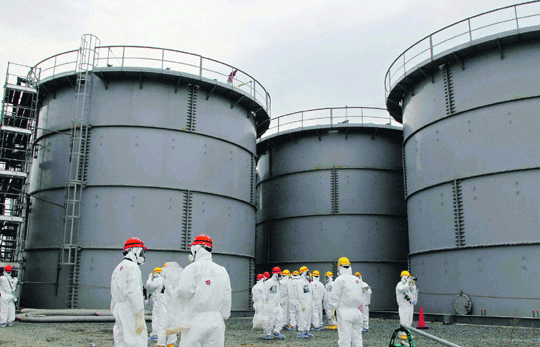
“What is the worse is the water leakage everywhere else – not just from the tanks. It is leaking out from the basements, it is leaking out from the cracks all over the place. Nobody can measure that. […]
“It is much worse than we have been led to believe, much worse,” said Mr Schneider, who is lead author for the World Nuclear Industry status reports. […] Full BBC report here
Massive underground reservoir of radioactive water moves closer to Fukushima coast
 The turbine buildings at the Fukushima Dai-ichi plant are about 150 meters (500 feet) from the ocean. According to a Japan Atomic Energy Agency document, the contaminated underground water is spreading toward the sea at a rate of about 4 meters (13 feet) a month.
At that rate, “the water from that area is just about to reach the coast,” if it hasn’t already,
radioactive cesium levels in most fish caught off the Fukushima coast hadn’t declined in the year following the March 2011 disaster, suggesting that the contaminated water from the reactor-turbine areas is already leaking into the sea.
But TEPCO hasn’t provided the details he and other scientists need to further assess the situation.
Radioactive Groundwater at Fukushima Nears Pacific abc news, TOKYO August 23, 2013 (AP) By MARI YAMAGUCHI Associated Press Deep beneath Fukushima’s crippled nuclear power station, a massive underground reservoir of contaminated water that began spilling from the plant’s reactors after the 2011 earthquake and tsunami has been creeping slowly toward the Pacific.
Now, 2 1/2 years later, experts fear it is about to reach the ocean and greatly worsen what is fast becoming a new crisis at Fukushima: the inability to contain vast quantities of radioactive water.
The looming crisis is potentially far greater than the discovery earlier this week of a leak from a tank that stores contaminated water used to cool the reactor cores. That 300-ton (80,000-gallon) leak is the fifth and most serious from a tank since the March 2011 disaster, when three of the plant’s reactors melted down after a huge earthquake and tsunami knocked out the plant’s power and cooling functions.
But experts believe the underground seepage from the reactor and turbine building area is much bigger and possibly more radioactive, confronting the plant’s operator, Tokyo Electric Power Co., with an invisible, chronic problem and few viable solutions. Continue reading
Tepco digging ground to assess extent of radiation contamination at Fukushima
The utility will dig areas measuring 12 sq. meters in total to a depth of 40 to 50 cm where pools of leaked radioactive water formed, and then measure levels to determine how far the contamination has spread and how much soil needs to be removed.
Some 300 tons of highly radioactive water recently spewed into the Pacific from one of 26 tanks built in an area just 500 meters from the plant’s seawall. The tanks are surrounded by dikes, but some 120 liters of the water leaked outside of them, making it necessary to collect soil to prevent the contamination from spreading……. Groundwater that mixed with the tainted water has already flowed to the ocean, and Tepco said Friday it has launched an operation to pump it out of 28 wells….. http://www.japantimes.co.jp/news/2013/08/23/national/tepco-testing-tainted-earth-at-no-1-plant/#.UhleVNJwonF
Radioactive water crisis out of control at Fukushima
Japan’s leaky nuclear plant, No end in sight The Fukushima nightmare lingers http://www.economist.com/news/asia/21584054-fukushima-nightmare-lingers-no-end-sight Aug 24th 2013 | TOKYO THE agonising efforts to clean up the crippled Fukushima Dai-ichi nuclear power plant hit new obstacles this week. On August 21st the Nuclear Regulation Authority (NRA) said that leaks of radioactive water were a level three, or “serious”, incident on a scale that goes up to seven. Some help from American experts aside, Japan has been dealing with the disaster itself. Now, even Tokyo Electric Power (TEPCO), the plant’s owner, would welcome foreign help.
TEPCO is under intense fire at home. It “has no sense of crisis at all”, grumbled Shunichi Tanaka, chairman of the NRA, as the leaks worsened. Another NRA commissioner questioned whether TEPCO’s data could even be trusted. After months of denial, the firm has only just admitted that contaminated water is leaking into the Pacific. China and South Korea have both expressed concern.
The plant’s melted reactor cores are tainting both the hundreds of tonnes of water pumped into them each day and the groundwater, producing vast quantities of radioactive liquid. After underground pools leaked, TEPCO has hastily built around 1,000 surface storage tanks. Several are leaking from joints sealed with plastic. The most recent leak, of 300 tonnes, prompted the NRA alert. Experts say many more tanks are at risk.
A shortage of cash may have heightened the crisis. TEPCO faces massive bills for replacement fuels and compensating evacuees. It failed to install even the most basic system to monitor water leaks. Its workers stand on tanks and memorise water levels. The NRA this week ordered TEPCO to install water gauges at once. “What’s needed is tanks with stainless-steel seals, but that would take time and money,” says Neil Hyatt, professor of radioactive-waste management at the University of Sheffield.
Huge and growing area of tanks storing Fukushima’s radioactive water
 Radioactive Leaks in Japan Prompt Call for Overseas Help, Bloomberg, By Yuji Okada, Jacob Adelman & Peter Langan – Aug 21, 2013
“……..Toxic Sludge. Tepco was storing 330,000 tons of radioactive water as of Aug. 13 in tanks covering an area equal to 37 football fields, according to the company. The utility is clearing forest to make room for more tanks as it adds to the stored water at a rate of 400 tons a day after pumping it out from under the plant’s reactors, which melted down as a result of the March 2011 earthquake and tsunami.
The water is treated to remove some of the cesium particles before it is stored, which has left 480 filters clogged with the radioactive material at the site. Each weigh 15 tons and are warehoused in what the utility calls temporary storage, though it will take hundreds of years for the radiation to decay. Other radioactive contaminants remain in the water even after treatment. That includes strontium, which has been linked to bone cancers.
Besides radiated water, the site north of Tokyo has more than 73,000 cubic meters of contaminated concrete, 58,000 cubic meters of irradiated trees and undergrowth, and 157,710 gallons of toxic sludge, according to the utility.
’Biggest Concern’
Japan’s nuclear watchdog has ratcheted up alarm over the potential for more leaks of highly radioactive water from the hundreds of storage tanks at the Fukushima atomic plant.
The possibility of leaks from other tanks “is the biggest concern,” said Nuclear Regulation Authority Chairman Shunichi Tanaka at a press conference yesterday. “This will need to be handled carefully on the assumption that one incident could bring another.”
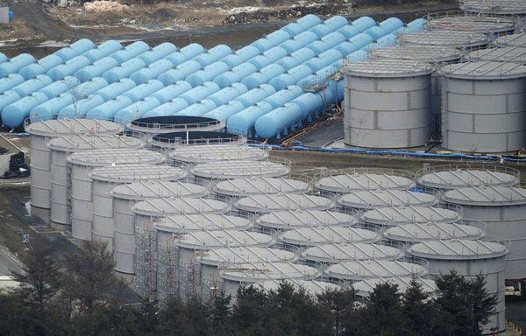
Late last night, Tepco said water leaking from the storage tank probably ran into the ocean, citing high radiation readings in a drainage ditch.
As much as 20 trillion becquerels of cesium and 10 trillion becquerels of strontium leaked into the ocean since May 2011, Tepco spokeswoman Mayumi Yoshida said today. The total amount of cesium and strontium is equivalent to about 100 times the annual limit on radiation from the plant to the ocean under normal conditions, according to calculations based on Tepco data……….
Leaking Tanks
Japan’s government has ordered an investigation into the safety of hundreds of other tanks storing contaminated water in Fukushima, the site of the world’s worst civilian nuclear disaster since the Chernobyl reactor exploded in 1986.
There are 226 tanks of similar bolted design to the leaking unit with the same 1,000-ton capacity at the site, said Tatsuya Shinkawa, director of the nuclear accident response office in the government’s Agency for Natural Resources and Energy, which called for the probe…… http://www.bloomberg.com/news/2013-08-21/tepco-shares-plunge-on-report-of-serious-radiated-water-leak.html
1 This Month

of the week – Shut Down Drone Warfare!


Tell the Ukrainian Government to Drop Prosecution of Peace Activist Yurii Sheliazhenko

Petition to revoke the licensing of the Near Surface Nuclear Disposal Facility (NSDF) at Chalk River. https://www.ourcommons.ca/petitions/en/Petition/Details?Petition=e-7247
To see nuclear-related stories in greater depth and intensity – go to https://nuclearinformation.wordpress.com
-
Archives
- March 2026 (244)
- February 2026 (268)
- January 2026 (308)
- December 2025 (358)
- November 2025 (359)
- October 2025 (376)
- September 2025 (257)
- August 2025 (319)
- July 2025 (230)
- June 2025 (348)
- May 2025 (261)
- April 2025 (305)
-
Categories
- 1
- 1 NUCLEAR ISSUES
- business and costs
- climate change
- culture and arts
- ENERGY
- environment
- health
- history
- indigenous issues
- Legal
- marketing of nuclear
- media
- opposition to nuclear
- PERSONAL STORIES
- politics
- politics international
- Religion and ethics
- safety
- secrets,lies and civil liberties
- spinbuster
- technology
- Uranium
- wastes
- weapons and war
- Women
- 2 WORLD
- ACTION
- AFRICA
- Atrocities
- AUSTRALIA
- Christina's notes
- Christina's themes
- culture and arts
- Events
- Fuk 2022
- Fuk 2023
- Fukushima 2017
- Fukushima 2018
- fukushima 2019
- Fukushima 2020
- Fukushima 2021
- general
- global warming
- Humour (God we need it)
- Nuclear
- RARE EARTHS
- Reference
- resources – print
- Resources -audiovicual
- Weekly Newsletter
- World
- World Nuclear
- YouTube
-
RSS
Entries RSS
Comments RSS
 nuclear-news