For the 29th consecutive year, India and Pakistan exchange lists of nuclear facilities
 India, Pakistan exchange list of nuclear installations, https://economictimes.indiatimes.com/news/defence/india-pakistan-exchange-list-of-nuclear-installations/articleshow/73056333.cms
The two countries exchanged the list of nuclear installations and facilities covered under the Agreement on the Prohibition of Attack against Nuclear Installations between India and Pakistan, the External Affairs Ministry said. This was done simultaneously through diplomatic channels in New Delhi and Islamabad.
The two countries exchanged the list of nuclear installations and facilities covered under the Agreement on the Prohibition of Attack against Nuclear Installations between India and Pakistan, the External Affairs Ministry said.
This was done simultaneously through diplomatic channels in New Delhi and Islamabad.
The exchange of the list came amid tense diplomatic ties between the two countries over the Kashmir issue
How India’s Kudankulam Nuclear Power Plant (KNPP) got hacked
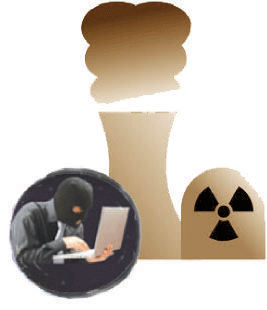 How a nuclear plant got hacked, Plugging nuclear plants into the internet makes them vulnerable targets for nation-state attack. By J.M. Porup, Senior Writer, CSO December 9, 2019 If you think attacking civilian infrastructure is a war crime, you’d be right, but spies from countries around the world are fighting a silent, dirty war to pre-position themselves on civilian infrastructure — like energy-producing civilian nuclear plants — to be able to commit sabotage during a moment of geopolitical tension.
What follows is an explanation of how India’s Kudankulam Nuclear Power Plant (KNPP) got hacked — and how it could have been easily avoided.
The KNPP hack The news came to light, as it so often does these days, on Twitter. Pukhraj Singh (@RungRage), a “noted cyber intelligence specialist” who was “instrumental in setting up of the cyber-warfare operations centre of the National Technical Research Organisation (NTRO),” according to The New Indian Express, tweeted: “So, it’s public now. Domain controller-level access Kudankulam Nuclear Power Plant. The government was notified way back. Extremely mission-critical targets were hit,” noting in a quote tweet that he was aware of the attack as early as September 7, 2019, calling it a “causus belli” (an attack sufficiently grave to provoke a war).
In a later tweet, Singh clarified that he did not discover the malware himself. A third party “contacted me & I notified National Cyber Security Coordinator on Sep 4 (date is crucial). The 3rd party then shared the IoCs with the NCSC’s office over the proceeding days. Kaspersky reported it later, called it DTrack.”
At first the Nuclear Power Plant Corporation of India (NPCI) denied it. In a press release they decried “false information” on social media and insisted the KNPP nuclear power plant is “stand alone and not connected to outside cyber network and internet” and that “any cyber attack on the Nuclear
Power Plant Control System is not possible.”
Then they backtracked. On October 30, the NPCI confirmed that malware was in fact discovered on their systems, and that CERT-India first noticed the attack on September 4, 2019. In their statement, they claimed the infected PC was connected to the administrative network, which they say is “isolated from the critical internal network.”
“Investigation also confirms that the plant systems are not affected,” their statement concludes.
Power Plant Control System is not possible.”
Then they backtracked. On October 30, the NPCI confirmed that malware was in fact discovered on their systems, and that CERT-India first noticed the attack on September 4, 2019. In their statement, they claimed the infected PC was connected to the administrative network, which they say is “isolated from the critical internal network.”
“Investigation also confirms that the plant systems are not affected,” their statement concludes.
A targeted attack
Contrary to some initial reporting, the malware appears to have been targeted specifically at the KNPP facility, according to researchers at CyberBit. Reverse-engineering of the malware sample revealed hard-coded administrator credentials for KNPP’s networks (username: /user:KKNPP\\administrator password: su.controller5kk) as well as RFC 1918 IP addresses (172.22.22.156, 10.2.114.1, 172.22.22.5, 10.2.4.1, 10.38.1.35), which are by definition not internet-routable.
That means it is highly likely the attacker previously broke into KNPP networks, scanned for NAT’ed devices, stole admin credentials, and then incorporated those details into this new malware, a second-stage payload designed for deeper and more thorough reconnaissance of KNPP’s networks.
“This was a very targeted attack on just this plant,” Hod Gavriel, a malware analyst at CyberBit, tells CSO. “Probably this was the second stage of an attack.”
The malware discovered, however, did not include Stuxnet-like functionality to destroy any of KNPP’s systems. “This phase was only for collection of information, it wasn’t sabotageware,” Gavriel says. ….. https://www.csoonline.com/article/3488816/how-a-nuclear-plant-got-hacked.html
India’s government ignores opposition as it plans to build spent nuclear fuel storage facility
|
Govt to build KNPP nuke fuel storage despite opposition Anirban Bhaumik, Deccan Herald, DHNS, New Delhi, NOV 20 2019, The Government is set to go ahead with its plan to set up a facility for storing spent fuel of the first and second units of the Kudankulam Nuclear Power Plant (KNPP) in Tamil Nadu – brushing aside opposition by political parties in the state.
Jitendra Singh, Union Minister of State (MoS) in charge of Department of Atomic Energy, on Wednesday informed the Lok Sabha that the designing of the “Away From Reactor” (or AFR) Spent Fuel Storage facility for the first and second units of the KNPP …….
The DMK MPs from Tamil Nadu were not convinced though. “I feel that it is unfair to decide about the necessity of repository considering the quantity of radioactive waste. Any day, an atomic reactor is like a Damocles Sword hanging over you,” Thamizhachi Thangapandian, the MP from Chennai South, said…….. https://www.deccanherald.com/national/govt-to-build-knpp-nuke-fuel-storage-despite-opposition-778172.html
|
|
|
In Tamil Nadu, Rooftop Solar Has the Potential to Outdo Nuclear Power
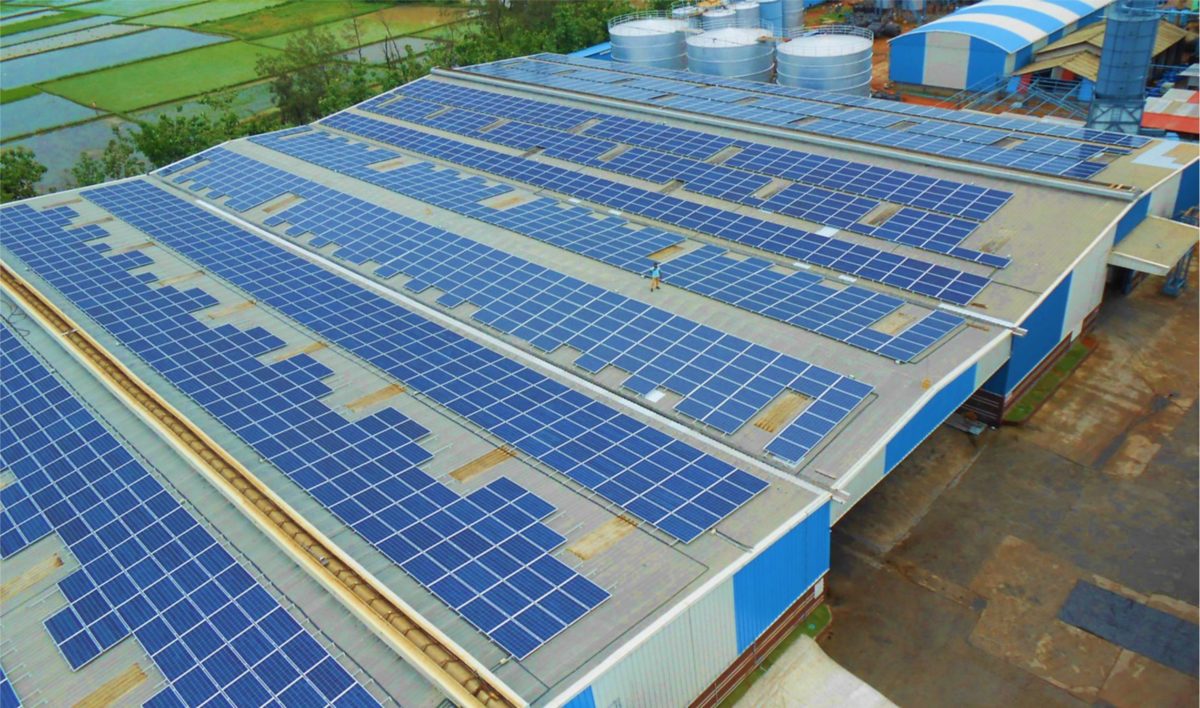
In Tamil Nadu, Rooftop Solar Has the Potential to Outdo Nuclear Power https://thewire.in/energy/tamil-nadu-rooftop-solar-nuclear-power Poonkuzhali 8 Nov 19,
Tamil Nadu has said its vision is to have an installed solar powergeneration capacity of 9,000 MW by 2023.
In September, India and Russia announced joint plans to set up 20 nuclear power units in the former over the next two decades.
India’s nuclear establishment believes that the use of nuclear energy can only be good for the country’s industrial development and prosperity. However, nuclear isn’t the only mode of power generation that can make such a claim.
Tamil Nadu is the only state in the country with two nuclear power plants: at Kalpakkam and Kudankulam.
The Kalpakkam complex, commissioned by 1986, has four operating units. Two of them are of 235 MW capacity and two of 600 MW capacity. The complex’s gross generation in 2017-2018 was 1,194 MU (at 64% availability; in 2015-2016, with an availability of 97%, it generated 1,861 MU).
The Kudankulam power plant is the single largest nuclear power station in India. It has two operational units of 932 MW (net) each. In 2018-2019, with an availability of 33%, it generated 2,797 MU.
Tamil Nadu isn’t the sole beneficiary of the power generated by these plants. In 2016, it required 100,319 MU. It received 99,691 MU from various sources, including state, central and private, and renewable and non-renewable. Of this, nuclear power plants supplied 4,999 MU.
As it turns out, it’s possible to generate this 4,999 MU from rooftop solar panels alone.
On March 31, 2017, Tamil Nadu had the highest installed capacity of grid-connected renewable power (10,562.39 MW), followed by a distant Maharashtra (7,647.60 MW), thanks to wind energy.
According to a 2014 book by S. Gandhi, former president of the Electrical Engineers’ Association of the Tamil Nadu Electricity Board, a 1-MW panel in Tamil Nadu produces 1.5 MU per year on average. This conversion accounts for various factors, including that power production happens only during the day and that production efficiency varies according to the season. Extrapolating from the book, to produce 4,999 MU, Tamil Nadu needs an installed capacity of 3,333 MW.
A 1-kW solar panel over 1,000 roofs can produce 1 MW, so to produce 3,333 MW, we need to install 1-kW solar panels over 3,333,000 roofs. A 1-kW rooftop panel requires about 100 sq. ft. According to state data, there are 2,392,457 buildings in town panchayats alone. Including the total area of all rooftops in Tamil Nadu’s urban centres, and assuming all roofs will generate 10 W/sq. ft., solar power should be easily able to provide the requisite 3,333 MW.
The Government of India and various state governments have consistently presented nuclear power as a safe, sustainable and preferable alternative to coal power. However, while nuclear power plants have very low carbon emissions and have historically caused the fewest fatalities, these advantages are substantially offset by the cost of disposing radioactive waste and an opaque administrative setup in India that has often disprivileged marginalised communities living around power generation complexes.
On the other hand, the biggest downsides of solar power generation are that solar panels lower the productivity of the land they’re setup on, and the batteries used to store power contain toxic materials whose extraction and processing has harmed people in other, often poorer, countries.
But both issues are quickly resolved in the current example. The question of land productivity doesn’t apply since the panels are to be installed on rooftops. Second, in its solar energy policy published in February 2019, the Tamil Nadu government declared it now has the technology to support grid-connected solar panels on a large scale. This means even domestic solar panels can be connected to the grid, obviating the need for power storage batteries.
According to its policy, the state government says its vision is to have an installed solar power generation capacity of 9,000 MW by 2023.
As of today, the Tamil Nadu government requires every new building erected in the state to be equipped with a rainwater harvesting system. If lawmakers issue a similar mandate vis-à-vis solar panels, at least for apartment complexes and non-residential buildings, Tamil Nadu could soon be self-sufficient about its energy needs, if not produce a surplus it can sell to its neighbours.
Poonkuzhali is a writer and activist based in Chennai.
Heat deaths in India will increase greatly, if greenhouse emissions increase
 If Emissions Continue, India Could See 1 Million Heat Deaths a Year, https://www.scientificamerican.com/article/if-emissions-continue-india-could-see-1-million-heat-deaths-a-year/?utm_medium=social&utm_content=organic&utm_source=twitter 3 Nov 19,
Premature deaths from extreme heat next century could top those from infectious diseases today, A new study predicts there’ll be more than 1 million deaths a year from extreme heat in India by the next century if greenhouse gas emissions continue at their current level.Research by the Climate Impact Lab with the University of Chicago’s Tata Centre for Development projects India’s average annual temperature will rise 4 degrees by 2100.
When broken down by location, 16 of India’s 36 states and union territories will become hotter than Punjab, which is currently the hottest state, with an average annual summer temperature around 90 degrees Fahrenheit (32 degrees Celsius).
As temperatures rise, the number of extremely hot days is expected to rise, as well.
The state of Odisha will see the highest increase, with an average of 48.05 hot days by 2100 compared with 1.62 in 2010. Delhi is projected to experience 22 times as many days with extreme heat, and Haryana is estimated to see 20 times as many days.
The study estimates the combination of hotter summers and more high-heat days will contribute to more than 1.5 million deaths each year by 2100.
The projected death rate is as high as the current death rate from all infectious diseases in India today. Six states—Uttar Pradesh, Bihar, Rajasthan, Andhra Pradesh, Madhya Pradesh and Maharashtra—are expected to contribute to more than half of the excess death rate from rising temperatures.
“Having already seen 2,500 deaths due to a heat wave in 2015, the future is projected to be even more worrying if India—and the world—does not change course to mitigate the harmful effects of climate change,” said Amir Jina of the Climate Impact Lab.
If the world commits to the Paris Agreement and regularly updates its commitments, the study estimates India’s excess death rate from high heat will drop more than 80%.
The study comes as India’s energy use is expected to more than double by 2040, with fossil fuels serving as the main source.
The country’s 5% increase in coal demand last year contributed to a nearly equal percentage in its carbon emissions. India is currently the world’s third-largest carbon emitter (Climatewire, Aug. 14).
Michael Greenstone, faculty director at the Tata Centre and a co-founder of the Climate Impact Lab, said the continued reliance on fossil fuels will harm India in the years to come. The need to balance cheap and reliable energy sources while managing climate risks, he said, is “perhaps the defining challenge of our generation.”
Officials confirm that Indian nuclear power plant’s network was hacked
 Indian nuclear power plant’s network was hacked, officials confirm
After initial denial, company says report of “malware in system” is correct. SEAN GALLAGHER – 10/31/2019
The Nuclear Power Corporation of India Limited (NPCIL) has acknowledged today that malware attributed by others to North Korean state actors had been found on the administrative network of the Kudankulam Nuclear Power Plant (KKNPP). The admission comes a day after the company issued a denial that any attack would affect the plant’s control systems.
In a press release today, NPCIL Associate Director A. K. Nema stated, “Identification of malware in NPCIL system is correct. The matter was conveyed by CERT-In [India’s national computer emergency response team] when it was noticed by them on September 4, 2019.”
That matches the date threat analyst Pukhraj Singh said he reported information on the breach to India’s National Cyber Security Coordinator.
“The matter was immediately investigated by [India Department of Atomic Energy] specialists,” Nema stated in the release. “The investigation revealed that the infected PC belonged to a user who was connected to the Internet connected network used for administrative purposes. This is isolated from the critical internal network. The networks are being continuously monitored.”
Lazarus in the house
It’s not clear if data was stolen from the KKNPP network. But the nuclear power plant was not the only facility Singh reported being compromised. When asked by Ars why he called the malware attack a “casus belli”—an act of war—Singh, a former analyst for India’s National Technical Research Organization (NTRO), said, “It was because of the second target, which I can’t disclose as of now.”
The malware in question, named Dtrack by Russian malware protection company Kaspersky, has been used in widespread attacks against financial and research centers, based on Kaspersky data collected from over 180 samples of the malware. Dtrack shares elements of code from other malware attributed to the Lazarus threat group, which, according to US Justice Department indictments, is a North Korean state-sponsored hacking operation. Another version of the malware, ATMDtrack, has been used to steal data from ATM networks in India.
DTrack appears to be an espionage and reconnaissance tool, gathering data about infected systems and capable of logging keystrokes, scanning connected networks, and monitoring active processes on infected computers. The malware may have been delivered by an “in-memory implant,” Singh said, though he added that he is waiting for confirmation from other sources. He added that he had not seen any data indicating whether data had been stolen from the KKNPP network. “I didn’t have the full indicators,” Singh said.
While the attack may not have given direct access to nuclear power control networks, it could have been part of an effort to establish a persistent presence on the nuclear plant’s networks. As a paper published in May by the International Committee of the Red Cross on the human cost of cyber operations pointed out, “the majority of the computer devices in the world are only one or two steps away from a trusted system that a determined attacker could compromise.” Lukasz Olejnik, a security researcher who co-authored the paper, noted that “preemptive compromise of trusted systems would make attacks significantly easier,” and that establishing a persistent presence on a network could aid in things such as supply-chain attacks—attempts to use software update processes or other potential opportunities to move to isolated networks to deliver an attack in the future.
That’s similar to the route demonstrated by Stuxnet, the malware attributed to US and Israeli intelligence that managed to jump an “air gap” into Iranian nuclear enrichment equipment controls. While the administrative network of KKNPP was likely not a good route for such an attack given standards for nuclear control systems security, it certainly could provide information about maintenance operations that would be useful for espionage—or for a future attempted cyber-attack. more https://arstechnica.com/information-technology/2019/10/indian-nuclear-power-company-confirms-north-korean-malware-attack/
The hazards of nuclear submarines
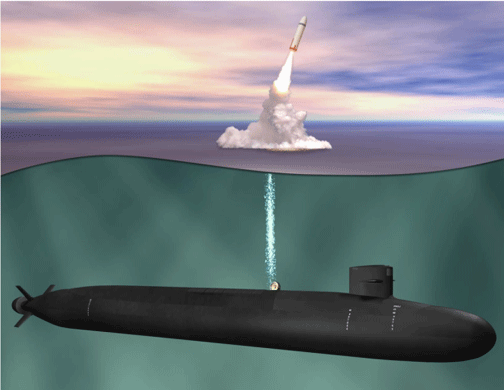
In 2019, a new set of nuclear dangers emerged for Southasia. The growing danger was underscored during the military crisis between India and Pakistan in February 2019, when India put one or more of its nuclear submarines on “operational deployment mode.” During the crisis, the Pakistani Navy claimed to intercept an Indian submarine. No one has confirmed if this interception involved an Indian submarine carrying nuclear weapons. With India and Pakistan on an accelerated programme of acquiring and developing nuclear submarines, Southasia needs to pay urgent attention to the risks of nuclear accidents at sea.
The expansion of nuclear operations to the sea also raises issues about who has the ability to authorise the use of these weapons, especially in a crisis. This is of particular concern in the case of India because it has already deployed such weapons. According to a November 2018 announcement by Prime Minister Narendra Modi, the Arihant nuclear-powered submarine successfully completed its maiden “patrol”.
A further source of concern is the August 2019 announcement by India’s defence minister to the effect that the country’s ‘No First Use’ (NFU) policy – which pledges not to attack with nuclear weapon unless attacked first – “would depend on the circumstances.” His comments, made during a period of increased tension between India and Pakistan following the amendment to Article 370 of India’s Constitution conferring special status to Jammu & Kashmir, underscore these risks.
India’s nuclear submarines……… Strategic competition with China in the Indian Ocean may be another factor. Serving and retired members of India’s Navy publicly express concerns about the deployment of Chinese submarines, warships and tankers in the Indian Ocean.
India’s growing arsenal also makes it a more valuable ally for the United States in its efforts to deal with the growth in China’s political and military power. For some time now, the US and India have been conducting joint naval exercises.
Pakistan’s naval force
Pakistan, for its part, announced the setting up of a Naval Strategic Force Command in 2012. Pakistan’s Navy has started preparing to put nuclear-armed cruise missiles on conventional submarines. The cruise missile is expected to be the 450-kilometer range Babur, which had a successful underwater test launch in 2018. There are reports that Pakistan is seeking to develop or acquire a nuclear-powered submarine…..
Submarine accidents
Almost all the countries operating nuclear-powered or nuclear-armed submarines have experienced accidents, often with significant loss of life and the spread of radioactivity in the environment. There have been over 40 accidents involving nuclear-powered submarines, claiming a total of over 650 lives. Of these accidents, more than half involved Soviet/Russian submarines resulting in over 400 deaths. The United States comes next, with at least a dozen submarine accidents leading to well over 200 deaths.
Two accidents have involved India’s nuclear submarines. …….
It would be unreasonable to expect that no more accidents involving nuclear submarines would ever take place. Nuclear submarines involve many technologies that are susceptible to a range of accidents affecting the submarine, nuclear reactor, missiles and nuclear weapons. All of these are operating under challenging conditions: deep under water, with limited supplies of air and water, possibly under attack. None of these factors is likely to change…….. Should a naval nuclear-reactor accident occur, especially at or near a naval base, coastal city or town the consequences could extend far beyond the vessel and its crew……
Pathways to war
The introduction of nuclear armed submarines, whether diesel or nuclear-fuelled, increases the likelihood of conventional conflicts escalating to a nuclear one. Any use of nuclear weapons would have devastating consequences, especially if the use of nuclear weapons by one country sets off a nuclear response from the other side.
In a military crisis, nuclear armed submarines increase the potential for nuclear war because they open up new risk pathways. The Australian strategist Desmond Ball pointed out in 1985 that “the sea is the only area where nuclear weapon platforms [of adversary states] … actually come into physical contact” and this contact can lead to accidents from several kinds of what seem to be typical naval operations.
There have already been incidents of Indian and Pakistani naval platforms coming into physical contact, for example in 2011, when the Pakistani vessel PNS Babur brushed past India’s INS Godavari. Contact between Navy forces from India and Pakistan might also result from deliberate attempts to attack submarines. Both countries are known to be acquiring anti-submarine warfare capabilities.The consequences of such events could be worse if submarines come into contact with each other during periods of heightened tensions or crises.
During a crisis, there may be inadvertent attacks on submarines carrying nuclear weapons, because these are intermingled with submarines carrying only conventional weapons. One notable instance occurred during the Cuban Missile Crisis, when US ships used practice depth charges against Soviet nuclear-armed submarines. This almost led to the use of nuclear weapons by the Soviet submarine.
Challenges to controlling nuclear weapons
A significant new challenge resulting from the deployment of nuclear weapons at sea is managing command and control. To the extent that such things are publicly known, India and Pakistan were believed to keep their nuclear weapons on land separate from the delivery vehicles, be they missiles or aircraft. This separation makes it harder for the weapons to be used without proper authorisation. With submarines armed with nuclear weapons at sea, this separation may not be possible and so the risk of unauthorised use is greater.
At the same time, one purpose of the nuclear-armed submarine is to be a final fail-safe means of nuclear attack even if a country’s political leadership is killed and its cities destroyed. To serve this role, the nuclear weapons on the submarine cannot rely on timely launch orders from political authorities. A further problem for submarines is that they are supposed to remain hidden from the enemy. Constant communication from the submarine to the military or civilian leadership may make it easier to detect. All of this means that during the time of a crisis, the personnel in a nuclear submarine might be the ones making decisions on whether or not to use nuclear weapons.
Southasians need to consider how they feel about trusting their lives in some future crisis to the restraint of Indian or Pakistani submariners far from home and fearful that their vessel is under attack, trying to decide about launching their nuclear missiles in a ‘use them or lose them’ scenario. The consequences would be devastating.
~Zia Mian is co-director of Princeton University’s Program on Science and Global Security, where he also directs the Project on Peace and Security in South Asia.
~M V Ramana is the Simons Chair in Disarmament, Global and Human Security at the Liu Institute for Global Issues in the School of Public Policy and Global Affairs at the University of British Columbia in Vancouver, Canada.
~Abdul H Nayyar is a physicist and a founder and former President of the Pakistan Peace Coalition, a national network of peace and justice groups. https://himalmag.com/nuclear-dangers-of-the-naval-kind-2019/?fbclid=IwAR0G8NZSV5ANg7Ag7KcuJU_80iv3pNJiqb6E_T12sylV9BaJWIvcZ3Vb_j0
 |
ReplyForward
|
Determined opposition to nuclear expansion in India’s iconic tiger reserve
|
Karnataka activists may approach court to oppose Kaiga nuclear plant expansion
Earlier, a Tata Memorial Trust report had said the nuclear plant, was responsible for increasing cancer cases in the region. The News Minute, Soumya Chatterjee, Saturday, October 19, 2019 Environmental activists are determined to oppose the expansion of the Kaiga Atomic Power Station in the buffer zone of the Kali Tiger Reserve in Uttara Kannada district of Karnataka. Currently, the plant has four units. The Nuclear Power Corporation Ltd. has proposed a fifth and a sixth unit, the proposal for which has cleared all environmental regulatory hurdles from both the state and union governments recently. Activists argue that expanding the Kaiga plant will result in the loss of 54 hectares of pristine forests in the fragile Western Ghats near the Kali Tiger Reserve. They also question the practicality of setting up more nuclear power plant units or replacing it with other safer and cheaper power generating options like solar and wind energy. Incidentally, the Karnataka High Court also recently ordered an interim stay on further felling of trees by the National Highway Authority of India for the expansion of NH4A (Belagavi-Goa), after it learnt that the authorities had violated the Forest Protection Act. Encouraged by this, activists opposing the new units in the Kaiga plant are planning to approach the court, if other means of protest do not work. A threat to eco-sensitive area “When the whole world is shifting away from nuclear power and looking for eco-friendly sources like solar and water, why do we want to create problems like Fukushima (Japan) with already four dams created in the upper course of the Kali river? Why do we want to destruct forests further when climate change is already impacting us?” asks Joseph Hoover, a former member of State Wildlife Board and founder of United Conservation Movement. “It is not necessary as the state is power surplus and will primarily help other states. There is also the issue of increased cancer cases in the area because of the plant,” he added. A Tata Memorial Centre report in 2010 had said there was a spurt in cases of cancer over the past two decades in Kaiga. Experts insist that this is because of radioactive pollution caused by the nuclear power plant. Advocate Prince Isaac, who represented the United Conservation Movement, which was one of the petitioners in the NH4A case, said, “This area is classified as eco-sensitive area-1, according to a specific order from November 2013 under Section 5 of the Environmental Protection Act by the Union Ministry of Forest, Environment and Climate Change. By the same order, no developmental work (construction involving space more than 20,000 sq metres) can take place in this zone.” Pointing out that the government is breaking its own law, he added, “Other than this, for projects in sensitive areas, there is a legal mandate to carry a biological impact assessment as there are rare species that are endemic to the area. That has not been undertaken here.”…… https://www.thenewsminute.com/article/karnataka-activists-may-approach-court-oppose-kaiga-nuclear-plant-expansion-110831 |
|
India keeps increasing its nuclear weaponry – aimed at Pakistan and China
“India is estimated to have produced enough military plutonium for 150 to 200 nuclear warheads, but has likely produced only 130 to 140,” according to Hans Kristensen and Matt Korda of the Nuclear Information Project at the Federation of American Scientists. “Nonetheless, additional plutonium will be required to produce warheads for missiles now under development, and India is reportedly building several new plutonium production facilities.”
In addition, “India continues to modernize its nuclear arsenal, with at least five new weapon systems now under development to complement or replace existing nuclear-capable aircraft, land-based delivery systems, and sea-based systems.”……https://news.yahoo.com/indias-nuclear-weapons-arsenal-keeps-183000277.html
Continued strong public opposition to nuclear power in India
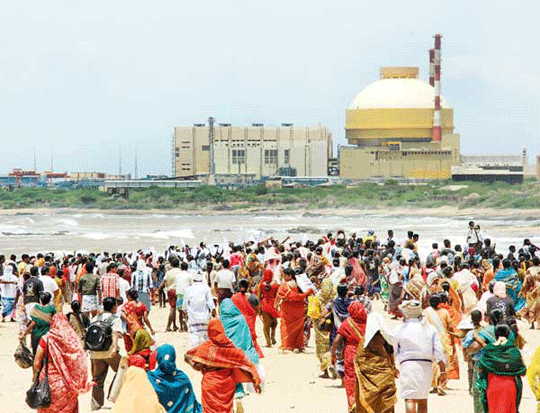
Now, an in-principle approval given by the Indian government to initiate exploratory mining for more uranium across the two southern provinces of Andhra Pradesh and Telangana has locals up in arms.
The location also includes a nature reserve not only rich in flora and fauna, but also with a large tiger population. The technical go-ahead was given a few months back for Uranium Corporation of India Limited (UCIL) to begin exploration for uranium, but an earlier protest led to a temporary pause in the process.
Andhra Pradesh is the largest producer of uranium in India. Tummalapalle village, located in the Kadapa district of Andhra Pradesh, is considered to have one of the largest uranium reserves in the world.
Next to the mine there is a processing plant that converts the uranium ore into sodium diuranate for use in nuclear power plants. Over the years, local farmers and environmentalists have alleged that it had led to the contamination of soil and groundwater, in addition to the destruction of water bodies.
A rethink by the government to go ahead with the fresh exploration has once again raised the hackles of environmentalists in India, who argue that whatever the procedure used to extract uranium, the wholesale mining for uranium would produce large amounts of radioactive waste that would pollute a major river nearby (as well as the surrounding areas).
They claim even if the waste is treated before disposal, uranium mining can still lead to the contamination of water and soil, eventually harming the flora and fauna of the region.
Officials of the Atomic Minerals Directorate tried to take samples after drilling a bore well for exploration and research, but were prevented by villagers, according to the News Minute.
The villagers have also been joined by opposition parties in the protests.
India’s nuclear plants are controlled by Nuclear Power Corporation of India (NPCIL), a state-owned corporation. India currently has seven nuclear power plants, but there are plans to add more.
But toward that goal, the government faces an uphill task………. https://oilprice.com/Alternative-Energy/Nuclear-Power/The-Biggest-Hurdle-In-Indias-Nuclear-Energy-Push.html
India and Pakistan sliding toward potential nuclear war
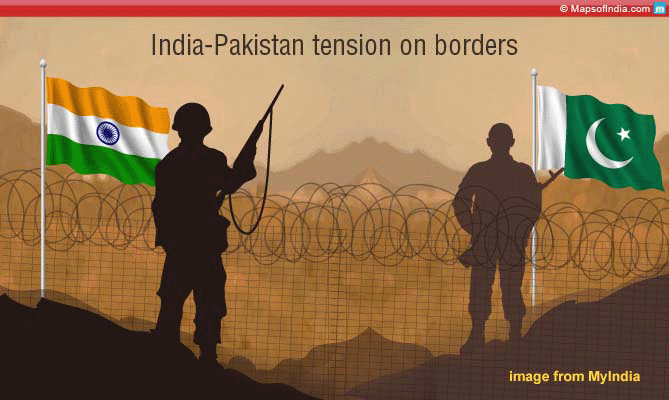 Kashmir crackdown: A warning of nuclear war between India and Pakistan, Axios, Dave Lawler $ Oct 19, India and Pakistan are sliding toward potential nuclear war, according to the president of Pakistani-controlled Kashmir. The warning comes as Pakistan attempts to rally global outrage against its neighbor and rival.
Catch up quick: On Aug. 5, India revoked the constitutional autonomy of Jammu and Kashmir — the state it controls within the disputed Himalayan territory — while instituting a communications blackout and a curfew enforced by hundreds of thousands of troops.
Tensions between India and Pakistan, as India contemplates abandoning its No First Use policy on nuclear weapons
|
Some experts watching the situation have told Naturethat the risk of a conflict between the two countries has never been greater since they both tested nuclear weapons in 1998……… What is no first use and who else has adopted it? Of the world’s eight declared nuclear-weapons states, only China and India have an unambiguous no first use nuclear weapons policy. This is a commitment only to use nuclear weapons in response to a nuclear attack and never in retaliation for one using conventional weapons. Such a policy also includes comprehensive protocols in which activating nuclear weapons would only ever be a last resort. India tested its first nuclear weapon in 1974 and the government committed to no first use in 2003, five years after conducting a second set of nuclear-weapons tests on 11 and 13 May 1998. The intention in declaring no first use was partly to help defuse tensions with its neighbour, which had responded to India’s second test with its own nuclear tests the same month. Over the past two decades, Pakistan has amassed 150–160 nuclear missiles, to India’s 130–140, according to the Stockholm International Peace Research Institute. Both countries, moreover, have advanced nuclear weapons, as well as ballistics research and development programmes. Why doesn’t Pakistan have a no first use policy? According to Feroz Hassan Khan, who teaches security studies at the Naval Postgraduate School in Monterey, California, if Pakistan were to adopt the same policy, that would negate its reason for developing nuclear weapons in the first place……..https://www.nature.com/articles/d41586-019-02578-5 |
|
Kashmir – a “nuclear flashpoint”?
Kashmir a nuclear flashpoint: Pakistan army spokesman Asif Ghafoor https://www.livemint.com/politics/news/kashmir-a-nuclear-flashpoint-pakistan-army-spokesman-asif-ghafoor-1566058203618.html : 17 Aug 2019,
- Indian defence minister Rajnath Singh on Friday said India could review its nuclear no first use policy
- The UN Security Council on Friday said India and Pakistan should sort out their differences bilaterallyNew Delhi: Pakistan army spokesman Asif Ghafoor on Saturday described Kashmir as a “nuclear flashpoint”, a day after defence minister Rajnath Singh said India could review its nuclear no first use policy.
Ghafoor’s comment, quoted by news reports, could be seen as another attempt by Pakistan to internationalise the Kashmir dispute between the two countries and invite offers of mediation. Western nations have always been wary of tensions flaring up between the two countries that have nuclear weapons.
Ghafoor’s comments also come after the UN Security Council on Friday said India and Pakistan should sort out their differences bilaterally after closed-door consultations. This came after China sought the meeting on Pakistan’s behalf after India revoked a provision in its constitution giving special status to Kashmir.
In his remarks on Saturday, Ghafoor also said Pakistan was ready to repulse any Indian attack, the news reports said.
On Friday, during a visit to Pokhran, defence minister Rajnath Singh said, “Till today, our nuclear policy is ‘No First Use’. What happens in future depends on the circumstances,” media reports said quoting the minister who was at an event in Pokhran, the site of India’s nuclear tests in 1998.
The comments followed heightened tensions between India and Pakistan after the Indian government revoked Article 370that gave special status to Jammu and Kashmir. Pakistan had condemned the move.
In a tweet, Rajnath Singh added, “Pokhran is the area which witnessed Atal Ji’s firm resolve to make India a nuclear power and yet remain firmly committed to the doctrine of ‘No First Use’. India has strictly adhered to this doctrine. What happens in future depends on the circumstances.”
Implications for India if it revokes its No First Use nuclear weapons policy
Nuclear rethink: A change in India’s nuclear doctrine has implications on cost & war strategy
A nuclear doctrine states how a nuclear weapon state would employ its nuclear weapons both during peace and war. Economic Times ET Bureau|, Aug 17, 2019,
“…….. revoking the NFU would have its own costs. First, India’s image as a responsible nuclear power is central to its nuclear diplomacy. Nuclear restraint has allowed New Delhi to get accepted in the global mainstream. From being a nuclear pariah for most of the Cold War, within a decade of Pokhran 2, it has been accepted in the global nuclear order. It is now a member of most of the technology denial regimes such as the Missile Technology Control regime and the Wassenaar Arrangement. It is also actively pursuing full membership of the Nuclear Suppliers Group. Revoking the ‘no first use’ pledge would harm India’s nuclear image worldwide.
In fact, when compared with the estimates a decade earlier of 70 nuclear warheads, there has only been a modest increase in India’s nuclear inventory. If India does opt for first use of nuclear weapons and given that it has two nuclear adversaries, it would require a far bigger inventory of nuclear weapons particularly as eliminating adversaries’ nuclear capabilities would require targeting of its nuclear assets involving multiple warheads. The controversy around the supposed low yield of its Hydrogen weapon test in 1998 further complicates this already precarious calculation.
Similarly, first use of nuclear weapons would require a massive increase in India’s nuclear delivery capabilities. There is yet no evidence suggesting that India’s missile production has increased dramatically in recent times. Moreover, India is yet to induct the Multiple Reentry Vehicle (MRV) technology in its missiles, which is fundamental to eliminating hardened nuclear targets. Finally, India’s ISR capabilities would have to be augmented to such a level where India is confident of taking out most of its adversary’s arsenal. According to a senior officer who had served in the Strategic Forces command, this is nearly an “impossible task”. Finally, India would have to alter significantly its nuclear alerting routine. India’s operational plans for its nuclear forces involve a four-stage process. Nuclear alerting would start at the first hints of a crisis where decision-makers foresee possible military escalation. This would entail assembly of nuclear warheads and trigger mechanisms into nuclear weapons. The second stage involves dispersal of weapons and delivery systems to pre-determined launch positions. The third stage would involve mating of weapons with delivery platforms.
The last and final stage devolves the control of nuclear weapons from the scientific enclave to the military for their eventual use. Canisterization of missiles has combined the dispersal and mating of weapons into a single step, cutting down the effort required for achieving operational readiness. Even then, this model does not support first use of nuclear weapons as it gives ample warning to the adversary of India’s intentions. There is certainly a need for a reappraisal of India’s nuclear doctrine.
All doctrines need periodic reviews and India’s case is no exception. Given how rapidly India’s strategic environment is evolving, it is imperative to think clearly about all matters strategic. But if Indian policymakers do indeed feel the need to review the nation’s nuclear doctrine, they should be cognizant of the costs involved in so doing. A sound policy debate can only ensue if the costs and benefits of a purported policy shift are discussed and debated widely. https://economictimes.indiatimes.com/news/defence/nuclear-rethink-a-change-in-indias-nuclear-doctrine-has-implications-on-cost-war-strategy/articleshow/70718646.cms
India ponders changing its “no first use” nuclear weapons policy
India hints at changing ‘no first use’ nuclear policy Channel News Asia, NEW DELHI: India’s defence minister hinted on Friday (Aug 16) that New Delhi might change its “no first use” policy on nuclear weapons, amid heightened tensions with fellow atomic power Pakistan.
India committed in 1999 to not being the first to use nuclear weapons in any conflict. Among India’s neighbours China has a similar doctrine but arch rival Pakistan does not.
Defence Minister Rajnath Singh made the comment on Twitter after visiting Pokhran, the site of India’s successful nuclear tests in 1998 under then prime minister Atal Vajpayee.
“Pokhran is the area which witnessed (Vajpayee’s) firm resolve to make India a nuclear power and yet remain firmly committed to the doctrine of ‘No First Use’ (NFU),” Singh wrote.
“India has strictly adhered to this doctrine. What happens in future depends on the circumstances,” Singh tweeted.
The statement comes as tensions rise with Pakistan after Prime Minister Narendra Modi’s government stripped Indian-administered Kashmir of its autonomy, a move sharply condemned by Islamabad……..
Observers said Singh’s statement is the clearest so far with regards to a change in India’s nuclear doctrine.
……….https://www.channelnewsasia.com/news/asia/india-hints-at-changing-no-first-use-nuclear-policy-11816218
1 This Month
To see nuclear-related stories in greater depth and intensity – go to https://nuclearinformation.wordpress.com/
12 February – Webinar The Big Push: New Nuclear Projects in Canada
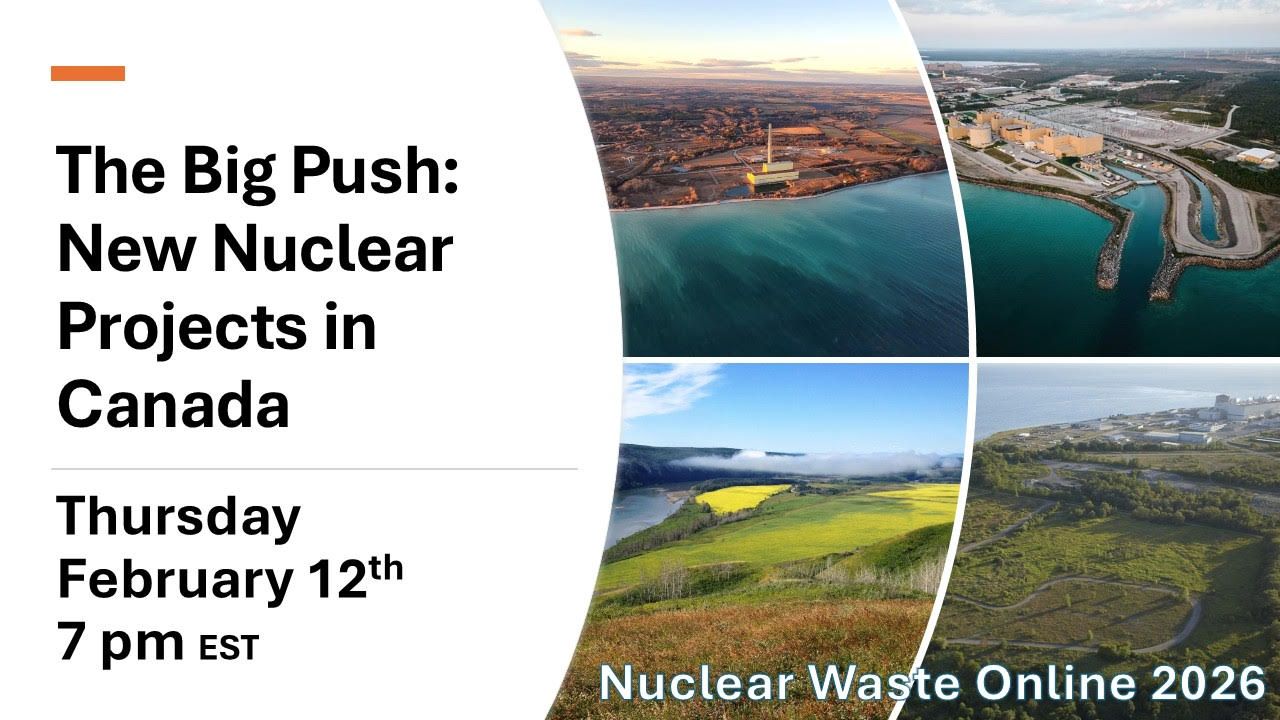
Thursday, February 12, 7 pm Eastern | 2nd of 4 sessions in the 2026 Nuclear Waste Online webinar series
Join a webinar on the push for new nuclear generation in Canada. Go to Northwatch.org to register or use the registration link https://us02web.zoom.us/webinar/register/WN_ZfWOf1GITqSRIZX8CB-A9w
-
Archives
- February 2026 (115)
- January 2026 (308)
- December 2025 (358)
- November 2025 (359)
- October 2025 (376)
- September 2025 (258)
- August 2025 (319)
- July 2025 (230)
- June 2025 (348)
- May 2025 (261)
- April 2025 (305)
- March 2025 (319)
-
Categories
- 1
- 1 NUCLEAR ISSUES
- business and costs
- climate change
- culture and arts
- ENERGY
- environment
- health
- history
- indigenous issues
- Legal
- marketing of nuclear
- media
- opposition to nuclear
- PERSONAL STORIES
- politics
- politics international
- Religion and ethics
- safety
- secrets,lies and civil liberties
- spinbuster
- technology
- Uranium
- wastes
- weapons and war
- Women
- 2 WORLD
- ACTION
- AFRICA
- Atrocities
- AUSTRALIA
- Christina's notes
- Christina's themes
- culture and arts
- Events
- Fuk 2022
- Fuk 2023
- Fukushima 2017
- Fukushima 2018
- fukushima 2019
- Fukushima 2020
- Fukushima 2021
- general
- global warming
- Humour (God we need it)
- Nuclear
- RARE EARTHS
- Reference
- resources – print
- Resources -audiovicual
- Weekly Newsletter
- World
- World Nuclear
- YouTube
-
RSS
Entries RSS
Comments RSS
 nuclear-news