India may have to shut down two uneconomic reactors at Tarapur
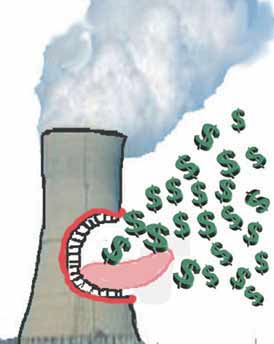
 Oldest Indian Nuclear Reactors Near Mumbai May Be Shut Down, Bloomberg, Rajesh Kumar Singh, 14 Mar 16
-
Tarapur 1 & 2 unprofitable, undergoing frequent maintenance
-
Nuclear Power Corp. may seek higher tariff from regulator
-
India may shut two of its oldest reactors almost five decades after they went into operation as power tariffs aren’t keeping pace with maintenance costs, according to Sekhar Basu, secretary at the Department of Atomic Energy.
The first two reactors at Tarapur, about 100 kilometers (62 miles) from Mumbai at India’s western coast, suffer frequent maintenance shutdowns that make them unprofitable, Basu said in a phone interview. They earn about 0.89 rupees (1 cent) for every kilowatt hour of electricity produced, which isn’t enough to sustain operations. Nuclear plants in India received an average tariff of 2.78 rupees per kilowatt hour in the year ended March 2015, according to the Department of Atomic Energy.
“We are pouring in money into the reactors rather than making income from them,” Basu said. “At the current tariff, it’s become unviable to run the two reactors and we may be forced to shut them down if the tariff is not increased.”
Basu didn’t provide details on the timing of a possible decommissioning, a process that can take decades and generate thousands of tons of radioactive waste. Nuclear Power Corp., the nation’s sole operator of nuclear power plants, may approach the electricity regulator for a tariff increase when operations become unsustainable, Basu said. -
Liability Law
Nuclear Power spokesman N. Nagaich couldn’t be reached on his office phone for a comment. Sanjeev Kumar, chairman at Maharashtra State Electricity Distribution Co., which buys power from the reactors, didn’t respond to phone calls and a text message sent on his mobile phone.
The boiling water reactors, which can produce 160 megawatts each, were supplied by General Electric Co. and started operating in 1969, marking India’s foray into nuclear energy. India plans to raise atomic power capacity more than ten-fold by 2032 as part of its clean-energy drive. The expansion plans have been complicated by the nation’s liability law. The statute, which exposes plant equipment suppliers to accident claims, is borne out of concerns over nuclear safety……..http://www.bloomberg.com/news/articles/2016-03-15/india-mulls-shutting-oldest-nuclear-plants-amid-mounting-costs
Is India’s Government Hiding A Serious Accident Underway In Gujarat?
India’s Former Nuclear Regulator Says, Govt Might Be  , CounterCurrents By Kumar Sundaram 13 March, 2016 Indiaresists.com The retired chief of India’s nuclear regulator, Dr. A Gopalakrishnan has sent out an urgent note in which he has cautioned that a ‘loss of coolant accident(LOCA)’ might be underway in Gujarat’s Kakrapar Nuclear Power Station(KAPS). A LOCA accidents is the most serious accident that can happen in nuclear plants and it might lead to the meltdown of the reactor fuel core.
The same reactor had a major accident in 1994 when floodwaters drowned Kakrapar. The floodgates meant to release excess water could not be opened and the water kept increasing–which could lead to a major accident–but it was prevented with the efforts of local engineers. Mr. Manoj Mishra, a worker in the power station then who blew whistle on that accident was terminated by the NPCIL. He was denied justice even by the Supreme Court in India which bought the NPCIL’s argument that he cannot be a whistle-blower as he did not have technical degrees. Mr. Mishra had years of experience in the reactor and he was a strong leader of the workers’ union.
Kakrapar is situated not very far from the Vansda-Bharuch earthquake faultline running through Gujarat, which has experienced several major earthquakes.
Exactly on the 5th anniversary of Fukushima, a leak has been reported in the Unit-1 of the Kakrapar Nuclear Power Station near Surat in Gujarat.
Here is the note by Dr. Gopalakrishnan:
The Kakrapar Unit-I nuclear reactor in Gujarat is undergoing a moderately large leakage of heavy water from its Primary Heat Transport (PHT) system since 9.00 AM on March 11,2016. From the very limited information released by the Nuclear Power Corporation of India Limited (NPCIL) and the Atomic Energy Regulatory Board (AERB) of the government , as well as from the conversations I had with press people who have been in touch with nuclear officials, few inferences can be drawn.
Till 7.00 PM on March 12,2016 , the DAE officials have no clue as to where exactly the PHT leak is located and how big is the rate of irradiated heavy water that is leaking into the reactor containment . However, some reports indicate that the containment has been vented to the atmosphere at least once , if not more times , which I suspect indicates a tendency for pressure build up in that closed space due to release of hot heavy water and steam into the containment housing . If this is true, the leak is not small , but moderately large , and still continuing. No one confirms that any one has entered the containment (in protective clothing) for a quick physical assessment of the situation , perhaps it is not safe to do so because of the high radiationfields inside . When NPCIL officials state that the reactor cooling is maintained , I believe what they may be doing is to allow the heavy water or light water stored in the emergency cooling tanks to run once-through the system and continue to pour through the leak into the containment floor through the break .
All this points to the likelihood that what Kakrapar Unit-1 is undergoing is a small Loss-of-Coolant Accident (LOCA) in progress. It is most likely that one or more pressure tubes (PT) in the reactor (which contain the fuel bundles) have cracked open , leaking hot primary system heavy-water coolant into the containment housing . ……….
. It may be possible that , having built more than 20 PHWRs , NPCIL and AERB in recent years have become overconfident and relaxed their strict adherence to this Aging Management Program , which might have been the reason for the current accident.
Let me caution the reader that the above conjecture is based on bits and pieces of reliable and not so reliable information gathered from different people close to the accident details and in positions of authority. Future detailed evaluation may or may not prove my entire set of conclusions or part of them to be not well-founded. But , technical experts are compelled to put out such conjectures because of the total lack of transparency of the Indian cilvilian nuclear power sector and the atomic energy commission (AEC) , the Dept. of Atomic Energy (DAE) , the NPCIL and the AERB . Public have a need to know and , therefore , the AEC and its sub-ordinate organizations need to promptly release status reports on the progressing safety incident which could affect their lives , to alleviate their concerns and anxieties . It is a series of such lapses in communication over the years which has built up the ever-increasing trust deficit in the DAE system among the general public. All future plans for expanding the civilian nuclear power sector should be put on hold until a truly independent nuclear safety regulator is put in place , who is not controlled by the AEC or the Prime Minister’s Office (PMO) , who will then be answerable to openly communicating with the public on all civilian nuclear power matters.
Kumar Sundaram is a senior researcher with Coalition for Nuclear Disarmament and Peace (CNDP) and Editor of DiaNUke.org http://www.countercurrents.org/sundaram130316.htm
Major leak shuts down India’s Gujarat Nuclear Plant
Gujarat Nuclear Plant Shut Down After Major Leak, All Workers Safe http://www.ndtv.com/india-news/gujarat-nuclear-plant-shut-down-after-major-leak-workers-isolated-but-safe-1286198 NDTV, All India | Written by Pallava Bagla March 12, 2016 NEW DELHI:
An emergency has been declared within the nuclear plant at Kakrapar in Gujarat after a major heavy water leak in a nuclear reactor. No worker has been exposed to radiation, said officials, adding that the employees remained sequestered till their shift ended, which is standard operating procedure for a crisis.
The workers were allowed to go home after they had been counted and accounted for as officials checked to ensure that no radioactivity was reported outside the plant.
Officials at India’s nuclear operator, Nuclear Power Corporation of India Limited (NPCIL), told NDTV “The reactor has shut down safely and no radiation has leaked out”. According to Nalinish Nagaich a senior official at NPCIL, no worker was stationed in the affected area.
The nuclear reactor is slowly cooling down and is in a “safe stage” confirmed Dr Sekhar Basu, Chairman of the Atomic Energy Commission.
The heavy water leak affected the reactor’s cooling system. If emergency cooling systems do not kick in after this sort of glitch, the temperature can rise so much that the core of the reactor can melt down completely.
Heavy water, formed with a hydrogen isotope, is used in Indian reactors as a preferred cooling agent.
India’s Prime Minister Modi in the grip of the global nuclear salesmen
 PM’s recent visits to France, Russia and Japan India Infoline News Service | Mumbai | March 10, 2016
The Prime Minister Narendra Modi’s recent visits to France, Russia and Japan were aimed to bring in socio-economic and scientific development particularly in the field of atomic energy
India about to get a nuclear-armed submarine
India close to first nuclear-armed submarine, SMH, February 27, 2016 N.C. BipindraNew Delhi: India is close to becoming the world’s sixth country to put a nuclear-armed attack submarine into operation, a move that would give it a leg up on neighbouring Pakistan and intensify a race for more underwater weapons in Asia.
The 6000-tonne Arihant, developed over the past three decades under a secret government program, is completing its final trials in the Bay of Bengal, according to a senior navy officer who declined to be identified because he’s not authorised to speak about the program. The vessel will be operated by the navy yet remain under the direct control of India’s Nuclear Command Authority headed by Prime Minister Narendra Modi.
The deployment would complete India’s nuclear triad, allowing it to deliver atomic weapons from land, sea and air. Only the US and Russia are considered full-fledged nuclear triad powers now, with China and India’s capabilities still largely untested……… http://www.smh.com.au/world/india-close-to-first-nucleararmed-submarine-20160226-gn54ja.html#
Corporate elites push their toxic nuclear products onto India
Perverted Logic of Powerful Corporate Interests drive the India-France Nuclear Connection Mainstream Weekly, VOL LIV No 8 New Delhi by Harsh Kapoor The French President was in India as the chief guest at the surreal nationalist military parade of January 26, 2016. As is the practice, he was accompanied by a high-powered delegation and many multilateral deals got signed between the two countries. There are big ones that have been in the news, have been in the making for many years and may still take time to fructify. These concern the sale by France of nuclear power plants and of flying war toys to India.
India’s proposed purchase of military weaponry and nuclear power plants from France constitute the big centrepiece—attention and money involved in the overall scheme of Franco-Indian ties of the moment. These involve the sale of the Rafale-Multi Role Fighter jets, made by Dassault, said to be the most expensive in the world, and the sales of EPR (European Pressurised Reactors) nuclear reactors, made by Areva, also in the league of the most expensive.

Both these, that is, the civilian nuclear programme and defence procurement, are holy cows that are tightly sealed off by a firewall insulating them from reasoned public scrutiny; all this is managed and scripted by bureaucrats, lobbyists and keepers of ‘national interest’ who hold the keys. The Indian establishment of recent times seems to have grown very big pockets and a big-time ‘folie de grandeur’ where the bigger, more expensive, noisier, higher, shinier are seen as better benchmarks. (A sign of times we are in, that India’s Prime Minister walks about in clothes with his name printed on it all over.) Undue influence of foreign vendors and big Indian and foreign firms and lobbyists is a new reality in the corridors of our decision-making circles. That a new corporate-military industrial complex is shaping India’s drive down this road is a matter which should be the subject of social and economic enquiry by the academia. That is the Indian side of the picture.
But what is driving the French establishment in this foray into India?
The French authorities and the corporate elites see India (and China) as the new market to push their wares. It’s as banal and straight as that. It’s mostly about shoring up economic ties and in the process principally to bailout two crises-ridden sections of the French economy, namely, the civilian nuclear sector and the sagging military-industrial sector. Both of these continue to exercise a considerable hold over the French elites……..
Let us look at the story of the crisis-ridden French civilian nuclear programme to under-stand why the sale of the French EPR reactors for the proposed Jaitapur nuclear park is important to the French……..
The European Pressurised Reactor or EPR was a new generation design and a big bet of the French reactor-maker, Areva NP. The initial optimism from the EPR and the orders for new plants—first in Finland in 2003 (Olkiluoto), then in France in 2006 (Flamanville) and thereafter in China in 2007 (Taishan)—has dissolved with both Olkiluoto and Flamanville now nearly three times over-the-budget and at least 10 years and five years late respectively. Even the Chinese plants under construction are running late. Not a single functioning nuclear plant running the EPR reactor exists so far. There have been huge problems with the reactor design and construction quality despite years of experience in nuclear plant engineering in France. The highly trusted and independent-minded French nuclear safety agency (ASN) has found problems with the pressure vessel forgings in the Flamanville plant……..
The initial cost of the French EPR reactor was to be 3 billion euros but current estimates say it would be close to 11.5 billion euros. [One billion euros come to Rs 7000 crores and one French reactor would cost more then Rs 70,000 crores whereas the annual plan outlay for Maharashtra is Rs 47,000 crores.] The very largely state-owned company, Areva, that made the EPR has been running huge losses. In 2014 the losses were close to 5 billion euros. In July 2015 Areva sold off its reactor business to the French state-run electricity utility, EDF, which is also the biggest operator of nuclear power plants. Now the EDF, which has been economically sound, will have to manage the many very economically risky foreign projects of the former Areva. Experts say the EPR’s design problems and costs have dragged down Areva economically and the EDF is unlikely to want a similar fate for itself. The EDF has been developing its own designs for smaller nuclear reactors. Given the construction and operation problems of the EPR there is a possibility that the EDF could shelve the EPR’s giant reactor programme and place it in long-term cold storage.
The in-principle sale of six EPR reactors to India is a bet for the rescue of the crisis-marked French nuclear sector — imagine an injection of 60 billion euros if the price is, say, 10 billion dollars a piece. There was a joint venture by Areva and L & T, the Indian engineering major, which is negotiating the price of building the Jaitapur reactors with the Nuclear Power Corporation of India (NPCIL). They say the will bring down the price by sourcing the parts under a ‘make an India’ bid. All this will need to be reworked with the EDF being the new French entity in charge……….http://www.mainstreamweekly.net/article6209.html
Ambiguities in marketing nuclear reactors to India
Nuclear ambiguities, THE HINDU, 7 Feb 16 India’s nuclear politics was in the limelight again last week, and not for the best of reasons. More than five years after it signed the Convention on Supplementary Compensation (CSC), India ratified the insurance pooling agreement, which pertains to civil liability in the event of a nuclear accident in any of the acceding countries. Prima facie, this was a good move, bringing to an end a game of will-they-or-won’t-they, which had cast India in poor light internationally and which sat uncomfortably beside three hard-fought nuclear landmarks — the India-U.S. Civil Nuclear Agreement (CNA) and the Nuclear Suppliers Group (NSG) waiver, both passed in 2008, and India’s Civil Liability for Nuclear Damage Act (CLNDA), which became law in 2010.
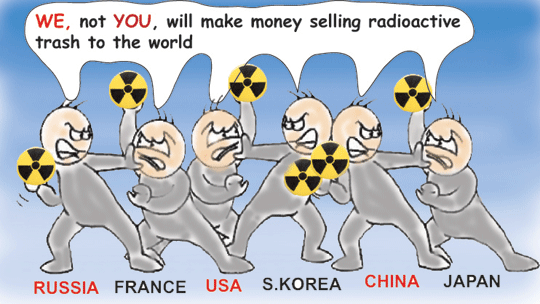
Convention on Supplementary Compensation for Nuclear Damage might or might not work for global nuclear salesmen
India Joins Nuclear Liability Pact, Opening Door to Foreign Reactor Investments http://www.insurancejournal.com/news/international/2016/02/05/397765.htm By Rajesh Kumar Singh and Stephen Stapczynski | February 5, 2016 India’s decision to join a global treaty on nuclear accident liability may help it woo reactor suppliers, including Westinghouse Electric Co. and General Electric Co., that have been reluctant to sell technology to the nation.
The country ratified the Convention on Supplementary Compensation for Nuclear Damage, also known as CSC, the International Atomic Energy Agency said on Thursday. India’s current law allows operators to hold suppliers responsible for accidents, making international equipment makers hesitant to sign deals as the nation seeks to expand nuclear power capacity more than 10-fold by 2032………
India’s decision to join a global treaty on nuclear accident liability may help it woo reactor suppliers, including Westinghouse Electric Co. and General Electric Co., that have been reluctant to sell technology to the nation.
The country ratified the Convention on Supplementary Compensation for Nuclear Damage, also known as CSC, the International Atomic Energy Agency said on Thursday. India’s current law allows operators to hold suppliers responsible for accidents, making international equipment makers hesitant to sign deals as the nation seeks to expand nuclear power capacity more than 10-fold by 2032.
One Step
Ratifying the CSC is the latest effort the government has taken to ease suppliers’ concerns that they would be open to liability claims in case of a nuclear accident. Joining the treaty “marks a conclusive step in the addressing of issues related to civil nuclear liability in India,” the country’s external affairs ministry said in a statement Thursday.
In 2011, India capped suppliers’ liability, saying claims by the nation’s nuclear plant operator can’t exceed the amount of compensation paid by the utility. That was followed last year with the creation of a 15 billion rupees ($222 million) insurance pool to shield the operator, Nuclear Power Corp. of India Ltd., and the suppliers against claims. The government also last year issued a note explaining the law, including the sections that leave suppliers exposed to lawsuits.
No Modification
“The ratification is a very important step for the comfort of foreign vendors,” said Sekhar Basu, secretary at India’s Department of Atomic Energy.
Westinghouse Electric expects to reach a deal with India by the end of this year to provide at least six nuclear reactors, Chief Executive Officer Daniel Roderick said in December. France’s Areva SA signed an accord in 2009 to supply six 1,650-megawatt reactors at Jaitapur, a coastal town in India’s western province of Maharashtra.
“Ratifying the CSC is a step in the right direction towards unlocking the market potential for further nuclear development in India,” Jeff Benjamin, senior vice president of new plants and major projects at Westinghouse, said by e-mail. General Electric and Areva didn’t respond to requests for comment outside normal business hours.
The ratification doesn’t change the country’s existing liability laws, according to R. Rajaraman, emeritus professor of physics at Jawaharlal Nehru University’s School of Physical Sciences.
“This will not lead to a re-think or a modification of our liability act,” Rajaraman said in an e-mail. “That would not be politically feasible.”
Vikas Swarup, spokesman for India’s External Affairs Ministry, didn’t respond to requests seeking comment. Calls to Jagdish Thakkar, a spokesman at the prime minister’s office, weren’t answered.–With assistance from Archana Chaudhary.
Convention on Supplementary Compensation (CSC) does not override India’s nuclear liability law
Nuclear still unclear: Does ratification of CSC fix problems of nuclear law? Now that India has ratified the Convention on Supplementary Compensation (CSC) for Nuclear Damage, the question is whether this paves the way for firms like GE, Westinghouse and Areva setting up nuclear plants in India or whether the Indian Civil Liability for Nuclear Damage (CNLD) Act still effectively acts as a deterrent. The Financial Express, By: Sunil Jain | New Delhi | February 5, 2016 Now that India has ratified the Convention on Supplementary Compensation (CSC) for Nuclear Damage, the question is whether this paves the way for firms like GE, Westinghouse and Areva setting up nuclear plants in India or whether the Indian Civil Liability for Nuclear Damage (CNLD) Act still effectively acts as a deterrent. Considering that, on his visit to India less than six months ago, GE CEO Jeff Immelt was quite dismissive of the changes proposed by India, it would appear it isn’t quite the done deal that was made out by the government which, after the ratification in Vienna, said “this marks a conclusive step in the addressing of issues related to civil nuclear liability in India”.
While in India, Immelt had said “the world has an established liability regime … it has been accepted and adopted … I can’t put my company on risk … India can’t reinvent the language on liability”. All that the ratification means, for all practical purposes, is that India considers its nuclear liability law to be in conformity with the CSC; it doesn’t mean that the CSC will now override the Indian law. Indeed, as the FAQs released by the ministry of external affairs (MEA) last year in February make clear, India has believed its law to be in conformity with CSC for a long time. “Based on the presentations by the Indian side …”, the MEA’s FAQs read, “there is a general understanding that India’s CLND law is compatible with the CSC”; at another place, the FAQs states “the provisions of the CLND Act are broadly in conformity with the CSC”.
Protest repressed in India, as government panders to France, USA
the international nuclear industry has faced its worst crisis globally. The industry is looking at India as a big market where they can compensate for their losses and revive their fortunes. India has become an attractive market for global nuclear corporations

France Peddles Unsafe Nuclear Reactors to India, Drawing Protest , 29 January 2016 By Kumar 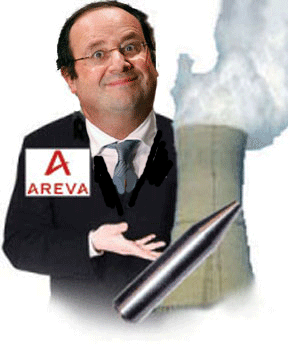 Sundaram, Truthout | News Analysis On January 26, French President François Hollande was the chief guest for India’s Republic Day ceremony, where India showcases its military hardware in a colonial-era parade in its capital. Meanwhile, in Jaitapur on India’s western coast, farmers and fisherfolk were protesting against Hollande’s visit, arguing that the nuclear reactors that India is importing from France threaten their lives, livelihoods and the local ecology.
The Joint Declaration: Localizing Risk, Siphoning Off Profit
In a joint declaration issued on January 25 in New Delhi, the two governments reaffirmed their commitment to go ahead with a long-pending nuclear deal. As per the declaration, the intense negotiations to finalize the commercial agreement are expected to conclude by the end of this year, and the construction of six European pressurized reactors (EPR) imported from France is to begin by early 2017.
The new twist in the declaration is the “maximum localization” of the project and “technology transfer” for the same. Although the government of Indian Prime Minister Narendra Modi seems to have proudly included these new terms and added a “Made in India” tag on the Jaitapur project, it actually means that the French industry would be transferring the burden of its most controversial reactor design at a time of its worst crisis.
The safety vulnerabilities of the reactor pressure vessel (RPV) – the huge iron core where radioactive fission takes place – came under serious questions, raised by France’s own nuclear safety regulator Autorité de Sûreté Nucléaire (ASN) in April 2015. Later in 2015, Areva, the French reactor builder, had to ask the US Nuclear Regulatory Commission to suspend certification review for EPR design. The United States has been postponing certification for EPR since 2007. The Finnish regulator has taken Areva to court on this issue, and Finland has canceled the order for its second EPR. Just two days after the publication of ASN’s report, Modi reaffirmed the EPR deal from France during his visit to Paris in April 2015. It is exactly this controversial component – the RPV – that an Indian private company L&T will now be building, with no experience in the nuclear sector at all.
The current phase of negotiations on Jaitapur is about the price of reactors, which remains a major sticking point. Although the former chief of India’s Atomic Energy Commission promised a tariff of a maximum of 10 US cents per unit for the electricity produced in Jaitapur, independent experts have claimed it will be much higher (20 to 30 cents per unit). This means the government of India would use taxpayers’ money to keep the price competitive. If we go by the cost of EPRs in the United Kingdom, each Indian reactor may cost as much as $8.9 billion. Two reactors in Jaitapur’s first phase will cost as much as India’s total expenditure on science and technology (including the departments of space, science and technology, biotechnology, and research for the entire country). A diplomatic cable revealed by WikiLeaks quoted the general manager of the Nuclear Power Corporation (NPCIL), saying that India is paying a “high” price for Jaitapur………….
The Indian government has managed to acquire land for the project by pressuring farmers and luring a handful of landlords. Despite land acquisition, the farmers in Jaitapur continue to resist. Most villagers either work on others’ land or provide rural services to the agrarian community and do not get any compensation when villages are dislocated for “development” projects. Tabrez Soyekar, a young fisherman, was killed in an indiscriminate police shooting in April 2011, during a peaceful protest. Hundreds of activists and eminent citizens, including the former Navy chief of India and retired justice of the Supreme Court of India, were detainedduring a protest march.
Thirteen village councils in Jaitapur passed unanimous resolutions against the project as recently as November 2015. It is utterly hypocritical for both countries to laud each other’s democratic credentials for international diplomacy if the democratically elected village councils are neglected violently……..
Independent energy experts in India, including a former top official in the Ministry of Power, have argued for a decentralized energy framework that would suit India better, as the majority of its population still lives in villages scattered across the country and transmission losses in centralized Indian grids are staggering.
The 2015 World Nuclear Industry Status Report concludes that, after the Fukushima accident, the international nuclear industry has faced its worst crisis globally. The industry is looking at India as a big market where they can compensate for their losses and revive their fortunes. India has become an attractive market for global nuclear corporations, where the government is mortgaging its financial and environmental health to welcome them. This includes channeling the accident liability to the public; undermining environmental, geological and safety laws; and ignoring the measured advice of independent experts.
Besides Jaitapur, massive and intense anti-nuclear protests have arisen in Koodankulam, Mithi Virdi and Kovvada, where Russian and US corporations are setting up nuclear power plants. Local communities in other places like Chutka, Fatehabad and Mahi Banswara have also been agitating against the nuclear projects. The government has resorted to brutal crackdowns and repression against these consistently peaceful protests. More than 8,000 people in Koodankulam are facing fabricated police cases under colonial-era sedition laws and charges of waging war against the Indian state. The police have killed, arrested and harassed villagers indiscriminately, including women and children. They surrounded the Idinthakarai village in 2012 and disrupted its vital supply lines that deliver goods, including food and milk for children and medicines, to force the village to surrender. One of the first steps that the new government under Modi took in 2015 was to come up with a “confidential” report by the Intelligence Bureau, naming Greenpeace, the Coalition for Nuclear Disarmament and Peace, and other anti-nuclear and environmentalist organizations “anti-national.”http://www.truth-out.org/news/item/34627-france-peddles-unsafe-nuclear-reactors-to-india-drawing-protest
Community and environmental impact of the Jaitapur nuclear power project
France Peddles Unsafe Nuclear Reactors to India, Drawing Protest , 29 January 2016 By Kumar Sundaram, Truthout | News Analysis “………the concerns of the local community in Jaitapur go beyond the cost of the project. Jaitapur is located in the stunningly beautiful Konkan region, replete with verdant plateaus, magical mountains and undulating hills, lagoons, creeks, the open sea and infinite greenery. The NPCIL has labeled nearly 65 percent of the land as “barren,” despite the fact that Konkan is one of the world’s 10 “biodiversity hotspots,” sheltering over 5,000 species of flowering plants, 139 of mammals, 508 of birds and 179 of amphibians, including 325 globally threatened species.

Altogether, the nuclear park would jeopardize the livelihoods of 40,000 people. The annual turnover of Jaitapur’s fishing villages is about $2.2 million. In Nate Village alone, there are 200 big trawlers and 250 small boats. Nearly 6,000 people depend directly on fishing and over 10,000 are dependent on ancillary activities.
The community is apprehensive that the elaborate security arrangements around the project would block the fisherfolks’ use of the two creeks of Jaitapur and Vijaydurg. The fish population will also be affected since the nuclear plant would release a massive 52 billion liters of hot water into the Arabian Sea daily, raising the local sea temperature by 5 to 7 degrees Celsius.
Jaitapur has highly fertile land, which produces rice and other cereals, and arguably the world’s most famous mango, the Alphonso. Cashews, coconuts, kokum, betel nuts, pineapples and other fruits are found in abundance. The land is also quite productive in terms of its use for cattle-grazing and rain-fed agriculture.
The environmental impact assessment (EIA) for Jaitapur, conducted by the government-run National Environmental Engineering Research Institute (NEERI), did not even look into the crucial aspects of radiological releases, decommissioning and nuclear waste, besides summarily neglecting the vital issues of ecosystems and livelihoods, terrestrial ecosystems and farming, mangrove forests and the fragile marine ecology and fisheries in the region.
NEERI admits it does not have any expertise in radiation-related issues and it just mentioned in its report that all the stipulations of the government’s nuclear regulator would be followed. The then-minister for environment and forests, Jairam Ramesh, had himself termed these EIA assessments a joke. Even that environmental clearance, granted on 35 absurdly weak conditions, was given only for a period of five years, which lapsed as of November 2015. Citizens groups and independent experts have demanded a fresh EIA in place of an extension……… http://www.truth-out.org/news/item/34627-france-peddles-unsafe-nuclear-reactors-to-india-drawing-protest
Solar business India: coal develop makes the switch to solar
India Coal Plant Developer Switches to Solar for Site in Punjab, Bloomberg Business, Anindya Upadhyay 29 Jan 16
-
RattanIndia to convert 800-acre site to PV instead of coal
-
Company to raise 6 billion rupees for current solar projects
-
A prominent developer of coal-fired power plants in India is seeking to switch to solar for an 800-acre (324-hectare) site in Punjab it had earmarked for another thermal plant, saying the economics of photovoltaics are more attractive.
RattanIndia Power Ltd. which has 1.6 gigawatts of thermal capacity in central India, asked government permission to install solar panels at the site in Punjab instead of the coal plant it was planning, said Rajiv Rattan, chairman of RattanIndia Group.
“In the next three to four years, you will see the entire 800 acres getting used for solar,” Rattan said in an interview.
The decision highlights increasing interest in India’s solar program after Prime Minister Narendra Modi set out a target to install 100 gigawatts of capacity by 2020 at an estimated cost of $100 billion. Incentives and regulations designed to draw finance from companies to help meet the target have attracted a handful of overseas developers to bid in auctions for power contracts in India, reducing the cost of solar electricity to a record low.RattanIndia is the only domestic firm to take on large foreign companies in Indian government auctions for solar contracts, which were dominated by SunEdison Inc. of the U.S., SoftBank Group Corp. from Japan, Fortum OYJ of Finland and Solairedirect Group from France.
RattanIndia has made a bold statement by making aggressive bids and competing with foreign companies in large government solar tenders where most Indian corporates were out, the solar research firm Bridge to India said……….
- The cost of solar power touched a record low of 4.34 rupees (or 6 cents) a kilowatt-hour for contracts awarded on Jan. 19 in the sunny southern state of Rajasthan, where a total of 420 megawatts of capacity was granted…….http://www.bloomberg.com/news/articles/2016-01-29/india-coal-plant-developer-switches-to-solar-for-site-in-punjab
Untested and unsafe technology ? Jaitapur nuclear power station
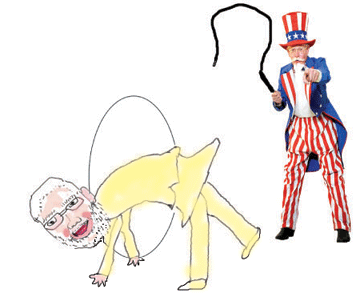 Last year on the Republic Day, to please the United States President Obama who was the chief guest, Modi government effectively surrendered the govt’s option to sue the nuclear vendors in case of a nuclear accident by creating an insurance pool from public funds to channel suppliers’ liability back to the taxpayers, taking an about turn from earlier strong reservations of the BJP on nuclear liability.
This year, Modi’s government seems bent on finalising an insanely dangerous and destructive nuclear project.
Another Republic Day, another compromise on nuclear safety? A year after giving in on nuclear liability during Barack Obama’s visit, India’s enthusiasm to seal a deal with France on the expensive and dangerous Jaitapur nuclear project is disturbing. Scroll In 28 Jan 16 Kumar Sundaram On Tuesday, chief guest Francois Hollande looked on as India showcased its military might at the Republic Day parade in New Delhi. Nearly 2,000-km away in Maharashtra, farmers and fisherfolk in the port town of Jaitapur are gearing up to protest the French president’s visit. They believe that the nuclear reactors India wants to import from France pose a threat to their lives, livelihoods and the local ecology.
Untested and unsafe technology
In the joint declaration issued on Monday in New Delhi, the two governments reaffirmed their commitment to go ahead with the nuclear deal. The project has been in the pipeline for almost a decade now, and last several bilateral annoucements have ceremoniously menioned the nuclear agreement. The intense negotiations to finalise the commercial agreement are yet to be completed as the staggering cost of the project remains a major sticking point.
The Modi government has added “make in India” in the declaration, a reference to the prime minister’s ambitious plan to turn India into a hub of manufacturing. Now, this is more than a ceremonial insertion and has potentially dangerous implications. The joint declaration mentions “large-scale localisation” of components for the nuclear power project at Jaitapur, a Memorandum of Understanding for which was signed between the Nuclear Power Corporation of India Limited and French government-owned nuclear corporation Areva last year. “Transfer of technology” is also being considered, claims the declaration.
The French company Areva, which is verging on bankruptcy after the Fukushima disaster, desperately needs this project to survive. Its terminal financial crisis has also led to a major re-structuring in France. To save Areva from bankruptcy, the Électricité de France, a govt owned electricity utility company has bought majority stake in Areva. Areva has resorted to massive job cuts – it did 6,000 lay offs worldwide in 2015 – and is frantically seeking investorsto rescue itself from the crisis.
It is actually this financial crisis that has forced Areva to consider partial closure and outsourcing of its reactor manufacturing business. There too, it is giving away only the parts which it cannot absolutely manage on its own for financial and safety reasons. And the European Pressurised Reactor design fits in this scheme. France is building reactors in Jaitapur of the same design, of 1650MWe capacity each. Totalling 9,900 Mwe, Jaitapur would be the world’s largest nuclear power park.
The safety of this design, especially the vulnerabilities of the Reactor Pressure Vessel – the huge iron core where radioactive fission takes place – came under serious questions, raised by France’s own nuclear safety regulator Autorité de Sûreté Nucléaire in April last year. Later in 2015, Areva had to ask the US Nuclear Regulatory Commission to suspend certification review for EPR design. The US has been postponing certification for the European Pressurised Reactor( since 2007. In Finland’s Olkiluoto, the only other place where Areva is building these reactors, the project was supposed to be completed in 2009 but has run into massive cost and time over-run and cannot be completed before 2018. The Finnish regulator has taken Areva to the court on this issue and Finland has cancelled the order for the 4th reactor. Even in China’s Taishan, the only other place where such a reactor is under construction, the project has been delayed. Ironically, just after two days of publication of Autorité de Sûreté Nucléaire’s report, Modi re-affirmed the commitment to buy the reactors from France during his visit to Paris last year in April.
In another extremely dangerous irony, the Modi govt is lauding Jaitapur as a “Make in India” project. The localisation in this case is nothing more than Areva passing off its burden and risks to Indian companies. Without much experience in nuclear sector, Larsen and Toubro has been given the task of collaborating in manufacturing of pressure vessel, the same crucial equipment in which the French regulator has found vulnerabilities. There is also pressure on L&T to keep the cost to the minimum, which would have its own safety implications. Technology transfer in this case actually means experimenting an untested and unsafe technology on the Indian people……….
U-turns and misadventures
For its entire 10-year entire stint in the opposition the Bharatiya Janata Party kept opposing Manmohan Singh government’s nuclear policy, but now nuclear deals have become matters of pride for Modi’s foreign sojourns. In 2010, the BJP had sought a review of the environmental clearance given to the Jaitapur project on the eve of the visit of the then French president Nicholas Sarkozy. But now the government has sought an extension of the same.
Last year on the Republic Day, to please the United States President Obama who was the chief guest, Modi government effectively surrendered the govt’s option to sue the nuclear vendors in case of a nuclear accident by creating an insurance pool from public funds to channel suppliers’ liability back to the taxpayers, taking an about turn from earlier strong reservations of the BJP on nuclear liability.
This year, Modi’s government seems bent on finalising an insanely dangerous and destructive nuclear project.
Kumar Sundaram is Senior Researcher with the Coalition for Nuclear Disarmament and Peace, India. http://scroll.in/article/802473/another-republic-day-another-compromise-on-nuclear-safety
France’s President Hollande visits India, hoping to market nuclear reactors
France Signals Rafale, Nuclear Progress as Hollande Visits India, Bloomberg, HeleneFouquet January 24, 2016 France signaled a state-to-state accord with India could be signed on Monday over a deal for 36 Dassault Aviation SA Rafale fighter jets, and that a six-year-old plan to build nuclear reactors in the South Asian nation would see some progress…………
The reactors are planned for Jaitapur, a coastal town in India’s western province of Maharashtra. Areva was seeking further clarity from India on its nuclear liability law before moving ahead with what would be India’s biggest nuclear plant.
The agreement India and the U.S signed recently over insurance-related issues for nuclear plants will help in overcoming certain hurdles, Royal said.
No response fro India’s PM Modi to Shiv Sena’s report on Jaitapur nuclear plant
PMO yet to respond to Shiv Sena’s report on Jaitapur nuclear plant By PTI | 21 Jan, 2016, MUMBAI: Shiv Sena is yet to receive a response from the Prime Minister’s Office (PMO) on a report it sent more than a month ago detailing “adverse” impact the proposed Jaitapur nuclear power plant would have on the green belt in Maharashtra’ Konkan region.
1 This Month
19 February – VIRTUAL EVENT-Decision Time: AI and Our Nuclear Arsenal
12:45 p.m. Central / 1:45 p.m. Eastern
To see nuclear-related stories in greater depth and intensity – go to https://nuclearinformation.wordpress.com
-
Archives
- February 2026 (141)
- January 2026 (308)
- December 2025 (358)
- November 2025 (359)
- October 2025 (376)
- September 2025 (258)
- August 2025 (319)
- July 2025 (230)
- June 2025 (348)
- May 2025 (261)
- April 2025 (305)
- March 2025 (319)
-
Categories
- 1
- 1 NUCLEAR ISSUES
- business and costs
- climate change
- culture and arts
- ENERGY
- environment
- health
- history
- indigenous issues
- Legal
- marketing of nuclear
- media
- opposition to nuclear
- PERSONAL STORIES
- politics
- politics international
- Religion and ethics
- safety
- secrets,lies and civil liberties
- spinbuster
- technology
- Uranium
- wastes
- weapons and war
- Women
- 2 WORLD
- ACTION
- AFRICA
- Atrocities
- AUSTRALIA
- Christina's notes
- Christina's themes
- culture and arts
- Events
- Fuk 2022
- Fuk 2023
- Fukushima 2017
- Fukushima 2018
- fukushima 2019
- Fukushima 2020
- Fukushima 2021
- general
- global warming
- Humour (God we need it)
- Nuclear
- RARE EARTHS
- Reference
- resources – print
- Resources -audiovicual
- Weekly Newsletter
- World
- World Nuclear
- YouTube
-
RSS
Entries RSS
Comments RSS
 nuclear-news