Japanese and Chinese top envoys eye more talks on Fukushima row
Jsapan Times, BY JESSE JOHNSON, STAFF WRITER 26 Nov 23
Foreign Minister Yoko Kamikawa met her Chinese counterpart, Wang Yi, on Saturday, with the top Japanese diplomat “strongly urging” Beijing to immediately remove its complete ban on seafood imports from Japan over Tokyo’s release of treated wastewater from the Fukushima No. 1 nuclear plant.
The Fukushima issue has bedeviled Sino-Japanese relations already facing tensions over issues such as China’s growing military assertiveness in the region. Despite this, both sides agreed to find a way to resolve the wastewater matter “through discussion and dialogue in a constructive manner,” Japan’s Foreign Ministry said.
Wang repeated China’s opposition to the discharge of “nuclear-contaminated water,” a move that he labeled as “irresponsible,” according to the Chinese Foreign Ministry.
The two top diplomats also agreed to hold bilateral security talks “at an early date,”…………………………………………………………………………………………….
On Thursday, Wang met with Natsuo Yamaguchi, head of Komeito, the Liberal Democratic Party’s coalition partner in the ruling bloc, for talks in Beijing. China called for independent monitoring of the ongoing Fukushima discharge, according to Yamaguchi.
China’s seafood ban has hit Japanese exporters hard, with Chinese customs authorities reporting last week that imports of fish and shellfish from Japan in October dropped 99% from a year earlier to $332,000. https://www.japantimes.co.jp/news/2023/11/25/japan/politics/japan-china-yoko-kamikawa-wang-yi/
The US and China re-engage on arms control. What may come next
Bulletin, By Daryl G. Kimball | November 15, 2023
For more than six decades, the United States has been worried about China’s regional influence, military activities—and its nuclear potential. For instance, in 1958, US officials considered using nuclear weapons to thwart Chinese artillery strikes on islands controlled by Taiwan, according to a document leaked by Daniel Ellsberg in 2021. Now, as then, a nuclear conflict between the United States and China would be devastating for both sides and the world.
The United States has a decades-long experience of nuclear arms control and strategic stability talks with the Soviet Union, and later Russia. However, there has not been a sustained bilateral dialogue between Washington and Beijing on how to reduce the risk of conflict, nuclear escalation, and nuclear arms control and disarmament. Until recently, China had rebuffed US overtures for bilateral talks on nuclear risk reduction and arms control, and on other security issues.
Adding to the tensions, China has embarked since the early 2000s on a major buildup of its relatively smaller nuclear arsenal and has resisted calls for a global halt on the production of fissile material for nuclear weapons. In response, some current and former national security insiders, as well as many in Congress, suggest that the US arsenal “should be supplemented” to add more capability and flexibility to counter two “near-peer” nuclear adversaries. In other words, the potential for an unconstrained, three-way arms race is growing.
But things started to change on November 6 with the meeting in Washington between US Assistant Secretary of State for the Bureau of Arms Control, Verification and Compliance Mallory Stewart and China’s Ministry of Foreign Affairs Director-General of Arms Control Sun Xiaobo.
A modest yet important breakthrough. The US-Chinese discussion on arms control—the first of its kind since 2018—was described by the US side as a “candid and in-depth discussion on issues related to arms control and nonproliferation.” According to the State Department’s readout of the meeting, “the United States highlighted the need to promote stability, help avert an unconstrained arms race, and manage competition so that it does not veer into conflict.” The Chinese Foreign Ministry’s readout also said the “[t]he two sides had an in-depth, candid and constructive exchange of views” on nuclear weapons matters, as well as an exchange on “regular arms control.”
Several participants told me that the meeting was “wide-ranging” and “positive in tone,” but that it did not involve much substantive exchange of views on the issues, which is not surprising. Tangible progress will require time and sustained give-and-take from both sides.
The next step, ideally, will be for Presidents Joe Biden and Xi Jinping, who are set to meet this week, to direct their teams toward concrete nuclear risk reduction and arms control measures that enhance mutual security.
More nuclear capabilities imply more responsibilities.……………………………………………….
China’s arsenal is not only growing (it had less than 200 nuclear warheads in 2000), but it is also diversifying and modernizing. It is now well-documented that China has started to deploy new solid-fueled missiles that can be launched more quickly than its older liquid-fueled missiles. …………………………………………………………………………..
Of course, China’s nuclear arsenal is still modest by comparison to the US and Russian arsenals, each of which are about nine times larger than China’s. But China’s nuclear modernization efforts could have significant strategic implications that make it even more important for the “Big Three” (the United States, Russia, and China) to pursue meaningful progress on nuclear arms control to avoid a destabilizing and dangerous nuclear arms race.
Toward a more serious, sustained dialogue. In response to China’s nuclear buildup, US officials—Republicans and Democrats alike—have prioritized engagement with China in talks to identify measures to reduce nuclear risks and prevent destabilizing and costly strategic weapons competition………………………….
Sullivan’s June 2 address provides some important clues about the types of issues the US side likely raised in the arms control talks. Sullivan suggested that the United States and China, along with the other NPT nuclear-armed states, could engage in new nuclear arms control and risk reduction efforts such as establishing more robust crisis communications channels and “formalizing a missile launch notification regime” for all five permanent members of the UN Security Council—the United States, Russia, China, the United Kingdom, and France. “It’s a small step that would help reduce the risk of misperception and miscalculation in times of crisis,” Sullivan added.
These suggestions don’t happen in a vacuum: The United States and Russia have a ballistic missile launch notification agreement already in place, and Russia and China have their own bilateral agreement too.
In his remarks, Sullivan also called for talks on “maintaining a ‘human-in-the-loop’ for command, control, and employment of nuclear weapons” to reduce the risk of miscalculation in a crisis. This would require that the US and China—and other nuclear-armed states—agree to pursue technical discussions designed to reach common understandings on how the use of artificial intelligence, particularly high-risk, cutting-edge deep learning models, can be banned or at least limited so the use of nuclear weapons is effectively kept under human control. This proposal seems to have reached the highest level with Presidents Biden and Xi reportedly discussing limits on the employment of artificial intelligence in the control and deployment of nuclear weapons.
In future meetings, US and Chinese diplomats should go one step further and set out a process for formulating a joint understanding that cyberwarfare capabilities will not be used to try to interfere with other states’ nuclear command and control systems, which could also severely alter decision-making in a crisis……………………………………………………..
From talks to concrete actions. Further down the road, an even more ambitious approach that might be considered in the multilateral, nuclear-five setting would be for Washington and Moscow to propose that China, France, and the United Kingdom freeze the size of their nuclear stockpiles so long as the United States and Russia maintain the current limits on their strategic arsenals—even after New START expires—and make good faith efforts to negotiate deeper verifiable reductions in their stockpiles…………………………………………………………………
With US-Russian relations at rock bottom, the Kremlin still wedging its war on Ukraine, and the last remaining treaty limiting US and Russian strategic nuclear arsenals set to expire in early 2026, the risk of nuclear escalation and a nuclear arms race with Russia is already too high. That makes it all the more important for Xi and Biden to direct their team to work harder and more steadily to reduce tensions and head off the possibility of a costly, dangerous, unconstrained three-way nuclear race that no one can win.
China’s Misunderstood Nuclear Expansion
How U.S. Strategy Is Fueling Beijing’s Growing Arsenal
Foreign Affairs, By M. Taylor Fravel, Henrik Stålhane Hiim, and Magnus Langset Trøan, November 10, 2023
Among the many issues surrounding China’s ongoing military modernization, perhaps none has been more dramatic than its nuclear weapons program. For decades, the Chinese government was content to maintain a comparatively small nuclear force. As recently as 2020, China’s arsenal was little changed from previous decades and amounted to some 220 weapons, around five to six percent of either the U.S. or Russian stockpiles of deployed and reserve warheads.
Since then, however, China has been rapidly expanding and modernizing its arsenal. In 2020, it began constructing three silo fields to house more than 300 intercontinental ballistic missiles (ICBMs). A year later, it successfully tested a hypersonic glide vehicle that traveled 21,600 miles, a test that likely demonstrated China’s ability to field weapons that can orbit the earth before striking targets, known as a “fractional orbital bombardment system.” Simultaneously, the Chinese government has accelerated its pursuit of a complete nuclear triad—encompassing land-, sea-, and air-launched nuclear weapons—including by developing new submarine- and air-launched ballistic missiles. By 2030, according to U.S. Defense Department estimates, China will probably have more than 1,000 operational nuclear warheads—a more than fourfold increase from just a decade earlier…………………………………………………………………………………………………………………………………..
writings and analysis since 2015 suggest that China’s nuclear expansion is less a shift in Chinese intentions than a response to what Beijing perceives as threatening changes in U.S. nuclear strategy, reflecting an acute security dilemma. Chinese analysts are worried that the United States has lowered its threshold for nuclear use—including allowing for limited first use in a Taiwan conflict—and that the U.S. military is acquiring new capabilities that could be used to destroy or significantly degrade China’s nuclear forces. Thus, many Chinese experts have concluded that China needs a more robust arsenal.
Given Chinese and U.S. fears about each other’s nuclear programs, increased communication may help to break the spiral. Based on Chinese fears, the United States should understand how changes in its nuclear capabilities and doctrine play a critical role in shaping China’s threat perceptions and perceived force requirements. Going forward, China will continue to respond to U.S. advances that are viewed as weakening China’s nuclear deterrent.
Similarly, Beijing should understand that the lack of transparency surrounding its rapid nuclear expansion has fueled worst-case assessments by the United States. Continued lack of transparency will lead to even greater U.S. suspicion—and feed an intensifying arms race between the two countries……………………………………………………………………………….
the 2018 review increased Chinese fears that the United States might engage in limited nuclear first use during a conventional conflict with China, most likely over Taiwan. According to Chinese arms control expert Li Bin, the document suggested that “the United States would use its nuclear weapons to respond to nonnuclear Chinese aggressions.”………………………………………………………………………………………………………………………………………………………………………………………………………….. more https://www.foreignaffairs.com/china/chinas-misunderstood-nuclear-expansion
China agrees to nuclear arms-control talks with US -WSJ
Reuters, November 2, 2023
China and the United States will discuss nuclear arms control next week, the first such talks since the Obama administration, the Wall Street Journal reported on Wednesday.
China’s Foreign Ministry said on Monday after a visit by Foreign Minister Wang Yi to Washington that the two countries would hold “consultations on arms control and non-proliferation” in the coming days, as well as separate talks on maritime affairs and other issues.
Those arms talks would be led on Monday by Mallory Stewart, a senior State Department official, and Sun Xiaobo, the head of the arms-control department at China’s Foreign Ministry, the Wall Street Journal report said.
The U.S. State Department and China’s embassy in Washington did not immediately respond to requests by Reuters for comment on the timing or format of the talks.
U.S. National Security Advisor Jake Sullivan said in 2021 that the Chinese and U.S. presidents had agreed to “look to begin to carry forward discussion on strategic stability”, a reference to Washington’s concerns about Beijing’s nuclear weapons build-up.
But the White House was quick to say at the time that the discussions would not resemble formal arms reduction talks, like those the U.S. has had with Russia.
Since then, U.S. officials had expressed frustration that China showed little interest in discussing steps to reduce nuclear weapons risks.
China has more than 500 operational nuclear warheads in its arsenal and will probably have over 1,000 warheads by 2030, the Pentagon said in October. But Beijing has long argued that the U.S. already has a much larger arsenal. The arms talks would occur before a likely meeting between U.S. President Joe Biden and Chinese President Xi Jinping in San Francisco in November, although a senior Biden administration official said on Tuesday important details have yet to be hammered out…………………………………more https://www.reuters.com/world/china-agrees-nuclear-arms-control-talks-with-us-wsj-2023-11-01/ #nuclear #antinuclear #nuclearfree #NoNukes
China-Russia in a nuclear sub counter to AUKUS
China’s Type 096 nuclear submarine draws on Russian tech and expertise and once operational will bring US mainland into closer missile range
Asia Times, By GABRIEL HONRADA, OCTOBER 23, 2023
China is making new quiet nuclear submarines with Russia’s expert assistance, an answer to the AUKUS alliance and the latest sign of the two powers’ converging strategic interests against the United States and its Pacific allies
The project could make it harder for the US and its allies to track China’s submarines in crucial theaters including the South China Sea and represents a direct challenge to US undersea dominance in the Pacific.
This month, Reuters reported that China is producing a new generation of nuclear-armed submarines, citing evidence that its Type 096 nuclear ballistic missile (SSBN) submarine will be operational before the end of the decade. The report said that breakthroughs in the submarine’s quietness have been aided partly by Russian technology……………………………………..more https://asiatimes.com/2023/10/china-russia-in-a-nuclear-sub-counter-to-aukus/ #nuclear #antinuclear #nuclearfree #NoNukes
China rejects Pentagon report that claimed China was starting a nuclear arms race
US says China likely to have 1,000 nuclear warheads by 2030 China said the report is ‘filled with prejudice and distorts face’
Namita Singh https://www.independent.co.uk/asia/china/china-nuclear-weapons-pentagon-report-india-b2433066.html 21 Oct 23
China has rejected a US Pentagon report claiming that the Asian country has more than 500 operational nuclear warheads in its arsenal and will probably have over 1,000 by 2030.
China said the report was “filled with prejudice and distorts face”, as it clarified that it has no intention of indulging in a nuclear arms race.
The statement came a day after the Pentagon released its annual report on the Beijing military. In the wide-ranging report, the Pentagon said China’s more than 500 warheads as of May 2023 were on track to exceed projections.
In a previous report, the Pentagon estimated that Beijing had more than 400 operational nuclear warheads in 2021.
“We see the PRC (People’s Republic of China) continuing to quite rapidly modernize and diversify and expand its nuclear forces,” a senior US official told reporters during a briefing on the report.
However, on Friday, China’s foreign ministry spokesperson issued a statement rejecting the US claims.
“First of all, the United States report, like similar reports before it, ignores the facts, is full of prejudice and spreads the theory of the threat posed by China,” ministry spokesperson Mao Ning told a press briefing in response to a question about the US report.
“China firmly adheres to a nuclear strategy of self-defence and defence, we have always maintained our nuclear forces at the lowest level required for national security, and we have no intention of engaging in a nuclear arms race with any country,” Mr Mao said.
The report reiterated concern about pressure by Beijing on self-ruled Taiwan, an island China sees as a breakaway province.
“As long as any country does not use or threaten to use nuclear weapons against China, it will not be threatened by China’s nuclear weapons,” Mr Mao said.
Relations between China and the United States have been tense, with friction between the world’s two largest economies over everything from Taiwan and China’s human rights record to its military activity in the South China Sea.
But Washington has been eager to revive military-to-military communications with China.
Last week the Pentagon said it had accepted an invitation to attend China’s top annual security forum in late October, the latest sign of potentially warming ties between the two countries’ militaries. #nuclear #antinuclear #nuclearfree #NoNukes
China highlights marine radiation monitoring in draft law revision
China Daily, Xinhua 2023-10-20
BEIJING — China is considering strengthening its monitoring of radiation in the marine environment in the latest draft revision to the Marine Environment Protection Law, a spokesperson said Thursday.
Scheduled for its third deliberation at a session of the country’s top legislature in late October, the draft revision states that departments of the State Council in charge of environmental issues should set out emergency plans for radiation monitoring and organize its implementation.
The draft stresses improving the capacity of monitoring and managing the marine environment by raising the technological and informatization level, and requires efforts to enhance comprehensive, coordinated and regular monitoring, according to Yang Heqing, a spokesperson for the Legislative Affairs Commission of the National People’s Congress (NPC) Standing Committee, at a press briefing.
Pollution prevention and control in rivers flowing into the sea should also be strengthened in coordinated efforts to ensure the water quality at the mouths of the rivers meets the relevant standards, Yang said citing the draft revision
The sixth session of the 14th NPC Standing Committee will be held from Oct. 20 to 24. The NPC Standing Committee completed two readings of previous versions of the draft revision to the Marine Environment Protection Law in December last year and June……..
https://www.chinadaily.com.cn/a/202310/20/WS6531db77a31090682a5e9b28.html #nuclear #antinuclear #nuclearfree #NoNukes
China expanding nuclear arsenal much faster than predicted, US report says
Guardian, 20 Oct 23
Pentagon report also says Beijing is intensifying pressure on neighbours to push back on US efforts to contain it.
A Pentagon report on China’s military power says Beijing is exceeding previous projections of how quickly it is building up its nuclear weapons arsenal and is “almost certainly” learning lessons from Russia’s war in Ukraine about what a conflict over Taiwan might look like.
The report released on Thursday also warns that China may be pursuing a new intercontinental missile system using conventional arms that, if fielded, would allow Beijing “to threaten conventional strikes against targets in the continental United States, Hawaii and Alaska.”
The China report comes a month before an expected meeting between Chinese leader Xi Jinping and President Joe Biden on the sidelines of the Asia-Pacific Economic Cooperation summit in San Francisco.
The annual report, required by Congress, is one way the Pentagon measures the growing military capabilities of China, which the US government sees as its key threat in the region and America’s primary long-term security challenge.
But after Hamas’s 7 October attacks on Israel, the US has been forced again to focus on the Middle East, instead of its widely promoted pivot to the Pacific to counter China’s growth. The US is rushing weapons to Israel while continuing to support and deliver munitions to Ukraine in its 20-month struggle to repel Russia’s invasion.
Still, the Pentagon’s national defense strategy is shaped around China remaining the greatest security challenge for the US, and that the threat from Beijing will determine how the US military is equipped and shaped for the future.
The Pentagon report builds on the military’s warning in 2022 that China was expanding its nuclear force much faster than US officials had predicted, highlighting a broad and accelerating buildup of military muscle designed to enable Beijing to match or surpass US global power by midcentury.
Last year’s report warned that Beijing was rapidly modernizing its nuclear force and was on track to nearly quadruple the number of warheads it has to 1,500 by 2035. The US has 3,750 active nuclear warheads.
The 2023 report finds that Beijing is on pace to field more than 1,000 nuclear warheads by 2030, continuing a rapid modernization aimed at meeting Xi’s goal of having a “world class” military by 2049.
After the previous report, China accused the US of ratcheting up tensions and Beijing said it was still committed to a “no first use” policy on nuclear weapons.
The Pentagon has seen no indication that China is moving away from that policy but assesses there may be some circumstances where China might judge that it does not apply, a senior US defense official said without providing details. The official briefed reporters on Wednesday on condition of anonymity before the report’s release
The US does not adhere to a “no first use” policy and says nuclear weapons would be used only in “extreme circumstances.”………………………………………. more https://www.theguardian.com/world/2023/oct/20/china-expanding-nuclear-arsenal-much-faster-than-predicted-us-report-says #nuclear #antinuclear #nuclearfree #NoNukes
Half of China’s people are worried about Fukushima water release: poll
Japan Today Oct. 11 TOKYO
About half of Chinese respondents to a recent survey expressed concern about the release of treated radioactive water from Japan’s Fukushima nuclear power plant into the sea, according to the results released Tuesday, amid a row between the two Asian neighbors over the issue.
According to an annual joint poll by Japanese nonprofit think tank Genron NPO and the China International Communications Group on public views in both countries on bilateral ties, 22.1 percent of 1,506 Chinese surveyed said they are “very worried” and 25.5 percent are “worried to some extent” about the water discharge.
In the poll, conducted in China in 10 cities from Aug. 18 to Sept. 1, 8.0 percent answered they are “not worried at all” about the water release and 18.7 percent said they are “not very worried,” with 25.0 percent replying they “currently cannot judge.”………………………………………………………………….. https://japantoday.com/category/national/about-half-of-chinese-worried-about-fukushima-water-release-poll #nuclear #antinuclear #NuclearFree #NoNukes #NuclearPlants
A Chinese nuclear-powered submarine has sunk with the loss of 55 sailors
#nuclear #anti-nuclear #nuclear-free #NoNukes The nuclear submarine sank after it was caught in a trap intended for American and British vessels, leaked intelligence reports disclose. China has six Type 093 attack
submarines, which have a displacement of 6,096 tonnes and are armed with
553mm torpedoes. The nuclear-powered submarines, designed to be quieter
than previous models, entered service in the past 15 years.
Times 4th Sept 2023
Fukushima: China’s seafood imports from Japan down 67% in August
China’s imports of seafood from Japan slumped last month as Tokyo started
to release treated waste water from the damaged Fukushima nuclear power
plant. Imports of Japanese seafood fell 67.6% in August from the same month
last year, China’s customs authority said.
Japan’s ministry of agriculture
and fisheries says China was the world’s top importer of the country’s
seafood. Last year, Asia’s largest economy imported 84.4 billion yen
($571m; £461m) of seafood from its neighbour. The sharp fall came as Japan
prepared to start releasing the waste water and in the aftermath of the
release.
BBC 20th Sept 2023
Germany’s Scholz: Fresh nuclear disarmament talks should include China
Reuters, September 12, 2023 https://www.reuters.com/world/germanys-scholz-fresh-nuclear-disarmament-talks-should-include-china-2023-09-12/
BERLIN, Sept 12 (Reuters) – German Chancellor Olaf Scholz called for new international negotiations on nuclear disarmament on Tuesday, saying that not only Russia and the United States but also China should be involved.
“Getting a fresh start on arms control would be very important,” he said at a religious event in Berlin, adding that several other countries had also built up a nuclear arsenal.
Preventing Iran from producing uranium that could contribute to nuclear weapon production “remains an important task,” he said.
Scholz said nuclear weapons posed an existential threat to humanity, which is why there is an “immediate obligation” to do everything possible to ensure they are never used.
According to the Stockholm International Peace Research Institute (SIPRI), the number of operational nuclear weapons rose slightly in 2022 as countries implemented long-term force modernisation and expansion plans.
Reporting by Andreas Rinke, Writing by Friederike Heine, Editing by Miranda Murray
The West’s blueprint for goading China was laid out in Ukraine
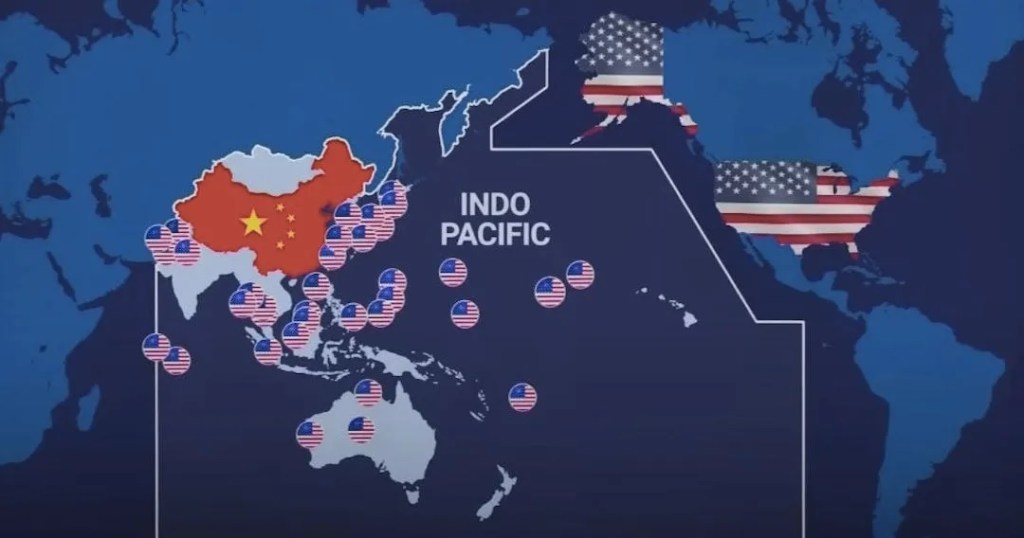
After Ukraine, Taiwan, we are told, must be the locus of the West’s all-consuming security interest.
Europe fears losing access to Chinese markets, plunging it deeper into a cost-of-living crisis. But it fears Washington’s wrath more
JONATHAN COOKSEP 8, 2023, Middle East Eye
The West is writing a script about its relations with China as stuffed full of misdirection as an Agatha Christie novel.
In recent months, US and European officials have scurried to Beijing for so-called talks, as if the year were 1972 and Richard Nixon were in the White House.
But there will be no dramatic, era-defining US-China pact this time. If relations are to change, it will be decisively for the worse.
The West’s two-faced policy towards China was starkly illustrated last week by the visit to Beijing of Britain’s foreign secretary, James Cleverly – the first by a senior UK official for five years.
While Cleverly talked vaguely afterwards about the importance of not “disengaging” from China and avoiding “mistrust and errors”, the British parliament did its best to undermine his message.
The foreign affairs committee issued a report on UK policy in the Indo-Pacific that provocatively described the Chinese leadership as “a threat to the UK and its interests”.
In terminology that broke with past diplomacy, the committee referred to Taiwan – a breakaway island that Beijing insists must one day be “reunified” with China – as an “independent country”. Only 13 states recognise Taiwan’s independence.
The committee urged the British government to pressure its Nato allies into imposing sanctions on China.
Upping the stakes
The UK parliament is meddling recklessly in a far-off zone of confrontation with the potential for incendiary escalation against a nuclear power, a situation unrivalled outside of Ukraine.
But Britain is far from alone. Last year, for the first time, Nato moved well out of its supposed sphere of influence – the North Atlantic – to declare Beijing a challenge to its “interests, security and values”.
There can be little doubt that Washington is the moving force behind this escalation against China, a state posing no obvious military threat to the West.
t has upped the stakes significantly by making its military presence felt ever more firmly in and around the Straits of Taiwan – the 100-mile wide waterway separating China from Taiwan that Beijing views as its doorstep.
Senior US officials have been making noisy visits to Taiwan – not least, Nancy Pelosi last summer, when she was house speaker.
Meanwhile, the Biden administration is showering Taiwan with weapon systems.
If this weren’t enough to inflame China, Washington is drawing Beijing’s neighbours deeper into military alliances – such as Aukus and the Quad – to isolate China and leave it feeling threatened. The Chinese president, Xi Jinping, describes this as a policy of “comprehensive containment, encirclement and suppression against us”.
Last month, President Biden hosted Japan and South Korea at Camp David, forging a trilateral security arrangement directed at what they called China’s “dangerous and aggressive behavior”.
Meanwhile, the Pentagon’s “Pacific Defence Initiative” budget – chiefly intended to contain and encircle China – just keeps rising.
In the latest move, revealed last week, the US is in talks with Manila to build a naval port in the northernmost Philippine islands, 125 miles from Taiwan, boosting “American access to strategically located islands facing Taiwan”.
That will become the ninth Philippine base used by the US military, part of a network of some 450 operating in the South Pacific.
Dirty double game
So what’s going on? Is Britain – along with its Nato allies – interested in building greater trust with Beijing, as Cleverly argues, or backing Washington’s escalatory manoeuvres against a nuclear-armed China over a small territory on the other side of the globe, as the British parliament indicates?
Inadvertently, the foreign affairs committee’s chair, Alicia Kearns, got to the heart of the matter. She accused the British government of having a “confidential, elusive China strategy”, one “buried deep in Whitehall, kept hidden even from senior ministers”.
And not by accident.
European leaders are torn. They fear losing access to Chinese goods and markets, plunging their economies deeper into recession after a cost-of-living crisis precipitated by the Ukraine war. But most are even more afraid of angering Washington, which is determined to isolate and contain China.
That divide was highlighted by French President Emmanuel Macron following a visit to China in April,……………………………………………………………………………………….
After Ukraine, Taiwan, we are told, must be the locus of the West’s all-consuming security interest…………………………………………………………………………………………………………………………………………………..
Economic chokehold
As with Ukraine, the cover story concealing the West’s provocations towards China has been carefully directed from Washington.
Europeans like Cleverly are parading around Beijing to make it look like the West desires peaceful engagement. But the only real engagement is the crafting of a military noose around China’s neck, just as a noose was crafted earlier for Russia. …………………………………………………………………………………………………………………..
The US isn’t likely to go down without a fight. Which is why Ukrainians and Russians are currently dying on the battlefield. And why China and the rest of us have good reason to fear who may be next. https://www.middleeasteye.net/opinion/china-west-blueprint-goading-ukraine-laid-out
China Outlines ‘Obstacles’ to Resuming High-Level Military Talks With U.S.
The US has always sold weapons to Taiwan but has never financed the purchases or provided them free of charge until this year. China is opposed to all US arms sales to Taiwan, and the new military aid especially angers Beijing.
A Chinese official mentioned US sanctions on China’s defense minister, US military support for Taiwan, and US patrols in the South China Sea
By Dave DeCamp / Antiwar.com https://scheerpost.com/2023/09/02/china-outlines-obstacles-to-resuming-high-level-military-talks-with-us/
A spokesman for the Chinese Defense Ministry on Thursday outlined “obstacles” that are preventing the resumption of high-level military talks between the US and China.
Secretary of Defense Lloyd Austin and Chinese Defense Minister Li Shangfu both attended the Shangri-La Security Dialogue in Singapore back in June. Beijing declined to hold a meeting between Austin and Li, primarily due to US sanctions that are imposed on the Chinese defense chief.
The US sanctioned Li in 2018, when he was in a lower-level position, and has refused to lift the measures since he became defense minister. Chinese Defense Ministry spokesman Col. Wu Qian outlined other issues impeding high-level military talks, including US support for Taiwan, and US military activity in the South China Sea and the Taiwan Strait.
Wu noted that while there have not been talks at the defense minister level, there are other communications between the US and Chinese militaries. “I want to clarify that military-to-military communication between China and the United States has not stopped,” he said at a press briefing, according to The South China Morning Post.
Wu said that Gen. Xu Qiling, deputy chief of China’s Joint Staff Department of the Central Military Commission, attended a recent US-hosted military conference in Fiji, the 25th annual Indo-Pacific Chiefs of Defense. While at the conference, which took place from August 14-16, Xu met with his American counterparts.
But Wu said that there were a series of “difficulties and obstacles” preventing talks between Austin and Li, including new forms of military aid the US recently approved for Taiwan, which is unprecedented since Washington severed diplomatic relations with Taipei in 1979.
The US has always sold weapons to Taiwan but has never financed the purchases or provided them free of charge until this year. China is opposed to all US arms sales to Taiwan, and the new military aid especially angers Beijing.
Addressing US military activity in the South China Sea and Taiwan Strait, Wu said the US should “mind its own business.”
“China urges the US to stop its military provocations to prevent any extreme events that the world doesn’t want to see happening. We can only have communication and dialogue that is in line with our principles and does not go against our bottom lines,” he said.
Ukraine war: how China can get the world to step back from nuclear Armageddon
China and the US have reached nuclear weapons agreements before. After India and Pakistan launched nuclear tests in 1998, China and the US, in a rare show of solidarity, declared they would not target their nuclear weapons at each other. This led to a joint statement in 2000 from the five nuclear-weapon states of China, the US, Britain, France and Russia that their nuclear weapons would not target each other or any other state.
- Hope lies in getting nuclear powers to agree to a ‘no first use’ policy. If China can persuade the US, then Britain and France are likely to fall in line
- The challenge is getting Moscow on board – which is likely to require Nato to agree to ‘no first use’ against Russia and back down on its eastward expansion
SCMP, Zhou Bo 4 Sept 23
No one knows how long the war in Ukraine will last. But everyone knows what the worst nightmare is: Russia unleashing nuclear weapons. The Russian leadership has repeatedly hinted at this.
Russian scholars such as Sergei Karaganov and Dmitri Trenin have recently joined the chorus, calling for tactical nuclear attacks on a Nato country, say Poland, to break “the West’s will” and convince them that Russia’s nuclear threats are no bluff.
By giving people pause, Russia’s nuclear deterrence seems to be working. But what if Moscow is not bluffing?
With the West nibbling away at its own red lines by sending more sophisticated weapons to Kyiv that were considered taboo at the beginning of the war effort, how can one rest assured that Moscow will not reach for nuclear weapons eventually?
The battle is in a stalemate. Kyiv’s attack drones have reportedly been found in Moscow. Ukrainian President Volodymyr Zelensky recently warned that “war is returning” to Russia. As the threat of an unspeakable horror against humanity looms larger, there is an urgent need to prevent a nuclear fallout.
Perhaps China can persuade the US to agree first to a nuclear weapons policy of “ no first use”, which can then be joined by Britain, France and finally – hopefully – Russia.
China and the US have reached nuclear weapons agreements before. After India and Pakistan launched nuclear tests in 1998, China and the US, in a rare show of solidarity, declared they would not target their nuclear weapons at each other. This led to a joint statement in 2000 from the five nuclear-weapon states of China, the US, Britain, France and Russia that their nuclear weapons would not target each other or any other state.
More recently, in January last year, a month before Russia’s invasion of Ukraine, the five nuclear power powers agreed that “a nuclear war cannot be won and must never be fought”.
So why can’t they pledge a “no first use” policy? Such a stance would neither exclude nuclear retaliation nor neutralise a nuclear power’s ability to deter an attack.
For China, “no first use” has been its ironclad policy since its detonation of a nuclear device in 1964. Relations with Russia will not change China’s time-honoured policy. The Biden administration has declared that it “would only consider the use of nuclear weapons in extreme circumstances to defend the vital interests of the United States or its allies and partners”. This stance is not so far away from that of Beijing……………………………………………………………………………………………………………………… more https://www.scmp.com/comment/opinion/article/3233136/ukraine-war-how-china-can-get-world-step-back-nuclear-armageddon
1 This Month

of the week – Shut Down Drone Warfare!


Tell the Ukrainian Government to Drop Prosecution of Peace Activist Yurii Sheliazhenko

Petition to revoke the licensing of the Near Surface Nuclear Disposal Facility (NSDF) at Chalk River. https://www.ourcommons.ca/petitions/en/Petition/Details?Petition=e-7247
To see nuclear-related stories in greater depth and intensity – go to https://nuclearinformation.wordpress.com
-
Archives
- April 2026 (68)
- March 2026 (251)
- February 2026 (268)
- January 2026 (308)
- December 2025 (358)
- November 2025 (359)
- October 2025 (376)
- September 2025 (257)
- August 2025 (319)
- July 2025 (230)
- June 2025 (348)
- May 2025 (261)
-
Categories
- 1
- 1 NUCLEAR ISSUES
- business and costs
- climate change
- culture and arts
- ENERGY
- environment
- health
- history
- indigenous issues
- Legal
- marketing of nuclear
- media
- opposition to nuclear
- PERSONAL STORIES
- politics
- politics international
- Religion and ethics
- safety
- secrets,lies and civil liberties
- spinbuster
- technology
- Uranium
- wastes
- weapons and war
- Women
- 2 WORLD
- ACTION
- AFRICA
- Atrocities
- AUSTRALIA
- Christina's notes
- Christina's themes
- culture and arts
- Events
- Fuk 2022
- Fuk 2023
- Fukushima 2017
- Fukushima 2018
- fukushima 2019
- Fukushima 2020
- Fukushima 2021
- general
- global warming
- Humour (God we need it)
- Nuclear
- RARE EARTHS
- Reference
- resources – print
- Resources -audiovicual
- Weekly Newsletter
- World
- World Nuclear
- YouTube
-
RSS
Entries RSS
Comments RSS
 nuclear-news