Wind energy in full sail in China
Winds of change blow through China as spending on renewable energy soars World’s biggest polluter spends £4bn a year on wind and solar power generation in single region as it aims to cut fossil fuel use Jonathan Watts in Jiuquan Guardian UK, 19 March 2012 “….. the landscape has started to undergo a transformation as Gansu has moved to the frontline of government efforts to reinvent China’s economy with a massive investment in renewable energy. Continue reading
New computer spy malaware targets U.S. military computers
 New malware preys on Iran nuclear weapons tension, msnbc, 13 March 12, Researchers: China-based hackers goal is to corrupt US military computers Chinese cybercriminals have crafted a sophisticated, robust malware attack that exploits growing political tension and fear over Iran’s alleged covert nuclear weapons program to infect PCs.
The goal of the hackers is to corrupt the computers of U.S. military employees, according to researchers from the security firm Bitdefender , who detected the malware.
Calling it “the perfect firebomb,” the China-borne malware embeds itself in an email with an attached Microsoft Word document titled “Iran’s Oil and Nuclear Situation.doc.” The document, Bitdefender explained, contains an Adobe Shockwave Flash applet that attempts to get the recipients to load a fake YouTube video. While the rigged video (an .mp4 file) loads, the malware exploits an Adobe Flash flaw that sneaks an executable file into the initial Word document.
If it sounds complicated, that’s the point, Bitdefender’s Bogdan Botezatu said. “The operation is covert: the MP4 file triggering the exploit is streamed from the Web, which means the PC will be exploited by the time an anti-virus would generally scan a file,” he wrote. “Further, the malicious file delivered inside the doc file (us.exe) has multiple
layers of obfuscation to dodge detection.”
Once the malware is implanted on a victim’s computer, it communicates with a command-and-control server in China. Carefully crafted exploits aimed at military targets are nothing new; a November congressional report outlined state-sponsored cybercrime missions carried out by Chinese and Russian criminals against U.S. government agencies……
http://www.msnbc.msn.com/id/46722543/ns/technology_and_science-security/#.T2EiZ8WPX_M
China restricting rare earths production for environmental reasons
China defends rare earths limits The Age, JOE McDONALD March 13, 2012 China defended curbs on production of rare earths used in mobile phones and other high-tech products as an environmental measure Tuesday… Beijing needs to limit environmental damage and conserve scarce resources, said a foreign ministry spokesman, Liu Weimin.
“We think the policy is in line with WTO rules,” Liu said at a regular briefing…… Rare earths are 17 elements including cerium, dysprosium and lanthanum that are used in manufacturing flat-screen TVs, batteries for electric cars and wind turbines. They also are used
in some high-tech weapons…. http://news.theage.com.au/breaking-news-technology/china-defends-rare-earths-limits-20120313-1uygw.html
Chinese County rejects nuclear plant as a “time bomb”

 Chinese County Protests Nuclear Plant Construction, VOA, February 9th, 2012 Chinese state media say authorities in eastern China are demanding construction of a local nuclear-power plant be stopped permanently because residents in the earthquake-prone region are at risk.
The state-run Global Times newspaper says a campaign against the plant was launched in the Anhui provincial county of Wangjiang. The paper says the controversy had drawn nationwide attention after a report in November questioning the plant’s safety was posted last week on the Internet.
 The newspaper quotes critic and activist Sun Bin as saying “we all believe the plant is a time bomb.” The paper said the November critique pointed out that the facility – located in an adjacent county – sits on a seismic fault zone “with frequent occurrences of earthquakes.” The November report also said fault-zone data was not mentioned in earlier environmental impact reports. Plant construction was suspended for further impact studies last year, after Japan’s Fukushima nuclear disaster…….. http://blogs.voanews.com/breaking-news/2012/02/09/chinese-county-protests-nuclear-plant-construction/
BRICs – Brazil, Russia, China, India, all nuclear prospects looking dodgy
China is looking much less committed to nuclear power than it was a year ago.
The reality is that China needs nuclear power much less than the nuclear industry needs China.
 Prospects for Nuclear Power in 2012 Source: Platts – a leading global provider of energy, metals and petrochemicals information. London, 30 January 2012 “….BRICs [Brazil, Russia, India and China] + South Korea China has dominated new nuclear plant orders in the past few years, accounting for 25 out of the 38 reactors on which construction started worldwide between 2008-2010. Six of these units were for Gen III+ designs, four AP1000s and two EPRs. Almost all the others used a design imported from France in the 1980s, which in turn had been licensed from Westinghouse in the early 1970s. This design, the CPR1000, is showing its age and there was an expectation, even before Fukushima, that the AP1000 would replace it. This would have been a huge boost to the AP1000, giving it the volume of orders that might have allowed costs to come down and for teething problems to be solved. The EPR, by contrast, appears to have no prospect of further orders in China.
However, there were signs that the strain of the rapid pace of construction was beginning to show. In 2011, no new starts were made, compared with ten in 2010. Fukusima explains this to a degree, but some might have been expected in the first three months of 2011 before disaster struck. The reason behind the slowdown is the high cost of the AP1000. The large Chinese utilities appear to be looking at other options.
There is now talk of pursuing indigenous advanced designs developed from the CPR1000 as well as Small Modular Reactors. China has always been adept at convincing nuclear suppliers that there was a great future for their particular technology in China.
It is unclear whether talk of SMRs and new advanced designs will go any further. Continue reading
China remains inscrutable on nuclear safety
China denies nuclear accident Telegraph, 27 Jan 12, China has moved swiftly to deny it has become the latest nation to experience a nuclear accident, after claims that it was forced to shut down its newest nuclear reactor last year. By David Eimer in Beijing 27 Jan 2012 A report from Japan’s Atomic Energy Agency said the China Experimental Fast Reactor (CEFR) stopped generating electricity in October following an accident. With Japan already reeling from the meltdown at the Fukushima nuclear plant in March last year, the incident sparked alarm there and in South Korea over the prospect of radiation leaking from the CEFR.
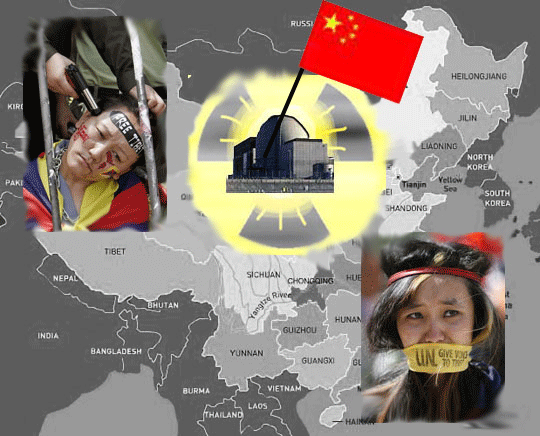
Those fears were intensified by Beijing’s failure to report the accident or release details of what happened, according to a Tokyo newspaper which cited the Japanese Atomic Energy Agency’s investigation. Continue reading
China’s revolutionary new storage battery for renewable energy
China’s State Grid and BYD Launch World’s Largest Battery Energy Storage Station, Market Watch . ZHANGBEI, China, Dec 30, 2011 (BUSINESS WIRE) — BYD and the State Grid Corporation of China (SGCC) have finished construction on what may be the world’s largest battery energy storage station.
This large utility-scale project, located in Zhangbei, Hebei Province, combines 140 Mega-Watts of renewable energy generation (both wind & solar), 36 Mega-Watt-Hours (MWh) of energy storage and a smart power transmission system. While there are renewable generation systems of this scale in service today, there are no battery systems of this size.
The State Grid system is demonstrating a stable solution for transferring vast amounts of
renewable electricity safely to the grid on an unprecedented scale. Although BYD manufactures 1GW of solar panels annually, their role in this project was primarily providing energy storage batteries in arrays larger than a football field…. This new project with the
State Grid has outpaced other grid projects in China and, though independently designed by SGCC, is part of the national “Golden Sun” program. The first phase investment with 100MW of Wind, 40MW of Solar and 36MWh of Battery is worth over $500M USD (~3.3 Billion RMB). Continue reading
China continues research on Fukushima radiation in Pacific Ocean
China conducts second radiation monitor in Pacific Ocean By Yu Jianbin (People’s Daily Overseas Edition), December 29, 2011 Edited and translated by People’s Daily Online A marine monitoring team dispatched by China’s State Oceanic Administration accomplished the mission of monitoring radiation in the western Pacific Ocean for the second time, and returned to Xiamen on Dec. 27 aboard the Xiangyanghong 09 scientific exploration ship.
The monitoring team sailed about 6,100 nautical miles in 30 days, and monitored radiation in the air over and water in the western Pacific Ocean as well as radiation-sensitive sea creatures, chemistry and dynamic environments.
This is the second time that China has monitored radiation in international waters in the western Pacific Ocean.
The aim of the mission is to gain a deeper understanding of the impact of Japan’s Fukushima Daiichi nuclear disaster on the western Pacific Ocean and China’s marine environment, and to help build a western Pacific marine environmental monitoring and early warning system.
http://english.peopledaily.com.cn/202936/7691886.html
China might not save the nuclear industry, as they had hoped
Even before Fukushima, China’s government was asking tough questions of its nuclear growth ambitions. Late last year, its State Council Research Office issued a report outlining a number of concerns about the expansion program.
Since Fukushima, China’s government has pressed the pause button on nuclear expansion
the new generation AP1000 reactors that make up a large portion of the proposed nuclear capacity are not yet in operation anywhere in the world. It is an as yet unproven technology
there is reason for the people of China to be asking questions about the country’s ability to deliver large-scale, hi-tech projects as memories of July’s tragic Wenzhou high-speed rail crash, in which 40 passengers died, are still fresh in their minds….. Nuclear will remain a fringe source of power in China
 China’s nuclear ambitions move to the slow lane, BY: PAUL GARVEY , The Australian, December 19, 2011 CHINA has been the one ray of hope in a miserable year for the global uranium industry. But sadly for uranium stocks, it looks increasingly likely China’s substantial nuclear reactor development program will take much longer to roll out than planned.
With the nuclear industry under review across Europe and Japan in the wake of the Fukushima disaster earlier this year, China has represented one of the only, and certainly the largest, growth market for uranium. Continue reading
Arms control experts doubt report that China’s nuclear arsenal is very large
US experts skeptical over China nuclear force report, By Dan De Luce (AFP) –2 Dec 11 WASHINGTON — Arms control experts are dismissing a report by US university students that suggests China’s nuclear arsenal may be much larger than previously estimated, saying the research is shoddy and unreliable. Continue reading
Nuclear power falling behind, as China grows its wind power
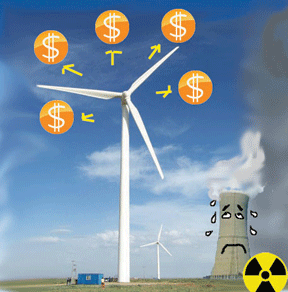 In China, and globally, wind power will stay well ahead of nuclear for decades and replace it altogether…..
China’s path to renewable superpower, Climate Spectator, Matthew Wright, 23 Nov 11 Comparing China’s wind and nuclear power sectors reveal much about the fortunes of new and old energy technologies.
Wind power in China is growing at a blinding pace. China commenced construction of its first wind turbines in 2005 and in just six years has installed 58GW worth of wind power, which now contributes 128TWh to its grid. …
What’s remarkable about China’s wind sector is the speed and scale of its expansion. Wind generators are up and operating within nine months of breaking ground. Continue reading
USA’s new military base in Australia seen as threatening by some in China
The Global Times, a tabloid owned by the Communist Party’s People’s Daily newspaper, hit hard upon the theme of besiegement. It quoted a People’s Liberation Army major general as saying that the expanded U.S. training and deployment base inAustralia was one of a series of U.S. installations to “encircle China from the north to the south of the Asia-Pacific region.”….
Beijing is wary of Obama’s assertive China policy Taiwan news, By CHRISTOPHER BODEEN Associated Press 2011-11-18 President Barack Obama‘s sudden moves to contest rising Chinese power are setting this capital on edge, even if in public the response has been muted. Continue reading
To make money, USA to sell nuclear technology to China nuclear weapons company
 It’s our first real entry into supporting this nuclear market, which for us is huge,”…
The cooperation with Exelon appears to be a significant pivot for CNNC, which in recent years unsuccessfully lobbied Beijing against embracing foreign nuclear technology standards.The company is also responsible for developing military nuclear capabilities for the People’s Liberation Army. China has embraced AP1000 reactor technology made by Toshiba Corp. unit Westinghouse….
Exelon to Provide Nuclear Advice to China, WSJ, 12 Nov 11, By BRIANSPEGELE, BEIJING—Exelon Corp. will provide consulting and training services to an arm of state-owned China National Nuclear Corp., ……. As part of the deal disclosed on Friday, instructors from Chicago-based Exelon will be stationed at Qinshan Nuclear Power Station in China’s eastern Zhejiang province. The initial consulting deal is a small one…..Exelon said it could subsequently grow to include a variety of services for China’s nascent nuclear industry. Continue reading
China waking up to the danger of its nuclear program
 Nuclear-safety risks rising in China, warns minister, Economic Times, 27 OCT, 2011, BEIJING: China is facing increasing safety risks from its nuclear power plants as existing facilities age and a large number of new reactors go into operation, the country’s environmental minister said in comments published on Wednesday. “The safety standards of China’s early-phase nuclear facilities are relatively low, operation times are long, some facilities are obsolete and the safety risks are increasing ,” said Zhou Shengxian in a speech published on the website of China’s parliament, the National People’sCongress. Zhou told legislators that the scale and pace of nuclear construction had accelerated, a larger range of technologies had been introduced, and potential sources of radiation had become more widespread, making it harder to monitor safety .
China has 13 nuclear reactors in operation and another 28 under construction, but it has suspended all new project approvals in the wake of the tsunami in northeast Japan, which left the Fukushima Daiichi reactor on the brink of meltdown. After the suspension, Beijing launched a nationwide inspection of all nuclear sites, including reactors already operating and those under construction, and is drawing up comprehensive new industry guidelines.. http://economictimes.indiatimes.com/news/politics/nation/nuclear-safety-risks-rising-in-china-warns-minister/articleshow/10503077.cms
Why China might put nuclear warheads in underground tunnels
try to understand China’s strategic challenges and why it might go to some fairly extreme lengths to try to solve them.
The “Underground Great Wall:” An Alternative Explanation James M. Acton PROLIFERATION ANALYSIS, OCTOBER 26, 2011 It is tempting to dismiss the story in Monday’s Wall Street Journal claiming that China has around 3,000 nuclear warheads as the kind of reporting that could only be considered “fair and balanced” on Fox News and just ignore it. After all, as long ago as 2004, Jeffrey Lewis tracked down the origin of media reports cited by the Journal that China has 2,350 nuclear weapons. Embarrassingly, the source is an online essay based on bogus U.S. intelligence information that was posted by a Singapore University student. Moreover, it hardly seems worth wasting storage space on the Carnegie server explaining why it is invalid to estimate the size of China’s contemporary arsenal by taking a 1960s U.S. intelligence report that predicted how many warheads China would have in 1973 and then assuming that it has built up at a constant rate since then. Continue reading
1 This Month



26 September – International Day for the Total Elimination of Nuclear Weapons


PLEASE OPPOSE HR 8255 AND S.3639 – bills would accelerate satellite deployment, with no environmental review or safeguards – https://ncstd5li.quorum.us/campaign/169331/
To see nuclear-related stories in greater depth and intensity – go to https://nuclearinformation.wordpress.com
-
Archives
- September 2026 (233)
- August 2026 (330)
- July 2026 (355)
- June 2026 (287)
- May 2026 (306)
- April 2026 (356)
- March 2026 (251)
- February 2026 (267)
- January 2026 (308)
- December 2025 (358)
- November 2025 (359)
- October 2025 (375)
-
Categories
- 1
- 1 NUCLEAR ISSUES
- business and costs
- climate change
- culture and arts
- ENERGY
- environment
- health
- history
- indigenous issues
- Legal
- marketing of nuclear
- media
- opposition to nuclear
- PERSONAL STORIES
- politics
- politics international
- Religion and ethics
- safety
- secrets,lies and civil liberties
- spinbuster
- technology
- Uranium
- wastes
- weapons and war
- Women
- 2 WORLD
- ACTION
- AFRICA
- Atrocities
- AUSTRALIA
- Christina's notes
- Christina's themes
- culture and arts
- Events
- Fuk 2022
- Fuk 2023
- Fukushima 2017
- Fukushima 2018
- fukushima 2019
- Fukushima 2020
- Fukushima 2021
- general
- global warming
- Humour (God we need it)
- Nuclear
- RARE EARTHS
- Reference
- resources – print
- Resources -audiovicual
- Weekly Newsletter
- World
- World Nuclear
- YouTube
-
RSS
Entries RSS
Comments RSS
 nuclear-news