Comparison between USA and China’s management of their nuclear arsenals
Sino-American rivalry: Energy consumption, nuclear energy and deadly nukes Dr. Can Erimtan is an independent scholar residing in İstanbul, with a wide interest in the politics, history and culture of the Balkans and the Greater Middle East. He tweets at @theerimtanangle July 10, 2014
“………Just the other day, the Associated Press (AP) released a timely report on America’s still-existing nuclear arsenal, in which Robert Burns insightfully explained that the “nuclear missiles hidden in plain view across the prairies of northwest North Dakota reveal one reason why trouble keeps finding the nuclear Air Force. The ‘Big Sticks’, as some call the 60-foot-tall Minuteman 3 missiles, are just plain old. The Air Force asserts with pride that the missile system, more than 40 years old and designed during the Cold War to counter the now-defunct Soviet Union, is safe and secure. None has ever been used in combat or launched accidentally. But it also admits to fraying at the edges: time-worn command posts, corroded launch silos, failing support equipment and an emergency-response helicopter fleet so antiquated that a replacement was deemed ‘critical’ years ago. The Minuteman is no ordinary weapon. The business end of the missile can deliver mass destruction across the globe as quickly as you could have a pizza delivered to your doorstep.”Even as the Minuteman has been updated over the years and remains ready for launch on short notice, the items that support it have grown old, Burns also writes.
In 2012, Michelle Spencer, Aadina Ludin and Heather Nelson compiled a troubling report for the USAF Counterproliferation Center. The report’s title illustrates just how dangerous these remnants from the Cold War on US soil today are: The Unauthorized Movement of Nuclear Weapons and Mistaken Shipment of Classified Missile Components. The authors present a narrative of frolic and detour that is unsettling to say the least: “[o]n August 31, 2007, a US Air Force B-52 plane with the call sign ―Doom 99‖ took off from Minot Air Force Base (AFB), North Dakota, inadvertently loaded with six Advanced Cruise Missiles loaded with nuclear warheads and flew to Barksdale AFB, Louisiana. After landing, Doom 99‖ sat on the tarmac at Barksdale unguarded for nine hours before the nuclear weapons were discovered… While the Air Force was reeling from the investigations of the unauthorized movement of nuclear weapons, it was revealed that Taiwan had received classified forward sections of the Minuteman III intercontinental ballistic missile rather than the helicopter batteries it had ordered from the US, bringing to light a second nuclear-related incident”. Particularly, the phrase “inadvertently loaded with six Advanced Cruise Missiles loaded with nuclear warheads” should make everyone’s blood boil.
In contrast, the up-and-coming superpower of the 21st century China does not seem to dispose of such a wide array of technical and/or other difficulties besetting its nuclear arsenal. In 2011, the Washington Post ran a story indicating that the Chinese (or rather the CCP) constructed “a vast network of tunnels designed to hide their country’s increasingly sophisticated missile and nuclear arsenal”, called the“Underground Great Wall”. An associate professor of strategy at the US Naval War College, James Holmes, then, writes that in “March 2008, China’s state-run CCTV network broke the news about a 5,000 kilometer network of hardened tunnels built to house the Chinese Second Artillery Corps’s increasingly modern force of nuclear-tipped ballistic missiles. Tunneling evidently commenced in 1995. Located in, or rather under, mountainous districts of Hebei Province, in northern China, the facility is reportedly hundreds of meters deep”
In the end, the US as the only nation to have ever exploded a nuclear device during wartime appears to be experiencing difficulties managing its now-aging stockpile of nuclear warheads. While China, on the other hand, seems to have devised a novel way of controlling its own nuclear arsenal. In a way, these two different stories of nuclear arms’ storage could be understood as a metaphor for the waning and the rising of fortunes … Does the dragon ascend to ever-loftier heights as the eagle is slowly touching down? Will the ongoing yet somewhat unseen rivalry between Obama’s America and Xi Jinping’s China determine the course of humanity in the coming year or will the large-scale food shortages expected by 2050 combined with the ill-effects of climate change make the continuation of such competitions utterly futile and pointless? http://rt.com/op-edge/171824-sino-american-rivalry-energy/
China’s underground nuclear reactors
 The Untold Story of China’s Forgotten Underground Nuclear Reactor, FP BY JEFFREY LEWIS JULY 8, 2014 How social media and a little sleuthing turned up a Mao-era nuclear program. “……despite official secrecy about China’s production of plutonium for nuclear weapons, my colleague Catherine Dill and I discovered an underground nuclear reactor that China attempted to construct near Yichang in Hubei province during the 1960s and 1970s……..
In the early 1960s, China had one plant to make highly enriched uranium near Lanzhou and was completing one nuclear reactor to produce plutonium at Jiuquan. In 1964, China began the “Third Line” effort — a massive construction effort to relocate all of China’s heavy industries, nuclear and otherwise, in the interior of the country. Often these factories, including things as mundane as steel mills, were placed underground to protect them from Soviet or American attack. As you might expect, the disruption of attempting to relocate the country’s heavy industries to underground caverns in the rural interior was a complete and total cluster… well, you know. Wikipedia calls the Third Line “an economic fiasco,” which seems to me to be an example of the wisdom of crowds.
As part of the Third Line effort, China’s nuclear engineers were supposed to build a copy of the first reactor — the one where Cui worked — in an underground cavern being dug near Fuling. But placing a nuclear reactor under a mountain is about as slow and arduous as you might expect. At some point in 1969, with relations between Moscow and Beijing collapsing, Beijing decided it could not wait for the engineers to finish Fuling. The first proposal suggested physically picking up and moving the reactor near Jiuquan somewhere else. Eventually the technical personnel convinced the Chinese leadership this was total madness. So, instead, China started building a temporary replacement above ground, near a place called Guangyuan in Sichuan.
I always wondered how, in the middle of the paranoia associated with the Cultural Revolution, Chinese leaders came to their senses and ditched the underground reactor at Fuling in favor of the above-ground copy at Guangyuan. It turns out they didn’t. Instead of replacing one crazy project with a more sensible one, the Chinese doubled-down on crazy — continuing the reactor project at Fuling, starting a new one at Guangyuan and, we now know, starting the underground reactor at Yichang. … As best we can tell, China never finished the heavy water at Yichang, just as it never finished Fuling or any other number of wildly implausible Third Line projects. Construction at Yichang lumbered on through the 1970s, before being shut down around 1980 or so. At this point, the Chinese government took a number of steps to transition its nuclear industry to civilian power generation, converting and eventually decommissioning the reactor near Jiuquan, as well as giving up on Fuling and Yichang. China would not build a heavy water reactor until it bought CANDU heavy water reactors from Canada, one in 2002 and another in 2003. (CANDU is a portmanteau of “Canada” and “deuterium oxide,” better known as heavy water.) Yichang is just a footnote. A crazy, implausible footnote…….
Of the two plutonium production reactors that China finished, Jiuquan closed in the late 1980s and Guangyuan closed sometime in the 1990s. China never finished the reactors at Fuling or Yichang. China’s surprisingly small stockpile of plutonium isn’t so surprising once we know this historical context. They tried to make more. They just couldn’t…..
There will be more disclosures. Like yet another unfinished secret underground nuclear reactor that I haven’t mentioned. That’s right, there is a third underground nuclear reactor project that we’ve found. …..http://www.foreignpolicy.com/articles/2014/07/08/the_untold_story_of_chinas_forgotten_underground_nuclear_reactor_yichang_827_plant
Safety and secrecy concerns about China owning and managing Britains nuclear reactors

 CHINA NIGHTMARE http://tomburke.co.uk/2014/07/03/china-nightmare/ July 3, 2014 by tomburke The prospect of the Chinese becoming owners, managers and even constructors of nuclear power stations in Britain has caused anxiety in some unexpected places. Both the right and the left, united in their determination to press ahead with more nuclear, have raised objections. Carefully wrapped in a blanket of security rhetoric, their argument boils down to an Augustinian ‘Bring me nuclear, but not by them’.
Meanwhile, a truly substantial reason why we should worry about Chinese involvement in the nuclear industry is yet to be noticed by anyone but the French Nuclear Safety Authority. They have just complained publicly about the lack of communication with their Chinese counterparts. Explaining this to the French Parliament they pointed out that ‘one of the difficulties in our relations is that the Chinese safety authorities lack means. They are overwhelmed.’
This led one of the French regulators to worry that ‘It’s not always easy to know what is happening at the Taishan site.’ (where Areva are constructing a reactor of the same type as they want to build in Britain). Another French inspector reported seeing big machinery such as steam generators and pumps not being maintained at ‘an adequate level.’
So why does this matter to us? We have very good safety regulators with an impressive track record of managing nuclear facilities well. We should worry about it because the Chinese are currently building only 28 reactors at the same time. This is the fastest rate of reactor build anywhere ever. Even so, they intend to double this build rate before the end of this decade. This is likely to make ‘overwhelmed’ seem like an understatement.
The importance of a rigorous regulatory regime has long been understood by the nuclear industry to be essential to retaining public confidence. ‘ An accident anywhere is an accident everywhere.’ has long been a mantra of industry leaders. Among the many contributors to the seriousness of the accident at Fukushima were failings in the nuclear regulatory culture.
Britain’s nuclear reactor programmes may have been a regulatory success but they have been an economic failure. A former head of the then nationalised electricity industry told Parliament that the AGR programme was ‘the worst civil engineering disaster in British history’. But this had one huge, if unlooked for advantage. No-one else had reactors like them. This meant that when the accidents at Three Mile Island, Chernobyl and Fukushima happened we were well placed to argue that it couldn’t happen here.
If we go ahead with the reactor at Hinkley this comfortable position will no longer be defensible. Hinkley will be a pressurised water reactor (PWR) just like most of the reactors in operation around the world and all those the Chinese are building. If the already stretched Chinese nuclear regulators prove unable to prevent a nuclear accident in China it will have direct repercussions here.
This compounds the gamble that the British government is taking with Hinkley. Not only are we selling 35 years of index linked tax receipts to the French government in return for electricity at twice the price we are currently paying for it but we are also placing the security of our future electricity supply into the hands of China’s ‘overwhelmed’ nuclear regulators.
If they fail to prevent an accident at a PWR in China it is very unlikely that the people of Somerset, or the rest of the country for that matter, will consent to one continuing to operate in Britain.
To revitalise its economy, Japan needs to turn to renewable energy
To revitalize its economy and politics, Japan needs an efficiency-and-renewables leapfrog that enables the new energy economy, not protects the old one. Japanese frogs jump too, says Bashō’s famous haiku “The old pond / frog jumps in / plop.” But we’re still waiting for the plop
How Opposite Energy Policies Turned The Fukushima Disaster Into A Loss For Japan And A Win For Germany Forbes, Amory B Lovins 28 June 14 “……..More than the sacred sun on Japan’s flag, its leaders appear to worship old policies that retard wide use of the energy sources now taking over the global market. Since 2008, half the world’s added electric generating capacity has been renewable. Non-hydroelectric renewables, chiefly wind and solar, got a quarter-trillion dollars of private investment and added over 80 billion watts in each of the past three years. Three of the world’s top four economies—China, Japan, and Germany, as well as India—now produce more electricity from non-hydro renewables than from nuclear power. Japan is on that list only because its nuclear production is roughly zero; it remains the rich nations’ renewable laggard. Perhaps the unexpected May 2014 court decision that prohibited restart of the Oi reactors as unsafe, and for the first time prioritized public safety over utility profits, may signal an emergent change beyond the cosmetic reforms offered by the executive and legislative branches—2016 “deregulation” in name only.
In 2012 and 2013, China made more electricity from wind than from the world’s most aggressive nuclear power program. In 2013, China added more solar power than its first developer, the United States, has installed in its whole history. But Japan is heading in the opposite direction: of the 8 GW of renewables brought into operation in the first 20 months after it introduced renewable FITs in July 2012, 97.5% was solar and only 1% windpower. Windpower (especially onshore where it’s cheapest) is stymied, first by uniquely slow and onerous approval processes and then by outright rejection by utility monopsonists who get to bar competitors from their regional grids. Japan’s windpower association projects the same market share in 2050 that Spain achieved three years ago.
It’s not hard to figure out why. Solar power displaces daytime peak that’s costly to generate, but the way the solar feed-in tariff works, it’s profitable for utilities. In contrast, they lose money on cheap windpower that also runs at night, displacing coal and nuclear. Japan’s latest rules reiterate utilities’ right to refuse renewable power that would displace such legacy “baseload” plants. Japanese business leaders may be upset to learn that their electricity, among the world’s costliest, is even costlier because their utilities run their own costlier thermal plants while rejecting windpower with nearly zero operating cost.
The electricity reforms passed in late 2013 by the lower house of the Diet (23 years after Germany’s reforms began) still let Japan’s utilities reject cheaper renewable power for any reason or no reason. Many claim renewables could harm grid stability. So why do Germany, with 25% renewable electricity in 2013, and Denmark, with at least 47%, have Europe’s most reliable electricity, about ten times more reliable than America’s? These countries, like three others in Europe (none very rich in hydropower) that used roughly half-renewable electricity in 2013—Spain 45%, Scotland 46%, Portugal 58%—simply require fair grid access and competition. Of all major industrial nations, only Japan doesn’t.
Germany also uses energy more efficiently. In each of the past three years, German electricity consumption fell while GDP grew. During 1991–2013, i.e.since reunification, German real GDP grew 33% using 4% less primary energy and 2% less electricity, and emitting 21% less carbon. Even more ambitious savings are available and planned.
In contrast, Japan’s world-leading energy efficiency gains in the 1970s later stagnated. Japanese industry has continued to improve, and remains among the most efficient of 11 major industrial nations, but Japan ranks tenth in industrial cogeneration and commercial building efficiency, eighth in truck efficiency, and next-to-last (tied with the U.S.) in car efficiency. Yet Japan’s sky-high energy prices make energy efficiency very profitable, most of all in buildings. Semiconductor company Rohm’s office opposite Kyōto Station, for example, cut its energy use 46% and repaid its cost in two years. With a few exceptions, like the Tōkyō Metropolitan Government’s efficiency efforts, few Japanese buildings have received the kind of kaizen (continuous improvement) that has long distinguished Japanese industry.
To revitalize its economy and politics, Japan needs an efficiency-and-renewables leapfrog that enables the new energy economy, not protects the old one. Japanese frogs jump too, says Bashō’s famous haiku “The old pond / frog jumps in / plop.” But we’re still waiting for the plop.http://www.forbes.com/sites/amorylovins/2014/06/28/how-opposite-energy-policies-turned-the-fukushima-disaster-into-a-loss-for-japan-and-a-win-for-germany/
Anxiety in China, over its not so safe rush to nuclear power
Losers aplenty in China’s race for nuclear power THE AUSTRALIAN JUNE 21, 2014 Scott Murdoch China
Correspondent Beijing IN China’s far eastern region of Rongsheng, the government is rolling out one of the most ambitious nuclear power developments in the world.
China has commissioned at least three power plants in the Shandong province as it attempts to reduce its reliance on fossil fuels. However, the details of the projects remain tightly controlled, with hundreds of residents, farmers and business owners left to question their future amid concerns over the safety of nuclear technology.
A journalist, photographer and news assistant from The Weekend Australian were recently detained by police while researching the Shidaowan project. The company behind the development, the China Huaneng power company, refused to answer questions. French nuclear regulators this week warned China needs to step up its level of supervision, control and interaction with the rest of the world as it invests more in nuclear generation. There are 20 nuclear reactors in operation in China and a further 28 under construction.
It has been mooted that Shidaowan will come online by 2017, more than three years behind schedule, after the 2011 Fukushima disaster in Japan halted nuclear development around the world.
Under the government’s plans, next-generation CAP1400 reactors are being developed in Shandong. The program has been approved by the National Development and Reform Commission, the peak economic planning agency in China.
It is forecast that nuclear power generation will almost triple, from 15.69 gigawatts to at least 58GW, by 2020, as China aims to reduce its reliance on coal-fired power generation.
However, in the small villages around the new power plant in Rongsheng, the human and environmental costs of the development are already clear.
Villages have been razed, with dozens of residents forced from their homes in the early stages of the plant’s construction.
The project has brought work, with labourers housed in cramped conditions. But residents are concerned about the use of world-first technology. Some have been told they will be moved and placed in high-rise accommodation, leaving behind their friends, family, traditions and culture………
“The villagers have had land by the seaside for generations, we could grow our own food, we could fish, and not only feed our family but we could make some money from that.
“But now the land has been seized and if something goes wrong then the seas will be completely damaged and our villages could be wiped out.”………
Former nuclear power engineer Du Minghai said while China was rolling out the most ambitious nuclear program in the world, it had to ensure it strengthened safeguards to prevent environmental, social and health problems.
“In terms of the plant design, equipment manufacturing and maintenance management, China still has gaps compared with the world’s most advanced levels,” he said.
“We should introduce and insist that foreign-management methods are put in place, and make sure that we don’t localise the management systems of the plants.
“Some people are saying that China is using the highest standards and building the most advanced nuclear units, but to some extent I think this is just political language being used to make sure politicians support their projects.”
Additional reporting: Wang Yuanyuan http://www.theaustralian.com.au/news/world/losers-aplenty-in-chinas-race-for-nuclear-power/story-e6frg6so-1226961728367#
China’s nuclear plants face safety challenges (Is near enough good enough?)
China’s nuclear power plants “generally safe”: watchdog
Xinhua) 20:34, June 04, 2014 BEIJING, June 4
China’s operating nuclear power units enjoy a relatively good safety record, and the quality of the units under construction has been well controlled, said the head of China’s nuclear watchdog on Wednesday…
.. However, Li said maintaining safety in this area is a challenging task,
as it concerns state security. He admitted that loopholes and problems, both in supervision and the whole nuclear industry, still exist.
The vice minister vowed to strengthen supervision with a well-established institution, a perfected legal system, as well as more capable personnel.
http://english.peopledaily.com.cn/n/2014/0604/c90882-8736930.html
The nuclear industry is not winning hearts and minds in China
People power holds key to China’s nuclear plans FT.com, By Lucy Hornby at Daya Bay, 26 May 14, China’s nuclear industry has in recent years ventured overseas for new opportunities but it is now facing challenges at home gaining public acceptance of its $150bn expansion plans.
Fears of a nuclear power backlash, stoked by recent demonstrations against other large industrial projects, have rattled regulators as well as nuclear operators China National Nuclear Corp (CNNC) and China General Nuclear Power Corp (CGN).
Regulators fear images of riot police crushing protests at a reactor site – like this month’s violent clashes over a planned garbage incinerator – could quickly harden attitudes against nuclear power.
“If the government just keeps the same attitude of secrecy as in the past, it will create more problems. They need to pursue nuclear power appropriately and safely otherwise there will be more conflicts between the government and people,” says Cao Heping, who studies green economy at Peking University.
The concerns have even moved Chinese regulators to request help from the UK in the hope its government can offer tips on developing public and media support for nuclear power.
Industry executives say Mr Li’s “when appropriate” caveat followed internal discussions about the need to tread carefully, to avoid arousing any anti-nuclear sentiment.
Meanwhile, the meltdown at Fukushima in Japan strengthened Chinese regulators’ hand but also raised worries about public acceptability.
After the Fukushima meltdown, regulators shelved almost half of the 100 or so planned reactor projects due to design or site concerns, including those in earthquake zones or on inland rivers with limited water supply.
That review plus signs of slippage in construction means China could struggle to have all of the new reactors operational in the next six years.
China’s protracted crackdown on civil dissent deters local activists from taking the lead publicly on sensitive projects. Opposition can thus quickly turn into street protests despite new government initiatives to allow public feedback and that could prove a problem if public opinion sours on nuclear power.
Local governments often welcome the investment and jobs nuclear projects bring but disagreement among local officials can fuel protests. City officials’ unease over oil company Sinopec’s long-delayed paraxylene plant was a factor http://www.ft.com/intl/cms/s/0/a6f10e96-e41c-11e3-a73a-00144feabdc0.html#axzz32rprEjFF
USA charges Chinese officials with nuclear cyberspying
 Chinese officials indicted in nuclear cyberspying case, By Eric Tucker, The Times of Israel, 19 May 14 US announces unprecedented charges against military hackers who targeted big-name firms, stole trade secrets WASHINGTON (AP) — The United States announced on Monday unprecedented cyber espionage charges against five Chinese military officials accused of hacking into US companies to gain trade secrets The hackers targeted big-name makers of nuclear and solar technology, stealing confidential business information, sensitive trade secrets and internal communications for competitive advantage, according to a grand jury indictment……..
The indictment says that five hackers — members of the People’s Liberation Army — worked from a building in Shanghai to steal proprietary information from the companies and the labor union, including communications that could have helped Chinese firms learn strategies and weaknesses of American companies involved in litigation with the Chinese government or Chinese firms.
The defendants are all believed to be in China and it was unclear whether they would ever be turned over to the US for prosecution. But the Justice Department, publicizing the charges, identified all five by name and issued “wanted” posters………
The indictment will put a greater strain on the US-China relationship and could provoke retaliatory acts in China or elsewhere.
“What we can expect to happen is for the Chinese government to indict individuals in the United States who they will accuse of hacking into computers there,” said Mark Rasch, a former US cybercrimes prosecutor. “Everybody now is going to jump into the act, using their own criminal laws to go after what other countries are doing.”
Rasch said the indictments attempt to distinguish spying for national security purposes — which the US admits doing — from economic espionage intended to gain commercial advantage for private companies or industries, which the US denies it does. Classified documents disclosed by former National Security Agency analyst Edward Snowden described aggressive US efforts to eavesdrop on foreign communications that would be illegal in those countries.
“These five people were just doing their jobs. It’s just that we object to what their jobs are,” Rasch said. “We have tens of thousands of dedicated, hard-working Americans who are just doing their jobs, too.”
Unlike in some countries, there are no nationalized US industries. American officials have flatly denied that the government spies on foreign companies and then hands over commercially valuable information to American companies. http://www.timesofisrael.com/chinese-officials-indicted-in-nuclear-cyberspying-case/#ixzz32JH7SA85
North Korea warned by China against conducting 4th nuclear test
China warns North Korea against fourth nuclear test, Australia Network News, 20 May 14 China has used diplomatic channels to warn North Korea against conducting a fourth nuclear test after the reclusive state renewed its threat of “counter-measures” against perceived US hostility.
North Korea, which regularly threatens the South and the United States with destruction, is already under heavy sanctions imposed by several UN resolutions beginning in 2006 but has defied pressure to abandon its missile and nuclear programs.
It last conducted a nuclear test in February 2013.
“China has told North Korea that there is no justification for a new nuclear test and that they should not do it,” a Western diplomat who was briefed by Chinese officials said.
The sources said China had used diplomatic channels in Beijing and Pyongyang to convey its anxiety about the possibility of a fourth test to the North……http://www.abc.net.au/news/2014-05-20/an-china-warns-nkorea/5463466
Uranium truck set on fire in India

 Maoists set truck carrying uranium for UCIL ablaze, DNA , 8 May 2014 Maoists torched a government-owned truck in a uranium mining area close to Jamshedpur.
The truck was carrying materials for the Uranium Corporation of India Limited (UCIL) and was engaged at the Bagjata Mines.
From last few weeks, posters with instructions for drivers to stop ferrying uranium ore from the Bagjata Mines have appeared on trucks at regular intervals, instilling fear and tension among transporters.
Maoist leaders have threatened transporters with dire consequences if they continue to do business with UCIL.
The banned outfit had been demanding permanent jobs for locals in the company as compensation for acquisition of their lands in Bagjata.
Senior Superintendent of Police (SSP) of Jamshedpur Amol Venukant Homkar said the incident took place early this morning, and added that 15 unidentified armed persons pulled the driver down from the vehicle and then set it ablaze. Uranium Corporation of India Limited (UCIL) plays a very significant role in India’s nuclear power generation programme……….http://www.dnaindia.com/india/report-maoists-set-truck-carrying-uranium-for-ucil-ablaze-1986317
The world will be changed by China’s renewable energy revolution
China’s Renewable Energy Revolution Has Global Implications, Clean Technica John Mathews and Hao Tan, 8 April 14, China’s renewable energy revolution is powering ahead, with the year 2013 marking an important inflection point where the scales tipped more towards electric power generated from water, wind and solar than from fossil fuels and nuclear. This means that its energy security is being enhanced, while carbon emissions from the power sector can be expected to soon start to fall.
China’s energy revolution, which underpins its transformation into the world’s largest manufacturing system (the new “workshop of the world”), continues to astonish all observers, and terrify some. China is known widely as the world’s largest user and producer of coal, and the world’s largest emitter of carbon dioxide and other greenhouse gases. This is true. Less noticed has been the fact that China is also building the world’s largest renewable energy system – which by 2013 stood at just over 1 trillion kilowatt-hours – already nearly as large as the combined total of electrical energy produced by the power systems of France and Germany.1
The energy landscape continues to give the clearest indication of the trends in industrial dynamics and prospects for the future. China is powering ahead with renewables while at the same time it expands its reliance on fossil fuels; the US by contrast is further locking in its dependence on fossil fuels. The distinction is critical………
We need to sketch in the background to China’s energy revolution, so that the enormity of its commitment to renewables may be appreciated. ……. While coal for thermal power continues to rise, the overall consumption of coal appears to be ‘capped’ at 3,500 million tonnes – a desperate measure taken no doubt in response to the blackening skies and poisoning of water and air
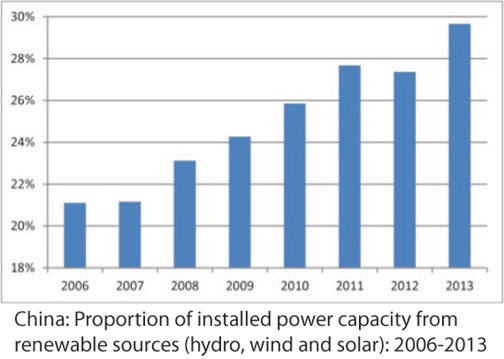
In just the space of eight years, China has become the world’s most important generator of wind power, with the world’s largest capacity and the largest addition of new power capacity in the year 2013. The increase in all three sources of renewables – hydro, wind and solar PV – is shown in Fig. 3, in terms of the proportion of power generated by renewables and its relentless rise (apart from a dip in 2012, following world recession in 2011).
The proportion reached by 2013, of close to 30% of electrical energy generated from renewable sources (hydro, wind and solar), is what gives China its international influence in renewables – and it demonstrates a relentless trend towards greater reliance on manufacturing systems for production of, e.g. wind turbines and solar cells, as opposed to the reliance elsewhere on alternative fossil fuels such as coal seam gas and shale oil…….
The sharp rise in renewables reflects particularly the new commitment to wind power – and it looks set to continue through industrial logistic dynamics. We will develop an argument below for the significance of this date……….
3. Investment trends
Expenditure in building new power generating infrastructure can reveal more than data on capacity and generating additions. The CEC has released investment data for 2013, which reveal the following trends. In terms of investment, China spent more on its grid in 2013 than on new power generation facilities………The significance of this is that China is spending on infrastructure to accommodate more renewable power facilities, as well as on the facilities themselves. Of the new generation facilities, investment in new energy sources accounted for more than 40% of the total investment in new power generation facilities…….
Thus our conclusion that in 2013, China’s leading edge of change in its electric power system is now more “green” than “black”. We have demonstrated above that this is unambiguously so in terms of capacity added and in terms of investment, while in terms of new generation of electrical energy thermal still marginally outranks renewables (180 billion kWh generated to 160 billion kWh)………
at the leading edge, for the year 2013 alone, China added 94 GW of new capacity, of which 55.3 GW came from renewables (59%), and just 36.5 GW (or 39%) came from thermal sources – a dramatic reversal of past trends;…….
our analysis that China’s carbon emissions are set to peak and then to fall – and fall faster than in the US or in Europe……..http://cleantechnica.com/2014/04/08/chinas-renewable-energy-revolution-global-implications/
China’s motives in developing renewable energy
China is serious in its pursuit of renewables, because it seems to believe that its future prosperity depends on building the industries that produce power – complementing its activities in searching for fossil fuels supplies all around the world. There is a lesson here for all other developing countries, and notably for India and Brazil. And not only developing countries.
China’s Renewable Energy Revolution Has Global Implications, Clean Technica John Mathews and Hao Tan, 8 April 14, “……The motives Finally, we need to ask what are the motives for China’s dramatic shift to a renewables trajectory? The common assumption is that it is concern over climate change (global warming) that drives the shift. Important as this motive is, we believe it is the least likely of the explanations for China’s shift. We believe the more plausible explanation for China’s new trajectory – and for the determination with which it is being pursued – is energy security and industrial development. Continue reading
China is No.1 in renewable energy investment
 U.S. Lags Behind China in Renewables Investments, Clean Technica, 6 April 14 By Bobby Magill Follow @bobbymagill Don’t let all those Texas wind farms and massive installations of solar panels in California fool you. The U.S. is not the world leader in clean energy investment.
China is.
China Is #1 In Renewable Energy Investment, US #2, Japan #3 (CHART) With record-breaking solar installations in the US, and solar actually coming in as the #2 source of new electricity capacity in 2013, you might think the US was the #1 market in the world for renewable energy investment. Of course, if you follow how much renewable energy China is installing… or if you just read the headline above, you know otherwise. Here are more details from Climate Central:
For the second year, an annual Pew Charitable Trusts report, “Who’s Winning the Clean Energy Race?”, shows that China is the world leader in clean energy investment, with $54 billion in investments in renewables in 2013, well above total U.S. investment of $36.7 billion. No other clean energy market in the world is operating at that scale,” Phyllis Cuttino, director of Pew’s clean energy program, said during a teleconference Thursday, referring to China.
The report was released just days after the Intergovernmental Panel on Climate Change released the second part to its fifth assessment report, which states unequivocally that people will have to adapt to a world in which human fossil fuel emissions have caused the climate to change, threating lives across the globe as temperatures and seas rise and extreme weather becomes more frequent. Developing renewable energy is seen as one of the primary ways to reduce humans’ impact on the climate.
The Pew report says China’s efforts to slash poverty, expand economic development and solve its air pollution problems have driven the country to invest heavily in clean energy…………
Zwindler said the solar and wind power industries worldwide are in a transition period as subsidies for renewables are scaled back, especially in Germany and Italy, but he is confident renewables will be able to compete in the future with few subsidies.
“It does not take place in all places at the same time,” he said. “If you’re in a sunny part of the world with high electricity prices, putting solar on your roof clearly can make more sense.” http://cleantechnica.com/2014/04/05/china-1-renewable-energy-investment-us-2-japan-3-chart/
Renewed demand for solar PV in China
 Solar PV rebounds as demand comes back with ‘a vengeance’ SMH, March 20, 2014 Solar manufacturers are returning to profit as demand in China soaks up a supply glut that gutted margins for more than two years.
The largest solar-panel maker Yingli Green Energy said it expects to be profitable in the third quarter. It joins peers including JinkoSolar, Trina Solar and JA Solar in guiding investors to expect both income and higher shipments in 2014.
Climbing demand for solar panels is countering a global oversupply of production capacity that erased profits across the industry and bankrupted more than a dozen companies. Developers installed 37.5 gigawatts of panels worldwide last year, up 22 per cent from 2012, and that figure may increase as much as 39 per cent this year, according to data compiled by Bloomberg.
That growth is starting to “sponge up” much of the glut, especially among Chinese manufacturers, that resulted from a buildup in the late 2000s, Pavel Molchanov, an analyst at Raymond James & Associates in Houston, said in an interview. “That has made a real dent in the overcapacity.”
The largest solar manufacturers have cut expenses and are poised to take advantage of growth this year, said Nimal Vallipuram, an analyst at Gilford Securities Inc. in New York.
“They continue to do very well at reducing the costs and their volume is going up very strongly,” he said. “Demand has come back with a vengeance.” http://www.smh.com.au/business/carbon-economy/solar-pv-rebounds-as-demand-comes-back–with-a-vengeance-20140320-353ir.html
China’s nuclear power ambitions fading?
Why China’s nuclear energy ambitions are falling flat http://qz.com/189731/why-chinas-nuclear-energy-ambitions-are-falling-flat/ By Lily Kuo @lilkuo March 19, 2014 At a time when other countries are scaling back their nuclear energy programs, China has been plowing ahead. Its largest nuclear energy companies are considering initial public offerings to raise over $2 billion, and Chinese researchers are racing to build the world’s first nuclear plant that runs on thorium. China’s nuclear reactors account for almost 40% of the world’s total. This year alone, the country plans to add 8.6 gigawatts of nuclear power capability—almost as much as the United Kingdom’s annual nuclear power capacity.
Thus, nuclear power’s contribution to China’s goal of reducing its reliance on coal—and, crucially, reducing the air pollution that is choking many of its major cities and contributing to global warming—is likely to be modest for decades to come.
Nuclear power has been underwhelming in China for many of the same reasons it has struggled elsewhere: it’s technically difficult, expensive, and resisted by parts of the public. Because nuclear power plants take so long to build, and China’s energy demands are imminent, other forms of renewable energy like wind and hydropower have taken precedence. (Nuclear reactors typically require at least six years to build, compared to around two years for geothermal power plants and just a few months for wind farms.)
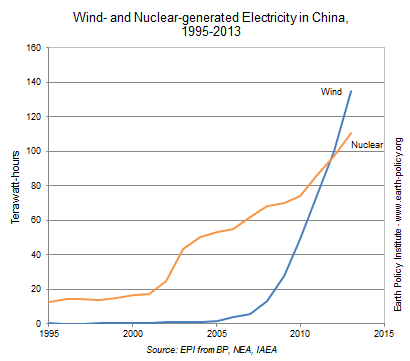
Engineering problems and delays are also a major culprit, and may prevent China from meeting its scaled-down nuclear power goals. As Grist points out, even if all Chinese nuclear capacity currently under construction were to become operational in the next six years, China would have reached only 45 gigawatts by 2020, well shy of its 58 gigawatts goal. Advanced plants that could bring higher efficiency, like a thorium reactor, will still require years of work to resolve engineering issues, researchers say.
Moreover, one of the benefits of nuclear power is that it can be installed close to where it is in demand—in contrast to wind and hydropower—lessening the distance that electricity has to travel along a power grid where some of the power is inevitably lost. But China is spending over 1 trillion yuan ($162.8 billion) to upgrade and expand its grid. As of last year, 84% of the country’s wind capacity was connected to the grid, from 72% in 2011, and the amount of wind-generated electricity wasted in transfer has fallen to 11% from 16% over the same period,according to Fitch Ratings.
1 This Month



26 September – International Day for the Total Elimination of Nuclear Weapons


PLEASE OPPOSE HR 8255 AND S.3639 – bills would accelerate satellite deployment, with no environmental review or safeguards – https://ncstd5li.quorum.us/campaign/169331/
To see nuclear-related stories in greater depth and intensity – go to https://nuclearinformation.wordpress.com
-
Archives
- September 2026 (219)
- August 2026 (330)
- July 2026 (355)
- June 2026 (287)
- May 2026 (306)
- April 2026 (356)
- March 2026 (251)
- February 2026 (267)
- January 2026 (308)
- December 2025 (358)
- November 2025 (359)
- October 2025 (375)
-
Categories
- 1
- 1 NUCLEAR ISSUES
- business and costs
- climate change
- culture and arts
- ENERGY
- environment
- health
- history
- indigenous issues
- Legal
- marketing of nuclear
- media
- opposition to nuclear
- PERSONAL STORIES
- politics
- politics international
- Religion and ethics
- safety
- secrets,lies and civil liberties
- spinbuster
- technology
- Uranium
- wastes
- weapons and war
- Women
- 2 WORLD
- ACTION
- AFRICA
- Atrocities
- AUSTRALIA
- Christina's notes
- Christina's themes
- culture and arts
- Events
- Fuk 2022
- Fuk 2023
- Fukushima 2017
- Fukushima 2018
- fukushima 2019
- Fukushima 2020
- Fukushima 2021
- general
- global warming
- Humour (God we need it)
- Nuclear
- RARE EARTHS
- Reference
- resources – print
- Resources -audiovicual
- Weekly Newsletter
- World
- World Nuclear
- YouTube
-
RSS
Entries RSS
Comments RSS
 nuclear-news