China’s much touted nuclear future is not so sure
 Nuclear power in China – Promethean perils, The Economist Dec 6th 2014 | SHANGHAI |
One factor that could slow growth is cost. In the past Chinese governments were happy to throw endless pots of money at favoured state firms in industries deemed “strategic”. Times are changing, however. Economic growth is slowing, and the government must now deal with massive debts left over from previous investment binges. Since the export-oriented and investment-led model of growth is sputtering, officials may soon be keen to boost domestic consumption rather than merely shovel subsidised capital at big investment projects.
China’s nuclear power investment might not be such a good deal
 China Nuclear IPO Risks Fading Afterglow By ABHEEK BHATTACHARYA, WSJ Nov. 24, 2014 China’s largest nuclear power company is coming to the table with a high minimum bet.
State-owned CGN Power plans to sell shares worth up to $3.16 billionin Hong Kong this week, making it one of the few pure-play listed nuclear companies in the world. ………
 CGN Power’s multiple is substantially higher than U.S. nuclear operator Exelon ’s 6.7 times and French EDF’s 4.9 times. It is also more expensive than CGN Meiya, CGN Power’s smaller affiliate that went public in September and that fetches 11.2 times Ebitda.
High valuations for CGN Power are dicey because China regulates electricity prices more heavily than in the West. For instance, new nuclear-power plants can’t charge higher tariffs than neighboring coal-fired power, capping earnings potential.
Though Beijing’s plans to cut back on fossil fuels will help growth, the state-run grids prioritize wind and solar over nuclear power when buying and dispatching electricity, according to CGN’s prospectus. Given China’s ambitions to build out solar power, this means nuclear could occasionally lose out. It is also a reminder that nuclear energy may not always enjoy the government’s graces.
CGN Power’s novelty may attract some betting on China’s nuclear future. Yet like many Hong Kong IPOs that do well at first, this bet may lose its afterglow. http://online.wsj.com/articles/china-nuclear-ipo-risks-fading-afterglow-heard-on-the-street-1416819232
Thorium – no prospects as an energy source, but China might use it for weapons
 NUCLEAR OPTIONS: WHAT EXPLAINS U.S.-CHINA COOPERATION ON THORIUM? Georgetown Public Policy Review MATTHEW STRABONE NOVEMBER 6, 2014
China’s nuclear power programme has dubious economic future
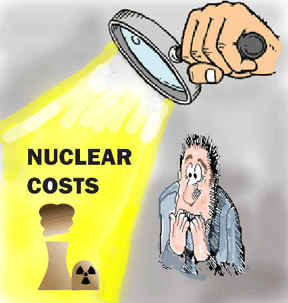 China’s Risky Nuclear Renaissance http://online.wsj.com/articles/heard-on-the-street-chinas-risky-nuclear-renaissance-1414508639 CGN Power’s Plan to Go Public Could Be Dicey By ABHEEK BHATTACHARYA Oct. 28, 2014
Nuclear energy: It’s risky stuff. Hence, there is often a heavy degree of government control over it—which makes it a doubly risky investment proposition.
Especially when that government is China’s.
A number of Chinese state-owned nuclear companies are going public these days. CGN Power, the country’s largest with 9.4 gigawatts of operating capacity, will likely offer $3 billion worth of new shares in Hong Kong next month, reports The Wall Street Journal. A small affiliate, CGN Meiya Power , raised $262 million in Hong Kong last month and has seen its shares rise by 20% since. Meanwhile, another top operator, China National Nuclear Power, also plans an initial public offering.
Once listed, these will be one of a handful of stocks globally, including the likes of Exelon of the U.S. and EDF of France, offering high or pure exposure to nuclear energy. And while much of the rest of the world is ambivalent about or hostile to nuclear energy, Beijing has big expansion plans. The Chinese government suspended new project approvals after Japan’s Fukushima accident in March 2011. But the need to diversify away from smog-causing coal has put its nuclear ambitions back on track. China now targets nearly tripling the nuclear capacity that’s up and running to 58 gigawatts by 2020. The IPOs will help fund that ambition.
The state’s involvement can cut both ways, though. CGN Power sells most of its output to state-run electricity grids at regulated tariffs. For power plants that began operating before 2013, these tariffs are tailored to yield a “reasonable” profit, according to CGN’s prospectus. Yet its net profit has fallen since 2011 because of either surging costs or weakening sales.
For newer plants, the tariff is supposed to be fixed—except when it isn’t. In a bid to avoid competition, these plants are required to cut tariffs if neighboring coal-fired power is cheaper. That’s quite likely as coal prices spiral downward. Energy prices are heavily regulated precisely because consumers are rather attached to light and heat. That makes them subject to political, as well as economic, forces.
In France, for example, shares in state-run EDF tanked 14% in June when the government scrapped a planned tariff increase. There’s even more reason to worry in China since governments could keep down power prices as a stimulus to troubled heavy industries. Growth prospects are high, which is likely one reason that CGN Meiya already trades at 10.9 times 2013 earnings before interest, tax, depreciation and amortization. That is far higher than EDF’s 4.8 times or Exelon’s 6.6 times.
Double-digit multiples are no doubt tempting for IPO bankers but look too much for a large nuclear generator carrying this much political risk. Problem is, CGN’s balance sheet means it needs a high multiple, or fast growth in profits, to make its IPO math work.
Net debt as of this March is a hefty 5.1 times 2013 Ebitda, and still high at four times even if related-party loans are excluded. And less than 10% of the IPO proceeds are currently earmarked for paying off borrowings. As if nuclear power wasn’t risky enough
China launches long range test missile, in effort to catch up with USA’s nuclear arsenal
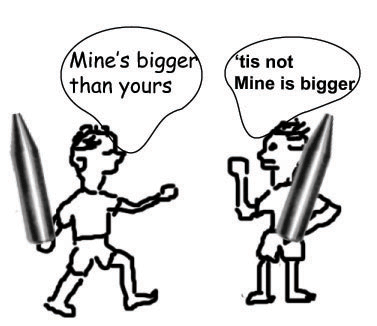 China Launches Test Missile Capable of Carrying Nuclear Warheads to Europe and US New missile system places London and US east coast under the crosshairs of China’s military .International Business Times By Mark Piggott October 5, 2014 China has successfully launched a test missile capable of carrying a nuclear warhead 10,000km – meaning the whole of Europe and parts of the US is within its range.
“We continue to monitor China’smilitary modernization, including its missile tests”
– Pentagon spokeswoman Cynthia O Smith
The Dongfeng missile can be fired from mobile launchers capable of traversing rough terrain, meaning they can be easily moved and hidden from detection by spy satellites.
China launched the missile on 26 September. The Pentagon confirmed the launch it took place.
Although refusing to provide details, Pentagon spokeswoman Cynthia O Smith told the Washington Free Beacon: “We continue to monitor China’s military modernization, including its missile tests.”…..
It is estimated that China only has around 250 nuclear warheads, compared with the 2,104 operational warheads operated by the US.
Major General Yao Yunzhu, China’s director of the Center of America-China Defense Relations for the Academy of Military Science, said in a letter to the Pacific Forum of the Center for Strategic and International Studies, that China still lags behind the US in terms of nuclear weapons.
“The Ballistic Missile Defense systems that the US and its allies have deployed, or are planning to deploy, are capable of intercepting Chinese nuclear weapons launched for retaliation after it has already been attacked, thus potentially negating the deterrence effect of the Chinese nuclear arsenal,” said Yunzhu.
Retired Peoples’ Liberation Army general Xu Guangyu told the South China Morning Post: “Beijing just wants to increase China’s military might and its nuclear strategic threat. It’s not really targeting the US or other countries.
“China needs to conduct intensive weapons tests and military drills because the (US-led build-up) now in the Asia-Pacific area is not good for Beijing………,.”http://www.ibtimes.co.uk/china-launches-test-missile-capable-carrying-nuclear-warheads-europe-us-1468574
China joins the nuclear marketing frenzy to sell to India
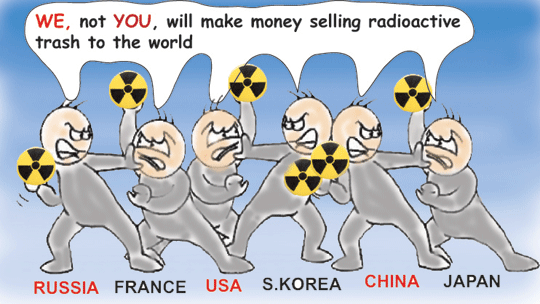 China joins nations eyeing India’s civil nuclear sector, Cold Air Currents, 21 Sept 14 Yahoo News UK: NEW DELHI (Reuters) – China became the latest nation to line up for a stake in India’s civil nuclear energy drive on Thursday, agreeing to open talks on cooperation in a sector that New Delhi sees as the solution to its chronic power problems.
...”I think the Chinese are looking basically at the commercial angle, since India is going to be giving contracts for nearly $150 billion in the next 10-15 years,” said Srikanth Kondapalli, a China watcher at Delhi’s Jawaharlal Nehru University.
The announcement, made after Xi met Prime Minister Narendra Modi in New Delhi, comes on the heels of a deal India struck earlier this month to buy uranium from Australia to increase its fuel supplies.
Days before that, Modi and Japanese Prime Minister Shinzo Abe agreed to accelerate talks on a nuclear energy pact……http://coldaircurrents.luftonline.net/2014/09/china-joins-nations-eyeing-indias-civil.html
China’s renewable energy – not only to decarbonise, but for energy security
China shows there’s more to renewable energy than fighting climate change ” The Conversation.11 September 2014, .… China’s large investments in renewables are best understood as enhancing the country’s energy security and not solely as a means of reducing carbon emissions…….
As the scale of Chinese manufacturing has grown — in our article we note that production of solar cells has expanded about 100-fold since 2005 — the costs of renewable-energy devices have plummeted. Countries such as Germany and South Korea, like China, are boosting their national renewable-energy industries and markets.
But others, including the United States, seem yet to notice this shift and are pursuing ineffective energy policies, including considering alternative fossil-fuels sources like coal-seam gas and putting trade tariffs on Chinese-made solar panels. Indeed oil addiction in the US appears to be worse than ever.
There are clear implications for Australia too. The current wave of anti-renewables rhetoric and negative reaction by the Australian government is out of step with the rest of world, and in particular with China and India, (and Germany) all of which countries see renewables as an important and growing element of their energy mix.
And there is a second clear implication: as they build their renewables industries, these countries will come to depend less and less on fossil fuels – and (China in particular), less and less on imports of Australian fossil fuels……..
In terms of electric power generation, China generated over 1,000 terawatt hours of electricity from water, wind and solar sources in 2013, which is comparable to the entire power generation combined of France and Germany.
But it is the rate of expansion that is so remarkable. China is rapidly expanding its renewable energy industries and its use of renewable devices to generate electric power.
Its latest target is that renewables will have a capacity of 550 gigawatts — over half a trillion watts — by the year 2017. We calculate that this will exert a major impact in China — enhancing energy security; reducing emissions pollution; and reducing carbon emissions.
But the primary impact will be on energy security. China became a net importer of oil in 1993; of natural gas in 2007; and of coal in 2011. If it can reach its 2017 target of 550 GW renewables, we calculate that this would translate into a saving of 45% on current imports of coal, oil and natural gas.
China is leading the way to a world of decarbonized energy, by placing the emphasis of its policy on growing the markets for renewables and building the industries to supply wind turbines, solar cells, batteries and other devices.
In this way it is driving down costs, through the learning curve, and making renewables more accessible to all countries. This is good for China, and for the world.http://theconversation.com/china-shows-theres-more-to-renewable-energy-than-fighting-climate-change-31471
China to start huge carbon trading scheme
China’s national carbon market to start in 2016, official says SMH, September 1, 2014 China plans to roll out its national market for carbon permit trading in 2016, an official said Sunday, adding that the government is close to finalising rules for what will be the world’s biggest emissions trading scheme.
The world’s biggest-emitting nation, accounting for nearly 30 per cent of global greenhouse gas emissions, plans to use the market to slow its rapid growth in climate-changing emissions.
China has pledged to reduce the amount of carbon it emits per unit of GDP to 40-45 per cent below 2005 levels by 2020.
It has already launched seven regional pilot markets in a bid to gain experience ahead of a nationwide scheme…….The Chinese market, when fully functional, would dwarf the European emissions trading system, which is currently the world’s biggest.
It would be the main carbon trading hub in Asia and the Pacific, where Kazakhstan and New Zealand already operate similar markets. South Korea will launch a national scheme on Jan. 1, 2015, while Indonesia, Thailand and Vietnam are drawing up plans for markets of their own. http://www.smh.com.au/business/carbon-economy/chinas-national-carbon-market-to-start-in-2016-official-says-20140901-10arz1.html#ixzz3CDBKLO8u
Wind energy shown to be much more scalable than nuclear energy.
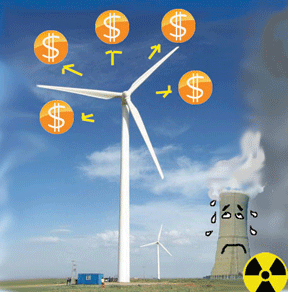 Which Is More Scalable, Nuclear Energy Or Wind Energy? Forbes, 22 Aug 14 Answer by Mike Barnard, Senior Fellow – Wind, E&PI,on Quora,
China is the true experiment for maximum scalability of nuclear vs wind. It has a tremendous gap between demand and generation. It can mostly ignore democracy and social license for nuclear. It is building both wind and nuclear as rapidly as possible. It has been on a crash course for both for about the same period of time. It has bypassed most of the regulatory red tape for nuclear.
So how is it doing?
- China turned on just over 16 GW of nameplate capacity of wind generation in 2013 according to the Global Wind Energy Council.
- Over the four years of 2010 to 2014, China managed to put 4.7 GW of nuclear intooperation at the Qinshan Phase II, Ling Ao Phase II, Ningde, Hongyanhe and Yangjiang plants. This is not their stated plans for nuclear, which had them building almost double this in 2013 alone and around 28 GW by 2015, but the actual plants put into production. The variance between the nuclear roadmap and nuclear reality in China is following the trajectory of nuclear buildout worldwide: delays, cost overruns, and unmet expectations.
- Modern wind turbines have a median 40.35% capacity factor and exceed 50% in the best wind resources according to the US National Renewable Energy Laboratory (NREL) who track the actuals on this sort of thing.
- Taking similarly sourced numbers for nuclear capacity factor from the Nuclear Energy Institute, we see 90.9% capacity factors for nuclear reactors. These are apples-to-apples statistics from the same country.
Running the math, that’s about 6.5 GW of real capacity of wind energy in one year vs 4.3 GW of real capacity for nuclear over four years. That’s roughly six times more real wind energy capacity than nuclear per year. 2014 might be better than average as perhaps 2 GW have been made operational this year. We’ll see what reality brings as wind energy is being expanded rapidly as well. So far nuclear is losing the race badly.
No other geography is capable of building as much nuclear per capita as China is. In the most pro-nuclear geography in the world with the most relaxed regulatory regime, the nuclear industry is being outstripped by the wind industry…………http://www.forbes.com/sites/quora/2014/08/22/which-is-more-scalable-nuclear-energy-or-wind-energy/
Nuclear-armed hypersonic glider test fails: China.
China’s second test of nuclear-armed hypersonic glider fails SCMP, Minnie Chan
A US-based news website, the Washington Free Beacon, reported on this month’s test on Tuesday, quoting unnamed American government officials.
Hong Kong still restricting foodstuffs imported from Japan’s irradiated areas
 The government of Hong Kong rejected Japanese request to lift restriction on Japanese imports http://fukushima-diary.com/2014/08/government-hong-kong-rejected-japanese-request-lift-restriction-japanese-imports/ Iori Mochizuki On 8/13/2014, Hayashi, the Minister of Agriculture, Forestry and Fisheries visited Hong Kong to request the government of Hong Kong to lift the restriction on Japanese imports however Ko Wing Man, the chief of the department of food and hygiene rejected the offer.
Since Fukushima accident, the government of Hong Kong stop importing vegetables, fruits, milk, milk based drinks and powdered milk from 5 prefectures to consist of Fukushima, Ibaraki, Tochigi, Gunma and Chiba.
Ko Wing Man commented “Lifting the restriction is difficult at this moment.”.
China’s fast development of big and small solar energy systems
China adds Australian-levels of solar capacity in clean energy push, http://www.smh.com.au/business/carbon-economy/china-adds-australianlevels-of-solar-capacity-in-clean-energy-push-20140808-101qe4.html#ixzz39rGnpkOv August 8, 2014 – Bloomberg NewsChina, the world’s biggest carbon emitter, accelerated solar power installations in the first half, adding enough capacity in the period to equal Australia’s entire supply of power from sunlight at the end of last year.
China added 3.3 gigawatts of solar capacity in the six months ended June 30, double last year’s additions, the National Energy Administration said today in a statement.
China now has 23 gigawatts of solar power supply, almost seven times as much as Australia, which is described by its own government as the world’s highest recipient of radiation per square meter.
China’s race to add renewable energy comes as policymakers push for ways to combat the nation’s growing problem of air pollution. Just this week, Beijing ordered official vehicles off the road and urged the use of public transport to ensure smog- free skies for a preparatory meeting ahead of an Asia-Pacific Economic Cooperation summit in November.
Utility-scale photovoltaic power plants accounted for 2.3 gigawatts of the new capacity in the first half, with distributed projects comprising the remainder, the NEA said.
The northwestern region of Xinjiang led the way, with 900 megawatts of photovoltaic power plants in the first six months. Xinjiang was followed by Inner Mongolia, Qinghai and Shanxi. The eastern province of Jiangsu added 270 megawatts of distributed solar capacity, according to the NEA.
Distributed solar
Distributed generation refers to electricity produced at or near where it’s used. In the case of solar, distributed projects typically include rooftops or ground-mounted panels near facilities such as sporting arenas or municipal buildings.
The agency vows to install 13 gigawatts of solar power capacity this year by supporting the development of distributed solar power generation, Xinhua News Agency reported August 5, citing Wu Xinxiong, the NEA’s head.
China may announce policies as soon as this month to encourage such installations, people familiar with the matter, who asked not to be identified because they aren’t authorized to speak publicly, said earlier this week.
“Demand will be quite positive” from August in China, Xie Jian, president of JA Solar Holdings Co., said in an interview last month.
China is developing wind energy much more than nuclear energy
Wind Energy Beats Nuclear & Carbon Capture For Global Warming Mitigation Clean Technica July 29th, 2014 by Mike Barnard “……….
What is the reality of nuclear vs wind built out?
 China turned on just over 16 GW of nameplate capacity of wind generation in 2013 according to the Global Wind Energy Council.
- Over the four years of 2010 to 2014 China managed to put 4.7 GW of nuclear into operation. This is not their stated plan for nuclear which is much higher, but the actual generation capacity put into production.
- Modern wind turbines have a median 40.35% capacity factor and exceed 50% in the best wind resources according to the US National Renewable Energy Laboratory (NREL) who track the actuals on this sort of thing.
- Taking similarly sourced numbers for nuclear capacity factor from the Nuclear Energy Institute, we see 90.9% capacity factors for nuclear reactors. These are apples-to-apples statistics from the same country.
Running the math, that’s about 6.5 GW of real capacity of wind energy in one year vs 4.3 GW of real capacity for nuclear over four years. That’s roughly six times more real wind energy capacity than nuclear per year. 2014 might be better than average as perhaps 2 GW have been made operational this year. We’ll see what reality brings as wind energy is being expanded rapidly as well.
Comparing 2013 only we see over six times as much real capacity from wind energy as from nuclear. There’s no reason to believe that this will change significantly as years slide by, as China is well below projections for new nuclear generation in operation, much like most jurisdictions’ experiences with the realities of getting nuclear to work.
No other geography is capable of building as much nuclear per capita as China is. India’s track record as the next biggest source of nuclear growth is poor as well, as they’ve only managed to build 4.2 GW in several decades.
Globally nuclear capacity has diminished and is expected to continue to diminish over the next few years as France shuts off 33% of its fleet in favour of mostly wind energy, Germany shuts off its fleet, Ontario intends to move from 55% to 42% supply from nuclear according to its draft long term energy plan and aging reactors globally reach end-of-life with no economic refurbishment possible. In empirical terms it doesn’t matter what anybody claims is possible: wind energy is growing rapidly while nuclear is going backwards. That’s reality.
Meanwhile, most geographies are perfectly capable of building wind farms and are, with utility-scale wind generation in 100 countries so far. For the past five years wind energy has averaged 40 GW of new operational nameplate capacity according to GWEC or 16 GW of median capacity and that is expected to grow………. http://cleantechnica.com/2014/07/29/wind-energy-beats-nuclear-carbon-capture-global-warming-mitigation/
China to get “zombie” Canadian nuclear reprocessing, from SNC Lavalin
SNC-Lavalin seeks to expand nuclear enterprise in China SHAWN MCCARTHY – GLOBAL ENERGY REPORTEROTTAWA — The Globe and Mail Apr. 13 2014,SNC-LAVALIN INC. IS HOPING TO REVITALIZE ITS INTERNATIONAL NUCLEAR BUSINESS THROUGH AN EFFORT WITH ITS CHINESE PARTNERS TO BURN REPROCESSED FUEL IN A CANDU REACTOR AS A WAY TO REDUCE RADIOACTIVE WASTE.
Officials from Candu Energy Inc. are leading a Canadian nuclear industry mission to China this week, which will include a visit Monday to the Qinshan nuclear power station south of Shanghai where two heavy-water Candu 6 reactors are in operation. Candu Energy is the former Atomic Energy of Canada Ltd., and is now wholly owned by SNC-Lavalin……..
Critics contend the Candu 6 is an outdated design that lacks safety features included in newer reactors, and that it is a technology that the international marketplace has largely rejected since the 1990s.
“So yeah, the industry is trying to say Candu isn’t dead. Never say die,” said Shawn-Patrick Stensil, a nuclear campaigner at Greenpeace Canada. “If Candu isn’t dead, it’s a zombie.”
Nuclear Gambling with Earth’s future
Sino-American rivalry: Energy consumption, nuclear energy and deadly nukes Dr. Can Erimtan is an independent scholar residing in İstanbul, with a wide interest in the politics, history and culture of the Balkans and the Greater Middle East. He tweets at @theerimtanangle July 10, 2014“……….. not content with just matching Chinese commitment to fossil fuel imports and consumption by means of production, the Obama administration also “incentivizes oil, gas, and coal production overseas by providing billions of dollars in favorable financing each year to fossil fuel projects through its participation in multilateral development bank lending as well as bilateral financing through the US Export-Import Bank and the Overseas Private Investment Corporation … Since President Obama was elected, US financing of fossil fuel projects overseas through these international financial institutions has increased by 14 percent from $4.1 billion in 2009 to $4.7 billion in 2013, having declined from a peak of $6.3 billion in 2012.
Both global powerhouses thus appear to persist in gambling with the Earth’s future. In fact, American and Chinese willingness to continue playing with fire is also demonstrated by their actions in the field of nuclear energy and weapons. Some time ago, the award-winning journalist Ken Silverstein wrote in the Christian Science Monitor that the “Obama administration wants to seed the United States with pint-size nuclear reactors … The US Department of Energy said it would provide $217 million in matching funds over five years to [the private company] NuScale, which builds small, ready-made reactors that can be strung together”. These pint-size nuclear reactors would be added to the already existing “100 commercial nuclear power reactors [that] are licensed to operate at 62 sites in 31 States.”
Meanwhile, in China 20 nuclear power reactors are in operation, with a further 28 under construction, and even more about to start construction. The recent Fukushima disaster in Japan (11 March 2011) and the now-legendary Chernobyl disaster in the Ukraine (26 April 1986) provide ample evidence that the mere principle of nuclear energy seems patently absurd: in order to boil water to operate some turbines, nuclear material is fused to produce high levels of energy (or heat) that is then put to use to boil water basically, or to put it in more formal words, as can be found on the website Three Mile Island (named after another famous nuclear mishap on 28 March 1979): the “only purpose of a nuclear power plant is to produce electricity. To produce electricity, a power plant needs a source of heat to boil water which becomes steam. The steam then turns a turbine, the turbine turns an electrical generator, and the generator produces electricity”. And the dangers of nuclear radiation are manifold, as explained by Dr. Helen Caldicott, the well-known Australian anti-nuclear advocate: “[n] dose of radiation is safe. Each dose received by the body is cumulative and adds to the risk of developing malignancy or genetic disease … Children are ten to twenty times more vulnerable to the carcinogenic effects of radiation than adults. Females tend to be more sensitive compared to males, whilst fetuses and immuno-compromised patients are also extremely sensitive … High doses of radiation received from a nuclear meltdown or from a nuclear weapon explosion can cause acute radiation sickness, with alopecia, severe nausea, diarrhea and thrombocytopenia”.
All in all, the US and China seem well-matched in their dedication to endangering the continued existence of humanity on this earth: either by their use and propagation of fossil fuels leading to disastrous climate change. Or by sticking to nuclear energy as an alternative, which is a dangerous proposition to begin with, while the issue of the resultant nuclear waste material has not even been touched upon.
The military perspective
Even more ominous is the continued presence of nuclear arsenals in the US as well as in China. During the Cold War the US and the Soviet Union superpowers adhered to the principle of mutually assured destruction, which meant that the whole world was basically kept hostage to a game of chicken. Now that the Cold War is over, one would think that these nuclear warheads would finally be confined to the dustbin of history. Alas, nothing seems further from the truth, as the US still deploys about 2,000 strategic warheads, with even more in reserve.
Just the other day, the Associated Press (AP) released a timely report on America’s still-existing nuclear arsenal,http://rt.com/op-edge/171824-sino-american-rivalry-energy/
1 This Month



26 September – International Day for the Total Elimination of Nuclear Weapons


PLEASE OPPOSE HR 8255 AND S.3639 – bills would accelerate satellite deployment, with no environmental review or safeguards – https://ncstd5li.quorum.us/campaign/169331/
To see nuclear-related stories in greater depth and intensity – go to https://nuclearinformation.wordpress.com
-
Archives
- September 2026 (219)
- August 2026 (330)
- July 2026 (355)
- June 2026 (287)
- May 2026 (306)
- April 2026 (356)
- March 2026 (251)
- February 2026 (267)
- January 2026 (308)
- December 2025 (358)
- November 2025 (359)
- October 2025 (375)
-
Categories
- 1
- 1 NUCLEAR ISSUES
- business and costs
- climate change
- culture and arts
- ENERGY
- environment
- health
- history
- indigenous issues
- Legal
- marketing of nuclear
- media
- opposition to nuclear
- PERSONAL STORIES
- politics
- politics international
- Religion and ethics
- safety
- secrets,lies and civil liberties
- spinbuster
- technology
- Uranium
- wastes
- weapons and war
- Women
- 2 WORLD
- ACTION
- AFRICA
- Atrocities
- AUSTRALIA
- Christina's notes
- Christina's themes
- culture and arts
- Events
- Fuk 2022
- Fuk 2023
- Fukushima 2017
- Fukushima 2018
- fukushima 2019
- Fukushima 2020
- Fukushima 2021
- general
- global warming
- Humour (God we need it)
- Nuclear
- RARE EARTHS
- Reference
- resources – print
- Resources -audiovicual
- Weekly Newsletter
- World
- World Nuclear
- YouTube
-
RSS
Entries RSS
Comments RSS
 nuclear-news