Decades to solve problems of Thorium nuclear reactors
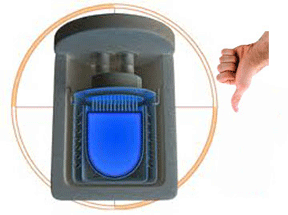 South China Morning Post, 19 March 14 ……….Researchers working on the project said they were under unprecedented “war-like” pressure to succeed and some of the technical challenges they faced were difficult, if not impossible to solve in such a short period.
They would also probably face opposition from sections of the Chinese public after the nuclear disaster at Fukushima in Japan….One of the technical difficulties is that the molten salt produces highly corrosive chemicals such as fluoride that could damage the reactor.
The power plant would also have to operate at extremely high temperatures, raising concerns about safety. In addition, researchers have limited knowledge of how to use thorium.
“We are still in the dark about the physical and chemical nature of thorium in many ways,” said Li. “There are so many problems to deal with but so little time.”
Western countries such as the United States have experimented with thorium reactors but gave up on the technology because of the engineering difficulties………
One of the technical difficulties is that the molten salt produces highly corrosive chemicals such as fluoride that could damage the reactor.
The power plant would also have to operate at extremely high temperatures, raising concerns about safety. In addition, researchers have limited knowledge of how to use thorium.
“We are still in the dark about the physical and chemical nature of thorium in many ways,” said Li. “There are so many problems to deal with but so little time.”
Western countries such as the United States have experimented with thorium reactors but gave up on the technology because of the engineering difficulties……The thorium reactors would need years, if not decades, to overcome the corrosion issue and the stability of accelerator-driven plants was also in doubt, he said.
“These projects are beautiful to scientists, but nightmarish to engineers,” he said…….After the Fukushima nuclear disaster three years ago, the central government withheld approval for new nuclear plants.
Part of the resistance came from the public, as many people were worried that nuclear plants would cause more serious contamination than the pollution created by coal-fired stations, Gu said.
Government agencies such as the Ministry of Water Resources also opposed the construction of nuclear plants in land-locked areas over concerns that radioactive waste would worsen river pollution.
Wind power racing ahead of nuclear in China
Why is Wind Power Generation Surpassing Nuclear? One of the reasons why nuclear power has not kept up with wind in China is the relative time it takes to get a project up and running. Whereas the typical Chinese nuclear reactor takes roughly six years to build, a wind farm can be completed in a matter of months.
 Wind Leaves Nuclear Behind In China http://cleantechnica.com/2014/03/13/wind-leaves-nuclear-behind-china/By J. Matthew Roney In China, wind power is leaving nuclear behind. Electricity output from China’s wind farms exceeded that from its nuclear plants for the first time in 2012, by a narrow margin. Then in 2013, wind pulled away—outdoing nuclear by 22 percent. The 135 terawatt-hours of Chinese wind-generated electricity in 2013 would be nearly enough to power New York State. Once China’s Renewable Energy Law established the development framework for renewables in 2005, the stage was set for wind’s exponential growth. Wind generating capacity more than doubled each year from 2006 to 2009 and has since increased by nearly 40 percent annually, to reach 91 gigawatts by the end of 2013 (1 gigawatt = 1,000 megawatts). Over 80 percent of this world-leading wind capacity is now feeding electricity to the grid.
Wind generation in 2013 could have been even higher, by an estimated 10 percent, but for the problem known as curtailment—when wind turbines are stopped because the grid cannot handle any more electricity. To help reduce curtailment and reach the official 2020 goal of 200 grid-connected gigawatts, China is building the world’s largest ultra-high-voltage transmission system. The raft of projects now under construction will connect the windier north and west to population centers in the central and eastern provinces. Continue reading
China’s repressive policies in Tibet
 Human Rights Watch chides China for enforcing highly repressive policies in Tibet http://tibet.net/2014/01/23/human-rights-watch-chides-china-for-enforcing-highly-repressive-policies-in-tibet-2/ DHARAMSHALA: China’s policies in Tibet once again came under criticism from Human Rights Watch, which says in annual report released on Tuesday that the Chinese government systematically suppresses Tibetan political, cultural, religious and socio-economic rights.
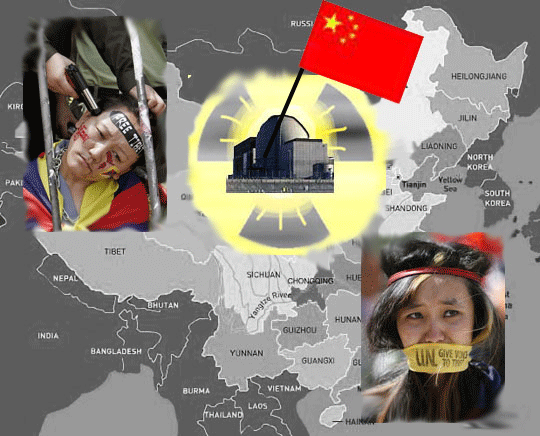 The Chinese government systematically suppresses Tibetan political, cultural, religious and socio-economic rights in the name of combating what it sees as separatist sentiment including non-violent advocacy for Tibetan independence, the Dalai Lama’s return, or opposition to government policy, the report said.
“Arbitrary arrest and imprisonment remains common, and torture and ill-treatment in detention is endemic. Fair trials are precluded by politicised judiciary overtly tasked with suppressing separatism,” it said.
“The Chinese government carries out involuntary population relocation and rehousing on a massive scale, and enforces highly repressive policies in ethnic minority areas in Tibet, Xinjiang, and Inner Mongolia,” Human Rights Watch said in its report.
“The government is also subjecting millions of Tibetans to a mass rehousing and relocation policy that radically changes their way of life and livelihoods, Continue reading
Solar PV installation at record high in China
China’s solar PV installations soared to record in 2013 http://www.smh.com.au/business/carbon-economy/chinas-solar-pv-installations-soared-to-record-in-2013-20140124-31cck.html Developers in China installed a record 12 gigawatts of solar panels last year, almost matching the total amount of solar power in operation in the U.S., and may exceed that this year, according to Bloomberg New Energy Finance.
The power plants were built mostly in the sunny, western provinces of Gansu, Xinjiang and Qinghai and make China’s state-owned power companies the world’s biggest owners of solar assets, the London-based research company said today in a statement.
China was the biggest solar market last year, surpassing longtime leader Germany. Chinese installation more than tripled from 3.6 gigawatts in 2012, and the nation expects to add 14 gigawatts of solar capacity this year, according to New Energy Finance.
China led a 28 per cent increase in global solar installations last year of 39 gigawatts, and total installation may increase another 20 per cent this year, according to the statement. Before 2013, no nation had ever installed more than 8 gigawatts of solar power in a year.
China blocking “inconvenient” foreign news sites
China blocks foreign news sites that revealed elite’s offshore holdings Guardian among sites blocked over reports • China Digital Times publishes details of directive Tania Branigan in Beijing and James Ball in New York theguardian.com, Thursday 23 January 2014
The blocking of foreign news sites that revealed details of offshore holdings by the relatives of senior leaders has continued in China as reports emerged of a propaganda directive ordering websites and services to target users posting on the subject.
Details of the order were published by China Digital Times, a website that monitors censorship instructions.
“Immediately find and remove the foreign media report “China’s Secret Offshore Tax Havens” and related content. Interactive platforms must strictly check [users]. Related images and accusatory comments about leaders and the system [of government] must be deleted without exception,” said the instructions, according to CDT.
“Block the [user] IDs of those who have an evil influence and coordinate on-the-ground investigations with the relevant departments.”…http://engineeringevil.com/2014/01/23/china-blocks-foreign-news-sites-that-revealed-elites-offshore-holdings/
Thorium nuclear reactors for military use, too, funded by USA and Chinese tax-payers
 SPECIAL REPORT-The U.S. government lab behind China’s nuclear power push Dec 20, 2013 Dec 20 (Reuters) – Scientists in Shanghai are attempting a breakthrough in nuclear energy: reactors powered by thorium, an alternative to uranium.
 The project is run by the Chinese Academy of Sciences, a government body with close military ties that coordinates the country’s science-and-technology strategy. The academy has designated thorium as a priority for China’s top laboratories. The program has a budget of $350 million. And it’s being spearheaded by the influential son of a former Chinese president.
But even as China bulks up its military muscle through means ranging from espionage to heavy spending, it is pursuing this aspect of its technology game plan with the blessing – and the help – of the United States. Read more »
China marketing nuclear technology to Pakistan
 How Pakistan and China Are Strengthening Nuclear Ties http://world.time.com/2013/12/02/how-pakistan-and-china-are-strengthening-nuclear-ties/?iid=gs-main-lead
The reactors are expected to start supplying 2,200 megawatts to the grid by 2019. The complex is not the first energy investment or nuclear project in Pakistan that China has been involved with, but it will be by far the largest.
 The nuclear power relationship between Pakistan and China is widely seen as a continuing effort to respond to the India-U.S. civilian nuclear deal, which, among other things, ended a decades-long moratorium on U.S. companies selling nuclear technology to India, despite India not being a signatory to the Nuclear Non-Proliferation Treaty. The move rankled Pakistan, which has also not signed the treaty and worries about a nuclear buildup by a country it considers its archenemy. China, too, criticized the deal for, it asserted, undermining nonproliferation. That the U.S. was building ties with India to counterbalance China’s growing power in Asia was probably not lost on Beijing either.
USA nuclear missile arsenal far outweighs China’s
Admiral: China Nuclear Missile Submarine Threat is Not Credible Says U.S. nuclear-armed missile submarines remain a powerful deterrent Washington Free Beacon, BY: Bill Gertz November 16, 2013 SIMI VALLEY, Calif. — China’s recent threat to use submarine-launched nuclear missiles to attack U.S. cities lacks credibility, the Navy’s top admiral said on Saturday.
“For a submarine-launched ballistic missile to be effective it has to be accurate, and you have to be stealthy, and survivable and I’ll leave it at that,” Adm. Jonathan Greenert, chief of naval operations, said when asked about publication in China’s state-run press last month of plans for killing between 5 million and 12 million Americans in a nuclear strikes.
Greenert said U.S. nuclear-armed missile submarines remain a powerful deterrent despite an aging U.S. nuclear arsenal and the urgent need to upgrade those forces in the face of sharp defense spending cuts……http://freebeacon.com/admiral-china-nuclear-missile-submarine-threat-is-not-credible/
China will have controlling interest in UK’s nuclear power!
 Britain’s debt to foreign power: China’s nuclear revolution George Osborne has effectively handed the nation’s nuclear industry over to Chinese and French giants Telegraph, By Geoffrey Lean 18 Oct 2013 How’s this for a turn-up
  for the books? A Conservative Chancellor, promoter of free markets and defender of national sovereignty, is boasting of “allowing” (a euphemism, it seems, for “begging”) a totalitarian Communist country to build nuclear power stations in Britain.
It will all start – under a deal expected to be finalised next week – with the state-owned China General Nuclear Power joining the equally nationalised Electricité de France (EDF) in constructing a £14 billion brace of reactors at Hinkley Point in Somerset. The Chinese will have a minority share in the project, but have made it clear – and George Osborne accepts this – that they should have a controlling interest in future schemes.
So, much of Britain’s highly sensitive nuclear industry – which sprang from the atomic bomb programme – is effectively to be owned by two foreign powers, one the country’s oldest traditional enemy, the other a bitter Cold War opponent. Few other nations, and certainly not China, would dream of permitting anything of the kind. Doesn’t Mr Osborne see that this could be a bit radioactive, shall we say? Continue reading
Unusual cancers in Xinjiang, China’s nuclear test area
China’s top-secret nuclear base to be revived as £30m Communist Party theme park, Telegraph, 7 Nov 13 One of China’s most secret military compounds is undergoing an unlikely transformation into a “red tourism” theme park for Communist Party aficionados By Tom Phillips, Red Mountain Command Base, Xinjiang“………According to a report by the Stockholm International Peace Research Institute earlier this year, China now possesses around 250 of the world’s estimated 17,270 nuclear weapons and and appears to be expanding its nuclear arsenal…….
A “Political Department Exhibit Hall” will display the official narrative but there is no indication its displays will delve into the long-hidden controversies surrounding the tests’ human cost.
 As early as 1981 Beijing-based diplomats began whispering about fears of a hidden nuclear catastrophe in Xinjiang.
Citing one local official, Canada’s Globe and Mail reported “lung, liver and skin cancer has greatly increased in the area, touching off increased fears of [nuclear] contamination”. A number of cancer patients had been sent to Beijing for “special study”, the newspaper added.
In the absence of any public investigation such concerns have persisted. In 1998, a team of Channel Four journalists accused Beijing of a systematic cover-up after they obtained evidence pointing to a dramatic rise in the number of cancer cases in the region since 1965, the year after China’s first nuclear test.
“Basically, cancer is everywhere in Xinjiang,” one local doctor told the programme, adding: “We can’t do research into it. It’s not allowed.”
Beijing rejected that report as “sheer fabrication”. But a 2008 study by a Japanese scholar claimed up to 190,000 people may have died from illnesses linked to radiation.
Local officials say there is no risk of lingering radiation at the Red Mountain theme park and some tourists are already making the pilgrimage to the birthplace of China’s nuclear arsenal….. http://www.telegraph.co.uk/news/worldnews/asia/china/10433364/Chinas-top-secret-nuclear-base-to-be-revived-as-30m-Communist-Party-theme-park.html
Secrecy still surround China’s revamped nuclear test base

 China’s top-secret nuclear base to be revived as £30m Communist Party theme park, Telegraph, 7 Nov 13 One of China’s most secret military compounds is undergoing an unlikely transformation into a “red tourism” theme park for Communist Party aficionados By Tom Phillips, Red Mountain Command Base, Xinjiang
“…… Nearly half a century ago, the base was one of the most highly classified locations on earth: a heavily-guarded compound in Xinjiang province where scientists toiled day and night to catapult Chairman Mao’s China into the nuclear elite, alongside the US, the USSR, France and Britain.
With the US and the Soviet Union locked in a Cold War arms race, Mao decided China needed a bomb of its own to fend off what he saw as imperialist bullying.
And it was here, on the sand-swept fringes of the Taklamakan desert, that some of China’s most brilliant military and scientific minds gathered to plot a nuclear revolution of almost inconceivable speed that would change their country forever.
In 1964, just five years after the command centre was set up, PLA scientists detonated China’s first atom bomb at a nearby testing site – a 22-kiloton blast that set the desert sky alight and sparked jubilant celebrations in Beijing.
Today, almost 50 years on, the top-secret facility where the test was partly conceived lies largely abandoned…….Extraordinarily, after years of neglect, plans are now afoot to transform this scruffy compound into a 300 million yuan (£30 million) “red tourism” destination. Continue reading
Does China have secret tunnels of nuclear warheads?
China ‘hiding up to 3,000 nuclear warheads in secret tunnels’, Telegraph, 01 Dec 2011
An unconventional project by US university students has concluded that China’s nuclear arsenal could be many times larger than current estimates, drawing the attention of Pentagon analysts. The Washington Post reported on Tuesday that Georgetown University students under the instruction of a former Pentagon official have assembled the largest body of public knowledge yet about a vast network of secret tunnels dug by China’s secretive Second Artillery Corps, responsible for nuclear warheads.
The 363-page study has not yet been published, but has already sparked a congressional hearing and been circulated among top US defence officials, including the Air Force vice chief of staff, the Post reported…….. the students were able to obtain a 400-page manual produced by the Second Artillery and usually only available to Chinese military personnel.The students’ professor, Phillip Karber, 65, spent the Cold War as a top strategist reporting directly to the secretary of defence and the chairman of the Joint Chiefs of Staff, the Post said.
Karber said that – based on the study of the tunnels – China could have up to 3,000 nuclear warheads, far higher than the current estimates, which range from 80 to 400, according to the Post.
US officials could not immediately be reached to comment on the report. http://www.telegraph.co.uk/news/worldnews/asia/china/8927580/China-hiding-up-to-3000-nuclear-warheads-in-secret-tunnels.html
How long can China’s nuclear industry stay “safe”?
 Chinese nuclear disaster ‘highly probable’ by 2030 The Ecologist, He Zuoxiu 25th October 2013 “……But if China sticks to plans to build another 30 third-generation power stations between 2015 and 2020, the risks rocket. No AP1000 reactors – one of the key third-generation designs – have yet been built anywhere in the world, meaning there are no reactor-years of experience. Only the figures of 267 reactor-years from Three Mile Island’s 267 reactor years and Chernobyl’s 162 reactor-years can be used as reference.
Even if we take the larger of those numbers, that brings the “most probable” period for a nuclear accident in China forward to between 2020 and 2030.
Some may say that “theoretically” third-generation reactors are safer than their second-generation equivalents. In fact, these 30 nuclear power plants will use reactors that have not been operationally tested. They are all being built inland and all face problems with water supply. Several third-generation plants, including Pengze in Jiangxi and Taohuajiang in Hunan, each with six reactors, cheated during the environmental impact assessment process, with no action taken by the National Nuclear Safety Administration.
For safety’s sake, it would be better to stop at 41 reactors, a number due to be reached in 2015. The Great Leap Forward mentality
Why did the US and former Soviet Union see nuclear accidents so soon? Apart from a lack of experience and immature technology, another factor was the Cold War mentality – both were fighting to be the world’s number one nuclear power.
Similar attitudes exist in China today. Nuclear decision-makers aim to build up to 500 nuclear power stations by 2050, exceeding the current global total of 443, and allowing the country to claim the world’s number one spot.
This is nothing but Great Leap Forward thinking. If these attitudes continue, we will likely see “most probable” will become the “actual”.
This article was first published by China Dialogue under a Creative Commons “Some Rights Reserved” licence. http://www.theecologist.org/News/news_analysis/2133281/chinese_nuclear_disaster_highly_probable_by_2030.html
China’s nuclear safety prospects are not good
China is projected to have 71 nuclear power stations by 2020. If we use the figure of 4,922 reactor-years as explained above, then China will “most probably” suffer a major nuclear accident within the next 69 years.
Chinese nuclear technology can be regarded as approaching global levels, with similar design, safety and operational standards. But to reduce costs, Chinese designs often cut back on safety. In the past, earthquake-resilience was lower than in Japan, for example. China also has much less experience of this sector than Japan.
Chinese nuclear disaster ‘highly probable’ by 2030 The Ecologist, He Zuoxiu 25th October 2013 As the UK prepares to build a fleet of new nuclear power stations with Chinese capital and expertise, a former state nuclear expert warns: China itself is heading for nuclear catastrophe. Some members of the nuclear power industry rely too much on theoretical calculations, when only experience can provide real accuracy.
The lifetime of nuclear reactors is calculated in “reactor-years”. One reactor year means one reactor operating for one year. The world’s 443 nuclear power plants have been running for a total of 14,767 reactor-years, during which time there have been 23 accidents involving a reactor core melting. That’s one major accident every 642 reactor years.
But according to the design requirements, an accident of that scale should only happen once every 20,000 reactor years. The actual incidence is 32 times higher than the theory allows. Continue reading
China’s legacy of radioactive pollution from rare earths processing
Whole villages between the city of Baotou and the Yellow River in Inner Mongolia have been evacuated and resettled to apartment towers elsewhere after reports of high cancer rates and other health problems associated with the numerous rare earth refineries there.
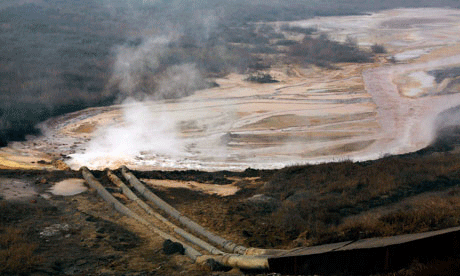
China Tries to Clean Up Toxic Legacy of Its Rare Earth Riches NYT By KEITH BRADSHER : October 22, 2013 TIANJIN, China — In northern China, near the Mongolian border, radioactively contaminated leaks from two decades of rare earth refining have been slowly trickling underground toward the Yellow River, a crucial water source for 150 million people. In Jiangxi province in south-central China, the national government has seized control of rare earth mining districts from provincial officials after finding widespread illegal strip-mining of rare earth metals.
And in Guangdong province in southeastern China, regulators are struggling to repair rice fields and streams destroyed by powerful acids and other runoff from open-pit rare earth mines that are often run by violent organized crime syndicates.
Communities scattered across China face heavy environmental damage that accumulated through two decades of nearly unregulated rare earth mining and refining. While the Chinese government has begun spending billions of dollars to clean up the damage, the environmental impact is becoming an international trade issue, with a World Trade Organization panel in Geneva expected to issue a crucial draft report on Wednesday……. The rare earth case “will be a landmark case in terms of both export restrictions and the environment,” said James Bacchus, the former two-term chairman of the W.T.O. appeals tribunal in Geneva. Continue reading
1 This Month



26 September – International Day for the Total Elimination of Nuclear Weapons


PLEASE OPPOSE HR 8255 AND S.3639 – bills would accelerate satellite deployment, with no environmental review or safeguards – https://ncstd5li.quorum.us/campaign/169331/
To see nuclear-related stories in greater depth and intensity – go to https://nuclearinformation.wordpress.com
-
Archives
- September 2026 (219)
- August 2026 (330)
- July 2026 (355)
- June 2026 (287)
- May 2026 (306)
- April 2026 (356)
- March 2026 (251)
- February 2026 (267)
- January 2026 (308)
- December 2025 (358)
- November 2025 (359)
- October 2025 (375)
-
Categories
- 1
- 1 NUCLEAR ISSUES
- business and costs
- climate change
- culture and arts
- ENERGY
- environment
- health
- history
- indigenous issues
- Legal
- marketing of nuclear
- media
- opposition to nuclear
- PERSONAL STORIES
- politics
- politics international
- Religion and ethics
- safety
- secrets,lies and civil liberties
- spinbuster
- technology
- Uranium
- wastes
- weapons and war
- Women
- 2 WORLD
- ACTION
- AFRICA
- Atrocities
- AUSTRALIA
- Christina's notes
- Christina's themes
- culture and arts
- Events
- Fuk 2022
- Fuk 2023
- Fukushima 2017
- Fukushima 2018
- fukushima 2019
- Fukushima 2020
- Fukushima 2021
- general
- global warming
- Humour (God we need it)
- Nuclear
- RARE EARTHS
- Reference
- resources – print
- Resources -audiovicual
- Weekly Newsletter
- World
- World Nuclear
- YouTube
-
RSS
Entries RSS
Comments RSS
 nuclear-news