China really part of te global nuclear marketing conglomerate
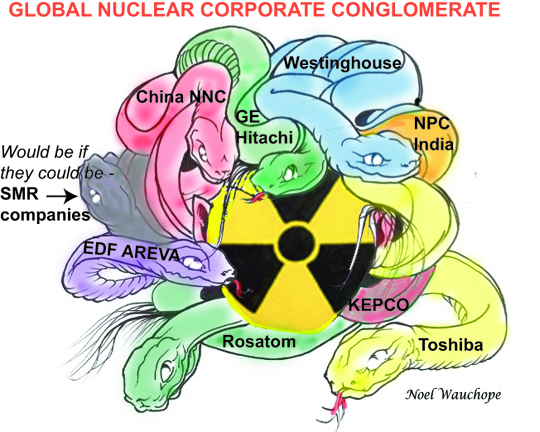
China plans to make nuclear energy tech a major export, Electric Light and Power 08/25/2016 By Joe McDonald Associated Press The Hualong One, developed by two state-owned companies, is one multibillion-dollar facet of the Communist Party’s aspirations to transform China into a creator of profitable technology from mobile phones to genetics.
Still, experts say Beijing underestimates how tough it will be for its novice nuclear exporters to sell abroad. They face political hurdles, safety concerns and uncertain global demand following Japan’s Fukushima disaster.
China’s government-run nuclear industry is based on foreign technology but has spent two decades developing its own with help from Westinghouse Electric Co., France’s Areva and EDF and other partners. A separate export initiative is based on an alliance between Westinghouse and a state-owned reactor developer……..
China’s status as an important market for global suppliers gives Beijing leverage in acquiring technology. Westinghouse, which was acquired by Japan’s Toshiba Corp. in 2006, Areva and France’s EDF have had partnerships with Chinese researchers since the early 1990s.
“I see them as customers, competitors and partners,” said Jeff Benjamin, Westinghouse’s senior vice president for new plants and major projects. Other global suppliers include GE Hitachi Nuclear Energy, South Korea’s KEPCO, Canada’s Candu Energy Inc. and Russia’s Atomstroyexport.
Westinghouse transferred technology for its latest reactor, the AP1000, to China’s State Nuclear Power Technology Corp. in 2007 as part of a transaction that included the sale of four reactors.
The AP1000 became the basis for future Chinese reactor development and Westinghouse agreed to sell reactors with SNPTC. The Chinese partner, which merged with another state company to form the State Power Investment Corp. last year, also developed its own, bigger version, the CAP1400.
The two companies are in talks with Turkey about selling four reactors based on the AP1000. The AP1000 has been approved by U.S. and British regulators, Benjamin said, while the CAP1400 is just beginning the review process. “We look forward to participating in the China market for many years to come,” he said. Abroad, “there will be markets either SPIC on their own or Westinghouse on our own might not have access to, but together we can gain access.” http://www.elp.com/articles/2016/08/china-plans-to-make-nuclear-energy-tech-a-major-export.html
China seriously overestimating the global market for their nuclear reactors
Beijing is “seriously underestimating” how hard global sales will be, said Schneider. He said obstacles include strict quality controls, regulations that differ from country to country and competition from the falling cost of wind and solar.
“There is simply no market out there,” said Schneider.
Overseas, China’s nuclear companies face questions over their status as arms of the state
 Here comes a new Chinese export: Nuclear reactors, CBS, 24 Aug 16 BEIJING – On a seaside field south of Shanghai, workers are constructing a nuclear reactor that’s the flagship for Beijing’s ambition to compete with the U.S., France and Russia as an exporter of atomic power technology.
The Hualong One, developed by two state-owned companies, is one multibillion-dollar facet of the Communist Party’s aspirations to transform China into a creator of profitable technology from mobile phones to genetics.
Still, experts say Beijing underestimates how tough it will be for its novice nuclear exporters to sell abroad. They face political hurdles, safety concerns and uncertain global demand following Japan’s Fukushima disaster.
China’s government-run nuclear industry is based on foreign technology but has spent two decades developing its own with help from Westinghouse Electric, France’s Areva and EDF, and other partners. A separate export initiative is based on an alliance between Westinghouse and a state-owned reactor developer.
The industry is growing fast, with 32 reactors in operation, 22 being built and more planned, according to the World Nuclear Association, an industry group. China accounted for eight of 10 reactors that started operation last year and six of eight construction starts.
Abroad, builders broke ground in Pakistan last year for a power plant using a Hualong One, supported by a $6.5 billion Chinese loan. Also last year, Argentina signed a contract to use the reactor in a $15 billion plant financed by Chinese banks.
Sales come with financing from state banks, a model that helped Chinese companies break into the market for building highways and other public works in Africa and the Middle East. State-owned companies also are lining up to invest in nuclear power plants in Britain and Romania.
“This is generating significant build-up of skills and industrial experience,” said Mycle Schneider, a nuclear energy consultant in Paris, in an email.
Still, Beijing is “seriously underestimating” how hard global sales will be, said Schneider. He said obstacles include strict quality controls, regulations that differ from country to country and competition from the falling cost of wind and solar.
“There is simply no market out there,” said Schneider.
At home, Beijing faces public unease about nuclear power following an avalanche of industrial accidents and product safety scandals.
This month, thousands of residents of Lianyungang, north of Shanghai, protested after rumors spread that a facility to process nuclear waste might be built there. Authorities said the city, home to one of China’s biggest nuclear power plants, was only one of several being considered. After more protests, they announced the search for a site was suspended.
Overseas, China’s nuclear companies face questions over their status as arms of the state………
China’s nuclear industry has yet to report a major accident but reflexive official secrecy makes it hard for outsiders to assess its safety.
Changes in Chinese-designed models based on foreign technology, such as making reactors bigger while using cooling techniques for smaller units, “raise questions about safety and the good judgment of Chinese reactor engineers,” said Edward Lyman, a nuclear power specialist for the Union of Concerned Scientists in Washington, in an email.
“It is crucial for countries importing Chinese nuclear technology to rigorously conduct their own oversight over the products they are buying,” Lyman said………http://www.cbsnews.com/news/here-comes-a-new-chinese-export-nuclear-reactors/
Chinese nuclear company Pushed U.S. Experts for Nuclear Secrets – says FBI
 FBI Files Say China Firm Pushed U.S. Experts for Nuclear Secrets , Bloomberg, David Voreacos davidvoreacos David McLaughlin damclaughAugust 25, 2016
-
China General Nuclear Power charged with conspiracy by U.S.
-
CGN is partner in delayed British Hinkley plant under review
-
A state-owned Chinese power company under indictment in the U.S. pressed American nuclear consultants for years to hand over secret technologies and documents they weren’t supposed to disclose — and in some cases it got them, several of the consultants have told the FBI.
Summaries of the consultants’ interviews with agents from the Federal Bureau of Investigation were filed this month in a federal court where the company, China General Nuclear Power Corp., has been charged with conspiring to steal nuclear technology.
The FBI documents surfaced shortly after the same company became a focus of concerns across the Atlantic: The U.K. last month delayed approval of the country’s biggest nuclear power station in a generation as questions swirled about whether China General Nuclear’s investment in the plant poses a security risk.
The filings provide a window into the tactics of CGN, China’s biggest nuclear power operator. One of the consultants said CGN employees asked for off-limits operational manuals to nuclear equipment and software, according to the interview summaries. Another said he was asked to provide proprietary temperature settings for material used to contain nuclear fuel. After he refused, he wasn’t offered more consulting jobs, he told the FBI…….. -
China Warning
While the U.S. court case doesn’t address the U.K. plant, the FBI interviews could add to concerns expressed by British officials like Nick Timothy, a close adviser to the new prime minister, Theresa May. Timothy warned last year that China’s involvement in nuclear projects there might allow it to “shut down Britain’s energy production at will.”
The prime minister hasn’t said why she put the brakes on the 18 billion pound ($24 billion) Hinkley Point plant in southwest England, a project one-third owned by CGN and led by Electricite de France SA. In addition to the security concerns, the project has faced criticism over its price tag and the above-market electricity rates that U.K. taxpayers would have to pay. Electricite de France declined to comment……….
-
U.S. Indictments
In the U.S., CGN was indicted along with Szuhsiung “Allen” Ho, an American nuclear engineer born in Taiwan who recruited the U.S. consultants for CGN. Ho and the company are accused in a federal court in Knoxville, Tennessee, of conspiring to help Beijing obtain restricted U.S. nuclear technology over two decades. Ho, 66, is also accused of acting as an unregistered agent of the Chinese government. He faces life in a U.S. prison in what prosecutors call an “extremely significant national security case.”
- Ho has pleaded not guilty. His lawyers say that he was merely helping China’s civil nuclear power industry and that he had no intent to break the law or steal U.S. secrets.
The case is unfolding as U.S. officials say they see Beijing’s hand in cyber-espionage, indicting five Chinese military officials in absentia in 2014 for allegedly stealing trade secrets from U.S. companies — including Westinghouse Electric Co., a unit of Japan’s Toshiba Corp. that designs nuclear power plants. Westinghouse, which didn’t respond to requests for comment, is the former employer of Ho and many of the experts he brought to China to consult for CGN……..http://www.bloomberg.com/news/articles/2016-08-25/fbi-files-say-china-firm-pushed-u-s-experts-for-nuclear-secrets
Perception that China is not to be trusted is hampering its nuclear marketing ambitions
Going Out’ to Hinkley Point? China’s Uncertain Future in International Energy China’s ambition to become a global energy power will have to overcome geopolitical hurdles, The Diplomat By Mykael Goodsell-SooTho August 18, 2016 “…….Recently, China has faced a number of setbacks which demonstrate several countries’ apprehension at the prospect of Chinese involvement in their energy infrastructure. Last week, the Australian government threw a wrench into the plans of China’s State Grid Corporation and Hong Kong’s Cheung Kong Infrastructure Holdings by preliminarily barring their bids for a controlling stake in Ausgrid, the country’s largest electricity network. This came just weeks after a similar decision by the U.K. government to postpone approval of the Hinkley Point C nuclear reactor project pending a comprehensive review of the plans. In both instances, officials have cited security concerns surrounding Chinese involvement in British and Australian energy infrastructure as primary reasons for the countries’ hesitance to conclude the deals. Whether or not these worries are well-founded, they constitute a significant obstacle to Chinese energy companies’ international ambitions.
Chinese executives charged with spying on USA nuclear technology, particularly Small Nuclear Reactor plans
US government accuses Hinkley point partner of nuclear espionage, SC Magazine, Max Metzger, Reporter, 12 Aug 16 Major partners in the controversial nuclear power plant at Hinkley Point have been accused in American courts of attempting to steal US nuclear technology. Fears over Chinese involvement in a new nuclear power plant at Hinkley Point have been reinforced as a major partner in the plant’s development has been accused by the US government of nuclear espionage.
Szuhsiung Ho, an advisor to the state-owned China General Nuclear Power (CGN) company, which would have a 33 percent stake in the new plant at Hinkley, has been charged with “conspiracy to unlawfully engage and participate in the production and development of special nuclear material outside the United States”.
Essentially, the US Department of Justice has accused Szuhsiung Ho, otherwise known as Allen Ho, of trying to steal US nuclear technology.
Ho, under orders from CGN, is supposed to have tried to get US nuclear experts to help develop nuclear material in China. According to a statement released by the DoJ, for nearly 20 years, between 1997 and 2016, Ho “identified, recruited and executed contracts with US-based experts from the civil nuclear industry who provided technical assistance related to the development and production of special nuclear material”.
Of particular interest to Ho and his co-conspirators was assistance with CGN’s programmes on small modular reactors, advanced fuel assembly and fixed in-core detectors.
If one is to act as an agent of a foreign power within the United States, their status must be declared to the US attorney general. Not only did Ho not do this but explicitly told those he was trying to recruit that he was acting on behalf of the Chinese state. The DoJ records him as telling his potential recruits that he was working surreptitiously to help China “to design their Nuclear Instrumentation System independently and manufacture them independently”.
None of the accusations have yet been proven but the charges could carry a sentence of life and a US$250,000 (£192,000) fine.
The case is being pursued by a number of US law enforcement agencies including the Department of Energy – National Nuclear Security Administration and the US Federal Bureau of Investigation (FBI). Executive assistant director of the FBI’s national security branch Michael Steinbach said in a statement, “The arrest and indictment in this case send an important message to the US nuclear community that foreign entities want the information you possess”.
“The federal government has regulations in place to oversee civil nuclear cooperation, and if those authorities are circumvented, this can result in significant damage to our national security. The US will use all of its law enforcement tools to stop those who try to steal US nuclear technology and expertise.”…….http://www.scmagazineuk.com/us-government-accuses-hinkley-point-partner-of-nuclear-espionage/article/515702/
Chinese City Backs Down on Proposed Nuclear Fuel Plant After Protests
BEIJING — Bowing to days of passionate street protests, a city government in eastern China said Wednesday that it had halted any plans to build a nuclear fuel plant there. The reversal was the latest indication of how public distrust could hold back China’s ambitious plans for expanding its nuclear power industry.
The government of Lianyungang, a city near the coast of Jiangsu Province, announced the retreat in a terse message online. “The people’s government of Lianyungang has decided to suspend preliminary work for selecting a site for the nuclear cycle project,” it read, referring to a proposed plant for reprocessing used fuel from nuclear plants.
No reason was given, but it appeared clear enough. In recent days, residents have taken to the streets to oppose any decision to build the plant nearby. The main urban area of Lianyungang is just 20 miles southwest of a large and growing nuclear power plant on the coast, but the idea of a nuclear fuel reprocessing facility also being built in the area seemed to push public unease to a new height.
A 21-year-old Lianyungang resident with the surname Tang said Wednesday that demonstrators had been chanting “Oppose nuclear waste, defend our home.” Like other people contacted there, she did not want her full name used, citing fear of reprisal for talking to reporters.
“Nobody wants this kind of thing built in their own home,” Ms. Tang said.
China’s authoritarian leaders are wary of local protests escalating into broader challenges to their power. But local governments have often given ground in the face of growing public opposition to chemical plants, waste incinerators and other potential sources of pollution. Now proposed nuclear projects are also becoming increasingly troublesome.
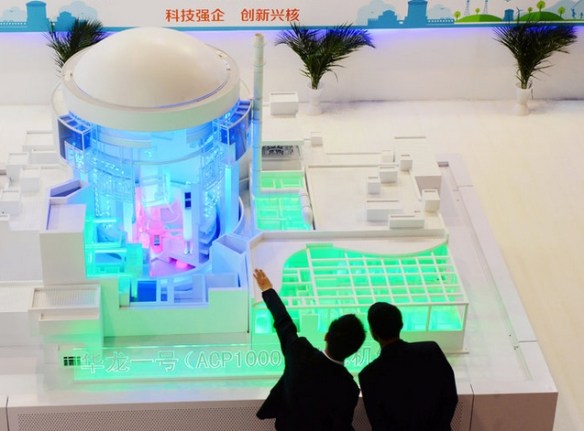
A model of a nuclear reactor on display at the stand for the China National Nuclear Corporation at an expo in Beijing last year. Across the country, the nuclear disaster in Fukushima, Japan, in 2011 has hardened public wariness of nuclear power.
“While the Chinese government does not hesitate to arrest the few political dissidents, it spends more time and energy to appease public demands,” Wenfang Tang, a professor of political science at the University of Iowa, who studies public opinion and politics in China, said in emailed comments.
“The high level of government sensitivity and responsiveness to public opinion further encourages political activism in Chinese society,” Professor Tang said. “The louder you are, the more quickly the government will respond.”
In Lianyungang and across China, the nuclear calamity in Fukushima, Japan, in 2011 has hardened public wariness of nuclear power, although the government argues that expanding the industry is essential for weaning the economy off coal, with all of its dangerous pollutants.
The biggest protest in Lianyungang took place on Saturday, when many thousands of people, including families with children, marched through the downtown area.
Despite warnings from the government, protests continued on a smaller scale this week, as residents defied ranks of riot officers with shields, according to news reports and video that people shared through social media.
“I told my daughter that she must go to this protest,” one resident said, according to Sixth Tone, an English-language news website based in Shanghai. “With every extra person, the momentum will get bigger.”
The announcement does not mean the nuclear fuel-reprocessing proposal is dead. The project is a collaboration between the China National Nuclear Corporation and a French company, Areva, and it has high-level government support, although no final agreement to build it has been signed. Five other Chinese provinces are under consideration for the initiative, and Lianyungang could lift its suspension. The two companies have said that they want to start building in 2020 and finish by 2030.
But in China, suspensions of contentious projects have a way of quietly turning into permanent cancellations, and Lianyungang appears likely to follow that pattern. The big question now will be whether public opposition coalesces in the five other areas under consideration.
All but one — Gansu Province in the northwest — is a heavily populated coastal province. Gansu is already home to China’s first civilian nuclear reprocessing plant, a small facility that has been held back by technical problems.
In 2013, officials jettisoned plans for a nuclear fuel fabrication plant in the southern province of Guangdong after protests. Preliminary proposals to build nuclear power plants inland have also ignited intense opposition.
The Chinese government has said that as it expands its fleet of nuclear power plants, it needs a plant for reprocessing spent fuel, a practice that separates unused plutonium and some uranium from waste. That unused material could be used to generate power, but critics have warned that the plutonium could be deployed for weapons. Japan has also built a full-scale reprocessing plant, but it has not started up yet.
On Chinese social media, and even on news websites, commentators said that the contention in Lianyungang showed that the public should have a bigger say in nuclear energy planning.
“In just a few days, the official stand of Lianyungang has undergone a sea change,” read a comment on Sohu.com, a Chinese news website. “Don’t underestimate just how determined the public is in opposition to nuclear waste, which is far more dangerous than wastewater from any paper pulp mill.”
http://www.nytimes.com/2016/08/11/world/asia/china-nuclear-fuel-lianyungang.html
Accidents will happen, but covering them up is unacceptable

Shenanigans at a nuclear power plant in Guangdong show that transparency when incidents occur is just as important as safety protocols
The official report on an incident at a nuclear power plant near Hong Kong, more than a year ago, raises some serious safety questions. As a result of a breach of operational guidelines, and an attempted cover-up, three staff at the Yangjiang nuclear plant in Guangdong, 220km from Hong Kong, received administrative warnings and their crew leader was stripped of his senior nuclear operator licence – a more severe punishment, though none lost their jobs. The Ministry for Environmental Protection said the incident occurred during maintenance in March last year. After receiving a system alert, the four staff took actions that caused a “residual heat removal pump” on one of the reactors – a crucial back-up part of the water-cooling system – to stop functioning for six minutes. They then tried to cover up the incident and did not enter it into a log book as required.
Technician shortage in China ‘threatens nuclear plant safety’
On the face of it, the incident may sound relatively trivial, especially if the unit was not running. People familiar with such operations say breaching guidelines briefly would usually fall well short of immediate safety significance. But a number of points remain unclear after an investigation that took more than a year. The statement did not say what caused the alert, what actions the four took that led to their warnings, or how the incident and the attempted cover-up came to light. Thankfully, two nuclear experts dismissed the possibility of a radioactive leak or public safety threat.
The most serious concern is the attempted cover-up. This perverts a reporting system put in place to help safeguard life and property because human error and safety incidents cannot be eradicated. The Yangjiang incident also highlighted a growing operational problem in the nuclear industry – the shortage of senior operators for a massive expansion needed to meet the country’s consumption and emissions-reduction goals. Uncompetitive pay rates for what can be a high-pressure job do nothing to help recruitment.
That said, it remains true there is no more reliable or cleaner way of producing electricity. China has earned a reputation for taking nuclear safety seriously and wanting to be seen to do so to help promotion of its nuclear technology to potential foreign buyers.
Exposure of the attempted cover-up is a reminder that transparency is as important with nuclear power plants as safety. Lessons learned with each incident can only result in safer and better reactors.
China’s backdown on nuclear waste facility could be permanent
in China, suspensions of contentious projects have a way of quietly turning into permanent cancellations, and Lianyungang appears likely to follow that pattern.
“Don’t underestimate just how determined the public is in opposition to nuclear waste, which is far more dangerous than wastewater from any paper pulp mill.”
 Chinese City Backs Down on Proposed Nuclear Fuel Plant After Protests, NYT, 点击查看本文中文版 Read in Chinese By CHRIS BUCKLEY AUG. 10, 2016 BEIJING — Bowing to days of passionate street protests, a city government in eastern China said Wednesday that it had halted any plans to build a nuclear fuel plant there. The reversal was the latest indication of how public distrust could hold back China’s ambitious plans for expanding its nuclear power industry.
The government of Lianyungang, a city near the coast of Jiangsu Province, announced the retreat in a terse message online. “The people’s government of Lianyungang has decided to suspend preliminary work for selecting a site for the nuclear cycle project,” it read, referring to a proposed plant for reprocessing used fuel from nuclear plants.
No reason was given, but it appeared clear enough. In recent days, residents have taken to the streets to oppose any decision to build the plant nearby. The main urban area of Lianyungang is just 20 miles southwest of a large and growing nuclear power plant on the coast, but the idea of a nuclear fuel reprocessing facility also being built in the area seemed to push public unease to a new height…….The announcement does not mean the nuclear fuel-reprocessing proposal is dead. The project is a collaboration between the China National Nuclear Corporation and a French company, Areva, and it has high-level government support, although no final agreement to build it has been signed. Five other Chinese provinces are under consideration for the initiative, and Lianyungang could lift its suspension. The two companies have said that they want to start building in 2020 and finish by 2030.
On Chinese social media, and even on news websites, commentators said that the contention in Lianyungang showed that the public should have a bigger say in nuclear energy planning.
Nuclear plant scheme halted in eastern China after thousands take part in street protests
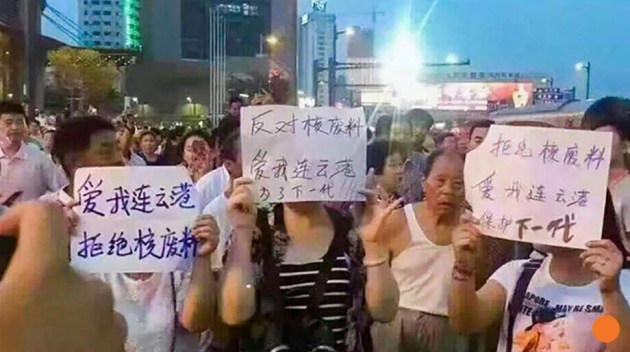
The government in Lianyungang in Jiangsu province issues brief statement saying work on nuclear fuel reprocessing plant project suspended
The authorities in Lianyungang, Jiangsu province, have suspended plans to build a nuclear fuel reprocessing plant after several days of street protests against the project.
Observers said the decision could put other nuclear projects under greater public scrutiny, and urged backers of similar schemes to improve transparency.
The Lianyungang city government announced the halt in a one-sentence statement issued early Wednesday morning.
“The government has decided to suspend preliminary work on site selection for the nuclear recycling project,” the statement said.
It came after thousands of protesters launched a series of street demonstrations from Saturday, protesting about the potential radiation risks and the alleged lack of transparency in the decision-making process for the project.
Residents used social media platforms to question the process but the comments were soon deleted by censors. “What if there is any radiation leakage? Why does the government want to make a decision on such a big issue on its own, a decision that will affect future generations?” they asked.
China National Nuclear Corporation planned to use technology supplied by French firm Areva to develop the spent nuclear fuel reprocessing plant.
The companies previously said construction would start in 2020 and be completed by 2030, but had not settled on a site.
The process has been shrouded in secrecy, with Lianyungang residents discovering that their city could be the site for the plant after the State Administration of Science, Technology and Industry for National Defence announced in a press release that a deputy head visited the city on July 26 and claimed “much progress has been made on site selection”.
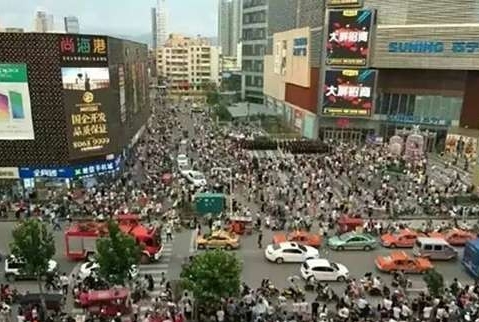
The Lianyungang city government issued a statement on Sunday to try to calm the public, saying the plans were still at an early stage and no location had been confirmed.
Sporadic protests continued on Monday and Tuesday, with video footage posted online showing police mobilised to protect the city government’s office building from protesters.
Xiamen University energy policy specialist Lin Boqiang said the plan was shelved as a result of a lack of transparency and communication by the government and state-owned nuclear companies.
Residents come out in force to protest against Sino-French nuclear project
“Public concerns can be contagious and spill over to other cities, as has been the case with various incinerator and PX [chemical] projects,” he said.
Many local governments have been forced to scrap plans for such projects after public protests over health and safety concerns.
A series of deadly blasts at industrial sites over the years has only worsened public fears and deepened distrust of government.
“China’s PX industry suffered a severe setback. If the developers of nuclear projects do not learn a lesson, they could be faced with similar problems in future,” Lin said.
China is the world’s most active builder of nuclear power plants. It has 32 reactors in operation, 22 under construction and more planned.
The government has also spent heavily to build up its ability to produce nuclear fuel and process the waste.
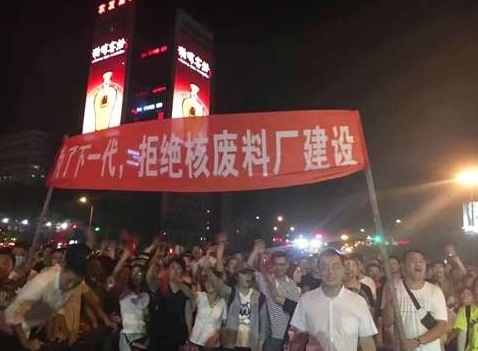
Residents come out in force to protest against Sino-French nuclear project

Rumours that Lianyungang, Jiangsu province will be site of plant sparks rally in city
Residents in Lianyungang in Jiangsu province ignored police warnings and filled a square for a demonstration over rumours the city would be the site of a Sino-French nuclear project.
The rally over a used-nuclear-fuel processing and recycling plant underscored the tension between public concern over nuclear safety and the growing pressure on China to reduce its reliance on fossil fuels.
The scene appeared to turn tense on Sunday night, the second night of the protest, with pictures posted on Weibo claiming to show police in riot gear, and messages claiming police scuffled with demonstrators. The claim could not be independently verified.
The Lianyungang city government also issued a statement late on Sunday, saying the site for the project was still being deliberated. The government pledged to ensure transparency and consult the public, but also warned it would deal with rumour-mongers severely.
Residents started to gather in a square downtown on Saturday night, with some chanting the slogan “boycott nuclear waste”, videos and photos circulating on mainland social media showed.
“The government only highlights the mass investment in the project and its economic benefit, but never mentions a word about safety or health concerns,” a local resident surnamed Ding told the Post by phone. “We need to voice our concerns, that’s why we went on our protests,” he said.
Police had issued a warning late on Friday saying that the demonstration organiser had not applied for the gathering, and calling on residents not to be misled by information circulating on the internet. Large numbers of police officers were also deployed to the demonstration venue.

Saturday’s demonstration appeared to be peaceful, with no reported conflicts.
Meanwhile over the weekend, the country conducted its first comprehensive nuclear-emergency drill, which aimed to test and improve responses to nuclear incidents, according to the State Administration of Science, Technology and Industry for National Defence, Xinhua reported.
Dubbed Storm-2016, the drill had no pre-planned scripts or expected results, Xinhua added.
China’s ambition to develop nuclear power was briefly hampered in 2011, after Beijing suspended approval for new nuclear power stations and started to conduct nationwide safety checks of all projects in the wake of the disaster in Fukushima, Japan.
The moratorium was lifted last year when at least two nuclear power plants, including one in Lianyungang, were given the green light for construction.
The nation’s five-year plan covering 2016 to 2020 calls for a dramatic increase in non-fossil-fuel energy sources, with six to eight new nuclear plants to be built each year.
China has 35 nuclear reactors in operation and 20 under construction, according to the International Atomic Energy Agency.
Six provinces – including Guangdong, Shandong , Fujian, Zhejiang and Gansu – the only inland province – are listed as candidates for the Sino-French project, according to China Business News.
However, public anger was triggered late last month when comments on a government news website hinted that Lianyungang would be the site of the new project. According to CNNC’s website, the plant was to be the biggest ever project between China and France, and would be built by CNNC using technology from Areva, France’s state-owned maker of nuclear reactors.
After huge public protest Chinese town halts nuclear waste project
Chinese town suspends nuclear waste project, DW, 10 Aug 16 A city in the eastern part of China has said it’s suspending preliminary work on a nuclear waste processing plant after days of protests by local residents over health concerns. No final decision has been made yet. The Chinese city of Lianyungang in the eastern province of Jiangsu announced Wednesday it would suspend preparations for a possible Sino-French nuclear waste processing project after thousands of local residents had taken to the streets to protest the plan.
The protesters had called for the project to be canceled altogether on health grounds, clashing with police.
French nuclear fuel group Areva agreed in 2012 to cooperate with state-run China National Nuclear Group (CNNC) to build a reprocessing facility in China, without stating any specific location…….
The $12.05-billion (10.81-billion-euro) waste processing project had been scheduled to get off the ground in 2020 to be completed by 2030, but its future is now unclear.
The project had been opposed by US authorities saying it would harm efforts to limit the spread of materials that could be used in weapons.
The Lianyungang protests highlighted local opposition to nuclear projects across China, which is increasing its atomic power capacity on a huge scale and encouraging state-run firms to build plants abroad.……http://www.dw.com/en/chinese-town-suspends-nuclear-waste-project/a-19462414
China keen to market its nuclear reactors to UK, warns Britain not to dump Hinkley
That’s not sitting well with China.
“Right now, the China-U.K. relationship is at a crucial historical juncture,” China’s ambassador to Britain, Liu Xiaoming, wrote in an article for the Financial Times.
“I hope the U.K. will keep its door open to China and that the British government will continue to support Hinkley Point — and come to a decision as soon as possible so that the project can proceed smoothly,” he added.His warning comes at a delicate time for the U.K. economy. The Bank of England last week forecast lost growth and higher unemployment as it cut interest rates in response to the decision to leave the European Union.
Having thrown the future of its relationship with its biggest trading partner up in the air, Britain is looking to boost trade and investment ties with the rest of the world.
Liu pointed out in his article that Chinese companies have invested more in the U.K. over the past five years than in France, Germany and Italy combined. China also accounted for just over 3% of U.K. exports last year.
Under the deal announced in October, China General Nuclear Power Corporation (CGN) would have a 33.5% stake in the power plant. France’s EDF (ECIFY) will hold the rest.
The bigger prize for China, though, is a related deal to build another nuclear power plant some 60 miles northeast of London, using its own reactor technology. It would have 66.5% of that venture.
May hasn’t given much away about her reasons for delaying the decision on Hinkley Point.
But the deal was controversial from the start, with critics warning that giving China access to vital infrastructure could compromise national security. The plan has also come under fire for guaranteeing an electricity price way above market levels……… http://money.cnn.com/2016/08/09/news/companies/china-uk-nuclear-power-plant-hinkley/
Thousands in Eastern Chinese City Protest Nuclear Waste Project

Jean-Bernard Lévy, left, chief executive of the French power company EDF, with Qian Zhimin, center, president of the China National Nuclear Corporation, and Philippe Knoche, chief executive of Areva, in Paris last year.
BEIJING — China’s efforts to expand its nuclear power sector suffered a backlash in one eastern seaboard city over the weekend, as thousands of residents took to the streets to oppose any decision to build a reprocessing plant in the area for spent nuclear fuel.
The government of Lianyungang, a city in Jiangsu Province, tried to calm residents on Sunday, a day after thousands of people defied police warnings and gathered near the city center, chanting slogans, according to Chinese news reports and photographs of the protests shared online.
They chanted “no nuclear fuel recycling project,” the state-run Global Times reported, citing footage from the scene. “It is unsafe to see another nuclear project coming and besieging us,” one resident told the paper.
Residents used WeChat, a popular Chinese messaging service, to share video footage showing downtown Lianyungang at night crowded with hundreds of people, many of them middle-aged, walking down a broad street in waves and chanting loudly, “Oppose nuclear waste, defend our home.”
The city government responded with the mix of reassurances and warnings that Chinese officials often use in the face of protests over pollution and environmental concerns. “Currently, the project is still at the stage of preliminary assessment and comparing potential sites, and nothing has been finally decided,” the city government said in a statement issued on Sunday.
But officials did not rule out that the site chosen might be somewhere near Lianyungang, and they warned against any more protests. “The relevant departments will use the law to strike hard against a tiny number of lawbreakers who concoct and spread rumors and disturb the social order,” the city government said.
On Monday, there were no signs of renewed demonstrations in the city. But the residents had made their point: Another possible building block of China’s nuclear power expansion had come under passionate public attack, defying the police warnings and government attempts to defuse alarm.
The Chinese government has said that it will accelerate building nuclear power and processing plants to wean the economy more quickly off coal. In March, the national legislature endorsed a five-year plan that promises to push forward with more nuclear power plants and a reprocessing plant for used fuel from China’s growing number of reactors. Japan also has plans to open a reprocessing plant.
But in Lianyungang and elsewhere, fears over the safety of nuclear power — magnified by the Fukushima calamity in Japan in 2011 — could frustrate those plans.
Lianyungang is just 20 miles southwest of a coastal nuclear power plant at Tianwan, which has two units operating, two under construction and approval to build two more. But the idea that used nuclear fuel might be reprocessed in the area seemed to renew anxieties about radiation risks.
A 2010 survey of 1,616 residents in the area already showed widespread apprehension about the Tianwan plant: 83.5 percent of respondents said they “worried about improper handling of nuclear waste.”
Complaints over industrial pollution, waste incinerators, toxic soil and other environmental issues have become one of the biggest causes of mass protest in China. And nuclear facilities have also become a source of worry for many.
In July 2013, officials in southern China shelved plans for a nuclear fuel fabrication plant after hundreds of nearby residents protested. Proposals for new nuclear power stations have also been met by online denunciations and petitions.
The demonstrations in Lianyungang broke out on Saturday after rumors spread that the area had been chosen as the site for a nuclear fuel processing and recycling plant to be built by the China National Nuclear Corporation, in cooperation with a French company, Areva. The companies have said construction will start in 2020 and be finished by 2030.
The companies have not reported settling on a site, nor have they revealed many other details about the proposed plant. But when China’s premier, Li Keqiang, visited France in June of last year, the companies agreed “to finalize the negotiations in the shortest possible time frame.”
Last month, a unit of the China National Nuclear Corporation said on its website that managers had visited Lianyungang to “study the proposed site.” That news appeared to sow alarm among some residents, who, in addition to the street protests, have taken to social media and online forums to voice opposition to the idea.
On Sina.com Weibo, a popular Chinese site that works like Twitter, messages have sprung up using a picture of a face in a heavy protective mask holding up a nuclear radiation sign with a red X across it. “The people of Lianyungang don’t want radiation,” the picture says.
The China National Nuclear Corporation’s nuclear fuel reprocessing unit said on its website on Saturday that the proposed plant would help the country become a “nuclear strong power.” But it emphasized that a site had not been chosen. It said places in six provinces, including Jiangsu, were under consideration.
http://www.nytimes.com/2016/08/09/world/asia/china-nuclear-waste-protest-lianyungang.html?_r=0
‘We know about Fukushima’: Thousands rally in China over nuclear project fears
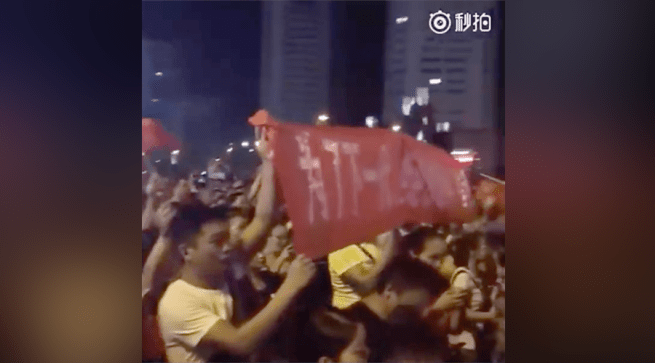
Thousands of people have taken to the streets of Lianyungang, China, to protest against a possible French-Chinese nuclear project, according to local media. Clashes have been reported between police and demonstrators.
Photos and videos on social media show crowds of people shouting slogans and waving banners.
“There were several thousand people,” a hotel worker told AFP on condition of anonymity.
Thousands in Lianyungang protest possible China-France nuclear project https://t.co/D7guEPGC9ppic.twitter.com/FYhMBftzyB
— Hong Kong Free Press (@HongKongFP) August 8, 2016
“Building a nuclear waste processing plant in Lianyungang is a recipe for disaster for future generations, local people have a right to express anger,” another witness said.
Pictures also show demonstrators surrounded by police. A local resident identified as Xu described “clashes between police and protesters.”
Rumors have emerged that one of the activists was beaten to death. Police have denied those reports, and also said that officers have not clashed with demonstrators.
The protest was staged over an agreement between French nuclear fuel group Areva and China National Nuclear Corp (CNNC), which took place in 2012. The companies agreed to build a reprocessing facility in China, but didn’t elaborate on the location.
But Lianyungang residents fear the plant will be constructed in their city, as China National Nuclear Corp (CNNC) is currently building a nuclear object nearby, AFP reported.
连云港市民抗议兴建核废料处理厂 https://t.co/braDcGZbn8
— 艺术家王鹏 (@wangpeng89) August 7, 2016
“The government kept the project a secret. People only found out about it recently. That’s why most people are worried,” local resident Sheng told The Financial Times. “Some speculate that the nuclear waste is from other countries and do not understand why the project should be built here instead of over there if it’s as safe and beneficial as they say.”
全世界唯一的核电站废料处理中心将在连云港建设!投资1000个亿工程!如果爆炸!连云港将寸草不生!辐射范围大概在800公里,连云港到上海500公里,到浙江杭州680公里,一旦爆炸意味着江苏浙江上海都将陷入万劫不复的未来 pic.twitter.com/gasVOBtda9
— 小李 (@a10024770291) August 8, 2016
Lianyungang is also situated near the Tianwan Nuclear Power Plant, built by Russia in 2006. The site is set to become one of the biggest nuclear power plants in China, with two operational units and six additional units planned.
今夜,连云港没有赢家,
只有暴力和被打者的哀鸣,
鲜血染红了某些人的顶子,
第一个遇难者不知道是谁?
一棍从后脑敲下,
三十几人拳打脚踢,
…………
呼吁理性爱国,保护自身安全!
今夜无眠
祈求连云港的这些英雄都很平安 pic.twitter.com/GcdMTZomJY
— Zhumengru (@xiaoru1989) August 8, 2016
“We already have a chemical industrial park in Lianyungang and the pollution problem is quite worrying. Nuclear waste is far worse than normal chemical pollution,” local shop owner He told The Financial Times. “Also, we all know what happened to Fukushima in Japan after the nuclear accident. We are really worried.”
Lianyungang, a port city in Jiangsu province, eastern China, has a population of around five million people. It is located some 480 kilometers (298 miles) north of Shanghai.
https://www.rt.com/news/355066-china-france-nuclear-protest/
Chines military nuclear firm invited to bid for building Small Nuclear Reactors in Britain

 Chinese firm with military ties invited to bid for role in UK’s nuclear future,
China National Nuclear Corporation on government list of preferred bidders for development funding for next-generation modular reactors, Guardian, Adam Vaughan, 8 Aug 16, A controversial Chinese company has been selected to bid for millions of pounds of public money in a UK government competition to develop mini nuclear power stations.
The China National Nuclear Corporation (CNNC) features twice in a government list of 33 projects and companies deemed eligible to compete for a share in up to £250m to develop so-called small modular reactors (SMR).
The involvement of a different Chinese company in the high-profile Hinkley Point C project in Somerset was widely believed to have prompted the government’s decision to pause the deal at the 11th hour last month.
Nick Timothy, Theresa May’s co-chief of staff, has previously expressed alarm at the prospect of CNNC having such close access to the UK’s energy infrastructure because it would give the state-owned firm the potential ability to build weaknesses into computer systems.
The company was formerly China’s Ministry of Nuclear Industry and developed the country’s atomic bomb and nuclear submarines, as well as being a key player in its nuclear power industry.
In an article on the ConservativeHome website, Timothy singled out CNNC’s military links as a reason the UK government should be wary of such involvement.
“For those who believe that such an eventuality [shutting down UK energy at will] is unlikely, the Chinese National Nuclear Corporation – one of the state-owned companies involved in the plans for the British nuclear plants – says on its website that it is responsible not just for ‘increasing the value of state assets and developing the society’ but the ‘building of national defence’,” he wrote.
Tom Burke, chairman of the environment thinktank E3G and a former British government adviser, said there were legitimate concerns over the company. “I don’t fuss very much about the Chinese owning a nuclear power station [China General Nuclear in the case of Hinkley]. But I would be much more concerned about bringing in CNNC because they are known to be much more closely involved with the military and Chinese nuclear weapons programmes,” he said.
CNNC was not involved in the original Hinkley deal but it was reported on Sunday that the company has agreed in principle to buy half of China’s 33% stake in the £24bn project if it goes ahead…….. https://www.theguardian.com/environment/2016/aug/07/chinese-firm-with-military-ties-invited-to-bid-for-role-in-uks-nuclear-future
1 This Month
Chernobyl: The Lost Tapes – A good documentary on Chernobyl on SBS available On Demand for the next 3 weeks– https://www.sbs.com.au/ondemand/tv-program/chernobyl-the-lost-tapes/2352741955560

of the week–London Campaign for Nuclear Disarmament

Tell the Ukrainian Government to Drop Prosecution of Peace Activist Yurii Sheliazhenko
To see nuclear-related stories in greater depth and intensity – go to https://nuclearinformation.wordpress.com
-
Archives
- April 2026 (126)
- March 2026 (251)
- February 2026 (268)
- January 2026 (308)
- December 2025 (358)
- November 2025 (359)
- October 2025 (376)
- September 2025 (257)
- August 2025 (319)
- July 2025 (230)
- June 2025 (348)
- May 2025 (261)
-
Categories
- 1
- 1 NUCLEAR ISSUES
- business and costs
- climate change
- culture and arts
- ENERGY
- environment
- health
- history
- indigenous issues
- Legal
- marketing of nuclear
- media
- opposition to nuclear
- PERSONAL STORIES
- politics
- politics international
- Religion and ethics
- safety
- secrets,lies and civil liberties
- spinbuster
- technology
- Uranium
- wastes
- weapons and war
- Women
- 2 WORLD
- ACTION
- AFRICA
- Atrocities
- AUSTRALIA
- Christina's notes
- Christina's themes
- culture and arts
- Events
- Fuk 2022
- Fuk 2023
- Fukushima 2017
- Fukushima 2018
- fukushima 2019
- Fukushima 2020
- Fukushima 2021
- general
- global warming
- Humour (God we need it)
- Nuclear
- RARE EARTHS
- Reference
- resources – print
- Resources -audiovicual
- Weekly Newsletter
- World
- World Nuclear
- YouTube
-
RSS
Entries RSS
Comments RSS
 nuclear-news