Global nuclear industry’s confidence is wobbling, as China loses enthusiasm for nuclear power
 China’s losing its taste for nuclear power. MIT Technology Review, Once nuclear’s strongest booster, China is growing wary about its cost and safety. by Peter Fairley,December 12, 2018
Most beautiful wedding photos taken at a nuclear power plant” might just be the strangest competition ever. But by inviting couples to celebrate their nuptials at the Daya Bay plant in Shenzhen and post the pictures online, China General Nuclear Power (CGN), the country’s largest nuclear power operator, got lots of favorable publicity.
A year later, the honeymoon is over.
For years, as other countries have shied away from nuclear power, China has been its strongest advocate. Of the four reactors that started up worldwide in 2017, three were in China and the fourth was built by Beijing-based China National Nuclear Corp. (CNNC) in Pakistan. China’s domestic nuclear generation capacity grew by 24% in the first 10 months of 2018.
The country has the capacity to build 10 to 12 nuclear reactors a year. But though reactors begun several years ago are still coming online, the industry has not broken ground on a new plant in China since late 2016, according to a recent World Nuclear Industry Status Report.
Officially China still sees nuclear power as a must-have. But unofficially, the technology is on a death watch. Experts, including some with links to the government, see China’s nuclear sector succumbing to the same problems affecting the West: the technology is too expensive, and the public doesn’t want it.
The 2011 meltdown at Japan’s Fukushima Daiichi plant shocked Chinese officials and made a strong impression on many Chinese citizens. A government survey in August 2017 found that only 40% of the public supported nuclear power development.
The bigger problem is financial. Reactors built with extra safety features and more robust cooling systems to avoid a Fukushima-like disaster are expensive, while the costs of wind and solar power continue to plummet: they are now 20% cheaper than electricity from new nuclear plants in China, according to Bloomberg New Energy Finance. Moreover, high construction costs make nuclear a risky investment.
And gone are the days when nuclear power was desperately needed to meet China’s soaring demand for electricity. In the early 2000s, power consumption was growing at more than 10% annually as the economy boomed and manufacturing, a heavy user of electricity, expanded rapidly. Over the past few years, as growth has slowed and the economy has diversified, power demand has been growing, on average, at less than 4%.
China’s disenchantment with nuclear power corresponds with an overall decline in nuclear generation elsewhere in the world. Utilities are retiring existing plants and have stopped building new ones. If China, too, gives up on nuclear, it could sound the death knell………
Within days of Fukushima, nuclear reactor construction in China was frozen. When building resumed months later, after a wave of inspections, Beijing insisted that future nuclear power projects adopt more advanced designs with extra safety features.
The damage to public confidence, however, had already been done. In 2013 over a thousand people assembled in Jiangmen, east of Hong Kong, to decry a planned uranium fuel plant. Within days the state-run project was scrapped. In 2016 local officials suspended preliminary work on a site in Lianyungang, in northeastern Jiangsu province, after an uproar caused by revelations that it might host a recycling plant for spent nuclear fuel. In the wake of that protest, China’s State Council amended its draft regulations on nuclear power management, requiring developers to hold public hearings before siting projects…………
Dwindling options
The government has lately said little about nuclear policy. Its official target, last updated in 2016, calls for 58 gigawatts of nuclear generating capacity to be installed by 2020 and for another 30 GW to be under construction. All experts agree China won’t reach its 2020 goal until 2022 or later, and pre-Fukushima projections of 400 GW or more by midcentury now look fanciful. Han says he is betting that after the country builds the 88 GW in its 2020 plan, it will move on to other energy sources. …….
If the Hualong One proves too expensive, China’s lingering nuclear hopes will be pinned to its advanced-reactor program—an effort to develop a new generation of technologies that include high-temperature gas-cooled reactors, designs cooled with sodium metal or salt, and smaller versions of pressurized-water reactors. These various designs are meant to be cheaper to build and operate—and much safer—than conventional reactors.
But so far there is little evidence that any of them will solve nuclear’s problems. A sodium-cooled reactor completed near Beijing in 2011 has had familiar technical glitches such as problems in its coolant systems. And the rising cost of a pair of high-temperature gas-cooled reactors nearing completion at Shandong Province’s Shidao Bay ended plans for a further 18 such reactors at the site.
There’s always the possibility of a breakthrough that would make nuclear safe and cheap enough to compete with renewables and coal. But even China’s nuclear giants are hedging their bets. Both CGN and the state-owned firm funding China’s AP1000 investments rank among the world’s top 10 renewable-power operators……..
Chinese military is building a test facility to simulate thermonuclear explosions
|
Operation Z machine: China’s next big weapon in the nuclear ‘arms race’ could create clean fuel – or deadly bombs
The Chinese military is building a test facility to simulate thermonuclear explosions on a much greater scale than comparable US centres It’s been described as a Chinese version of America’s “Z machine” – formally known as the Z Pulsed Power Facility – a giant wheel-like device developed by the United States to see how particles react under extreme radiation and magnetic pressure. Z machines have been used in the development of nuclear weapons, from conventional warheads to the pure fusion bomb – a hydrogen bomb that can in theory be made in any size, cost a fraction of today’s nuclear stockpile and burn “cleanly” without producing radioactive fallout. And for decades, the Z machine at Sandia National Laboratories in Albuquerque, New Mexico, has led the way in the field. But now Chinese researchers are trying to build a machine that will produce much more electricity to create much more extreme environments for testing weapons, allowing scientists to delve deeper into the nuclear unknown……….. Lei Yuan, a nuclear physicist at Peking University’s school of physics, said the project team should prepare for massive challenges. Lei said there had been costly failures in developing the technology in the US and Chinese scientists faced equal if not greater uncertainties because of their much more ambitious goals. For instance, fusion could produce a large number of fast flying neutrons that will weaken or damage critical components. While the equipment was durable, researchers had not yet been able to solve the neutron problem, Lei said. He warned the development of a pure fusion bomb would meant international nuclear weapons treaties would have to be rewritten. “But I don’t think we need to worry about this, not until we see a real new bomb. The technology is so difficult, it remains more fantasy than real threat.” https://www.scmp.com/news/china/science/article/2177652/operation-z-machine-chinas-next-big-weapon-nuclear-arms-race |
|
China’s push to take over the abandoned Moorside nuclear project
 Chinese nuclear giant flags interest in NuGen’s abandoned Cumbria plant, Building, 7 December 2018 China General Nuclear also reveals plans to speed up delivery of nuclear power plant in Essex.China General Nuclear has flagged interest in building on the Moorside site recently vacated by Toshiba subsidiary NuGen as it reveals plans to speed up development of a nuclear power plant in Essex.
China General Nuclear (CGN), who is already developing Hinkley Point C (pictured) with EDF Energy, is carrying out technical assessments with a view to building another plant with the French energy giant in Bradwell, Essex.
Speaking at the Nuclear 2018 conference in London Rob Davies, the UK chief operating officer of CGN, said: “With the demise of NuGen there is a gap in the UK’s nuclear programme; the expected sequence of reactors coming down the line has been interrupted.
“We are confident we can close that gap by bringing Bradwell into operation much sooner.”…….https://www.building.co.uk/news/chinese-nuclear-giant-flags-interest-in-nugens-abandoned-cumbria-plant/5096959.article
China and USA competing to market technology to Argentina
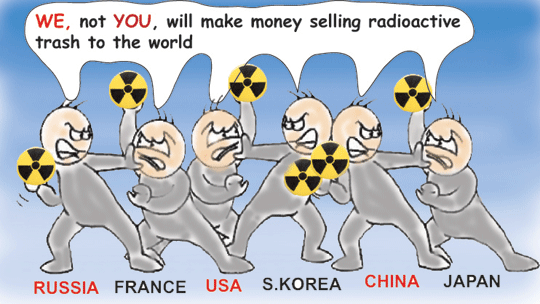
China, vying with U.S. in Latin America, eyes Argentina nuclear deal, Cassandra Garrison, Matt Spetalnick, BUENOS AIRES/WASHINGTON (Reuters) 29 Nov 18 – Argentina and China are aiming to close a deal within days for the construction of the South American nation’s fourth nuclear power plant, a multi-billion dollar project that would cement Beijing’s deepening influence in a key regional U.S. ally.
Argentina hopes to announce an agreement on the Chinese-financed construction of the Atucha III nuclear power plant during Chinese President Xi Jinping’s state visit on Sunday following the summit of leaders of G20 industrialized nations in Buenos Aires, Juan Pablo Tripodi, head of Argentina’s national investment agency, told Reuters in an interview.
The potential deal, reportedly worth up to $8 billion, is emblematic of China’s strengthening of economic, diplomatic and cultural ties with Argentina. It is part of a wider push by Beijing into Latin America that has alarmed the United States, which views the region as its backyard and is suspicious of China’s motives.
………. The negotiations on Chinese financing of the Atucha III nuclear power plant are a key cause for concern for the U.S. government, a senior Trump administration official told Reuters.
Atucha III would be one of the biggest projects financed by China in Argentina, according to the Reuters review of Chinese state funding data…….. https://www.reuters.com/article/us-argentina-china-insight/china-vying-with-u-s-in-latin-america-eyes-argentina-nuclear-deal-idUSKCN1NX0FE
USA issues stark warning against UK partnering with China on nuclear power stations


 US warns Britain against Chinese alliances on nuclear plants, Security official claims evidence of civilian nuclear technology being put to military use, Ft.com, David Sheppard in London , 25 Oct 18
The US has issued a stark warning to the UK about partnering with China’s largest state-backed nuclear company on a host of new power plants, saying it has evidence that it is engaged in taking civilian nuclear technology and transferring it to military uses. Christopher Ashley Ford, the US assistant secretary for international security and non-proliferation, said that China General Nuclear (CGN), which is a partner on the £18bn Hinkley Point C nuclear project, among others, was at the forefront of Chinese efforts to militarise civilian nuclear technology.
“It’s quite clear now that essentially the entirety of the Chinese nuclear industry is lashed up with military-civil fusion,” Mr Ford said in a briefing with the Financial Times. “There is a growing pattern of information of which we have become aware over time related to technological theft issues.” Mr Ford said the US had shared evidence, both “open source” and from intelligence gathering, with the UK, showing CGN was involved in the transfer of technology that could be used for a range of military applications. That could include powering China’s new breed of nuclear powered submarines, aircraft carriers and “floating nuclear reactors for the ongoing militarisation of the South China Sea”, Mr Ford
“If CGN is engaged in helping the Chinese navy . . . with missiles that could presumably be pointed at western capitals, including London . . . It’s worth thinking about whether that’s a particularly good idea,” Mr Ford said. The bluntly delivered warning comes as UK prime minister Theresa May has tried to increase scrutiny of Chinese investment in key UK infrastructure compared to her predecessor David Cameron, including over involvement in nuclear power plants.
But the US intervention, given their status as the UK’s key military ally, is likely to increase pressure on Downing Street. The Trump administration is locked in a trade war with China, with tensions ramping up over tariffs and the balance of payments between the two countries. But the US this month also updated its own policies on civilian nuclear co-operation with China to say that there would be a “presumption of denial” for any US company seeking to transfer technology to CGN or its subsidiaries. …..
A contract between China and Westinghouse Electric Company, the US nuclear engineering group sold by Toshiba to Canadian asset manager Brookfield last year, is not, however, broadly affected by the US policy shift, although future deals could be. The second Westinghouse plant in China started up on Wednesday, 11 years after the deal to build four AP1000 reactors was first signed. …..
Last month, CGN told the Financial Times that political sensitivities could prompt it to give up the chance to operate a new atomic power plant at Bradwell in Essex, as the group also outlined ambitious plans for an industrial partnership with Britain. …..
CGN has invested more than £2bn in its British nuclear projects in the past two years, and has committed to spend £9.5bn in this area in total. https://www.ft.com/content/84ab26f6-d7a5-11e8-a854-33d6f82e62f
Future of Bradwell nuclear project in doubt – Chinese company might withdraw
BANNG 22nd Oct 2018 , BANNG has long maintained that there is no need for a new nuclear powerstation at Bradwell. The costs, in terms of the long-lasting, physical
damage to the tranquil and vulnerable Blackwater estuary, of the finances,
of the potential for terrorist attacks and of the uncertainties around
investment by a potentially hostile state, are too high.
in the costs of renewables and storage, there will be no need for it by the
time Bradwell B could be in operation.
in the Bradwell B project. However, it seems now that CGN is wavering. In
the Financial Times of 18 September it was reported that CGN ‘has
admitted that political sensitivities could prompt it to give up the chance
to operate a new atomic power plant in the UK’.
security issues surrounding Chinese investment into a highly sensitive part
of the UK’s national infrastructure. In the Financial Times, Zheng
Dongshan, Chief Executive of CGN’s UK subsidiary, is reported as
acknowledging that it would take time for CGN ‘to show the public, the
government they can trust us’. Andy Blowers, Chair of BANNG, said: ‘The
project may be doomed anyway as the Bradwell B site is totally unsuitable
and is opposed by communities all around the Blackwater estuary.’
https://www.banng.info/news/is-bradwell-b-going-down-the-drain/
Risk of nuclear war between USA and China “not as implausible” no, as it was in the past
|
Newsweek 17th Oct 2018, It is more likely than in the past that China and the U.S. could enter into
a military conflict, and the possibility of such a battle going nuclear is higher than many analysts believe, a security expert from Georgetown University has warned. Caitlin Talmadge, who is an associate professor of
security studies at the Walsh School of Foreign Service, laid out a grim picture of how military escalation could play out between Washington and Beijing in an article for Foreign Affairs’ November-December issue.
“The odds of such a confrontation going nuclear are higher than most
policymakers and analysts think,” she wrote. However, she also pointed out that “a war between the two countries remains unlikely, but…no longer seems as implausible as it once did.” https://www.newsweek.com/us-china-nuclear-war-threat-greater-most-people-realize-expert-warns-1175610 |
|
Trump restricting U.S. nuclear power exports to China could hurt America’s nuclear industry
 Trump’s Latest China Salvo Could Hurt U.S. Nuke Industry, Administration says Beijing is diverting U.S. nuclear technology for military use. BY KEITH JOHNSON, FP.COM OCTOBER 12, 2018, The Trump administration is increasing its economic pressure on China by restricting U.S. nuclear power exports, a move that could end up hurting an American industry desperate to compete in the world’s fastest-growing market for nuclear energy.
Senior administration officials say Beijing is stealing U.S. nuclear technology to gain a competitive edge and is also diverting U.S. nuclear technology toward military uses, such as propulsion systems for submarines and aircraft carriers. In response, after almost a year of review, the administration decided Thursday to restrict the export of some U.S. nuclear technology and components to China.
“The United States cannot ignore the national security implications of China’s efforts to obtain nuclear technology outside of established processes of U.S.-China civil nuclear cooperation,” U.S. Energy Secretary Rick Perry said in a statement.
The restrictions essentially prohibit any new technology transfers, as well as the export of advanced reactor technologies, including small, modular reactors that are seen by many as the industry’s future. Additionally, the U.S. government is essentially banning any and all U.S. exports to China General Nuclear Power Group, one of the country’s two big nuclear energy developers. China General Nuclear was indicted in 2016 for organizing an espionage campaign to acquire U.S. nuclear know-how.
But the new restrictions won’t apparently affect some of the highest-profile U.S. projects in China, such as the construction of new nuclear power plants using the state-of-the-art Westinghouse AP1000 reactor. Chinese utilities are currently building four Westinghouse reactors at two locations; the first just became operational.
For the U.S. nuclear power industry, further restrictions on its ability to compete overseas come as a blow. For a year, export licenses to China have been held up by the government’s review, and nuclear industry advocates have repeatedly warned U.S. officials of the economic harms of being locked out of the world’s one real growth market, potentially worth tens of billions of dollars in future sales……..https://foreignpolicy.com/2018/10/12/trumps-latest-china-salvo-could-hurt-u-s-nuke-industry/
China losing enthusiasm for nuclear power
Nuclear power continues its decline as renewable alternatives steam ahead, World Finance, Author: Courtney Goldsmith, October 15, 2018“…………
China’s waning nuclear interest
By a wide margin, China is currently the global leader in the construction of new nuclear plants. In fact, for three years in a row, global electricity generation from nuclear power would have decreased if China were removed from the picture. By 2030, the IEA expects the country to overtake the US as the world’s top generator of nuclear power.
Of the 10 reactors that started up globally in 2016, half were located in China. Meanwhile, nearly 40 percent of the total reactors currently in construction are Chinese. However, China has not launched a new construction of a commercial reactor since December 2016.
The country had planned for 58GW of total nuclear capacity to be in place by 2020, but having failed to get 30GW of new plants under construction by 2018, China’s lead in the field of nuclear power may be slipping.
What’s more, even in this hub of nuclear activity, renewable generation is moving even faster. As of July 2017, China had 37 operating nuclear reactors with a total net capacity of around 32GW. In 2017, however, the country added a whopping 53GW of solar power.
“To illustrate the speed with which things change, and [which] the invading species is taking over, if you only go back five years in 2012, Germany was the world record holder in the addition of [solar PV] with 7.5GW,” Schneider said. “Now it’s China with [53GW] five years later. The speed is just unbelievable.”
The return of small reactors
One often-cited glimmer of hope for the nuclear industry is in small modular reactors (SMRs). These shrunken-down nuclear reactors generate electrical output of between 50MW and 300MW on average, compared with the generation of 1,000MW or more from a conventional reactor, but it is unlikely they will be commercially available before 2030.
Proponents say SMRs will be cheaper and safer than conventional nuclear plants, and will be capable of competing with solar and wind power. Desbazeille said SMRs were a “game changer” that could put Europe back at the forefront of nuclear technology…….
But while SMRs are purported to be the key to transforming the nuclear sector, history has painted a troubling picture: SMR designs have been in the works for decades, but none have reached commercial success. In fact, Westinghouse worked on an SMR design for about a decade, but the project was abandoned in 2014. At the time, then-CEO Danny Roderick said: “The problem I have with SMRs is not the technology, it’s not the deployment – it’s that there’s no customers.”
A number of companies continue to work on new designs, however. US firm NuScale Power plans to develop an SMR to re-establish the country’s leadership in nuclear technology. The design is currently under review for approval by US regulators. While NuScale is seen as one of the firms closest to commercialisation, it may be too late by the time the arduous process of securing approvals is completed.
Therefore, by the time SMRs are ready for mass deployment, the energy debate may already be over. “Look at what happened over the past five years,” Schneider said. “But can you imagine what will happen in the next 10 years? This is going to be a completely different world.”…
Although SMRs have been talked about for decades, the progress made so far has been tiny. New technologies in the nuclear sector take a huge amount of time to develop – just look at the struggle to build EPRs in Europe. Plus, opting for a small design cuts out the economies of scale, or the cost advantages that come about due to increasing the size of a project. This is something nuclear projects often rely on.
A report by researchers at Harvard University, Carnegie Mellon University and the University of California, San Diego concluded that in the absence of a “dramatic change in the [US] policy environment”, a convincing case for a domestic market for SMRs is difficult to make.
Much of the nuclear debate is powered by opinions and estimates, but looking at the hard data, it’s strikingly clear that the industry is in a slow and inevitable decline. China’s plans to become a nuclear powerhouse have been overshadowed by its huge investments in renewable energy – in fact, the number of new construction starts (see Fig 2) has fallen around the world as stubbornly high costs and complex designs make new nuclear a hard sell.
Even in spite of nuclear power’s role in reducing carbon emissions, the potential safety issues and environmental impact of a meltdown are too big to ignore. With the cost of renewable and battery technologies expected to continue falling, wind and solar power appear to be the next golden opportunity. https://www.worldfinance.com/markets/nuclear-power-continues-its-decline-as-renewable-alternatives-steam-ahead
USA restricts nuclear technology exports to China
US ‘cannot ignore national security implications’ of supplying China with nuclear technology any longer, Energy Secretary Rick Perry said, SCMP, 12 October, 2018, The United States said Thursday that it will increasingly restrict civilian nuclear exports to China as President Donald Trump vowed a hard line on trade, bluntly warning not to think Americans are “stupid”……..
The Energy Department said it would not end exports to China but would show greater scrutiny and that there “will be a presumption of denial” for new licences related to the state-owned China General Nuclear Power Corp.
Nuclear weapons proliferation risks in China’s push to export nuclear reactors
|
China’s Nuclear Diplomacy in the Middle East
China will have to balance its nuclear ‘going out’ with nonproliferation concerns. The Diplomat , By Samuel Hickey, October 09, 2018 On September 21, China’s Ministry of Justice published its draft Atomic Energy Law, which urges its vast nuclear industry to go forth into the world and secure a portion of the nuclear export market. Unlike the “Gold Standard” interpretation of the “1+2+3” agreement in the U.S. Atomic Energy Act of 1954, China will not officially limit a partner country’s access to the full nuclear fuel cycle in exchange for nuclear cooperation. |
|
|
China drafting laws to promote marketing of nuclear reactors overseas
Euro News 22nd Sept 2018 , China will provide more support for its nuclear firms to go overseas and strengthen their position on the international market, according to new
draft legislation submitted to the industry for consultation on Friday.
“The state will encourage and support the positive and orderly
participation of its enterprises in the international market” and promote
the export of nuclear equipment, fuel and services, the draft Atomic Energy
Law says.
China aims to bring its total installed nuclear capacity to 58
gigawatts (GW) by the end of 2020, up from 37 GW at the end of June this
year, but it also has ambitions to dominate the global market and has
created a unified third-generation reactor brand known as the “Hualong One”
to sell overseas. China has already signed a series of preliminary
agreements with countries like Brazil, Argentina, Uganda and Cambodia and
it is also undergoing a technical approval process for the Hualong One in
Britain.
https://www.euronews.com/2018/09/22/china-drafts-new-nuclear-energy-law-focus-on-international-market
Typhoon Mangkhut heading straight for 2 Chinese nuclear power stations
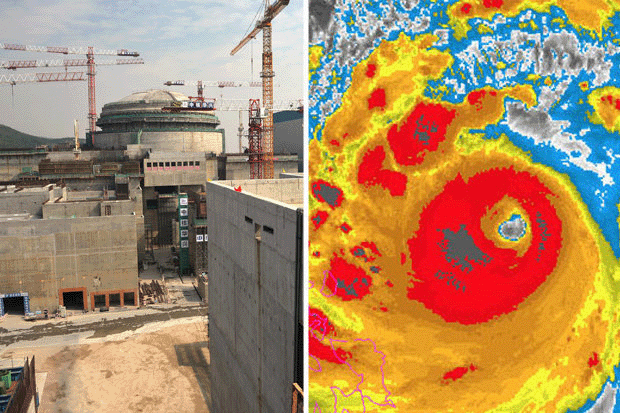
RED ALERT: Typhoon Mangkhut to SMASH into TWO nuclear plants as MILLIONS evacuate in panic https://www.express.co.uk/news/world/1018412/Typhoon-Mangkhut-Hong-Kong-China-nuclear-plants-red-alert-worst-storm
TYPHOON MANGKHUT – the most powerful storm of the year – is expected to directly hit two nuclear power plants later today with shocking 120mph winds, as officials issue a red alert warning.
The typhoon is the world’s most powerful storm of the year, with winds as high as 170 miles per hour – twice as powerful as Hurricane Florence which has struck the US east coast. At least 64 people have died in the wake of the typhoon in the Phillipines while so far two are reportedly dead in Hong Kong.
Officials have issued a red alert warning amid mounting fears over two nuclear power stations in the direct path of the typhoon.There are concerns the typhoon will damage the nuclear reactors and efforts are underway to avoid a repeat of the Japanese Fukushima catastrophe, when an earthquake and tsunami sent three nuclear reactors into meltdown.
The Taishan Nuclear Power Plant and Yangjiang Nuclear Power Station, both in Guangdong, mainland China, confirmed they were “combat ready” and in emergency lockdown as the superstorm nears.
Emergency safety investigations have been carried out at both plants for last-minute preparations behind the typhoon strikes this evening with 120mph winds.
A spokesman for the Taishan facility said: “All emergency personnel are at their posts and have conducted their preparatory work.The plant is fully prepared for the typhoon, and everything is in its place.”
Workers at the Yangjiang plant also secured the facility’s five generating units but fears remain for the sixth, which remains under construction.
Plant manager Chen Weizhong added that all doors and windows were tightly closed.
Mangkhut has already caused mass devastation in the Philippines, where around 40 gold miners are feared trapped following a landslide.The Hong Kong Observatory (HKO) raised the storm signal to T10 – the highest level possible, as the city shut down.
Footage from Hong Kong shows the scale of devastation, including a high-rise construction crane collapsing and windows in skyscrapers breaking under pressure.
One video shows a father and son swept off their feet and thrown into a wall due to the sheer power of the winds
After the typhoon passes over Hong Kong, the powerful storm is expected to wreak havoc across several Chinese megacities.
Typhoon Mangkhut heads towards two nuclear power stations on China’s Guangdong coast
 Typhoon Mangkhut: Two nuclear power plants on China’s Guangdong coast in path of storm Workers batten down the hatches at Yangjiang and Taishan facilities as superstorm set to make landfall nearby, South China Morning Post Sarah Zheng, 16 September, 2018,Two nuclear power plants stand on the projected path of Typhoon Mangkhut, which is expected to make landfall in mainland China as early as Sunday afternoon. Taishan Nuclear Power Plant and Yangjiang Nuclear Power Station, both in Guangdong province, said they were “in combat readiness” mode as the superstorm approached.
Mangkhut LIVE blog: signal No 10 raised as typhoon batters Hong Kong
Emergency response teams had also been briefed and were prepared for the typhoon’s arrival………
The Yangjiang power plant, which went into commercial operation in 2014, has been in the news before.
In 2016, four members of its staff were punished for breaching operational guidelines and covering up an incident in which a residual heat-removal pump on one of the reactors stopped functioning for six minutes.
Last year, component supplier Dalian Teikoku Canned Motor Pump Company was fined for violating operating rules regarding welding at the plant……..https://www.scmp.com/news/china/society/article/2164363/chinese-nuclear-power-plant-path-super-typhoon-mangkhut
China Building a Nuclear-Powered Icebreaker
|
Why Is China Building a Nuclear-Powered Icebreaker? The melting ice of the Arctic does offer things that China wants: resources and shipping routes. And that means profits are to be had. National Interest
Wait a minute. China doesn’t have any Arctic territories. Its northern borders are Central Asia and Siberia, not the North Pole. Nonetheless, China has joined other nations, such as Russia, the United States, Norway and Canada, in positioning itself for the perceived riches of the North Pole. The nuclear icebreaker will join the recently launched Snow Dragon 2, China’s first domestically produced icebreaker, and the older Xuelong, built in Ukraine. “The ship’s nuclear power unit is huge and can be applied to a nuclear-powered aircraft carrier once updated, so it can be seen as a preparation for the aircraft carrier,” a Chinese analyst told another Chinese state-owned site. Significantly, the headline of the Chinamil.com article was “China one step closer to nuke-powered aircraft carrier with cutting-edge icebreaker,” which suggests that preparing to confront the U.S. Navy is more important than Arctic exploration……..https://nationalinterest.org/blog/buzz/why-china-building-nuclear-powered-icebreaker-31257 |
|
1 This Month

of the week – Shut Down Drone Warfare!


Tell the Ukrainian Government to Drop Prosecution of Peace Activist Yurii Sheliazhenko

Petition to revoke the licensing of the Near Surface Nuclear Disposal Facility (NSDF) at Chalk River. https://www.ourcommons.ca/petitions/en/Petition/Details?Petition=e-7247
To see nuclear-related stories in greater depth and intensity – go to https://nuclearinformation.wordpress.com
-
Archives
- April 2026 (79)
- March 2026 (251)
- February 2026 (268)
- January 2026 (308)
- December 2025 (358)
- November 2025 (359)
- October 2025 (376)
- September 2025 (257)
- August 2025 (319)
- July 2025 (230)
- June 2025 (348)
- May 2025 (261)
-
Categories
- 1
- 1 NUCLEAR ISSUES
- business and costs
- climate change
- culture and arts
- ENERGY
- environment
- health
- history
- indigenous issues
- Legal
- marketing of nuclear
- media
- opposition to nuclear
- PERSONAL STORIES
- politics
- politics international
- Religion and ethics
- safety
- secrets,lies and civil liberties
- spinbuster
- technology
- Uranium
- wastes
- weapons and war
- Women
- 2 WORLD
- ACTION
- AFRICA
- Atrocities
- AUSTRALIA
- Christina's notes
- Christina's themes
- culture and arts
- Events
- Fuk 2022
- Fuk 2023
- Fukushima 2017
- Fukushima 2018
- fukushima 2019
- Fukushima 2020
- Fukushima 2021
- general
- global warming
- Humour (God we need it)
- Nuclear
- RARE EARTHS
- Reference
- resources – print
- Resources -audiovicual
- Weekly Newsletter
- World
- World Nuclear
- YouTube
-
RSS
Entries RSS
Comments RSS
 nuclear-news