But the deal failed to emerge then, and in January Argentina’s nuclear energy undersecretary, Julian Gadano, and the ambassador to China, Diego Guelar, met officials in Beijing for talks about the project, the government source said.
China’s new solar thermal power plan to reduce carbon dioxide emissions by 350,000 metric tonnes yearly
 Energy Live News 21st June 2019 China’s first 100MW molten salt solar thermal power plant has
successfully hit its maximum power levels. Built by Beijing Shouhang IHW
Resources Saving Technology, the three billion yuan (£345m) project in
Dunhuang uses 12,000 mirrors to concentrate sunlight onto a receiver, which
is then used to heat the molten salt. It is capable of generating 390
million kWh of clean power each year, enough to reduce carbon dioxide
emissions by 350,000 metric tonnes – engineers at the facility say it has
already reached or exceeded its designed values.
Chinese President Xi to North Korea prior to G20 conference
Xi heads to North Korea as fate of US nuclear deal still up in the air, Analysis by Joshua Berlinger, CNN, June 19, 2019 Hong Kong (CNN )More than 15 months after Kim Jong Un traveled to Beijing and invited the Chinese President to visit Pyongyang, Xi Jinping is finally heading to the North Korean capital for a two-day state visit this week.
China wants to sell nuclear technology to Argentina – but big problems plague the industry
 Once again, the media here mindlessly regurgitates nuclear lobby propaganda that nuclear power is “zero carbon”. It’s not. Even the reactor’s operation emits a timy amount of carbon 14. But, more importantly, the entire fuel chain, and all its transport, from uranium mining through to the disposal of wastes and of the dead reactor – is highly carbon emitting.
Even if nuclear power were low carbon (which it’s not), it would require thousands of reactors to be built very very quickly, in order to have any effect on global warming.
Meanwhile, funds, and energy are being diverted from genuinely useful measures, in renewable energy, and above all, in energy conservation.
*************************************************************************
China eyes Argentina in global nuclear roll out, China Dialogue, Lili Pike, Fermín Koop, 04.06.2019 “……. Costs, emissions and safety at stake as Argentina and China look set to seal a nuclear power ……… With China looking to increase its nuclear power exports and countries seeking low-carbon electricity, the project in Argentina could be the beginning of a China-led renaissance. However, concerns over the cost and safety of nuclear power continue to plague the technology…….
The Atucha III project is part of an agreement signed in 2015 by former president Cristina Fernández de Kirchner, which approved two nuclear plants: one using Canadian technology in Argentina’s existing plants, and one using Chinese technology.
Macri scrutinised the deal on taking office, amid doubts over whether nuclear was a sufficiently economical energy source. He eventually approved construction, but Argentina’s economic crisis led one of the plants to be shelved to reduce the size of the loan.
“Argentina is going through an economic crisis and money is tight. Investing in nuclear requires a long-term commitment, but China can offer subsidised capital to its foreign customers,” said Mark Hibbs, senior fellow at Carnegie’s Nuclear Policy Program.
“This gives China an advantage over other nuclear exporting countries.” …….
Backlash
The nuclear deal attracted criticism from a group of former energy secretaries, who claimed in a November press release that it would be cheaper to develop solar and wind projects.
“Any future energy projects have to be part of a national and long-term energy plan, which now doesn’t exist. All new projects should be economically competitive and should be in line with the country’s mitigation commitments,” said Jorge Lapeña, a former energy secretary.
Environmental organisations that prioritise wind and solar proliferation agree.
“We don’t consider nuclear as renewable energy, it has many risks regarding the functioning of the reactors and waste. It’s not suitable for Argentina,” said Andrés Nápoli, head of Fundación Ambiente y Recursos Naturales (FARN).
He added: “A new nuclear plant would require risk and impact studies and we haven’t seen any.”……….
The Argentina deal is one of the first success stories for Chinese nuclear overseas. Since 2000, Russia has dominated overseas nuclear power, supplying 45% of total capacity. China is the fifth largest exporter, supplying just 9%. So far, the only Chinese reactors constructed overseas are in Pakistan.
Beyond the Argentina and Pakistan deals, it is unclear whether China’s nuclear power reactors will find other markets.
“After the Fukushima accident, global demand for nuclear power hasn’t been strong, and the US, Germany, South Korea and others are phasing it out,” said Zhang Hua, a senior engineer at the State Power Investment Corporation’s Institute of Science and Technology.
“Demand from South Africa, Turkey, Argentina and other countries is also not as high as expected. The current outlook for China’s nuclear power exports is not optimistic,” Zhang added……….
Weighing risks
Even as the climate crisis deepens, countries may reject nuclear because of concerns over safety and cost.
While Generation III reactors are safer, nuclear power still poses myriad risks. These include radiation exposure from uranium mining, meltdowns like Fukushima and using the technology to produce nuclear weapons………..
Geopolitical tensions could also stymie China’s export ambitions. In the UK, where the utility China General Nuclear Power has gained a foothold through investment in nuclear plants and plans to build a Hualong One, critics have raised concerns over China’s involvement in sensitive infrastructure.
In markets new to nuclear power, researchers also warn that the regulatory environment may not be mature enough to assess and safely manage new Chinese plants.
In Argentina, several civil society groups oppose nuclear. Rio Negro province has already passed a law banning it………..
World’s second EPR nuclear reactor starts work in China
Phys Org, 6 May 19 A next-generation EPR nuclear reactor in China has carried out its first chain reaction, French energy giant EDF announced Wednesday, becoming the second using the much-delayed European technology to reach the milestone…….
EDF, which helped design the European Pressurised Reactor (EPR), is a minority shareholder in the Taishan project, which is a joint venture with China’s state-run CGN and regional Chinese utility Yuedian.
The first nuclear fuel was loaded into the Taishan 2 reactor in early May in the southern Chinese province of Guangdong……….
EDF has faced serious problems rolling out the technology and has managed to sell just a handful of the reactors as construction problems piled up.
EDF has been building an EPR reactor at Flamanville along the Atlantic coast of northwest France. It was originally set to go online in 2012 but the project has been plagued by technical problems and budget overruns.
Levy acknowledged that the “difficulty” of the Flamanville project had been “underestimated.”
French President Emmanuel Macron has asked EDF to study the feasibility of building more next-generation EPR nuclear reactors in the country, but will wait until 2021 before deciding whether to proceed with construction. https://phys.org/news/2019-05-world-epr-nuclear-reactor-china.html
Chinese public’s trust in government means that nuclear power better able to go ahead in China
|
China and the Nuclear Debate, China’s nuclear energy sector is expanding amid the glow of positive public opinion. The Diplomat, By Layne Vandenberg, May 15, 2019 “……… The Diplomat sat down with Tobi Du, a Yenching Scholar at the Yenching Academy at Peking University to discuss nuclear issues in East Asia, how Chinese view nuclear threats, and the development of nuclear energy…….. Although China is one of the five official nuclear weapons states as designated by the Treaty on the Nonproliferation of Nuclear Weapons, China has historically supported North Korea. While China does facilitate denuclearization talks, it definitely does not feel threatened in the same way that the U.S. and Japan do considering North Korea has explicitly stated that its nuclear weapons program is intended to deter the U.S. and its allies. Because of this, people in China are not currently as sensitive to nuclear threats as they are in other countries. …… Despite the lack of public support for development of the nuclear energy industry in most other countries, research shows that the Chinese public is not strongly against nuclear power. …… [following the Fukushima nuclear accident] despite a negative outlook for nuclear energy globally, China is unique in that the public did not become as opposed to the development of nuclear energy. Trust in the government has a lot to do with this. Since Chinese citizens generally possess a low level of knowledge about nuclear energy and related issues, the public places a significant amount of trust in the government to conduct its own assessments and accepts the results. Generally, the Fukushima nuclear accident did not affect the direction of Chinese policy for nuclear energy but prompted a more careful and measured attitude towards implementation. Considering China’s unique ability to interact with and shape public discourse around sensitive topics, public input in decision-making is minimal because of this control. The central government is able to implement the nuclear energy industry in China as it sees fit. In contrast to China’s more receptive public opinion, most countries are keenly cognizant of issues related to nuclear weapons, and mostly focus on these issues and their accompanying negative connotations. ….. So while it is true that Chinese people generally have a more positive opinion of nuclear energy in China than in other countries after Fukushima, it is China’s political governance that allows the country to push forward with nuclear power.…….. https://thediplomat.com/2019/05/china-and-the-nuclear-debate/ |
|
|
China says it won’t take part in trilateral nuclear arms talks
https://www.channelnewsasia.com/news/asia/china-says-it-won-t-take- part-in-trilateral-nuclear-arms-talks-11507850 BEIJING: China on Monday (May 6) dismissed a suggestion that it would talk with the United States and Russia about a new accord limiting nuclear arms, saying it would not take part in any trilateral nuclear disarmament negotiations.
US President Donald Trump said he and Russian President Vladimir Putin discussed on Friday the possibility of the new accord that could eventually include China in what would be a major deal between the globe’s top three atomic powers.
Chinese Foreign Ministry spokesman Geng Shuang said that the country’s nuclear forces were at the “lowest level” of its national security needs, and that they could not be compared to the United States and Russia.
“China opposes any country talking out of turn about China on the issue of arms control, and will not take part in any trilateral negotiations on a nuclear disarmament agreement,” Geng told a daily news briefing, when asked about Trump’s remarks.
China has always advocated the complete prohibition and thorough destruction of nuclear weapons, Geng added.
China believes that countries with the largest nuclear arsenals have a special responsibility when it comes to nuclear disarmament and should continue to further reduce nuclear weapons in a verifiable and irreversible manner, creating conditions for other countries to participate, he said.
The 2011 New START treaty, the only US-Russia arms control pact limiting deployed strategic nuclear weapons, expires in February 2021 but can be extended for five years if both sides agree. Without the agreement, it could be harder to gauge each other’s intentions, arms control advocates say.
China keen to sell nuclear reactor to Bangladesh – an inflated and costly project
Chinese companies lobby for 2nd nuclear power plant in Bangladesh, New Age, Shakhawat Hossain | Apr 21,2019 Chinese companies are showing interest in constructing the planned second nuclear power plant in Bangladesh’s south although the site is yet to be selected.
Two Chinese companies — Dongfang Electric Corporation and China State Construction Engineering Corporation — have already lobbied the Bangladesh Atomic Energy Commission to win the deal, officials said. …….The officials said that some other Chinese companies, including Guangdong Nuclear Power Group, were making queries about the second nuclear power plant, site of which was likely to be selected in June 2019.
Two Chinese companies — Dongfang Electric Corporation and China State Construction Engineering Corporation — have already lobbied the Bangladesh Atomic Energy Commission to win the deal, officials said. …….The officials said that some other Chinese companies, including Guangdong Nuclear Power Group, were making queries about the second nuclear power plant, site of which was likely to be selected in June 2019.
Science and technology secretary Anwar Hossain said that they were considering extending the duration of the site selection programme by six months.
………..Officials said that the Chinese corporation assured the commission of ‘timely commencement and completion’ of the project against the backdrop of criticism that many projects, including Padma Multipurpose Bridge, implemented by Chinese companies in Bangladesh caused cost overrun due to delay in construction.
National committee to protect oil, gas, mineral resources, power and ports member secretary Anu Muhammad said that he was not surprised to find the over enthusiasm of the Chinese companies for the planed second nuclear power plant.
Since the government hardly maintains transparency in the energy related projects, many Chinese companies are active to win projects through the ‘backdoor’, he noted.
Since the government hardly maintains transparency in the energy related projects, many Chinese companies are active to win projects through the ‘backdoor’, he noted.
He alleged that a ‘nexus between locals and foreigners’ was influencing the government to undertake inflated and costly projects, many of which had no national interest. …….http://www.newagebd.net/article/70470/chinese-companies-lobby-for-2nd-nuclear-power-plant-in-bangladesh
China gambles on untested “Hualong One” nuclear reactor, and plans for international sales
 China goes all-in on home grown tech in push for nuclear dominance, David Stanway, SHANGHAI (Reuters)17 Apr 19 – China plans to gamble on the bulk deployment of its untested “Hualong One” nuclear reactor, squeezing out foreign designs, as it resumes a long-delayed nuclear program aimed at meeting its clean energy goals, government and industry officials said. China goes all-in on home grown tech in push for nuclear dominance, David Stanway, SHANGHAI (Reuters)17 Apr 19 – China plans to gamble on the bulk deployment of its untested “Hualong One” nuclear reactor, squeezing out foreign designs, as it resumes a long-delayed nuclear program aimed at meeting its clean energy goals, government and industry officials said.
China, the world’s biggest energy consumer, was once seen as a “shop window” for big nuclear developers to show off new technologies, with Beijing embarking on a program to build plants based on designs from France, the United States, Russia and Canada. But after years of construction delays, overseas models such as Westinghouse’s AP1000 and France’s “Evolutionary Pressurised Reactor” (EPR) are now set to lose out in favor of new localized technologies, industry experts and officials said. ……….Though China has yet to complete its first Hualong One, officials are confident it will not encounter the delays suffered by rivals, and say it can compete on safety and cost. Beijing has already decided to use the Hualong One for its first newly commissioned nuclear project in three years, set to begin construction later this year at Zhangzhou, a site originally earmarked for the AP1000. [nL3N2152KM] ……… EDF, France’s state-run utility, which helped build the EPR project at Taishan in Guangdong province, declined to comment. Westinghouse, now owned by Brookfield after entering bankruptcy restructuring, also did not respond to a request for comment. INTERNATIONAL AMBITIONSChina’s ambitions for the Hualong One extend overseas as well. The first foreign project using the reactor is under construction in Pakistan and the model is in the running for projects in Argentina and Britain……..https://www.reuters.com/article/us-china-nuclearpower-hualong/china-goes-all-in-on-home-grown-tech-in-push-for-nuclear-dominance-idUSKCN1RT0C0 |
China opens fourth border crossing with North Korea, complete with radiation detectors
Japan Times AFP-JIJI, APR 10, 2019
BEIJING – A Chinese city has opened a new border crossing with North Korea — fitted with radiation detectors — even as talks between Washington and Pyongyang have languished over disagreements for nuclear sanctions relief………
The crossing also has a nuclear radiation detection gate, the city said. China has long been worried about any fallout from North Korea’s nuclear activities and Jilin was rocked by an earthquake after a massive bomb test across the border in September 2017. ….. https://www.japantimes.co.jp/news/2019/04/10/asia-pacific/china-opens-fourth-border-crossing-north-korea-complete-radiation-detectors/#.XK6MiFUzbGg
China will fall short of its nuclear power generation capacity target for2020
Reuters 2nd April 2019 China will fall short of its nuclear power generation capacity target for
2020, according to a forecast from the China Electricity Council on
Tuesday. Total nuclear capacity is expected to reach 53 gigawatts (GW) next
year, below a target of 58 GW, council vice chairman Wei Shaofeng told the
China Nuclear Energy Sustainable Development Forum in Beijing.
China is the world’s third-biggest nuclear power producer by capacity, with 45.9 GW
installed by end-2018 and 11 units still under construction, but its
reactor building program has stalled since the 2011 Fukushima nuclear
disaster in Japan.
No new approvals have been granted for the past three
years, amid spiraling costs, delays for key projects and safety concerns
about new technologies. Environmental impact assessments for two new
projects in southeast China were submitted to regulators last month,
however, paving the way for a resumption of its atomic energy program.
China to Resume Approving Nuclear Power Plants
SIXTH TONE, Li YouApr 02, 2019 Energy official’s announcement comes after the Fukushima disaster in Japan led to new nuclear power projects in China being halted.
China will begin construction on several new nuclear power projects this year, according to Liu Hua, deputy minister of the Ministry of Ecology and Environment and head of the National Nuclear Safety Administration.
Liu’s announcement — made Monday during the China Nuclear Energy Sustainable Development Forum in Beijing and later reported by Economic Information Daily — marks an end to the country’s three-year halt to approving new nuclear projects. Since the 2011 Fukushima nuclear disaster in Japan, China has been circumspect in approving new projects. From 2016 to 2018, the country did not greenlight a single one…….
treating spent nuclear fuel and disposing of nuclear waste raise concerns for both the environment and public safety. In August 2016, thousands of residents protestedagainst a planned nuclear waste facility in Lianyungang, Jiangsu province, that led to the project being halted. ….https://www.sixthtone.com/news/1003796/china-to-resume-approving-nuclear-power-plants
Orano (makeover of bankrupt AREVA ) not getting anywhere in selling nuclear reprocessing plant to China
 Les Echos 23rd March 2019 Another place, another atmosphere. Xi Jinping’s
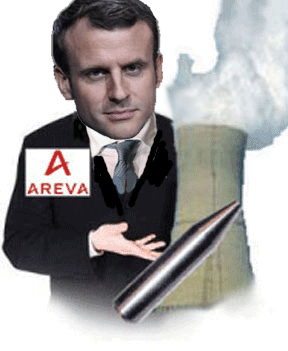 visit to France is not expected to lead to any major breakthrough on Orano’s long-awaited contract to build a used nuclear fuel processing and recycling plant in China.
Fifteen months after Emmanuel Macron’s visit to Beijing during which the French industrialist and his partner CNNC had concluded a new memorandum of understanding , Orano (the former Areva refocused on the fuel cycle) is still far from to have won the bet. At the time, Orano and CNNC had given themselves until the end of 2018 to formally agree on this mega contract of more than 10 billion dollars.
China trying to market nuclear technology to Argentina
Chinese delegation set to revive stalled Argentina nuclear power plant talks
Technical team expected to go to Latin American country to discuss project reportedly worth up to US$8 billion, SCMP, 16 Mar, 2019 A delegation from China will visit Argentina this month to discuss the construction of a nuclear power plant, signalling possible progress in a deal that could increase Beijing’s deepening influence in the South American nation.
“Never Recognised India, Pakistan As Nuclear Countries,” Says China
https://www.ndtv.com/india-news/china-never-recognised-india-pakistan-as-nuclear-countries-2001316
“China has never recognised India and Pakistan as nuclear countries. Our position on this has never changed,” Chinese Foreign Ministry spokesman Lu Kang told a media briefing in Beijing.
All India | Press Trust of IndiaMarch 01, 2019 BEIJING: China Friday said it has never recognised India and Pakistan as nuclear powers and ruled out extending such a status to North Korea following the unsuccessful second summit between US President Donald Trump and North Korean leader Kim Jong-un in Vietnam.
“China has never recognised India and Pakistan as nuclear countries. Our position on this has never changed,” Chinese Foreign Ministry spokesman Lu Kang told a media briefing in Beijing.
He was replying to a question whether China would recognise North Korea as a nuclear state like India and Pakistan as talks between Trump and Kim at the second summit in Hanoi broke down over Pyongyang’s refusal to give up two nuclear processing plants.
China has been blocking India’s entry into the 48-member Nuclear Suppliers Group (NSG) on the ground that New Delhi has not signed the Nuclear Non-Proliferation Treaty (NPT).
After India applied for NSG membership, Pakistan too applied for the same following that China has called for a two-step approach which states that NSG members first need to arrive at a set of principles for the admission of non-NPT states into the NSG and then move forward discussions of specific cases.
Wind and solar power in China – fast outstripping nuclear power
Wind & Solar In China Generating 2× Nuclear Today, Will Be 4× By 2030, Clean Technica, February 21st, 2019 by Michael Barnard, Close to five years ago I published an assessment of nuclear scaling vs wind and solar scaling using China as the proving ground in the CleanTechnica article “Wind Energy Beats Nuclear & Carbon Capture For Global Warming Mitigation.” Today, the China example is more clear proof that wind and solar are the better choice for global warming mitigation than nuclear generation.China’s example is meaningful because it disproves several arguments of those in favor of increased nuclear generation. It’s not suffering under regulatory burden. It’s mostly been using the same nuclear technologies over and over again, not innovating with every new plant. It doesn’t have the same issues with social license due to the nature of the governmental system. The government has a lot of money. The inhibitors to widespread deployment are much lower.
Yet China has significantly slowed its nuclear generation rollout while accelerating its wind and solar rollout. Even strong industry insiders accept this, ones such as former World Nuclear Association executive Steve Kidd, writing in Nuclear Engineering International in 2017.
Kidd estimates that China’s nuclear capacity will be around 100 gigawatts (GW) by 2030, well below previous expectations. Forecasts of 200 GW by 2030 were “not unusual only a few years ago,” he writes, but now seem “very wide of the mark.” And even the 100 GW estimate is stretching credulity ‒ nuclear capacity will be around 50 GW in 2020 and a doubling of that capacity by 2030 won’t happen if the current slow-down sets in.
Why is China slowing its nuclear rollout so drastically? Because nuclear is turning out to be more expensive than expected, new nuclear designs are proving to be uneconomical, and new wind and solar are dirt cheap and much easier to build.
Recently I published an assessment of the potential for wind and solar to massively exceed US CO2 reductions from nuclear in the CleanTechnica article US Could Achieve 3× As Much CO2 Savings With Renewables Instead Of Nuclear For Less Money. As usual, many of the comments from nuclear advocates related to the relative success of China, its speed of deployment compared to other jurisdictions and similar things.
In the discussion threads, I attempted to find apples-to-apples comparisons of China’s nuclear, solar, and wind generation compared, but none seemed to exist. As a result, I developed a model spanning 2010 to 2030, core years for all three programs. The charts are generated from the model

As I noted in 2014, the wind generation program had started much later than the nuclear program yet had been able to build much more capacity much more quickly, roughly six times more real wind energy capacity than nuclear per year over the years of 2010 through 2014. At the time, I used best of breed capacity factors for both wind and nuclear. One of the arguments against this at the time and on an ongoing basis is that China is curtailing wind and solar generation and achieving lower capacity factors. However, China is also experiencing less than best of breed capacity factors with its nuclear fleet, averaging 80% instead of 90%. This would have put the real world generation in the range of 3–4 times better for wind than for nuclear.
It doesn’t really matter as even with the diminished capacity factors for wind and solar currently experienced, they generated more than double the electricity generated by nuclear in 2018. Wind and solar each generated more electricity last year than nuclear did. By 2030, the ratio is very likely to be 4:1 in favor of wind and solar. And as Lazard has shown, wind and solar are much, much cheaper than nuclear, so China will be getting a lot more electricity at a lower cost point.
The chart above uses the capacity factors being experienced for wind, solar and nuclear to date in China and projects that all three will improve over the coming decade as operational efficiencies and grid connections improve………….

The quote from Kidd above suggests China might achieve only 100 GW of nuclear capacity by 2030. That’s an overestimation according to the actual data. Nuclear reactors in construction today only bring Chinese nuclear capacity to 55 GW by 2023. Reactors scheduled to start construction in the next three years only bring that number to 66 GW. Reactors planned but not scheduled at all are only likely to see 88 GW by 2030. There is no planned capacity that achieves even 100 GW, never mind the heady days when 200 GW was thought to be possible.
And to be clear, even if 200 GW of nuclear had been realized, it still would have been less actual generation than wind and solar.
As I indicated in the recent article on US ability to decrease carbon load, nuclear is much lower carbon per MWh than either coal or gas generation, as well as being free of chemical and particulate pollution. However, wind is still quite a bit lower than nuclear in CO2e per MWh and solar is around the same. Given the speed of deployment per GW of capacity and the much lower price per MWh of wind and solar, nuclear as part of the mix doesn’t make a lot of sense in most places…………https://cleantechnica.com/2019/02/21/wind-solar-in-china-generating-2x-nuclear-today-will-be-4x-by-2030/
|
|
1 This Month

To see nuclear-related stories in greater depth and intensity – go to https://nuclearinformation.wordpress.com
-
Archives
- September 2026 (194)
- August 2026 (330)
- July 2026 (355)
- June 2026 (287)
- May 2026 (306)
- April 2026 (356)
- March 2026 (251)
- February 2026 (267)
- January 2026 (308)
- December 2025 (358)
- November 2025 (359)
- October 2025 (375)
-
Categories
- 1
- 1 NUCLEAR ISSUES
- business and costs
- climate change
- culture and arts
- ENERGY
- environment
- health
- history
- indigenous issues
- Legal
- marketing of nuclear
- media
- opposition to nuclear
- PERSONAL STORIES
- politics
- politics international
- Religion and ethics
- safety
- secrets,lies and civil liberties
- spinbuster
- technology
- Uranium
- wastes
- weapons and war
- Women
- 2 WORLD
- ACTION
- AFRICA
- Atrocities
- AUSTRALIA
- Christina's notes
- Christina's themes
- culture and arts
- Events
- Fuk 2022
- Fuk 2023
- Fukushima 2017
- Fukushima 2018
- fukushima 2019
- Fukushima 2020
- Fukushima 2021
- general
- global warming
- Humour (God we need it)
- Nuclear
- RARE EARTHS
- Reference
- resources – print
- Resources -audiovicual
- Weekly Newsletter
- World
- World Nuclear
- YouTube
-
RSS
Entries RSS
Comments RSS
 nuclear-news