Kushner Reveals Dystopic Plan to Build Data Centers on Ruins of Gaza Genocide.
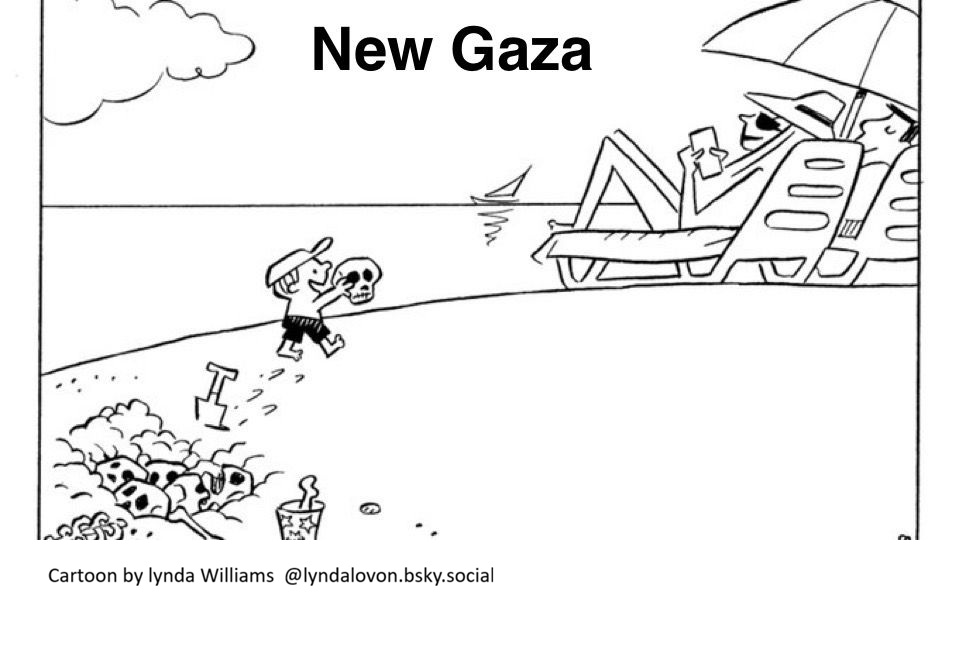
“This is a plan to erase Gaza’s indigenous character, turn what remains of her people into a cheap labor force to manage their ‘industrial zones’ and create an exclusive coastline for ‘tourism,’”
The plan appears to be to finish Israel’s bulldozing of Gaza to make real estate opportunities for investors.
“This is a plan to erase Gaza’s indigenous character, turn what remains of her people into a cheap labor force to manage their ‘industrial zones’ and create an exclusive coastline for ‘tourism,’”
The plan appears to be to finish Israel’s bulldozing of Gaza to make real estate opportunities for investors.
By Sharon Zhang , Truthout, January 22, 2026, https://truthout.org/articles/kushner-reveals-dystopic-plan-to-build-data-centers-on-ruins-of-gaza-genocide/

White House Adviser Jared Kushner revealed a neocolonial plan to transform Gaza into a home for luxury tourist resorts and data centers at the World Economic Forum on Thursday.
The plan has been widely condemned by human rights advocates, who say it is an an attempt to erase Palestinians by building a capitalist dystopia on the ruins of Israel’s genocide.
At the signing ceremony for President Donald Trump’s “Board of Peace,” Kushner shared a set of slides depicting a colonialist fantasy of the Gaza Strip under a hypothetical “demilitarization” of Hamas — despite the group’s repeated refusal to disarm, saying it would leave them defenseless against further attacks by Israel or otherwise.
The slides show computer-generated photos of high rise buildings along the coast and rows of residential buildings elsewhere.
The presentation includes a blueprint of Gaza divided into sections, which Kushner says is the U.S.’s plan for “catastrophic success” in the event of demilitarization of Hamas. The blueprint, labelled as the “Master Plan,” shows the entirety of the coast — where Palestinians have long fished for sustenance — dedicated to “coastal tourism,” with a sea port and an airport. There are large swaths dedicated to “parks, agriculture, and sports facilities.”
Tellingly, numerous parts of the map located next to residential areas are dedicated to industry and “data centers.” Ruinous technology like AI, reports have said, are slated to be a major part of the White House’s plan for Gaza, with other slides in the pitch deck reported by The Wall Street Journal showing a transformation of the Strip into a “smart city” with “tech driven governance.”
Nowhere is there a designation for cultural sites, nor does the map seem to be built around keeping or restoring any parts of Gaza that retain Palestinian heritage or life. The plan appears to be to finish Israel’s razing of the territory, clear the rubble in which thousands of Palestinians’ bodies are thought to be trapped, and replace it with real estate opportunities for investors.
“Gaza, as President Trump has been saying, has amazing potential,” said Kushner.
At the signing ceremony, Trump said that Gaza, home to millions of Palestinians, is “a great location” that should be viewed as a “big real estate site,” and expressed his interest in the region as a “real estate person at heart.”
“I said, look at this location on the sea, look at this beautiful piece of property — what it could be for so many people, it’ll be so great, people that are living so poorly are gonna be living so well,” Trump said.
Kushner touted the White House’s goal of applying “free market economy principles” to the razing and redevelopment of Gaza. He also expressed a desire to replace the humanitarian aid system for Palestinians in the region using those principles.
Palestinians have strongly condemned the plan.
“This is a plan to erase Gaza’s indigenous character, turn what remains of her people into a cheap labor force to manage their ‘industrial zones’ and create an exclusive coastline for ‘tourism,’” wrote Palestinian American writer Susan Abulhawa. “Palestinians will be pushed behind walls and gates, retrained in ‘technical schools’ to serve Israel’s supremacists ideology. The indigenous traditions and social fabric of this land will be obliterated utterly.”
“If the goal is truly peace, then the path is simple: end the occupation and help restore the rights that have been taken from Palestinians since 1948,” said Mosab Abu Toha, a Palestinian writer from Gaza. “We, the Palestinian people, are the ones who must determine our own future. Peace cannot be imposed while our land is occupied, our lives controlled, and our voices ignored.”
Nuclear project with locals opposed will get federal review
Federal law requires large projects to examine whether there are other feasible ways to meet the same goals with fewer risks.
That opens the door to arguments that renewables, storage and grid upgrades could deliver similar benefits faster, more cheaply and with less environmental harm.
Recent studies from the Ontario Clean Air Alliance suggest alternatives exist and that the province could save up to $19 billion per year by investing in wind, solar and storage instead of pursuing the Wesleyville nuclear megaproject.
Canada’s National Observer, By Abdul Matin Sarfraz, January 22nd 2026
For most of her life, Faye More has lived in the shadow of nuclear waste, grappling with radioactive contamination in her home and her hometown left behind by uranium and radium processing.
She grew up in Port Hope, a lakeside community about 100 kilometres east of Toronto that is still undergoing cleanup of contaminated soil that continues to be removed from neighbourhoods and stored in a huge engineered mound about the size of 70 hockey rinks, visible from Highway 401.
In the 1970s, government investigators found high levels of radon gas at St. Mary’s elementary school in Port Hope, where radioactive mining waste from the town’s uranium mine had been used as fill beneath the building. The school was closed and tests were conducted elsewhere around the town. Investigators uncovered contamination in unexpected places — including backyards and basements.
“I grew up in a contaminated house. I later ended up buying a contaminated property without knowing it and I raised my family there because the locations of radioactive waste were not being disclosed,” More said.
Radon is a colourless, odourless radioactive gas that forms naturally as uranium breaks down in soil and can seep into homes through foundations — it’s naturally occurring in many places but, in Port Hope, levels were significantly higher than normal. Health Canada says radon is the second-leading cause of lung cancer after smoking, linked to about 16 per cent of cases nationwide, or more than 3,000 deaths each year.
Now, More’s community is being asked by the Ford government to shoulder another nuclear burden, one of the largest nuclear projects in the world. This time, she is fighting back, helping lead local residents who say they have already paid the price.
The province last year announced that Ontario Power Generation (OPG) is proposing a new nuclear generating station on its Wesleyville property. The company says the project could eventually host up to 10,000 megawatts of generating capacity, enough to power up to 10 million homes for roughly 78 years.
In its own documents, the Ontario Power Generation says it is not considering alternatives to the Wesleyville project itself. It describes nuclear expansion as a policy decision already made by the province.
The Ford government celebrated the project, claiming more nuclear power is essential to meet rising electricity demand while helping Canada hit its climate targets.
Nuclear energy is frequently cited as a clean, reliable alternative to fossil fuels…………………….
“I was really shocked and appalled,” said More, now chair of the Port Hope Community Health Concerns Committee. “I felt it was very disrespectful to the people, the way it was announced as good news.”
More says the group has more than 100 members and is a volunteer-run non-profit formed in 1995 to address health and environmental risks linked to radioactive contamination in the town.
The group organizes public meetings, shares information online, writes letters to officials and urges residents to take part in public consultations.
Last week, the federal government formally designated the proposed Wesleyville project for a federal environmental impact assessment, opening the door to public consultation.
Unlike most major infrastructure projects, nuclear plants fall largely under federal jurisdiction. The Federal Impact Assessment Act requires a full review for any new nuclear facility larger than 200 megawatts.
The Canadian Nuclear Safety Commission must then decide whether the project meets safety and environmental rules under the Nuclear Safety and Control Act and the Impact Assessment Act before issuing a licence.
More hopes the federal process will stop the project altogether. She says the risks to nearby communities are too great, that safer alternatives exist and that the Ford government ignored Port Hope’s long and painful history with the nuclear industry.
For her, the idea of building one of the world’s largest nuclear plants nearby feels surreal.
“To suddenly hear that in this beautiful rural area they are going to build what could be the largest nuclear plant in the world is really unimaginable,” she said.
More worries about what that would mean for land, water and ecosystems. “It is hard to picture the scope of changes that would happen out there,” she told Canada’s National Observer. “And with that scale comes enormous risks, including emissions to the water, the air and impacts on biodiversity.”
OPG’s filings describe major physical changes that would come with the project. These include shoreline filling, dredging, building docks and large-scale excavation and blasting.
The company also says the plant would rely on cooling water from Lake Ontario. The company acknowledges the site includes wetlands, creeks and fish habitat. It also says parts of the area fall within highly vulnerable aquifer zones.
More says the pace of the project is almost as alarming as its size. She believes people should have veto power, a view not shared by the Ford government, which like the federal government is seeking to build infrastructure more quickly.
“One of the most basic questions in any environmental assessment is: Do we actually need this much energy? And if we do, why does it have to come from here?”
The company says it already owns the property, that it has been intended for electricity generation for decades and that the region has major infrastructure nearby such as transmission corridors, rail access and road that make the site ideal for the expansion plans.
Moving faster than expected
Legal experts note the project is moving at unusual speed.
Theresa McClenaghan, executive director and counsel at the Canadian Environmental Law Association, has followed nuclear projects for decades and says the timeline alone should raise red flags.
“From the very first idea, where the province asked OPG to look at potential new sites, to filing a project description with the federal agency, it’s been something like a year,” she told Canada’s National Observer. “That’s incredibly fast for something of this scale.”
McClenaghan believes OPG is trying to secure approvals while political conditions are favourable.
““They see a friendly Nuclear Safety Commission. They see a supportive provincial government and a supportive federal government,” she said.
“I think they’re thinking: let’s get this licence in our back pocket.”
She points to earlier cases where OPG obtained approvals long before construction began, protecting itself from future political or economic shifts. That strategy matters, she says, because nuclear megaprojects often face soaring costs.
Recent regulatory changes mean many of those costs can now be passed on to ratepayers long before any electricity is produced.
McClenaghan says the federal impact assessment may be the only real opportunity for the public to closely examine the project’s risks, costs and alternatives.
“It’s extremely rare for nuclear projects to be denied,” she said. “But it’s not impossible.”
The review will eventually combine two decisions into one: whether the project’s impacts are acceptable under federal law and whether the Canadian Nuclear Safety Commission should grant OPG a licence.
Under federal rules, the process must look at accident scenarios, long-term environmental effects and whether the project makes sense in its proposed location, including near population centres. In its own documents, OPG says it is not considering alternatives to the Wesleyville project itself. It describes nuclear expansion as a policy decision already made by the province.
McClenaghan says that stance could become a major sticking point. Federal law requires large projects to examine whether there are other feasible ways to meet the same goals with fewer risks.
That opens the door to arguments that renewables, storage and grid upgrades could deliver similar benefits faster, more cheaply and with less environmental harm.
Recent studies from the Ontario Clean Air Alliance suggest alternatives exist and that the province could save up to $19 billion per year by investing in wind, solar and storage instead of pursuing the Wesleyville nuclear megaproject.
Ontario’s big nuclear bet
More than half of Ontario’s electricity currently comes from nuclear power.
Under the province’s long-term planning, that share is projected to rise above 70 per cent by 2050 as electricity demand is expected to increase by about 75 per cent.
Nuclear projects are expensive and complex. The province says it plans to explore new ownership models and equity partnerships to attract private capital.
The government argues nuclear power is more cost-effective and land-efficient than renewables. It says alternatives would require vast amounts of land and major new transmission infrastructure, a claim challenged by energy experts.
For More, the fight has already begun. She is organizing meetings, sharing information online and urging people to take part in the consultation. But she says the timelines are too short for communities to respond in a meaningful way.
She worries that political efforts to “cut red tape” are turning health and environmental protections into barriers to be removed.
“What happens at Wesleyville doesn’t stay at Wesleyville. The reach of a nuclear plant is enormous,” More said. “When a wind turbine fails, it doesn’t contaminate an entire region,” she said. “Nuclear is different.”
More says her community has already paid the price of Canada’s nuclear history once and they are not willing to do it again.
World’s Largest Nuclear Station or Lower Electricity Bills?

Nuclear Power: The Most Expensive and Slowest Option
Nuclear reactors are the highest cost option to meet Ontario’s electricity needs – up to 10 times higher than energy efficiency, and 2 to 8 times higher than new wind and solar energy.
They are also far too slow. According to OPG, these new nuclear reactors would not come online until 2040 – 2048. That means more than 20 years of construction, cost overruns, and continued reliance on polluting gas.
By contrast, new wind and solar projects can be built in 6 months – 2 years, reducing emissions and lowering bills quickly.
A Risky Dependence on Foreign Fuel
To make matters worse, OPG is considering purchasing American-designed reactors from GE-Hitachi or Westinghouse. These reactors would require Ontario to import enriched uranium from the United States to fuel them. Does that seem like a good idea given the current political craziness unfolding south of the border?
The Better Alternative
OPG’s proposal fails to examine crucial alternatives.
Could Ontario meet its electricity needs more cheaply, more quickly, and more safely by investing in energy efficiency, wind power, solar energy, and energy storage (such as batteries and compressed air storage)?
This is a question that the Impact Assessment Agency of Canada (IAAC) must examine during its mandatory review. That will only happen if the public demands it.
What you can do
 Submit Public Comments – Deadline: Midnight, Wed. Feb. 11
The IAAC is accepting public comments on OPG’s application.
Submit your comments through the IAAC portal or email them to: wesleyville@iaac-aeic.gc.ca
Ask the IAAC to direct OPG to evaluate whether energy efficiency, renewables, and energy storage are lower-cost, faster, safer, and more secure ways to meet Ontario’s electricity needs than building a massive new nuclear station at Port Hope
What Canada’s nuclear waste plan means for New Brunswick
by Mayara Gonçalves e Lima, January 20, 2026, https://nbmediacoop.org/2026/01/20/what-canadas-nuclear-waste-plan-means-for-new-brunswick/
Canada is advancing plans for a Deep Geological Repository (DGR) to store the country’s used nuclear fuel. In early 2026, the Nuclear Waste Management Organization (NWMO) entered the federal regulatory process by submitting its Initial Project Description — a major step in a project with environmental and social implications that will last for generations.
The implications of this project matter deeply to New Brunswickers because the province is already part of Canada’s nuclear legacy through the Point Lepreau Nuclear Generating Station. The proposed repository in Ontario is intended to become the final destination for used nuclear fuel generated in New Brunswick, currently stored on site at Point Lepreau.
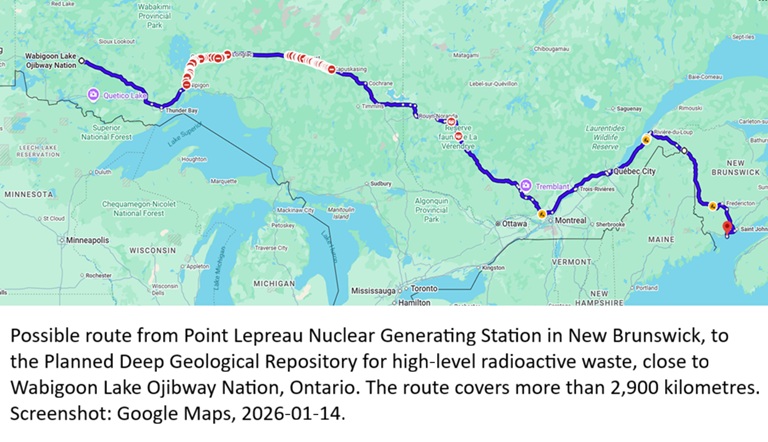
If the project goes ahead, highly radioactive nuclear waste would be transported across New Brunswick. Current NWMO plans envision more than 2,100 transport packages of New Brunswick’s used nuclear fuel travelling approximately 2,900 kilometres, through public roads in the province and across Canada, over a period of 10 to 15 years.
For many residents, the project raises long-standing concerns about safety, accountability, and cost — especially as NB Power continues to invest in nuclear technologies and considers new reactors. Decisions about the DGR will influence how long New Brunswick remains tied to nuclear power, carrying the risks of waste that remains hazardous far beyond any political or economic planning horizon.
This is a critical moment because public input is still possible — but the comment period window is narrow. Environmental organizations and community advocates are calling for extended consultation timelines, full transparency on transport risks, and meaningful consent from affected communities. Several groups have organized a sign-on letter that readers can review and support.
How New Brunswickers respond now will help determine whether these decisions proceed quietly — or with public accountability.
Unproven science and public concerns
Globally, no deep geological repository for high-level nuclear waste has yet operated anywhere on the planet. Finland’s Onkalo facility is often cited as the first of its kind, but it remains in testing, relies on unproven assumptions about geological containment, and will not be fully sealed for decades.
The lack of proven DGR experience matters for Canada because the proposed repository would be among the world’s earliest attempts to isolate high-level radioactive waste “forever,” despite the absence of any real-world proof that such facilities can perform as claimed. Canada’s decision therefore sets not only a national course, but a global precedent built on uncertain science and long-term safety assumptions.
The proposed DGR would be built 650 to 800 metres underground in northwestern Ontario, near the Township of Ignace and Wabigoon Lake Ojibway Nation (WLON), in Treaty #3 territory. Its purpose is to bury and abandon nearly six million bundles of highly radioactive used nuclear fuel, attempting to isolate them from the biosphere for hundreds of thousands of years.
The Nuclear Waste Management Organization describes the site selection as “consent-based,” but this framing raises difficult questions. Consent in economically marginalized regions — particularly where long-term funding, jobs, and infrastructure are promised — is not the same as free, prior, and informed consent, especially when the risks extend far beyond any western planning horizon.
In 2024, the Assembly of First Nations held dialogue sessions on the transport and storage of used nuclear fuel. Communities raised serious concerns that the proposed DGR could harm land, water, and air — all central to Indigenous culture and way of life.
Guided by ancestral knowledge and a duty to protect future generations, the Assembly warned that the DGR threatens sacred sites, ecosystems, and groundwater, including the Great Lakes. Climate change and natural disasters heighten these risks, exposing the limits of the current monitoring plan and prompting calls for life-cycle oversight.
A token consultation for a monumental project
As anticipated, the Initial Project Description raises serious concerns about the DGR process itself. One of the most serious flaws is the stark mismatch between the project’s scale and the time allowed for public input. Although the DGR is framed as a 160-year project with risks lasting far longer, communities, Indigenous Nations, and civil society groups have been given just 30 days to review the Initial Project Description, with submissions due by February 4.
Thirty days to read dense technical documents, consult communities, seek independent expertise, formulate questions, and respond meaningfully to a proposal that will affect land, water, and people for generations. This is not a generous consultation — it is the bare legal minimum under federal impact assessment rules.
While regulators emphasize that the overall review will take years, this early stage is crucial in shaping what will be examined and questioned later. Rushing public input at the outset risks reducing participation to a procedural checkbox rather than a genuine democratic process, particularly for a decision whose consequences cannot be undone.
The overlooked threat of waste transport
Another serious shortcoming in the project proposal is a failure to adequately address the nationwide transport of radioactive waste. Transporting highly radioactive material through communities by road or rail is central to the project and carries significant safety and environmental risks that remain largely unexamined.
By excluding radioactive waste transportation from the Initial Project Description, the Nuclear Waste Management Organization is effectively removing it from the scope of the comprehensive federal Impact Assessment. If transport is not formally included at this stage, it will not receive the same level of environmental review, public scrutiny, or interdepartmental oversight as the repository itself.
Instead, transportation would be left primarily to the Canadian Nuclear Safety Commission and Transport Canada to assess under the existing regulations — an approach that is fragmented and insufficient given the scale, duration, and risks of moving highly radioactive waste through communities.
The transport of radioactive waste is a critical yet often overlooked issue. As Gordon Edwards, president of the Canadian Coalition for Nuclear Responsibility notes, Canada has no regulations specifically governing the transport of radioactive waste — only rules for radioactive materials treated as commercial goods. This gap matters because radioactive waste is more complex, less predictable, and potentially far more dangerous.
Transporting high-level nuclear waste is inherently risky: the material remains hazardous for centuries, and accidents, equipment failures, extreme weather, security breaches, or human error can still occur despite careful planning. Unlike other hazardous materials, radioactive contamination cannot be easily contained or cleaned up, leaving land, water, and ecosystems damaged for generations. Even a single transport incident could have lasting, irreversible consequences for communities along the route.
Radiation risks extend beyond transport workers. People traveling alongside shipments may face prolonged exposure, while those passing in the opposite direction are briefly exposed in much larger numbers. Residents and workers along transport routes can experience repeated exposure, and accidents or unplanned stops could result in localized contamination. Emergency response is further complicated by leaks or hard-to-detect releases, with standard spill or firefighting methods potentially spreading contamination.
These risks are not hypothetical. Last summer, Gentilly-1 used fuel was transported from Bécancour, Quebec, to Chalk River, Ontario, along public roads — without public notice, consultation, Indigenous consent, or clear evidence of regulatory compliance — underscoring the ongoing risks to our communities.
According to the 2024 Assembly of First Nations report, at least 210 First Nations communities could be affected by shipments of radioactive waste traveling from nuclear reactors to the repository via railways and major highways, though the full scope may be even larger when considering watersheds and alternative routes.
Given this reality, it is unacceptable that the DGR Project Description largely ignores waste transport. Any credible assessment must examine how waste will be moved, who will be affected, what rules apply, who is responsible for oversight, and how workers, communities, and the environment will be protected in emergencies. It is the job of the Impact Assessment Agency of Canada to examine these plans in depth.
A high-stakes decision that demands public voice
Canada’s proposed Deep Geological Repository is one of the most ambitious and high-stakes projects in nuclear waste management. Framed as a permanent solution, it remains untested — no country has safely operated a deep repository for used nuclear fuel over the long term. Scientific uncertainty and multi-decade timelines make its risks profound and enduring.
Dr. Gordon Edwards warns: “The Age of Nuclear Waste is just beginning. It’s time to stop and think. […] we must ensure three things: justification, notification, and consultation — before moving any of this dangerous, human-made, cancer-causing material over public roads and bridges.”
Now is the moment for public voices to be heard. Legal Advocates for Nature’s Defence (LAND), an environmental law non-profit, has prepared a sign-on letter and accompanying press release calling for a more precautionary, transparent, and democratic approach to the Deep Geological Repository. This is your chance to have a say in decisions that could expose you, your neighbours, and your communities to serious environmental and health risks.
The letter urges federal regulators to extend public consultation timelines, require that the Impact Assessment Agency of Canada conduct a comprehensive Impact Assessment that includes the transportation of radioactive waste, and uphold meaningful consent and accountability.
New Brunswickers and allies across the country are encouraged to read the letter, add their names, and speak up before decisions are finalized. How Canada handles nuclear waste today will shape risks borne by our communities for generations.
The DGR is more than a technical project; it is a test of democratic process, scientific caution, and intergenerational responsibility. Canadians deserve a transparent, thorough, and precautionary approach to ensure that decisions made today do not compromise the safety of future generations.
Mayara Gonçalves e Lima works with the Passamaquoddy Recognition Group Inc., focusing on nuclear energy. Their work combines environmental advocacy with efforts to ensure that the voice of the Passamaquoddy Nation is heard and respected in decisions that impact their land, waters, and future.
Danish MP Warns US Takeover of Greenland Will Start a War
by Kyle Anzalone , January 21, 2026 , https://news.antiwar.com/2026/01/20/danish-mp-warns-us-takeover-of-greenland-will-start-a-war/
Trump has placed tariffs on Europeans nations that oppose the US seizing Greenland
Amid threats from President Donald Trump to take over Greenland, a Danish politician said that if the US seized the colony, a war would break out.
Danish MP Rasmus Jarlov said that if the US military invades Greenland, “it would be a war, and we would be fighting against each other.”
“There’s no threat, there’s no hostility. There’s no need, because the Americans already have access to Greenland, both militarily and in all other ways.” He continued, “There are no drug routes. There is no illegitimate government in Greenland. There is absolutely no justification for it– no historical ownership, no broken treaties, nothing can justify it.”
In recent weeks, President Trump said the US will take control of Greenland. The President argues it is a matter of national security, as Russia or China will seize Greenland from Denmark if the US does not gain control first.
In response to Trump’s threats, Denmark has begun increasing its military presence in Greenland.
Trump’s plan to take Greenland has met stiff opposition in Europe. The President has slapped 10% tariffs on eight European countries. Trump said the tariffs would increase if those nations did not change policy and support the US seizure of Greenland.
An executive at Deutsche Bank suggested that European countries could pressure the US to back away from Greenland by refusing to buy US bonds. George Saravelos, head of FX research, explained, “For all its military and economic strength, the US has one key weakness: it relies on others to pay its bills via large external deficits.”
Trump and Treasury Secretary Scott Bessent downplayed the risk of a currency war with Europe. “The media has latched on to this. I think it is a completely false narrative. It defies any logic,” he said Tuesday.
“If you look, the US Treasury market was the best-performing market in the world, or the best G7-performing bond market, and we had the best performance since 2020. It is the most liquid market.” Bessent continued,” It is the basis for all financial transactions, and I am sure that the European governments will continue holding it.”
The President said he did not expect Europe to push back too much if he annexed Greenland. “I don’t think they are going to push back too much,” he said, adding, “We have to have it.”
It wasn’t Trump’s mind or morality that stopped his Iran attack.
Walt Zlotow West Suburban Peace Coalition, 21 Jan 26
A week ago President Trump was posturing about an imminent attack to overthrow the Iranian regime embroiled in massive protests. His declared motive was to save the Iranian protesters seeking internal regime change who were being slaughtered by the regime.
Then Trump pivoted, declaring since the regime was no longer planning to execute protesters, he wouldn’t attack.
But it wasn’t Iranian government benevolence that persuaded Trump to stand down. The two reasons Trump’s explanation was covering up were reality on the ground and a phone call.
The massive but failed protests were not solely a spontaneous internal revolt. They were fomented and supported by both the US and Israel to complete their long sought dream of regime change to destabilize Iran, Israel’s last hegemonic rival in the region. Israel’s Mossad was definitely on the ground and likely the CIA as well. Trump was cheering on the protests from the sidelines.
Trump was poised to attack to complete the regime change operation when protest success appeared imminent. But Iran’s government quickly and decisively snuffed out the protests, ending Trump’s dream of adding more thousands to his massive, murderous death toll bombing 7 countries in his first year of term two.
Trump also got a call from the real boss of US Middle East policy….Israel’s Benjamin Netanyahu. He told Trump that with the regime intact, Israel would be decimated by thousands of Iranian missiles once Trump attacked.
Iran’s government may be secure for now but Israeli, US dream of Iranian regime change will never cease.
Trump lied to the New York Times when he said the only thing that can stop him from foreign intervention is “my own mind, my own morality.” What stopped Trump from attacking Iran again, as he did in June, is what stopped him then… failure on the ground and a call from the guy giving Trump his orders on Middle East foreign policy.
Summary comments on the Deep Geologic Repository (DGR) Project for Canada’s Used Nuclear Fuel
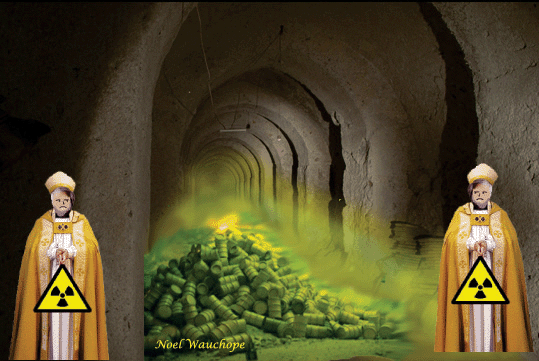
The nuclear waste will be radioactive for, say, a period of time that is close to eternity, whereas the project covers a period of 160 years. The solution is therefore very far from permanent.
We are swimming here in the middle of a pro-nuclear religion.
by Miguel Deschênes, 20 Jan 26
a translation of comments submitted in French to the Impact Assessment Agency of Canada (IAAC) by Miguel Deschêne on this subject.
Seven major objections stand out:
1- Developers are not trustworthy
On page v of the document, it states that “Canada’s nuclear power plants have been providing clean energy for decades,… ». Then, on page vii, it is explained that the project itself “would contain and isolate approximately 5.9 million spent fuel assemblies,” representing approximately 112,750 tonnes of irradiated and highly radioactive heavy metals. This waste contains a wide variety of radioactive substances that are dangerous to living beings. One of the most famous isotopes found in these spent fuel bundles is plutonium-239. Need we remind you that Canadian plutonium was used in the bomb that destroyed the city of Nagasaki in 1945? To say on page v of the document that nuclear energy is clean and to specify on page vii that it will generate 112,750 tonnes of highly radioactive (and potentially destructive) heavy metals in Canada is staggering incoherent.
On page iv of the document, there is a list of twelve specialists and managers who prepared, reviewed, approved and accepted this document, which includes this glaring logical error. This leads to the conclusion that the developers seem willing to present all possible arguments, however incongruous, to defend this project, while concealing the negative aspects that could overshadow it. They therefore have neither the capacity for reflection nor the objectivity required to manage this project, when it would be essential to protect the safety of the public and the environment in complete transparency.
2- The objective(s) are unattainable
The document presents the objective of the project in two places, but they are two different objectives. These objectives look strangely like advertising slogans or the creeds of a pro-nuclear cult. Neither is attainable in practice, but they make it easy to project yourself into a world of unicorns:
a- On page viii, it is stated that: “The objective of the Project is to ensure the safe long-term management of used nuclear fuel so that it does not pose a risk to human health or the environment.”
We are talking about guaranteeing, for 160 years. A great Quebec poet would say “it’s better to laugh than to cry.” A car, which is one of the most advanced technological objects on the planet, is guaranteed for 3 or 5 years. How can we believe that we can guarantee a new landfill technology for a period of 160 years? It’s simply delusional.
In addition, even a simple plastic bottle carries risks to human health or the environment. And they want us to believe that this project will make it possible to store 112,750 tonnes of radioactive nuclear waste so that it does not pose any risk to human health or the environment? What sensible person can believe such a statement?
b- On page 20, it states that: “The objective of the Project is to provide a permanent, safe and environmentally responsible solution for the management of all of Canada’s used nuclear fuel.”
The nuclear waste will be radioactive for, say, a period of time that is close to eternity, whereas the project covers a period of 160 years; The solution is therefore very far from permanent. The solution is also presented as safe and environmentally friendly: based on what? The solution is safe as long as it is sold by convinced developers, but everyone knows that it involves enormous risks. And environmentally friendly? How can we say that burying 112,750 tonnes of radioactive nuclear waste is an environmentally friendly solution? We are swimming here in the middle of a pro-nuclear religion.
Obviously, neither of these two objectives is achievable in practice.
What is the real objective of the project? Indirectly extract as much money as possible from the public treasury and taxpayers? Putting hundreds of highly paid employees to work unnecessarily for decades? Shovel the problem of nuclear waste to our descendants?
The project is therefore, even before it has begun, doomed to failure, since it is impossible for it to achieve its totally utopian objectives. To believe in the success of this project, it is absolutely necessary to be overwhelmed by the pro-nuclear faith.
3- The budget is not presented
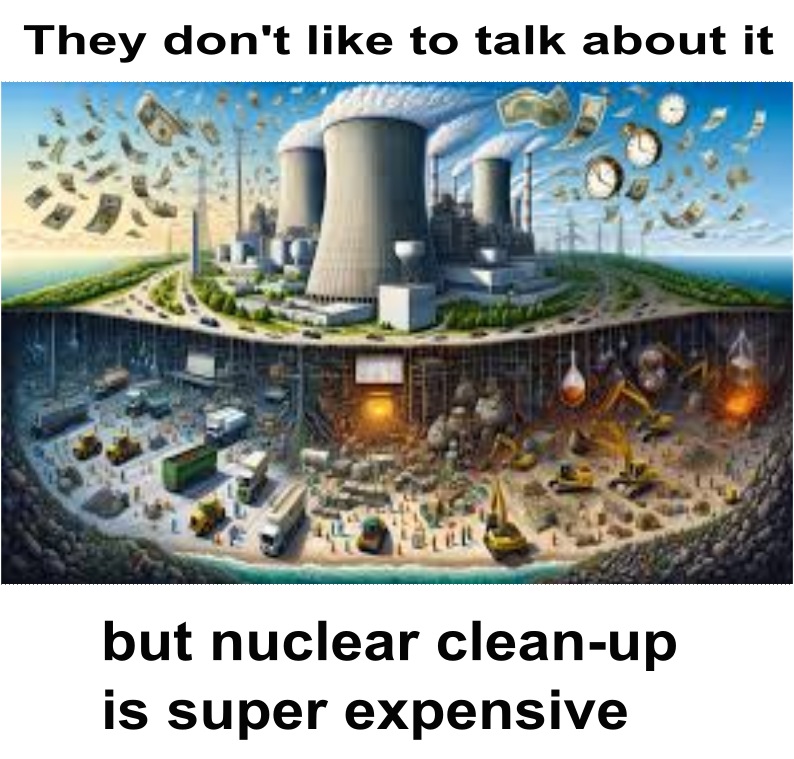
On page 52, it states that “Federal authorities are not providing any financial support to the Project.”
On page 65, it states that: “In addition, although the NWMO is a regulated entity by the CNSC, it is not a federal agency or authority. Rather, it is a question of a not-for-profit organization mandated by the federal government under the NFCA to managing Canada’s nuclear waste. The NWMO is fully funded by industry nuclear power. »
However, the Government of Canada and some provincial governments subsidize and financially encourage the nuclear industry.

So, in a nutshell, taxpayers are giving money to governments, which in turn subsidizes the nuclear industry, and which in turn funds the NWMO. The present project is therefore indirectly financed by taxpayers and by the federal authorities, which is not revealed by the sentence on page 52. Could we conclude that it is not necessary to call on an accountant if you have a good conjurer?
A detailed budget is one of the essential elements of project planning and monitoring. Where is the budget? How is it cut? And how much will it indirectly cost taxpayers? It would be reasonable to describe the sums required as potentially pharaonic and to require a project plan that includes a complete financial plan.
The absence of a budget in the presentation of a project is an unacceptable shortcoming.
4- The project’s time scale is doubly absurd
On page v, it states that “The Project is expected to span approximately 160 years, including site preparation, construction, operation (approximately 50 years), decommissioning and closure, and post-closure monitoring.”
This duration is both too short and too long:

a- Too short: the half-life of plutonium-239 is about 24,130 years. It is calculated that after a duration of approximately seven times the half-life of an isotope, less than 1% (more precisely, 1/128) of the initial radioactive atoms remain. In the case of plutonium-239, it would therefore be necessary to wait about 168,000 years to reach this target. Obviously, this calculation would have to be done for all the isotopes found in the original waste and for all the isotopes created during subsequent decays in order to properly assess the hazardousness of the waste as a function of time, which is very complex. But we can see right away that the 160-year period is far too short to ensure the safety of the public and the environment.
b- too long: if we go back 160 years in time, we find ourselves in 1866, when the Canadian federation did not even exist. Since that time, humanity has experienced various epidemics (plague, cholera, Spanish flu, covid, etc.), two world wars and a multitude of other wars, major geopolitical reorganizations and major economic crises. It is perfectly utopian to think that a human project that has no other objective than to bury waste will be able to be carried out without hindrance for 160 years. What happens if there is a major epidemic, a world war, a coup d’état by an outsized geographic neighbour, a split in Canada, an unforeseen IT upheaval? How can we seriously believe that all the governments and political parties that will succeed each other will have at heart, for 160 years (if each party remains in power for 4 years, we are talking about 40 different governments), to adequately supervise this project?
In general, the longer a project lasts, the greater the likelihood of not achieving objectives, exceeding costs and exceeding the originally planned schedule. It is therefore quite reasonable and prudent to predict that the 160-year deep geological repository project is likely to be a complete failure: it will not achieve its objectives, while exceeding the planned deadlines and costs.
5- The responsibility for the project in the medium and long term cannot be assumed
What will be the responsibility for the project in the medium and long term, i.e. in 10, 20, 50 or 100 years? What if there is a design problem, a technical problem, a supplier problem, a funding problem, a nuclear incident or whatever? Who will be responsible when most of us are dead? To whom can our descendants turn to ask for accountability and rectification if necessary? No one can imagine or predict it, and it is likely that any assumption today about it will prove wrong tomorrow.
6- The risks associated with transportation are far too high
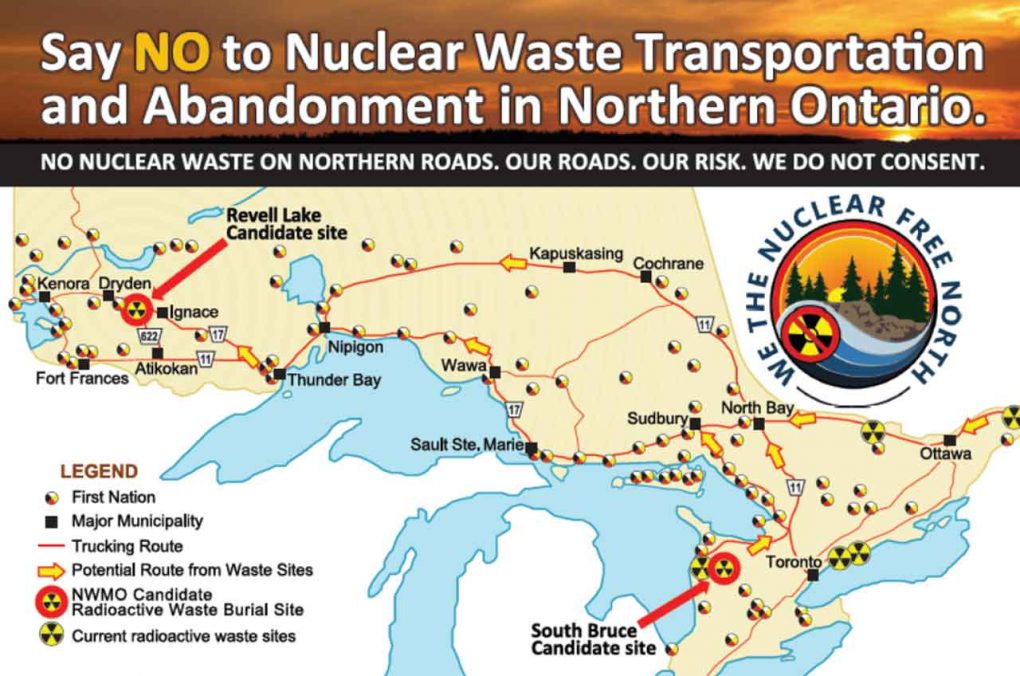
No means of transportation is perfectly safe. Regularly, planes crash, trains derail (the Lac-Mégantic rail accident in 2013 is a sad example) and trucks are involved in pile-ups. Sometimes, a space shuttle explodes in mid-flight.
On page vii, it states that “The Project does not include: the transportation of used fuel from the reactor sites to the Project beyond the primary and secondary access roads to the Project site, as the Project site is regulated separately under CNSC certification and uses existing transportation infrastructure.”
This seems to be, once again, a tactic to make the authorities and citizens swallow the pill of the project. The risks associated with a possible incident during the transportation of 112,750 tonnes of high-level radioactive waste on Canada’s roads, over a period of about fifty years (according to the projected schedule on page 31), are obviously far too high. It is therefore easy to understand why the developer prefers not to include this aspect in his project.
The excessive risk associated with transporting radioactive waste is an argument used by the Nuclear Waste Management Organization itself on its information page about Canada’s used nuclear fuel (https://www.nwmo.ca/fr/Canadas-used-nuclear-fuel): “Related questions: Couldn’t spent nuclear fuel be sent into space? No. In a three-year dialogue with experts and the public on possible long-term management options, the disposal of used nuclear fuel into space was one of the options of limited interest that we eliminated. Space-based evacuation has been ruled out as a solution because it is an unproven concept, not implemented anywhere in the world and not part of any national research and development plan. Concerns about the risk of accidents and the risks to human health and the environment have been amplified in particular by the accidents of the American space shuttles Challenger and Columbia. »
Why should the risk of an accident not be a consistent factor in the Nuclear Waste Management Organization’s reasoning? There have certainly been more train derailments and truck accidents than space shuttle incidents in human history. By what form of logic can we conclude that it is too risky to send used nuclear fuel into space, but that it is safe to transport it by train or truck? The only plausible explanation may be that we must have pro-nuclear faith.
7- Governments do not have a strategy to exit the nuclear industry

On page vii of the document, it states that: “The Project would contain and isolate approximately 5.9 million used fuel assemblies, which is the total anticipated inventory of used nuclear fuel that is expected to be produced in Canada by the current fleet of reactors until the end of their lifetime, as outlined in the NWMO’s 2024 Nuclear Fuel Waste Projections Report (NWMO, 2024). This projection is based on published plans for the refurbishment and life extension of the Darlington and Bruce reactors, as well as the continued operation of the Pickering A (until the end of 2024) and Pickering B (until the end of 2026) reactors, and the assumptions used by the NWMO for planning purposes. »
However, in October 2025, Ottawa and Ontario announced the construction of 4 new nuclear reactors (https://ici.radio-canada.ca/nouvelle/2201625/darlington-nucleaire-reacteur-opg-ontario). What about the waste that will be generated by these plants, which is not part of the inventory considered by the project? And what about those generated by other hypothetical power plants to come? Or those that the government could import from other countries?
Successive governments are constantly creating, recreating and amplifying the problem of nuclear waste, with no intention of ending this mess. The only decision that would limit this ecological disaster would be to abandon the nuclear industry, which would include stopping uranium mining, no longer building new nuclear power plants and never importing nuclear waste from other countries. Unfortunately, no decision-maker seems to have the foresight to move in this direction.
Even before the project begins, we already understand that the planned landfill will not be able to store all of Canada’s nuclear waste. Without a clear direction on the denuclearization of the country, the problem of radioactive waste is far from being solved.
In any case, a deep geological repository will never be a good solution for nuclear waste; This far too risky avenue is really only used to shovel the problems created by today’s decision-makers until a time when they will all be dead and will not have to assume the disastrous consequences.
Conclusion :
In my view, these arguments are more than enough to justify never authorizing the Deep Geologic Repository (DGR) Project for Canada’s used nuclear fuel. It seems that the “original project description” seeks to conceal the real issues related to nuclear waste management, in order to obtain the required authorizations, spend obscure (but potentially staggering) amounts of money, and perpetuate nuclear madness, with no regard for public safety and the environment. Unfortunately, this is a typical project of the nuclear industry, which relies on the blind complacency of the authorities and on daydreams rather than on transparency and objective arguments.
Government funding for Saskatchewan SMR test facility

World Nuclear News 20th Jan 2026
Western Canada’s first Small Modular Reactor Safety, Licensing, and Testing Centre at the University of Regina is to receive nearly CAD6 million (USD4.3 million) in funding from the federal and provincial governments.
The facility – the SMR-SLT – will be located at the Innovation Saskatchewan Research and Technology Park. It will house two test loops that simulate a part of a small modular reactor (SMR), modelling water-cooled systems using electrical heat, allowing researchers to test components under conditions similar to those in operating reactors.
The funding was announced by Buckley Belanger, Canada’s Secretary of State (Rural Development), on behalf of Minister of Emergency Management and Community Resilience and Minister responsible for Prairies Economic Development Canada Eleanor Olszewski. The federal government is investing CAD1.96 million (USD1.4 million) in the SMR-SLT through Olszewski’s department, PrairiesCan – a federal government department supporting business growth, innovation and community economic development across Alberta, Saskatchewan and Manitoba.
Provincial government support for the project is through SaskPower, the principal supplier of electricity in Saskatchewan, and a Crown Corporation – a commercial entity owned by the Government of Saskatchewan. It will be investing CAD4 million in the SMR-LT……………………..
Innovation Saskatchewan is contributing CAD1 million plus an in-kind contribution of the leased space at the Innovation Saskatchewan R+T Park for the first three years of operation. Canadian Nuclear Laboratories (CNL) will also provide in-kind design support. The centre will be led by University of Regina researchers, with the Global Institute for Energy, Minerals and Society (GIEMS) partnership between the University of Regina, University of Saskatchewan, and Saskatchewan Polytechnic playing a key role to ensure all three institutions have access to the test loops for training and research, SaskPower said.
The government of Saskatchewan signalled its commitment to incorporating nuclear capacity into its provincial electricity system in a long-term policy document released last year. SaskPower has previously selected GE Hitachi Nuclear Energy’s BWRX-300 SMR for potential deployment in the province in the mid-2030s and has identified two potential sites for SMR deployment, both in the Estevan area in the south-east of the province…………………
Arthur Situm, Canada Research Chair in SMR Safety and Licensing at the University of Regina, said the facility will help train the next generation of nuclear professionals by providing hands-on experience with safety systems and processes that define modern nuclear technology.
“Together, this work positions the University of Regina and Saskatchewan as a leader in safe, responsible, small modular reactor research with a global impact,” he said on YouTube…….
https://www.world-nuclear-news.org/articles/government-funding-for-saskatchewan-smr-test-facility
HIGH LEVEL NUCLEAR WASTE REMAINS UNAPPROACHABLE AND EXTREMELY TOXIC FOR HUNDREDS OF MILLIONS OF YEARS

Gordon Edwards, 20 Jan 26
Q: When is irradiated nuclear fuel less radioactive than uranium ore?
A: Never!
Mark Twain once wrote, “There are three kinds of lies: lies, damned lies, and statistics.” I would add to that short list many of the reassurances promulgated by nuclear enthusiasts. Take high-level nuclear waste for example.
Nuclear proponents often reassure the public and decision-makers that, after 10 million years or so, the high-level radioactive waste from nuclear reactors is more-or-less on a par with the original uranium ore found in nature from which the uranium fuel was extracted. Sounds reassuring, no doubt, but it is not true.
First of all, the language itself can be misleading. Many people may not realize that uranium ore is much more dangerously radioactive than uranium itself.
That’s because the ore is a mélange of uranium and its two dozen radioactive progeny, including isotopes of radium, polonium, and radon, as well as radioactive varieties of bismuth and lead. See www.ccnr.org/U-238_decay_chain.png & www.ccnr.org/U-235_decay_chain.png
Each one of these byproducts of uranium is much more radiotoxic (i.e.following ingestion or inhalation) than uranium itself. Indeed these pernicious radioactive poisons have already killed countless hundreds of thousands of humans exposed to them in one way or another.
Due to the presence of the radioactive progeny, uranium ore gives off a lot of highly penetrating gamma radiation (the principal cause of external whole-body irradiation) – far more than uranium itself. Pure uranium gives off very little gamma radiation.
Secondly, not all uranium ore is the same. Some ores are a lot more dangerous than others.
The potential health hazard of uranium ore depends on the “grade” of the ore. The grade is the concentration of uranium per gram of ore. The grade dictates the concentration of all of the radioactive progeny as well. So, the higher the grade, the more radioactive and the more radiotoxic the ore is.
At Cigar Lake in Northern Saskatchewan, for example, we have “high-grade” ore averaging about 17 percent uranium, which makes that ore more than 150 times more radioactive (and radiotoxic) than uranium ore from Elliot Lake Ontario (having a grade of about 0.1 percent).
The Cigar Lake ore is the richest (i.e. the highest grade) ever found. The ore is so radioactive that it cannot be safely mined by human beings, but must be mined using robotic equipment. See https://saskpolytech.ca/news/posts/2021/Cigar-Lake-project-collaboration-a-high-tech-home-grown-win.aspx .
But hold on a minute. Even after ten million years, the concentration of uranium left in spent fuel is about 98.5 percent. That is a MUCH higher grade than any ore ever found in nature.
So even after ten million years, used nuclear fuel is about 480 percent MORE radioactive and radiotoxic than the uranium ore at Cigar Lake – which is in turn more than 100 times more radioactive and radiotoxic than most other uranium deposits that have been mined in other countries. And that estimate is based ONLY on the uranium progeny mentioned above.
But that’s not all. In addition to uranium and its progeny, the ten-million-year-old CANDU used fuel bundles contain other radioactive poisons not found in uranium ore at all, such as caesium-135 (half-life 2.3 million years), iodine-129 (half-life 16 million years), palladium-107 (half-life 6.5 million years), and zirconium-93 (half-life 1.6 million years).
So when Canadian nuclear establishment people tell you that after 10 million years CANDU spent fuel is about as dangerous as naturally-occurring uranium ore, they are bending the truth by a significant amount. They are also misleading people by not explaining the difference between uranium ore and uranium in a refined form.
Incidentally, the Ontario Royal Commission on Electric Power Planning (commonly called the Porter Commission) published a graph in their 1978 Report “A Race Against Time” showing that the overall radiotoxicity of used CANDU fuel (the blue line in the graph) decreases for the first 50,000 years or so, and then increases to a higher level as the result of inbreeding of uranium progeny. Although it is not stated in the report, the radiotoxicity level of used nuclear fuel after ten million years does not change for a very long time – it remains relatively constant for the next several hundred millions of years.
Zionist Billionaires Openly Acknowledge Manipulating The US Government.
Caitlin Johnstone, Jan 19, 2026, https://www.caitlinjohnst.one/p/zionist-billionaires-openly-acknowledge?utm_source=post-email-title&publication_id=82124&post_id=185023681&utm_campaign=email-post-title&isFreemail=true&r=1ise1&triedRedirect=true&utm_medium=email
Speaking together at the Israeli-American Council Summit on Saturday, billionaire Zionist megadonors Miriam Adelson and Haim Saban strongly implied that they are engaged in some extremely shady activities to manipulate the US government in advancement of Israeli interests.
There’s a guy I follow on Twitter named Chris Menahan who’s always posting clips from Zionist events which might otherwise go unnoticed, frequently turning up jarring admissions from pro-Israel operatives who tend to loosen their lips a bit when addressing an audience of like-minded individuals. I recently cited a clip he spotted featuring former Obama speechwriter Sarah Hurwitz decrying the way social media has allowed the public to view evidence of Israeli atrocities in Gaza.
Menahan has spotlighted some very revealing moments from Adelson and Saban, both of whom are dual US-Israeli citizens, and both of whom have provided funding to the Israeli-American Council (IAC). In 2014, The Nation’s MJ Rosenberg wrote that Saban and Miriam Adelson’s late husband Sheldon were using influence operations like the IAC to become “the Koch brothers on Israel.”
Here’s a transcript of a very revealing interaction between Adelson and event host Shawn Evenhaim:
Evenhaim: Miri, you and Sheldon created a lot of relationships over the years with politicians, at the state level, and especially at the federal level. I want you to share with everyone why is it so important and how you do it, and again, writing cheques is a part of it, but there is more than writing just cheques so, how do you do it?
Adelson: Shawn, can you allow me not to answer?
Evenhaim (shrugs): You choose!
Adelson: I want to be truthful and there are so many things that I don’t want to talk about.
Evenhaim: Yeah, I mean we don’t want specifics but that’s okay.
Miriam Adelson is here admitting that in addition to the hundreds of millions of dollars that she and Sheldon are known to have poured into the political campaigns of Donald Trump and other Republican politicians, they have also been manipulating US politics behind the scenes in ways that she would prefer to keep secret from the public. Presumably because it would cause a significant scandal if the public ever found out.
Trump, for the record, has repeatedly admitted that he provided political favors to Israel at the urging of the Adelsons during his first term, saying he moved the US embassy in Israel from Tel Aviv to Jerusalem and legitimized the Israeli annexation of the Golan Heights in order to please them.
And please them he did. He must have, because Miriam Adelson donated another $100 million to Trump’s 2024 campaign to help him become president again. And now he’s spent the first year of his administration bombing Iran and Yemen, working to take control of Gaza, and aggressively stomping out criticism of Israel in the United States.
Back in 2020, before all these blatant admissions, musician Roger Waters was smeared as an antisemite by the Anti-Defamation League and other Zionist groups for saying that Sheldon Adelson was using his wealth to exert influence over US politics.
Saban was even more guarded about his political operations than Adelson in his response to the same question from Evenhaim:
“I want to be cautious how I’m saying… (Pause) It’s a system that we did not create. It’s a system that’s in place. It’s a legal system and we just play within the system. And that’s it! I mean it’s really quite simple. If you support a politician, you, under normal circumstances, should have access to be able to share opinions and try to help them see your point of view. That’s what access grants you, and the contribution and the financial support grants you the access, sooooo… I mean…. (shrugs) those that give more have more access and those that give less have less access. It’s a simple math. Trust me.”
Haim Saban, whose campaign donations focus on the other side of the aisle with Democratic Party funding, has famously said “I’m a one-issue guy, and my issue is Israel.” In 2022 AIPAC’s superpac cited Saban’s financial clout to argue that deviating from support for Israel would cost the Democrats critical funding, saying “Our activist donors, who include one of the largest donors to the Democratic Party, are focused on ensuring that we have a U.S. Congress that, like President Biden, supports a vibrant and robust relationship with our democratic ally, Israel.”
As with Adelson, we can surmise that Saban said he wanted to be “cautious” how he described his influence operations because it would cause a major scandal if the American people understood what he’s been up to.
Some people will look at these clips and claim it’s antisemitic to even share them. Others will look at them and cite them as evidence that the world is ruled by Jews. For me they’re just evidence that the world is ruled by wealthy sociopaths, and that western democracy is an illusion.
I mean, you really couldn’t ask for a better illustration of the sham of American democracy than this. Two billionaires from supposedly opposite political parties publicly admitting that they use their obscene wealth to manipulate US politics to advance the military and geopolitical agendas of a foreign state on the other side of the planet.
And as Saban said, it’s all legal. Corruption is legal in the United States of America. Plutocrats are allowed to leverage their fortunes to manipulate the US government using campaign funding and lobbying for the advancement of their personal, financial, and ideological agendas. If you have a few million dollars to spare you can use them to make criminal charges go away, to roll back environmental regulations or worker protections which hurt the profit margins of your business, or even to get military explosives shipped to a foreign government for use in an ongoing genocide.
And it’s all being done with complete disregard for the will of the electorate. The American people have no control over what their government does under the current political system. They vote for one oligarchic puppet, then they vote for the oligarchic puppet in the other party when that doesn’t work out, going back and forth without realizing that at no point are they changing the actual power structure under which they live.
That power structure is called plutocracy. That’s only real political system the United States has.
US aggression, UK support: The ‘special relationship’
From Iran to Libya, from Panama to Venezuela, there is a history of the UK supporting illegal US military interventions
MARK CURTIS, 12 January 2026, https://www.declassifieduk.org/us-aggression-uk-support-the-special-relationship/
Forty years ago, US warplanes bombed Libya, attempting to assassinate its leader Muammar Gaddafi. Failing in that task, they managed to kill dozens of civilians in Tripoli, Libya’s capital.
The attacks, which were in response to the bombing of a Berlin nightclub blamed on Gaddafi, were strongly supported by Margaret Thatcher’s government. Indeed, she allowed some of the US jets to take off from bases in Britain.
In the face of widespread public opposition to the US raid, a defiant Thatcher told parliament it was “a necessary and proportionate response to a clear pattern of Libyan terrorism” and to “uphold international law”.
However, the UN General Assembly, and most world opinion, condemned the attack as a violation of international law.
But for the British prime minister: “The United States has stood by us in times of need, as we have stood by her. To refuse their request for the use of bases here would have been to abandon our responsibilities as an ally and to weaken the fight against terrorism.”
Fast forward two decades, and we find ourselves in a not dissimilar situation over US attacks on Venezuela.
UK ministers give their backing to the kidnapping of a foreign head of state amidst a military intervention, condemned in the wider world but supported in Whitehall because of the so-called “special relationship”.
‘Our full support’
It was always thus. Three years after the attack on Libya, the US invaded Panama in December 1989. US aggression killed up to 3,000 people in this instance, and overthrew President Manuel Noriega, who had been on the CIA’s payroll for decades.
The invasion was widely considered to be illegal and in violation of the charters of both the UN and the Organization of American States.
A Foreign Office legal adviser wrote on the day of the invasion that “it is not possible to conclude that the American action was justified in international law”.
This didn’t matter in the British corridors of power. In a private phone call, Thatcher assured US president George W Bush that the intervention “was a very courageous decision which would have our full support”.
In the days that followed, Britain even vetoed a UN Security Council resolution which “strongly deplores” the invasion.
Clinton/Blair double act
A change in leadership in London and Washington made little difference to this pattern in the 1990s when the double act became Bill Clinton and Tony Blair.
In August 1998, Clinton launched a wave of cruise missile attacks on targets in Afghanistan and Sudan in retaliation for Al Qaeda’s bombing of US embassies in Kenya and Tanzania earlier that month.
Al Qaeda’s bombings were horrific, killing over 300 people. But while the US retaliation struck terrorist training camps in Afghanistan, its target in Sudan was a pharmaceuticals factory that produced medicines for the country’s population.
The US claimed the plant was manufacturing chemical weapons but no strong evidence ever emerged for this.
Amid the controversy, Bill Clinton blocked proposals for a UN investigation into the matter while Tony Blair strongly backed his ally’s attacks — against the advice of some British diplomats reportedly being appalled at them.
‘Proper legal authority’
It was only a few months later, in December 1998, that Bill and Tony worked even more closely together in a new bombing campaign.
They authorised four days of air strikes on Iraq, ostensibly to degrade dictator Saddam Hussein’s ability to store and produce weapons of mass destruction (which, of course, never materialised).
The declassified files show that Blair and his closest advisers were consistently informed by UK legal advisers that attacking Iraq would not be lawful.
The only exception would be if a new UN Security Council resolution were to be passed saying Saddam was in “material breach” of Iraq’s previous commitments – which London and Washington never secured.
In a sign of Blair’s attitude towards legal requirements, he privately wrote at the time that he found his law officers’ legal advice “unconvincing”.
When he announced military action to parliament in November 1998, Blair misled the house by saying: “I have no doubt that we have the proper legal authority, as it is contained in successive Security Council resolution documents”.
‘Act of war’
Over 20 years later, it was the turn of Boris Johnson to acquiesce to Donald Trump in an overtly illegal US act of aggression.
In January 2020, Trump ordered a drone strike that killed Iranian General Qasem Soleimani, the commander of the Quds force, a branch of Iran’s Islamic Revolutionary Guard Corps which the US had designated a terrorist organisation.
Washington tried to justify the killing by claiming it had intelligence that Soleimani was plotting imminent attacks on US interests across the Middle East.
But a UN report found that the assassination was illegal. Indeed, the then UN special rapporteur on extrajudicial executions, Agnes Callamard, said it marked a watershed in international law.
“It is hard to imagine that a similar strike against a Western military leader would not be considered as an act of war, potentially leading to intense action, political, military and otherwise, against the State launching the strike”, she wrote.
By contrast, Johnson defended the US action and said that “we will not lament” Soleimani’s death. He added that “the strict issue of legality is not for the UK to determine since it was not our operation” — precisely what Keir Starmer has just said about Venezuela.
London’s support for Washington also came in the form of Johnson’s equally belligerent foreign secretary, Dominic Raab, who added that the US “had a right to exercise self-defence”.
Bombing Iran
Trump attacked Iran again after Keir Starmer had been in office for nearly a year. In June last year, the US launched air strikes on nuclear-related sites in the country, ostensibly to prevent Tehran developing a nuclear arms programme.
A group of UN experts condemned the intervention, stating: “These attacks violate the most fundamental rules of world order since 1945 – the prohibition on the aggressive use of military force and the duties to respect sovereignty and not to coercively intervene in another country.”
Yet Starmer’s response was a rehearsal of his reaction to Trump’s recent kidnapping of Nicolas Maduro in Venezuela. The British prime minister failed to condemn the US intervention, instead going along with it by saying it was “clear Iran cannot have a nuclear weapon”.
Similarly, foreign secretary David Lammy was repeatedly asked whether the US attacks were illegal, and refused to say.
Backing the law by violating it
By the time the US under Trump overthrew the Venezuelan government earlier this month, the UK response was utterly predictable.
Starmer and other ministers welcomed Maduro’s overthrow, failed to identify it as an obvious violation of international law and even had the audacity to claim they remained strong supporters of that law.
Foreign secretary Yvette Cooper said in a parliamentary debate on Venezuela that “we will always argue for the upholding of international law”, precisely at a time she was supporting an obvious violation of it.
It was the same with her deputy. A day after telling parliament she welcomed the illegal US removal of Maduro, foreign minister Jenny Chapman told parliament the UK’s “support for international law… is unwavering”.
Maduro’s kidnapping was strongly condemned by UN experts while its human rights chief, Volker Turk, said it “violates the country’s sovereignty and the UN charter”.
This failed to deter the UK immediately proceeding with military collaboration with Trump’s rogue state. Four days after the kidnapping, the UK provided military support to Washington to help it seize a Russian-flagged oil tanker near the northwest waters of the UK.
Declassified asked legal experts to comment on Trump’s latest military intervention and many are concluding it is yet another violation.
The decades-long cycle goes on. The US and UK have long been repeatedly undermining what exists of a rules-based international order – while claiming to uphold it.
Who knows where it will lead us in terms of future wars and what price will be paid by ordinary people for the world’s leading states creating a global law of the jungle.
Trump Lashes Out At Norway Over Nobel Peace Prize In Latest Push To Annex Greenland.

“I no longer feel an obligation to think purely of peace.”
blueapples, Jan 20, 2026, https://ddgeopolitics.substack.com/p/trump-lashes-out-at-norway-over-nobel?utm_source=post-email-title&publication_id=1769298&post_id=185048801&utm_campaign=email-post-title&isFreemail=true&r=1ise1&triedRedirect=true&utm_medium=email
Although the integrity of the Nobel Peace Prize had fallen into tatters long before President Donald J. Trump’s recent quest to have it awarded to him, a bizarre letter he penned to Norwegian Prime Minister Jonas Gahr Støre has taken the mockery of the prize to new heights. Trump declared he “no longer feels an obligation to think purely of peace” in the letter to Norway’s head of state, raising tensions even higher over the U.S.’ continued quest to annex Greenland after several NATO member states deployed troops to the Danish territory.
Trump reaffirmed his administration’s position that U.S. control of Greenland is necessary to secure the Western Hemisphere from the threat of Russian and Chinese infiltration. Trump’s claim that Denmark cannot protect Greenland from Russia or China is contravened by the fact that the Danish territory is covered by NATO’s collective security pact. By virtue of being a territory of Denmark, one of NATO’s founding member states, Greenland is protected by Article 5 of the North Atlantic Treaty. This means that any attack on Greenland by a nation such as Russia or China would constitute an attack against all member states, providing as much protection to Greenland as is provided to the U.S., Canada, or any European nation belonging to NATO.
The letter written by Trump to Støre was leaked after being forwarded to several European ambassadors in Washington, D.C., and reads as follows:
“Dear Jonas: Considering your country decided not to give me the Nobel Peace Prize for having stopped 8 wars PLUS, I no longer feel an obligation to think purely of peace, although it will always be predominant, but can now think about what is good and proper for the United States of America. Denmark cannot protect that land from Russia or China, and why do they have a “right of ownership” anyway? There are no written documents; it’s only that a boat landed there hundreds of years ago, but we had boats landing there also. I have done more for NATO than any other person since its founding, and now, NATO should do something for the United States. The world is not secure unless we have complete and total control of Greenland. Thank you! President DJT”
Although Trump alleges that the country of Norway decided not to award him the Nobel Peace Prize, the Norwegian government plays no role in determining its recipient. The prize is awarded by the Norwegian Nobel Committee, a five-member body elected by the Norwegian Parliament in accordance with the will of the late eponymous founder of the award, Alfred Nobel. The Nobel Peace Prize is the only award determined by the committee. The other five Nobel Prizes in physics, chemistry, medicine, literature, and economics are awarded by respective Swedish bodies, including the Royal Swedish Academy of Sciences, the Karolinska Institutet, and the Swedish Academy. Although the Norwegian Parliament does elect the members of the Norwegian Nobel Committee, it has no authority in determining who they vote to recognize as the laureate of the Nobel Peace Prize.
The Norwegian Nobel Committee voted to award the 2025 Nobel Peace Prize to María Corina Machado despite Trump and other world leaders, such as Israeli Prime Minister Benjamin Netanyahu, lobbying to have him selected as its laureate. Machado, the longtime opponent of the Venezuelan governments led by presidents Hugo Chávez and Nicolás Maduro, was awarded the prize on October 10th, 2025 for what the committee praised as her setting “one of the most extraordinary examples of civilian courage in Latin America in recent times.”
Despite that acclaim, Machado is seen by much of the world as a puppet of the West being used to expand its control over South America. Just weeks after the U.S. deposed Venezuelan President Nicolás Maduro by executing Operation Absolute Resolve in the early morning hours of January 3rd, Machado visited the White House to hand over the 2025 Nobel Peace Prize to Trump. Machado’s decision to give Trump the prize came as the U.S. continues to determine its vision for the future of the governance of Venezuela in the wake of overthrowing Maduro. Despite being propped up to replace Maduro, the Trump administration has not endorsed Machado as his successor just yet, though her decision to give Trump the award appears designed to curry his favor by influencing that decision.
While Trump characterized Machado’s decision as a “wonderful gesture of mutual respect,” the gesture was a performative one, as the prize is non-transferable. In a statement released following Trump and Machado’s meeting, the Norwegian Nobel Committee stated, “The medal and the diploma are the physical symbols confirming that an individual or organization has been awarded the Nobel Peace Prize. The prize itself—the honor and recognition—remains inseparably linked to the person or organization designated as the laureate by the Norwegian Nobel Committee.” Trump’s decision to accept the award is ironic, considering how he and his MAGA acolytes have mocked participation trophies as symbols of the declining American culture they stand against. By choosing to accept the Nobel Peace Prize from Machado, Trump has effectively received his very own participation trophy.
Despite now having the 2025 Nobel Peace Prize firmly in his grasp, the letter Trump wrote to Norwegian Prime Minister Jonas Gahr Støre shows that being passed over for its actual awarding continues to leave a sour taste in his mouth. The letter also conveys the vindictiveness Trump has over the snub, which ostensibly is influencing his foreign policymaking as he uses it to continue to justify the U.S.’ territorial claim to Greenland.
As the Trump administration continues to escalate the pressure it places on the rest of the world in its quest to annex Greenland, most recently by vowing to implement tariffs on nations that oppose the U.S. acquiring the territory, the Nobel Peace Prize isn’t the only thing this saga has brought the fallacy of to light. The conflict also reveals the fallacy of NATO, which has deployed troops to protect itself against what it deems as a threat against it from its leading member state. That internal strife makes NATO appear to be an antiquated and entangled web of alliances, reminiscent of the pre-World War I world order. The disorder caused by those alliances ultimately erupted into a global conflict following the assassination of Austrian Archduke Franz Ferdinand. With NATO continuing to wage a proxy war against Russia in Ukraine, the internal conflict it finds itself in over the U.S.’ claim to Greenland may be the catalyst leading to the facade of its alliance crumbling, which the aftermath of risks leading to that history repeating itself all over again.
US Evacuating Some Troops From Middle East Bases as It Considers Attacking Iran
One of the bases the US is pulling troops from is the Al Udeid Air Base in Qatar, which Iran previously attacked in retaliation for the US bombing its nuclear facilities
NEWS.ANTIWAR.COM, by Dave DeCamp | January 14, 2026
The US is pulling some troops from several of its bases in the Middle East, as European officials told Reuters on Wednesday evening that a US attack on Iran could come within the next 24 hours. The US pulled forces from bases in the region before the start of the 12-day US-Israeli war against Iran in June 2025.
One of the bases the US is pulling troops from is the Al Udeid Air Base in Qatar, which Iran attacked in June in retaliation for the US bombing its nuclear facilities. Iran gave the US advanced warning ahead of the attack, giving the US military time to evacuate its forces and prepare to intercept the missiles.
Iranian officials have been warning they will strike US bases and ships in the region in response to any attack, and it’s likely this time they won’t give advanced notice……………………………………………………………………………………… https://news.antiwar.com/2026/01/14/us-evacuating-some-troops-from-middle-east-bases-as-it-considers-attacking-iran/
All the president’s yes-men?
The NRC commission looks poised to rubber-stamp “Cowboy Chernobyl”, write Paul Gunter and Linda Pentz Gunter
Donald Trump loves a yes-man. What we are now waiting to learn is just how many of those yes-men are sitting on the US Nuclear Regulatory Commission (NRC).
The agency was ordered late last year by the then White House and Elon Musk-created US Department of Government Efficiency, to effectively accelerate and “rubber stamp” reactor license approvals in order to fulfill the White House’s reckless directive, contained in four executive orders issued last May, to license new reactors at lighting speed.
On December 1, the NRC proudly announced that its staff had completed their final safety evaluation for the Bill Gates company TerraPower’s small modular reactor design in record time, in keeping with the make haste mandate from the White House. The NRC staff had concluded that “there are no safety aspects that would preclude issuing the construction permit.”
NRC commissioner David Wright was abruptly and surprisingly demoted from his position as chairman after serving in that capacity for less than one year.
Jeremy Groom, acting director of the NRC’s Office of Nuclear Reactor Regulation, even bragged how the NRC staff “finished our technical work on the Kemmerer review a month ahead of our already accelerated schedule, as we aim to make licensing decisions for new, advanced reactors in no more than 18 months.”
What we are now waiting to find out, likely sometime this month, is whether the five NRC commissioners will indeed grant a construction license to a patently dangerous reactor design (we are using the term “dangerous” here under their own definition since all of us already know that every nuclear reactor design is inherently dangerous and the so-called new ones haven’t changed that reality.)
Who will be calling those shots, however, has now been significantly reshuffled by the Trump administration.
Sitting NRC commissioner and Republican David Wright had been appointed commission chair immediately after Trump’s January 2025 inauguration, bumping the Biden administration’s appointed chair, Democrat Christopher Hanson, to commissioner.
By June, the White House had unceremoniously fired Hanson from the commission “without cause” in a move widely viewed as illegal based on US Supreme Court precedent case law that went unchallenged. By August, Republican commissioner Annie Caputo had resigned, a surprise move explained by the need to “spend more time with family,” invariable a convenient cover story. This left two vacant seats on the commission.
These have now been filled by two Republicans nominated by the White House — Douglas Weaver (straight from industry) and Ho Nieh, who has been spinning through industry-regulator revolving doors for much of his career.
Nieh has been an NRC employee for 23 years, reaching senior management level. He was confirmed to the commission by the US Senate on November 19, 2025 and sworn in on December 4, 2025.
Then, in yet another surprise move, on January 8, 2026, Trump named Ho Nieh the new NRC commission chairman, effective immediately, bumping David Wright back to commissioner. Caputo’s vacant seat was filled by Weaver.
This was a strategic political maneuver to set up a 3-2 Republican majority on the commission, with the Democrats — Bradley Crowell (term expiring June 30, 2027) and Matthew Marzano (term expiring June 30, 2028 — now pushed to the minority………………………………………………………………………………………………………………………………………………………………………………………………………
The witnesses for the House hearing — tellingly called “American Energy Dominance: Dawn of the New Nuclear Era” — came exclusively from the industry, with representatives from the Nuclear Energy Institute — the nuclear industry’s paid propaganda arm — and from Southern Company, the Nuclear Innovation Alliance and the Idaho National Laboratory.
Entirely missing were any contrary, independent, objective and scientifically knowledgeable voices. Did they invite Lyman or M.V. Ramana, or Arjun Makhijani, physicists who actually understand how precisely dangerous these new reactor schemes are?
Did they invite Amory Lovins to blow the lid off the extreme costs or Mark Jacobson to educate them on how they could achieve their same goals with renewables instead?
And did they invite anyone from the targeted communities to see if they actually wanted these things in their neighborhoods or had even been consulted?
Even the right wing British daily newspaper, the Daily Mail, ran a headline that screamed “Tiny city of just 2,000 residents are fearful as Bill Gates-backed nuclear plant dubbed ‘Cowboy Chernobyl is built on their doorstep,” borrowing the moniker Lyman had used for the Natrium plan.
“I don’t think there are, at least from our perspective, many communities that are out there raising their hands saying, ‘Yes. We want a nuclear project in our community with an expedited safety and environmental review,’” John Burrows, Wyoming Outdoor Council’s energy and climate policy director told his local NPR station. “It’s just not something that any community wants to see, especially for a pilot or demonstration project.”
At least 60 percent of Americans now say they want more nuclear power according to a recent Pew Research Center poll. Of course they do, because they, like members of Congress, are only listening to the endless propaganda drumbeat from the nuclear industry, blasted non-stop across mainstream media and almost always without challenge.
Lyman’s “Cowboy Chernobyl” quip is actually a deep serious warning. It’s time we drove those nuclear cowboys off into the sunset, not in glory but in disgrace.
Paul Gunter is the Director of the Reactor Oversight Project at Beyond Nuclear. Linda Pentz Gunter is the founder of Beyond Nuclear and serves as its international specialist. Her book, No To Nuclear. Why Nuclear Power Destroys Lives, Derails Climate Progress and Provokes War, can be pre-ordered now from Pluto Press. https://beyondnuclearinternational.org/2026/01/15/all-the-presidents-yes-men/
Revealed: The CIA-Backed Think Tanks Fueling The Iran Protests

Reading between the lines, the National Endowment for Democracy (NED) is attempting to build up a widespread network of media outlets, NGOs, activists, intellectuals, student leaders and politicians who will all sing from the same hymn sheet, that of “transitioning” from “authoritarianism” (i.e., the current system of government” to “democracy,” (i.e., a U.S.-picked government). In other words: regime change.
Mint Press News, January 15th, 2026. Alan Macleod
As waves of deadly demonstrations and counter-demonstrations hit Iran, MintPress examines the CIA-backed NGOs helping to stir the outrage and foment more violence.
One of these groups is Human Rights Activists In Iran, frequently referred to as HRA or HRAI in the media. The group, and its media arm, the Human Rights Activists News Agency (HRANA) have become the go-to group of experts for Western media, and are the source of many of the most inflammatory claims and shockingly high casualty figures reported in the press. In the past week alone, their assertions have provided much of the basis for stories in CNN, The Wall Street Journal, NPR, ABC News, Sky News, and The New York Post, among others. And in a passionate plea for leftists to support the protests, Owen Jones wrote in The Guardian Tuesday that HRAI are a “respected” group whose death toll proclamations are “probably significant underestimates.”
Yet what none of these reports mention is that Human Rights Activists In Iran is bankrolled by the Central Intelligence Agency, through its cutout organization, the National Endowment for Democracy (NED)
“Independent” NGOs, Brought to You By the CIA
Established in 2006, Human Rights Activists in Iran is based in Fairfax, Virginia, just a stone’s throw away from CIA headquarters in Langley. It describes itself as a “non-political” association of activists dedicated to advancing freedom and rights in Iran. On its website, it notes that, “because the organization seeks to remain independent, it doesn’t accept financial aid from neither political groups nor governments.” Yet, in the same paragraph, it notes that “HRAI has also been accepting donations from National Endowment for Democracy, a non-profit, non-governmental organization in the United States of America.” The level of NED investment into HRAI has been substantial, to say the least; journalist Michael Tracey found that, in 2024 alone, the NED had apportioned well over $900,000 towards the organization.
Another NGO widely cited in recent media reports on the protests is the Abdorrahman Boroumand Center for Human Rights in Iran (ABCHRI). The group has been quoted widely, including by The Washington Post, PBS, and ABC News. Like with the HRAI, these reports also fail to disclose the Abdorrahman Boroumand Center’s proximity to the U.S. national security state.
Although it does not mention it in its funding disclaimer, the center is supported by the NED. Last year, the NED described the center as a “partner” organization, and awarded its director, Roya Boroumand, their 2024 Goler T. Butcher medal for democracy promotion.
“Roya and her organization have worked rigorously and objectively to document human rights violations committed by the regime in Iran,” said Amira Maaty, senior director for NED’s Middle East and North Africa programs. “The work of the Abdorrahman Boroumand Center is an indispensable resource for victims to seek justice and hold perpetrators accountable under international law. NED is proud to support Roya and the center in their advocacy for human rights and tireless pursuit of a democratic future for Iran.”
In addition to this, sitting on the center’s board of directors is controversial academic, Francis Fukuyama, a former NED board member and an editor of its “Journal of Democracy” publication.
If anything, the Center for Human Rights in Iran (CHRI) has gone further than HRAI or the ABCHRI. Widely cited across Western media (e.g., The New York Times, The Guardian, USA Today), the CHRI has been the source of many of the goriest and most lurid stories coming out of Iran. A Monday article in The Washington Post, for example, leaned on the CHRI’s expertise to report that Iranian hospitals were being overwhelmed and had even run out of blood to treat the victims of government repression. “A massacre is unfolding. The world must act now to prevent further loss of life,” a CHRI spokesperson said. Given President Trump’s recent threats about U.S. military attacks on Iran, the implications of the statement were clear.
And yet, like with the other NGOs profiled, none of the corporate media outlets citing the Center for Human Rights in Iran noted its close connections to the U.S. national security state. The CHRI – an Iranian human rights group based in New York City and Washington, D.C. – was identified by the government of China as directly funded by the NED.
The claim is far from outlandish, given that CHRI board member, Mehrangiz Kar, is a former Reagan-Fascell Democracy Fellow at the NED. And in 2002 at a star-studded gala on Capitol Hill, First Lady Laura Bush and future president Joe Biden presented Kar with the NED’s annual Democracy Award.
A History of Regime Change Ops
The National Endowment for Democracy was created in 1983 by the Reagan administration, after a series of scandals had seriously damaged the image and reputation of the CIA. The Church Committee – a 1975 U.S. Senate investigation into CIA activities – found that the agency had masterminded the assassination of several foreign heads of state, was involved in a massive domestic surveillance campaign against progressive groups, had infiltrated and placed agents in hundreds of U.S. media outlets, and was carrying out shocking mind control experiments on unwilling American participants.
Technically a private entity, although receiving virtually all its funding from the federal government and being staffed by ex-spooks, the NED was created as a way to outsource many of the agency’s most controversial activities, especially overseas regime change operations. “It would be terrible for democratic groups around the world to be seen as subsidized by the CIA,” Carl Gershman, the NED’s longtime president, said in 1986. NED co-founder Allen Weinstein agreed: “A lot of what we do today was done covertly 25 years ago by the CIA,” he told The Washington Post.
Part of the CIA’s mission was to create a worldwide network of media outlets and NGOs that would parrot CIA talking points, passing it off as credible news. As former CIA taskforce leader John Stockwell admitted, “I had propagandists all over the world.” Stockwell went on to describe how he helped flood the world with fake news demonizing Cuba:
We pumped dozens of stories about Cuban atrocities, Cuban rapists [to the media]… We ran [faked] photographs that made almost every newspaper in the country… We didn’t know of one single atrocity committed by the Cubans. It was pure, raw, false propaganda to create an illusion of communists eating babies for breakfast.”
Mike Pompeo, former CIA director, alluded this being active CIA policy. At a 2019 talk at Texas A&M University, he said, “When I was a cadet, what’s the cadet motto at West Point? You will not lie, cheat, or steal or tolerate those who do. I was the CIA director. We lied, we cheated, we stole. We had entire training courses [on] it!”
One of the NED’s greatest successes came in 1996, when it successfully swung elections in Russia, spending vast amounts of money to ensure U.S. puppet ruler Boris Yeltsin would remain in power. Yeltsin, who came to power in a 1993 coup that dissolved parliament, was deeply unpopular, and it appeared that the Russian public were ready to vote for a return to Communism. The NED and other American agencies flooded Russia with money and propaganda, ensuring their man remained in power. The story was cataloged in a famous edition of Time magazine, whose title page was emblazoned with the words, “Yanks To The Rescue: the Secret Story of How American Advisors Helped Yeltsin Win.”
Six years later, the NED provided both the finances and the brains for a briefly successful coup d’état against Venezuelan president, Hugo Chavez. The NED spent hundreds of thousands of dollars flying coup leaders (such as Marina Corina Machado) back and forth to Washington, D.C. After the coup was overturned and the plot was exposed, NED funding to Machado and her allies actually increased, and the organization has continued to fund her and her political organizations.
The NED would have more luck in Ukraine, playing a key role in the successful 2014 Maidan Revolution that toppled President Viktor Yanukovych and replaced him with a pro-U.S. successor. The Maidan affair followed a tried-and-tested formula, with large numbers of people coming out to protest, and a hardcore of trained paramilitaries carrying out acts of violence aimed at destabilizing the government and provoking a military response.
Assistant Secretary of State for European and Eurasian Affairs (and future NED board member) Victoria Nuland flew to Kiev to signal the U.S. government’s full support of the movement to oust Yanukovych, even handing out cookies to protestors in the city’s main square. A leaked telephone call showed that the new Ukrainian prime minister, Arseniy Yatsenyuk, was directly chosen by Nuland. “Yats is the guy,” she can be heard telling U.S. Ambassador to Ukraine, Geoffrey Pyatt, citing his experience and friendliness with Washington as key factors. The 2014 Maidan Revolution and its aftermath would lead to Russia’s invasion of Ukraine eight years later.
Just across the border in Belarus, the NED planned similar actions to overthrow President Alexander Lukashenko. At the time of the attempt (2020-2021), the NED was pursuing 40 active projects inside the country.
On a Zoom call infiltrated and covertly recorded by activists, the NED’s senior Europe Program officer, Nina Ognianova, boasted that the groups leading the nationwide demonstrations against Lukashenko were trained by her organization. “We don’t think that this movement that is so impressive and so inspiring came out of nowhere — that it just happened overnight,” she said, noting that the NED had made a “significant contribution” to the protests.
On the same call, NED President Gershman noted that “we support many, many groups, and we have a very, very active program throughout the country, and many of the groups obviously have their partners in exile,” boasting that the Belarusian government was powerless to stop them. “We’re not like Freedom House or NDI [the National Democratic Institute] and the IRI [International Republican Institute]; we don’t have offices. So if we’re not there, they can’t kick us out,” he said, comparing the NED to other U.S. regime change organizations.
The attempted Color Revolution did not succeed, however, as demonstrators were met with large counter-demonstrations, and Lukashenko remains in power to this day. The NED’s actions were a key factor in Lukashenko’s decision to abandon his relationship with the West, and ally Belarus with Russia.
Just months after their failure in Belarus, the NED fomented another regime change attempt, this time in Cuba. The agency spent millions of dollars infiltrating and buying off pliant musical artists, especially in the hip hop community, in an attempt to turn local popular culture against its revolution. Led by Cuban rappers, the U.S. attempted to rally the people into the streets, flooding social media with calls from celebrities and politicians alike to topple the government. This did not translate into boots on the ground, however, and the fiasco was written off sarcastically as the U.S.’ “Bay of Tweets.”
So many of the most visible protest movements the world over have been quietly masterminded by the NED. This includes the 2019-2020 Hong Kong protests, wherein the agency funnelled millions to the movement’s leaders to keep people in the streets as long as possible. The NED continues to work with Uyghur and Tibetan separatist groups, in the hope of destabilizing China. Other known NED meddling projects include interfering with elections in France, Panama, Costa Rica, Nicaragua, and Poland.
It is precisely for these reasons, therefore, that accepting funding from the NED should be unthinkable for any serious NGO or human rights organization, as so many that do have been front groups for American power and clandestine regime change operations. It is also why the public should be extremely wary about any claims made by organizations on the payroll of a CIA cutout organization, especially those that attempt to hide the fact. Journalists, too, have a duty to scrutinize any statements made by these groups, and inform their readers and viewers about their inherent conflicts of interests.
Targeting Iran
Apart from funding the three U.S.-based human rights NGOs profiled here, the NED is spearheading a myriad of operations targeting the Islamic Republic. According to its 2025 grant listings, there are currently 18 active NED projects for Iran, although the agency does not divulge any of the groups they are working with.
It also refuses to divulge any hard details about these projects, beyond rather bland descriptions that include:
Empowering” a network of “frontline and exiled activists” inside Iran;
“Promoting independent journalism,” and “Establishing media platforms to influence the public;”
“Monitoring and promoting human rights;”
“Training student leaders inside Iran;”
“Advancing policy analysis, debate, and collective actions on democracy,” and;
“Foster[ing] collaboration between Iranian civil society and political activists on a democratic vision and raise awareness on civic rights within the legal community, the organization will facilitate debate on transition models from authoritarianism to democracy.”
Reading between the lines, the NED is attempting to build up a widespread network of media outlets, NGOs, activists, intellectuals, student leaders and politicians who will all sing from the same hymn sheet, that of “transitioning” from “authoritarianism” (i.e., the current system of government” to “democracy,” (i.e., a U.S.-picked government). In other words: regime change.
Iran, of course, has been in American crosshairs ever since the removal of the Shah Mohammad Reza Pahlavi during the Islamic Revolution of 1978-79. Pahlavi himself had been kept in place by the CIA, who engineered a coup against the democratically-elected government of Mohammad Mossadegh (1952-53). Mossadegh, a secular liberal reformer, had angered Washington by nationalizing the country’s oil industry, carrying out land reform, and refusing to crush the communist Tudeh Party.
The CIA (the NED’s parent organization), infiltrated Iranian media, paying them to run hysterical anti-Mossadegh content, carried out terror attacks inside Iran, bribed officials to turn against the president, cultivated ties with reactionary elements within the military, and paid protestors to flood the streets at anti-Mossadegh rallies.
The shah reigned for 26 bloody years between 1953 and 1979, until he was overthrown in the Islamic Revolution.
The U.S. supported Saddam Hussein’s Iraq, who almost immediately invaded Iran, leading to a bitter, eight-year long conflict that killed at least half a million people. Washington supplied Hussein with a wide range of weapons, including components for chemical weapons used on Iranians, as well as other weapons of mass destruction.
Since 1979, Iran has also been under restrictive American economic sanctions, measures that have severely hindered the country’s development. During his first term, Trump withdrew from the Iran Nuclear Deal and turned up the economic pressure. The result was a collapse in the value of the Iranian rial, mass unemployment, soaring rents and a doubling of the price of food. Ordinary people lost both their savings and their long-term security.
Throughout this, Trump has constantly threatened Iran with attack, finally following through in June, bombing a host of infrastructure projects inside the country.
A Legitimate Protest
The current demonstrations began on December 28 as a protest against rising prices. Yet they quickly ballooned into something much bigger, with thousands calling for an overthrow of the government, and even the reinstatement of the monarchy under the son of the shah, Crown Prince Reza Pahlavi.
They were quickly supported and signal boosted by the U.S. and Israeli national security states. “The Iranian regime is in trouble,” Pompeo announced. “Happy New Year to every Iranian in the streets. Also to every Mossad agent walking beside them…” he added. Israeli media are openly reporting that “foreign elements” (i.e., Israeli) are “arming the protesters in Iran with live weapons, and this is the reason for the hundreds of dead among the regime’s people.”
The Israeli intelligence services confirmed Pompeo’s not-so-cryptic assertion. “Go out together into the streets. The time has come,” the spying agency’s official social media accounts instructed Iranians: “We are with you. Not only from a distance and verbally. We are with you in the field.”
Trump echoed those words. “TAKE OVER YOUR INSTITUTIONS!!! Save the names of the killers and abusers. They will pay a big price,” he roared, adding that American “help is on the way.”
Any debate about what Trump meant by “American help” was ended on Monday, when he stated that “If Iran shots [sic] and violently kills peaceful protesters, which is their custom, the United States of America will come to their rescue… We are locked and loaded and ready to go.” He also attempted to place an all-out economic blockade, announcing that any country trading with Tehran would face an additional 25% tariff.
All of this, added to the increasing violence of the protests, makes it much harder for Iranians to express themselves politically. What started as a demonstration about the cost of living has spiralled into a huge, openly insurrectionist movement, backed and fomented by the U.S. and Israel. Iranians, of course, have every right to protest, but a wealth of factors have raised the very real possibility that much of the anti-government movement is an inorganic, U.S.-orchestrated attempt at regime change. While Iranians can argue about how they wish to express themselves and what sort of government they want, what is undebatable is that so many of the think tanks and NGOs called upon to provide supposed expert evidence and commentary about these protests are tools of the National Endowment for Democracy.
Alan MacLeod is Senior Staff Writer for MintPress News. He completed his PhD in 2017 and has since authored two acclaimed books: Bad News From Venezuela: Twenty Years of Fake News and Misreporting and Propaganda in the Information Age: Still Manufacturing Consent, as well as a number of academic articles. He has also contributed to FAIR.org, The Guardian, Salon, The Grayzone, Jacobin Magazine, and Common Dreams. Follow Alan on Twitter for more of his work and commentary:
1 This Month

Protect Sazan Island from the Trump family! https://secure.avaaz.org/campaign/en/protect_sazan_island_from_the_trump_family_loc/?bqFCVab&v=174511&cl=22707147157&_checksum=5e9dde668860e8231c33699735e16a1fbf22ab2cb01da50c999fe8732b9775ef&utm_source=email&utm_medium=blast_email&utm_campaign=174511
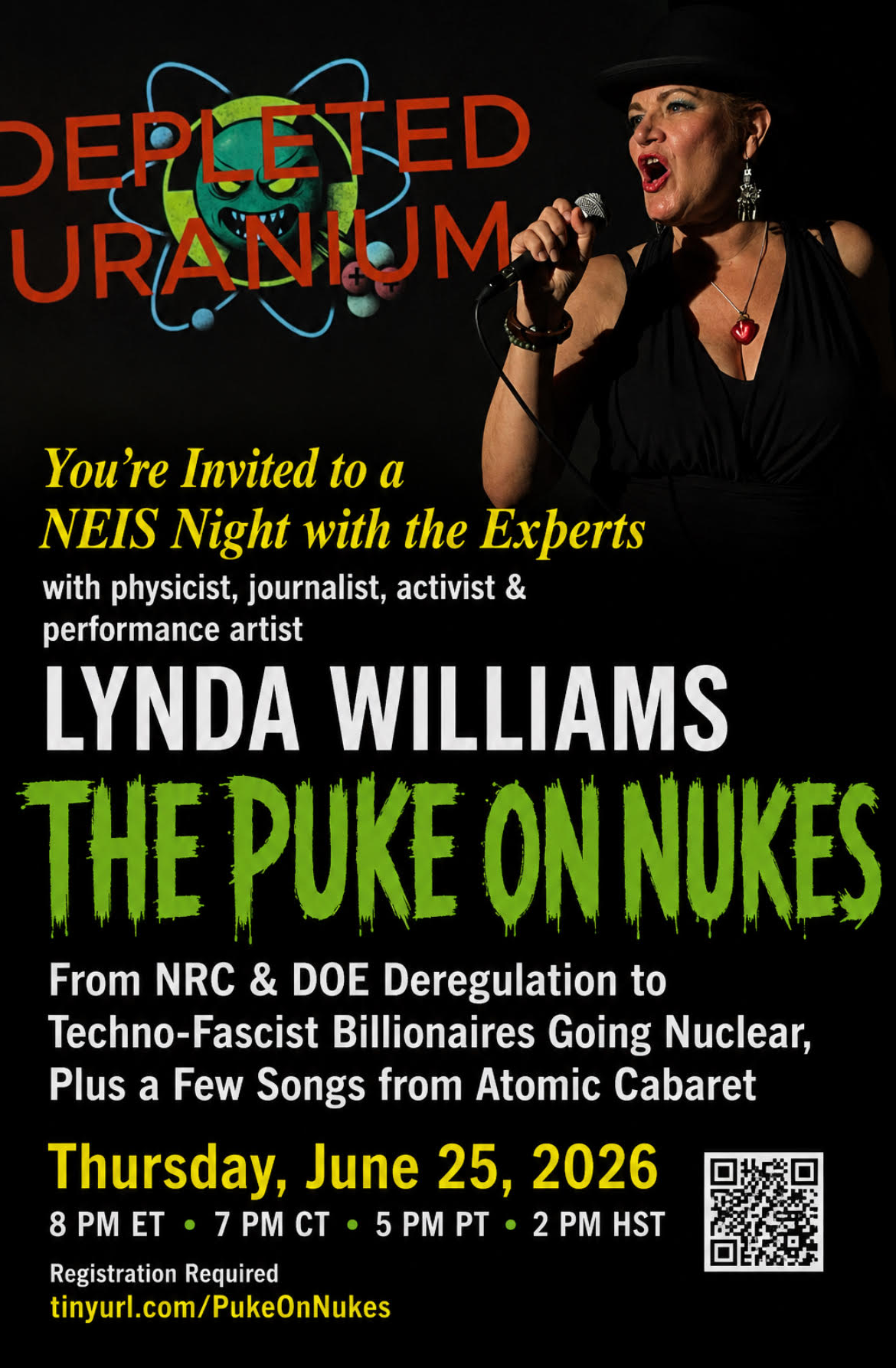
25 June- THE PUKE ON NUKES
Thursday, June 25, 2026
7pm Central Time (8pm ET, 6pm MT, 5pm PT) UTC – 5
From NRC & DOE Deregulation to Techno-Fascist Billionaires Going Nuclear, Plus a Few Songs from Atomic Cabaret REGISTER
26 June – Radiation Trainwreck at the NRC / Join the Protect Better Campaign – https://us02web.zoom.us/meeting/register/4ZlZ5_qLSHGiLSCg8FF6Bg#/registration


Cuba Is Not a Failed State – It Is a Besieged State
PETITION: “Global Appeal to Endorse Palestinian Right of Return of Refugees”
To see nuclear-related stories in greater depth and intensity – go to https://nuclearinformation.wordpress.com
-
Archives
- June 2026 (142)
- May 2026 (306)
- April 2026 (356)
- March 2026 (251)
- February 2026 (268)
- January 2026 (308)
- December 2025 (358)
- November 2025 (359)
- October 2025 (376)
- September 2025 (257)
- August 2025 (319)
- July 2025 (230)
-
Categories
- 1
- 1 NUCLEAR ISSUES
- business and costs
- climate change
- culture and arts
- ENERGY
- environment
- health
- history
- indigenous issues
- Legal
- marketing of nuclear
- media
- opposition to nuclear
- PERSONAL STORIES
- politics
- politics international
- Religion and ethics
- safety
- secrets,lies and civil liberties
- spinbuster
- technology
- Uranium
- wastes
- weapons and war
- Women
- 2 WORLD
- ACTION
- AFRICA
- Atrocities
- AUSTRALIA
- Christina's notes
- Christina's themes
- culture and arts
- Events
- Fuk 2022
- Fuk 2023
- Fukushima 2017
- Fukushima 2018
- fukushima 2019
- Fukushima 2020
- Fukushima 2021
- general
- global warming
- Humour (God we need it)
- Nuclear
- RARE EARTHS
- Reference
- resources – print
- Resources -audiovicual
- Weekly Newsletter
- World
- World Nuclear
- YouTube
-
RSS
Entries RSS
Comments RSS
 nuclear-news