Trump’s October 10 ceasefire, Board of Peace, simply continues Israeli Palestinian genocide in slow motion.

Walt Zlotow West Suburban Peace Coalition Glen Ellyn IL , 26 Jan 26
That was some ceasefire Trump negotiated with Israel October 10. Since then Israel has killed nearly 500 Palestinians with bullets and bombs. Many more are likely dead from starvation and disease as Israel lets in less than 170 trucks of food daily instead of the required and promised 600. ‘Ha ha…little nourishment for you starving Palestinians.’
Water, medicine, everything needed to sustain life is restricted to drive out the beleaguered living in makeshift tents. Why tents? Israel, with over 50,000 tons of Biden, Trump bombs, pulverized over 80% of all Gaza buildings, including over 90 % of all housing. Likely over 10,000 Gaza corpses are rotting under the 60 million tons of rubble including over 9 million tons of hazardous material. Ceasefire notwithstanding, Israel has knocked down or damaged over 2,500 post ceasefire buildings.
In order to force Palestinians from Gaza, Israel has reopened the Rafah Crossing between Gaza and Egypt. But it’s Israel’s version of a reverse Roach Motel. Palestinians can check out…but they can never check back into their rightful homeland. Every Palestinian that leaves, along with every Palestinian shot, bombed or starved to death, is one less pesky Palestinian to get rid of in absorbing Gaza into Greater Israel.
Israel has exploited the ceasefire to occupy over 50% of Gaza territory, shooting any Palestinian who strays over or close to Israel’s yellow boundary lines.
Astonishingly, the UN Security Council’s November 17 Resolution 2803 (2025) certified Trump’s Board of Peace which effectively makes Trump Gaza’s ruler, totally excluding Palestinian involvement. In doing so it upends over 70 years of UN resolutions and requirements that Palestinians in Gaza have the right to live and govern their homeland free from subjugation; indeed annihilation.
Why did this Security Council resolution pass? Simple, Trump essentially blackmailed Council members that it was either Trump’s ceasefire and Board of Peace, excluding Palestinians, or he would greenlight continuing the horrific 2 year bombing obliteration of Gaza and its citizens till they were all dead and gone. .
Israel, with US support, will never allow a Palestinian state in Gaza the West Bank and East Jerusalem. The horrific daily slaughter may be reduced to a trickle, but it will continue indefinitely till every Palestinian in Gaza is gone.
Trump’s ceasefire and Board of peace have the additional benefit to both Israel and Trump administration of removing the daily ethnic cleansing of Gaza from mainstream media coverage. They have moved on to more dramatic foreign hotspots in Venezuela, Iran and Greenland as well as Trump’s ICE thugs murdering fellow citizens in Minneapolis
Israel and the Trump administration’s slow motion genocide of Palestinians in Gaza should be opposed by all decent, moral nations and persons as fervently as their opposition to the preceding two yearlong all out genocide. Trump’s ceasefire and Board of Peace has put lipstick on the pig of Israeli genocide destroying Palestinians in Gaza.
Government by AI? Trump Administration Plans to Write Regulations Using Artificial Intelligence.

The Transportation Department, which oversees the safety of airplanes, cars and pipelines, plans to use Google Gemini to draft new regulations. “We don’t need the perfect rule,” said DOT’s top lawyer. “We want good enough.”
ProPublica, by Jesse Coburn, January 26, 2026,
The Trump administration is planning to use artificial intelligence to write federal transportation regulations, according to U.S. Department of Transportation records and interviews with six agency staffers.
The plan was presented to DOT staff last month at a demonstration of AI’s “potential to revolutionize the way we draft rulemakings,” agency attorney Daniel Cohen wrote to colleagues. The demonstration, Cohen wrote, would showcase “exciting new AI tools available to DOT rule writers to help us do our job better and faster.”
Discussion of the plan continued among agency leadership last week, according to meeting notes reviewed by ProPublica. Gregory Zerzan, the agency’s general counsel, said at that meeting that President Donald Trump is “very excited about this initiative.” Zerzan seemed to suggest that the DOT was at the vanguard of a broader federal effort, calling the department the “point of the spear” and “the first agency that is fully enabled to use AI to draft rules.”
Zerzan appeared interested mainly in the quantity of regulations that AI could produce, not their quality. “We don’t need the perfect rule on XYZ. We don’t even need a very good rule on XYZ,” he said, according to the meeting notes. “We want good enough.” Zerzan added, “We’re flooding the zone.”
These developments have alarmed some at DOT. The agency’s rules touch virtually every facet of transportation safety, including regulations that keep airplanes in the sky, prevent gas pipelines from exploding and stop freight trains carrying toxic chemicals from skidding off the rails. Why, some staffers wondered, would the federal government outsource the writing of such critical standards to a nascent technology notorious for making mistakes?
The answer from the plan’s boosters is simple: speed. Writing and revising complex federal regulations can take months, sometimes years. But, with DOT’s version of Google Gemini, employees could generate a proposed rule in a matter of minutes or even seconds, two DOT staffers who attended the December demonstration remembered the presenter saying. In any case, most of what goes into the preambles of DOT regulatory documents is just “word salad,” one staffer recalled the presenter saying. Google Gemini can do word salad.
Zerzan reiterated the ambition to accelerate rulemaking with AI at the meeting last week. The goal is to dramatically compress the timeline in which transportation regulations are produced, such that they could go from idea to complete draft ready for review by the Office of Information and Regulatory Affairs in just 30 days, he said. That should be possible, he said, because “it shouldn’t take you more than 20 minutes to get a draft rule out of Gemini.”
The DOT plan, which has not previously been reported, represents a new front in the Trump administration’s campaign to incorporate artificial intelligence into the work of the federal government. This administration is not the first to use AI; federal agencies have been gradually stitching the technology into their work for years, including to translate documents, analyze data and categorize public comments, among other uses. But the current administration has been particularly enthusiastic about the technology. Trump released multiple executive orders in support of AI last year. In April, Office of Management and Budget Director Russell Vought circulated a memo calling for the acceleration of its use by the federal government. Three months later, the administration released an “AI Action Plan” that contained a similar directive. None of those documents, however, called explicitly for using AI to write regulations, as DOT is now planning to do.
Those plans are already in motion. The department has used AI to draft a still-unpublished Federal Aviation Administration rule, according to a DOT staffer briefed on the matter.
Skeptics say that so-called large language models such as Gemini and ChatGPT shouldn’t be trusted with the complicated and consequential responsibilities of governance, given that those models are prone to error and incapable of human reasoning. But proponents see AI as a way to automate mindless tasks and wring efficiencies out of a slow-moving federal bureaucracy.
Such optimism was on display in a windowless conference room in Northern Virginia earlier this month, where federal technology officials, convened at an AI summit, discussed adopting an “AI culture” in government and “upskilling” the federal workforce to use the technology. Those federal representatives included Justin Ubert, division chief for cybersecurity and operations at DOT’s Federal Transit Administration, who spoke on a panel about the Transportation Department’s plans for “fast adoption” of artificial intelligence. Many people see humans as a “choke point” that slows down AI, he noted. But eventually, Ubert predicted, humans will fall back into merely an oversight role, monitoring “AI-to-AI interactions.” Ubert declined to speak to ProPublica on the record.
A similarly sanguine attitude about the potential of AI permeated the presentation at DOT in December, which was attended by more than 100 DOT employees, including division heads, high-ranking attorneys and civil servants from rulemaking offices. Brimming with enthusiasm, the presenter told them that Gemini can handle 80% to 90% of the work of writing regulations, while DOT staffers could do the rest, one attendee recalled the presenter saying………………………………………………………………………………………..
Academics and researchers who track the use of AI in government expressed mixed opinions about the DOT plan. If agency rule writers use the technology as a sort of research assistant with plenty of supervision and transparency, it could be useful and save time. But if they cede too much responsibility to AI, that could lead to deficiencies in critical regulations and run afoul of a requirement that federal rules be built on reasoned decision-making. https://www.propublica.org/article/trump-artificial-intelligence-google-gemini-transportation-regulations
The ‘Peace President’ Who Bombed 10 Countries and Wants $1.5 Trillion for War
SCHEERPOST, Joshua Scheer,
Donald Trump keeps insisting he’s a “peace president.” The record shows something closer to a global arsonist with better PR. In just one year of his second term, he bombed seven countries—adding to a list that now reaches ten, more than any president in U.S. history—while demanding a $1.5 trillion Pentagon budget that would eclipse the military spending of nearly the entire planet combined.
This video dissects the chasm between Trump’s self‑mythology and the reality of an empire that has only expanded its reach, its violence, and its appetite for public money. It also exposes the bipartisan machinery behind it: Democrats and Republicans alike feeding the military‑industrial complex while slashing social programs at home and calling it “efficiency.”
As Ben Norton lays out, the U.S. isn’t just waging endless wars abroad—it’s waging a class war at home, shifting wealth upward while telling working people to tighten their belts. Trump’s rhetoric may promise peace, prosperity, and fiscal responsibility, but the policies tell a very different story: more bombs, more debt, more suffering, and more power for the same billionaire class that bankrolls Washington.
This is the reality behind the branding. And it’s why journalism that cuts through the mythology is more essential than ever.
Some facts to consider
Trump repeatedly brands himself a “peacemaker” and “peace president,” despite overseeing more bombings than any president in U.S. history.
In 2025 alone, he bombed seven countries; across both terms, the total reaches ten
The countries bombed so far include Afghanistan, Pakistan, Yemen, Somalia, Libya, Syria, Iraq, Nigeria, Iran, and Venezuela—on top of ongoing U.S. military actions and blockades throughout Latin America. And now Washington is posturing against Mexico as well.
In the last few days, a Cuban diplomat accused the United States of “international piracy” as Washington continues blocking Venezuelan oil shipments to the island in the aftermath of the U.S. attack on Venezuela and the abduction of President Nicolás Maduro. Carlos de Céspedes, Cuba’s ambassador to Colombia, told Al Jazeera that the U.S. is effectively imposing a “marine siege.”
Trump, meanwhile, is bragging that “Cuba is ready to fall.” On January 5 he declared, “Cuba now has no income. They got all of their income from Venezuela, from the Venezuelan oil. They’re not getting any of it. Cuba literally is ready to fall.”
All of this sits atop a much longer record: Brown University researchers estimate that U.S. wars since 2001 have caused at least 4.5 million deaths and displaced 38 million people worldwide.
This is certainly not a peace president or a peaceful country. And for anyone who still needs to understand how U.S. policy devastates other nations through coercive measures that overwhelmingly harm children, an October study published in The Lancet found that sanctions imposed by the United States and its Western allies from 1971 to 2021 caused more than 550,000 deaths every year—a toll comparable to the annual global deaths from war, both military and civilian, over the same period.
For more on his campaigns, remember that “Little Marco” and his own State Department were hailing Trump as the “Peacemaker‑in‑Chief” as recently as August—a whiplash‑inducing reversal given today’s situations globally.
For more stories about these issues:……………………………………………………………………………………………………………………………………………………………………………………………………….. https://scheerpost.com/2026/01/26/the-peace-president-who-bombed-10-countries-and-wants-1-5-trillion-for-war/
US military moves Navy, Air Force assets to the Middle East: What to know
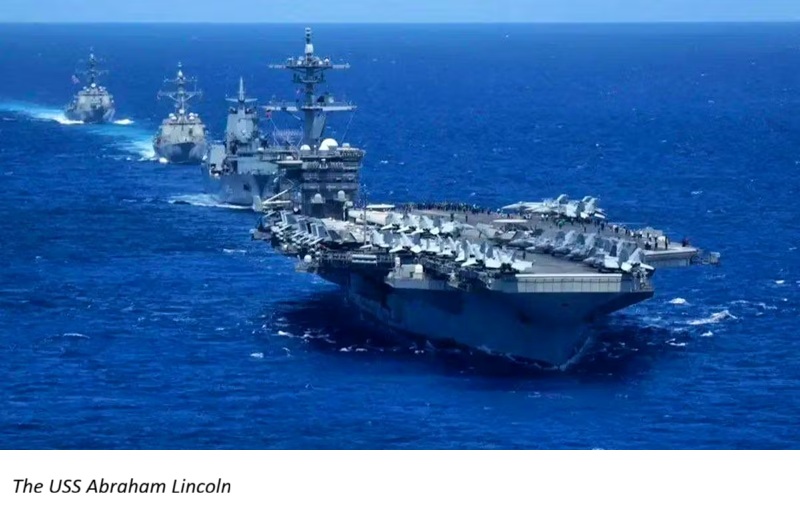
Trump says US ‘armada’ is heading towards the Gulf, raising fears of a military escalation in the region.
Aljazeera, By Yashraj Sharma, 25 Jan 2026
A United States aircraft carrier strike group is heading towards the Gulf as tensions build with Iran.
The US military last staged a major build-up in the Middle East in June – days before striking three Iranian nuclear sites during Israel’s 12-day war with Tehran.
This month, US President Donald Trump backed antigovernment protesters in Iran. “Help is on its way,” he told them as the government cracked down. But last week, he dialled down the military rhetoric. The protests have since been quashed.
So what are the US military assets moving to the Gulf? And is the US preparing to strike Iran again?
Why is the US moving warships?
Trump said on Thursday that a US “armada” is heading towards the Gulf region with Iran being its focus.
US officials said an aircraft carrier strike group and other assets are to arrive in the Middle East in the coming days.
“We’re watching Iran. We have a big force going towards Iran,” Trump said.
“And maybe we won’t have to use it. … We have a lot of ships going that direction. Just in case, we have a big flotilla going in that direction, and we’ll see what happens,” he added.
The aircraft carrier Abraham Lincoln changed its path from the South China Sea more than a week ago towards the Middle East. Its carrier strike group includes Arleigh Burke-class destroyers equipped with Tomahawk cruise missiles capable of striking targets deep inside Iran.
The US military vessels en route to the Middle East are also equipped with the Aegis combat system, which provides air and missile defence against ballistic and cruise missiles and other aerial threats.
When Washington hit Iran’s nuclear sites, US forces reportedly launched 30 Tomahawk missiles from submarines and carried out strikes with B-2 bombers.
When asked on Thursday if he wanted Iranian Supreme Leader Ali Khamenei to step down, Trump replied: “I don’t want to get into that, but they know what we want. There is a lot of killing.”
He also reiterated claims that his threats to use force stopped authorities in Iran from executing more than 800 people who had taken part in the protests, a claim denied by Iranian officials.
An unnamed US official told the Reuters news agency that additional air defence systems were being considered for the Middle East, which could be critical to guard against an Iranian strike on US bases in the region.
Iranian state media said the protests killed 3,117 people, including 2,427 civilians and members of the security forces.
How widespread is the US military presence in the Middle East?
The US has operated military bases in the Middle East for decades and has 40,000 to 50,000 soldiers stationed there.
According to the Council on Foreign Relations, the US operates a broad network of military sites, both permanent and temporary, at at least 19 locations in the region.
Of these, eight are permanent bases, located in Bahrain, Egypt, Iraq, Jordan, Kuwait, Qatar, Saudi Arabia and the United Arab Emirates.
The first US deployment of soldiers in the Middle East was in July 1958 when combat troops were sent to Beirut. At its height, almost 15,000 Marines and Army soldiers were in Lebanon.
The US naval movement towards Iran was ordered despite a new National Defense Strategy being released on Friday. The document is drawn up every four years by the Department of Defense, and the latest security blueprint outlines a pullback of US forces in other parts of the world to prioritise security in the Western Hemisphere.
How has Iran responded?
Ali Abdollahi Aliabadi, who heads coordination between Iran’s army and its Islamic Revolutionary Guard Corps, warned on Thursday that any military strike on Iran would turn all US bases in the region into “legitimate targets”.
General Mohammad Pakpour, the commander of the Revolutionary Guard, said two days later that Iran is “more ready than ever, finger on the trigger”.
He warned Washington and Israel “to avoid any miscalculation”……………………………………………………………………………………………. https://www.aljazeera.com/news/2026/1/25/us-military-moves-navy-air-force-assets-to-the-middle-east-what-to-know
U.S. Department of Energy signs additional OTAs to accelerate nuclear reactor pilot projects

Energies Media, by Warren, January 24, 2026
The U.S. is aiming to lead the surge in new nuclear energy developments across the international market
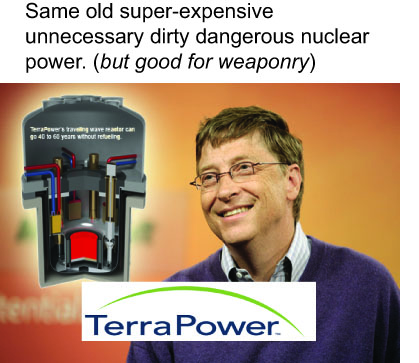
Since taking office for his second term, Donald Trump has shaken the U.S. energy market to its core. Trump signed several executive orders aimed at increasing the oil and gas production in the U.S., and has actively been approving the nuclear buildout as part of the government’s efforts to increase nuclear energy output in the United States.
The U.S. DOE has now finalized two new Other Transaction Agreements with Terrestrial Energy and Oklo. The new OTAs form part of the U.S. Reactor Pilot Program, which has outlined a target of fast-tracking the deployment of the reactors by July 4 of this year.
The context behind the new nuclear development in the U.S.
In August of 2025, the U.S. DOE formally selected ten companies as part of the Reactor Pilot Program, a new path for nuclear energy developers to leverage the accelerated DOE approval instead of the standard Nuclear Regulatory Commission licensing process. Initially, the U.S. was targeting to get up to three reactors online within a year, but that target was amended by Energy Secretary Chris Wright at the 2025 ANS Winter Conference & Expo.
Other notable selections by the Department as part of the Reactor Pilot Program include:
- Aalo Atomics
- Deep Fission
- Last Energy
- Natura Resources
- Standard Nuclear
Oklo and Terrestrial Energy will boost the U.S. nuclear energy output capacity
Oklo is as unique as it gets within the framework of the Reactor Pilot Program, as it has three distinct nuclear energy projects in the United States, namely the Aurora Powerhouse development, the Pluto reactor, and a third reactor being developed by the company’s subsidiary, Atomic Alchemy…….
Terrestrial Energy, on the other hand, follows a more conventional OTA process. The company’s Project Tetra has been slowly developing over the past few months and has now been added to the Reactor Pilot Program by the U.S. authority………………………. https://energiesmedia.com/us-department-of-energy-signs-additional-otas/
Trump shamelessly plays the Russia/China bogeyman card for Greenland grab
NATO’s civilian head, Mark Rutte, the former Dutch prime minister and abject flunky, appeased Trump at Davos by offering more NATO defenses deployed to Greenland. Rutte, who previously referred to Trump as “daddy”, made the “deal” in private with Trump. No details have been made public nor even shared among other NATO members. How’s that for contempt of underlings?
Since the end of World War Two, the United States paid lip service to global law and order along with its European allies. Under Trump, there is no longer any pretense of lip service. It’s outright imperialist power for naked domination. At one point in his rambling Davos speech, Trump declared such might-is-right land grabbing as normal.
Russia and China, among others, have repeatedly declared the paramount need to abide by international law and the principles of the UN Charter. U.S. imperialist power has no such respect. Trump has openly said so.
Sat, 24 Jan 2026, https://strategic-culture.su/news/2026/01/23/trump-shamelessly-plays-russia-china-bogeyman-card-for-greenland-grab/
Under Trump, the European appeasers are inviting disaster as they indulge his bogeyman games over Greenland.
The old saying that a week is a long time in politics is especially true under the U.S. Presidency of Donald Trump, given his propensity for unhinged bombast, zig-zags, U-turns, vendettas, and theatrics.
So, last week, he was threatening to take over the Danish Arctic territory of Greenland by military force, if needed. Trump was also gearing up to launch an unprecedented trade war against European states that, with pipsqueak temerity, dared to support Denmark, a move that would have cratered the eight-decade-old transatlantic Western alliance.
This week, in a 70-minute rant at the World Economic Forum in Davos, Switzerland, Trump, seemingly magnanimously, announced that he was not going to deploy military power to subordinate European NATO “allies”. But he insisted that Greenland must be annexed under U.S. control.
In a telling quip, he said: “I don’t have to use force.” Trump is right on that score. There is no need for military coercion because the European “allies” have been exposed as a bunch of dithering vassals who were pathetically clutching their pearls for the past week out of fear and angst that Uncle Sam was slapping them.
However, when vassals appease, they only end up being abused. The American Don may have softened his contemptuous rhetoric at Davos, but there is little doubt that the expansionist ambitions to grab Greenland will be pursued, and the Europeans will be, in time, further degraded in their submission to the American overlord.
Oddly enough, for a president who boasts about flexing military muscle for imperialist aims, Trump couched his takeover of Greenland as a matter of “national security.” He is claiming that the United States needs to take control of the “big, beautiful piece of ice” to defend it from Russia and China.
He lied that it wasn’t because of Greenland’s vast mineral resources, including oil and rare-earth metals. Trump was claiming that the U.S. is the only NATO member strong enough to keep Russia and China from gaining a foothold. Beijing slammed Trump’s claims as baseless.
In an insulting and absurd remark, he likened Russia and China to how Nazi Germany tried to take Greenland from Denmark during the Second World War, and it was the U.S. that prevented that.
Only a few days before, Trump contradicted himself (not hard for him) by posting a comment deriding how Russia and China are used as “bogeymen”, that is, as false enemies.
Another anomaly was seen with Trump inviting Russia and China to join his dubious Global Board of Peace initiative, which he unveiled with much corny fanfare in Davos. Enemies for peace?
In other words, on Greenland, Trump is cynically playing the Russia and China threat as a pretext for blatantly violating the sovereignty of an ally.
Not that Denmark deserves sympathy. It is questionable how it retains any territorial right to a distant Arctic island whose people have consistently demanded independence from Copenhagen’s colonialist control.
NATO’s civilian head, Mark Rutte, the former Dutch prime minister and abject flunky, appeased Trump at Davos by offering more NATO defenses deployed to Greenland. Rutte, who previously referred to Trump as “daddy”, made the “deal” in private with Trump. No details have been made public nor even shared among other NATO members. How’s that for contempt of underlings?
Trump hailed the so-called framework agreement as a “great deal” for the United States and Europe without sharing the details. It’s believed to permit the installation of Trump’s futuristic Golden Dome missile defense system. If that goes ahead, it will heighten strategic tensions with Russia by militarizing the Arctic, not bring peace or stability. Denmark is reportedly wary that its sovereignty is being sold out in a grubby behind-closed-doors private takeover.
Hence, the transatlantic storm may have subsided somewhat for now, but the damage and mistrust that have shattered the alliance are not going to be repaired. It will only get worse because of the thug-vassal relationship unravelling.
The Canadian Prime Minister, Mark Carney, in his speech at Davos, made a shocking admission when he said that the “fiction of rules-based order” between the U.S. and its Western allies is dead.
Trump may have been appeased and placated for a while. But it’s like keeping a predator at bay by throwing pieces of meat at it. Sooner or later, the minions will be on the menu.
Only last week, Denmark and the other European states were dismissing Trump’s outlandish claims about defending the free world from Russia and China by taking control of Greenland. They knew it was a brazen land grab. Now, however, Rutte, the European NATO chief, is saying that NATO must accede to Trump’s demands to protect Greenland from the alleged threat from Russia and China.
After saying there is no such threat, now the Europeans will indulge Trump’s fantasy about Greenland, just to restrain him from overtly abusing them.
The trouble for the European and other Western allies of the United States is that they have consorted with decades of American violations of international law. They have played along with the charade of using Russia and China as enemies of convenience. This has hollowed out any claim of upholding international order and norms.
The U.S. and Europe have played the bogeyman card with regard to Ukraine. The Europeans supported Trump’s aggression against Venezuela and Iran, and they have been complicit in the U.S.-backed genocide in Gaza.
This week, while French President Emmanuel Macron was admonishing Trump to respect international order concerning Greenland, he ordered French troops to seize a Russian-linked oil tanker in neutral maritime waters. The latter act of piracy on the high seas was probably an effort by France to demonstrate its loyalty to Washington’s policy of hijacking Russian cargo ships.
Since the end of World War Two, the United States paid lip service to global law and order along with its European allies. Under Trump, there is no longer any pretense of lip service. It’s outright imperialist power for naked domination. At one point in his rambling Davos speech, Trump declared such might-is-right land grabbing as normal.
During the past eight decades of charade and lip service, the U.S. needed the Europeans as a facade of multilateralism for its stealth imperialism. Washington indulged the Europeans, Canadians, and others as “allies”. In reality, they were always vassals.
Now, in the latest historical phase of returning to flagrant imperialism and brazen power, the United States has no use for the pretense of allies. They can be slapped around for the lackeys they are. And we are seeing that with brutality.
Ironically, the European powers have a historic tendency for appeasement. The British and French appeased Nazi Germany in the 1930s with disastrous results. Today, the Europeans are appeasing the United States in its every criminal demand. That is only emboldening the U.S. to expand its outright abuse of international law, or, in other words, its descent into barbarism.
This is not merely about Trump as a maverick megalomaniac. He is but a symptom of the U.S. global empire in desperation mode to maintain its waning power as a new multipolar world potentially emerges. U.S. hegemonic ambitions are untenable, but in a desperate bid to assert itself, the world is being turned upside down and intimidated into submission.
Russia and China, among others, have repeatedly declared the paramount need to abide by international law and the principles of the UN Charter. U.S. imperialist power has no such respect. Trump has openly said so.
Total domination is the only acceptable end for U.S. imperialism. Russia and China should not have any illusion about it, even if, in the short term, Trump wants to make an expedient withdrawal deal in Ukraine, or if he invites them to join his “Bored of Peace” boondoggle.
History shows us that rampant imperialist violence ends in disaster. Under Trump, the European appeasers are inviting disaster as they indulge his bogeyman games over Greenland.
Is Trump a Useful Idiot? Project 2025 Is in Power Now.
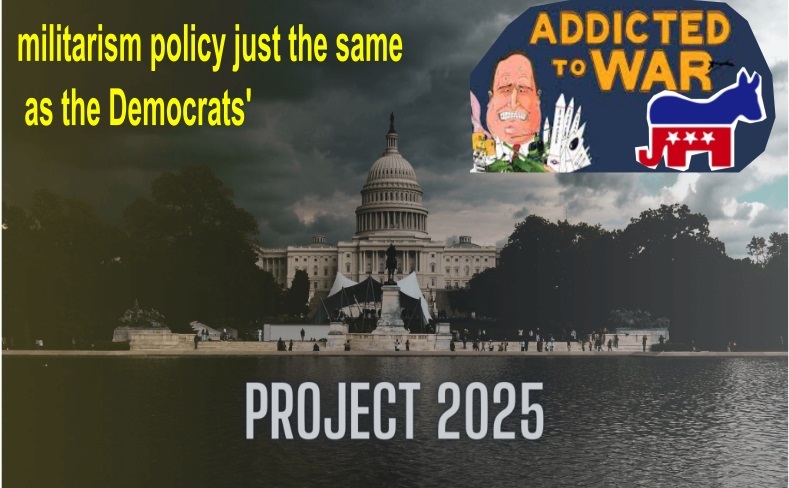
January 24, 2026, by Joshua Scheer, https://scheerpost.com/2026/01/24/is-trump-a-useful-idiot-project-2025-is-in-power-now/
With Project 2025 in full effect, Chris Hedges explains that Trump is neither necessary nor a real player. The “death grip” on our society is already in full force—this goes beyond Trump, threatening to destroy the very fabric of our existing ways of resisting it.
The very idea of elections being free, fair, or even occurring at all is now in question. Far more alarming than Trump’s musings about canceling the midterms was what the president told the New York Times in another Oval Office interview. he admitted that he “regretted not ordering the National Guard to seize voting machines in swing states after his loss in the 2020 election.”
One of the central tenets of Project 2025 will be a direct assault on election officials. The Brennan Center warns that Project 2025 “threatens to reverse progress made over the last four years by stripping crucial federal resources from election officials and weaponizing the Department of Justice against officials who make decisions the administration disagrees with.”
With many Americans—and the other useful idiots in the Democratic Party—counting on elections to save us, we are living in a perilous moment that demands action, not hope. Chris Hedges warns that the U.S. has entered an age of authoritarian consolidation, where meaningful resistance must be rebuilt from the ground up. In a fractured society marked by economic precarity, surveillance, and the hollowing out of collective power, traditional movements have been systematically dismantled, leaving dissenters vulnerable. True resistance, Hedges insists, requires disciplined, long-term organizing—starting from zero—because corporate and state power is more entrenched and repressive than ever.
Another crucial step is supporting all independent media, because the New York Times and other media monopolies are not serving our interests. Real resistance requires amplifying voices outside the corporate mainstream.
The ridiculous 2026 “National Defense Strategy”

As for the National Defense Strategy, it concludes in climactic fashion by declaring that the US must maintain capability to “conduct devastating strikes and operations against targets anywhere in the world.” As if that’s just the most obvious imperative of responsible statecraft that anyone could possibly fathom.
As for the National Defense Strategy, it concludes in climactic fashion by declaring that the US must maintain capability to “conduct devastating strikes and operations against targets anywhere in the world.” As if that’s just the most obvious imperative of responsible statecraft that anyone could possibly fathom.
Michael Tracey, Jan 25, 2026, https://www.mtracey.net/p/2026-national-defense-strategy?utm_source=post-email-title&publication_id=303188&post_id=185665591&utm_campaign=email-post-title&isFreemail=true&r=ln98x&triedRedirect=true&utm_medium=email
The new 2026 “National Defense Strategy,” released yesterday, contains a lot of airy rhetoric about finally transitioning to “hardnosed realism,” and away from the misbegotten “grandiose strategies” of yesteryear, wherein the US had foolishly set out to “solve all the world’s problems.” More tangibly, however, the document doesn’t call for a single discernible reduction to America’s comically-large global military footprint. In fact, it calls for expanding that footprint, rather dramatically.
Among these expansions will be for the US to “erect” new military installations in close proximity to China. Per the jargon of NatSec Speak, this means establishing “strong denial defense” in the “First Island Chain” — which may sound like a modestly-sized region to the unschooled reader, but actually encompasses Japan, the Philippines, Taiwan, and perhaps a smattering of other places like Vietnam and Malaysia, depending on what the cockamamie Grand Strategists decide to theorize and war-game next.
There will also be unspecified measures to “guarantee US military and commercial access” to what is now described as the “key terrain” of Greenland and Panama. On top of “deepening” US military involvement in the Middle East, so as to “enable integration between Israel and our Arabian Gulf partners.”
The document gestures vaguely at Europe needing to take more responsibility for its own defense, but then talks about US-directed efforts to “expand transatlantic defense” with Europe, and affirms the “vital” role of the US in leading NATO — including to counter “Russian threats to the US Homeland.” No specific adjustments in force posture re: Europe are identified.
Iran is back as an urgent threat, as it’s allegedly in the process of “reconstituting its conventional military forces,” and is again seeking to obtain a nuclear weapon. Even though its nuclear facilities were supposedly “obliterated” last June. Naturally, confronting Iran will require the US to “further empower” Israel — what more “empowerment” could they possibly be given at this point? — in recognition of our profound “shared interests” with this “model ally.”
Even in Africa, the document says the US must “empower allies and partners” to prevent Islamic terrorists from establishing “safe havens” — apparently anywhere throughout that vast continent — and the US is itself prepared to strike where deemed necessary. As we already saw with the random bombing of Nigeria last month. (Whatever happened with that? Did we eliminate the Terrorists?)
The document also calls for accelerating US military-industrial production to levels not seen since the Second World War. Yet another devastating blow to the “military-industrial complex.”
It lambasts ill-fated “regime change” expeditions of the past, but heralds the most recent foray into Venezuela, which was legally designated by the Trump DOJ as an explicit “regime change” operation.
“Nation-building” is predictably derided — mere weeks after Trump unilaterally declared himself the new ruler of Venezuela, the economy and governmental structures of which he now wants to personally “rebuild.” This open-ended endeavor could last “much longer” than people think, he says. That’ll be in addition to his other signature “nation-building” initiative — making good on his landmark pledge to “take over” Gaza, which was widely dismissed as outlandish when he first announced it last February. But then by October, there he was, bestowing himself with ultimate governing authority over Gaza. Jared Kushner just rolled out their innovative new “master plan” for nation-building the hell out of that place — complete with cool little diagrams showing how each quadrant of land will be granularly organized. The deal has apparently been sealed for Gaza as a newly-established US military protectorate: an American General was just named Commander of the “International Stabilization Force,” putting him in charge of “security operations” across the territory. A fun new dialect of Arabic might have to be invented for all the American-originated euphemisms.
As for the National Defense Strategy, it concludes in climactic fashion by declaring that the US must maintain capability to “conduct devastating strikes and operations against targets anywhere in the world.” As if that’s just the most obvious imperative of responsible statecraft that anyone could possibly fathom.
Sooooo…. there’s your historic pivot from “grandiose adventures” abroad — which the self-congratulatory document writers hold themselves out as repudiating — and toward a glorious restoration of “practical, hardnosed realism.” Of course, trying to translate the predilections of Trump into some grand strategic treatise is a pretty pointless exercise to begin with — but the intellectual warfighter Pete Hegseth and his underlings evidently felt they should at least give it a whirl. So they “fucked around and found out,” as Pete loves to smugly bluster, and out plopped whatever this is.
True “realism” would necessitate swiftly discarding the document as little more than a collection of meaningless pablum and cliches — just like the differently-named, but weirdly redundant “National Security Strategy” produced in November 2025. Among other silly items, that cousin document contains the assertion that “the days in which the Middle East dominated American foreign policy in both long-term planning and day-to-day execution are thankfully over.” And further, when it comes to changing sub-optimal systems of government in that neck of the woods, “we should encourage and applaud reform when and where it emerges organically, without trying to impose it from without.”
Then within a matter of weeks, right on cue, Trump was boisterously posting that he was “locked and loaded,” and ready to attack Iran again — this time ostensibly in defense of the besieged Iranian protesters. He also announced it’s time for the imposition of “new leadership,” i.e. removal of the Ayatollah. “Freedom” and “human rights” have even been resurrected as viable pretexts for punitive US action. Currently, large-scale US military assets are reassembling in the region.
To comprehend these bewildering developments, perhaps we’ll have to wait in suspense for a revised edition of some supplemental “strategy” document. Which we can then all download together in PDF format, and earnestly ponder, perhaps with coffee and donuts, like a book club brooding over Moby Dick.
Back in some version of “realist” reality, these “strategy” documents are really only notable insofar as they give some morbid insight into how presidential subordinates are required to haphazardly “ideologize” whatever their superior is doing at any given time. A well-worn heuristic would be much simpler, and more instructive: “America First” is still whatever he says it is.
A Note On the 2026 US National Defense Strategy and Extended Deterrence
What does the NDS have to say about nuclear weapons and the nuclear environment facing the United States? Turns out, not much.
Ankit Panda, Jan 25, 2026, https://panda.substack.com/p/a-note-on-the-2026-us-national-defense?utm_source=post-email-title&publication_id=10286&post_id=185656884&utm_campaign=email-post-title&isFreemail=true&r=ln98x&triedRedirect=true&utm_medium=email
The Trump administration’s unclassified summary of the National Defense Strategy (notably, they can’t call it a National “War” Strategy, by statute) is here (PDF). It released on a Friday evening, after 5 p.m.. My understanding is that the classified version has been complete for about a couple months now and this unclassified summary was going through reframing after the release of last month’s much-discussed National Security Strategy. Anyway, it’s here now, so let’s talk about it.
Much ink will be spilled elsewhere on what this document tells us about the United States’ defense priorities as the Trump administration continues to take a sledgehammer to longstanding principles of U.S. grand strategy. I want to focus on how nuclear policy-minded readers should approach this document.
If you haven’t heard, this administration is not planning on publishing a Nuclear Posture Review, which is not currently required by law, unlike the NDS. The 2026 NDS itself has very little to say on nuclear weapons. Page 17 contains this bullet, which sums up nearly the totality of what this document has to say about U.S. nuclear forces and policy:
“Modernise and adapt U.S forces: The United States requires a strong, secure and effective nuclear arsenal adapted to the nation’s overall and defense strategies. We will modernise and adapt our nuclear forces accordingly with focussed attention on deterrence and escalation management amidst the changing global nuclear landscape. The United State should never – will never- be left vulnerable to nuclear blackmail.”
Note the lack of any mention of the role of U.S. nuclear weapons or declaratory policy. Insofar as the role of U.S. nuclear forces is discussed, it is done so in a single sentence on page 3: “We will maintain a robust and modern nuclear deterrent capable of addressing the strategic threats to our country…”
There’s also no nod to allies here, either. In many of my conversations in Europe and Asia over the last year, there’s been quite a bit of interest in what the Trump NDS would have to say about alliances and extended deterrence. Silence, I suppose, is not the worst outcome, especially given the spotlighting of active U.S. hostility toward European allies in the last few weeks amid the Greenland imbroglio. Some allies took solace in the fact that the NSS did include a sentence on nuclear weapons that did allude to some role in their defense: “We want the world’s most robust, credible, and modern nuclear deterrent, plus next-generation missile defenses—including a Golden Dome for the American homeland—to protect the American people, American assets overseas, and American allies” (emphasis added, NSS, pp. 3).
Close allied readers of the NDS, however, might find that the document does appear to have something to say about how the United States views their security interests. Page 8 of the NDS observes that what makes the Trump administration’s strategy “fundamentally different from the grandiose strategies” of the past is that this document is apparently tethered to “Americans’ practical interests.” The document continues:
‘It does not conflate Americans’ interests with those of the rest of the world—that a threat to a person halfway around the world is the same as to an American.”
Part of the very premise of extended deterrence is that the United States would treat threats to allied persons (and nations) halfway around the world the same as those to the U.S. homeland. This, naturally, has been a very difficult premise to render credible—hence much of the history of our alliance management efforts over the last seven-ish decades.
It doesn’t seem far-fetched to me that allies will be willing to believe what the Trump administration is telling them here. There’s actually much in this NDS that I find doesn’t correspond all that well to the president’s views of the world (for starters, I don’t think Trump knows what the first island chain is). This bit, however, does correspond to much of what we know about how this president reasons about allies. Here you have the United States, I think, stating rather openly that, actually, it would not be willing to trade “Paris for New York,” as De Gaulle once famously asked of Kennedy. As I’ve written elsewhere, the ripple effects of this will likely be severe.
So, there’s that on extended deterrence.
Through the rest of the document, there’s very little on nuclear matters. There’s considerable attention on Iran’s program, with the expected commitment to denying Tehran the bomb (this also got a lot of attention in the NSS). North Korea is acknowledged as a country “increasingly capable of threatening to the U.S. Homeland” with its nuclear forces (a view that’s hardly controversial now in the United States). Very little else; even China’s historic nuclear build-up is not discussed head on in any detail.
It’s probably the case that the classified NDS has more to say on some of these questions, but that doesn’t excuse the lack of attention to nuclear matters in the unclassified version. Insofar as this document communicates U.S. priorities, it suggests an administration deeply uninterested in nuclear matters and aloof, at best, toward allies.
The Funeral of Hegemony
How America’s Decision to Attack Iran Would Be Strategic Suicide
Ibrahim Majed, Jan 25, 2026, https://ddgeopolitics.substack.com/p/the-funeral-of-hegemony?utm_source=post-email-title&publication_id=1769298&post_id=185644623&utm_campaign=email-post-title&isFreemail=true&r=1ise1&triedRedirect=true&utm_medium=email
n American attack on Iran would not be a limited military operation, a punitive strike, or a calibrated act of deterrence.
It would represent a strategic rupture, a point at which accumulated American power begins converting itself into cascading liabilities. This is not a moral argument, nor is it a humanitarian one, it is more like a balance-sheet assessment of empire.
The question is not whether the United States can strike Iran. It can, and we’ve seen it. In June 2025, American warplanes joined Israel’s twelve-day campaign against Iranian nuclear facilities. Tehran struck back at a U.S. base in Qatar. The damage was extensive on both sides.
The question is what the United States loses the moment it does so again, and this time, without a ceasefire to stop the bleeding.
What follows is not ideology, but an autopsy written before the patient is declared dead.
The Liquidation of ‘FOB Israel’
For decades, Washington has not treated Israel merely as an ally, but as a Forward Operating Base, an unsinkable aircraft carrier, an intelligence nerve center, and the technological anchor of U.S. power projection in the Middle East.
A war with Iran inverts this logic.
Iran’s response would not be symbolic or theatrical. It would be functional. Through what Tehran describes as the Unity of Arenas, a coordinated strategy of simultaneous pressure across multiple fronts, retaliation would be applied with a singular objective: rendering Israel operationally unreliable as a base.
This doctrine is not a myth. It was first operationalized in 2021 during the Saif al-Quds war, when a joint command structure coordinated operations between Hamas, Hezbollah, and other Iranian-aligned groups. The concept matured through 2023 and 2024, expanding the geography of confrontation to encircle Israel from Gaza, Lebanon, Syria, Iraq, and Yemen.
If airports are disrupted, ports degraded, and civilian life in Israel’s economic and technological core placed under persistent stress, the asset ceases to function as an anchor. The United States would no longer project power from Israel, it would divert power into Israel merely to keep it viable.
At the moment of maximum strategic need, Washington loses its most valuable regional platform.
And then the anchor chain is cut.
The Trap of Strategic Overstretch
The U.S. military is built for dominance through speed, precision, and overwhelming force. Iran is built for endurance.
It will not fight where the United States is strongest. It will fight in time, depth, and dispersion, and force escalation without resolution.
The June 2025 strikes exposed this dynamic. Iran acknowledged extensive damage to its nuclear infrastructure. But within months, Foreign Minister Abbas Araghchi was claiming that Iran had “reconstructed everything that was damaged.” Whether true or not, the statement illustrated Iran’s strategy: absorb the blow, reconstitute, and wait.
Once engaged, Washington faces a structural dilemma: it cannot disengage without reputational collapse, yet it cannot remain without accelerating exhaustion. Every escalation deepens commitment. Every deployment degrades readiness. Every month consumes forces needed elsewhere.
The U.S. military currently maintains approximately 50,000 troops across bases in the Middle East. The USS Abraham Lincoln carrier strike group has just been diverted from the South China Sea, the very theater where America’s strategic future will be decided, and is now steaming toward the Gulf.
Iran seeks defeat by entropy—the slow erosion of capacity through overuse.
This is how empires bleed.
Economic Hemorrhage
A war with Iran would not be financed through shared sacrifice. It would be financed through monetary expansion and debt.
The consequences are predictable: inflationary pressure, rising energy costs, and the diversion of capital away from domestic resilience. Infrastructure, innovation, and social cohesion would erode as resources are consumed by a conflict offering no strategic return.
The Strait of Hormuz remains the world’s most critical energy chokepoint. Roughly one-fifth of global oil consumption passes through its narrow waters. Iran has long threatened to mine or close the strait in the event of war, and this threat grows more credible as conflict intensifies.
Tehran could also target energy infrastructure across Gulf states: pipelines, terminals, refineries. The resulting supply disruptions would send shockwaves through global markets, punishing American allies in Europe and Asia far more than the United States itself.
The empire would stabilize its periphery by hollowing out its core. History is unforgiving to systems that consume their own interior to preserve external dominance.
The China Dividend
The greatest beneficiary of a U.S.–Iran war would not be Iran. It would be China.
While Washington’s strategic nervous system is absorbed by escalation management in the Middle East, Beijing gains freedom of maneuver. The Indo-Pacific becomes secondary. Influence expands. Partnerships deepen. American deterrence thins.
This calculus is openly acknowledged in Beijing. As one prominent Chinese scholar at Renmin University recently observed: “Washington’s deeper involvement in the Middle East is favorable to Beijing, reducing Washington’s ability to place focused attention and pressure on China.”
The arithmetic is brutal. If the United States deploys two carrier strike groups off the coast of Iran, and it can only maintain three on station globally at any given time, that leaves one for the entire Pacific theater. Taiwan. The Philippines. Japan. All left with diminished coverage.
Every missile expended in the Gulf is one unavailable in East Asia. Every carrier tied down is one removed from Pacific balance.
In a zero-sum system, China collects the dividend without firing a shot.
Unconventional Retaliation
Perhaps the most underestimated consequence of attacking Iran is retaliation by actors who are not Iranian at all.
A U.S. strike would not be perceived globally as a bilateral conflict. It would be read as a hegemonic act and a signal that force remains Washington’s primary language. This perception would activate a diffuse ecosystem of anti-hegemony actors: ideological extremists, decentralized cells, and radicalized individuals scattered across continents.
They require no coordination, no command structure, and no attribution. The danger is not scale, but diffusion. American embassies, corporations, logistics nodes, and symbolic targets would face persistent, low-intensity pressure worldwide. Deterrence fails when the enemy is not a state but an environment.
This is the empire’s nightmare: a world where American presence itself becomes the trigger.
The Collapse of Credibility
Power ultimately rests on belief.
If the United States initiates a war it cannot conclude, fails to secure trade routes, exports inflation to allies, and generates instability rather than order, confidence erodes. Allies will hedge, partners will diversify, and rivals will start to probe.
The June 2025 campaign was supposed to demonstrate resolve. Instead, it demonstrated limitations. Six months later, western-backed protests have erupted across all 31 Iranian provinces, and the regime still stands. The strikes did not produce regime change. They did not eliminate the nuclear program. They did not deter reconstruction.
If the most powerful navy in history cannot impose decisive control over critical chokepoints, if it cannot translate kinetic superiority into political outcomes, the myth dissolves.
The emperor is revealed, not as weak, but overextended.
The Self-Inflicted Defeat
The final assessment is brutally simple. The greatest threat to American power is not Iran’s missile program. It is the American decision to attack it.
By doing so, the United States would neutralize its forward base, exhaust its military, hollow out its economy, accelerate China’s rise, and globalize resistance to its presence.
Empires do not collapse only when defeated. They collapse when they choose wars that consume them faster than their rivals.
In the case of Iran, this would not be miscalculation, it would be strategic suicide.
Democrats vote to hand Trump hundreds of billions for immigration crackdown and global war.

Andre Damon, 24 Jan 26, https://www.wsws.org/en/articles/2026/01/24/vmym-j24.html
As the Trump administration proceeds with the military-police occupation of Minnesota in the face of mass resistance, and wages war all over the world, the majority of Democrats have joined with Republicans to pass a record military spending bill.
On Thursday, the House passed the combined defense and consolidated spending bills (H.R. 7148) by a vote of 341-88, with 149 Democrats voting yes and only 64 voting no. A separate bill funding the Department of Homeland Security and Immigration and Customs Enforcement (H.R. 7147) passed 220-207, with seven Democrats crossing the aisle to vote yes.
Republicans made no secret of what Democrats were voting for. After the vote Thursday, Representative Tom Cole, chairman of the House Appropriations Committee, declared the legislation would “champion American military power, ensuring that our brave warfighters have the tools, weapon systems and capabilities to meet any foe anywhere in the world at any time.” He summarized the bill’s purpose in three words: “America First, Fully Funded.”
Representative Ken Calvert, chairman of the Defense Subcommittee, said the bill “protects the administration’s ‘America first’ defense agenda.”
The House Appropriations Committee issued a statement hailing the “Republican-led funding that puts America First. These bills advance President Trump’s agenda.”
Despite Republicans openly proclaiming that the legislation would fund Trump’s fascistic agenda, nearly two-thirds of House Democrats voted in favor of the defense and consolidated spending bill.
An “opposition” party that votes this way is not in opposition, but an active collaborator. The Democratic Party is an instrument of the same ruling class that stands behind Trump.
The total defense appropriations amount to $839 billion, some $8.4 billion above what even Trump requested. The bill funds $27.2 billion for 17 warships, including a Columbia-class nuclear ballistic missile submarine and two Virginia-class fast attack submarines. It allocates $7.6 billion for 47 F-35 stealth fighters, $3 billion for the Air Force’s sixth-generation F-47 fighter, $1.9 billion for the B-21 Raider stealth bomber, and $4.5 billion for hypersonic weapons systems. The legislation fully funds the ongoing “modernization” of the nuclear triad—the B-21, the Columbia-class submarine, and the Sentinel intercontinental ballistic missile.
The Department of Homeland Security receives $64.4 billion, with approximately $10 billion earmarked for ICE. While the vote totals differed between the two bills, the fundamental intention is the same: the Democratic Party is systematically enabling the Trump administration’s assault on democratic rights and its preparations for global war.
The seven Democrats who voted for the DHS funding bill—Don Davis, Henry Cuellar, Laura Gillen, Marie Gluesenkamp Perez, Vicente Gonzalez, Jared Golden and Tom Suozzi—voted to fund the military occupation of Minnesota currently terrorizing immigrant communities. More than 2,000 ICE officers have been deployed across the state. Earlier this month, Renée Nicole Good, a 37-year-old Minneapolis woman and US citizen, was shot dead by a federal immigration agent. A 5-year-old boy was detained by ICE officers. On Wednesday, whistleblowers leaked an internal ICE memo authorizing agents to enter homes without judicial warrants.
The passage of the military spending bill comes after the Trump administration invaded Venezuela, overthrew the Maduro government and seized the country’s oil resources as part of Washington’s drive to consolidate its grip over Latin America in preparation for confrontation with China.
On Friday, US President Donald Trump announced that a “massive American fleet” is heading toward Iran, “just in case.” The USS Abraham Lincoln carrier group has reportedly been redeployed from the South China Sea to the Middle East. This follows Trump’s bombing of Iranian nuclear facilities last year.
As Trump Uses Military to Threaten Democracy, NYT Declares Military Needs More Resources.

In 2024, the US spent $997 billion on its military—more than the next nine countries’ spending combined, according to the Stockholm International Peace Research Institute, a fact the Times (12/10/25) acknowledged. What it didn’t state was that China—the second-biggest military spender—spent only $314 billion in 2024. Why must the US spend even more than three times more on its military than China? The Times never addressed this obvious question.
Drew Favakeh, FAIR, January 23, 2026
The New York Times published a seven-day series of editorials (12/8/25–12/14/25) meant to examine, as the initial piece put it, “what’s gone wrong with the US military” and “how we can create a relevant and effective force that can deter wars whenever possible and win them wherever necessary.”
These editorials serve as little more than propagandistic, jingoistic and Sinophobic tools that treat war as a game, turning a blind eye to the very real harms that wars have on civilians.
Devoting seven editorials to boosting the US military when the country’s own democracy is under threat—and Trump is using the military so irresponsibly and illegally that high-level officers are resigning—the Times demonstrated that its commitment to militarism knows few bounds.
‘Threaten democracies everywhere’
In total, the New York Times series referenced China 50 times, Russia 26 times and Israel just twice. It fed into an increasing Yellow Peril hysteria in a country that has a long history of hatred towards China and Chinese people, and from a news outlet that has repeatedly expressed anti-China sentiment.
The Times (12/8/25) kicked off the series by citing a Pentagon “classified, multiyear assessment,” called the “Overmatch brief,” which “catalogs China’s ability to destroy American fighter planes, large ships and satellites, and identifies the US military’s supply chain choke points.” The paper—which didn’t disclose how it obtained the brief, and didn’t publish its contents—called it “consistent and disturbing.”
The editorial opined that a “rising China” will “outlast this administration,” and will “require credible US military power as a backstop to international order and the security of the free world.”
…………………………………….It’s not China, though, that is threatening to annex its neighbors—by force if need be—or declaring it has the right to replace the leaders of any country in its hemisphere it disapproves of.
The US has overthrown at least 31 foreign governments since the late 19th century—with Trump’s kidnapping of Venezuela’s Nicolas Maduro marking only the latest in that long string—and conducted more than 80 election meddling operations from 1946 to 2000 (NPR, 12/22/16). It has caused, conservatively, nearly a million deaths in the post-9/11 wars. By comparison, China has not been directly involved in a major external conflict since its 1979 invasion of Vietnam.
US special operations forces are deployed to 154 countries (Intercept, 3/20/21), and the Pentagon has at least 750 overseas military bases in 80 countries (Al Jazeera, 9/10/21), many of which surround China.
China, meanwhile, has just two overseas military bases, one it opened in 2017 in the East African nation of Djibouti (Reuters, 8/1/17; Foreign Policy, 7/7/21) and another it opened in 2025 in Cambodia (Newsweek, 4/7/25).
Moreover, the US currently has imposed some form of damaging economic sanctions on more than 20 countries, while China has issued no nationwide sanctions.
…………………………………………………………. While the US declares a right to use nuclear weapons first in a war (Council on Foreign Relations, 12/16/25), China has maintained a “no first use policy” since it first developed nuclear weapons in 1964—a position it has repeatedly re-affirmed, including late last year (Arms Control Association, 12/11/25).
The Times also warned about hypersonic missiles: “China in recent years has amassed an arsenal of around 600 hypersonic weapons,” compared to the US, which “has yet to deploy a single hypersonic missile,” wrote the Times (12/8/25). FAIR (7/12/19) has written before about media attempts to hype a hypersonic missile gap.
In fact, the US has pursued hypersonic weapons since 9/11, and is now among those “leading the pack” (Bulletin of the Atomic Scientists, 3/12/24), underscored by Trump’s near $4 billion request in 2026 for hypersonic weapons research. Most US hypersonic weapons are being designed for conventional payloads—making them usable weapons rather than deterrents. This means they will take longer to deploy (Congressional Research Service, 8/27/25), and will be more destabilizing if they are deployed.
………………………………….The Times‘ enthusiasm for defending Taiwan from forcible reunification with China contrasts sharply with its commitment to supporting Ukraine in its efforts to retake breakaway territories. In the Taiwanese case, the right to self-determination is unquestioned, trumping China’s sovereignty; in Ukraine’s case, the sacredness of national borders renders self-determination claims irrelevant.
Though popularity of a war hardly seems to matter to US administrations, intervening to protect Taiwan separatism remains largely unpopular among US citizens (although more are in favor of intervention this year than last).
‘Transformation of the American military’
US politicians often leverage the alarmist message of “imminent military threats” to increase military spending (Defense News, 2/17/21). The New York Times took on that role in these editorials. To achieve this country’s foreign policy goals, it argued (12/8/25), requires not just maintaining current obscene levels of military spending, but increasing them: “In the short term, the transformation of the American military may require additional spending, primarily to rebuild our industrial base.”
In 2024, the US spent $997 billion on its military—more than the next nine countries’ spending combined, according to the Stockholm International Peace Research Institute, a fact the Times (12/10/25) acknowledged. What it didn’t state was that China—the second-biggest military spender—spent only $314 billion in 2024. Why must the US spend even more than three times more on its military than China? The Times never addressed this obvious question.
While the paper occasionally criticized military spending—calling the 2026 defense budget “loaded with pork for unnecessary programs” (12/11/25)—its issue wasn’t the amount spent, but rather how it was spent—“a stronger US national security depends less on enormous new budgets than on wiser investments” (12/8/25).
Ultimately, the Times (12/11/25) suggested spending $150 billion more on “manufacturing capacity” to rebuild the US naval industrial base, despite noting that the US has already spent nearly $6 billion on the industry over the past decade.
The editorial board didn’t seem to consider what the public wants in our nominal democracy: Only one in ten voters want a bigger military budget (Jacobin, 12/15/25).
Rather than funding an arms race, the US could focus more on diplomacy and turn its investments towards more popular measures like government-subsidized housing, healthcare for all, universal childhood education, infrastructure, clean energy, and/or community college. A 2023 report published by Brown University’s Costs of War project showed reducing military spending and diverting funds to these areas would create 9% to 250% more jobs than the military.
The killer robot gap
Another area where the New York Times wants the US military to spend more money is autonomous weapons systems.
The Times (12/9/25) wrote that “China is testing how to fly drones in sync. Soon such swarms could hunt and kill on their own.” To counter this “growing threat,” the US “must simultaneously win the race to build autonomous weapons and lead the world in controlling them.” To do so, “Congress needs to expand funding for research and development into technologies with military applications” and Trump needs to “bring private industry into the mission.”
The Times wrote that they “join the United Nations secretary general and the International Committee of the Red Cross in their call for a new treaty to be concluded by 2026 on autonomous weapons systems.” The editors then say the treaty should include
limits on the types of targets, such as outlawing their use in situations where civilians or civilian objects are present; and requirements for human-machine interaction, notably to ensure effective human supervision, and timely intervention and deactivation.
But that’s far short of what the secretary general and the Red Cross recommend: a ban on all autonomous weapons used to attack humans. This humanitarian goal doesn’t square with the Times‘ enthusiasm for the US to “win the race to build autonomous weapons,” even if it says it also wants to “win the race to control them.”
Then again, there’s nothing about the Times‘ editorial series that suggests any honest consideration of humanitarian concerns—just adding another notch on its belt of warmongering on behalf of the State. https://fair.org/home/as-trump-uses-military-to-threaten-democracy-nyt-declares-military-needs-more-resources/
Trump offers states a deal to take nuclear waste

POLITICIPRO, By: Sophia Cai | 01/20/2026
The Trump administration wants to quadruple America’s production of nuclear power over the next 25 years and is hoping to entice states to take the nuclear waste those plants produce by dangling the promise of steering massive investments their way.
President Donald Trump’s big bet on amping up nuclear production is not an easy feat, fraught with NIMBY concerns about safety and waste byproducts. The administration hopes to solve at least one of those issues — what to do with toxic nuclear waste — with a program they plan to roll out this week.
Governors would effectively be invited to compete for what the administration believes is a once-in-a-generation economic development prize in exchange for hosting the nation’s most politically and environmentally toxic byproduct.
Energy Secretary Chris Wright has already begun laying groundwork with governors. Over the last two weeks, Wright has met with at least two governors who have expressed interest, according to two officials familiar with the private meetings granted anonymity to discuss them……………………………….(Subscribers only) https://subscriber.politicopro.com/article/2026/01/trump-offers-states-a-deal-to-take-nuclear-waste-00738104
Trump Could Offer Deals to U.S. States to Store Nuclear Waste
Oil Price, By Charles Kennedy – Jan 22, 2026,
The Trump Administration plans to offer U.S. states incentives for building nuclear reactors in exchange for agreeing to store nuclear waste, a source familiar with the matter told Reuters on Thursday.
However, a spokesperson for the U.S. Energy Department told Reuters that the story was “false” and that “no decisions have been made at this time,” after POLITICO first reported on the plan late on Wednesday.
The POLITICO report said that the Energy Department could invite interest from U.S. states as early as this week.
Handling nuclear waste is a politically and environmentally sensitive issue, and the U.S. may have much more of that in the coming years as it the Trump Administration plans to facilitate the expansion of U.S. nuclear energy capacity from about 100 gigawatts (GW) in 2024 to 400 GW by 2050.
The U.S. Administration has bet big on nuclear power, alongside gas, to meet the expected surge in America’s electricity demand driven by AI, data centers, and the onshoring of manufacturing………….
Earlier this month, the Energy Department announced a $2.7 billion investment to strengthen domestic enrichment, in support of President Trump’s commitment to expand U.S. capacity for low-enriched uranium (LEU) and jumpstart new supply chains and innovations for high-assay low-enriched uranium.
Last month, the Energy Department awarded $800 million to TVA and Holtec to advance the deployment of U.S. small modular reactors.
In November, DOE extended a $1-billion loan to help Constellation Energy restart the Three Mile Island Unit 1 nuclear reactor to add baseload power to the grid and help the AI advancement in the United States. https://oilprice.com/Latest-Energy-News/World-News/Trump-Could-Offer-Deals-to-US-States-to-Store-Nuclear-Waste.html
Today in History – January 24: Pure luck stops two nuclear bombs destroying US city

By Nick Pearson, Jan 24, 2026, https://www.9news.com.au/world/today-in-history-january-24-what-happened-on-this-day/67dc0e76-b5a5-4799-8fd0-ef2c401b7812
Two concurrent nuclear explosions over a US town were narrowly averted on January 24, 1961.
A B-52 bomber flying over Goldsboro, North Carolina, started to break up in mid-air after a fuel leak.
The centrifugal forces set off a trigger in the cockpit which would be used to drop the payload in the back of the plane.
That payload was two hydrogen bombs, which dropped out of the plane as it broke up in the sky.
Five of the eight crew were able to bail out safely, but three were killed.
Meanwhile, the two hydrogen bombs fell to the ground.
By pure luck, neither of the weapons exploded.
The first weapon had landed in a field on a farm, landing reasonably softly because of its deployed parachute.
With one of the 24-megaton warheads, there were six interlocking safety mechanisms which needed to be triggered for the bomb to explode.
“When Air Force experts rushed to the North Carolina farm to examine the weapon after the accident, they found that five of the six interlocks had been set off by the fall,” nuclear safety supervisor Parker F. Jones wrote in a 1969 report.
“Only a single switch prevented the 24-megaton bomb from detonating and spreading fire and destruction over a wide area.”
The second bomb landed in a muddy field, leaving a 1.5m hole in the ground.
When it was recovered after a three-day operation, they found the safety switch had been turned to “Armed”.
It created a mystery as to why this bomb did not detonate.
The conclusion from investigators was that the impact from hitting the earth shifted the switch to “Armed”, but that same impact had broken the circuits that would have set the bomb off.
After breaking up on impact and sinking into deep mud, some major components of the bomb have still not been recovered.
If either bomb had detonated, it would have likely wiped out a city of about 30,000 people.
The farmer was paid $100 by the US government for a 61m-radius section of the farm.
They are still allowed to use the land for agricultural purposes but forbidden from digging more than five feet down.
1 This Month

Protect Sazan Island from the Trump family! https://secure.avaaz.org/campaign/en/protect_sazan_island_from_the_trump_family_loc/?bqFCVab&v=174511&cl=22707147157&_checksum=5e9dde668860e8231c33699735e16a1fbf22ab2cb01da50c999fe8732b9775ef&utm_source=email&utm_medium=blast_email&utm_campaign=174511
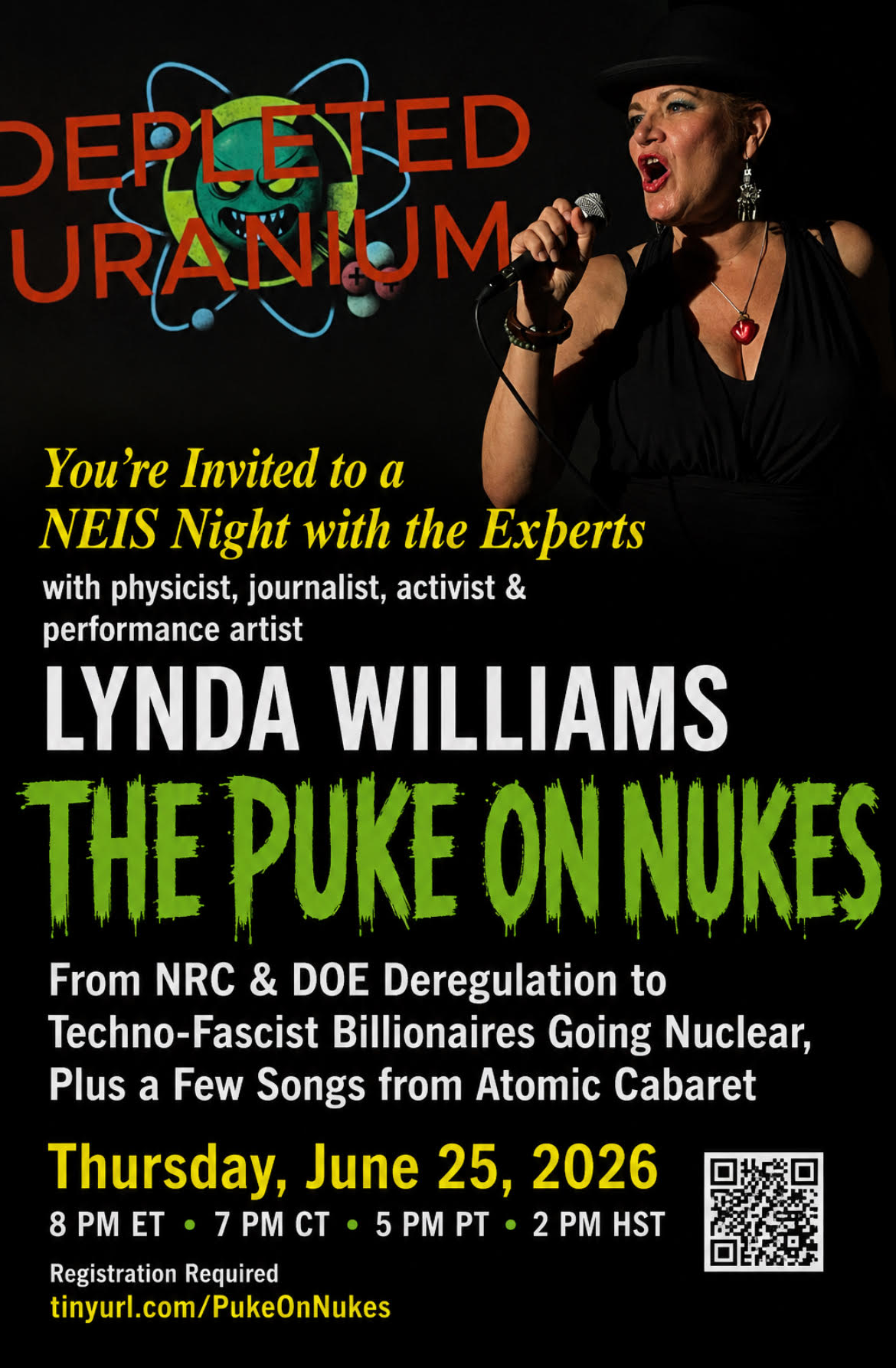
25 June- THE PUKE ON NUKES
Thursday, June 25, 2026
7pm Central Time (8pm ET, 6pm MT, 5pm PT) UTC – 5
From NRC & DOE Deregulation to Techno-Fascist Billionaires Going Nuclear, Plus a Few Songs from Atomic Cabaret REGISTER
26 June – Radiation Trainwreck at the NRC / Join the Protect Better Campaign – https://us02web.zoom.us/meeting/register/4ZlZ5_qLSHGiLSCg8FF6Bg#/registration


Cuba Is Not a Failed State – It Is a Besieged State
PETITION: “Global Appeal to Endorse Palestinian Right of Return of Refugees”
To see nuclear-related stories in greater depth and intensity – go to https://nuclearinformation.wordpress.com
-
Archives
- June 2026 (142)
- May 2026 (306)
- April 2026 (356)
- March 2026 (251)
- February 2026 (268)
- January 2026 (308)
- December 2025 (358)
- November 2025 (359)
- October 2025 (376)
- September 2025 (257)
- August 2025 (319)
- July 2025 (230)
-
Categories
- 1
- 1 NUCLEAR ISSUES
- business and costs
- climate change
- culture and arts
- ENERGY
- environment
- health
- history
- indigenous issues
- Legal
- marketing of nuclear
- media
- opposition to nuclear
- PERSONAL STORIES
- politics
- politics international
- Religion and ethics
- safety
- secrets,lies and civil liberties
- spinbuster
- technology
- Uranium
- wastes
- weapons and war
- Women
- 2 WORLD
- ACTION
- AFRICA
- Atrocities
- AUSTRALIA
- Christina's notes
- Christina's themes
- culture and arts
- Events
- Fuk 2022
- Fuk 2023
- Fukushima 2017
- Fukushima 2018
- fukushima 2019
- Fukushima 2020
- Fukushima 2021
- general
- global warming
- Humour (God we need it)
- Nuclear
- RARE EARTHS
- Reference
- resources – print
- Resources -audiovicual
- Weekly Newsletter
- World
- World Nuclear
- YouTube
-
RSS
Entries RSS
Comments RSS
 nuclear-news