Hinkley Point C owner warns fish protection row may further delay nuclear plant.
The prospect of a fresh delay to the plant, which is expected to generate about 7% of the UK’s electricity in the 2030s, comes amid a deepening row between green groups and the government over the chancellor, Rachel Reeves’s plan to prioritise economic growth over other considerations, including the environment and net zero.
Solution to stop River Severn fish being sucked into cooling systems taking too long to resolve, EDF says
Jillian Ambrose, Guardian 30th Jan 2025
The owner of Hinkley Point C in Somerset has warned that the much-delayed construction of Britain’s first new nuclear power plant in a generation could face further hold-ups because of a row over its impact on local fish.
The nuclear developer, EDF Energy, warned that the “lengthy process” to agree to a solution with local communities to protect fish in the River Severn had “the potential to delay the operation of the power station”.
As a result, the developer, which is owned by the French state, raised the threat of further delays to Hinkley Point – a project already running years late and billions of pounds over budget.
EDF said last year that Hinkley could be delayed to as late as 2031 and cost up to £35bn, in 2015 money. The actual cost including inflation would be far higher. EDF declined to say how long any new delay could be.
The prospect of a fresh delay to the plant, which is expected to generate about 7% of the UK’s electricity in the 2030s, comes amid a deepening row between green groups and the government over the chancellor, Rachel Reeves’s plan to prioritise economic growth over other considerations, including the environment and net zero.
EDF last week welcomed the government’s new reforms to “stop blockers getting in the way” of new infrastructure projects, including nuclear power plants. It called for the government to establish a framework to manage environmental concerns “in a more proportionate” manner.
The developer has pressured the government to loosen environmental rules while at loggerheads with local communities over its complex plans to protect local fish populations which are at risk of being sucked up into the nuclear power plant’s cooling systems.
The company had planned to install an “acoustic fish deterrent” to keep fish away from the reactor’s water intake system, which is nearly two miles offshore.
The project, which was reportedly informally dubbed “the fish disco” among former ministers, would require almost 300 underwater speakers to boom noise louder than a jumbo jet 24 hours a day for 60 years.
But the plan was later scrapped by EDF over concerns for the safety of divers who would need to maintain the speakers in dangerous conditions. There are also questions over its effectiveness.
Without the deterrent an estimated 18 to 46 tonnes of fish could be killed every year, according to estimates provided by EDF.
The company dismayed local farmers and landowners last year by suggesting plans to turn 340 hectares (840 acres) of land along the River Severn into a salt marsh to compensate for the number of fish forecast to be killed by the reactor every year.
After a growing outcry, it said earlier this month it would delay the formal consultation on its salt marsh plan, which it says would provide safe habitats for fish and animals, from the end of this month until later this year.
Mark Lloyd, the chief executive of the Rivers Trust, said any fish deterrent was vital. “The water intakes will suck in an Olympic swimming pool’s worth of water every 12 seconds, more than the normal flow of all the rivers flowing into the Severn estuary, and without a deterrent mechanism will cause a vast slaughter of millions of fish every year for the next 60 years.
“This will cause the potential extinction of populations of rare and endangered species … As the Severn estuary is a vital fish nursery for the whole region, the strategic and economic impacts for marine fisheries throughout the Irish Sea will be devastating.”……………………………………………………………………………………… https://www.theguardian.com/business/2025/jan/30/hinkley-point-c-owner-warns-fish-row-may-further-delay-nuclear-plant
Somerset Green councillor slams Sir Keir Starmer over Hinkley Point C comments
Why should UK environmental protection be sacrificed for the profit of the French nationalised electricity industry?”
Sir Keir Starmer is trying to make it harder to oppose major infrastructure projects
By Daniel Mumby, Local Democracy Reporter, Somerset Live 28th Jan 2025, https://www.somersetlive.co.uk/news/somerset-news/somerset-green-councillor-slams-sir-9900421
The leader of the Green Party on Somerset Council has attacked the prime minister following his recent comments on Hinkley Point C. EDF Energy has courted controversy over plans to create new saltmarshes in the Severn estuary to offset the environmental impact of Somerset‘s new nuclear power station.
In an article for Mail Online, prime minister Sir Keir Starmer lambasted efforts to block major infrastructure projects, singling out opposition to the acoustic fish deterrent which EDF had originally proposed for Hinkley Point C. These comments have drawn the ire of Councillor Martin Dimery, who warned Mr Starmer that his stance would lose him support across the south west.
Mr Starmer’s comments came as the government announced reforms to the judicial review system, restricting the grounds on which such reviews could be lodged to “stop blockers getting in the way” of infrastructure projects. He said in his article: “There are countless examples of nimbys and zealots gumming up the legal system often for their own ideological blind spots to stop the government building the infrastructure the country needs……………………………………
In an open letter to Mr Starmer, he said: “I wish I was joking when I point out that the sonar device due to be installed at Hinkley Point C was agreed from the outset to avoid the mass carnage of fish being sucked into the reactor’s mechanism, thus destroying huge quantities of the Bristol Channel’s fish stock. Fish remnants can also cause blockage and mechanical failure in nuclear power plants.
“Last year, EDF applied to Somerset Council to scrap the sonar device in an attempt to cut construction costs. As chairman of the climate and place scrutiny committee, I refused to sign off this appalling attempt to disregard the natural environment and the region’s fishing industry for the sake of EDF’s profits. Why should UK environmental protection be sacrificed for the profit of the French nationalised electricity industry?”
Reports recently resurfaced in the national press that Mr Starmer stated “I hate tree-huggers” at a shadow cabinet meeting in July 2023, at which current net zero secretary Ed Miliband MP unveiled new energy policies to combat climate change.
Mr Starmer denied using this phrase, telling BBC correspondent Laura Kuennsberg that his comments about green energy had been taken out of context.
Mr Dimery added, in direct reference to these claims: “‘Tree hugger’ I may be, prime minister, but if you’re so appalled at the prospect of individuals standing for the environment and against disreputable business practice, then you may find you lose a great deal of support from elected councillors of all political persuasions.”
EDF signals ageing British nuclear fleet can run into ‘the 2030s’.
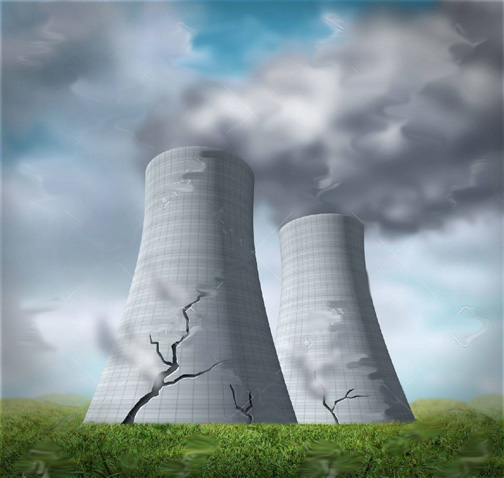
EDF has signalled that Britain’s fleet of ageing
nuclear power plants can keep running into the next decade amid a scramble
to hit Ed Miliband’s [?]clean power targets. The company on Monday said it
aimed to “maximise output” from the remaining gas-cooled nuclear
reactors to “2030+”, providing this can be agreed with regulators.
It is the strongest sign yet that EDF, which is owned by the French state,
believes the plants can go even further beyond their planned lifespans
after extensions were most recently announced in December. Further
extensions would deliver a boost to Mr Miliband, the Energy Secretary, as
he seeks to make the electricity grid at least 95pc reliant on “clean”
sources of power – including wind, solar, batteries and nuclear – in
just five years.
Two of EDF’s oldest nuclear power stations, Heysham 1 in
Lancashire and Hartlepool in Teesside, have had their shutdowns postponed
from spring 2026 to 2027, while the other two, Heysham 2 and Torness in
East Lothian, were extended from 2028 to 2030. But in a newly-published
fleet update, EDF says there is a potential opportunity for all four plants
to remain online until at least 2030.
Telegraph 27th Jan 2025, https://www.telegraph.co.uk/business/2025/01/27/edf-signals-ageing-british-nuclear-fleet-can-run-into-2030s/
The Changing Goal Posts of Nuclear Wastes Crazily Earmarked for “Geological Disposal”

The following letter was sent today to Millom Town Council, 25 Jan 25
The Changing Goal Posts of Nuclear Waste Geological Disposal
Lakes Against Nuclear Dump is a Radiation Free Lakeland campaign with a Facebook group of almost 1000 many of whom live in the Millom area.
We would like to thank Millom Town Council for voting to pull out of the so called “Community Partnership” with Nuclear Waste Services. The developer NWS has one aim and that is to deliver a “Geological Disposal Facility.” Nuclear Waste Services are proving to be the very worst of developers. We all know of developers who put in an application for works to get initial approval knowing full well the goal posts are to be changed later down the line. The latest being to bury 140 tonnes of plutonium. The US is looking to bury a far smaller stockpile of plutonium at WIPP, this has generated criticism from the Bulletin of Atomic Scientists and others concerned with nuclear safety, We assume the burial of plutonium was a NDA decision rather than a “Community Partnership” decision.
This is all a far cry from the 1990s NIREX days. The nuclear wastes slated for burial then on what is now the Wasdale Mountain Rescue Centre at Longlands Farm, Gosforth were low and intermediate. A long public inquiry involving multiple scientists and geologists found the NIREX plan for burial of low and intermediate level nuclear wastes to be ultimately flawed and dangerous to public health. The nuclear dump mission creep now includes plutonium. Deep burial and abandonment of long lived nuclear wastes is not a safe option given the shortfalls in the technical and scientific knowledge of permanent containment. The wastes should be constantly monitored and repackaged when necessary. The push for burial in a very large, very deep (and earthquake inducing) sub-sea mine is a purely political choice in order to justify new nuclear wastes.
We believe you will be ratifying your decision on January 29th and we look forward to others including Friends of the Lake District, taking Millom Town Council’s lead and pulling out of the Geological Disposal Facility “Community Partnerships”. of South and Mid Copeland.
Yours sincerely
Marianne Birkby
Lakes Against Nuclear Dump – a Radiation Free Lakeland campaign
Risks of geologic disposal of weapons plutonium
By Cameron Tracy | January 13, 2025https://thebulletin.org/premium/2025-01/risks-of-geologic-disposal-of-weapons-plutonium/
Ministers urged to clarify nuclear deployment

“US nuclear weapons at RAF Lakenheath will present a major threat, not only to communities near the base but to Britain as a whole, by putting us all on the US/Nato nuclear front line.”
Matt Precey, BBC News, Suffolk, 25th Jan 2025
The government is facing fresh demands to disclose whether US nuclear weapons are on British soil.
It comes as a senior American official confirmed the deployment of a new generation of bombs had been completed.
The Campaign for Nuclear Disarmament (CND) has written to the prime minister and the defence secretary to ask whether RAF Lakenheath in Suffolk is housing B61-12 munitions.
The UK and Nato have a long-standing policy to neither confirm nor deny the presence of nuclear weapons at a given location.
……………………………..The B61-12 is a thermonuclear bomb which can be carried by F-35A Lightning II aircraft, which are stationed at RAF Lakenheath.
US Department of Defense documents revealed $50m was being allocated to build new facilities at RAF Lakenheath known as “surety dormitories”, which the Federation of American Scientists claimed pointed to the arrival of nuclear weapons.
Another document seen by the BBC, which has since been removed from the internet, stated there was related work at the base in preparation for its “upcoming nuclear mission”.
Weapons of mass destruction were withdrawn from RAF Lakenheath in 2008.
The US and its Nato partners do not disclose figures for their European-deployed weapons but the Washington-based Center for Arms Proliferation and Control estimates there are 100 warheads stored across five countries.
Security risks
In a letter to the government, CND general secretary Sophie Bolt said Ms Hruby’s disclosure suggested the nuclear bombs could now be in the UK.
She said: “There has been no information presented to local communities about the new security risks that they face.
“US nuclear weapons at RAF Lakenheath will present a major threat, not only to communities near the base but to Britain as a whole, by putting us all on the US/Nato nuclear front line.”
The letter added that the public “has a right to know about the risks posed by such a deployment – and the right to express their opposition to it”.
In November, the US Air Force confirmed that unidentified drones had been spotted over three of its airbases in the UK, including RAF Lakenheath.
No further information has emerged as to the origin or intentions of these aircraft.
But CND said the sightings “increased risks” at the base.
Ms Bolt told the BBC: “An accident involving drones and an aircraft carrying nuclear material, or drones causing aircraft to crash on the base near where nuclear weapons are stored, could have catastrophic consequences.”
https://www.bbc.co.uk/news/articles/c20kwzyg721o
Heysham power station debate sparks questions on safety and incidents
By Robbie Macdonald, Lancaster Guardian 24th Jan 2025
Heysham nuclear power station safety, public health, waste, jobs, clean energy and the roles of councillors, from scrutiny to enthusiastic support, were raised in a Lancaster City Council debate.
It followed a recent announcement by the government and EDF about extending the generating lives of Heysham’s two nuclear reactors and the possibility of smaller reactors being there in the future.
Labour Coun Phillip Black, the former city council leader who resigned in November, put forward a motion backed by others, welcoming the news about extending Heysham 1’s and Heysham 2’s generating lives to 2027 and 2030.
Labour councillors and some others also wanted the council to state it had ‘confidence’ in the safety considerations underpinning the date extensions. And they also wanted the council to state support for new nuclear’ activity at Heysham in future.
However, others including many Greens, said Labour was irresponsible with the motion, given the wide spectrum of responsibilities councillors were supposed to consider.
Green Coun Gina Dowding said: “It’s really irresponsible to bring these two issues into one motion. Both are really important and deserve separate consideration.
“I recently asked a qualified architect, who has spent her working life on nuclear issues, about this. She said it would be deeply irresponsible for the council to ‘welcome’ the extensions. Extending the operating dates beyond the sites’ lifetimes should be questioned by the council – that is our role,” she emphasised. “These buildings were built in the 1980s based on reactor designs in the 1970s.”
She added: “We should also look at anomalies, such as an unforeseen circumstances , which are increasingly happening. There have been unplanned shut-downs. There was one last week. A loud bang was heard and a cloud seen, which concerned residents and the fire brigade was called.”
She also highlighted the proximity of the Heysham nuclear site, along with one at Hartlepool in the north-east, to areas with populations of over 100,000. She added: “At Heysham, the majority of people would be down-wind of any incident. So any motion saying this is ‘great for the future’ is not appropriate. Just because nothing has happened so far does not mean it couldn’t happen in future.
“Of course, there are skills and jobs in nuclear energy. But there are also skills and jobs in the decommissioning stages. Also in renewable energy, along with the potential to create more jobs and generate electricity for less cost.”
…………………………………….Fellow Green Tim Hamilton-Cox said. “Small modular reactors are still beyond the horizon and we have not yet got a permanent solution for nuclear waste. Some councillors have been against having that discussion. Speaking personally, I am not against nuclear power per se. But there are still many considerations and still no permanent solution for waste.”
Lib-Dem Peter Jackson, a member of the city council’s new cabinet, said: “I invite Labour councillors to bring forward a separate discussion about future Heysham questions as soon as possible.”
Morecambe Bay Independent Martin Bottoms, also on the new cabinet, also argued the extensions and any future developments should be treated separately. New modular reactors would not be on the horizon until at least 2025……………………………………
But Labour councillors opposed separating current and future topics. https://www.lancasterguardian.co.uk/news/national/heysham-power-station-debate-sparks-questions-on-safety-and-incidents-4958881
Brian Goodall slams MP over Rosyth Dockyard nuclear submarines move
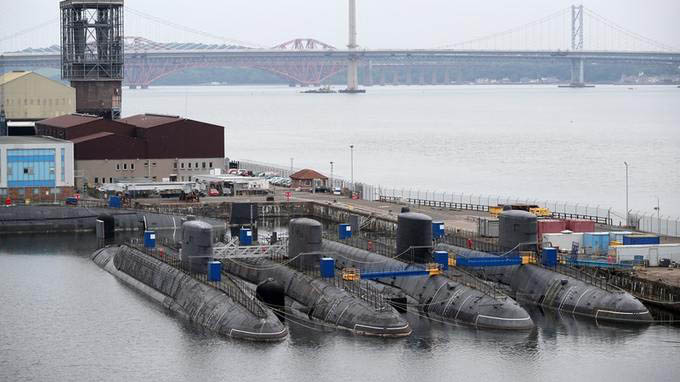
“As if it’s not bad enough that there are seven of these environmental time bombs already here, some of which have now been here for decades.“
By Ally McRoberts, Dunfermline Press 25th Jan 2025
A ROSYTH SNP councillor said he was “totally outraged” at the prospect of more nuclear submarines being brought to the dockyard for dismantling.
Brian Goodall said the “environmental time bombs” should be nowhere near the town and hit out at Labour MP Graeme Downie for pushing for more of the work to be done here.
One old Royal Navy sub, HMS Swiftsure, is being cut up and the radioactive waste removed as part of an innovative recycling scheme and there are six more vessels laid up at Rosyth, and another 16 at Devonport in Plymouth.
Mr Downie – who dismissed the criticism as “scaremongering” – wants the Ministry of Defence to put up the money to deal with all of the decommissioned boats and said it would “guarantee decades of work” and bring hundreds of jobs to the dockyard.
But Cllr Goodall hopes to sink that plan and said: “I’ve been totally outraged to see that our area’s Labour MP has called for even more nuclear submarines to be dumped and broken up in Rosyth.
“Labour’s MP for Dunfermline and Dollar has asked the MoD to bring all of the UK’s decommissioned nuclear submarines to Rosyth Dockyard.
“As if it’s not bad enough that there are seven of these environmental time bombs already here, some of which have now been here for decades.”
One of the seven at the yard, HMS Dreadnought has been laid up so long – since 1980 – that much of her low-level radiation has “disappeared naturally”.
As well as dealing with the 23 vessels at Rosyth and Devonport, three more are due to come out of service.
Cllr Goodall continued: “His call runs contrary to Fife Council’s long-standing commitment as a leading nuclear free local authority and I also fear the major impact on Rosyth Dockyard’s contribution to Scotland’s green transition, and the jobs that come with that, if this change of policy was secured, and the dockyard couldn’t become de-regulated as a nuclear site in the medium term.
“Rosyth is simply not the right place for the MoD, or anyone else, to be storing radioactive materials.
“There are homes, shops and businesses within metres of the dockyard.
“There’s a Fife College campus within the dockyard and our brand-new high school is being built within a few hundred metres of the site.”………………………..
Cllr Goodall said: “The compromise that could see the submarines that are already here, dismantled at the dockyard with all radioactive substances being removed to more suitable interim storage facilities down south, is one that I can, reluctantly, agree with, but any suggestion of additional nuclear submarines being brought to Rosyth is an outrage, and would be a breach of promise from the MoD.”……………………… https://www.dunfermlinepress.com/news/24883349.brian-goodall-slams-mp-rosyth-dockyard-subs-move/
Plutonium Disposition Strategy

Statement,
UK Parliament 24th Sept 2025, https://questions-statements.parliament.uk/written-statements/detail/2025-01-24/hcws388
The Department for Energy Security and Net Zero will work with the Nuclear Decommissioning Authority (NDA) to immobilise the UK-owned civil separated plutonium inventory at Sellafield.
Continued, indefinite, long-term storage leaves a burden of security risks and proliferation sensitivities for future generations to manage. It is the Government’s objective to put this material beyond reach, into a form which both reduces the long-term safety and security burden during storage and ensures it is suitable for disposal in a Geological Disposal Facility (GDF). Implementing a long-term solution for plutonium is essential to dealing with the UK’s nuclear legacy and leaving the environment safer for future generations.
Following a public consultation in 2011 the government at the time formed a preliminary policy view to pursue reuse of plutonium as mixed oxide fuel (MOX) but to remain open to any alternative proposals for plutonium management.
NDA have since carried out substantial technical, deliverability and economic analysis to identify a preferred option for a long-term disposition solution, including options for immobilisation and reuse. The outcome of this work recommended immobilisation as the preferred way forward to put the material beyond reach soonest and with greatest delivery confidence.
Following further development work the NDA will select a preferred technology for immobilisation of the plutonium as a product suitable for long-term storage and subsequently disposal in a GDF. Organisations involved in the delivery of this work will include the NDA, in particular Sellafield Ltd and Nuclear Waste Services, the UK National Nuclear Laboratory and the wider supply chain.
We expect that around the end of the decade following Government approval the NDA and Sellafield will begin delivery of the major build programme of plutonium disposition infrastructure. This programme is expected to support thousands of skilled jobs during the multidecade design, construction and operational period.
While work continues on long term immobilisation, the NDA is ensuring the continued safe and secure storage of plutonium in the UK. As part of this approach, new facilities are being built at Sellafield to repack the plutonium inventory for placement in a suite of modern stores.
East Suffolk MP warned “billions worthlessly invested” in Sizewell C
Campaigners have written to Member of Parliament for Suffolk Coastal, Jenny
Riddell-Carpenter, about the billions spent on nuclear project Sizewell C,
after costs were speculated to end up spiralling to £40 billion.
The long-term expense of the project has come into question after it emerged
that spending on another nuclear power station that is being built by
French state-owned developer EDF is expected to be in excess of £40bn.
Cour des Comptes, the French state auditor, last week advised the energy
company to delay an investment decision on the nuclear power station in
Sizewell, after Hinkley Point C hit delays and refinancing difficulties.
It advised EDF to slash its financial exposure to the Hinkley Point C project
before making a final decision regarding its investment in Sizewell C.
Campaign group Together Against Sizewell C (TASC) said the auditor’s
advice “demonstrates there are external factors that are outside the
control of the UK government that mean the project might not be
completed”.
Energy Voice 23rd Jan 2025, https://www.energyvoice.com/renewables-energy-transition/nuclear/565933/east-suffolk-mp-warned-billions-worthlessly-invested-in-sizewell-c/
Hinkley Point C: EDF says fish issue could delay new plant operation
By Seth Dellow, Digital Reporter, Bridgwater Mercury 24th Jan 2025
EDF has stated that a “lengthy process” to identify acceptable compensation for the loss of fish stemming from Hinkley Point C could have “the potential to delay the operation of the power station.”
The French energy giant behind the nuclear project has welcomed government plans to stop delaying major infrastructure projects over ‘excessive’ environmental obligations.
The government is proposing to reduce the number of legal challenges a group can make in court, from three to just one attempt……………………………………………………….
EDF has warned that a “current lengthy process to identify and implement acceptable compensation for a small remaining assessed impact on fish has the potential to delay the operation of the power station.”
It follows the recent delay of a formal consultation over the proposed location of a new salt marsh, which would act as an environmental mitigation for the harm the project would bring to 44 tonnes of fish.
According to EDF, creating a salt marsh “is the only option currently likely to be accepted as a mitigation.” But local residents along the Severn, including landowners and farmers, have previously expressed their opposition to the plans. The initial proposal to create a saltmarsh at Pawlett Harms was opposed in Parliament, with Bridgwater’s MP Sir Ashley Fox branding the idea as a “disaster.” https://www.bridgwatermercury.co.uk/news/24878911.hinkley-point-c-edf-says-fish-issue-delay-new-plant-operation/
UK to dispose of, not re-use, radioactive plutonium stockpile
BBC 24th Jan 2025,
https://www.bbc.co.uk/news/articles/cjr8lzyg299o
The government says it will dispose of its 140 tonnes of radioactive plutonium – currently stored at a secure facility at Sellafield in Cumbria.
The UK has the world’s largest stockpile of the hazardous material, which is a product of nuclear fuel reprocessing.
It has been kept at the site and has been piling up for decades in a form that would allow it to be recycled into new nuclear fuel.
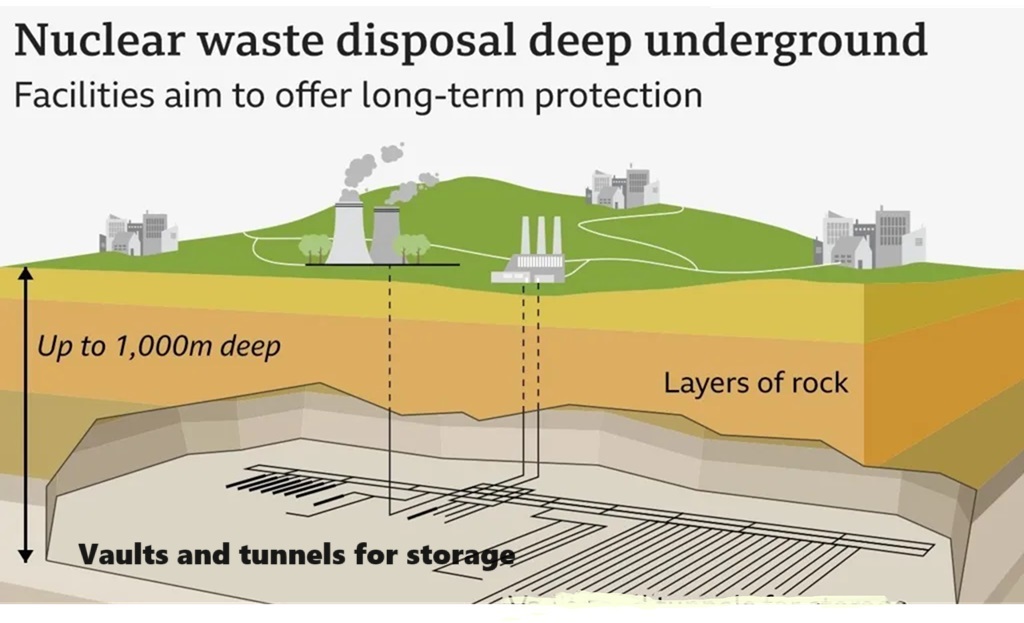
But the government has now decided that it will not be reused and instead says it wants to put the hazardous material “beyond reach” and made ready for permanent disposal deep underground.
That means that a facility will be built at Sellafield where the plutonium can be converted into a stable, rock-like material, which can eventually be disposed of deep underground.
In a statement, energy minister Michael Shanks said the objective was “to put this material beyond reach, into a form which both reduces the long-term safety and security burden during storage and ensures it is suitable for disposal”.
Nuclear materials scientist Dr Lewis Blackburn from the University of Sheffield said the plutonium would be “converted into a ceramic material” which, while still radioactive, is solid and stable so it is deemed safe to dispose of.
“The type of ceramic remains to be decided [and selecting the right material] is the subject of ongoing research.”
Nuclear waste expert Prof Claire Corkhill from the University of Bristol said the goverment’s decision was a “positive step”.
She told BBC News that it paved the way to removing the cost and hazard of storing plutonium at Sellafield “by transforming it and locking it away into a solid, durable material that will last for millions of years in a geological disposal facility”.
“These materials are based on those we find in nature – natural minerals, that we know have contained uranium for billions of years.”
The government is currently in the early stages of a long technical and political process of choosing a suitable site to build a deep geological facility that will eventually be the destination for all of the country’s most hazardous radioactive waste. That facility will not be operational until at least 2050.
Anti nuclear activists celebrate fourth banniversary of nuclear weapons

Half of the world’s nations, representing 2.5 billion people, have now signed and / or ratified the Ban Treaty. There are now 94 States Parties to the treaty and 73 have ratified their absolute adherence to it.
NFLA 22nd Jan 2025
Today (22nd January) is the banniversary, the fourth anniversary of the Treaty on the Prohibition of Nuclear Weapons[i] entering into international law at the UN.
This treaty, usually called the Ban Treaty, is the first piece of international legislation to outlaw the production, stockpiling, transfer, use or threat of use of nuclear weapons.
In the world today we have nine confirmed or acknowledged nuclear weapons states, the USA, Russia, United Kingdom, France, India, Pakistan, Israel and North Korea, with an estimated 12,121 nuclear weapons in January 2024[ii].
In 2023, these states were estimated to have spent $91.4 billion maintaining and enhancing their nuclear arsenals.
Nuclear proliferation has been restrained because of the Nuclear Non-Proliferation Treaty[iii] which was first signed by the USA, USSR and UK in 1968 and has almost universal acceptance in the world community. Signatory nations without nuclear weapons agree not to acquire them, whilst retaining the right to employ nuclear power for energy, whilst the five nuclear weapon states, the USA, Russia, UK, France and China, which have signed it have agreed not to deploy nuclear weapons against non-nuclear weapons states. Furthermore, under Article 6 they have committed to: pursue negotiations in good faith on effective measures relating to cessation of the nuclear arms race at an early date and to nuclear disarmament’.
The Ban Treaty came to pass because global civil society, particularly in nations whose people suffered greatly from post-war atomic and nuclear bomb testing, such as Australia, the Pacific Islands, Algeria, and Kazakhstan, became increasingly frustrated by the failure of these nuclear nations to conduct any negotiations in ‘good faith’, despite the passage of over 60 years. Civic society groups, scientists, physicians and the Hibakusha pushed back by establishing an International Campaign to Abolish Nuclear Weapons (ICAN) to bring about the world’s first definitive legislation to outlaw nuclear weapons.[iv]
In doing so they were following the example set by worldwide campaigners opposed to anti-personnel landmines, whose campaign led to the passage of the Ottawa Convention or the Anti-Personnel Land Mine Ban Convention.[v] This became law in 1997. Later that year the International Campaign to Ban Landmines won the Novel Peace Prize.
The new campaign aimed to bring in similar legislation to that which previously banned other weapons of mass destruction, namely chemical, biological and bacteriological weapons.
Lawyers from civil society groups and supportive nations drew up the legislation. Several years were spent by campaigners in international shuttle diplomacy, with private meetings and various regional conferences held across the world to build support amongst United Nations member states…………………………………………………………………………………………
Half of the world’s nations, representing 2.5 billion people, have now signed and / or ratified the Ban Treaty. There are now 94 States Parties to the treaty and 73 have ratified their absolute adherence to it.
……………………………………………………………………………………………………………………. The Nuclear Free Local Authorities and Mayors for Peace are both established partners in ICAN.
Interestingly in both organisations are member authorities in the Republic of Ireland and the UK. The Republic is a neutral and non-nuclear weapon state that has signed and ratified the Ban Treaty. The UK is a NATO and nuclear weapon state which is refusing to engage with the treaty. This creates a dichotomy.
What then will the UK/Ireland NFLAs and Mayors for Peace Chapter be doing in 2025 to build support for the treaty and the communities affected by nuclear weapons and testing?
Richard Outram, explains:
The big challenge here is getting any British Government, whatever its political persuasion, which remains wedded to nuclear weapons and is a member of a nuclear weapons alliance with a first use policy, to get on board with the Treaty.
“2025 will be an especially significant year in the history of nuclear weapons, being the 80th anniversary of the tragic atom bomb attacks on Hiroshima and Nagasaki, so it will be important to have a focused plan with positive actions.”
Richard intends to:
- Ask the Labour Government to send an official observer to the next conference of the Ban Treaty to join signatory states and civil society groups. This will be held in New York in March.
- Lobby the Government to acknowledge the moral imperative for the UK to provide reparations and practical support for the communities, generally Indigenous, impacted by British atomic and nuclear weapons, as per the provisions of Articles 6 and 7 in the Ban Treaty.
- Continue to work for justice and compensation for Britain’s atomic and nuclear test veteran community and their families. The NFLAs have been a major player in lobbying politicians at all levels in both Conservative and Labour governments, and has appointed a former British Army veteran, Councillor Tommy Judge, to be its spokesperson on these issues.
- Ask Mayors for Peace to follow Manchester’s example in passing resolutions in support of the ICAN Cities Appeal calling on the British Government to sign the Treaty.
- Write to parliamentarians at Holyrood in support of a resolution just tabled before the Scottish Government favouring nuclear disarmament and a nuclear free Scotland.
- Support any move to lobby local government pension funds to divest from nuclear weapons.
- Continue to work building up the number of our member authorities and to strengthen their capacity to act for peace in this 80th anniversary year of the atom bombings. https://www.nuclearpolicy.info/news/anti-nuclear-activists-celebrate-fourth-banniversary-of-nuclear-weapons/
Legal challenges to infrastructure plans to be blocked in Starmer growth push
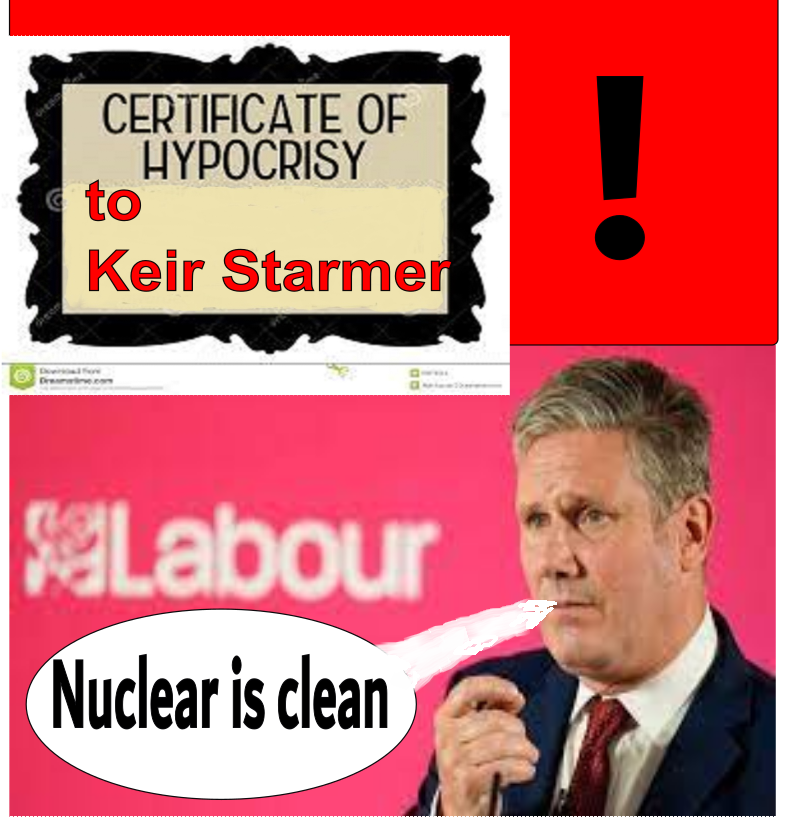
Dr Ruth Tingay, a prominent environmental campaigner and a co-director of Wild Justice, said: “It sounds like Starmer is auditioning for a role in Trump’s cabinet.
Prime minister hopes his plan to ‘take the brakes off Britain’ will send a message to business to build more
Pippa Crerar, Kiran Stacey, Sandra Laville and Patrick Barkham. Guardian 23rd Jan 2025
Legal challenges to infrastructure plans to be blocked in Starmer growth push
Prime minister hopes his plan to ‘take the brakes off Britain’ will send a message to business to build more
Pippa Crerar, Kiran Stacey, Sandra Laville and Patrick BarkhamThu 23 Jan 2025 11.01 AEDTShare
Campaigners will be blocked from “excessive” legal challenges to planning decisions for major infrastructure projects including airports, railways and nuclear power stations as part of the government’s drive for economic growth.
High court judges will be given the power to rule that judicial reviews on nationally significant projects that they regard as “totally without merit” – and which can currently be brought to the courts three times – will be unable to go to appeal.
Keir Starmer said the change would “take the brakes off Britain” by reforming the planning system, sending a message to business to build more national infrastructure, as ministers desperately pursue opportunities to improve the economy.
“For too long, blockers have had the upper hand in legal challenges – using our court processes to frustrate growth,” he said.
“We’re putting an end to this challenge culture by taking on the nimbys and a broken system that has slowed down our progress as a nation.”
It is one of a range of measures being considered by the government as part of an all-encompassing dash for growth, which has caused alarm among environmental groups.
With GDP figures barely moving since the election, Rachel Reeves is looking at proposals from airport expansion to widespread deregulation in an effort to improve the UK’s economic outlook.
Government sources said the chancellor was “deeply unimpressed” with the pro-growth ideas presented by a number of the country’s biggest regulators when she met them last week, and has since instructed them to improve their plans………………………………………………………………………….
However, some environmentalists have expressed unease with the government’s drive to curtail legal challenges to infrastructure projects, of which they have promised to deliver 150 this parliament………………….
In February 2020, Starmer tweeted “congratulations to the climate campaigners” when plans for a third runway at Heathrow airport were ruled illegal by the court of appeal after a judicial review.
“There is no more important challenge than the climate emergency. That is why I voted against Heathrow expansion,” he said then…………………………………
The current first attempt – known as the paper permission stage – will be scrapped. Primary legislation will be changed so that where a judge in an oral hearing at the high court deems the case “totally without merit”, it will not be possible to ask the court of appeal to reconsider. A request to appeal second attempt will be allowed for other cases………………………………….
Green groups also have voiced concerns over plans to overrule environmental protections to free up the planning system with a new Nature Restoration Fund which, the government said, would not allow protected species such as newts and bats to be deemed more important than homes or infrastructure.
Niall Toru, senior lawyer at Friends of the Earth, said: “No one is above the law, not even the government.
“Friends of the Earth only brings cases we think are strong and necessary to protect people and nature from unlawful harm – and considering our string of recent legal wins, so do the courts.
“It is deeply concerning that Labour is attempting to scapegoat claimants. If ministers don’t want to be challenged in the courts, they should act within the law, because already cases aren’t allowed to proceed unless they have merit.”
Dr Ruth Tingay, a prominent environmental campaigner and a co-director of Wild Justice, said: “It sounds like Starmer is auditioning for a role in Trump’s cabinet.
“This proposal doesn’t make any sense whichever way you look at it. First, campaigners can only take judicial reviews if their case does have merit, as judged by the high court.
“So to then allow another judge to block an appeal on the basis that the case is ‘totally without merit’ is nonsensical and will lead to problems of accountability and lack of scrutiny.
“Second, and more importantly, economic growth based on environmental and climate degradation is a loser’s game, and we’ll all be paying the price of that.” https://www.theguardian.com/politics/2025/jan/23/legal-challenges-to-infrastructure-projects-to-be-blocked-in-push-for-growth
Vegetation being removed to enable upgrade of Sizewell line
Work on a Suffolk railway line has sparked “fury and upset” over the
apparent removal of mature trees and vegetation. Leiston resident Hayley
Trueman said the foliage had been cut down along the Sizewell branch line
between Saxmundham and Leiston as part of an upgrade to enable the track to
be used to transport building materials to the new Sizewell C nuclear power
station.
She said: “The trees and vegetation not only provide screening for
us as residents, but is a green corridor for the abundant wildlife that
lives there.
East Anglian Daily Times 22nd Jan 2025 https://www.eadt.co.uk/news/24873970.vegetation-removed-enable-upgrade-sizewell-line/
Suffolk Coastal MP said priority to hold Sizewell to account.
24th January, By Dominic Bareham, East Anglian Daily Times
A Suffolk MP has written to the developers of the new Sizewell C nuclear power station expressing concerns raised by her constituents about the current construction.
Jenny Riddell-Carpenter, MP for Suffolk Coastal, said her priority was to hold Sizewell C to account on its “social valuable and charitable investments, employment opportunities and environmental actions”.
Campaigners from action group Together Against Sizewell C (TASC), which is opposed to the power station, have written to her asking her to call a halt to the project due to the “huge amount of environmental damage being inflicted by the project”.
………………………………………………………………In the letter, TASC raised concerns works associated with the Sizewell C project were causing environmental damage, including a new link road, access road, five roundabouts and park and ride sites.
It said: “These projects have resulted in the felling of thousands of trees, grubbing out miles of hedging and covering vast areas under concrete and tarmac, devastating the biodiversity-rich environment, Heritage Coast and the Area of Outstanding Natural Beauty landscape in the process.
“This amounts to wholesale environmental vandalism, especially when the project still not only lacks a final investment decision but also a final design of the all-important sea defences, has no guaranteed sustainable supply of potable water essential for its 60 years of operation and with the nuclear site’s ground stabilisation trials remaining unfinished.” https://www.eadt.co.uk/news/24876996.suffolk-coastal-mp-said-priority-hold-sizewell-account/
1 This Month

22 June – Virtual Event –Climate Change: New Data, New Debate

Monday, June 22, 2026 2:30 p.m. – 3:15 p.m. CT
YouTube. Register here

Protect Sazan Island from the Trump family! https://secure.avaaz.org/campaign/en/protect_sazan_island_from_the_trump_family_loc/?bqFCVab&v=174511&cl=22707147157&_checksum=5e9dde668860e8231c33699735e16a1fbf22ab2cb01da50c999fe8732b9775ef&utm_source=email&utm_medium=blast_email&utm_campaign=174511
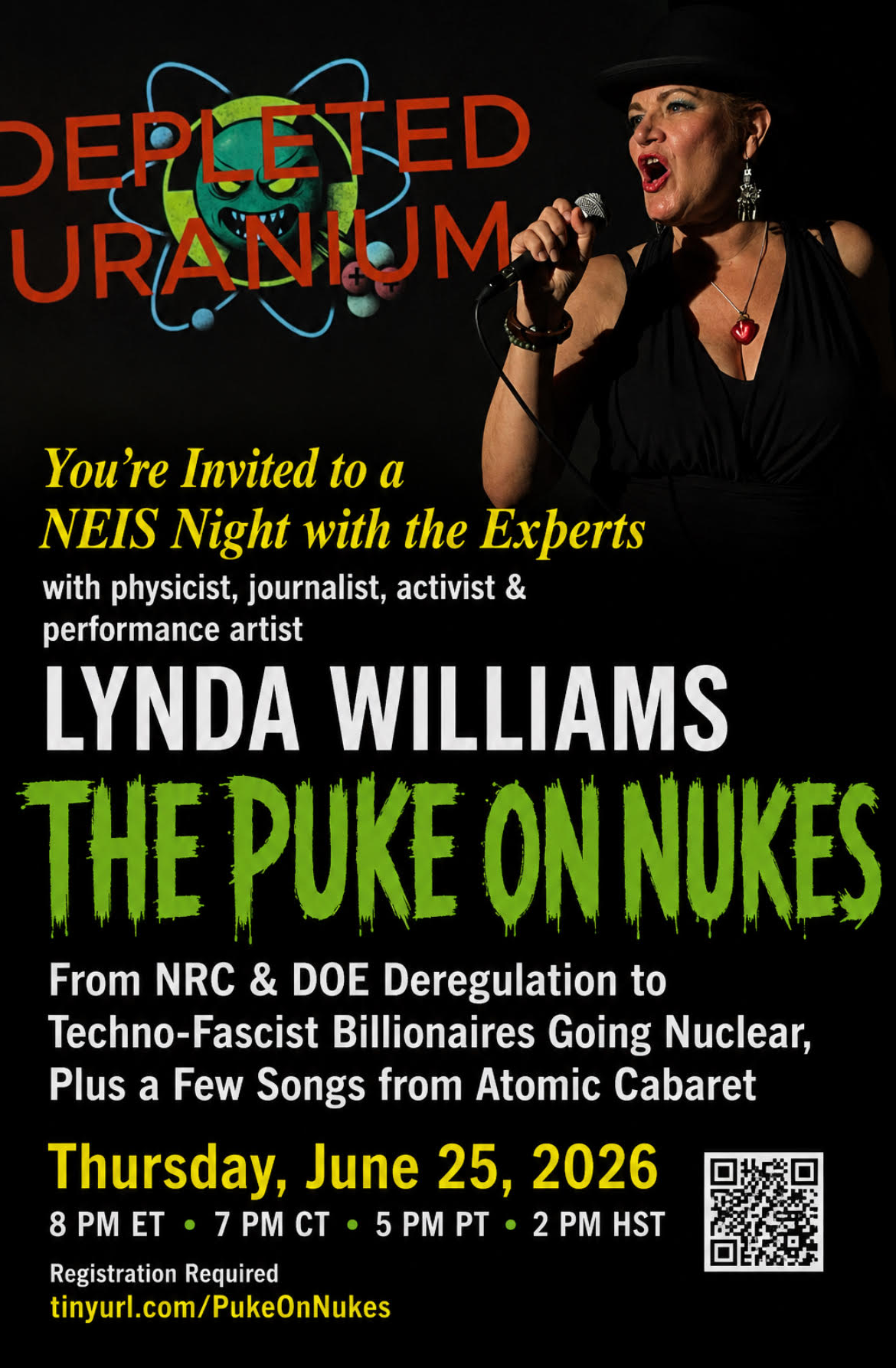
25 June- THE PUKE ON NUKES
Thursday, June 25, 2026
7pm Central Time (8pm ET, 6pm MT, 5pm PT) UTC – 5
From NRC & DOE Deregulation to Techno-Fascist Billionaires Going Nuclear, Plus a Few Songs from Atomic Cabaret REGISTER
26 June – Radiation Trainwreck at the NRC / Join the Protect Better Campaign – https://us02web.zoom.us/meeting/register/4ZlZ5_qLSHGiLSCg8FF6Bg#/registration


Cuba Is Not a Failed State – It Is a Besieged State
PETITION: “Global Appeal to Endorse Palestinian Right of Return of Refugees”
To see nuclear-related stories in greater depth and intensity – go to https://nuclearinformation.wordpress.com
-
Archives
- June 2026 (193)
- May 2026 (306)
- April 2026 (356)
- March 2026 (251)
- February 2026 (268)
- January 2026 (308)
- December 2025 (358)
- November 2025 (359)
- October 2025 (376)
- September 2025 (257)
- August 2025 (319)
- July 2025 (230)
-
Categories
- 1
- 1 NUCLEAR ISSUES
- business and costs
- climate change
- culture and arts
- ENERGY
- environment
- health
- history
- indigenous issues
- Legal
- marketing of nuclear
- media
- opposition to nuclear
- PERSONAL STORIES
- politics
- politics international
- Religion and ethics
- safety
- secrets,lies and civil liberties
- spinbuster
- technology
- Uranium
- wastes
- weapons and war
- Women
- 2 WORLD
- ACTION
- AFRICA
- Atrocities
- AUSTRALIA
- Christina's notes
- Christina's themes
- culture and arts
- Events
- Fuk 2022
- Fuk 2023
- Fukushima 2017
- Fukushima 2018
- fukushima 2019
- Fukushima 2020
- Fukushima 2021
- general
- global warming
- Humour (God we need it)
- Nuclear
- RARE EARTHS
- Reference
- resources – print
- Resources -audiovicual
- Weekly Newsletter
- World
- World Nuclear
- YouTube
-
RSS
Entries RSS
Comments RSS
 nuclear-news