Time to give up the pretense about Ukraine winning the war.

31 May 25, https://theaimn.net/time-to-give-up-the-pretense-about-ukraine-winning-the-war/
The war in Ukraine has reached a new, and very dangerous phase. Not that it wasn’t dangerous before. But the toll of militarism was being paid by the deaths and the sufferings only of soldiers and their communities of Ukraine and Russia.
That’s OK by the shareholders in U.S. and other weapons companies, and by warhawks and the virtuous Russian-haters of Western culture. But it’s another thing when the deaths and sufferings might now extend to European people, to the British – and heck, – to World War 3 and all of us.
The change is that German Chancellor Friedrich Merz pledged on 28th May to help Ukraine develop its own long-range missile systems that would be free of any Western-imposed limitations on their use and targets. So Ukraine could hit Moscow. Now Merz did back off in this, a bit, but later suggested that Taurus missiles might be delivered to UKraine. Germany would put up the money.
This would be a revolutionary change in the Western policy on the war in Ukraine.War-monger though he was, President Joe Biden saw the danger in escalating the war in this way, and for over 2 years refused Ukraine’s demand for long-range missiles. He changed his mind on this only at the last minute in December 2024. Then Trump, on taking office, paused weapons shipments to Ukraine. Now, characteristically, Trump has a confusing attitude on this – probably means “It’s OK as long as Ukraine pays up for them“.
Now, there are lots of impediments to Ukraine actually getting long-range missiles that could strike deep inside Russia. One big impediment is that the USA would have to be involved in missiles from Germany being used – this would necessitate U.S. software and technical support.
Lavrov on Germany’s Taurus Missiles: Approval for Ukraine’s Long-Range Strikes? | Times Now World https://www.youtube.com/watch?v=3L8ARMiQmdE
So, should we really worry about this bold initiative by the German Chancellor?
I think, yes. It’s a wake-up call. If we all think that it’s now OK for long-range missiles to hit deep inside Russia, well, I guess we don’t mind if Russia sends the same into Ukraine and beyond ?
Is anyone in the West paying attention to the facts on the actual progress of this war? Global Conflict Tracker now says:
“Russia still occupies roughly 20 percent of the country after gaining over four thousand square kilometers of territory in 2024. Russia continues to bombard Ukrainian cities…. Since January 2022, Ukraine has received about $407 billion in aid, including over $118 billion from the United States. Fighting and air strikes have inflicted over 40,000 civilian casualties, while 3.7 million people are internally displaced, and 6.9 million have fled Ukraine. 12.7 million people need humanitarian assistance.“
But never mind. The corporate media is still telling us that Ukraine can, and must, beat Russia. And they’re also telling us that Russia doesn’t want a negotiated settlement.
And why is it that Russia does not seem to want a negotiated settlement?
Well, that’s because the new “Coalition of the Willing”, led by Britain and France, supports Volodymyr Zelensky’s underlying demands for ending the war:
Zelensky’s underlying demands:
- Ukraine membership of NATO
- return of all Russian-occupied territories, including the Donbass and Crimea
- Western troops in Ukraine for security
- payment of reparations, war crimes trials for the Russian leadership
All of these are unacceptable to Russia – especially NATO membership – a definite “Red Line”
There have been previous negotiations between Ukraine and Russia. In the Istanbul talks of March-April 2022, the two parties were on the verge of an agreement, in which Russia made concessions, and Zelensky did not insist on NATO membership. The US and UK sabotaged the Istanbul talks by refusing to provide Ukraine with security guarantees and encouraging Zelensky to keep fighting instead.
Now Russia is in a militarily winning position, and has no inclination to submit to those underlying demands, nor to agree to a temporary ceasefire which would allow Ukraine to develop weaponry and troops.
But there is no suggestion from our bold, confident, Western leaders – Sir Keir Starmer, Friedrich Merz, Emmanuel Macron, that it might be best to pay more attention to the actual military situation, and less to the theatrical posturing of Volodymyr Zelensky. An unlikely source of common sense is America’s President Donald Trump – who actually does want peace, with his focus on making himself and his cronies richer, rather than on fighting Russia.
And the general public? Weary of it all, stunned into a sort of mental paralysis as we observe the barbarities going on in Gaza, the West en masse seems to be just sleep-walking into the military and economic disaster of a continuing war in Ukraine.
As with all wars, the media plays a huge role – glorifying that consummate media performer Zelensky, and regaling us with the civilian horrors suffered by Ukrainian civilians. (And they ARE really suffering). Of course, not a word about suffering Russians. Russian atrocities are publicised – both real ones, and fabricated. But if you see any news item about atrocities done by Ukrainians – you assume automatically that it must be a lie.
In fact, I’ve noticed that there is a powerful argument for the untruth of anything that shows any positive activity by Russians. If you mention it to any Westerner, it will be refuted because “After all, this news is just Russian propaganda“. You see, it doesn’t matter if the news is factual – it must be false, coming from Russia. In reality, of course the Russians are using factual news as propaganda. As well, they do have a sophisticated programme of misinformation as well. And so do we in the West, in all likelihood, when we consider America’s Central Intelligence Agency and its long history of disinformation.
So, it is a media mess. It’s tragic that Zelensky, elected on a pledge to honour agreements ensuring the autonomy of the largely Russian-speaking Donbass provinces, quickly went along with Europe and USA’s historic fear and hatred of Russia.
Never mind that Russia was on “our side” in the last big war, and largely won that war in Europe, at the price of some 27 million Russian lives. The Soviet Union did defeat the Nazis in Ukraine. But all that is forgotten, as Western leaders look solemn and statesman-like, pronouncing on coalition-of-the -willing plans for a big war in the air, with ever more powerful missiles, ending of course, in a glorious victory over Russia (and sorta bad luck that Ukraine is completely demolished along the way).
I don’t know what it might take for the public to wake up to the suicidal path on which these macho “statesmen” are leading the West, and “helping” Ukraine. A previous Coalition of the Willing” “helped Iraq”, and that hasn’t turned out so well.
It would be a good start if some in the corporate media could get away with telling the facts on the dismal situation of Ukraine in this war. Expanding the war sounds so noble and easy to decide on. Much more difficult would be a measured progress in negotiation, recognising the legitimate needs of each side.
How Donald Trump Discovers the Art of Political Negotiation
Donald Trump knew nothing about the history of Russia and Ukraine, but he’s learning quickly. He no longer believes the Western delusions that Moscow wants to invade Ukraine, and then the rest of Europe. Nor does he believe the delusions of Kaja Kallas and the Balts, for whom Russia is a “prison of peoples” that must be dismembered.
by Thierry Meyssan, Voltaire Network | Paris (France) | 27 May 2025 https://www.voltairenet.org/article222331.html
We don’t understand the negotiations in Ukraine and the Middle East because we don’t understand the difference between wars and civil conflicts. We approach peacemaking as if it were a matter of dividing up common property during a divorce, after a few years of living together. But wars are of unparalleled intensity and are rooted in long-standing conflicts, often spanning several generations. Generally speaking, material conditions, suffering, and violence are of secondary importance compared to injustices.
Furthermore, the negotiating method of this business leader turned head of state, like Donald Trump, is dizzying. He strives to evoke incoherent positions and maintain none, simply to shake up his partners in the hope of getting their assets out of their pockets. This method, which has nothing diplomatic about it, ignores the underlying causes of conflicts. It only acknowledges what each side complains about. Ultimately, it can lead to agreements that some signatories might accept at the moment, but later regret.
In any case, we must act quickly. The wars in Ukraine and the Middle East, even though they have diminished in intensity, continue to kill and destroy. The sensational announcements that this or that war could have been resolved in a few days have already run up against harsh realities.
True diplomats and true warriors don’t aim to win over others, but to live with them. They can’t get along with business leaders who want to be the best, but they can solve problems with the help of those who intend to produce what can be useful to others. Donald Trump is of this ilk.
However, the current problems are not Russian, but primarily American. This could also be the case with Palestine and Iran. Making progress on the Ukrainian conflict requires, first and foremost, not changing the Russian point of view, but addressing the unconditional support of some Westerners for the “integral nationalists,” historical allies of the Nazis. It quickly became clear to the Trump team that the Russian claim to “denazify” Ukraine was not a war propaganda invention [1]. There are several hundred monuments to the glory of Reich collaborators in Ukraine, not to mention buildings and avenues bearing their names [2]. Reading the works of Dmytro Dontsov, particularly his book Націоналізм (Nationalism), is now mandatory in the Ukrainian armed forces; a work equivalent to Adolf Hitler’s Mein Kampf (My Struggle) [3]. The most important church in Ukraine was banned because it recognizes the authority of the Patriarch of Moscow.
Several million books were burned because they were written in Russian, that evil language, or because they were written by Russian authors, such as Alexander Pushkin (1799-1837) or Leo Tolstoy (1828-1910). All opposition political parties have been banned, and the current president, Volodymyr Zelensky, has banned new elections by extending the martial law that prohibits them every three months.
To address this issue, Donald Trump must give the Ukrainians something in return. He chose to question the savagery Russia displays when it is certain it is right, which it is. The Western press chose to focus only on the passage where the US president wonders if Vladimir Putin has gone mad. But in the same post, he also denounced Volodymyr Zelensky’s speech. He thus equated the Russian president’s cruelty with the Ukrainian leader’s bad faith. It is important to realize that while emotionally he gives the Ukrainians the upper hand, politically he gives it to the Russians.
It turns out that we belong to a civilization where emotion has replaced reason. We mourn with the fundamental nationalists, believing we share the suffering of the Ukrainians. However, in time, we will recognize the facts and turn against the fundamental nationalists we support today, or even against Ukrainians in general, because we will be ashamed of our current positions. This is the way of history: we always return to positions we can be proud of.
Vladimir Putin has already anticipated our reversal. According to him, the European Union’s unilateral coercive measures will not last. We will eventually return to our former loves, when we celebrated Franco-Russian friendship. This is why he is holding back his army, whose military superiority would have allowed him to capture Odessa long ago and thus complete the reconstruction of the old Russia.
This is what’s at stake now. Territorial boundaries matter little compared to relationships between people. Material issues are always secondary to individual freedom. The people living in Ukraine will have no trouble accepting the partition of their country once they are freed from the pressure exerted on them by the fascists who massacred their great-grandparents.
Donald Trump knew nothing about the history of Russia and Ukraine, but he’s learning quickly. He no longer believes the Western delusions that Moscow wants to invade Ukraine, and then the rest of Europe. Nor does he believe the delusions of Kaja Kallas and the Balts, for whom Russia is a “prison of peoples” that must be dismembered.
Similarly, Donald Trump knew nothing about the history of Israel and Iran, but he learned that the revisionist Zionists of Yitzak Shamir organized SAVAK, the political police of the Shah, Reza Pahlevi, and his Prime Minister, the Nazi General Fazlollah Zahedi, who had just left British jails after the overthrow of Mohammad Mossadegh [4]. It is difficult to admit, but yes, the terrible SAVAK was organized by Israeli Jews, “revisionist Zionists,” in the service of a Nazi general [5], just as it is difficult to admit that the Ukrainian integral nationalists killed many more of their compatriots than foreign enemies. Donald Trump and his negotiator, Steve Witkoff, have understood that what is at stake in the Middle East is not military nuclear power (even if it is Israel and not Iran that has the bomb), but the second round of crimes committed by the Shah’s regime with the discreet support of certain Israelis.
Reform leader hits back after Tories saying he’s gone back on nuclear waste site promise.
By James Turner, Lincolnshire World, 28th May 2025, https://www.lincolnshireworld.com/news/environment/reform-leader-hits-back-after-tories-saying-hes-gone-back-on-nuclear-waste-site-promise-5149751
The new Reform UK leader of Lincolnshire County Council has hit back at accusations of failing to deliver on his election promises regarding a nuclear waste site.
The Lincolnshire Conservative group has highlighted that Coun Sean Matthews, recently elected as council leader, has yet to pull out of talks with government agency Nuclear Waste Services (NWS) about a Geological Disposal Facility (GDF) — despite saying he would cancel Lincolnshire’s involvement in the project on day one if elected.
NWS, formerly known as Radioactive Waste Management Limited, outlined three potential sites for its Geological Disposal Facility in January, including East Lindsey, and communities in Mid Copeland and South Copeland in Cumbria.
East Lindsey District Council withdrew from talks with NWS after the proposed location changed from the former gas terminal in Theddlethorpe to open countryside on land between the villages of Gayton le Marsh and Great Carlton.
The former Conservative administration of Lincolnshire County Council announced its intention to withdraw from talks in March, effectively cancelling the company’s consideration of the Lincolnshire coast for the facility. However, this had yet to be formalised before the local elections in May, when the administration switched to Reform UK.
During a demonstration outside East Lindsey District Council offices in early March, dozens of protesters called on Lincolnshire County Council to withdraw from the talks. Councillor Matthews attended with four of his Reform UK colleagues.
He told the Local Democracy Reporting Service: “On day one if elected as the leader of the Reform council, we will withdraw from the agreement.”
Coun Richard Davies, leader of the Conservative opposition group on the county council, said: “This is a clear U-turn from Sean Matthews and Reform UK.
“Local people were told the project would be scrapped on day one. Instead, the new Reform administration is delaying, consulting, and refusing to give communities the certainty they deserve.”
He added: “We call on Sean Matthews to explain why he has not kept his word to Lincolnshire residents. Reform UK cannot have it both ways — either they stand by their promises or admit they misled the public to win votes.”
Responding to the comments from his Tory counterpart, Coun Matthews said: “As Richard is well aware, there is a democratic process that needs to be followed to officially review the council’s membership of the Community Partnership. And he knows that if we don’t follow that process, we could open ourselves up to challenge, causing further uncertainty for local residents.
“We were clear in the campaign about our intentions, and on my first day as leader of the Reform group, I started that process — even enacting the council’s urgency protocol to allow us to have these important discussions as quickly as possible.
“It took me less than a day to start a process that the previous Conservative administration couldn’t complete in the several years they were in power. In fact, the mere fact they entertained the plans to bury nuclear waste under Lincolnshire in the first place is why this community has had to live with uncertainty for so many years.
“As far as I am concerned, in just one week a decision will have been made and then residents can judge for themselves whether their Reform councillors stick to their word.”
Councillors on Lincolnshire County Council’s Overview & Scrutiny Management Board were to review the council’s participation in the Community Partnership at a meeting on Thursday, May 29. A final decision on the council’s future involvement is expected to be taken by the Executive on Tuesday, June 3.
UK government’s Spending Review needs to allocate nuclear clean-up funds
Letter David Lowry: Julia Pyke, joint managing director of the planned
giant new nuclear power plant at Sizewell C in Suffolk (news, May 26)
asserts that the nuclear industry “prices decommissioning and waste
disposal into the price of its electricity”.
This is misleading. It is true that ministers have established a Nuclear Liabilities Fund, which aims to cover the future costs of dealing with the stewardship of radioactive
waste created from nuclear generation and with defunct contaminated
buildings at closed nuclear plants.
However, resources recovered from the
electricity bill payer, included in the cost of nuclear-generated
electricity, may not foot the full bill. The problem is that cleaning up
the radioactive residue from nuclear power is not a decades-long task, but
one that will last centuries. Nobody yet knows the final bill, but
experience tells us that it is likely to be higher than projected.
The top-up costs will fall to future taxpayers, even though Sizewell C will be
majority privately-owned. When the chancellor is considering allocating
billions of pounds in construction funds for Sizewell C in next month’s
spending review, she will need to allocate nuclear clean-up funds too.
Times 29th May 2025, https://www.thetimes.com/comment/letters-to-editor/article/times-letters-no-benefit-child-payment-cap-rc8xnsrn3
Dysfunctional: review reveals South Copeland GDF partnership at war
It reads like the potential plot for a sequel novel to J K Rowling’s
‘A Casual Vacancy’. For the report of the review of the South Copeland
GDF Community Partnership highlights internal disarray, with members in
conflict with an overbearing Nuclear Waste Services, whilst experiencing
increasing opposition within the local community.
The catalyst for the
review was the letter of withdrawal of Millom Town Council dated 28
November 2024, detailing numerous criticisms of its composition and
function. No consideration appears to have been given by NWS to have
convened a Task and Finish Group with Community Partnership members.
Such a group could have been charged with discretely, though earnestly,
considering the criticisms raised in the Millom Town Council letter, and
then to bring back its own report to the Partnership with its own
recommendations.
Instead, NWS commissioned an ‘external review of the
South Copeland GDF Community to ensure that is effectively fulfilling its
purpose and meeting the needs of the local community’; which for the
NFLAs begs two key questions, who determines its purpose and how are local
needs defined? For the review, Mary Bradley, the former Chair of the
Allerdale GDF Community Partnership, was commissioned by NWS to conduct
interviews with Partnership members and the NWS team and write a report
with her recommendations………………..
NFLA 29th May 2025, https://www.nuclearpolicy.info/news/dysfunctional-review-reveals-south-copeland-gdf-partnership-at-war/
Lincolnshire County Council leader Sean Matthews defends stance on nuclear waste site amid criticism from Tories
By James Turner, Local Democracy Reporter, 27 May 2025, https://www.lincsonline.co.uk/louth/reform-leader-hits-back-at-accusation-that-he-s-gone-back-on-9418880/
The new Reform UK leader of Lincolnshire County Council has hit back at accusations of failing to deliver on his election promises regarding a nuclear waste site.
The Lincolnshire Conservative group has highlighted that Coun Sean Matthews, recently elected as council leader, has yet to pull out of talks with government agency Nuclear Waste Services (NWS) about a Geological Disposal Facility (GDF)—despite saying he would cancel Lincolnshire’s involvement in the project on day one if elected.
NWS, formerly known as Radioactive Waste Management Limited, outlined three potential sites for its Geological Disposal Facility in January, including East Lindsey, and communities in Mid Copeland and South Copeland in Cumbria.
East Lindsey District Council withdrew from talks with NWS after the proposed location changed from the former gas terminal in Theddlethorpe to open countryside on land between the villages of Gayton le Marsh and Great Carlton.
The former Conservative administration of Lincolnshire County Council announced its intention to withdraw from talks in March, effectively cancelling the company’s consideration of the Lincolnshire coast for the facility. However, this had yet to be formalised before the local elections in May, when the administration switched to Reform UK.
During a demonstration outside East Lindsey District Council offices in early March, dozens of protesters called on Lincolnshire County Council to withdraw from the talks. Councillor Matthews attended with four of his Reform UK colleagues.
He told the Local Democracy Reporting Service: “On day one if elected as the leader of the Reform council, we will withdraw from the agreement.”
Coun Richard Davies, leader of the Conservative opposition group on the county council, said: “This is a clear U-turn from Sean Matthews and Reform UK.
“Local people were told the project would be scrapped on day one. Instead, the new Reform administration is delaying, consulting, and refusing to give communities the certainty they deserve.”
He added: “We call on Sean Matthews to explain why he has not kept his word to Lincolnshire residents. Reform UK cannot have it both ways—either they stand by their promises or admit they misled the public to win votes.”
Responding to the comments from his Tory counterpart, Coun Matthews said: “As Richard is well aware, there is a democratic process that needs to be followed to officially review the council’s membership of the Community Partnership. And he knows that if we don’t follow that process, we could open ourselves up to challenge, causing further uncertainty for local residents.
“We were clear in the campaign about our intentions, and on my first day as leader of the Reform group, I started that process—even enacting the council’s urgency protocol to allow us to have these important discussions as quickly as possible.
“It took me less than a day to start a process that the previous Conservative administration couldn’t complete in the several years they were in power. In fact, the mere fact they entertained the plans to bury nuclear waste under Lincolnshire in the first place is why this community has had to live with uncertainty for so many years.
“As far as I am concerned, in just one week a decision will have been made and then residents can judge for themselves whether their Reform councillors stick to their word.”
Councillors on Lincolnshire County Council’s Overview & Scrutiny Management Board will review the council’s participation in the Community Partnership at a meeting on Thursday, May 29. A final decision on the council’s future involvement is expected to be taken by the Executive on Tuesday, June 3.
France spent €90,000 countering research into impact of Pacific nuclear tests
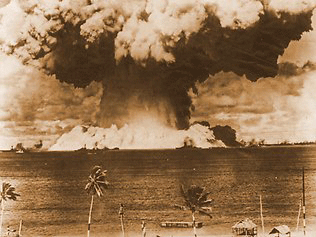
Radiation-related thyroid, breast and lung cancers, as well as leukaemia and lymphoma, are prevalent across the islands.
Documents suggest campaign to discredit revelation that tests contaminated many more people than acknowledged
Jon Henley Guardian, 27 May 25
France’s Atomic Energy Commission (CEA) has spent tens of thousands of euros in an effort to counter research revealing that Paris has consistently underestimated the devastating impact of its nuclear tests in French Polynesia in the 1960s and 1970s.
Days before a parliamentary inquiry presents its report on the tests, documents obtained by the investigative outlet Disclose, and seen by Le Monde and the Guardian, suggest the CEA ran a concerted campaign to discredit the revelations.
A 2021 book, Toxique, which focused on just six of the 193 nuclear tests that France carried out from 1966 to 1996 at Moruroa and Fangataufa atolls, drawing on 2,000 pages of declassified material and dozens of interviews, concluded that they contaminated many more people than France has ever acknowledged.
The latest documents show that a year after the book’s publication, the CEA published 5,000 copies of its own booklet – titled “Nuclear tests in French Polynesia: why, how and with what consequences?” – and distributed them across the islands.
As part of an operation costing more than €90,000, the commission also flew a four-man team by business class to French Polynesia, where they stayed at the Hilton hotel, to meet local dignitaries and give interviews to the media.
The CEA’s booklet, printed on glossy paper, claimed to provide “scientific responses” to the “allegations” contained in Toxique, whose authors it said did not have “the same level of expertise”. It claimed contamination had been limited and that France always behaved transparently and with respect for local inhabitants’ health.
The publication of Toxique – based on the investigation by Disclose, Princeton University’s science and global security programme and Interprt, an environmental justice research collective – caused a furore in France, prompting visits to French Polynesia by a minister and the president, Emmanuel Macron, who acknowledged France’s “debt” to the region.
In one 1974 test alone, the scientific research found, 110,000 people – the population of Tahiti and its nearby islands – could have received a radiation dose high enough to qualify them for compensation if they later developed one of 23 different cancers.
Toxique alleged the CEA has long underestimated the radiation levels involved, significantly limiting the numbers eligible for compensation: by 2023, fewer than half the 2,846 compensation claims submitted had even been judged admissible.
The parliamentary inquiry, which has so far called more than 40 politicians, military personnel, scientists and victims, is due to report before the end of May on the social, economic and environmental impact of the tests – and whether France knowingly concealed the extent of contamination.
The CEA’s military division, CEA/DAM, the inventor of France’s atomic bomb, has repeatedly called this a “false assertion”. But France’s nuclear safety body, the ASNR, has since acknowledged “uncertainties associated with [the CEA’s] calculations” and confirmed to the parliamentary inquiry that it was impossible to prove people received radiation doses lower than the compensation threshold.
The CEA said in a statement that the aim of its booklet “was to provide Polynesians in particular with the elements to understand” the tests and their impact. It said the booklet applied “the necessary scientific rigour” to explain “the health and environmental consequences of the tests” in a “factual and transparent manner”……………………..
The inquiry has heard that the CEA/DAM has so far declassified only 380 documents in the four years since Macron demanded “greater transparency” around the tests and their consequences – compared with 173,000 declassified by the army.
Jérôme Demoment, the director of CEA/DAM, told the parliamentary inquiry earlier this year that it was “highly likely, if we were to have to manage [nuclear tests] today, that the system put in place would respond to a different logic”.
Forty-six of France’s nuclear tests were atmospheric, exposing the local population, site workers and French soldiers who were stationed in Polynesia at the time to high levels of radiation before the testing programme was moved underground in 1974.
Radiation-related thyroid, breast and lung cancers, as well as leukaemia and lymphoma, are prevalent across the islands. For its part, the French army has said up to 2,000 military personnel could have been exposed to enough radiation to cause cancer.
“The notion of a ‘clean bomb’ has generated controversy, which I fully understand,” Demoment told the parliamentary inquiry. “No nuclear test generating radioactive fallout can be considered clean.” https://www.theguardian.com/world/2025/may/27/france-spent-90000-countering-research-into-impact-of-pacific-nuclear-tests
Roads to War: The EU’s Security Action for Europe Fund
May 29, 2025 Dr Binoy Kampmark, https://theaimn.net/roads-to-war-the-eus-security-action-for-europe-fund/
As the world was readying for the Second World War, the insightful humane Austrian author Stefan Zweig made the following glum observation: “Openly and flagrantly, certain countries express their will to expand and make preparations for war. The politics of rearmament is pursued in broad daylight and at breakneck speed; every day you read in the papers arguments in favour of armaments expansion, the idea that it reduces unemployment and provides a boost to the stock exchange.”
This is not so different from the approval by European Union countries on May 27 of a €150 billion loan program known as the Security Action for Europe (SAFE) borrowing scheme. A press release from the European Council stated that the scheme “will finance urgent and large-scale investments in the European defence technological and industrial base (EDTIB)” with the intention of boosting “production capacity, making sure defence equipment is available when needed, and to address existing capability gaps – ultimately strengthening the EU’s overall defence readiness.”
The statement also makes a central rationale clear: that SAFE will enable continued European support for Ukraine, linking its defence industry to the program. Despite not being an EU member, Kyiv will be able to participate in the scheme. Interestingly enough, the United Kingdom, despite leaving the EU, will also be able to participate via a separate agreement.
Disbursements to interested member states upon demand, considered along national plans “will take the form of competitively priced long-maturity loans, to be repaid by the beneficiary member states.”
The scheme further anticipates the types of weaponry, euphemistically titled “defence products”, that will feature. As outlined by the European Council on March 6, these will comprise two categories: the first covering, amongst others, such products as ammunition and missiles, artillery systems, ground combat capabilities with support systems; the second, air and missile defence systems, maritime surface and underwater capabilities, drones and anti-drone systems and “strategic enablers” including air-to-air refuelling, artificial intelligence and electronic warfare.
The broader militarisation agenda is confirmed by linking SAFE with broader transatlantic engagement and “complementarity with NATO.” It will “strive to enhance interoperability, continue industrial cooperation, and ensure reciprocal access to state-of-the-art technologies with trusted partners.”Significantly, the emphasis is on collaboration: a minimum of three countries must combine when requesting funding for SAFE defence projects.
There seems to be something for everyone: the militarist, the war monger and the merchants of death. Global Finance, a publication dedicated to informing “corporate financial professionals”, was already praising the SAFE proposal in April. “The initiative has the potential to transform the business models of many top European defense groups – like Saab, which has traditionally relied on contracts from the Swedish state to grow its sales.” What a delight it will be for such defence companies to move beyond the constraints on sales imposed by their limiting governments. A veritable European market of death machinery is in the offing.
The fund is intended for one, unambiguous purpose: war. The weasel word “defence” is merely the code, the cipher. Break it, and it spells out aggression and conflict, a hankering for the next great military confrontation. The reason is traditional, historic and irrational: the Oriental despotic eminence arising from the Asian steppes, people supposedly untutored in the niceties of European good manners and democracy. Not that European manners and democracy is in splendid health. A mere glance at some of the candidates suggests decline in institutional credibility and scepticism. But we can always blame the Russians for that, deviously sowing doubt with their disinformation schemes.
The initiative, and its tightening of ties with arming Ukraine, has made such critics as Hungary’s Prime Minister Viktor Orbán sound modestly sensible. “We need to invest in our own armies, but they expect us to fund Ukraine’s – with billions, for years to come,” he declared in a post on X. “We’ve made it clear: Hungary will not pay. Our duty is to protect our own people.”
The approval of the fund by the European Commission has also angered some members of the European Parliament, an institution which has been treated with near contempt by the European Commission. European Parliament Presidente Roberta Metsola warned Commission President Ursula von der Leyen earlier in May to reconsider the use of Article 122 of the EU Treaty, which should be used sparingly in emergencies in speeding up approvals with minimal parliamentary scrutiny. Bypassing Europe’s invigilating lawmakers risked “undermining democratic legitimacy by weakening Parliament’s legislative and scrutiny functions.” The Council’s resort to Article 122 potentially enlivened a process that could see a legal case taken to the European Court of Justice.
The European Parliament’s Legal Affairs Committee (JURI) has also supported a legal opinion repudiating the Commission’s cavalier approach in approving the fund. According to that tartly reasoned view, Article 122 was an inappropriate justification, as the threshold for evoking emergency powers had simply not been met.
Ironically, the rearmament surge is taking place on both sides of the Atlantic, at both the behest of the Trump administration, ever aggrieved by Europe not pulling its military weight,and Moscow, characterised and caricatured as a potential invader, the catalyst for decorating a continent with bristling weaponry. The former continues to play hide and seek with Brussels while still being very much in Europe, be it in terms of permanent garrisons and military assets; the latter remains a convenient excuse to cross the palms of the military industrial establishment with silver. How Zweig would have hated it.
Event: How can European countries break out of the downward spiral of militarisation, increasing their exports of war weapons, and unaccountability for war crimes?

| Join us June 13th in London for an important discussion on the intersection between European rearmament and the genocide perpetrated in Palestine with Western weapons. The genocide in Palestine and the war in Yemen were and are a litmus test for humanity. Most European governments, including the UK, undoubtedly failed the test. At the same time, Europe is on a path of militarisation following the Russian invasion of Ukraine. In this context, what are the impacts of European countries dismantling arms trade restrictions and the international rule of law? How can European countries break out of the downward spiral of militarisation, increasing their exports of war weapons, and unaccountability for war crimes? Register here: https://www.eventbrite.co.uk/e/between-gaza-and-rearmament-tickets-1363975821399?utm-campaign=social&utm-content=attendeeshare&utm-medium=discovery&utm-term=listing&utm-source=cp&aff=ebdsshcopyurl |
Trump’s role in provoking Russia’s destruction of Ukraine should not be ignored

May 28, 2025 AIMN Editorial By Walt Zlotow, , West Suburban Peace Coalition, Glen Ellyn IL , https://theaimn.net/trumps-role-in-provoking-russias-destruction-of-ukraine-should-not-be-ignored/
Russia invaded Ukraine under President Biden’s presidency, beginning its destruction as a viable state. Biden directly provoked the invasion in several ways.
He refused to promote implementing the Minsk II Accords which would have given the Russian cultured Ukrainians in Donbas independence and security from Kyiv nationalists killing them since 2014. He kept pushing for Ukraine to join NATO, a red line guaranteeing eventual Russian intervention. Seasoned US diplomates were apoplectic about that to no avail. He kept arming the Kyiv neofascists to complete victory over the Donbas separatists and further isolate Russia from Western Europe.
Worst of all Biden essentially told Russia to ‘piss off’ when they begged him to consider Russia’s valid security concerns over NATO expansion and sabotaging Minsk II. For Biden, Russia’s security concerns were simply “not subject for discussion.”
Trump campaigned for re-election charging the Russian invasion was solely Biden’s fault.
Big lie.
Trump spent his entire term keeping alive eventual Ukraine NATO membership. Worse, Trump set the stage for Biden’s duplicity by revering predecessor Obama’s prohibition on arming the Kyiv regime to both destroy the Donbas separatist movement and prepare for possible war with Russia. Trump didn’t interfere with Germany, France and UK using the promise of Minsk II independence to stall for time allowing Ukraine to build up its military capability mainly provided by Trump.
Trump now finds himself bollixed up from his stupid promise to end the war in one day. On day 127 he’s completely outmaneuvered by Russia which holds all the cards for completing their takeover of the eastern fifth of Ukraine, administering a crushing defeat to US plans to weaken/destroy the Russian regime while bringing Ukraine into NATO.
Historians will assign Biden’s unhinged Ukraine policy promoting Ukraine NATO membership, arming Ukraine to finish off Donbas separatists and dismissal of Russia’s security concerns as the primary causes of America’s failed proxy war against Russia in Ukraine.
But they should include Trump’s reckless, duplicitous Ukraine policy preceding Biden’s igniting the invasion in their history of this totally senseless, unnecessary war.
Ukraine ‘can’t afford’ it if US quits conflict – top Zelensky aide
Once Kiev’s top donor, Washington has shifted under Donald Trump from arming Ukraine to focusing on mediating peace with Moscow.
25 May, 2025 https://www.rt.com/russia/618112-ukraine-us-quit-podoliak/
Ukraine can’t afford to lose US military aid in its conflict with Russia, Mikhail Podoliak, adviser to Ukrainian leader Vladimir Zelensky, told the French newspaper Le Point on Friday. According to the official, US support is “essential” for Kiev’s war effort.
Under the previous US administration, Washington was Kiev’s largest donor. Since returning to office earlier this year, however, US President Donald Trump has not approved any new military aid for Ukraine, while the last remaining assistance package authorized under former President Joe Biden is expected to run out by mid-summer.
Despite pledging on the campaign trail to end the Ukraine conflict within 24 hours, Trump has recently warned he may “back away” from peace mediation unless Kiev and Moscow reach a deal. He has also questioned US commitments to NATO allies unless they boost defense spending, repeatedly insisting the EU should handle its own security and regional conflicts without depending on Washington.
Podoliak praised Europe for taking a firm pro-Ukrainian stance in the current conflict, but said it is currently too busy with its own rearmament to sufficiently support Kiev.
“Europe is rearming and changing its foreign and military policy… however, this transformation takes time. Unfortunately for Ukraine, that time is measured in lives lost,” he stated.
“We cannot afford to let the United States disengage from this war, because its military support is essential for both Europe and Ukraine,” he said, reiterating Kiev’s warnings that Russia “is a threat to Europe” and “wants to dominate” it – claims that Moscow has repeatedly dismissed as nonsense.
Russia has repeatedly condemned Western military aid to Ukraine, stating that it merely prolongs the conflict and hinders peace efforts. Last week, Russia and Ukraine held their first direct peace talks in three years in Istanbul. Both delegations agreed to stay in contact and to carry out a 1,000-for-1,000 prisoner-of-war swap, which transpired on Sunday.
Russian Foreign Minister Sergey Lavrov said Moscow and Kiev are expected to exchange draft ceasefire proposals once the swap is finished.
Rise in nuclear-related incidents deeply worrying

Scottish Greens 26th May 2025, https://greens.scot/news/rise-in-nuclear-related-incidents-deeply-worrying
Scottish Green MSP Ross Greer raises alarm on radioactive leaks at Faslane.
A concerning rise in nuclear-related incidents at the Faslane naval base should “sound the alarm” across Scotland, warns the area’s Scottish Green MSP, Ross Greer.
In an article in The Ferret, it was revealed that since 2023, 12 incidents occurred that could have led to radioactive materials leaking into the Gare Loch, Loch Long and the Firth of Clyde. However, the Ministry of Defence refused to give details of any specific incidents or leaks.
In the first four months of 2025, there were three incidents which had “actual or high potential for radioactive release to the environment”, the highest for the time period in 17 years.
In 2020 Ross Greer highlighted the issue of nuclear leaks at Faslane, with over 6,000 Scots signing a campaign to stop the Ministry of Defence from increasing the volume of radioactive materials such as cobalt-60 and radioactive tritium that it discharged into the waters around the base.
Scottish Greens MSP Ross Greer said:
“Another report on radioactive leaks at Faslane is deeply worrying but not surprising news for people living around the Gare Loch and Loch Long. For too long, the threat of a serious radioactive incident at the base has loomed over communities across the West of Scotland.
“The increasing number of incidents is just one of the many examples of the huge danger posed by Britain’s ageing nuclear arsenal. We have the right to sound the alarm and demand answers, but of course the Ministry of Defence regularly refuses to answer.
“For decades the Scottish Greens have raised concerns about Faslane. The weapons of mass slaughter houses there would be quite literally world-ending if they were ever used, but even their storage and the transportation of nuclear and explosive materials by road from England is a totally unacceptable risk.
“Of course, the only way to rid Scotland of these evil weapons and use the base for more conventional purposes instead is for Scotland to become an independent nation. Westminster will never give up an arsenal which allows it to continue pretending that Britain is a global superpower, even if it costs hundreds of billions of pounds which could otherwise be spent on our crumbling public services
“As an independent nation, we can remove these mass murder devices from Scotland and work toward a world without nuclear weapons.”
Europe’s defence without the U.S.: What does the new cost report say?
Strategic Culture, Erkin Oncan, May 23, 2025
A US draw‑down would leave a large “defence gap” for NATO’s European members.
The London‑based International Institute for Strategic Studies (IISS) has published a report entitled “Defending Europe Without the United States: Costs and Consequences.”
Founded in 1958, the IISS examines global security, defence and geopolitical issues, and its reports are frequently cited by NATO, the United Nations and national defence ministries.
Authored by Ben Barry, Douglas Barrie, Henry Boyd, Nick Childs, Michael Gjerstad, James Hackett, Fenella McGerty, Ben Schreer and Tom Waldwyn, the report concludes that if the United States withdrew from NATO, European countries would need to allocate USD 1 trillion to defence over the next 25 years.
That would mean raising defence spending to 3 percent of GDP.
According to the scenario, roughly 50 percent of total expenditure would go to procuring military equipment (tanks, armoured vehicles, aircraft, ships, missiles, UAVs, etc.); 25 percent to developing intelligence assets, space forces and command‑and‑control systems; 20 percent to equipping, training and logistically supporting personnel; and 15 percent to investments in the defence industry and purchases from abroad.
These hefty sums are based on a scenario in which all 128,000 US troops and their equipment are fully withdrawn from Europe by 2027.
What’s in the report?
The 32‑page report divides the threats Europe faces into two main headings.
The first points to Russia’s military power, noting:
“Russia’s economy is on a war footing and its defence industry is running at full capacity. Even if the fighting in Ukraine stops, Russia could rebuild its forces against NATO‑Europe.”
The second major problem is the shifting focus of the United States:
“Europe can no longer rely on automatic US support. Former President Donald Trump’s rhetoric on NATO and Secretary of Defense Pete Hegseth’s 2025 remark that ‘Europe must now shoulder its own defence’ show that Washington’s attention has pivoted to the Pacific. European allies therefore must build capabilities that can deter Russian aggression without US backing.”
The core assumption
The report assumes a mid‑2025 cease‑fire in Ukraine, after which the US begins to withdraw from NATO and pull troops out of Europe………………………………………………………………………………………………………………………………………………………………………………………………………………………………https://strategic-culture.su/news/2025/05/23/europe-defence-without-us-what-does-new-cost-report-say/
Gaza “a Gaping Wound on Humanity:” Spain Convenes Int’l Conference to call for Arms Embargo on Israel

Juan Cole, 05/26/2025, https://www.juancole.com/2025/05/solution-international-meeting.html
Ann Arbor (Informed Comment) – The Spanish wire service EFE reports that delegations from 20 countries met Sunday in Madrid in a push to pressure Israel to halt its total war on Gaza and to establish a Palestinian state. Convened by Foreign Minister José Manuel Albares, the conference sought to move to concrete actions.
Israel had blocked all humanitarian aid for two months beginning in March, provoking a crisis of malnutrition in Gaza, almost all of whose people have been made internal refugees several times over by the Israeli military. Israel began letting a small amount of aid in last week, apparently under the pressure of the Trump administration, but United Nations officials decried it as “a drop in the ocean” compared to the urgent needs of 2.2 million Palestinians.
Addressing the attendees at the conference on Sunday, Madrid’s foreign minister said, “The sole interest that all of us gathered here today have is to stop this unjust, cruel, and inhumane Israeli war in Gaza, break the blockade of humanitarian aid, and move definitively toward a two-state solution.”
Of this last point, according to the Anadolu Agency, he asked, “What’s the alternative? Kill all the Palestinians? Send them, I don’t know where -— to the moon?”
Albares said, “Gaza is a gaping wound in humanity… There are no words to describe what is happening in Gaza—but just because there are no words doesn’t mean we will remain silent.”
He said that the proposed measures were not intended to be anti-Israel and that Spain recognized Israel’s legitimate security needs. “But,” he observed, “exactly the same right to peace and security that the Israeli people possess is also possessed by the Palestinian people.” He added,”the Palestinian people cannot be condemned eternally to the estate of a people of refugees.”
Albares called for three tangible steps, including the suspension of the EU-Israel trade agreement. As for the second, he insisted, “We all need to implement an arms embargo; there can be no arms sales to Israel.”
He said that the proposed measures were not intended to be anti-Israel and that Spain recognized Israel’s legitimate security needs. “But,” he observed, “exactly the same right to peace and security that the Israeli people possess is also possessed by the Palestinian people.” He added,”the Palestinian people cannot be condemned eternally to the estate of a people of refugees.”
Albares called for three tangible steps, including the suspension of the EU-Israel trade agreement. As for the second, he insisted, “We all need to implement an arms embargo; there can be no arms sales to Israel.”
Speaking of the gathering, he observed optimistically, “There is a lot of diplomatic muscle in Madrid.” He urged the breaking of the “vicious circle” of Israeli-Palestinian violence.
The Madrid Plus group of nations met once before with 10 attendees, including Western European nations that had recognized the State of Palestine (Ireland, Spain and Norway), along with the Middle Eastern countries of Egypt, Jordan, Qatar, Saudi Arabia and Turkiye. The membership has doubled for this meeting. Germany, Italy, France, and Portugal joined this time, having been absent at the first gathering. Brazil was also there.
Rise in nuclear incidents at Faslane naval base, that could leak radioactivity

Rob Edwards, The Ferret, May 25, 2025
There have been 12 nuclear incidents that could have leaked radioactivity at the Faslane naval base since 2023, The Ferret can reveal.
According to the Ministry of Defence (MoD), the incidents at the Clyde nuclear submarine base had “actual or high potential for radioactive release to the environment”.
But the MoD has refused to say what actually happened in any of the incidents, or exactly when they occurred. There were five in 2023, four in 2024 and three in the first four months of 2025 – the highest for 17 years.
Campaigners warned that a “catastrophic” accident at Faslane could put lives at risk. The Trident submarines based there were a “chronic national security threat to Scotland” because they were “decrepit” and over-worked, they claimed.
New figures also revealed that the total number of nuclear incidents categorised by the MoD at Faslane, and the neighbouring nuclear bomb store at Coulport, more than doubled from 57 in 2019 to 136 in 2024. That includes incidents deemed less serious by the MoD.
The Scottish National Party (SNP) described the rising number of incidents as “deeply concerning”. It branded the secrecy surrounding the incidents as “unacceptable”.
The MoD, however, insisted that it took safety incidents “very seriously”. The incidents could include “equipment failures, human error, procedural failings, documentation shortcomings or near-misses”, it said.
The latest figures on “nuclear site event reports” at Faslane and Coulport were disclosed in a parliamentary answer to the SNP’s defence spokesperson, Dave Doogan MP. They show that a rising trend of more serious events – first reported by The Ferret in April 2024 – is continuing.
There was one incident at Faslane between 1 January and 22 April 2025 given the MoD’s worst risk rating of “category A”. There was another category A incident at Faslane in 2023.
The MoD has defined category A incidents as having an “actual or high potential for radioactive release to the environment” in breach of safety limits.
The last category A incident reported by the MoD was in 2008, when radioactive waste leaked from a barge at Faslane into the Clyde. There were spillages from nuclear submarines at the base in 2007 and 2006.
There were also four “category B” incidents at Faslane in 2023, another four in 2024 and two in the first four months of 2025. The last time that many category B incidents were reported in a year was 2006, when there were five.
According to the MoD, category B meant “actual or high potential for a contained release within building or submarine”, or “actual or high potential for radioactive release to the environment” below safety limits.
The MoD also categorised nuclear site events as “C” and “D”. C meant there was “moderate potential for future release to the environment”, or an “actual radioactive release to the environment” too low to detect. D meant there was “low potential for release but may contribute towards an adverse trend”.
The number of reported C incidents at Faslane and Coulport increased from six in 2019 to 38 in 2024, while the number of D incidents rose from 50 to 94.
At the same time the number of incidents described by the MoD as “below scale” and “of safety interest or concern” dropped from 101 to 39.
The SNP’s Dave Doogan MP, criticised the MoD in the House of Commons for the “veil of secrecy” which covered nuclear incidents. Previous governments had outlined what happened where there were “severe safety breaches”, he told The Ferret.
“The increased number of safety incidents at Coulport and Faslane is deeply concerning, especially so in an era of increased secrecy around nuclear weapons and skyrocketing costs,” Doogan added.
“As a bare minimum the Labour Government should be transparent about the nature of safety incidents at nuclear weapons facilities in Scotland, and the status of their nuclear weapons projects. That the Scottish Government, and the Scottish people, are kept in the dark about these events is unacceptable.”
Doogan highlighted that the government’s Infrastructure and Projects Authority had judged many of the MoD’s nuclear projects to have “significant issues”, as reported in February by The Ferret. The MoD nuclear programmes would cost an “eye-watering” £117.8bn over the next ten years, he claimed.
He said: “If the UK cannot afford to store nuclear weapons safely, then it cannot afford nuclear weapons.”
Anti-nuclear campaigners argued that the four Trident-armed Vanguard submarines based at Faslane were ageing and increasingly unreliable. They required more maintenance and their patrols were getting longer to ensure that there was always one at sea.
“The Vanguard-class submarines are already years past their shelf-life and undergoing record-length assignments in the Atlantic due to increased problems with the maintenance of replacement vessels,” said Samuel Rafanell-Williams, from the Scottish Campaign for Nuclear Disarmament.
“There is a crisis-level urgency to decommission the nuclear-capable submarines lurking in the Clyde. They constitute a chronic national security threat to Scotland, especially now given their worsening state of disrepair.”
He added: “The UK government is placing the people of Scotland at risk by continuing to operate these decrepit nuclear vessels until their replacements are built, which will likely take a decade or more.
“The Vanguards must be scrapped and the Trident replacement programme abandoned in favour of a proper industrial policy that could genuinely revitalise the Scottish economy and underpin our future security and prosperity.”
Nuclear accident could ‘kill our own’
Dr David Lowry, a veteran nuclear consultant and adviser, said: “Ministers tell us the purpose of Britain’s nuclear weapons is to keep us safe.
“But with this series of accidents involving nuclear weapons-carrying submarines, we are in danger of actually killing our own, if one of these accidents proves to be catastrophic.”
According to Janet Fenton from the campaign group, Secure Scotland, successive governments had hidden information about behaviour that “puts us in harm’s way” while preventing spending on health and welfare.
She said: “Doubling the number of incidents while not telling us the nature of them is making us all hostages to warmongers and the arms trade, while we pay for it.”…………………………………
In 2024 The Ferret revealed earlier MoD figures showing that the number of safety incidents that could have leaked radiation at Faslane had risen to the highest in 15 years. We have also reported on the risks of Trident-armed submarines being on patrol at sea for increasingly long periods.https://theferret.scot/nuclear-incidents-radioactivity-faslane/
1 This Month

petition to oppose the rapid increase of space-military industry threatening Jeju Island and the region.
[Petition by April 19th (KST)] Stop the joint military-Hanwha Systems-Jeju Provincial Government Sea Launch!
23 April – WEBINAR – Why new nuclear reactors are the wrong tools for decarbonization Thursday, April 23 • 1 AM – 2 AM AEST
World Nuclear Power. Reactors 1951-2026, 75 Years of Nuclear Power.
Interactive Map– https://dv.worldnuclearreport.org/

Chernobyl: The Lost Tapes – A good documentary on Chernobyl on SBS available On Demand for the next 3 weeks– https://www.sbs.com.au/ondemand/tv-program/chernobyl-the-lost-tapes/2352741955560

of the week–London Campaign for Nuclear Disarmament

Tell the Ukrainian Government to Drop Prosecution of Peace Activist Yurii Sheliazhenko
To see nuclear-related stories in greater depth and intensity – go to https://nuclearinformation.wordpress.com
-
Archives
- April 2026 (211)
- March 2026 (251)
- February 2026 (268)
- January 2026 (308)
- December 2025 (358)
- November 2025 (359)
- October 2025 (376)
- September 2025 (257)
- August 2025 (319)
- July 2025 (230)
- June 2025 (348)
- May 2025 (261)
-
Categories
- 1
- 1 NUCLEAR ISSUES
- business and costs
- climate change
- culture and arts
- ENERGY
- environment
- health
- history
- indigenous issues
- Legal
- marketing of nuclear
- media
- opposition to nuclear
- PERSONAL STORIES
- politics
- politics international
- Religion and ethics
- safety
- secrets,lies and civil liberties
- spinbuster
- technology
- Uranium
- wastes
- weapons and war
- Women
- 2 WORLD
- ACTION
- AFRICA
- Atrocities
- AUSTRALIA
- Christina's notes
- Christina's themes
- culture and arts
- Events
- Fuk 2022
- Fuk 2023
- Fukushima 2017
- Fukushima 2018
- fukushima 2019
- Fukushima 2020
- Fukushima 2021
- general
- global warming
- Humour (God we need it)
- Nuclear
- RARE EARTHS
- Reference
- resources – print
- Resources -audiovicual
- Weekly Newsletter
- World
- World Nuclear
- YouTube
-
RSS
Entries RSS
Comments RSS
 nuclear-news