UK to build up to 12 new attack submarines

Paul Seddon, Political reporter,Jonathan Beale, Defence correspondent, BBC 1 June 25
The UK will build “up to” 12 new attack submarines, the prime minister has announced, as the government unveils its major defence review on Monday.
The new conventionally-armed, nuclear-powered submarines will replace the seven-strong Astute class from the late 2030s onwards.
The review is expected to recommend the armed forces move to “warfighting readiness” to deter growing threats faced by the UK.
Sir Keir Starmer said the government will adopt a “Nato-first” stance towards defence, so that everything it does adds to the strength of the alliance.
The threat posed by Moscow has been a key part of the government’s pitch ahead of Monday’s review, led by ex-Labour defence secretary Lord Robertson, which was commissioned by Labour shortly after it took office last July.
The report will make 62 recommendations, which the government is expected to accept in full.
Speaking to BBC Radio 4’s Today programme ahead of its publication, Sir Keir said the danger posed by Russia “cannot be ignored” and the “best way” to deter conflict was to prepare for it…………………………………………………………………………………………………………
Other announcements in the review will include:
- Commitment to £1.5bn to build six new factories to enable an “always on” munitions production capacity
- Building up to 7,000 long-range weapons including missiles or drones in the UK, to be used by British forces
- Pledge to set up a “cyber and electromagnetic command” to boost the military’s defensive and offensive capabilities in cyberspace
- Extra £1.5bn to 2029 to fund repairs to military housing
- £1bn on technology to speed up delivery of targeting information to soldiers
…………………………Submarine plans
The Astute class is the Royal Navy’s current fleet of attack submarines, which have nuclear-powered engines and are armed with conventional torpedoes and missiles.
As well as protecting maritime task groups and gathering intelligence, they protect the Vanguard class of submarines that carry the UK’s Trident nuclear missiles.
The sixth submarine in the current Astute series was launched last October, with the seventh, the final one in the series, currently under construction.
The next generation of attack submarines that will replace them, SSN-AUKUS, have been developed with the Australian Navy under a deal announced in 2021 under the previous Conservative government.
The Ministry of Defence (MoD) said it expected the rollout of the new generation would see a submarine built every 18 months.
It added the construction programme would see a “major expansion of industrial capability” at BAE Systems’ shipbuilding site in Barrow-in-Furness, Cumbria, as well as the Derby site of Rolls-Royce, which makes nuclear reactors.
Meanwhile work on modernising the warheads carried by Trident missiles is already under way.
The £15bn investment into the warhead programme will back the government’s commitments to maintain the continuous-at-sea nuclear deterrent.
In his announcement on Monday, Sir Keir is to repeat a Labour manifesto commitment to deliver the Dreadnought class of nuclear-armed submarines, which are due to replace the ageing Vanguard fleet from the early 2030s onwards.
The MoD’s Defence Nuclear Enterprise accounts for 20% of its budget and includes the cost of building four Dreadnought class submarines.
https://www.bbc.co.uk/news/articles/c4g2jr1m49no
Off to War We Go: Starmer’s Strategic Defence Review

June 3, 2025, Dr Binoy Kampmark, https://theaimn.net/off-to-war-we-go-starmers-strategic-defence-review/
Unpopular governments always retreat to grounds of lazy convenience. Instead of engaging in exercises of courage, they take refuge in obvious distractions. And there is no more obvious distraction than preparing for war against a phantom enemy.
That is exactly where the government of Sir Keir Starmer finds itself. Despite a mammoth majority and a dramatically diminished Tory opposition, the Prime Minister acts like a man permanently besieged, his Labour Party seemingly less popular than Typhoid Mary. His inability to be unequivocal to questions of whether he will contest the next election suggest as much.
The same cannot be said about his enthusiasm for the sword and sabre. There are monsters out there to battle, and Sir Keir is rising to the plate. Sensing this, the military mandarins, most prominently General Sir Roland Walker, head of the Army, have been more than encouraging, seeing the need to ready the country for war by 2027. Given the military’s perennial love affair with astrology, that state of readiness could only be achieved with a doubling of the Army’s fighting power and tripling it by 2030.
Given that background, the UK Strategic Defence Review (SDR) was commissioned in July 2024. Led by former Labour Defence Secretary and NATO Secretary General Lord George Robertson, the freshly released report promises a fat boon for the military industrial complex. Like all efforts to encourage war, its narrative is that of supposedly making Britain safer.
Starmer’s introduction is almost grateful for the chance to out the blood lusting enemy. “In this new era for defence and security, when Russia is waging war on our continent and probing our defences at home, we must meet the danger head on.” The placing of noble Ukraine into the warming fraternity of Europe enables a civilisational twist to be made. The Russian military efforts in Ukraine are not specific to a murderous family affair and historical anxieties but directed against all Europeans. Therefore, all Europeans should militarise and join the ranks, acknowledging that “the very nature of warfare is being transformed” by that conflict.
In pursuing the guns over butter program, Starmer recapitulates the sad theme of previous eras that led to global conflict. As Europe began rearming in the 1930s, a prevalent argument was that people could have guns and butter. Greater inventories of weaponry would encourage greater prosperity. So, we find Starmer urging the forging of deeper ties between government and industry and “a radical reform of procurement,” one that could only be economically beneficial. This would be the “defence dividend,” another nonsense term the military industrial complex churns out with such disconcerting ease.
The foreword from the Defence Secretary, John Healey, outlines the objectives of the SDR. These include playing a leading role in NATO “with strengthened nuclear, new tech, and updated conventional capabilities”; moving the country to a state of “warfighting readiness”; nourishing the insatiable military industrial Moloch; learning the lessons of Ukraine (“harnessing drones, data and digital warfare”); and adopting a “whole-of-society approach”, a sly if clumsy way of enlisting the civilian populace into the military enterprise.
The review makes 62 recommendations, all accepted by the grateful government. Some £15 billion will go to the warhead programme, supporting 9,000 jobs, while £6 billion will be spent on munitions over the course of the current Parliament. A “New Hybrid Navy” is envisaged, one that will feature Dreadnought and the yet to be realised SSN-AUKUS submarines, alongside “support ships” and “autonomous vessels to patrol the North Atlantic and beyond.” Submarine production is given the most optimistic assessment: one completion every 18 months.
The Royal Air Force is not to miss out, with more F-35s, modernised Typhoons, and the next generation of jets acquired through the Global Combat Air Programme. To his splurge will be added autonomous fighters, enabling global reach.
Mindless assessments are abundant in the Review. The government promises a British army 10 times “more lethal to deter from the land, by combining more people and armoured capability with air defence, communications, AI, software, long-range weapons, and land drone swarms.” Some 7,000 new long-range weapons will be built and a New CyberEM Command established “to defend Britain from daily attacks in the grey zone.” Keeping those merchants of death happy will be a new Defence Exports Office located in the Ministry of Defence, one intended “to drive exports to our allies and growth at home.”
The fanfare of the report, festooned with fripperies for war, conceals the critical problems facing the British armed forces. The ranks are looking increasingly thinned. (In 2010, regular troop numbers stood at 110,000; the current target of 73,000 soldiers is being barely met.) Morale is ebbing. The state of equipment is embarrassingly poor. The UK’s celebrated submarine deterrent is somewhat less formidable in the deterrence department, with its personnel exhausted and subject to unpardonably lengthy stints at sea. The 204-day patrol by HMS Vanguard is a case in point.
Whether the SDR’s recommendations ever fructify remains the hovering question. It’s all very good to make promises about weapons programmes and boosting a country’s readiness to kill, but militaries can be tardy in delivery and faulty in execution. What saves the day may well be standard ineptitude rather than any firebrand conviction in war. To the unready go the spoils.
Jubilation at Ukraine’s Operation Spiderweb – but is this joy justified?

A web, or a trail to Armageddon?
Noel Wauchope, 3 June 25, https://theaimn.net/jubilation-at-ukraines-operation-spiderweb-but-is-this-joy-justified/#google_vignette
The news media is agog with the glorious success of drones sent deep inside Russia to damage 41 planes. Ukraine claims that these were A-50 surveillance planes, the supersonic Tu-160 and Tu-22 bombers, and the massive Tu-95s, which were developed to carry nuclear bombs and now launch cruise missiles.
The damage is estimated to be $7billion. The targets reached inside Russia included Belaya airbase over 4,000km) from Ukraine, and three other distant airbases. the complex operation was planned in secret, over 18 months.
It was such a clever operation, involving smuggling of drones into Russia and placing them inside containers, which were later loaded on to trucks. Remotely activated mechanisms opened the containers allowing the drones to fly out and make their distant attack.
Ukraine’s President Volodymyr Zelenskyy praised the “absolutely brilliant” Ukrainian drone attack’ – “produced by Ukraine independently”.
Wow! We’re all delighted, aren’t we, at this surprise, this ingenuity, done all alone by Ukraine – such a demonstration of how the clever Ukrainians will beat the stupid boorish Russians?
There are just a few questions that I would like to see posed, in the corporate media.
I hardly know where to start. Can we believe that:
- This was done over 18 months completely without the knowledge of Ukraine’s European partners, in particular Great Britain, France and Germany, who were all consulting with Ukraine over that period, and especially in the last few weeks?
- Without the knowledge of the USA, while Senators Lyndsay Graham and Richard Blumenthal, in Ukraine in the past week where they coordinated intensely with the Ukrainian government?
- Why was this attack timed exactly at the time of the Istanbul peace talks between Ukraine and Russia?
- Did Zelensky not understand that this would at least cast a damper on those talks, upsetting Russia – a bit like the effect on USA if someone attacked US Air Force B-52H bombers and B-2 bombers ?
- Well, if Zelensky did understand that, was his intention to sabotage the talks, and provoke Russia into a retaliation, which might bring Europeand even the USA into the war?
The jubilation of the media seems to completely ignore Russia’s stated policy on its use of nuclear weapons, updated in 2024 – nuclear weapons would be authorised for use in response to “attack by [an] adversary against critical governmental or military sites of the Russian Federation, disruption of which would undermine nuclear forces response actions”.
We don’t know how Russia will respond to this remarkable and unprecedented attack.
We don’t know how President Trump will respond.
What is clear is that the Istanbul peace talks have been wrecked, and a whole new phase now opens in the Russia’s invasion of Ukraine. It started out with the intention of a limited attack – the Russians still call it a Special Military Operation. Now Putin has no other option than to declare it a full scale war.
UK plan for fighter jets carrying nuclear bombs is slammed.

THE UK Government has been accused of “lurching towards war” after
reports suggested ministers were looking to purchase fighter jets capable
of carrying and firing tactical nuclear weapons.
If the Labour Government went through with the purchase, reportedly to counter the growing threat by Russia, it would be the biggest expansion of the UK’s so-called nuclear
deterrent since the Cold War. The Sunday Times reports that the Government
is taking part in “highly sensitive” talks and that US firm Lockheed
Martin’s F-35A Lightning stealth fighter jet and other aircrafts are
under consideration.
SNP MSP Bill Kidd said: “Many Scots will have concerns
about Labour spending billions of pounds of taxpayer money to expand the
UK’s nuclear arsenal at a time when many families continue to face the
impact of the cost of living crisis. “The UK’s nuclear capability is not
independent, has leaked in recent years putting workers and wildlife at
risk, frequently fails in safety tests and is highly unlikely to ever be
used.
We want an end to these dangerous weapons in Scotland, but Labour are
determined to write them another blank cheque. “Any further expansion of
the UK’s nuclear arsenal must therefore come before parliament for
democratic scrutiny.”
The National 1st June 2025, https://www.thenational.scot/news/25206192.uk-plans-fighter-jets-carrying-nuclear-bombs-slammed/
How many nuclear submarines does the UK have – and are they ready for war?
Britain currently has a fleet of nine submarines, including four Vanguard vessels armed with the Trident nuclear system
Alex Croft, Monday 02 June 2025, https://www.bbc.com/news/articles/c4g2jr1m49no
Britain will build up to 12 new nuclear-powered submarines, Sir Keir Starmer will announce as he unveils his much-anticipated defence review.
In a bid to “ensure the UK rises to the challenge” of growing global security threats, the prime minister will say that the 130-page review is a “radical blueprint” signalling a “wave of investments” into military infrastructure and weaponry.
An extra £15bn will be spent on new nuclear warheads for the UK’s nuclear deterrent.
The plans will significantly increase the UK’s conventionally armed, nuclear-powered submarine fleet, with the new vessels built under a joint deal with the US and Australia, known as the Aukus partnership.
Here’s all you need to know about the UK’s fleet of nuclear-deterrent submarines, and the proposed plans for its future:
How many submarines does the Royal Navy currently have?
The Royal Navy currently operates nine submarines, including five Astute-class conventionally armed nuclear-powered attack vessels. The Astute class is Britain’s largest and most advanced fleet of submarines.
The remaining four are Vanguard-class ballistic missile submarines (SSBN), which carry the UK’s Trident nuclear missile system.
A new group, the Dreadnought class, will be introduced in the early 2030s. These will be both nuclear-powered and ballistic missile-armed.
How many submarines will the UK have in the future?
Two further Astute-class submarines, HMS Agamemnon and HMS Agincourt, are set to enter service in late 2025 and late 2026 respectively.
Agamemnon is currently going through trials with the Royal Navy as part of a test and commissioning programme, while Agincourt remains under construction.
As part of the joint defence deal between the US, Australia and the UK – known as Aukus – the UK is set to significantly boost its fleet of submarines following the defence review.
An added 12 submarines would bring the UK’s fleet up to more than 20 in total. This remains far smaller than the US’s fleet of 71, and China and Russia’s fleets of 66 each.
Ukraine drone strikes hit nuclear bombers deep inside Russia
Japan Times, Jun 2, 2025
Ukraine staged a dramatic series of strikes across Russia, deploying drones hidden in trucks deep inside the country to hit strategic airfields as far away as eastern Siberia.
Around the same time, Moscow launched one of its longest drone and missile attacks against Kyiv, escalating tensions ahead of crucial peace talks this week.
More than 40 Russian aircraft, including the Tu-95 and Tu-22 M3 long-range bombers capable of deploying conventional and nuclear weapons as well as the A-50, are reported to have been damaged in the operation on Sunday, an official in Ukraine’s Security Service said on condition of anonymity as the details are not public. Ukraine’s Security Service chief Vasyl Malyuk led the operation and losses are assessed to be at least $2 billion, the person said…………………………………………………………………………………………………………. https://www.japantimes.co.jp/news/2025/06/02/world/ukraine-drone-nuclear-bombers-russia/
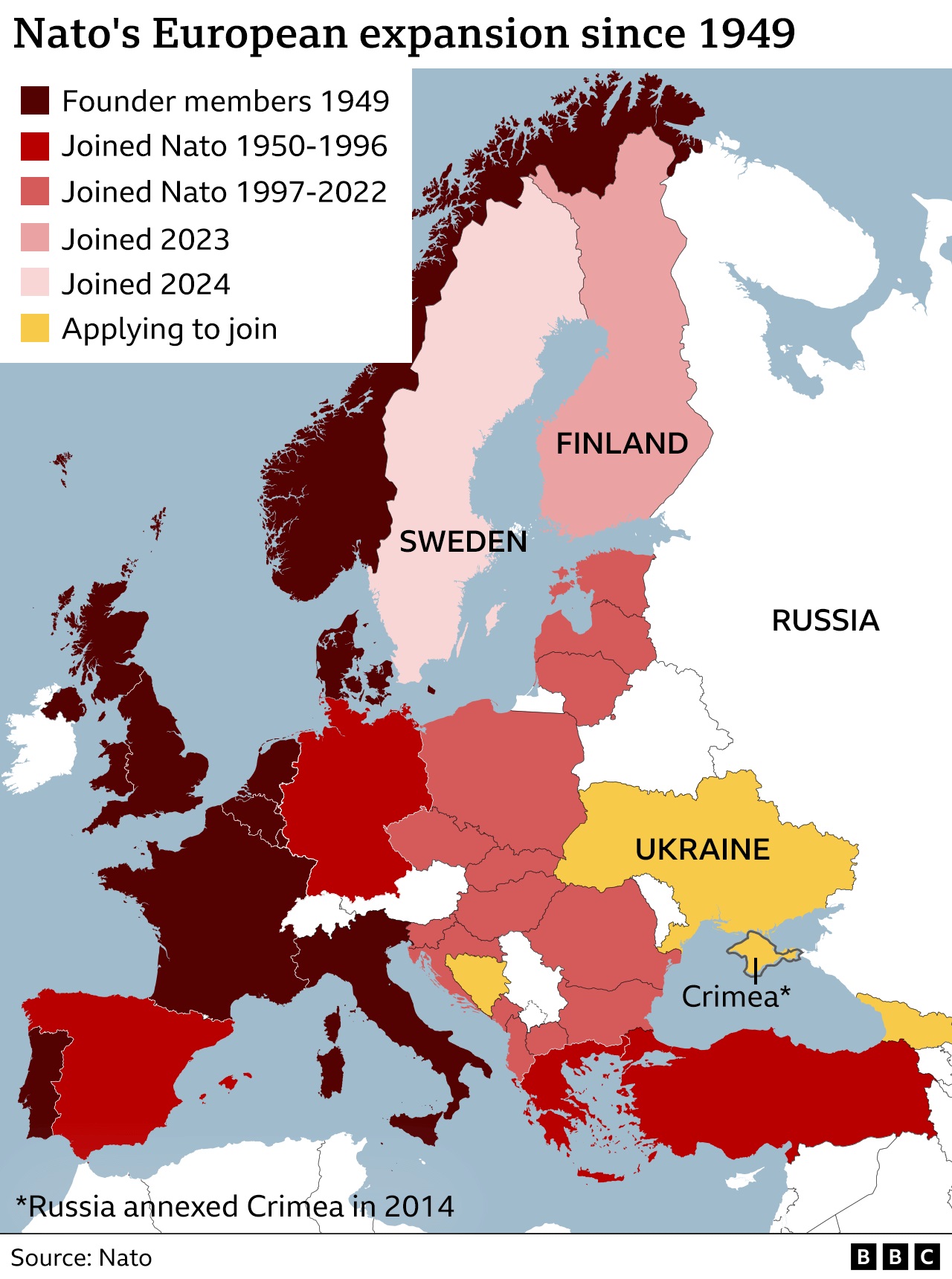
Putin’s demands for peace include an end to NATO enlargement, sources say.
By Guy Faulconbridge, https://www.reuters.com/world/europe/putin-ukraine-peace-wants-pledge-halt-nato-enlargement-sources-say-2025-05-28/
President Vladimir Putin’s conditions for ending the war in Ukraine include a demand that Western leaders pledge in writing to stop enlarging NATO eastwards and lift a chunk of sanctions on Russia, according to three Russian sources with knowledge of the negotiations. U.S. President Donald Trump has repeatedly said he wants to end the deadliest European conflict since World War Two and has shown increasing frustration with Putin in recent days, warning on Tuesday the Russian leader was “playing with fire” by refusing to engage in ceasefire talks with Kyiv as his forces made gains on the battlefield.
After speaking to Trump for more than two hours last week, Putin said that he had agreed to work with Ukraine on a memorandum that would establish the contours of a peace accord, including the timing of a ceasefire. Russia says it is currently drafting its version of the memorandum and cannot estimate how long that will take. Kyiv and European governments have accused Moscow of stalling while its troops advance in eastern Ukraine.
“Putin is ready to make peace but not at any price,” said one senior Russian source with knowledge of top-level Kremlin thinking, who spoke on condition of anonymity. The three Russian sources said Putin wants a “written” pledge by major Western powers not to enlarge the U.S.-led NATO alliance eastwards – shorthand for formally ruling out membership to Ukraine, Georgia and Moldova and other former Soviet republics.
Russia also wants Ukraine to be neutral, some Western sanctions lifted, a resolution of the issue of frozen Russian sovereign assets in the West, and protection for Russian speakers in Ukraine, the three sources said. The first source said that, if Putin realizes he is unable to reach a peace deal on his own terms, he will seek to show the Ukrainians and the Europeans by military victories that “peace tomorrow will be even more painful”. The Kremlin did not respond to a request for comment on Reuters’ reporting.
Putin and Russian officials have repeatedly said any peace deal must address the “root causes” of the conflict – Russian shorthand for the issue of NATO enlargement and Western support for Ukraine. Kyiv has repeatedly said that Russia should not be granted veto power over its aspirations to join the NATO alliance. Ukraine says it needs the West to give it a strong security guarantee with teeth to deter any future Russian attack.
President Volodymyr Zelenskiy’s administration did not respond to a request for comment. NATO has also in the past said that it will not change its “open door” policy just because Moscow demands it. A spokesperson for the 32-member alliance did not respond to Reuters’ questions. Putin ordered tens of thousands of troops into Ukraine in February 2022 after eight years of fighting in eastern Ukraine between Russian-backed separatists and Ukrainian troops. Russia currently controls just under one fifth of the country. Though Russian advances have accelerated over the past year, the war is costing both Russia and Ukraine dearly in terms of casualties and military spending. Reuters reported in January that Putin was growing concerned by the economic distortions in Russia’s wartime economy, amid labour shortages and high interest rates imposed to curb inflation. The price of oil, the bedrock of Russia’s economy, has declined steadily this year.
Trump, who prides himself on having friendly relations with Putin and has expressed his belief the Russian leader wants peace, has warned that Washington could impose further sanctions if Moscow delays efforts to find a settlement. Trump suggesting on social media on Sunday that Putin had “gone absolutely CRAZY” by unleashing a massive aerial attack on Ukraine last week. The first source said that if Putin saw a tactical opportunity on the battlefield, he would push further into Ukraine – and that the Kremlin believed Russia could fight on for years no matter what sanctions and economic pain were imposed by the West.
A second source said that Putin was now less inclined to compromise on territory and was sticking to his public stance that he wanted the entirety of four regions in eastern Ukraine claimed by Russia.
“Putin has toughened his position,” the second source said of the question of territory.
NATO ENLARGEMENT
As Trump and Putin joust in public over the outlook for peace in Ukraine, Reuters could not determine whether the intensification of the war and the toughening of positions heralds determination to reach a deal or the collapse of talks. In June last year, Putin set out his opening terms for an immediate end to the war: Ukraine must drop its NATO ambitions and withdraw all of its troops from the entirety of the territory of four Ukrainian regions claimed and mostly controlled by Russia.
In addition to Crimea, which it annexed in 2014, Russia currently controls almost all of Luhansk, more than 70% of Donetsk, Zaporizhzhia and Kherson regions. It also occupies a sliver of the Kharkiv and Sumy regions, and is threatening Dnipropetrovsk.
Former U.S. President Joe Biden, Western European leaders and Ukraine cast the invasion as an imperial-style land grab and have repeatedly vowed to defeat Russian forces. Putin casts the war as a watershed moment in Moscow’s relations with the West which he says humiliated Russia after the Soviet Union fell in 1991 by enlarging NATO and encroaching on what he considers Moscow’s sphere of influence.
At the 2008 Bucharest summit, NATO leaders agreed that Ukraine and Georgia would one day become members. Ukraine in 2019 amended its constitution committing to the path of full membership of NATO and the European Union.
Trump has said that previousU.S. support for Ukraine’s NATO membershipbid was acause of the war, and has indicated that Ukraine will not get membership. The U.S. State Department did not respond to a request for comment for this story.
Putin, who rose to the top Kremlin job in 1999, has repeatedly returned to the issue of NATO enlargement, including in his most detailed remarks about a possible peace in 2024.
In 2021, just two months before the Russian invasion, Moscow proposed a draft agreement, with NATO members that, under Article 6, would bind NATO to “refrain from any further enlargement of NATO, including the accession of Ukraine as well as other States.” U.S. and NATO diplomats said at the time that Russia could not have a veto on expansion of the alliance. Russia wants a pledge on NATO in writing because Putin thinks Moscow was misled by the United States after the 1989 fall of the Berlin Wall when U.S. Secretary of State James Baker assured Soviet leader Mikhail Gorbachev in 1990 that NATO would not expand eastwards, two of the sources said.
There was such a verbal promise, former Central Intelligence Agency Director Director William J. Burns said in his memoires, but it was never formalised – and it was made at a time when the collapse of the Soviet Union had not occurred.
NATO, founded in 1949 to provide security against the Soviet Union, says it poses no challenge to Russia – though its 2022 assessment of peace and security in the Euro-Atlantic area identified Russia as the most “significant and direct threat”.
Russia’s invasion of Ukraine that year prompted Finland to join NATO in 2023, followed by Sweden in 2024.
Western European leaders have repeatedly said that if Russia wins the Ukraine war, it could one day attack NATO itself – a step that would trigger a world war. Russia dismisses such claims as baseless scaremongering, but has also warned the war in Ukraine could escalate into a broader conflict.
Comment: Putin wants a deal, Trump wants a deal, Zelensky…wants.
Revealed: Nato rearmament could increase emissions by 200m tonnes a year

Exclusive: researchers say defence spending boosts across world will worsen climate crisis which in turn will cause more conflict
Damien Gayle 29 May 25, https://www.theguardian.com/environment/2025/may/29/nato-military-spending-could-increase-emissions-study-finds
A global military buildup poses an existential threat to climate goals, according to researchers who say the rearmament planned by Nato alone could increase greenhouse gas emissions by almost 200m tonnes a year.
With the world embroiled in the highest number of armed conflicts since the second world war, countries have embarked on military spending sprees, collectively totalling a record $2.46tn in 2023.
For every dollar invested in new hardware, there is not only a corresponding carbon cost but also an opportunity cost to potential climate action, critics say. This is on top of the huge death toll resulting from armed conflicts.
“There is a real concern around the way that we are prioritising short-term security and sacrificing long-term security,” said Ellie Kinney, a researcher with the Conflict and Environment Observatory and a co-author of the study, shared exclusively with the Guardian.
“Because of this kind of lack-of-informed approach that we’re taking, you’re investing in hard military security now, increasing global emissions for that reason, and worsening the climate crisis further down the line.”
That in turn is only likely to lead to further violence, with climate change itself now increasingly seen as a driver of conflict, albeit indirectly. In Sudan’s Darfur region, conflict was linked to competition over scarce resources after prolonged droughts and desertification. In the Arctic, receding sea ice is leading to tensions over who should control newly accessible oil, gas and critical mineral resources.
Few militaries are transparent about the scale of their fossil fuel use, but researchers have estimated that collectively they are already responsible for 5.5% of global greenhouse gas emissions.
That figure is expected to rise as tensions escalate in a number of regions and as the US, for decades the world’s biggest military spender, indicates that it expects its Nato allies to devote significantly more resources to their armed forces.
According to the Global Peace Index, militarisation increased in 108 countries in 2023. With 92 countries involved in armed conflict, in places ranging from Ukraine and Gaza to South Sudan and DRC, with tensions seething between China and the US over Taiwan, and with the frozen conflict between India and Pakistan flaring, governments fearful of war are investing heavily in their militaries.
In Europe, the increase has been particularly dramatic: between 2021 and 2024, EU states’ weapons spending rose by more than 30%, according to the International Institute for Strategic Studies.
In March, the EU, disconcerted by Donald Trump’s cutting of military aid and diplomatic support for Ukraine, indicated this would go further, with proposals for a further €800bn spend across the bloc outlined in a plan called “ReArm Europe”.
In analysis for the UN Office for Disarmament Affairs, Kinney and colleagues looked at the potential impact of increased militarisation on meeting climate goals. What they found was sobering: the likely increase in emissions from Nato’s remilitarisation alone would be the equivalent of adding the cost of a country as large and populous as Pakistan to the world’s remaining carbon budget.
“Our analysis specifically looks at the impact on sustainable development goal 13, which is climate action – to take urgent action to combat climate change and its impacts,” Kinney said. “And what our analysis finds, looking at the various sub-targets of that … [is] that there is a real threat to global climate action caused by global increase in military spending.”
Of all functions of states, militaries are almost uniquely carbon-intensive. “First of all, with the equipment that they purchase, which is mainly a lot of steel and aluminium, which is very carbon-intensive to produce,” said Lennard de Klerk, of the Initiative on the GHG Accounting of War, another co-author of the study.
“Secondly is during operations, armies are very mobile. And in order to move around they use fossil fuels – that’s diesel for ground operations and kerosene for air operations. Or for maritime operations it’s mainly diesel as well, if they’re not nuclear-driven.”
Given the secrecy that usually surrounds militaries and their operations, it is difficult to know just how much greenhouse gases they are emitting. Only Nato countries report enough of their emissions for scientists to attempt an estimate.
“We took Nato because they are the most transparent in terms of spending. So it’s not that we particularly want to focus on Nato, but simply because they have more data available,” De Klerk said.
The researchers calculated by how much greenhouse gas emissions would increase if Nato countries excluding the US – since it already spends far more than the others – made a two percentage point increase in the share of GDP they devoted to their militaries.
Such an increase is already under way, with many countries in Europe significantly increasing military spending in response to the crisis in Ukraine. Although Nato countries have publicly committed to increasing spending to 2% of GDP, the researchers say the ReArm Europe plan could lead to an eventual rise to 3.5%, from about 1.5% in 2020. The researchers assumed a similar eventual increase in Nato members that are not members of the EU, such as the UK.
Borrowing methodology from a recent paper that argued each percentage point increase in the share of GDP devoted to military spending would lead to an increase in national emissions of between 0.9% and 2%, they estimated that a two percentage point spending shock would lead to an increase across the bloc of between 87 and 194 megatonnes of carbon dioxide equivalent (CO2e) a year.
The researchers say that not only would such a huge increase in emissions supercharge climate breakdown but the increase in global temperatures would hurt the economy. Recent estimates of the social cost of carbon – a monetary indicator of the damage of CO2 emitted – put it at $1,347/tCO2e, suggesting the annual cost of Nato’s military buildup could be as much as $264bn a year.
And that is only a fraction of the true carbon cost of militarisation, Kinney points out. “The calculation in the paper, it’s 31 countries – that only represents 9% of total world emissions. If you consider … the impact of that, there’s a lot of the world that we haven’t taken into consideration of this specific calculation.”
The analysis notes that spending more money on militaries also reduces resources available for policies aimed at mitigating climate change. This already seems to be the case, with the UK, for example, funding its increase in spending by reducing its overseas aid budget – a move mirrored in Belgium, France and the Netherlands.
“This increase in military spending is impacting the kind of core trust that is necessary for multilateralism,” Kinney said. “At Cop29, global south countries like Cuba in particular pointed out the hypocrisy in the room of states being willing to spend increasing amounts on their military spending, but offering … completely, unacceptably low climate finance commitments.”
The Guardian has contacted Nato for comment.
Britain to buy fighter jets to carry nuclear weapons.
Britain wants to purchase fighter jets capable of firing tactical nuclear
weapons, in a major expansion of the deterrent intended to counter the
growing threat posed by Russia. Sir Keir Starmer’s government is in
highly sensitive talks over the move, which would represent the biggest
development in the UK’s deterrent since the Cold War and a recognition
that the world has entered a more dangerous nuclear era.
Times 31st May 2025, https://www.thetimes.com/uk/defence/article/review-fighter-jets-nuclear-weapons-x9vldt0sv
Nuclear power is back. Will it work out this time?

Britain used to lead the world but lost its way over decades of false starts. The planet’s
first small reactors could win us energy independence — at a price. The
energy secretary was very clear about the urgency of the problem. “The
British nuclear power programme has been in decline over the last
decade,” he told the House of Commons. “If we are to reverse this trend
and ensure that the industry is on a sound footing we must act now.”
This would be a very fair summary of Britain’s nuclear industry today. But
these comments were made nearly half a century ago, by David Howell in
December 1979. Fortunately, Howell, a key member of Margaret Thatcher’s
cabinet (and future father-in-law to one George Osborne), had a plan to put
things right. Construction would begin on ten new nuclear power stations in
the decade from 1982 — one a year. “We consider this a reasonable
prospect,” he assured the Commons.
Yet only one of those stations was
ever built: Sizewell B on the Suffolk coast. It was switched on in 1995.
Britain hasn’t completed a station since. This failure is not down to a
lack of ambition. Thirty years after the hubris of Howell, Ed Miliband,
during his first stint as energy secretary, again announced ten new power
stations. When he re-entered the energy department last summer, another 15
years later, construction had started on only one: Hinkley Point C.
On June 11, Milliband will confirm £2.7 billion of funding for Sizewell C, in
Suffolk, where ground preparation has begun. He will also announce a new
generation of small modular reactors (SMRs) — factory-built miniature
nuclear power generators that are seen by many as the future of the sector.
SMRs will cost a fraction of the price and take a fraction of the time to
build, and by the early 2030s will be sending vital power into our homes
… in theory.
Nobody in Britain, or indeed anywhere else, has even built a
prototype SMR. Why, one wonders, is it so fiendishly difficult to build
nuclear power stations in this country? With the sector’s questionable
safety record and such eye-watering costs, to be met through our energy
bills, do we even need new nuclear power? Next week Great British Nuclear
will announce the winner of a competition to build the UK’s first SMRs,
which will also be the world’s first if they get a move on. Four
companies are in the running: GE Hitachi, Rolls-Royce, Holtec and a
restructured Westinghouse.
Times 1st June 2025, https://www.thetimes.com/business-money/energy/article/british-nuclear-energy-what-went-wrong-future-wx2qtxqnd
Lincolnshire County Councillors move to pull the plug on nuclear waste site talks
Councillors have moved to pull the plug on talks to bury nuclear waste in
open countryside near the coast. Members of Lincolnshire County Council’s
Overview and Scrutiny Management Board have recommended the council’s
Executive withdraw from a community partnership it joined with Nuclear
Waste Services (NWS) in 2021, ending Lincolnshire’s involvement in the
Geological Disposal Facility (GDF) siting process.
Lincolnshire Live 30th May 2025, https://www.lincolnshirelive.co.uk/news/lincoln-news/lincolnshire-county-councillors-move-pull-10225069
Councillors move to end nuclear waste talks
James Turner, Local Democracy Reporting Service, BBC 29th May 2025
Councillors have moved to end talks to bury nuclear waste close to the Lincolnshire coast.
Nuclear Waste Services (NWS), a government body, had earmarked an area near Louth, in East Lindsey, as a possible site for a Geological Disposal Facility (GDF).
At a meeting earlier, members of Lincolnshire County Council’s overview and scrutiny management board recommended the authority’s executive withdraws its involvement in the process.
A final decision is due to be made at the next executive meeting on 3 June……………………………………………………………………….. https://www.bbc.co.uk/news/articles/czdyg8365llo
Dysfunctional: review reveals South Copeland GDF partnership at war
The NFLA has highlighted trouble on the South Copeland GDF Community
Partnership, which appears to be in disarray, with members in conflict with
an overbearing Nuclear Waste Services (NWS), and increasing opposition
within the local community. NWS has commissioned an ‘external review of
the South Copeland Partnership and suspended meetings during a critical
period when the Area of Focus in South Copeland was announced.
29th May 2025, https://www.nuclearpolicy.info/news/dysfunctional-review-reveals-south-copeland-gdf-partnership-at-war/
Desperation Time in Ukraine End-Game

Despite propaganda pieces touting a mythical Ukrainian superiority in drone production and warfighting, the truth is that it is Russia that enjoys these superiorities.
The financing of the army has now reached a deficit of 400-900 billion Ukrainian hryvnia ($20 billion), meaning the Ukrainian army is highly dependent not just on Western supplies but also Western financing (https://t.me/rezident_ua/26250).
by Gordonhahn, May 29, 2025, https://gordonhahn.com/2025/05/29/desperation-time-in-ukraine-end-game/
Europe in the form of the power triangle of Germany, France, and the UK have abandoned all caution and appeared to have decided to take a step they already twice had balked at because of a lack of U.S. support: allowing Kiev to hit targets deep inside Russia with longer-range missile systems that can hit Moscow.
New German Chancellor Freiderick Merz recently claimed then backed off the claim that the US and the three leading European governments had agreed to lift the restriction against such attacks.
Merz’s claim may have prompted US President Donald Trump to include in one of his recent ‘Truth Social’ tirades that he ‘has protected Russia from some very bad things.’ Merz also rolled backed his claim that Berlin is sending the requisite German ‘Taurus’ missile systems to Kiev and instead proposed after a meeting with Ukrainian President Volodomyr Zelenskiy in Berlin that Germany would finance the production of Ukrainian rockets with a capability to hit targets as far away as 2,500 kilometers—that is, deep inside Russia. Then today, Merz reiterated that sending Tauruses to Kiev is an option.
Even the former Joseph Biden administration had the sense to veto Europe’s and American neocons’ ‘hit Russia deep’ policy, which Washington is able to do, because Europe’s missiles with the needed range cannot be launched without the use of US software and technical support.
What has prompted Merz’s demarche and flailing about? There are at least four reasons, and they are the same ones that explain similar failed demarches and flailing about by French President Immanuel Macron and UK Prime Minister Kier Starmer.
First, Merz, a war hawk, sought to raise again the issue and mount pressure on the new U.S. administration of Ukraine dove, Donald Trump, to acquiesce in lifting the restriction should Russo-Ukrainian negotiations break down.
Second is the accelerating collapse of Ukraine’s defense lines across a broad swathe of the battle front and Russia’s mammoth superiority in missiles, artillery, conventional air power, and now drones.
Third is the US President Trump’s peace mission, which, though failing, has rendered Ukraine in a weaker position militarily and politically. The latter two reasons can combine forcing Volodomyr Zelenskiy’s or a moderate successor to essentially capitulate to Moscow’s topught demands, marking a major defeat for the NATO and the EU.
Fourth, any peace agreement achieved in a process initiated by Trump additionally likely would bolster national Trumpism’s hand in Europe, threatening its remaining woke, neo-liberal, globalist governments, most importantly those ruling over the leading EU troika of Germany, the UK, and France. In sum, for the woke, globalist Western elite, this is desperation time. Let’s look at these in some detail.
The accelerating collapse of Ukraine’s defense lines is approaching a critical mass at which point there will be a cascading collapse and mass, uncontrolled retreat of Ukrainian forces to the Dneiper River and Ukraine’s second city of Kharkiv (Kharkov). There they, respectively, will fight with their backs against the water and can be surrounded and forced to retreat further to the Dneiper as well. Russian forces have been accelerating their advance into Ukraine’s northeastern Sumy and Kharkiv Oblasts and recently entered the south-central region of Dnipro (Dnepropetrovsk) Oblast’. These are regions that Russia has not declared to be its sovereign territory.
In the annexed but not fully seized oblasts of Luhansk, Donetsk, Zaporozhia, and Kherson gains are also mounting. Luhansk is some 98 percent under Russian control. In Donetsk, Russian forces have made a major breakthrough between the key cities of Pokrovsk and Konstantinovka splitting Ukraine’s Donetsk defense lines, making the full occupation of Donetsk almost a certainty by autumn……………………………………….
Accelerating progress in the less-controlled southern regions of Zaporozhia and Kherson has also begun, with Russian forces moving on Gulyai Pole and Malaya Tokmachka, respectively. ……………………………………..
Russia’s mammoth superiority in missiles, artillery, conventional air power (rarely used), and now drones…………………………….
A similarly grave Werstern/Ukrainian deficit is evident with air defense missiles……………………..in 2024 Ukraine was able to intercept up to 90% of Shahed drones, now this figure has fallen sharply, to 30% in some areas of Ukrane (https://t.me/rezident_ua/26250).
The withdrawal of US support for the war and Europe’s lack of industrial capacity has crippled Ukraine in this regard. NATO rejected Ukraine’s recent request for additional missiles for such Ukraine’s Western-supplied air defense systems, since the West has spent some 40% of NATO’s strategic reserve in the NATO-Russia Ukrainian War (https://t.me/rezident_ua/26246). Russian artillery production outstrips Western production by a factor of five or so as the use of artillery on the front by Russia outstrips that of Ukraine by a factor of six to one.
Despite propaganda pieces touting a mythical Ukrainian superiority in drone production and warfighting, the truth is that it is Russia that enjoys these superiorities. Thus, Ukrainian intelligence concludes that Russian drone production will soon reach 500 per day within the next few months (https://t.me/rezident_ua/26250). Even the pro-Ukrainian, pro-NATO outlet, The Economist, notes that it is Russia not Ukraine that soon will be attacking with 1,000 Shahed drones alone nightly (https://english.nv.ua/nation/ukraine-russia-may-produce-500-shaheds-daily-launch-1-000-drones-per-strike-the-economist-50516881.html).
The financing of the army has now reached a deficit of 400-900 billion Ukrainian hryvnia ($20 billion), meaning the Ukrainian army is highly dependent not just on Western supplies but also Western financing (https://t.me/rezident_ua/26250).
All this compounds Ukraine’s manpower shortage, which is deepening, with the failure of the 18-24 Program that provided increased remuneration for service but which only attracted some 500 volunteers in a period of two months (March-April 2025)…………………………………………
Russian recruits are younger, better trained, better armed, and Russian soldiers are rotated away from the front for 30-day leaves, while Ukraine has been unable to adopt a law that would make rotation obligatory, and few ever receive leave outside of going AWOL. This leaves Ukraine’s middle-aged, little trained, and poorly armed army in combat on a permanent basis, destroying morale.
This dark picture or something very similar to it is certainly known to those working in the bowels of the state apparati in Washington, London, Paris, Berlin, Brussels, and Kiev.
In politics, desperation is masked by extreme denial, especially in Kiev, where Ukrainian President Volodomyr Zelenskiy’s penchant for simulacra over reality is evident and legend even among his own team. Nevertheless, there is some awareness, indeed panic over the fact that Trump’s withdrawal of full US support has weakened the positions of Kiev and Europe politically. US pressure on Kiev, forcing it to negotiate is undermining not just the army’s morale but also the public’s morale – already dangerously low – weakening Zelenskiy’s administration at home and abroad. At home, Zelenskiy’s refusal to negotiate with Moscow seriously is consternating the many Ukrainians predisposed to ending the war through a peace agreement with Moscow, even one that includes giving up Ukrainian territory. In addition, Ukraine’s powerful neofascists, now with many weapons in hand, are increasingly voicing their opposition to talks and threatening Zelenskiy.
Abroad, those few European and numerous non-European states that have been opposed to Europe’s rejection of Trump’s peace efforts and endeavors to undermine them are emboldened in this policy, further isolating Kiev and stressing its lone supporter, Europe and its pro-war governments. Pro-Ukrainian European governments and states have become less viable politically, economically, and financially. This, in turn, is marching such European governments inexorably towards an even less rational Ukraine policy—one that risks a broader, more overt European or Russo-Western war by, among other things, allowing Kiev to hit deep inside Russia with European-controlled weapons, which Freidrick Merz and the leaders of the other leading European states are pressuring Washington to back.
For Europe, it must be clear that soon the disparity between European/Ukrainian and Russian power will such that it will either force Kiev’s army, regime and perhaps state to collapse or dictate to Zelenskiy or a replacement that Kiev must sit at the negotiating table and accept unfavorable terms. Lacking the courage or social political, economic, financial, industrial, and technological whertewithall to enter the war directly with boots on the ground. Europe seeks parity and sekf-respect on the cheap. Bombing Russia from afar and having Ukraine pay the price has been a ‘good deal’ for many in the West.
The problem is that if Europeans do help Ukraine attack Russia in depth and succeed in striking Moscow or achieve some other blow, Europe will become a target in Putin’s ‘special military operation’ (SMO), as Putin implicitly warned last fall when the West wisely balked at taking such a dangerous step.
Indeed, in such an event, Putin is likely to upgrade the SMO to war status, with the State Duma adopting a declaration of war at his behest. The SMO will be no more, and actual ‘full-scale invasion’ of, and all-out war against Ukraine will ensue.
Ukraine will pay an even more steep price for Europe’s hubris, but also Europe will be hit. Will Trump enter the U.S. into the frey more directly, and in what form? Desperation’s frequent handmaiden is dangerous, fateful decision-making.
Watchdog probes Springbank baron over nuclear firm meeting
Herald Scotland, 29th May, Andrew Bowie, House of Lords,Politics
The House of Lords watchdog has launched an investigation into a Scottish Conservative peer over his role in arranging a meeting between a government minister and a Canadian nuclear technology firm he advises.
The probe into Ian Duncan by the House of Lords Commissioners for Standards’ Office, a former Scotland Office minister, follows a report published last month by the Guardian.
The paper stated that Lord Duncan of Springbank helped Terrestrial Energy secure a meeting in 2023 with Andrew Bowie, then the UK nuclear minister.
Lord Duncan, who has also served as a junior climate minister, has been an adviser to Terrestrial Energy since 2020.
The company is developing a new type of nuclear reactor it claims can be built more quickly and cheaply than traditional power stations.
Although Lord Duncan has not received a salary for the role, he has been granted share options—allowing him to buy company shares at a preferential rate if the business becomes profitable.
Documents released under freedom of information legislation show that, in 2023, Lord Duncan forwarded a letter from Terrestrial Energy’s chief executive, Simon Irish, to Mr Bowie.
In the letter, Mr Irish requested a meeting with the minister to introduce himself and brief him on the firm’s products. He noted that, alongside a partner, the company had “applied for a grant from [the] UK’s nuclear fuel fund programme”………………………………..
The House of Lords Commissioners for Standards’ website confirms that Lord Duncan is under investigation for a “potential breach” of paragraph 9(d) of the 12th edition of the House of Lords Code of Conduct, which states that “Members must not seek to profit from membership of the House by accepting or agreeing to accept payment or other incentive or reward in return for providing parliamentary advice or services.”………………………https://www.heraldscotland.com/politics/westminster/25198535.watchdog-probes-springbank-baron-nuclear-firm-meeting/
1 This Month

petition to oppose the rapid increase of space-military industry threatening Jeju Island and the region.
[Petition by April 19th (KST)] Stop the joint military-Hanwha Systems-Jeju Provincial Government Sea Launch!
World Nuclear Power. Reactors 1951-2026, 75 Years of Nuclear Power.
Interactive Map– https://dv.worldnuclearreport.org/

Chernobyl: The Lost Tapes – A good documentary on Chernobyl on SBS available On Demand for the next 3 weeks– https://www.sbs.com.au/ondemand/tv-program/chernobyl-the-lost-tapes/2352741955560

of the week–London Campaign for Nuclear Disarmament

Tell the Ukrainian Government to Drop Prosecution of Peace Activist Yurii Sheliazhenko
To see nuclear-related stories in greater depth and intensity – go to https://nuclearinformation.wordpress.com
-
Archives
- April 2026 (211)
- March 2026 (251)
- February 2026 (268)
- January 2026 (308)
- December 2025 (358)
- November 2025 (359)
- October 2025 (376)
- September 2025 (257)
- August 2025 (319)
- July 2025 (230)
- June 2025 (348)
- May 2025 (261)
-
Categories
- 1
- 1 NUCLEAR ISSUES
- business and costs
- climate change
- culture and arts
- ENERGY
- environment
- health
- history
- indigenous issues
- Legal
- marketing of nuclear
- media
- opposition to nuclear
- PERSONAL STORIES
- politics
- politics international
- Religion and ethics
- safety
- secrets,lies and civil liberties
- spinbuster
- technology
- Uranium
- wastes
- weapons and war
- Women
- 2 WORLD
- ACTION
- AFRICA
- Atrocities
- AUSTRALIA
- Christina's notes
- Christina's themes
- culture and arts
- Events
- Fuk 2022
- Fuk 2023
- Fukushima 2017
- Fukushima 2018
- fukushima 2019
- Fukushima 2020
- Fukushima 2021
- general
- global warming
- Humour (God we need it)
- Nuclear
- RARE EARTHS
- Reference
- resources – print
- Resources -audiovicual
- Weekly Newsletter
- World
- World Nuclear
- YouTube
-
RSS
Entries RSS
Comments RSS
 nuclear-news