Two stories: Denmark’s soaring renewable success and global nuclear construction disaster
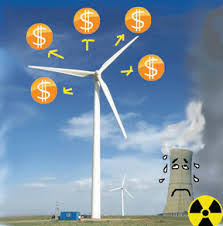
Denmark will soon achieve 100% electricity from wind and solar; but across the world nuclear power construction cost overruns soar
David Toke, May 22, 2025, https://davidtoke.substack.com/p/two-stories-denmarks-soaring-renewable
Two stories emerged on May 19th giving diametrically opposed results; one is very positive news for the booming deployment of renewable energy but the other is crushingly bad for nuclear power prospects. Renewables will make up more than of Danish 100% electricity in a couple of years time and just wind and solar not long after that. On the other hand a new study concludes that, around the world, nuclear power projects have cost overruns that are over 100%. Solar and wind have very low, if any cost overruns.
Danish renewables to reach 100 per cent of electricity
You can see the shares of electricity generation for Denmark in 2024 in Figure 1. Wind and solar already make up 69 per cent of generation and together with bioenergy they made up 87 per cent of electricity generation. But wind and solar generation is increasing rapidly. The different shares of power production can be seen in Figure 1.
Denmark blazed the trail for wind power starting in the 1970s as farmers and wind cooperatives put up their own wind turbines. Initially the turbines were only 20 kW in peak output. But the latest planned offshore windfarm will have turbines of 20 MW in size – a thousand times bigger! The early start for wind power in Denmark boosted its industry tremendously. Today Denmark also hosts Vestas, the largest wind generator manufacturer in the world.
There are still a trickle of onshore wind turbines being built. However, these days most of the new wind capacity is coming from offshore wind. The 1.08GW Thor windfarm that is currently being built will be fully operational in 2027. [on original]…………………………………………………………………………
Academic study reveals enormous average nuclear cost overruns around the world
Meanwhile, on the same day as the announcement of the forthcoming auction for the Danish offshore windfarms, an academic paper was announced which showed truly awful results for the nuclear industry. The study scoured the world for details on as many energy infrastructure projects that coud reliably be found – 662 in all – including 204 nuclear power plant constructions.
The researchers found that the average cost overrun for nuclear power plant was a staggering 102.5 per cent. That means that the construction costs were more than double the cost that was originally estimated before the construction started. What makes this figure all the more remarkable is that this was an average across the whole of the world.
The study includes Eastern countries like China. In these states there is still the specialist industrial skills (and more relaxed health and safety at work regulations) required to deliver nuclear power stations at anywhere near their projected construction time. Yet, in western countries, the construction cost overruns are much worse. Essentially, in western conditions, it has become impossible to deliver nuclear power plant at anything below astonomical costs.
I should add that there is an incredible amount of nonsense being spouted at the moment about how ‘small modular reactors’ are some way of saving nuclear power. Apart from occasioning a small amount of ultra-expensive nuclear capacity they are nothing of the sort. They are much worse in economic terms than even conventional reactors. See my discussion ‘Why small modular reactors do not exist – history gives the answer’. See HERE.
It is a completely different matter for renewable energy projects of course, where cost overruns are very low. But, from the press coverage, you would not guess all of this!
Conclusion
As we can see from this post Denmark is, within a few years, about to be the first country in the world with a net surplus of wind and solar power. Interestingly this is the country that turned its head against nuclear power forty years ago, although it never bult any nuclear power plant before then. I have heard an incredible amount of what could be described as nonsensical disinformation in the mainstream press about how nuclear power is accelerating around the world and even that is some sort of way renewables are in crisis. The reality is the exact opposite as the information in this post demonstrates.
US House seeks to create another Ukraine disaster in Georgia
Walt Zlotow, West Suburban Peace Coalition, Glen Ellyn IL, 22 May 25
Not satisfied with destroying Ukraine to weaken Russia, the US House passed a deranged bill to set the stage for a Ukraine redo, this time in tiny former Soviet republic Georgia.
It overwhelmingly passed the Mobilizing and Enhancing Georgia’s Options for Building Accountability, Resilience, and Independence Act (MEGOBARI Act) by a vote of 349 to 42.
MEGOBARI may be the stupidest acronym ever. But its intent is even stupider.
The bill is simply a Ukraine style regime change ploy to kick Russia out of its neighbor Georgia’s polity so Georgia can join NATO and the EU.
MEGOBARI doesn’t mince niceties” “[T}he consolidation of democracy in Georgia is critical for regional stability and United States national interests… (so it is) the policy of the United States to support the constitutionally stated aspirations of Georgia to become a member of the European Union and NATO,” to “continue supporting the capacity of the Government of Georgia to protect its sovereignty and territorial integrity… (and) to combat Russian aggression, including through sanctions on trade with Russia and the implementation and enforcement of worldwide sanctions on Russia.”
The US regime change party, including all but 34 Republican and 8 Democrats, can’t tolerate the duly elected Russian aligned Georgian Dream Party ruling Georgia. Claiming this tiny spec of a country with just 3.8 million souls and a miniscule $35 billion GEP is essential to US national security interests is preposterous.
Georgia has suffered thru senseless US intervention for 22 years beginning with the 2003 CIA aided Rose Revolution that eventually installed pro US puppet Mikheil Saakashviili as president, ousting pro Russian
Eduard Shevardnadze. Hear echoes of Ukraine there?
Five years later, goaded by the US, Saakashvili tried to reclaim 2 breakaway Georgian provinces aligned with Russia. Big mistake. His attack provoked a Russian pushback that crushed the Georgian intervention. At the start, premier US war lover Sen. John McCain shouted “Today we are all Georgians.” When Georgia caved so did McCain, likely channeling SNL’s Roseanne Roseannadanna’s ‘Oh, never mind.’
But here we are 17 years on and US war lovers are at it again in the ‘Weaken Russia’ game with patsy Georgia. MEGOBARI even includes the ominous directive that allows Congress “…in consultation with the Secretary of Defense… to expand military co-operation with Georgia, including by providing further security and defense equipment ideally suited for territorial defense against Russian aggression and related training, maintenance, and operations support elements.”
Might be time for all 349 clueless congresspersons supporting MEGOBARI to be flown to Ukraine’s eastern war front to see just how glorious their ‘Weaken Russia’ campaign is going with our hapless Ukrainian proxies.
Drone attacks Zaporizhia NPP training centre third time this year – IAEA
Zaporizhia Nuclear Power Plant (ZNPP) told the team of the International
Atomic Energy Agency (IAEA) based at the Plant that the drone hit the roof
of the training centre located just outside the ZNPP site perimeter on May
21, according to an update on the situation in Ukraine on the IAEA website
late on Wednesday.
The drone hit the roof, without causing any casualties
or major damage. It was not immediately known whether the drone had
directly struck the building or whether it crashed on the structure after
being shot down. The IAEA said that it was the third time this year that
the training centre was reportedly targeted by such an unmanned aerial
vehicle.
Interfax Ukraine 22nd May 2025, https://en.interfax.com.ua/news/general/1073812.html
Revealed: three tonnes of uranium legally dumped in protected English estuary in nine years
Expert raises concerns over quantities allowed to be discharged from nuclear fuel factory near Preston
Pippa Neill, 23 May 2025 , https://www.theguardian.com/environment/2025/may/22/revealed-uranium-from-uk-nuclear-fuel-factory-dumped-into-protected-ribble-estuary
The Environment Agency has allowed a firm to dump three tonnes of uranium into one of England’s most protected sites over the past nine years, it can be revealed, with experts sounding alarm over the potential environmental impact of these discharges.
Documents obtained by the Guardian and the Ends Report through freedom of information requests show that a nuclear fuel factory near Preston discharged large quantities of uranium – legally, under its environmental permit conditions – into the River Ribble between 2015 and 2024. The discharges peaked in 2015 when 703kg of uranium was discharged, according to the documents.
Raw uranium rock mined from all over the world is brought to the Springfields Fuels factory in Lea Town, a small village roughly five miles from Preston, where the rock is treated and purified to create uranium fuel rods.
According to the factory’s website, it has supplied several million fuel elements to reactors in 11 different countries.
The discharge point for the uranium releases is located within the Ribble estuary marine conservation zone – and about 800m upstream of the Ribble estuary, which is one of the most protected sites in the country, classified as a site of special scientific interest, a special protection area (SPA) and a Ramsar site (a wetland designated as being of international importance).
The government’s latest Radioactivity in Food and the Environment report, published in November 2024, notes that in 2023 the total dose of radiation from Springfields Fuels was approximately 4% of the dose limit that is set to protect members of the public from radiation.
However, Dr Ian Fairlie, an independent consultant on radioactivity in the environment, who was a scientific secretary to the UK government’s committee examining radiation risks of internal emitters, said that in terms of radioactivity, the discharges from Springfields Fuels were a “very large amount”.
“I’m concerned at this high level. It’s worrying”, he said, referring specifically to the 2015 discharge.
In a 2009 assessment, the Environment Agency concluded that the total dose rate of radioactivity for the Ribble and Alt estuaries SPA was “significantly in excess” of the agreed threshold of 40 microgray/h, below which regulators have agreed there would be no adverse effect to the integrity of a protected site. The report found the calculated total dose rate for the worst affected organism in the estuary was more than 10 times higher than this threshold, with discharges of radionuclides from the Springfields Fuels site to blame.
As a result, a more detailed assessment was undertaken. In this latter report, it was concluded that based on new permitted discharge limits, which had been lowered due to planned operational changes at Springfields Fuels, the dose rates to wildlife were below the agreed threshold and therefore there was no adverse effect on the integrity of the protected site.
Under the site’s current environmental permit, there is no limit on the weight of uranium discharges, which in itself has raised eyebrows. Instead, the uranium discharge is limited in terms of its radioactivity, with an annual limit of 0.04 terabecquerels. Prior to this, the discharge limit in terms of radioactivity was 0.1 terabecquerels.
A terabecquerel is a unit of radioactivity equal to 1tn becquerels. One becquerel represents a rate of radioactive decay equal to one radioactive decay per second.
Despite this tighter limit having been agreed six years ago, experts have raised concerns over the continued authorised discharges from the site.
Fairlile specifically questioned the Environment Agency’s modelling of how this discharge level could be classified as safe. “This is a very high level. The Environment Agency’s risk modelling might be unreliable. Which would make its discharge limits unsafe”, he said.
The Environment Agency said its processes for assessing impacts to habitats were “robust and follow international best practice, including the use of a tiered assessment approach”.
Dr Patrick Byrne, a reader in hydrology and environmental pollution at Liverpool John Moores University, said the 703kg of uranium discharged in 2015 was an “exceptionally high volume
Dr Doug Parr, a policy director at Greenpeace UK, said: “Discharges of heavy metals into the environment are never good, especially when those metals are radioactive.”
An Environment Agency spokesperson declined to comment directly, but the regulator said it set “strict environmental permit conditions for all nuclear operators in England, including Springfields Fuels Limited”.
It said these permits were based on “detailed technical assessments and are designed to ensure that any discharges of radioactive substances, including uranium, do not pose an unacceptable risk to people or the environment”.
While the government’s Radioactivity in Food and the Environment report found sources of radiation from Springfield Fuels were approximately 4% of the dose limit to members of the public, it also concluded that radionuclides – specifically isotopes of uranium – were detected downstream in sediment and biota in the Ribble estuary due to discharges from Springfields.
This is not the first time uranium levels in the estuary silt have been noted. Research conducted by the British Geological Survey (BGS) in 2002 detected “anomalously high” concentrations of uranium in a silt sample downstream of the Springfields facility.
The highest level recorded in the BGS report was 60μg/g of uranium in the silt – compared with a background level of 3-4μg/g. The researchers described this as a “significant anomaly”.
The UK is looking to expand its nuclear fuel production capabilities, including at Springfields Fuels. This is in order to increase energy security and reduce reliance on Russian fuel, and to deliver on a target of 24GW of new nuclear capacity by 2050.
A spokesperson from Westinghouse Electric Company UK, the operator of the factory), said: “Springfields is committed to strong environmental stewardship in our Lancashire community. The plant is monitored and regulated by the Environment Agency and operates well within those regulations. For nearly the past 80 years, Springfields has provided high-quality jobs to the local community and the fuel we provide to the UK’s nuclear power plants has avoided billions of tonnes of CO2 from fossil fuels.”
An Environment Agency spokesperson said: “The Environment Agency strictly regulates Springfields Fuels through robust environmental permits that control radioactive discharges, ensuring they pose no unacceptable risk to people or the environment. These permits are based on international best practice and are routinely reviewed, including detailed habitat assessments. Discharge limits have been progressively reduced over time, and monitoring by both the operator and the Environment Agency confirms no cause for alarm.
Atomic bombs destroyed their lives – now they want Russia to pay
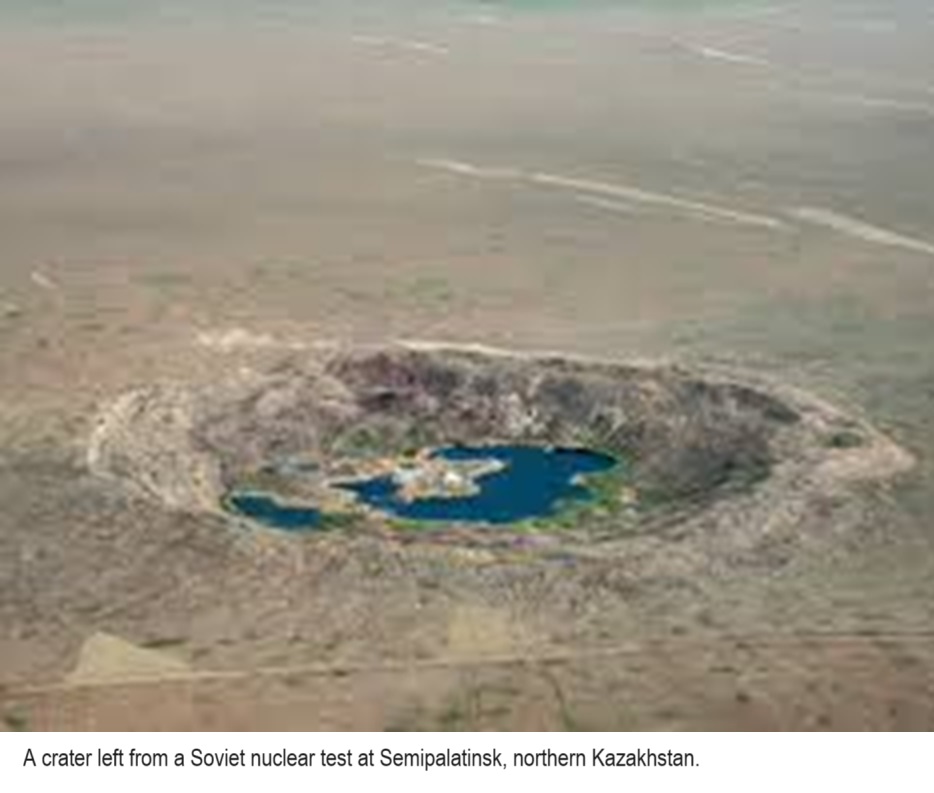
“People living around the test site “became unwitting test subjects, and their lives were treated with casual disregard due to racism and ignorance,”
“It was a crime of negligence, whereby secrecy, control, and the acquisition of more powerful nuclear weapons were prioritised over the lives of local people.”
Amid calls to restart nuclear testing, families are still suffering from mutations passed down through the generations
Arthur Scott-Geddes. Simon Townsley Photographer, in Semey, Telegraph, 21 May 2025
The Geiger counter came to life as we trudged toward the lip of the crater, its clicks becoming frantic before giving way to an alarm.
“This is the Atomic Lake,” said the hazmat-suited guide, throwing out his arms against the wind to encompass the circular expanse of water below. “Don’t get too close to the edge.”
Sixty years ago a nuclear bomb ten times more powerful than the one that destroyed Hiroshima exploded at the bottom of a 178-metre shaft in this remote (but not unpopulated) corner of Kazakhstan.
The blast excavated a basin a quarter of a mile wide and several hundred feet deep, sending up a plume of pulverised rock and radioactive material that was detected as far away as Japan.
It was not a one off. The hydrogen bomb was one of 456 nuclear weapons detonated by the Soviet Union at the Semipalatinsk Test Site, a 7,000 square mile swathe of steppe known as the Polygon.
The tests started in 1949 and continued right up until 1989 and the fall of the Berlin wall. They account for a quarter of all the nuclear explosions in history, creating an ongoing health crisis of a scale and nature that is hard to fathom.
The Kazakh authorities estimate that one-and-a-half million people living in nearby cities, towns and villages were exposed to the residual fallout.
The region has elevated rates of cancer, heart disease, birth defects and fertility problems – all linked to the tests. Suicides are common and the area’s graveyards are filled with people who died young.
But as well as sickening those who were directly exposed, the fallout has worked its way into the population’s DNA, leading to mutations that have been passed down through the generations.
‘There were so many children born with different mutations’
Almost everyone who grew up in Semey, a city of about 350,000 that lies only 75 miles from the Polygon, was affected in some way by the testing programme.
Olga Petrovskaya, the 78-year-old chair of Generation, a campaign group founded in 1999 to petition the government for greater support for the victims of the tests, remembers explosions shaking the city.
“We would be taken out of the classroom because they were worried about the windows shattering,” she said. “But nobody would explain why it was happening.”
White dust would sometimes fall on the city, causing sores to form on exposed skin. It was not long before people started dying.
“When we were six years old, at nursery school, there was a girl who died of leukaemia,” she said. “And then at [primary] school our classmates were also dying of cancerous diseases.
“Cancer became a very common diagnosis – there is no family that hasn’t been affected by it – and there were so many children born with different mutations.”
Ms Petrovskaya lost her brother, her aunt and her in-laws to cancer in the 1960s. She herself suffered numerous miscarriages and still has debilitating headaches and dizzy spells that she believes are linked to the radiation.
Her group of activists has dwindled as its members succumbed to their illnesses. There are now only a handful of them left.
The Soviet testing programme has been frequently criticised for its recklessness.
For instance, the first test of a two-stage hydrogen bomb created a blast much more powerful than anticipated, causing a building to collapse and killing a young girl in Kurchatov, the closed-off city 40 miles away where the tests were directed from
But the scientists and military personnel responsible understood the risks inherent in what they were doing. Modelling has shown that people who lived through all 456 tests received doses of radiation up to 120 times greater than survivors of the Hiroshima bombing.
“The Soviet authorities were absolutely not ignorant of the dangers of nuclear weapons testing,” said Dr Becky Alexis-Martin, a Lecturer in Peace, Science, and Technology at the University of Bradford.
“The tests occurred long after the Hiroshima and Nagasaki bombings, and records from the time reveal that the scientists involved in the Polygon tests had expert understandings of the impacts of ionising radiation on health.”
People living around the test site “became unwitting test subjects, and their lives were treated with casual disregard due to racism and ignorance,” added Dr Alexis-Martin
“It was a crime of negligence, whereby secrecy, control, and the acquisition of more powerful nuclear weapons were prioritised over the lives of local people.”
There is a growing body of evidence showing that radiation-induced mutations can be passed down multiple generations.
In 2002, an international study of 20 families living around the Semipalatinsk test site showed that exposure to fallout nearly doubled the risk of inherited gene mutations.
“Genetic consequences manifest in many different ways and any gene can be affected by radioactive exposure. Some gene changes are invisible beyond our DNA – but others can have harmful and intergenerational impacts,” said Dr Alexis-Martin.5
“We often think of birth defects when we think of radiation exposure, but hereditary heart conditions, blindness, and deafness can also arise.”
Today many Kazakh families still bear the marks of the tests several generations after the explosions stopped.
‘I will not live much longer’
Read more: Atomic bombs destroyed their lives – now they want Russia to pay
Asel Oshakbayeva was born in 1997, eight years after the last atomic detonation at the Polygon.
Yet she soon began to have seizures, and at the age of three months suffered a brain haemorrhage that left her blind and unable to speak, move or eat.
“She was in a coma, she couldn’t see anything,” said her mother, Sandugush.
The family sold their home and two cars to fund experimental surgical treatment in Russia that, after 14 operations, repaired damage to her optic nerve, partly restored her speech and made it possible for her to eat again.
But she remains totally dependent on her mother, and the pair left Semey and now live cheek-by-jowl with five other relatives in a small flat in Astana, the capital.
Sandugush, like her parents before her, was exposed to high levels of radiation while living near the Polygon.
In total, three generations of her family have now been officially recognised as victims of the testing, including her daughter. Her husband died of cancer 10 years ago, and she herself has a host of unusual health complaints.
“I will not live much longer,” she said, gesturing to her side where surgeons removed cancerous tumours from her breast and lymph nodes.
She now worries who will look after her daughter in the future. “She has the mind of a ten-year-old. If I die, what will happen?”
Despite the high prevalence of disability in the communities affected by the Polygon, a stigma around the children born with deformities persists.
Maira Zhumageldina, 56, lived for a time in the area of maximum radiation risk and gave birth to her daughter Zhannur in 1992.
Zhannur’s ribcage, spine and limbs never properly formed, leaving her permanently disabled – unable to walk, talk or feed herself.
When the extent of Zhannur’s disability became clear, Ms Zhumageldina came under pressure to give her up, even from her own family.
“When I had Zhannur about 13 or 14 children were born with different kinds of disabilities, so some were abandoned and some died at early ages,” she said.
“My parents-in-law said: ‘Why don’t you leave her?’ But I said ‘this is my child’ I could never leave her.”
A well-thumbed album of photographs documents the 28 years that Ms Zhumageldina devoted to caring for her daughter.
She trained as a massage therapist to ease her pain, and took her to Astana for specialised treatment……………………………………………………………………………………………………………………
‘The slow genocide’
……people whose families have been torn apart by the tests accuse the government of a “genocide” by inaction.
Reluctant to cough up the cash to properly support the hundreds of thousands of people sickened by the radiation and unwilling to press Russia for help in fear of provoking a diplomatic row, the government, they say, is simply waiting for them to die.
………Most of the fallout came their way – the Soviet scientists in Kurchatov made sure not to detonate any weapons while the wind was blowing towards them.
Hardly anyone here lives to retirement age, and cancer and birth defects are common.
“It’s a genocide,” said Acen Kusayenuli, 59, a veteran of the war in Afghanistan who recently had a portion of his lung removed after being diagnosed with cancer. He cannot afford chemotherapy so instead chews herbs to fight the disease.
“We were just like mice,” he said. “Why else would they not relocate the people and animals? They wanted to see how we would be affected.”
Even the landscape has suffered……..
the villagers, always kept in the dark about what was going on, bore the burden of death with a strange stoicism common to many parts of the former Soviet Union.
“We just accepted that whoever gets sick, gets sick,” she said……………………..
“The nuclear weapons tests were undertaken in the knowledge that the local ethnic Kazakhs could be harmed or even gradually eradicated,” said Dr Alexis-Martin.
“The lack of impetus and action across the decades by successive Soviet, Russian, and Kazakhstan governments and the global community amounts to ‘slow genocide’ – this arises when an ethnic or cultural group is gradually and systematically destroyed due to cumulative and sustained harm over time.”
Seventy-five miles further down the road is the village of Kaynar, which sits in the shadow of a rock formation overlooking the test site. Older residents remember climbing to the top to watch the explosions. ……………………………………………………………
Dr Saule Isakhanova, the head doctor of the Abralinski Regional Hospital which looks after around 2,100 people in Kaynar and the surrounding villages, said nearly half of her patients had health problems linked to the tests.
Her husband, the former mayor, was one of those who used to go out into the steppe to collect grass. He now has bowel cancer.
She said the effects of the tests could continue to harm people living in the area for a long time.
“Research shows that particles of these elements can remain in the dust for 300,000 years,” she said, referring to the radionuclides released by the bombs. “Those particles, once you breathe them in, they get into your bones.”
While much of the research attention has so far focused on rates of cancer and birth defects, little has been done to understand the prevalence of developmental disorders among children affected by the tests.
……………………………………………………..Dr Talgat Moldagaliyev, the former Director of the Institute of Radiation Medicine and Oncology in Semey, said more work is needed to understand the effects the tests are continuing to have.
“It’s a living experimental zone, but not enough research has been done.”
‘It should never happen again’
Most of the victims of the Polygon only learned the truth about what had been happening to them after the Soviet Union collapsed and Kazakhstan gained independence.
That moment gave rise to Kazakhstan’s first civil society movement, which connected survivors of the Polygon tests with communities affected by American nuclear testing in Nevada.
Over 35 years since the last nuclear explosion at the Polygon, there is a renewed push to win justice for those affected by the radiation.
Maira Abenova, the founder of Committee Polygon 21, an advocacy group representing the victims, lost her mother, brother, sister and husband to diseases related to the Polygon and now suspects she has cancer herself.
She wants the world to recognise that the suffering did not end with the closure of the test site.
“Currently the law recognises as a survivor of the nuclear tests only those people who lived in four regions around the Polygon from 1949 to 1991,” she said, referring to a law brought in in 1992 which gave people who qualified a “radiation passport” certifying their exposure to the radiation.
Those given the small, beige documents, which bear a blue mushroom cloud stamp on the cover, receive a small amount of compensation and other benefits including longer holidays.
While older survivors of the tests say the system worked at first, many of the families The Telegraph spoke to, particularly those in the hard-hit villages, said it was difficult to get official recognition for their children.
Rising medical costs far outstrip benefits worth around $40 a month and moving away from the villages, even to seek better medical care, disqualifies survivors from support.
Ms Abenova has been petitioning government agencies, who are more interested in collaborating with Russia on nuclear energy and turning the test site into a dark tourism destination, to take action on a grander scale.
“You cannot solve the problem just by paying small additional payments, you have to upgrade the economy in the region,” she said.
United Nations resolutions and the sustainable development goals (SDGs) should also be used to improve the lives of those living in the areas affected by the tests, and a new law is needed “which recognises all the survivors,” she said.
Committee Polygon 21 was among several Kazakh civil society groups to appeal to the UN in New York urging global action on justice for the testing victims.
After Vladimir Putin, the Russian President, withdrew his country’s ratification of the global treaty banning nuclear weapons tests, and with advisers of Donald Trump urging him to restart US testing, Ms Abenova hopes her work will also energise calls for disarmament.
“Kazakhstan suffered from nuclear tests […] Our people should use this opportunity to appeal to other countries that it should never happen again,” she said.
Meanwhile, how safe it is to live in the area around the Polygon remains unclear.
The site itself has been picked over by scavengers looking for – often highly irradiated – scrap metals.
Some 116 bombs were detonated in the atmosphere, but 340 exploded underground, and a secretive joint US-Russian-Kazakh cleanup programme to secure fissile material and even bomb components left behind by the Soviets in tunnels and shafts was only made public after it ended in 2012.
Those living nearby still do not know if their food and water is safe.
……………………..https://www.telegraph.co.uk/global-health/terror-and-security/soviet-union-nuclear-testing-atomic-bomb-kazakhstan/
We’re all pretending to be mad at Israel now that 14,000 babies are starving to death
At least we’re proving we’re serious about our opposition to genocide though. So serious, in fact, that the RAF is conducting surveillance flights and helping Israel select targets to bomb with the F-35s we helped build. Makes you proud to be British, doesn’t it?
This is about saving our reputations and avoiding arrest…
Laura and Normal Island News, May 21, 2025, https://www.normalisland.co.uk/p/were-all-pretending-to-be-mad-at?utm_source=post-email-title&publication_id=1407757&post_id=164073303&utm_campaign=email-post-title&isFreemail=true&r=ln98x&triedRedirect=true&utm_medium=email
As a journalist in the mainstream media, I have proudly defended Israel for the last 19 months, but now that everyone is realising how bad they are (and more ICC arrest warrants are coming), I would like to express my genuine anger at the killers I encouraged.
While I took no issue with the bombing of apartment buildings and hospitals and schools and universities and food distribution centres and aid vehicles and tents and even my fellow journalists, I have suddenly my found my conscience, which is a real thing that definitely exists.
The mass murder of civilians was fine while we could get away with blaming everything on Hamas, but now that Israel is starving 14,000 babies to death and openly boasting about it and saying not even the west can stop us, I’m shitting myself to be honest. I’m worried the International Criminal Court might see Normal Island News in the same light as Radio Rwanda.
I feel particularly bad for you, my obsessed readers, who face the real prospect of no more Normal Island News unless I act. If anyone knows a quick way to purge the internet of everything I’ve ever written it would be most appreciated.
I’m not alone in shitting myself because not only is almost every western journalist finding their conscience at the very last moment, but we’ve even seen Lammy and Starmer pretend to be mad at Israel in parliament. I say “pretend”, but they genuinely are mad, just not about the babies. They’re mad that Israel is making them look really fucking bad.
The foreign secretary has shrewdly noticed Israel has been blocking food for 11 weeks and Gaza’s babies look like skeletons. He has even noticed the genocidal words of Israeli ministers like Smotrich and Ben Gvir, but I’m unclear if he has noticed all the buildings have been destroyed and Gaza has the largest cohort of child amputees in history.
When discussing Netanyahu’s plans to take over Gaza and minimise food distribution, Lammy told MPs: “We must call this what it is. It is extremism… It is monstrous. I condemn it in the strongest possible terms.” He insisted the extremists have a right to defend themselves though and said he believes in their cause. Warms your heart, doesn’t it?
Sadly, Lammy’s olive branch was not enough to appease Israel whose spokesperson insisted Britain has an “anti-Israel obsession” and still thinks it is a colonial power. Obviously, Israel is the only colonial power in this equation.
Sadly, we’re all getting smeared now, apart from Priti Patel who is the only person in parliament still backing Israel. Turns out, Priti is as stupid as she is evil because she said she didn’t want to let Hamas win by feeding babies. She seemed blissfully unaware she could end up in jail for this. When the time comes, I will be more than happy to throw Priti under a bus to save my own skin.
As you can imagine, the Westminster WhatsApp group has been in panic mode so we’ve knocked together a cover story. The short version is that everything is Jeremy Corbyn’s fault. The long version is that we were so ashamed by the Labour antisemitism scandal (that we fabricated) that we felt the need to support Israel, no matter what. Our genocide support was our way of saying sorry about all those lefties who knew Israel was genocidal before it was cool.
Since 2015, the Corbynistas had accused Israel of being a genocidal state that would not stop until all the Palestinians were gone. It was antisemitic of them to be correct about Israel, every step of the way, long before the rest of us caught up.
Please understand it was our sense of national shame (combined with generous lobbying and threats from Mossad) that made us cheer for genocide for 19 straight months. Why did the Corbynistas make us do this? Why?
Thankfully, the prime minister is taking a principled stand against Israel by suspending trade talks. You know how we spent forever insisting BDS was antisemitic? Well, we’re now threatening Israel with sanctions which is a bit embarrassing, isn’t it? It’s gonna be so awkward if taking a stand works now when we’ve spent 19 months insisting nothing we could do would make a difference.
At least we’re proving we’re serious about our opposition to genocide though. So serious, in fact, that the RAF is conducting surveillance flights and helping Israel select targets to bomb with the F-35s we helped build. Makes you proud to be British, doesn’t it?
The prime minister said the suffering in Gaza is “utterly intolerable” which is quite the U-turn on that time he said Israel has the right to withhold food, water and medicine. I’m unclear if we’re supposed to be using the “G” word in public so I messaged Starmzy for an update, but I’m not getting a read receipt, presumably because his phone might explode for no apparent reason.
By the way, Spain’s mobile network coincidentally went down right after its government criticised Israel, just like that time its power grid went down right after it criticised Israel, so if the same happens to us, please remember to blame Jeremy Corbyn. If anyone blows up Starmer’s phone it will be him
US should never have intervened in Ukraine – Trump
19 May 25, https://www.rt.com/news/617888-us-never-intervened-ukraine-trump/
US President Donald Trump has rebuked his predecessor, Joe Biden, for funneling vast amounts of American taxpayer money into a foreign conflict that “should have remained a European situation.”
Speaking to reporters at the White House following a phone call with Russian President Vladimir Putin on Monday, Trump expressed frustration over the “crazy” scale of US involvement in the Ukraine conflict. He reiterated that it is “not our war” and stressed that his administration is working to end it through diplomacy.
This is not our war. This is not my war… I mean, we got ourselves entangled in something that we shouldn’t have been involved in. And we would have been a lot better off – and maybe the whole thing would have been better off – because it can’t be much worse. It’s a real mess,” Trump said.
The president stated that Washington has provided “massive” and “record-setting” levels of military and financial assistance to Kiev – far exceeding what the EU and other NATO countries have contributed.
“We don’t have boots on the ground, we wouldn’t have boots on the ground. But we do have a big stake. The financial amount that was put up is just crazy,” he added.
Again, this was a European situation. It should have remained a European situation. But we got involved – much more than Europe did – because the past administration felt very strongly that we should,” he said. “We gave massive amounts, I think record-setting amounts, both weaponry and money.”
Trump’s conversation with Putin was followed by calls with the leaders of Germany, Italy, and the UK, as well as European Commission President Ursula von der Leyen and Ukraine’s Vladimir Zelensky.
“They have a big problem. It’s a terrible war. The amount of anger, the amount of hate, the amount of death,” Trump said, adding that the conflict has reached a point where “it’s very hard to extradite themselves away from what’s taken place over there.”
Trump said he believes both Putin and Zelensky want peace, but only time will tell if it can be achieved.
Pressed by reporters on whether he has a “red line” that would cause him to walk away from mediating the conflict or potentially escalate US involvement, Trump declined to elaborate. “Yeah, I would say I do have a certain line, but I don’t want to say what that line is because I think it makes the negotiation even more difficult than it is,” he said.
Putin described the conversation with Trump as “substantive and quite candid,” adding that Moscow is prepared to work with Kiev on drafting a memorandum aimed at achieving a future peace agreement.
“In general, Russia’s position is clear. The main thing for us is to eliminate the root causes of this crisis,” the Russian president said.
‘Dad’s Army’ to return FOR REAL as UK military plans defence against Russian invasion.
The Home Guard will be a civilian unit tasked with protecting key infrastructure such as nuclear power plants, airports and telecommunications sites.
Michael D. Carroll and James Knuckey, Mirror, 20 May 2025
The Government is reportedly considering the establishment of a Home Guard, akin to the Dad’s Army model, to shield crucial British infrastructure from attacks by hostile nations and terrorists. These plans are rumoured to be part of the Government’s much-anticipated Strategic Defence Review (SDR), which is due for publication in the coming weeks.
The proposed unit is said to draw inspiration from the Home Guard formed during the Second World War in the 1940s as a last line of defence against a potential German invasion of Britain. The original members were typically men who were either too old or young to serve on the frontline, or those deemed unfit or ineligible…………………………………………………. https://www.mirror.co.uk/news/politics/dads-army-return-real-uk-35254242
Welcome to Britain’s biggest building site. There’s a ‘fishdisco’
It’s economy v ecology at Hinkley Point C power station, which
will power a fifth of British homes if it can pull off an audacious plan to
protect wildlife.
Two miles off the Somerset coast, a strange sound is
playing. About 20 metres below the slate-grey surface of the Bristol
Channel, a small device called a ceramic transducer blasts out a
high-pitched acoustic beam at a frequency far higher than can be detected
by the human ear. This machine — once disparaged by the former
environment secretary Michael Gove as a “fish disco” — is being
tested to see if it can scare off the salmon, herring, shad, eel and sea
trout that in six years’ time will start being sucked in their millions
into massive water inlets that have been built near by.
Hinkley Point C nuclear power station is late and over budget. This is the biggest building
site in Britain, possibly Europe: 12,000 staff and 52 cranes (including the
world’s tallest — “Big Carl”, 250 metres high) are working to
complete the project. When the £46 billion station finally switches on in
2031, it will power more than a fifth of the UK’s homes.
To cool the reactors, 120,000 litres of seawater a second — fish and all — will be
sucked into concrete pipes six metres wide. A complex mechanism has been
installed to return as many fish as possible to the sea, but even so,
Hinkley’s owner, EDF, estimates that up to 44 tonnes of marine life —
more than 180 million individual fish — will be killed each year.
Natural England, in consultation with the Environment Agency and Natural Resources
Wales, will advise EDF whether the fish disco machine is sufficient to
comply with its planning permission, or whether the company will need to
revert to its plans for creating salt marshes like the one at Steart.
David Slater, Natural England’s regional director for the southwest, said the
agency is keeping an open mind on the fish deterrents. But if the tests
fail to demonstrate the fish can be kept away, the energy company will be
required to return to its plan for “compensatory habit” — the jargon
for the salt-marsh reserves — as a condition of its planning permission.
Times 18th May 2025, https://www.thetimes.com/uk/environment/article/welcome-to-britains-biggest-building-site-theres-a-fish-disco-c0wqs8lg9
The media, scientific consensus, and toxic nuclear waste
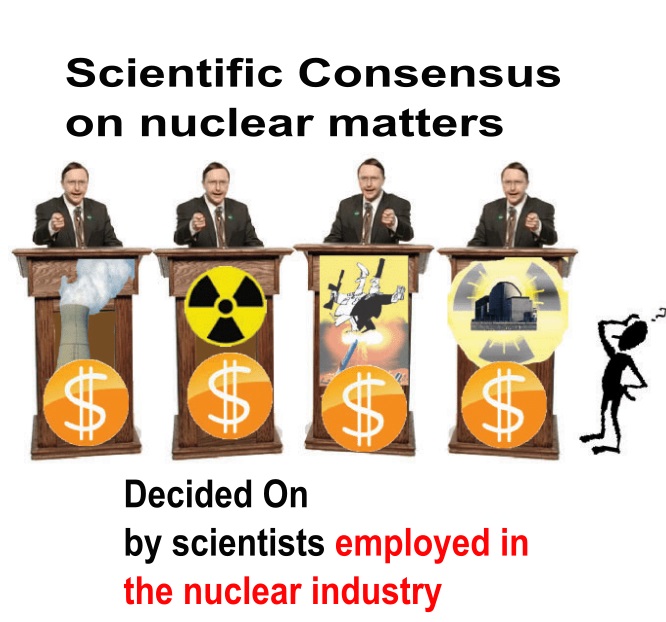
Not to be outdone by more modern means of propaganda, Nuclear Waste Services has continued the tradition of only providing the audience with the information that suits their argument.
The only way to reduce waste is to reduce the activities that cause it.
There is no other logical way.
News media tends to use ‘scientific consensus’ as if it is the end point of the discussion.
The implication that ‘this is the only way’ serves to quash dissenting voices and validate the overall message of the article.
When government agencies are hard to trust, who do we look to? Scientists. But what job is the concept of scientific consensus doing in the marketing of the GDF?
A Quiet Resistance, 8 May 2025
‘Scientific consensus’ carries a lot of weight in news media discussing the proposed Geological Disposal Facilities (GDFs) (nuclear waste dumps) in West Cumbria.
This consensus is also being used as a persuasion tool in the official literature handed out to communities by Nuclear Waste Services (NWS).
Since most of us aren’t scientists in either the nuclear industry or geodisposal, we have to turn to those who are if we’re to understand what’s going to happen to our community. Alongside the regular newsletters and other marketing from NWS, we usually access those people through articles in the news and on the internet.
But it’s important to keep asking questions about what we’re reading.
‘Scientific consensus’ doesn’t mean the science is settled; articles can contain facts and still be biased.
Biases in news media
The news media are paid for by advertisers. If they publish articles that make arguments against their advertisers’ interests, they lose advertising money. Their advertisers’ interests may not be clear. For example, they may be companies that have money invested in hedge funds, which in turn invest in nuclear power.
News media also come up against political pressure, as The Guardian found out a few years ago, to its long-term detriment.
There’s also the question of audience. News media write to a specific audience, one already sold on the ideas they are promoting, or at the very least, suggestible. Most people are aware of ‘climate change’. If someone authoritative tells them it’s important for us to have a GDF because nuclear energy will help us ‘beat climate change’, they are likely to accept that, unless they have some wider knowledge.
Bias can be edited into an article by keeping the facts, but leaving out certain contexts. They can also cherry pick facts, so that the only ones they use are those which suit their argument.
Biases and misinformation across the internet
Misinformation across the web is an endemic problem now, brought on by too little regulatory oversight, too late. A bitter combination of an advertising free-for-all, empty content for the sake of it, and algorithmic twists that feed on themselves has come together to make an internet that doesn’t run the kind of useful searches it did just 12 years ago.
On top of this, a type of information warfare has been raging, hidden in plain sight from the eyes of everyday people, and the proliferation of GenAI has made the situation much worse. Social media, news media, every place we get our information from has been seeded with doubt.
All of this means that when we read information anywhere, from both respectable and dubious sources, we have to take time to process what we’ve read before we lead with our emotions.
Bias and messaging in public information
Not to be outdone by more modern means of propaganda, Nuclear Waste Services has continued the tradition of only providing the audience with the information that suits their argument.
In the case of the Community Partnership newsletter this month, this includes a soothing word salad introduction from the outgoing Community Partnership Chair explaining that he has resigned, and our local Town Council has withdrawn from the group. There are then several pages on how the Community Investment Fund money has been spent recently.
From that messaging, it is clear they’re seeking to reassure the community – talk quietly, you don’t want them to startle – and remind us that we’re getting plenty of money for the deal.
So, what’s the problem with the scientific consensus on the idea of a geological disposal facility (GDF), more prosaically known as a nuclear waste dump?
What is ‘scientific consensus’?
Scientific consensus refers to an agreement amongst scientists in a specific, very narrow field of study.
In the consideration of a GDF, that field would be geology, and most likely a particular area of geology, such as geodisposal.
Why do we need ‘scientific consensus’?
For most of us, despite our education and our wide understanding of the world, we don’t have intensive scientific training. Even if we do, it may not be in the narrow field in question.
Ethan Siegel at Forbes.com explained this really clearly:
… Unlike in most cases, unless you are a scientist working in the particular field in question, you are probably not even capable of discerning between a conclusion that’s scientifically valid and viable and one that isn’t. Even if you’re a scientist in a somewhat related field! Why? This is mostly due to the fact that a non-expert cannot tell the difference between a robust scientific idea and a caricature of that idea.
Why should we believe ‘scientific consensus’?
Although a consensus is an impossible number to quantify, the argument for a consensus is that a lot of related research is borne out by the agreement, so if it isn’t correct – e.g. if a GDF isn’t a safe and complete solution for nuclear waste – then a lot of other research is also wrong.
That sounds reassuring, but there’s more to it.
What do we have to consider behind the messaging of ‘scientific consensus’?
News media tends to use ‘scientific consensus’ as if it is the end point of the discussion.
The implication that ‘this is the only way’ serves to quash dissenting voices and validate the overall message of the article.
This is also how Nuclear Waste Services is using ‘scientific consensus’. The inference is that there is only one solution, and a GDF is it.
But scientific consensus is not the end position of the science. It’s the starting position from which further investigation can arise.
While that future studying may not set out to prove early scientific reasoning wrong, it should seek to improve or refine our understanding of the science.
And the main problem with scientific investigation?
Take a look at this quote. It’s from the article Development in Progress, from the Consilience Project.
It is also important to consider how existing biases and values ‘prime’ us towards certain starting points when we seek to understand the world through science. Before we formulate questions of design experiments, we often have preconceived notions as to what we imagine as likely to be important to the question at hand.
You’ve got to ask what their starting point is, before you can evaluate the idea.
Or, to put it another way: if you ask a geodisposal specialist what the best way is to deal with a higher activity nuclear waste problem, they’re going to tell you to bury it underground.
What’s the motivation for a GDF? Why the bias? Where’s the starting point of the plan?
Waste is a massive issue for modern Western societies. Everything we do, everything we buy creates waste. The only way to reduce waste is to reduce the activities that cause it.
There is no other logical way.
Government and the nuclear industry are motivated towards using a geological disposal facility to store higher activity nuclear waste because:
- There’s almost seventy years’ worth of higher activity nuclear waste to store
- Nuclear appears to offer a solution to the legal requirements of Net Zero.
The more we use nuclear technology, the more toxic waste we will produce. It’s inevitable without social, political, and industrial change.
The nuclear industry
The nuclear industry’s back is against the wall. It urgently has to put the accruing waste somewhere permanently safe.
Nuclear waste is produced in solid, aqueous, and gaseous forms. If the industry reduces some of the gaseous waste, that means that it increases it in another form, e.g. aqueous. There is no escaping the waste issue without stopping the industry.
There’s a lot of money in nuclear.
The UK Government
The government has to enable the production of electricity, but having effectively phased out coal-fired power stations, it has brought in gas-fuelled hydrogen plants which are arguably just as greenhouse-gas-intensive as coal. Natural gas is still a fossil fuel, it still causes huge emissions, and it still presents supply problems.
For the government, nuclear represents a lower carbon option, with political expediencies, such as being free of Russian fossil fuel pressures (Russian uranium is still unsanctioned and likely part of the ‘diversified’ fuel mixes used in the UK).
There is also a disturbing link between civil nuclear skills and military nuclear skills which doesn’t get much media time:
Other countries tend to be more open about it, with the interdependence acknowledged at presidential level in the US for instance. French president Emmanuel Macron summarises: “without civil nuclear power, no military nuclear power, without military nuclear, no civil nuclear”.
This is largely why nuclear-armed France is pressing the European Union to support nuclear power. This is why non-nuclear-armed Germany has phased out the nuclear technologies it once lead the world in. This is why other nuclear-armed states are so disproportionately fixated by nuclear power.
In 2022, the Nuclear Decommissioning Authority (NDA) published a Radioactivity Waste Inventory with a timeline for the phasing out of nuclear power by 2136. But in early 2025, the Labour government announced it was keen to rapidly start up the building of Small Modular Reactors (SMRs) across the UK. Going forward from this year, nuclear waste will continue to be produced in the UK beyond the 100-year lifetime of the current GDF project. Waste is inevitable.
Waste isn’t the only issue for nuclear power, either. There is the question of what happens to nuclear power plants in the face of climate catastrophe. Fukushima wasn’t an anomaly, and it wasn’t avoidable. It could be seen as a foreshadowing of future possibilities.
Back to scientific consensus
So, when Nuclear Waste Services and other media proponents talk about scientific consensus being in agreement that a GDF is the best solution available for toxic nuclear waste, what they mean is:
- there is an inexorable accumulation of nuclear waste, both historical and into the future
- there are going to be more GDFs in the future
- they aren’t looking for other methods of storage
- they absolutely will not consider a non-nuclear future
- and they don’t want to argue about it.
And, for some reason, despite a GDF apparently being the safest possible housing for nuclear waste – and despite there being many geologically suitable locations – they don’t want to locate it under Westminster.
Ultimately, despite the focus given to the science, this isn’t about the science.
It’s about burying a waste product that they have no other solution for. Sweeping it under the carpet. And calling it common sense!
Common sense as a message, in an area of study called Semiotics, is a problematic idea. Although it is dressed up as the common, standard, everyday way of thinking, it is often used in marketing and media to promote the ideas of those in power.
As the future beckons, common sense should be saying no to nuclear. Just like with plastic, nuclear has no end and no sure way of getting rid of its byproducts.
For communities that ‘host’ a nuclear waste dump, the GDF solution represents a forever risk with inter-generational risks and costs along the way.
Somehow, West Cumbria always seems to be saddled with nuclear detritus.
The potential collateral damage, seen already across the United States and South America, is similar to that experienced around mining and climate solution industries.
It starts with
- environmental destruction,
- contamination of water sources and land,
- loss of biodiversity,
- loss of human rights,
- loss of health, and
- upheaval of established communities.
These may be experienced just in the construction of a GDF.
Who knows where it ends?
Further information on the proposed GDFs in West Cumbria:
Britain left out in the cold by Trump on Ukraine peace talks
How Starmer found himself on the road to nowhere
Ian Proud, May 20, 2025
Russia Ukraine peace talks are to restart immediately, but when Trump debriefed European leaders, Starmer was not on the call. Starmer has rendered himself completely irrelevant by sticking to the same tired approaches and blocking efforts at peace in Ukraine.
After Presidents Trump and Putin spoke for two hours today, 19 May, new impetus was injected in Russia-Ukraine negotiations towards a ceasefire. The Russian and Ukrainian delegations are now in contact and will start immediately preparations towards a second round of talks. After Vice President JD Vance’s meeting with Pope Leo, the Vatican is being touted as a possible venue. Clearly, direct engagement by the two Presidents is key to any progress being made to end the war. But when Trump phoned Zelensky and European leaders after the call, Prime Minister Keir Starmer was not included.
That may be because Trump has realised that Starmer has brought nothing new to the Ukraine peace process and, rather, is acting as a major brake on progress.
After a helpful, if tentative, first meeting for three years between Russian and Ukrainian delegations in Istanbul on Friday 16 May, it was clear that neither side was in a hurry to schedule further talks. For his part, Zelensky had spent most of the day on 15 May trying his best to find a way out of sending a delegation to Istanbul and blaming Russia for it. Following the standard script, British and European leaders indulged him, blaming Russia whose bemused delegation waited patiently in Istanbul for someone to show up. It was only after direct intervention from President Erdogan and the USA, that Zelensky finally relented allowing for talks on Friday.
That first Istanbul meeting, however brief, and however accompanied by the normal Ukrainian briefing out that ‘Russia doesn’t want peace’, was nonetheless a vital first step forward. But, and as Vice President JD Vance said today, we had reached an impasse, and Trump appears determined to keep the pressure up to secure an elusive ceasefire.
UK’s Geological Disposal Facility Community Partnership operates under restrictive government guidance and the management of Nuclear Waste Services
An interesting article recently sent to the NFLAs prompted a reply by our
Secretary identifying the limitations placed upon members of the Geological
Disposal Facility Community Partnerships wishing to source independent
information or commission bespoke research.
Such Community Partnerships operate under restrictive government guidance and the management of Nuclear Waste Services.
The Author and Article: A Quiet Resistance is run by a
writer, author, and marketing copywriter, living with her small family near
Millom. Understanding how language is used to persuade, convince, and
influence the decisions of mass populations, she set out to unpack the
messaging around the unfolding climate catastrophe, to help others decode
truth from fiction for themselves, and to open up critical thinking
pathways through the consumerism.
A Quiet Resistance documents this journey of discovery. AQuietResistance.co.uk –
https://aquietresistance.co.uk/the-media-scientific-consensus-toxic-nuclear-waste
23 April 2025. The media, scientific consensus, and toxic nuclear waste
When government agencies are hard to trust, who do we look to? Scientists. But
what job is the concept of scientific consensus doing in the marketing of
the GDF? ‘Scientific consensus’ carries a lot of weight in news media
discussing the proposed Geological Disposal Facilities (GDFs) (nuclear
waste dumps) in West Cumbria.
This consensus is also being used as a
persuasion tool in the official literature handed out to communities by
Nuclear Waste Services (NWS). Since most of us aren’t scientists in either
the nuclear industry or geodisposal, we have to turn to those who are if
we’re to understand what’s going to happen to our community. Alongside the
regular newsletters and other marketing from NWS, we usually access those
people through articles in the news and on the internet. But it’s important
to keep asking questions about what we’re reading. ‘Scientific consensus’
doesn’t mean the science is settled; articles can contain facts and still
be biased.
NFLA 16th May 2025, https://www.nuclearpolicy.info/wp/wp-content/uploads/2025/05/A431-NB317-The-media-scientific-consensus-and-toxic-nuclear-waste-May-2025.pdf
Trump should not threaten sanctions when he talks to Putin

It is clear to me that further US sanctions on Russia would kill stone dead any chance of a ceasefire in Ukraine at a time when Russia still has the upper hand.
Europe has neither the political capital nor the funds to maintain a losing war in Ukraine at enormous expense without massive domestic political blowback in their own countries.
Russia will keep fighting, Ukraine will lose all of the Donbass and Europe will pay the price
Ian Proud, May 18, 2025, https://thepeacemonger.substack.com/p/trump-should-not-threaten-sanctions?utm_source=post-email-title&publication_id=3221990&post_id=163841246&utm_campaign=email-post-title&isFreemail=true&r=1ise1&triedRedirect=true&utm_medium=email
Trump should not threaten Putin with sanctions during their planned phone call on Monday 19 May. This would only lock in the fighting for the rest of the year and leave Europe on the hook for a massive bill and political disruption that it cannot afford.
In the run up to the Russia-Ukraine bilateral peace talks which finally took place in Istanbul last week, both the EU and the UK imposed new sanctions on Russia. On 9 May, as Russian commemorated victory Day, Britain imposed sanctions on Russia’s shadow fleet and the EU followed suit with its 17th package of Russia sanctions on 14 May, the day before the Istanbul talks were due to start. Both the UK and EU have threatened further sanctions should Russia not agree a full and unconditional ceasefire in Ukraine and, with Zelensky, have actively urged the US to follow suit, which it has not done, so far. However, the Americans have spoken increasingly about the possibility of massive new sanctions against Russia: this would be a huge mistake.
Sanctioning a country before peace talks have already started, or while they are still going on, is already a bad look. Very clearly, the Ukrainians, Europeans and British hope that new sanctions will apply such pressure on Russia that it agrees to terms that are more favourable to the Ukrainian side. I.e. that Ukraine does not have to go back to the Istanbul 1 commitment to adopt permanently neutral status. The western mainstream press has been carpet bombing their intellectually degraded readers with the latest press line that Ukraine should not have to go back to the Istanbul 1 text as a starting point for talks. This is unrealistic.
But, in any case, there’s a problem. For this strategy to be effective, the sanctions have to work.
As I’ve pointed out before, sanctions against Russian have had limited impact, not just since 2022, but since 2014. Nothing about the glidepath of sanctions since February 2014 suggests that new sanctions will work now.
This latest round of UK and EU sanctions aimed to apply more pressure on enforcement of the G7 oil price cap of $60 which was first imposed in December 2022. Since the war started, that policy has failed.
Between 2021 and 2024, total volumes of Russian oil exported fell by just 0.2 million barrels per day, or 2.6%. After a bumper year for tax receipts in 2022 caused by Russian tumbling rouble and skyrocketing energy prices, Russia pulled in current account surpluses of $49.4bn and $62.3bn in 2023 and 2024. This was on the back of still strong goods exports of $425bn and $433bn respectively.
There are several reasons why the oil price cap didn’t work, the biggest being that Russia diverted 3 million barrels per day, around 39.5% of total oil exports to India (1.9 mbd), Türkiye (0.6 mbd) and China (0.5 mbd). Türkiye and India boosted exports of refined fuels to Europe providing a backdoor route for Russian oil to Europe. The second reason the oil price cap didn’t work is the near ten month time lag between war starting and the limit being imposed, which gave Russia space to readjust before punitive measure had been imposed. During this period, oil prices also dropped sharply from the high of $120 in the summer of 2022, to around $80 when the measure was imposed: the G7 missed the boat to impose maximum damage; this reinforces the point I make all the time that coalitions cannot act with speed and decisiveness.
Today, the Russian Urals oil price is below the $60 G7 cap meaning that any registered shipping company can transport it without penalty, which renders the British and European sanctions as pointless in any case.
Let’s be clear, western nations imposing sanctions against Russia that don’t work is not a new phenomena. As I have pointed out many times before, the vast majority (92%) of people that the UK has imposed assets freezes and travel bans upon have never held assets in the UK nor travelled here. For companies, the figure is just 23. The same, I am sure, is true of EU and US sanctions, which cover largely the same cast list of characters and companies, as we all share and compare the same lists of possible designations. Financial sector sanctions prompted a massive readjustment of Russia’s financial sector. Energy and dual use sanctions drove self-sufficiency in technology production, through Rosnet, Gazprom and RosTec: i.e. these companies invested more in R&D on component production while sourcing components from alternative markets, in particular China.
At well over 20,000 sanctions imposed so far, Russia’s economy has proved remarkably robust and its key export sectors still find ways to deliver similar volumes across the world. At some point, I hope policy makers in London, Brussels and Washington will start to ask whether this policy is working. We long ago passed the point of diminishing marginal returns. I fear, however, they have their heads in the sand or, possibly another, darker, place.
So, coming back to Trump’s phone call with Putin on Monday 19 May you might ask yourself, ‘so what if he imposes a few more sanctions if they won’t work anyway?’
Putin would see the imposition of new US sanctions as a complete 180, destroying any emerging trust he had in Trump or any belief in America’s stated intentions to end the war in Ukraine.
It is clear to me that further US sanctions on Russia would kill stone dead any chance of a ceasefire in Ukraine at a time when Russia still has the upper hand. Russia has increased the pace of its advance since the Victory Day ceasefire and seems to be adding new blocks of red to the battle map each day. At the current rate of advance, even without a catastrophic Ukrainian collapse, it seems realistic to expect that Russia would paint out the remaining territory in Donetsk and Luhansk during the remainder of this year. In the process they would need to overcome the heavily fortified towns of Pokrovsk, Kramatorsk and Sloviansk, in what would likely be brutal and attritional battles killing many thousands more on both sides.
Moreover, dragging out the war for longer would simply add to Europe’s contingent liability to fund Ukraine’s war effort at a time when it is only ever going to lose. Ukraine is spending over 26% of GDP on defence in 2025 and 67.5% of its budget expenditure is on defence and security, leaving a budget black hotel of $42bn that has to be filled. America under Trump isn’t going to fill this hole. And, as Ukraine is cut off from international lending markets, that black hole is being filled by Europe.
There is no money for this.
Europe has neither the political capital nor the funds to maintain a losing war in Ukraine at enormous expense without massive domestic political blowback in their own countries.
Notwithstanding the possibly understandable fear among European leaders of failing and being seen to fail in Ukraine, keeping the war going is at best, a gesture in cynical self-preservation, pushing their eventual political demise further down the track.
Unfortunately, we have been here so many times before. Right back to the Minsk II agreement, Ukraine has been pushing for ever more sanctions against Russia that only ever served to ramp up resentment and exacerbate the conflict. European leaders have invested too much in Zelensky and his self-serving demands aimed primarily at staying in power. He is quickly becoming the gun that shoots European elites in the head.
If Trump really wants to be seen as a peacemaker, he should avoid doing what every other western leader before him including Sleepy Joe did and resist the temptation to impose more sanctions. Instead, he should continue to press the President Putin to continue to engage with bilateral peace talks that finally recommences in Istanbul last week. He must also tell the Eurocrats and Zelensky that they must make compromises rather than plugging the same old failed prescriptions.
A home guard to protect British nuclear power plants against enemy attacks
A home guard will be established to protect British power plants and
airports against attack from enemy states and terrorists, under plans put
forward in the government’s strategic defence review (SDR).
It will be modelled on the citizens’ militia created in 1940, when Britain faced the
prospect of invasion by Nazi Germany during the Second World War. It would
be made up of several thousand volunteers, who would be deployed to
safeguard assets such as nuclear power plants, telecommunications sites and
the coastal hubs where internet cables connecting Britain to the rest of
the world come onto land. Guards could also be deployed to other sensitive
sites, such as energy stations providing power to major airports, with
senior sources pointing to the recent fire that shut down Heathrow as
evidence more resources are needed to guard them.
The home guard plan is a central part of the review, which focuses heavily on homeland security, national resilience and the need for the public to realise that Britain has
entered a pre-war era, as tensions heighten with an axis of Russia, Iran
and North Korea.
Times 17th May 2025 https://www.thetimes.com/uk/politics/article/home-guard-to-protect-uk-from-attack-lg2wf0slx
Why SNP national council must pass this motion on nuclear weapons.
Bill Ramsay: I’M puzzled as to why any proponent of Scottish nationalism
would be daft enough to tamper with a key tenet of SNP policy, the removal
of Broken Britain’s broken Vanguard fleet from Scotland.
The four Vanguard submarines carry the Trident nuclear missiles Britain rents at the
pleasure of President Trump. It’s been an axiom of Scottish politics that
although the SNP’s anti-nuclear policy is not in the SNP constitution,
it’s in the party’s DNA.
In recent weeks, though, there’s been a rash
of reports that some people who were once important in the SNP want to back
a British bomb. The timing of this has an air of panic. Those who wish to
hold fast to the crumbling totem of a British bomb are normally motivated
not by real security threats or concerns but by a delusional iteration of
British greatness. Bear in mind this off-stage pining for retention of the
British bomb (they dare not reveal themselves) is taking place at precisely
the same time as a central tenet of UK nuclear strategy is disintegrating
before our eyes.
The National 17th May 2025, https://www.thenational.scot/politics/25170582.snp-national-council-must-pass-motion-nuclear-weapons/
1 This Month

petition to oppose the rapid increase of space-military industry threatening Jeju Island and the region.
[Petition by April 19th (KST)] Stop the joint military-Hanwha Systems-Jeju Provincial Government Sea Launch!
23 April – WEBINAR – Why new nuclear reactors are the wrong tools for decarbonization Thursday, April 23 • 1 AM – 2 AM AEST
World Nuclear Power. Reactors 1951-2026, 75 Years of Nuclear Power.
Interactive Map– https://dv.worldnuclearreport.org/

Chernobyl: The Lost Tapes – A good documentary on Chernobyl on SBS available On Demand for the next 3 weeks– https://www.sbs.com.au/ondemand/tv-program/chernobyl-the-lost-tapes/2352741955560

of the week–London Campaign for Nuclear Disarmament


Tell the Ukrainian Government to Drop Prosecution of Peace Activist Yurii Sheliazhenko
To see nuclear-related stories in greater depth and intensity – go to https://nuclearinformation.wordpress.com
-
Archives
- April 2026 (210)
- March 2026 (251)
- February 2026 (268)
- January 2026 (308)
- December 2025 (358)
- November 2025 (359)
- October 2025 (376)
- September 2025 (257)
- August 2025 (319)
- July 2025 (230)
- June 2025 (348)
- May 2025 (261)
-
Categories
- 1
- 1 NUCLEAR ISSUES
- business and costs
- climate change
- culture and arts
- ENERGY
- environment
- health
- history
- indigenous issues
- Legal
- marketing of nuclear
- media
- opposition to nuclear
- PERSONAL STORIES
- politics
- politics international
- Religion and ethics
- safety
- secrets,lies and civil liberties
- spinbuster
- technology
- Uranium
- wastes
- weapons and war
- Women
- 2 WORLD
- ACTION
- AFRICA
- Atrocities
- AUSTRALIA
- Christina's notes
- Christina's themes
- culture and arts
- Events
- Fuk 2022
- Fuk 2023
- Fukushima 2017
- Fukushima 2018
- fukushima 2019
- Fukushima 2020
- Fukushima 2021
- general
- global warming
- Humour (God we need it)
- Nuclear
- RARE EARTHS
- Reference
- resources – print
- Resources -audiovicual
- Weekly Newsletter
- World
- World Nuclear
- YouTube
-
RSS
Entries RSS
Comments RSS
 nuclear-news