RAY McGOVERN: Putin Would Not Rise to the Bait

June 4, 2025, https://consortiumnews.com/2025/06/04/ray-mcgovern-putin-would-not-rise-to-the-bait/
The black-eye given Russian security services will eventually heal while the artful destruction of a handful of bombers – like earlier high-profile, but misguided operations – will have zero effect on the war in Ukraine.
By Ray McGovern, Consortium News
Ukraine’s drone attacks on air bases deep inside Russia on Sunday were timed to provoke Russia into shunning the Russia-Ukraine talks set for the next day in Istanbul. Volodymyr Zelensky and his European puppeteers also may have thought they could provoke Vladimir Putin to escalate attacks on Ukraine to such a degree that the U.S. could not “walk away” from Ukraine without appearing cowardly.
The PR benefits of destroying Russian aircraft far from Ukraine was part of Kyiv’s calculus. It was a huge embarrassment and a tactical victory in a short-lived, narrow sense.
But the black-eye given Russian security services will eventually heal. Most important, the artful destruction of a handful of bombers – like earlier high-profile, but misguided operations – will have zero effect on the war in Ukraine.
Doing Diplomacy For Once
Russian Foreign Minister Sergei Lavrov called U.S. Secretary of State Marco Rubio immediately after the drone attacks on the Russian air bases and the sabotage/destruction of two rail bridges in Russia earlier that day.
The Russian readout said that Secretary Rubio “conveyed sincere condolences on the civilian casualties from the rail infrastructure blasts in Russia’s Bryansk and Kursk regions.” This is a sign that Lavrov did not come in with accusatory guns blazing, so to speak.
It does seem certain that Lavrov asked Rubio whether he knew of the drone attacks beforehand. And what did President Trump know?
In my view, it is conceivable that neither had prior knowledge. When the drone operation was planned the geniuses working for Joe Biden were in charge of such things – the ones who destroyed the Nord Stream pipelines.
Most likely the U.S. was kept informed, but the operation itself bears the earmarks of the sabotage the British are so fond of carrying out – with particular lust after bridges.
They did so famously during World War II and they are quite good at it. Then, as now, such sabotage had little-to-no effect on the war – merely a transitory strengthening of their proverbial upper lip.
The Talks Went On, and Will Continue
Putin and Donald Trump wanted the negotiations in Istanbul to proceed, and those were their instructions to Lavrov and Rubio. They did, and with some tangible progress on small, but significant matters like the exchange of bodies. There was a highly important exchange of papers on the terms sought by each side, and a pledge to study them before the next meeting.
Bottom Line
The driving issue is bigger than Ukraine. Both Trump and Putin want improved U.S.-Russia relations. Other matters, including Ukraine, are secondary. As of now, at least, both sides seek a negotiated settlement to the war as the primary option.
And each side will do its best to avoid escalation and show a measured flexibility – and even patience – until such time as Ukraine’s army disintegrates.
It appears that this will happen soon. I believe that, at that point, Putin will be happy to supply as much lipstick as may be needed to conceal the pig of defeat for Ukraine-and-the-West.
Ray McGovern’s first portfolio as a C.I.A. analyst was Sino-Soviet relations. In 1963, their total trade was $220 MILLION; in 2023, $227 BILLION. Do the math.
Nuclear Power will ruin France

Nuclear power will ruin France , by Laure Nouahlat, published by Seuil , May 16, 2025, 224 p., 13.50 euros.
Neither the French population, nor any parliamentarian or senator had their say, as if nuclear power were democratically held above ground.
Reporterre 16th May 2025,
https://reporterre.net/Le-nucleaire-va-ruiner-la-France
Despite the staggering cost of all-nuclear power, France is stuck in this impasse. Here are the excerpts from the investigative book ”
Nuclear Power Will Ruin France
.” Laure Noualhat dissects the mechanisms of this waste.
Is nuclear revival reasonable ? According to Emmanuel Macron and many others, the nuclear ” holy grail “ would be the only solution to slow climate change and preserve our comfort. While the government is making savings at every turn, the sector seems to benefit from an unlimited budget.
It was announced Monday that the Cigéo nuclear waste disposal facility in Bure will cost up to €37.5 billion. To revive the industry, the bill will climb to at least €80 billion. As delays mount, these amounts are continually revised upwards. All this while EDF is already heavily in debt.
Where will the tens of billions of euros for these new EPRs be found ? And the necessary investments in the existing fleet ? It will be the State, that is, the taxpayer, who will pay.
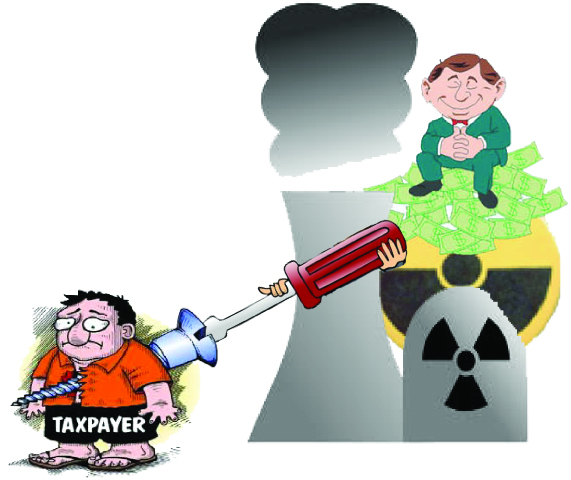
This is what journalist Laure Noualhat demonstrates in her relentless investigative book, Nuclear Power Will Ruin France . The result of six months of investigation, it is published today in the Seuil- Reporterre collection and will be accompanied by a documentary broadcast on YouTube in early June. Through this extensive work, Reporterre is tackling a crucial issue for the future of the country, largely absent from public debate. Because these choices are made in total secrecy, Reporterre is shedding light on a subject that concerns us all.
Here are the previews of “ Nuclear Power Will Ruin France ”:
What were you doing on February 10, 2022 ? For the small world of energy, it was a memorable day. On that day, presidential candidate Emmanuel Macron stood behind a lectern under the immense tin roof of the General Electric plant in Belfort. His voice echoed like a cathedral. Behind him, GE teams had positioned a gigantic Arabelle turbine, 300 tons of gleaming steel lit as if it were an industrial museum piece.
A group of masked employees, all wearing the same electric blue construction jackets, listens learnedly to the president. Four years earlier, these women and men were part of Alstom’s energy division, the industrial flagship that former Economy Minister Emmanuel Macron had conscientiously dismantled during his time at the Ministry of Finance.
No matter, on this Thursday, February 10, the now President has just announced the ” rebirth “ of French nuclear power, boasted of national ” sovereignty “ and praised the merits of ” planning “ to address the challenges of the moment: reducing our CO2 emissions by 55 % by 2050, ensuring France’s industrial development, and controlling the French people’s energy bill.
No law regulates presidential will
Regardless of the background—environmental, energy, nuclear, activist, industrial, or political—this speech hit the mark and is historic. With its delivery, President-candidate Macron has just rescued France from decades of uncertainty by relaunching the mass construction of nuclear reactors. Since its approval in 2003 by the National Assembly, the Flamanville EPR project has been mired in endless setbacks. In 2012, President Hollande chose a contrary path by enshrining in law the reduction of nuclear power’s share to 50 % of the electricity mix by 2025 (compared to 65-70 %) and to 30 % by 2030. In short, the socialist planned a slow phase-out of nuclear power, allowing for the preparation of the decommissioning of the oldest reactors, the ramp-up of renewables, and an unprecedented effort toward energy efficiency.
In February 2017, candidate Macron – a former minister under Hollande – took up this promise.
”
I will maintain the framework of the energy transition law. I am therefore maintaining the 50
% target,
“ he confided to the
WWF during a Facebook Live broadcast watched by 170,000 people and interviewed by… Pascal Canfin, who will join the President’s list for the 2019 European elections.
Five years later, facing General Electric employees, the Jupiterian president performed an about-face. Six
EPR2s will emerge, he promises, built in pairs on three sites: in Penly in Normandy, in Gravelines in the North, and in Bugey in the Ain. And eight more will be under consideration. Neither the French population, nor any parliamentarian or senator had their say, as if nuclear power were democratically held above ground. Since this announcement, the program of the six EPR2s
has still not been validated by any legal decision, much less by an ”
energy and climate programming law
” (
PPE ), which should have been revised for the occasion.
To date, in 2025, no law governs the presidential will shaped by long years of lobbying (by associations such as Xavier Moreno’s Cérémé or Bernard Accoyer’s Nuclear Heritage & Climate, but also Voies du nucléaire or the French Nuclear Energy Society) since his arrival in power.
A colossal cost
Knocking down walls or hiding the misery, insulating here or repainting there, moving the pipes, changing the door… it’s difficult to ask a tradesman for a quote for work if you don’t know what you’re going to do. It’s the same with nuclear reactors.
As these lines are being written, in March 2025, three years after the Belfort speech, no one knows how much the EPR2 will cost . This is normal: their detailed design has not been completed despite the 10.5 million hours of engineering already devoted to the project.
In February 2022, the government had put forward a construction cost of 51.7 billion (2020 euros). In 2023,
EDF made two updates to the costing, noted by the Court of Auditors in its report on the
EPR sector in January 2025:
”
The overnight construction cost [as if the reactor were completed in a single night] of three pairs of
EPR2s rose from 51.7 to 67.4 billion euros [2020 euros], an increase of 30
% under unchanged economic conditions and excluding the effect of inflation.
“ In 2023 euros, the bill reaches 80 billion. For comparison, this figure of 80 billion already represents four times the annual deficit of the Social Security…
Ukrainian attack on Russian bombers shows how cheap drones could upset global security
The June 1 Spider Web operation likely marks the largest attack on a nuclear-armed state’s nuclear assets to date, one that was executed using laptop-sized drones.
While this represents an operational success for Ukraine, it is still unclear whether and how the drone attack will impact Russia’s conduct of the war. Some fear this operation could lead to a nuclear escalation
By Julien de Troullioud de Lanversin | June 5, 2025, https://thebulletin.org/2025/06/ukrainian-attack-on-russian-bombers-shows-how-cheap-drones-could-upset-global-security/?utm_source=ActiveCampaign&utm_medium=email&utm_content=Drones%20attack%20on%20Russian%20bombers%20upset%20global%20security&utm_campaign=20250605%20Thursday%20Newsletter
On Sunday, social media started broadcasting videos of airfields shrouded with columns of smoke and parked airplanes on fire. These were not common airplanes but Russian strategic bombers capable of delivering nuclear weapons virtually anywhere on the globe. Behind these attacks were small drones, like those used to capture scenic social media videos, remotely operated by Ukrainian pilots.
The day after, some Russian media and influential figures called for retaliation with nuclear strikes. On Wednesday, Russian President Vladimir Putin reportedly said in a phone call with President Donald Trump that he planned to retaliate against Ukraine for its surprise attack. According to a reading of the Russian nuclear doctrine, the Ukrainian attacks could technically prompt a nuclear retaliation by Russia.
This military operation is the latest illustration of how cheap, accessible drones are changing modern warfare. It also exposed another reality: Drones will wreak havoc on global stability if nobody controls their proliferation.
A turning point. Last week’s drone operation, which the Ukrainian military called “Operation Spider’s Web” and which was 18 months in the making, looked like it came straight out of a James Bond movie: More than a hundred first-person view drones were secretly shipped inside containers on commercial trucks sent toward locations deep inside Russian territory, nearby highly sensitive military airfields. With just a click from operators based in Ukraine, all containers’ roofs simultaneously opened, and drones navigated to their targets to unleash destruction. The number of aircraft damaged or destroyed is still unclear. (Ukrainian authorities claim 41 aircraft were destroyed.) What is certain, however, is that several of Russia’s most critical and advanced strategic nuclear-capable bombers were damaged.
The drones were likely “Osa” quadcopters, 13-15 inches in length and developed and assembled in Ukraine at a cost of around $600 to $1000 each, according to an early analysis of the attack by the Center for Strategic and International Studies. Each drone likely carried an explosive payload of about 3.2 kilograms and detonated on impact with the targeted airplanes. To communicate with the drones, Ukrainian operators are believed to have used Russian mobile telecommunication networks, such as 4G and LTE connections. It is also likely that the drones were supported by artificial intelligence systems to give them autonomy in case the telecommunication with the operators would break, and to assist in precisely targeting identified weak spots on the airplanes.The drones were likely “Osa” quadcopters, 13-15 inches in length and developed and assembled in Ukraine at a cost of around $600 to $1000 each, according to an early analysis of the attack by the Center for Strategic and International Studies. Each drone likely carried an explosive payload of about 3.2 kilograms and detonated on impact with the targeted airplanes. To communicate with the drones, Ukrainian operators are believed to have used Russian mobile telecommunication networks, such as 4G and LTE connections. It is also likely that the drones were supported by artificial intelligence systems to give them autonomy in case the telecommunication with the operators would break, and to assist in precisely targeting identified weak spots on the airplanes.
The June 1 Spider Web operation likely marks the largest attack on a nuclear-armed state’s nuclear assets to date, one that was executed using laptop-sized drones. It also stands as the most significant demonstration of drones’ ability to penetrate deeply into heavily defended territory with significant strategic impact. While this represents an operational success for Ukraine, it is still unclear whether and how the drone attack will impact Russia’s conduct of the war. Some fear this operation could lead to a nuclear escalation.
For decades, major powers have pursued so-called strategic stability, a situation in which nuclear adversaries are deterred from launching direct military attacks against one another due to their mutually destructive nuclear capabilities. States also realized that continuing to develop more weapons in a never-ending arms race was costly and increased the risks of conflicts. This is why they agreed to engage in arms control and arms reduction, while making sure to maintain strategic stability.
But this fragile balance between great powers has always been vulnerable to new and disruptive technologies such as microchips, precision-guided missiles, or cybertechnology. Drones, especially small and cheap ones, represent a unique challenge to this balance, one that often evades the grasp of major powers.
‘Cheap drone’ warfare. Drone technology is not new. It was already used during the Cold War and has been a hallmark of the war in Iraq, with its precision strikes in the middle of the desert. Military powers such as the United States, Russia, and China have long invested in and developed expensive, highly advanced drones for various missions. Enhanced by artificial intelligence and increasing autonomy, modern drones have already promised to transform warfare by enabling operations without risking human pilots and possibly transforming the decision-making of those using them.
Things took another turn in the 2010s.
Enabled by advances in microelectronics and battery technologies, smaller and cheaper drones started to be mass-produced for commercial purposes by companies like DJI and others. It did not take long for the military to adapt these drones for warfare purposes. Combined with cutting-edge telecommunication technology, these smaller drones could form intelligent swarms and offer real-time video feeds to their operators.
This time, the nuclear powers were not the only ones to engage in the arms race. Unlike other delivery systems, such as missiles or jet fighters that have significantly higher entry costs, smaller states and even non-state actors could acquire inexpensive drones and transform them into rudimentary but effective “air force” and delivery systems.
The simplicity of their acquisition, use, and diffusion into the hands of actors of various sizes around the globe is what makes cheap drones such a game-changer for modern warfare—and now also for global security.
These inexpensive drones enable smaller states to conduct effective asymmetric warfare against more powerful opponents. It is in great part thanks to its drone force that Ukraine has stood its ground against the world’s second-largest military since 2022. Reports indicate that small drones may have contributed to up to 70 percent of Russian equipment losses so far in the conflict—and this number is likely to become higher if the war continues, given Ukraine’s rapidly growing drone production capacity.
More crucially, cheap drones can be used to sabotage well-defended strategic assets. In what is often described as terrorist acts, Yemen’s Houthis have used drones to attack commercial and military vessels in the Red Sea and the Gulf of Aden, thereby disrupting about 12 percent of global trade in 2024. Houthis’ drones also destroyed Saudi Arabia’s critical oil infrastructure, disrupting 5 percent of global oil supply in 2019.
But the most striking instance of their strategic reach remains the Ukrainian operation of June 1. This operation also foreshadows a dangerous shift in global stability.
Risk of escalation. Historically, only major nuclear powers had effective means to inflict damage on the nuclear capabilities of other major powers. And for most nuclear-armed states, an attack on their nuclear capabilities, even a conventional one, called for nuclear retaliation. To avoid nuclear escalation, nuclear powers have carefully crafted doctrines, strategies, and agreements between themselves to create predictability and increase strategic stability. But to a certain extent, this system of balance was not designed with the expectation that smaller actors could threaten critical nuclear assets of the nuclear-armed states.
Smaller states with no nuclear capabilities and less familiar with the game of strategic stability, like Ukraine, might not fully realize the direct or indirect risk of nuclear escalation that their drone operations could entail. More alarming, non-state actors could also potentially actively seek to initiate a nuclear escalation between nuclear adversaries with drone-enabled false flag operations.
Discussions around drone regulation in war often center around their ethical uses and their level of AI-powered autonomy, which are certainly crucial issues to tackle. But states must also recognize the highly disruptive impact that cheap and widely accessible drones can have not only on warfare but on global security and stability.
One way forward is to implement strict export control and purchase regulations on small drones, such as those implemented for small firearms. Such policies will inevitably collide with the booming industry and market of small, cheap drones that are increasingly popular for commercial purposes and leisure activities. But states will need to work on some form of control of drone export and weaponization, lest they are willing to risk more nuclear crises.
Let’s not pretend nuclear works

Funding the Future, Richard Murphy, June 6 2025, https://www.taxresearch.org.uk/Blog/2025/06/06/lets-not-pretend-nuclear-works/
As the Public Accounts Committee has reported this week:
The retrieval of waste from ageing buildings at the most hazardous nuclear site in the UK is not happening quickly enough.
In its report on decommissioning Sellafield, the Public Accounts Committee (PAC) warns that the estimated £136bn cost of the project would rise even more if work is further delayed, while expressing scepticism as to whether or not recent signs of improvement in performance could represent another false dawn.
The PAC found in 2018 that government needed a firmer grip on Sellafield’s nuclear challenges, and now warns that not enough progress has been made in addressing its most significant hazards.
One building, the Magnox Swarf Storage Silo (MSSS), has been leaking radioactive water into the ground since 2018 – the PAC calculates, at current rates, enough to fill an Olympic swimming pool roughly every three years. The Nuclear Decommissioning Authority (NDA) accepts this leak is its “single biggest environmental issue”, but that the radioactive particles are “contained” in the soil and do not pose a risk to the public.
The PAC’s report finds that Sellafield Ltd has missed most of its annual targets for retrieving waste from several buildings on the site, including the MSSS. The PAC’s inquiry heard that the MSSS is the most hazardous building in the UK, and as a result of Sellafield Ltd’s underperformance will likely remain extremely hazardous for longer. The report seeks answers from Government on how it will hold the NDA and Sellafield Ltd to account in ameliorating the site’s greatest hazards.
Nuclear power created the most hazardous building in the UK.
The cost of nuclear cleanups is staggering.
And still, we pretend that nuclear power is a cost-effective way of generating power.
Who do those making this claim think are fooled by it?
Ukraine’s dangerous new ‘gift’ to Washington
Striking Russia’s nuclear assets, Ukraine’s audacious operation newly imperils arms control and ensures that the war will drag on.
Aaron Maté, Jun 07, 2025
An audacious Ukrainian drone attack on four military bases across Russia, dubbed Operation Spider’s Web, handed Moscow one of its worst humiliations of the war. With a fleet of inexpensive drones hidden inside cargo trucks, Ukrainian intelligence penetrated deep inside Russian territory and caused significant damage to military aircraft, including long-range, nuclear-capable bombers. “The strike was a serious blow, and to suggest otherwise is self-delusion verging on sabotage,” wrote Rybar, a popular pro-Kremlin social media channel.
For Ukraine and its Western backers, the strikes reinforce their ability to inflict significant costs on Russia more than three years into an invasion that Kyiv was expected to lose within days — and bolster the case for continued US support. For Ukrainian president Volodymyr Zelensky, the images of smoldering Russian aircraft “help change the rhetoric in the US,” where it can no longer be said, as Donald Trump argued in their Oval Office showdown, that “Ukrainians are losing this war, and don’t have the cards.” Added former senior Zelensky aide Oleg Ustenko: “Trump said we don’t have the cards — this shows we do have the cards, and we can play them.”
Powerful elements in Washington would undoubtedly agree. By targeting part of Russia’s nuclear triad, “[s]ome officials said Ukraine’s drone attacks could be viewed as a gift to the United States,” the New York Times reported. Days after visiting Kyiv to promote his push for harsh sanctions on Russia’s trading partners, Republican Senator Lindsey Graham hailed Ukraine’s “ever-resourceful” effort “to successfully attack Russian bombers and military assets.”
As grateful proxy war sponsors like Graham illustrate, Ukraine had ample grounds to believe that it was handing the US a “gift.”…………………………………………………………………………..https://www.aaronmate.net/p/ukraines-dangerous-new-gift-to-washington?utm_source=post-email-title&publication_id=100118&post_id=165354982&utm_campaign=email-post-title&isFreemail=true&r=ln98x&triedRedirect=true&utm_medium=email
Ukraine “Stinks Of Authoritarianism” – Kiev Mayor Klitschko Hits Out At Zelensky

Meanwhile, after earlier in the week calling for three way meetings between himself, President Trump and Putin, Zelensky has now declared that it would be “meaningless” and instead wants more military aid.
by Tyler Durden, Tuesday, Jun 03, 2025
Authored by Steve Watson via Modernity.news,
The former mayor of Kiev, Vitali Klitschko has blasted Ukrainian President Volodymyr Zelensky, and bluntly stated that the country is plagued by authoritarianism.
The former world heavyweight champion boxer told the Times of London that Kiev City Council essentially cannot operate because of “raids, interrogations and threats of fabricated criminal proceedings.”
“This is a purge of democratic principles and institutions under the guise of war,” Klitschko declared, adding “I once said that it smells of authoritarianism in our country. Now it stinks of it.”
The Times describes Zelensky and Klitschko as being in a “de facto state of war.”
The report notes that the Ukrainian government has arrested seven Kiev city officials as part of ongoing investigations targeting an alleged criminal network involved in corruption cases related to urban development.
“Many mayors are intimidated, but my celebrity status is a protection,” Klitschko stated, adding “You can dismiss the mayor of Chernihiv, but it is very difficult to dismiss the mayor of the capital, whom the whole world knows.”
“That is why everything is being done to discredit and destroy my reputation,” he further urged.
Zelensky has reportedly been considering arresting Klitscho after he called for the President to consider ceeding Crimea to Russia as part of a peace deal.
This fued has been ongoing for sometime. A year and a half ago, Klitschko urged that Zelensky failed to prepare Ukraine properly for the war with Russia and will “pay for his mistakes.”
Meanwhile, after earlier in the week calling for three way meetings between himself, President Trump and Putin, Zelensky has now declared that it would be “meaningless” and instead wants more military aid.
A major escalation is expected after Ukraine launched a massive drone attack on Russian airbases Sunday, which many are equating with the Japanese attack on Pearl Harbor.
The true cost of the nuclear weapons industry
The CND responds to Starmer’s growing militarism with a ‘Tour of the bases’ protest. TONY STAUNTON reports from Plymouth
Morning Star 6th June 2025 https://www.morningstaronline.co.uk/article/true-cost-nuclear-weapons-industry
NE of the most outrageous elements of Starmer’s offensive Strategic Defence Review is the suggestion of a “Defence Dividend.” Our demand for “Welfare not Warfare” is acutely illustrated by the reality of life for working-class communities surrounding military nuclear sites.
Plymouth Devonport, with the Trident nuclear submarine base situated at its heart, is one of the poorest electoral wards in southern England.
The Devonport nuclear naval base is managed by Babcock International plc, the arms manufacturer with an annual turnover of £4.5 billion, profits mostly contrived out of taxpayers’ hefty payments.
That the nuclear weapons are in the hands of private corporations for profit surely undermines the concept of national security — Babcock is the main benefactor of the local freeport, deregulating its secret nuclear enterprise.
Plymouth’s Establishment constantly reminds the population that the nuclear facility is responsible for 10 per cent of the city’s economy. This alone is a fabrication. The highly paid nuclear engineers and scientists at the base live outside the infrastructure-poor city and take their incomes with them.
It’s been like this for 40 years. There has been no “Plymouth dividend.” One in three children in Devonport and neighbouring wards live in poverty, surely impossible were the dockyard to really be a “jobs magnet.”
In fact, a total of 5,500 people work there, half as naval service personnel with little local connection. The wages of many of the rest are nothing to shout about.
Meanwhile Devonport’s local index of social deprivation according to the Public Health Service is 44, twice the annual average. Nuclear weaponry does not produce social wealth and prosperity.
Investment in arms industries take the money away from social infrastructure. Plymouth has the huge regional hospital, Derriford, now in a financial meltdown, making cuts to the 11,000 staff and standards of service.
The hospital is reliant upon the addition of medical staff from the Royal Navy, offering a false-propaganda device for Babcock as the city’s benefactor.
Plymouth University is in financial crisis, with over 5,000 staff easily competing with the dockyard as an income generator for the city (students live in the city centre), now making 200 redundancies.
Babcock funds nuclear research and training at the Uni and FE College, making them beholden, uncritical, and pro-nuclear across the curriculum.
Plymouth’s Labour Council, combating potential bankruptcy and absurd debt levels, has always supported the nuclear dockyard, championing the military nuclear cause, the status of nuclear weaponry, and the nationalism it projects.
The council has half the workforce of 20 years ago. Our schools are crumbling, all “academised’ with the continuous shedding of staff.
Meanwhile, there have been at least 10 serious accidents at the dockyard including spills of radioactive waste in the past 30 years, Babcock was fined over £600,000 in 2022 for breaches in health and safety regulations (H&S). Human-made toxic radioactive elements are identifiable in our sea, rivers, soil and air.
Plymouth is the decommissioning centre for nuclear vessels, 15 rotting nuclear submarines bobbing at anchor and costing £30 million a year to “keep safe,” their nuclear cores needing constant cooling and the rusting hulks routinely patched to prevent leaks.
The subs are the subject of stalled decommissioning, the authorities not sure what to do with these hulks of radioactive waste. Were the UK’s nuclear weapons to be cancelled tomorrow, there is at least 100 years of work here, just to decommission and clean up the contamination.
Yet now they’re going to build more. Plymouth Devonport nuclear dockyard is receiving £1 billion to refit the dry docks in order to service the Dreadnought super-submarines carrying nuclear warheads up to 300 times the power of the bomb dropped on Hiroshima in 1945. The contract will suck-up 600 construction workers much needed for house building and home-retrofitting, the city is littered with half-finished buildings lost to skill shortages.
We all can list what £1 billion could do for the city if invested in social infrastructure and climate jobs.
Plymouth, our coastline dramatic and beautiful, could long have been a centre for construction of wind and wave electricity generators, our geography predisposed, but those industries are not nearly as profitable as the tax-funded nuclear blank-cheque cash cow.
Nuclear weapons are not just illegal weapons of mass destruction, they represent the impoverishment of working-class lives.
Join us on Saturday to send a powerful message to the government to shift its disastrous direction and invest in Peace not Nukes! March and rally. Meet at 12 noon at the Guildhall Square, Armada Way, Plymouth and from 2pm at Devonport MoD Naval Base, Camels Head.
Tony Staunton is CND vice-chair and Plymouth resident.
TASC’s new legal challenge against Sizewell C’s secret flood defences
by Together Against Sizewell C (TASC
ASC urgently need your help in our battle against the environmentally
damaging Sizewell C project. We have discovered that the project now
includes a stated commitment by Sizewell C Ltd to the Office for Nuclear
Regulation (ONR) to install additional sea defences in a ‘credible maximum’
climate change scenario. These defences in the form of two huge 10 metre
high ‘overland flood barriers’ were not included in the approved DCO
project. In our opinion, these flood barriers, if installed, will likely
have additional adverse impacts on the neighbouring designated wildlife
sites including RSPB Minsmere as well as the Heritage Coast and Suffolk
Coast & Heaths National Landscape. We need to ensure that the original
promotor EDF and the now UK government controlled Sizewell C Ltd are not
allowed to use climate change uncertainties as an excuse to delay
assessment and avoid public scrutiny of these additional structures for
decades. The full impact of the whole project should be assessed now.
Crowd Justice 5th June 2025,
https://www.crowdjustice.com/case/sizewell-c-legal-challenge/
Vatican City Is Now Powered By Solar

Carolyn Fortuna, May 2025
Vatican City Is Now Powered By Solar. Pope Francis had a dream that the
Vatican would run entirely on green energy. He wanted to highlight the need
“to make a transition to a sustainable development model that reduces
greenhouse gas emissions into the atmosphere, setting the goal of climate
neutrality.”
To model what this could look like, he announced that solar
panels would be installed on a Vatican-owned property outside Rome, and the
power generated from that could supply all of Vatican City’s energy
needs. The future installation would be projected to “ensure, not only
the power supply of the radio station existing there, but also the complete
energy support of Vatican City State,” he wrote. Fast forward to 2025,
and the project is completed.
Clean Technica 29th May 2025,
https://cleantechnica.com/2025/05/29/vatican-city-is-now-powered-by-solar/
Sellafield failing to address ‘intolerable risks’, damning parliamentary report warns
Sam Baker, Staff reporter, The Chemical Engineer, 6 June 25
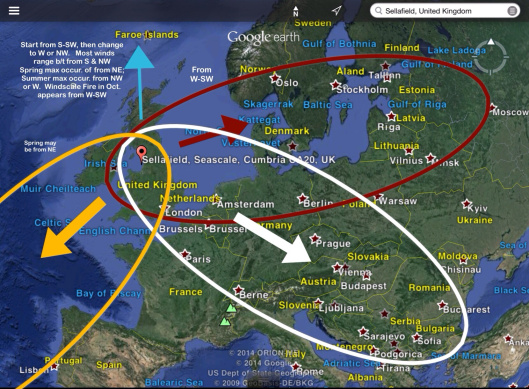
MANAGEMENT of the Sellafield nuclear facility in Cumbria, UK is not responding quickly enough to “intolerable risks” at the site posed by ageing assets, a damning new report has warned.
In the report published yesterday, the UK Public Accounts Committee (PAC), a group of MPs tasked with evaluating the cost-effectiveness of public spending projects, said that deteriorating assets are making the site “increasingly unsafe”.
Sellafield, the UK’s oldest nuclear site, has been in the long process of decommissioning since it stopped generating power in 2003, overseen by wholly state-owned Sellafield Ltd, and now works primarily in processing spent nuclear fuel.
The PAC’s report found that sluggish progress in decommissioning Sellafield has meant Sellafield Ltd has missed most of its annual targets in retrieving waste. This includes radioactive waste currently stored in Sellafield’s Magnox Swarf Storage Silo (MSSS), the UK’s most hazardous building.
After setting a target to have emptied the MSSS of waste by 2046, Sellafield Ltd now does not expect to achieve this until between 2054 and 2059. Problems at the MSSS are also behind the plant’s “single biggest environmental issue” – radioactive water has been leaking into the ground since 2018. Sellafield Ltd has confirmed that radioactive particles are “contained” in the soil and that there is no risk to the public…………………………………………………………………………………………………………………………..
Money not well spent
The current estimate for the total cost to the public of decommissioning Sellafield is £136bn (US$184bn), with completion expected no earlier than 2125, although problems identified by the PAC are likely to see the cost rise and the completion delayed.
One example of overspend highlighted in the report was the water sample lab refurbishment, which the PAC said was “very poorly managed” leading to a “waste” of £127m.
The report also resurfaced past issues of bullying and harassment at Sellafield, which the NDA settled in 2023-24 for £377,200. The PAC pointed out that Sellafield Ltd has signed 16 non-disclosure agreements in the last three years. These are separate from the Official Secrets Act which most staff routinely sign when joining Sellafield.
Clifton-Brown acknowledged the “early indications of some improvement” at Sellafield but said that the “government must do far more to hold all involved immediately accountable to ensure these do not represent a false dawn, and to better safeguard both the public purse and the public itself”………………………………………………………………………………………………………………………………………………………………
Not going underground
Sellafield’s troubles this week do not end with the PAC report. On Tuesday, Lincolnshire County Council withdrew its candidacy to host a geological disposal facility (GDF) that could store radioactive plutonium for thousands of years once retrieved from stockpiles at Sellafield.
As recently as July 2024, a site in Theddlethorpe in Lincolnshire was a leading candidate to build the GDF. However, the newly elected council, led since May 2025 by Reform UK, this week revoked its membership of the nuclear waste community partnership, which council leader Sean Matthews described as a “nuclear nightmare”.
Announcing the results of the vote to withdraw membership, Matthews, a former London police officer, said: “Now, Lincolnshire people can get back to living their lives, assured that this nuclear nonsense is over.” https://www.thechemicalengineer.com/news/sellafield-failing-to-address-intolerable-risks-damning-parliamentary-report-warns/
Nuclear-powered submarines, F35A fighter jets, a ‘more lethal’ army by 2035, and AI: How Starmer will spend billions to beef up Britain’s defences to make country ‘war-ready’
By MARK NICOL DEFENCE AND DIPLOMACY EDITOR, 3 June 2025 , https://www.dailymail.co.uk/news/article-14773857/Nuclear-powered-submarines-fighter-army-2035-Starmer.html
More submarines, soldiers and drones, along with an airborne nuclear strike capability and the exploration of technologies such as lasers, AI and robotics, are among the proposals in the Strategic Defence Review.
These are the key ambitions outlined in the SDR:
Army to be ‘ten times more lethal’
This ambition relies on the harnessing of new technologies and weapon systems, particularly drones. Lethality is difficult to measure and the claim is strong on political rhetoric.
Only a couple of months ago, the Chief of the Defence Staff, Admiral Sir Tony Radakin, said the ambition was to double lethality by 2027 and triple it by 2030.
The new Archer artillery system, the belated introduction of the Ajax vehicle and Challenger 3 tanks will increase lethality… but to what extent?
Three forces to be integrated into one
The Integrated Force, unveiled as part of the SDR, is not a merger of the Armed Forces, but they will lose much of the traditional
independence as they are moulded into a centralised Integrated Force. The SDR suggested the services were ‘siloed’. The need for them to train together and prepare for war shoulder to shoulder was essential in the months and years ahead.
£15billion boost for nuclear warheads
Britain’s nuclear deterrent has long been in need of recapitalisation. The £15billion will pay for these weapons to be upgraded or replaced.
It will also see the significant modernisation of infrastructure at the Atomic Weapons Establishment at Aldermaston, supporting more than 9,000 jobs at the Berkshire site
Up to 12 new nuclear attack submarines
The as yet uncosted pledge to develop ‘up to’ 12 new attack submarines has been welcomed by military observers but the first boat is not expected to enter service before the late 2030s.
The submarines will support the AUKUS security alliance between the UK, Australia and the United States and will be used to protect the Pacific from Chinese aggression.
Over the decades ahead, the boats will replace the Royal Navy’s current fleet of seven Astute-class submarines. They will be built at key sites such as BAE in Barrow-in-Furness.
Over the decades ahead, the boats will replace the Royal Navy’s current fleet of seven Astute-class submarines. They will be built at key sites such as BAE in Barrow-in-Furness.
Six new factories to make munitions
The SDR proposes at least six factories making munitions and energetics such as explosives and propellants for weapons.
The SDR recommends creating an ‘always on’ munitions production capacity in the UK, allowing production to be scaled up at speed if needed.
Britain’s military warehouses are bare after £5billion in weaponry and munitions was provided for Ukraine since the start of the conflict in 2022. The programme will create more than 1,000 skilled jobs, according to the SDR.
Robotics, cyber warfare and AI
The review says AI will improve the quality and speed of decision-making and operational effectiveness for Britain’s military, its allies… and its enemies.
It should be an immediate priority to ‘shift towards greater use of autonomy and AI within the UK’s conventional forces’. This has shown to be transformational in Ukraine. Chiefs will launch a Defence AI Investment Fund by February 2026.
The report warns cyber threats will become harder to mitigate as technology evolves, with government departments, military hardware, communications, increasingly vulnerable.
Hardening critical defence functions to cyber-attack is crucial. Directed Energy Weapon systems, such as the UK’s DragonFire, a world-leading laser ground to air system being developed at Porton Down, Wiltshire, can save millions of pounds in expenditure on ordnance systems.
The review also calls for the MoD to seize the opportunities presented by technologies such as robots and lasers.
£4billion expansion of the drone force
The Government unveiled a £4billion investment package for drones and autonomous systems. Drones are dominating the conflict in Ukraine and in Russia, following the audacious Ukrainian attack on Russian airfields in Siberia just days ago.
Hardening critical defence functions to cyber-attack is crucial. Directed Energy Weapon systems, such as the UK’s DragonFire, a world-leading laser ground to air system being developed at Porton Down, Wiltshire, can save millions of pounds in expenditure on ordnance systems.
The review also calls for the MoD to seize the opportunities presented by technologies such as robots and lasers.
£4billion expansion of the drone force
The Government unveiled a £4billion investment package for drones and autonomous systems. Drones are dominating the conflict in Ukraine and in Russia, following the audacious Ukrainian attack on Russian airfields in Siberia just days ago.
Fighter jets to carry nuclear bombs
Britain is exploring the potential return of air-delivered nuclear weapons in collaboration with the United States. America’s F-35A Lightning II aircraft is capable of carrying tactical gravity nuclear bombs.
The proposal marks the most significant shift in UK nuclear posture since the Cold War. Currently, this country’s nuclear deterrent is carried by the Royal Navy’s ‘bomber’ submarines.
The air-launched nuclear weapons would carry a much smaller payload. The lower yield B61 munitions are already integrated into US aircraft stationed on continental Europe and could be brought to Britain.
Thousands of new long-range weapons
At least 7,000 long-range weapons will be made to restock UK military warehouses and to prepare for an extended conflict against an adversary such as Russia.
Children taught value of the military
Defence chiefs will work with the Department for Education to develop understanding of the Armed Forces among young people in schools, by means of a two-year series of public outreach events across the UK, explaining current threats and future trends.
Schools and community-based cadet forces will also be expanded, with an ambition of a 30 per cent rise by 2030 with a view to the UK having 250,000 cadets, many of whom will then go on to join the armed forces.
More reservists and investment in them
To meet the challenge of engaging in a lengthy conflict, the report identified the need to boost the number of reservists.
These part-time personnel, many of whom are former regulars with operational experience, would join full-time troops on the frontline.
The report identified the need to increase the size of the UK’s Active Reserve forces by at least 20 per cent ‘when funding allows, most likely in the 2030s’.
The UK has around 25,000 Army reservists, 3,500 Royal Navy and Royal Marines reservists and 3,200 RAF reservists.
Russia at a Crossroads
Ukraine’s devastating drone strike deep into Russian territory is a gauntlet thrown down. Will Russia under Putin’s leadership ever be able to persevere to the point of claiming a clear victory?
Or has Ukraine under the leadership of Zelensky just changed the dynamic to the point of proving to the collective West that he is a leader worthy of continued support to the point of victory at all cost?
June 3, 2025, Consortium News, https://consortiumnews.com/2025/06/03/russia-at-a-crossroads/
Moscow’s military campaign under Putin’s leadership has focused on avoiding escalation, says John Wight. But Ukraine’s drone strike deep into Russian territory is a gauntlet thrown down.
Russian President Vladimir Putin now finds himself at a monumental crossroads when it comes to his stewardship of Russia at a time when nuclear Armageddon has never been closer.
Ukraine’s devastatingly successful and audacious strike against Russia’s long-range strategic bomber aircraft stock marks a major inflection point in a conflict that evidences no sign of ending.
But let us not lose sight of the salient fact that Russia is not engaged in a conflict with President Volodymyr Zelensky’s Ukraine. This is instead a conflict pitting the Russian Federation against NATO, with Ukraine a proxy of the latter. And NATO is taking advantage of Putin’s caution.
No consequential conflict has ever been won by half-measures. General William Sherman’s “March to the Sea” arguably did more to break the Confederacy than President Abraham Lincoln’s famed Emancipation Proclamation. The Allies firebombing of Dresden in February 1945 and the Soviets arrival on the outskirts of Berlin on April 25, 1945, did more to break the back of the Germans than Hitler’s suicide nine days later. The Vietnamese won their national liberation with the fully-committed and symbolically important Tet Offensive of 1968 rather than all of the diplomatic machinations that came thereafter.
Russia’s military campaign at Putin’s direction has placed a priority on avoiding escalation. But it is a posture that has invited escalation, evidenced by this latest major turn of events.
Russia has been fighting the West diplomatically but not militarily, while Ukraine under Zelensky has been waging its conflict with Russia in the name of the strategic aims of NATO, rather than the interests of Ukraine and its people.
Russia is at a decisive point. Does it continue its war carefully to avoid confrontation with NATO, while encouraging its continued provocations, or does it take the hardline approach of Yevgeny Prigozhin, the late outspoken leader of Russia’s Wagner Group, who made repeated demands for national mobilization in the name of a speedy victory dictated by Russia’s far superior mass and weight of industrial potential.
Putin is a deft leader. Even his adversaries in the corridors of power in the West would grudgingly admit this given his long record in power in the Kremlin. It was he who dragged Russia out of the free market abyss into which the country and its people were plunged in the wake of the demise of the Soviet Union in the early 1990s.
Putin’s Rebuilding of Russia
In the process, Putin succeeded in restoring the primacy of the state over a new rising Russian economic oligarchy — one that had been happy to allow the masses of the Russian people into the arms of destitution and despair because of its own greed and corruption.
The Russian leader then set about rebuilding state institutions that had been destroyed in the name of the religion of free market capitalism, with the result that slowly but surely a new state emerged from the ashes of the old. Russia regained pride in a new identity embraced the indispensable role of the Soviet Union in defeating the Nazis in World War II with respect for the pre-Bolshevik role of the Russian Orthodox church as a pillar of spiritual stability and social cohesion.
From the Russian standpoint, this is why Putin is credited as their historical version of Franklin Delano Roosevelt, the U.S. president who likewise saved his country from the abyss during the 1930s, when the Great Depression was at its terrible and destructive zenith and then went on to lead the bulk of the U.S. war effort during World War II.
But Putin has, it appears, misread the West’s resolve in this period of the rapidly shifting tectonic plates of geopolitics. Putin’s reasoning has been the avoidance of escalation to direct military conflict with the collective Western powers. However those powers are already heavily involved in the arming, training and direction of Kiev’s war effort.
So where now and what now?
Ukraine’s devastating drone strike deep into Russian territory is a gauntlet thrown down. Will Russia under Putin’s leadership ever be able to persevere to the point of claiming a clear victory? Or has Ukraine under the leadership of Zelensky just changed the dynamic to the point of proving to the collective West that he is a leader worthy of continued support to the point of victory at all cost?
President Donald Trump’s dressing down of the Ukrainian leader in the Oval Office back in March was driven and motivated by the belief that Ukraine’s war effort was faltering. Zelensky in this context appeared isolated, adrift and weak.
Well, not anymore.
They Dumped 200,000 Radioactive Barrels Into the Atlantic: 35 Years Later, French Scientists Are Going After Them.

For decades, radioactive barrels have sat hidden beneath the Atlantic, untouched and untracked. Now, French scientists are setting out on a mission unlike any before.
Arezki Amiri, May 29, 2025, https://indiandefencereview.com/they-dumped-200000-radioactive-barrels-into-the-atlantic-35-years-later-french-scientists-are-going-after-them/
For decades, they lay untouched and largely forgotten—hundreds of thousands of barrels filled with radioactive waste, scattered across the abyssal plains of the Atlantic Ocean. Now, more than 30 years after the last were submerged, a French scientific mission is preparing to search for them, raising fresh questions about the long-term impact of nuclear dumping at sea.
Decades-Old Barrels, Deep-Sea Mysteries
Between 1946 and 1990, over 200,000 barrels of radioactive waste were deliberately sunk into the Atlantic by various nations, including France. Packed in bitumen or cement, the containers were lowered into what scientists at the time considered to be lifeless zones, thousands of meters below the ocean surface and far from any coastline.
The practice was permitted until 1990, when it was banned under the London Convention following growing awareness of deep-sea ecosystems and the potential environmental risks of radioactive leakage. The barrels were never retrieved, and no comprehensive effort has since been made to assess their state—or their potential impact on marine life.
An Ambitious Mission Beneath 4,000 Meters
This summer, a group of French researchers will head into the Atlantic to do just that. The mission, called Nodssum, is a collaboration involving CNRS, Ifremer, and the French Oceanographic Fleet. Their immediate goal is to map a 6,000-square-kilometer section of the seafloor where a significant number of barrels are believed to be resting.
To locate them, the team will deploy a high-resolution sonar system and the autonomous submersible UlyX, one of the few underwater vehicles capable of operating at depths greater than 4,000 meters. UlyX will scan the ocean bottom, helping to establish the precise location of the containers and assess their current condition.
Questions of Leakage and Contamination
So far, the environmental effects of the submerged barrels remain unknown. As the article notes, “no one knows what impact the dumping of these barrels may have had on deep-sea ecosystems, or whether they still represent a radiological risk.” Part of the challenge lies in the vastness and inaccessibility of the ocean floor where the barrels were dropped.
Once the mapping phase is complete, a second campaign will be launched to collect samples of sediments, seawater, and marine organisms near the barrels. These samples will help determine whether radioactive materials have begun to escape their containers and what effect, if any, that may be having on surrounding ecosystems.
Unknowns Beneath the Surface
The mission represents one of the first large-scale scientific efforts to investigate this Cold War-era dumping ground. While scientists long assumed that the deep sea was barren and isolated, more recent research has shown that it is home to complex ecosystems, many of which remain poorly understood.
The researchers hope that the project will provide new insights into the long-term stability of radioactive waste in deep-sea environments and offer a clearer understanding of how past nuclear policies continue to shape today’s oceans.
Sellafield nuclear clean-up too slow and too costly, say MPs

Alex Lawson, 4 June 25 https://www.theguardian.com/business/2025/jun/04/sellafield-nuclear-clean-up-mps-public-accounts-committee
Parliamentary committee raises concerns over ‘suboptimal’ workplace culture at ageing waste dump.
MPs have warned about the speed and cost of cleaning up the Sellafield nuclear waste dump and raised concerns over a “suboptimal” workplace culture at the site.
Members of parliament’s public accounts committee (PAC) urged the government and bosses at the sprawling collection of crumbling buildings in Cumbria to get a grasp on the “intolerable risks” presented by its ageing infrastructure.
In a detailed report into the site, the PAC said Sellafield was not moving quickly enough to tackle its biggest hazards; raised the alarm over its culture; and said the government was not ensuring value for money was being achieved from taxpayer funds.
In 2023, the Guardian’s Nuclear Leaks investigation revealed a string of safety concerns at the site – including escalating fears over a leak of radioactive liquid from a decaying building known as the Magnox swarf storage silo (MSSS) – as well as cybersecurity failings and allegations of a poor workplace culture.
The PAC – which heard evidence in March from Sellafield and its oversight body, the Nuclear Decommissioning Authority (NDA) – found that the state-owned company had missed most of its annual targets to retrieve waste from several buildings, including the MSSS.
“As a result of Sellafield’s underperformance [the MSSS] will likely remain extremely hazardous for longer,” the MPs said.
The ultimate cost of cleaning up Sellafield, which contains waste from weapons programmes and atomic power generation, has been estimated at £136bn and could take more than 100 years.
Geoffrey Clifton-Brown, the chair of the PAC, said: “Unfortunately, our latest report is interleaved with a number of examples of failure, cost overruns, and continuing safety concerns. Given the tens of billions at stake, and the dangers on site to both the environment and human life, this is simply not good enough.”
He added: “As with the fight against climate change, the sheer scale of the hundred-year timeframe of the decommissioning project makes it hard to grasp the immediacy of safety hazards and cost overruns that delays can have.
“Every day at Sellafield is a race against time to complete works before buildings reach the end of their life. Our report contains too many signs that this is a race that Sellafield risks losing.”
MPs noted that one project, a now-paused replacement of an on-site lab, had resulted in “£127m wasted”.
The cost of cleaning up Sellafield has caused tensions with the Treasury as the chancellor, Rachel Reeves, attempts to tighten public spending and spur growth. Sellafield, which is home to the world’s largest store of plutonium, said in February that nearly £3bn in new funding was “not enough”.
Last year, Sellafield apologised and was fined £332,500 after it pleaded guilty to criminal charges over years of cybersecurity failings.
The PAC noted that the timeline for a government project to create a long-term deep underground store for nuclear waste, including that held at Sellafield, had slipped from 2040 to the late 2050s. The government is considering sites in Cumbria and Lincolnshire, although Lincolnshire county council is expected to withdraw the latter from the process after vocal local opposition.
The MPs said they had found “indications of a suboptimal culture” at Sellafield, and noted that the NDA paid £377,200 in 2023-24 to settle employment-related claims. Alison McDermott, a former HR consultant who raised concerns over bullying and a “toxic culture” at the site, said she felt “vindicated” by the report.
The PAC urged the government to set out how it would hold the NDA and Sellafield to account over its performance. It said Sellafield should report annually on progress against targets and explain how it is addressing the deteriorating condition of its assets. The NDA should publish data on the prevalence of bullying and harassment at nuclear sites, it said.
Clifton-Brown said there were “early indications of some improvements in Sellafield’s delivery” but said the government needed to do “far more” to ensure bosses safeguard the public and taxpayer funds.
The NDA’s chief executive, David Peattie, responding on behalf of Sellafield, said: “We welcome the scrutiny of the committee and their report. We will now look in more detail at the recommendations and consider how best to address them.
“We take the findings seriously, and the safety of the site and the wellbeing of our people will always be our highest priorities.”
A spokesperson for the Department for Energy Security and Net Zero said: “We expect the highest standards of safety and security as former nuclear sites are dismantled, and the regulator is clear that public safety is not compromised at Sellafield.
“We continue to support the Nuclear Decommissioning Authority in its oversight of Sellafield, while driving value for money. This is underpinned by monthly performance reviews and increased responsibility for overseeing major project performance, enabling more direct scrutiny and intervention.
“We have zero-tolerance of bullying, harassment and offensive behaviour in the workplace – we expect Sellafield and the NDA to operate on this basis, investigate allegations and take robust action when needed.”
Sizewell C nuclear power plant ‘could get go-ahead within weeks’

Keir Starmer expected to confirm result of 15-year search for investment at UK-France summit next month
Jillian Ambrose, 3 June 25, https://www.theguardian.com/business/2025/jun/03/sizewell-c-nuclear-power-plant-keir-starmer-uk-france-edf
UK ministers could give the go-ahead to the new Sizewell C nuclear power plant in Suffolk within weeks, according to reports.
Keir Starmer is expected to give the final nod to begin construction of Britain’s second new nuclear power project in a generation, alongside the French nuclear developer EDF, at a Franco-British summit next month.
The final approval for Sizewell C, first reported by the Financial Times, would mark the end of a 15-year journey to secure investment for the plant since the site was first earmarked for new nuclear development in 2010.
The government is understood to be in the final stages of securing billions of pounds of investment from the private sector to back the project, which follows the Hinkley Point C nuclear plant, which is under construction in Somerset.
Ministers are expected to use the government’s spending review, scheduled for 11 June, to set out the UK’s investment in the project, which will ultimately rely on a mix of funding from taxpayers and via energy bills.
The final go-ahead from Starmer and the French president, Emmanuel Macron, will then follow during the Anglo-French summit due to take place in London on 8-10 July, according to the Financial Times.
The UK government’s stake in the project stood at 84% at the end of last year compared with EDF’s 16% share of the project. The French state’s cash-strapped utilities company is understood to be eager to reduce its stake in the project even further.
Potential investors in the project according to the report include Schroders Greencoat, Equitix, the Canadian pension fund CDPQ, Amber Infrastructure Partners, Brookfield Asset Management, the UK pension fund USS and the insurer Rothesay, backed by the Singaporean infrastructure fund GIC.
EDF had originally planned to build the nuclear plant alongside China’s state nuclear developer China General Nuclear Power Corp, which also holds a stake in the Hinkley Point C project, but its partner was forced to step back from the project by the UK government on security grounds.
The project has secured £6.4bn of government funding to support its development to date, of which £2.5bn was granted by the Conservative government under Rishi Sunak and a further £3.9bn has come from the current Labour administration.
1 This Month

petition to oppose the rapid increase of space-military industry threatening Jeju Island and the region.
[Petition by April 19th (KST)] Stop the joint military-Hanwha Systems-Jeju Provincial Government Sea Launch!
World Nuclear Power. Reactors 1951-2026, 75 Years of Nuclear Power.
Interactive Map– https://dv.worldnuclearreport.org/

Chernobyl: The Lost Tapes – A good documentary on Chernobyl on SBS available On Demand for the next 3 weeks– https://www.sbs.com.au/ondemand/tv-program/chernobyl-the-lost-tapes/2352741955560

of the week–London Campaign for Nuclear Disarmament


Tell the Ukrainian Government to Drop Prosecution of Peace Activist Yurii Sheliazhenko
To see nuclear-related stories in greater depth and intensity – go to https://nuclearinformation.wordpress.com
-
Archives
- April 2026 (211)
- March 2026 (251)
- February 2026 (268)
- January 2026 (308)
- December 2025 (358)
- November 2025 (359)
- October 2025 (376)
- September 2025 (257)
- August 2025 (319)
- July 2025 (230)
- June 2025 (348)
- May 2025 (261)
-
Categories
- 1
- 1 NUCLEAR ISSUES
- business and costs
- climate change
- culture and arts
- ENERGY
- environment
- health
- history
- indigenous issues
- Legal
- marketing of nuclear
- media
- opposition to nuclear
- PERSONAL STORIES
- politics
- politics international
- Religion and ethics
- safety
- secrets,lies and civil liberties
- spinbuster
- technology
- Uranium
- wastes
- weapons and war
- Women
- 2 WORLD
- ACTION
- AFRICA
- Atrocities
- AUSTRALIA
- Christina's notes
- Christina's themes
- culture and arts
- Events
- Fuk 2022
- Fuk 2023
- Fukushima 2017
- Fukushima 2018
- fukushima 2019
- Fukushima 2020
- Fukushima 2021
- general
- global warming
- Humour (God we need it)
- Nuclear
- RARE EARTHS
- Reference
- resources – print
- Resources -audiovicual
- Weekly Newsletter
- World
- World Nuclear
- YouTube
-
RSS
Entries RSS
Comments RSS
 nuclear-news