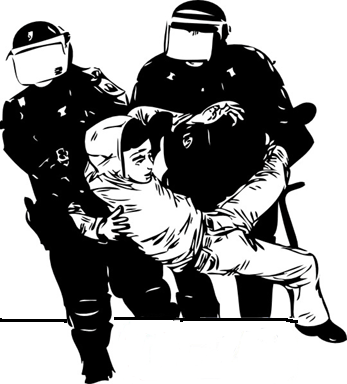
CRACKDOWN IN RUSSIA: CRITICS ACCUSE NUCLEAR AUTHORITIES OF SOVIET-STYLE COVER-UPS AND HEAVY-HANDED TACTICS, Newsweek, BY MARC BENNETTSOne thing that’s clear: The risks are growing for environmental and human rights activists who take on the powerful nuclear agency. Just ask Nadezhda Kutepova, 45, the head of a human rights organization that helped the victims of radiation pollution in and around Ozyorsk. “At first, I didn’t pay much attention to the reports about the radioactive pollution, but as soon as I heard that Rosatom had said everything was OK and that Mayak officials were denying an accident had taken place, I started to monitor the situation,” she tells Newsweek. “These are very cynical people.”
Kutepova was born in Ozyorsk in 1974. Her father worked at Mayak for 35 years and took part in the 1957 clean-up. He died of cancer in 1985, but the Soviet authorities never officially admitted that the illness was linked to his job. In 2007, after a long legal battle, Kutepova forced the government to recognize her father as a victim of occupational radiation sickness. Neither Kutepova nor her mother, however, received compensation.
Kutepova didn’t fight only for her family. She also tried to force Rosatom to pay for medical treatment for locals affected by illnesses related to decades of atomic pollution. In 2013, Kutepova discovered the first known case of third-generation radiation sickness in the region. The case involved a 6-year-old girl named Regina Khasanova who died of cancer. Medical experts said her death was caused by genetic mutations that resulted from the radiation her grandmother was exposed to during the 1957 clean-up at Mayak.
Two years later, Kutepova was forced to flee Russia after state TV accused her of trying to exploit the nuclear issue to foment revolution. Another report said she was attempting to destroy Russia’s nuclear deterrent on behalf of the United States. The purported evidence? Her human rights group received financing from the U.S. government–funded National Endowment for Democracy, which Russian officials have accused of seeking to topple Putin. (The NED says its aim is to promote worldwide democracy.) “We never covered up this funding,” Kutepova says. “We also received funds from organizations in Canada, Germany and the Netherlands.”
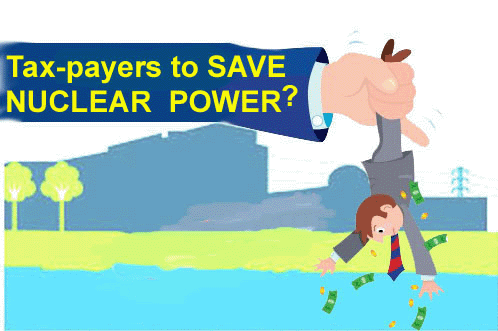
Updating and cleaning up Dutch nuclear industry could cost state €400m http://www.dutchnews.nl/news/archives/2017/12/updating-and-cleaning-up-dutch-nuclear-industry-could-cost-state-e400m/Updating the Netherlands nuclear industry could cost the state up to €400m, according to a review by four senior civil servants and quoted in Tuesday’s Volkskrant. Officials from the economic affairs, health, environment and finance ministries were asked to assess the cost of the clean-up and update by previous health minister Edith Schippers.
They say the biggest financial hit will come from demolishing the Dodewaard nuclear power station which was shut down in 1997. The government has insisted until now that the bill is paid by the power station’s shareholders, which include Vattenfall, the Volkskrant points out. However, the report indicates civil servants now assume the shareholders will default and put the cost of that project to the state at up to €200m.
A further €100m will be needed to deal with nuclear waste created at the Petten reactor – which makes medical isotopes. That waste is currently stored above ground near the Borselle nuclear power station and the state has paid €200m towards disposing of Petten’s waste over the past 20 years, the report says. In addition, the officials say that a ‘rough estimate’ of €60m to €100m will be needed to build a new reactor at Petten – another issue which the state has always assumed will be privately funded.
Confidential The Volkskrant says the report is notable because it is virtually identical to one sent to parliament in July, although that report did not contain the financial details. At the time, a finance ministry spokesman told the paper the figures were confidential. However, the paper has now been published on the website containing all the documents used during the formation of the current government and was spotted by anti-nuclear power group Laka. Laka spokesman Dirk Bannink said the report shows that the nuclear industry cannot exist without state support. ‘The government has to step in every time,’ he said.
The Russian Villagers Living In The Shadow Of A Nuclear Tragedy, Radio Free Europe, 16 Dec 17, Ramil Mukhamedyarov looks out at the placid waters of the Techa River in Russia’s Ural Mountains.
He says for kids in Novoye Muslyumovo, a mostly ethnic Tatar village, it serves as the local swimming hole. Cattle often lap at its waters and graze near its banks.
It sounds idyllic, but there’s a problem. For decades, radioactive waste has been dumped or seeped into the Techa.
Nearby is the Mayak nuclear installation, one of the largest nuclear complexes in the world, now run by Russian state nuclear regulator and operator Rosatom to reprocess spent nuclear fuel. In 1957, a nuclear accident at Mayak contaminated 20,000 square kilometers and affected an estimated 270,000 people.
It was one of history’s worst obscure nuclear tragedies. Since Mayak was a “secret site” and nearby Chelyabinsk a “closed town,” Soviet authorities didn’t flinch. They initially released no details of what would become known as the Kyshtym disaster, named after the nearest town actually listed on maps.
It was only in the 1990s, after the collapse of the Soviet Union, that the scale of the disaster emerged. And only in 2009, more than a half-century after the incident, were residents of Muslyumovo — the village worst-hit by the spillage at Mayak — relocated.
Mukhamedyarov and his neighbors were given a choice: a new home or a 1 million-ruble (about $30,000 at the time) payout. Announced in the wake of a visit to the area by then-Russian President Dmitry Medvedev, the program was riddled with corruption, however. Many of those who opted for the cash never saw most of it, and those who picked alternative housing were relocated just 2 kilometers down the road in what would become Noveye, or New, Muslyumovo, still well within the contamination zone.
Nice On The Surface…
Compared to other Russian villages of similar size, Noveye Muslyumovo has its appeal. The roads are smooth and paved. The rows of nearly identical, red-roofed, clapboard houses are tidy and clean. There’s a new school and other facilities. A poultry-processing facility, despite the smell wafting from it, provides locals with jobs.
Plus, living in an irradiated zone means residents receive some additional benefits from the federal government. Villagers get 500 rubles a month ($8.50) a month for living there, plus another 400 rubles ($6.80) for medicines……
According to the antinuclear group Bellona, those living near the Techa River suffer cancer rates 3.6 times higher than the national average and birth defects 25 times more frequently than in other parts of the country.
Buried Accident
Eventually details of the accident in the Ural Mountains seeped out. In the early hours of September 29, 1957, a tank containing nuclear-weapons waste exploded on the grounds of the Mayak Chemical Combine, Russia’s primary spent-nuclear-fuel-reprocessing center.
The fallout affected more than 200 towns and villages and exposed more than 240,000 people, a small portion of whom were quietly evacuated over the subsequent two years, to radiation.
Rashida Fattahova, 83, lived in Muslyumovo at the time. “It was horrible. [Ethnic] Russians were resettled right away after the catastrophe, but not the Tatars,” she says of those early Soviet attempts to cope with the accident.
In 2009, Rosatom was given a leading role in relocating villagers from Muslyumovo. Heavy earth-moving equipment was used by Rosatom to raze the village, literally leaving no trace behind. Deep pits were dug. Homes and other articles were demolished and dumped into them before being covered with earth.
“All the things around the house were buried. It was horrible, [the pit] was so deep. I left many things there that were buried,” Fattahova says.
A field of fir trees was planted in its place, but never took root and died.
Not all villagers were given a choice. Lacking documents, some still live in what remains of “Old” Muslyumovo, as the largely empty tract of land is now called……….
For those “lucky” enough to be resettled in Noveye Muslyumovo, life is constantly impacted by Mayak.
Radioactive wastewater is still dumped into ponds around and connected to the Techa River.
Rosatom no longer acknowledges spewing radioactive waste into the Techa or its tributaries. It says waste is deposited in “special industrial ponds” or “objects of nuclear energy use.” Whether that waste is seeping into the Techa is something Rosatom doesn’t address.
A visit to Noveye Muslyumovo by correspondents from RFE/RL’s Idel.Reality stirs the interest of local police, who ask why they are photographing before requesting their documents.
After the encounter with police, one woman, Nailya, pursues the reporters to tell them her story.
Unlike some who may be wary of making such remarks for fear of reprisals from local officials, she speaks openly about allegedly elevated risks of cancer. “People here die, several die a week. Most from tumors. Cancer. Edik was 42. Salavat 52. Just on this street, so many young people have died,” Nailya says…https://www.rferl.org/a/russia-mayak-villagers-living-in-shadow-nuclear-tragedy/28921944.html
** French state-controlled utility EDF’s CEO Jean-Bernard Levy tells Ouest France daily that EDF can no longer build new nuclear reactors in France without state support.
Asked when EDF could build new reactors at home, Levy says “Henceforth, we cannot build new reactors without adequate regulation providing guaranteed income”. He said that Flamanville was launched at a time of high power prices and that now all power sources, nuclear as well as renewable, need to get the same visibility on sales prices.
** For its project to build two EPRs in Hinkley Point, Britain, EDF has obtained an EU-approved state-guaranteed price of 92.5 pounds per megawatt-hour over 35 years, which is way above current market prices.
** The centrist government of French President Emmanuel Macron is not talking about building new nuclear reactors, but about closing old reactors in order to reduce the share of nuclear energy in French power generation to 50 percent by around 2035 from 75 percent today.
** Asked when the first Areva-designed EPR reactor could start up, Levy said ”that should be in a few weeks in China. The start-up will be gradual, to make sure everything works well.
** Levy said EDF expects to get approval to charge nuclear fuel in its Flamanville reactor at the end of 2018. He said that once operational, Flamanville will be a good showcase to sell nuclear reactors in Asia.
Plans for major nuclear power station in Wales win green light, Office for Nuclear Regulation approves design for new reactor at Horizon Nuclear Power’s plant at Wylfa, Anglesey, Guardian, Adam Vaughan, 13 Dec 17, Plans for a major new nuclear power station in Wales have taken a crucial step forward as UK regulators approved the project.
The Office for Nuclear Regulation and two other government bodies gave the green light on Thursday for the Japanese reactor design for Horizon Nuclear Power’s plant at Wylfa, marking the end of a five-year regulatory process……
Attention will now turn to financing the Hitachi-backed project on the island of Anglesey, which was the site of Britain’s oldest nuclear plant until it closed two years ago.
During a visit by UK ministers to Japan last December, it emerged that London and Tokyo were considering public financing for Wylfa. This would be a significant break with the UK government’s previous approach.
Hitachi has already spent £2bn on development. Last week the consortium said it needed a financial support package by mid-2018 or it could stop funding development.
Japan’s Toshiba has bowed out of the race to build nuclear plants in the UK, confirming last week that a South Korean nuclear firm had been chosen to buy its venture to build a plant in Cumbria.
Emmanuel Macron says the world is losing the battle against climate change , ABC, The World Today By Connie Agius 13 Dec 17, French President Emmanuel Macron has told fellow world leaders that the battle against climate change is being lost.
Key points:
Macron says 2015 Paris climate accord is in a fragile state since Trump pulled out in June
Summit marks two years since accord was signed in Paris
A dozen international projects were announced at the summit
Speaking at the One Planet Summit in Paris, Mr Macron said the 2015 Paris climate accord was in a fragile state after President Donald Trump pulled the US out in June.
“We’re not going fast enough, there lies the tragedy,” Mr Macron said.
“We’ve committed to limiting the temperature rise to 1.5 degrees Celsius, and if we carry on along this path, we’re heading towards 3 or 3.5.
“When I say that we’re losing the battle, I would like you to realise that of the countries represented here, 5, 10 or 15 of them won’t exist anymore in 50, 60 or 100 years.
“It’s as simple as that.”
Mr Macron emphasised that the need for action was now.
“The urgency is permanent and our generation’s challenge is to act, act faster and win this battle against time, and to put in place concrete measures that will change our countries, our societies, our economies.
Independent 13th Dec 2017, Britain should retain as a close as possible a relationship with the European civil nuclear regulator after Brexit, a Commons committee has demanded ahead of a crucial vote on the issue. MPs on the committee warn that the impacts of leaving Euratom will be “profound”, putting the UK in a much weaker position to drive regulatory standards at a European level.
“We conclude that the Government should seek to retain as close as possible a relationship with Euratom, and that this should include accepting its delivery of existing safeguards requirements in the UK,” the report from the Business, Energy and Industrial Strategy (BEIS) committee states.
Bloomberg 13th Dec 2017,France faces a decade-long struggle to upgrade its nuclear power plants, but for Natacha Piot, whose firm makes metal pipe supports for reactors, there’s little visibility beyond Christmas. She’s chief executive
officer of one of the dozens of subcontractors engaged in a 48 billion-euro ($56.4 billion) project to extend the life of Electricite de France SA’s aging atomic plants.
Like several of her peers, Piot is critical of how the state-run utility is managing the process. “I can’t afford to hire
because we don’t know what we’ll have to do in a month,” said Piot, CEO of CITA Production, based near the Saone River, north of the vineyards of Burgundy. “We’re overloaded until Christmas, but it’s a total haze for 2018. We’re in a permanent fog.”
EDF has cut earnings forecasts as longer-than-planned maintenance and refueling halts at its 58 reactors were
compounded by safety checks demanded by the nation’s nuclear watchdog. That means the utility expects nuclear-power generation to barely rebound this year, after a shortage of skilled workers at its contractors cut output by 7.9 percent to 384 terawatt-hours in 2016.
EDF will probably miss its nuclear output goals in 2017 and 2018, lowering earnings to the bottom of the company’s latest forecasts, Olly Jeffery, an analyst at RBC Capital Markets, wrote in a Dec. 6 note. “Delays could slip into 2019 as
well,” he said. As EDF wrestles to prolong the lifespan of reactors by at least an extra decade, CITA Production, the firm founded by Piot’s father in 1964, isn’t the only subcontractor struggling to keep up with the utility’s fast-changing requirements. https://www.bloomberg.com/news/articles/2017-12-12/french-nuclear-delays-escalate-as-contractors-fumble-in-the-dark
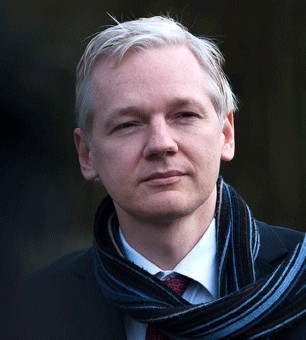
Julian Assange welcomes UK ruling that WikiLeaks is a media organisation, WikiLeaks founder welcomes ruling by UK tribunal. IBT ,By Jason Murdock, December 14, 2017WikiLeaks has been recognised as a “media organisation” by a UK tribunal in a ruling that flies in the face of claims by US officials who have branded it a “hostile intelligence agency”.
The anti-secrecy website – helmed by Julian Assange – has faced the ire of CIA director Mike Pompeo, who has compared its work to Hezbollah, Isis and al-Qaeda. Over the years, WikiLeaks has disclosed countless documents pilfered from the US government……….
The tribunal, in a section detailing the public interest for disclosing any withheld information, described Assange as “the only media publisher and free speech advocate in the Western world who is in a situation that a UN body has characterised as arbitrary detention”.
Donor nations backing the cleanup of Andreyeva Bay, one of Russia’s most deviling Cold War legacy projects, have agreed to put more funding toward removing damaged and broken nuclear fuel rods lurking at the site, which is located just 55 kilometers from the Norwegian border. Bellona, by Charles Digges
Donor nations backing the cleanup of Andreyeva Bay, one of Russia’s most deviling Cold War legacy projects, have agreed to put more funding toward removing damaged and broken nuclear fuel rods lurking at the site, which is located just 55 kilometers from the Norwegian border.
The removal of some 22,000 spent nuclear fuel assemblies left by Russia’s submarine fleet began earlier this year, constituting a major international victory toward securing radioactive hazards on the Kola Peninsula near Murmansk.
This is no small task. Spent fuel began building up at Andreyeva Bay, a Soviet nuclear submarine maintenance base, in the 1960s. Over the next two decades, many facilities at the site sprang radioactive leaks, and still more of the fuel was left out in the open air, where it degraded and threatened to contaminate portions of the Barents Sea.
Bellona and the Norwegian government took up the charge to clean up Andreyeva Bay in 1995. On June 27 of this year, their efforts finally met with success when a ship called the Rossita sailed away with the first of some 50 loads of spent nuclear fuel bound for storage and reprocessing at the Mayak Chemical Combine.
But complex problems of broken fuel elements, for which there are few blueprints in the annals of radioactive waste management, still remain
In 1982, a crack developed Andreyeva Bay’s now-notorious Building 5, a storage pool for thousands of spent fuel assemblies. The water was drained and the fuel painstakingly moved, but that created other problems. Some of those fuel elements broke, and remain at the bottom of storage pools within.
The fuel elements that were successfully removed were transferred to another facility at the site known as building 3A, where they were stuffed into chambers and cemented into place. This arrangement was only intended as temporary, but it lasted for 30 years. During that time, the cladding on much of the fuel has rusted, and the cement job makes it virtually impossible to remove them without risking further contamination.
A late November meeting of nations donating to the European Bank of Reconstruction and Development’s nuclear window project was aimed at solving those problems.
The funders, which are comprised of Sweden, Finland, Belgium, France, Canada, Germany, the Netherlands, Norway, Italy and the United Kingdom, have agreed to put €100,000 to prepare Building 3A for fuel removal–and another €675,000 for studies on removing broken elements from Building 5.
This funding is an addition to the $70 million these nations have already contributed toward Andreyeva Bay cleanup. Norway leads in funds contributed, however. The nation has giving $230 million toward the efforts over the last 20 years.
As unloading work continues at Andreyeva Bay’s other facilities, it is not expected that removal of the broken elements will begin before 2023.
Two loads of spent fuel assemblies have so far been removed from Andreyeva Bay since April. The fuel is first taken out by water and delivered to the Atomflot nuclear icebreaker port in Murmansk. Once there, it is loaded in railcars, and taken the remaining 3000 kilometers to the Mayak Chemical Combine.
The Fair Finance Guide organisation said that of the nine banks it reviewed, only three have zero-tolerance policies in relation to economic dealings involving nuclear weapons.
One bank highlighted by the organisation, Nordea, was placed in a ‘grey zone’. The bank has publicly expressed zero tolerance towards nuclear weapons in asset management and foundations, but does not have any lending policies with regard to nuclear weapons, according to Fair Finance Guide.
Nordea has business agreements with Russian state nuclear energy company Rosatom, which also manages the country’s nuclear weapons programme, according to a report by Svenska Dagbladet.
The Swedish bank has had a “strategic partnership” with Rosatom for several years, according to the newspaper.
Nordea maintains that it only finances the company’s nuclear energy activities.
“Nevertheless, this is enough to demonstrate support for the nuclear weapons arm of Rosatom, given that profits from the energy business are used to support its weapons industry,” Fair Finance Guide project leader Jakob König said in a press statement.
The organisation states on its website that it aims to improve the corporate social responsibility of banks.
Nordea sustainability manager Sasja Beslik rejected criticism of the bank. “The conclusion is incorrect. We do not finance – either directly or indirectly – any nuclear weapons production anywhere in the world,” Beslik said.
More than two months after a mysterious radioactive cloud was detected over Europe, Russia’s nuclear industry went public Friday in an attempt to dispel fears that one of its facilities had released a plume of ruthenium-106.Russia’s
state nuclear corporation, ROSATOM, released the findings of a special commission, which concluded that the Mayak nuclear reprocessing plant, near the border with Kazakhstan, could not have been the source of ruthenium-106, a radioactive isotope.
“There is no scientific basis for the hypothesis of some of our Western colleagues that there was a big release at Mayak,” Rafael Arutyunyan, deputy director of the Nuclear Safety Institute of the Russian Academy of Sciences and a member of the commission, said at a news conference in Moscow. European monitoring stations first picked up traces of ruthenium in the air in late September. While concentrations were too low to pose a health risk in Europe, scientists have
been puzzling over its origin. Wind patterns pointed to the south Urals, where the Mayak facility is located. The plant was the site of a 1957 explosion widely considered to be one of the world’s worst nuclear disasters.
In November, Russia’s meteorological service said that on Sept. 26, ruthenium-106 levels in a town 20 miles from the Mayak plant, Argayash, had exceeded the previous month’s by 986 times.
The same day, Mayak flatly denied that the spike in ruthenium had anything to do with its activities.
The ROSATOM commission that inspected the Mayak facility afterward reached the same conclusion. The commission said it hadn’t detected abnormal levels of ruthenium at the facility, there had been no malfunction of monitoring systems and none of the 250 Mayak employees tested had shown any trace of the isotope.
Arutyunyan rejected the suggestion that officials have been slow in informing thepublic, saying there had been no emergency situation that would have warranted an alarm. He called talk of a danger to health “nonsense.”
“Why should we come running to announce something? Mayak told us that all their systems were working absolutelynormally and routinely,” he said. “Why should they have jumped up and shouted? I think we spent the right amount of time to understand what happened.”
Environmental activists and government critics disagree.
After the findings of the commission were released, Greenpeace Russia started a petition drive addressed to the general prosecutor’s office, demanding an investigation by independent specialists and public figures into a possible release of ruthenium from Russian territory, as well as into the possible concealment of information by ROSATOM.
“The question is not only about the immediate danger, but the origin of this release,” Greenpeace energy campaigner Rashid Alimov said in a phone interview. “We think such incidents should be investigated and there must be an answer.”
Finding the source of the radioactive cloud was beyond the scope of the ROSATOM commission. But because the ruthenium-106 over Europe was found alone, that is, unaccompanied by other radioactive isotopes, the commission said nuclear power plants or spent nuclear fuel processing facilities like Mayak could be excluded as sources because they don’t produce “pure” ruthenium-106.
The commission said a satellite — or a fragment of one — re-entering the atmosphere cannot be completely ruled out as the source of the ruthenium.
According to French authorities,
the International Atomic Energy Agency found that no satellite containing ruthenium had fallen back to earth during the period in question.
The elephant in the room, of course, is the 1986 Chernobyl nuclear accident, when Soviet authorities lied for days about the scope of the disaster.
“What’s happening with the ruthenium cloud reminds me a lot of what went on with Chernobyl,”
Russian opposition leader Alexei Navalny said in a recent video blog. “In no way do I want to prove there’s been a catastrophe of that scale. I just want to say that the pattern of behavior is exactly the same.”
Navalny went on to pillory the headline on state television that “safe ruthenium rain fell on Bashkiria” and the chief oncologist of Chelyabinsk region, who advised people worried about high ruthenium levels “to watch soccer and drink beer.”
ROSATOM insistsit is being as transparent as possible.”Russia’s nuclear industry is a lot more open than our peers’,” ROSATOM spokesman Andrei Ivanov said at the news conference.
On Friday, local journalists were let into Mayak on the first press tour since the facility was identified as a possible source of the ruthenium cloud.
Foreign correspondents will have to wait up to two months to get a security clearance.
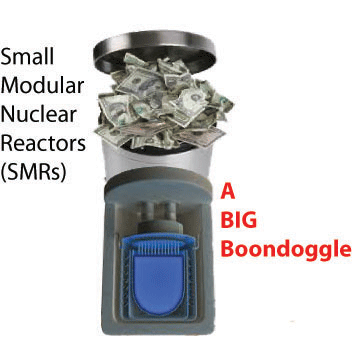
The government has announced up to £56m in funding for the development of
mini-nuclear plants. The money will be available over the next three years
to assess the potential of designs of advanced and small modular reactors
(SMRs). It will also support early access to regulators in order to build
the capability and capacity needed to assess and licence SMRs and will
establish an expert finance group to advise how small reactor projects
could raise private investment in the UK. The first round of funding
comprises up to £4m for feasibility studies and up to £7m to further
develop their capability. Should these efforts prove successful, up to
£40m will be made available for R&D projects to bring the technology into
the mainstream. The government said it wanted the UK to become a world
leader in developing the next generation of nuclear technologies.
Egypt to sign contracts for nuclear power plant during Putin’s visit: sources, CAIRO (Reuters) 10 Dec 17 –Egypt will sign contracts with Moscow during Russian President Vladimir Putin’s visit to Cairo on Monday for the country’s first nuclear power plant, three senior sources told Reuters on Sunday.
The construction of the 4,800 megawatt (MW) capacity plant, which is supposed to be built at Dabaa in the north of the country, is expected to be completed within seven years, added the sources, who spoke on condition of anonymity because they were not authorized to speak to the media……
Moscow and Cairo signed an agreement in 2015 for Russia to build a nuclear power plant in Egypt, with Russia extending a loan to Egypt to cover the cost of construction.
Egypt’s official gazette said last year the loan was worth $25 billion and would finance 85 percent of the value of each work contract, services and equipment shipping. Egypt would fund the remaining 15 percent.
The trial operation of the first nuclear reactor is expected to take place in 2022……
The nuclear plant is expected not to just cover the country’s energy needs, but to produce excess which can be exported, the sources told Reuters on Sunday.
Putin is scheduled to visit Cairo on Monday to meet with his counterpart Abdel Fattah al-Sisi, where they will discuss bilateral relations, trade and Middle Eastern issues, the Kremlin said last week.
Reporting by Momen Abdelkhalek; Writing by Amina Ismail; Editing by Toby Chopra
Russia says it is fully committed to nuclear missile pact, Reuters Staff, MOSCOW (Reuters) 9 Dec 17 – Russia said on Saturday it was fully committed to a Cold War-era pact with the United States banning intermediate-range cruise missiles, a day after Washington accused Moscow of violating the treaty.
The U.S. State Department said on Friday Washington was reviewing military options, including new intermediate-range cruise missile systems, in response to what it said was Russia’s ongoing violation of the 1987 Intermediate-Range Nuclear Forces Treaty.
The warning was the first response by President Donald Trump’s administration to U.S. charges first leveled in 2014 that Russia had deployed a ground-launched cruise missile that breaches the pact’s ban on testing and fielding missiles with ranges of 500-5,500 kms (310-3,417 miles).
Russian Deputy Foreign Minister Sergei Ryabkov said those allegations were “absolutely unfounded”……
Echoing previous Russian statements, Ryabkov said Moscow was fully committed to the treaty, had always rigorously complied with it, and was prepared to continue doing so.
“However, if the other side stops following it, we will be forced, as President of the Russian Federation Vladimir Putin has already said, to respond in kind,” he added.








 nuclear-news