The French utility company said on Tuesday that the planned investment would be used to develop an estimated 10 gigawatts of additional energy storage projects, or roughly twice the total amount of capacity it currently operates.
The utility said it would target energy storage projects in the European market, especially in France, but that it would also pursue opportunities in Africa, including battery storage and storage plus solar projects in Ghana and the Ivory Coast.
In 1989, Russia Left a Nuclear Submarine Dead in the Ocean (Armed with Nuclear Weapons) National Interest , Kyle Mizokami , 27 Mar 18
Komsomolets sank in 5,250 feet of water, complete with its nuclear reactor and two nuclear-armed Shkval torpedoes. Between 1989 and 1998 seven expeditions were carried out to secure the reactor against radioactive release and seal the torpedo tubes. Russian sources allege that during these visits, evidence of “unauthorized visits to the sunken submarine by foreign agents” were discovered.
In the mid-1980s, the Soviet Union constructed a super submarine unlike any other. Fast and capable of astounding depths for a combat submersible, the submarine Komsomolets was introduced in 1984, heralded as a new direction for the Soviet Navy.
Five years later, Komsomolets and its nuclear weapons were on the bottom of the ocean, two-thirds of its crew killed by what was considered yet another example of Soviet incompetence.
The history of the Komsomolets goes as far back as 1966. A team at the Rubin Design Bureau under N. A. Klimov and head designer Y. N. Kormilitsin was instructed to begin research into a Project 685, a deep-diving submarine. The research effort dragged on for eight years, likely due to a lack of a suitable metal that could withstand the immense pressures of the deep. In 1974, however, the double-hulled design was completed, with a titanium alloy chosen for the inner hull.
Project 685, also known as K-278, was to be a prototype boat to test future deep-diving Soviet submarines. The Sevmash shipyard began construction on April 22, 1978 and the ship was officially completed on May 30, 1983. The difficulty in machining titanium contributed to the unusually long construction period.
K-278 was 360 feet long and forty feet wide, with the inner hull approximately twenty-four feet wide. It had a submerged displacement of 6,500 tons, and the use of titanium instead of steel made it notably lighter. It had a unique double hull, with the inner hull made of titanium, that gave it its deep-diving capability. The inner hull was further divided into seven compartments, two of which were reinforced to create a safe zone for the crew, and an escape capsule was built into the sail to allow the crew to abandon ship while submerged at depths of up to 1,500 meters.
……….On April 7, 1989, while operating a depth of 1266 feet, Komsomolets ran into trouble in the middle of the Norwegian Sea. According to Norman Polmar and Kenneth Moore, it was the submarine’s second crew, newly trained in operating the ship. Furthermore, its origins as a test ship meant it lacked a damage-control party.
A fire broke out in the seventh aft chamber, and the flames burned out an air supply valve, which fed pressurized air into the fire. Fire suppression measures failed. The reactor was scrammed and the ballast tanks were blown to surface the submarine. The fire continued to spread, and the crew fought the fire for six hours before the order to abandon ship was given.
………. Only four men had been killed in the incident so far, but after the submarine sank many men succumbed to the thirty-six-degree (Fahrenheit) water temperatures. After an hour the fishing boats Alexi Khlobystov and Oma arrived and rescued thirty men, some of whom later succumbed to their injuries. Of the original sixty-nine men on board the submarine when disaster struck, forty-two died, including Captain First Rank Vanin.
Komsomolets sank in 5,250 feet of water, complete with its nuclear reactor and two nuclear-armed Shkval torpedoes. Between 1989 and 1998 seven expeditions were carried out to secure the reactor against radioactive release and seal the torpedo tubes. Russian sources allege that during these visits, evidence of “unauthorized visits to the sunken submarine by foreign agents” were discovered.
Kyle Mizokami is a defense and national security writer based in San Francisco who has appeared in the Diplomat, Foreign Policy, War is Boring and the Daily Beast. In 2009 he cofounded the defense and security blog Japan Security Watch. You can follow him on Twitter: @KyleMizokami.
U.K. Weighs Tidal Power Contract Aping Hinkley Nuclear Deal, Bloomberg ,By Alex Morales,
Swansea Bay plan could open up 40 billion pounds of spending
U.K. and Welsh ministers seek to forge deal to enable project
U.K. officials are in intensive talks with their Welsh counterparts to kick-start a tidal power plan by copying the controversial contract awarded to Electricite de France SA for its Hinkley Point nuclear power project.
Tidal Lagoon Power Ltd.’s Swansea Bay project would tap the ebb and flow of the tides to generate electricity. It’s been in limbo for 15 months since a government-commissioned review recommended giving it the go-ahead. The delay reflects a reluctance by ministers to accept costs for consumers that were once estimated at double the power price EDF will get.
Amid pressure from more than 100 backbench lawmakers who want the tidal plant to move ahead, ministers are grappling with how to make it palatable. The developer had proposed an initial power price a third higher than Hinkley’s. But an offer of assistance from the Welsh government has changed the game. Officials are now debating a deal on the same terms as Hinkley, according to Richard Graham, a lawmaker with the ruling Conservatives who chairs Parliament’s All-Party Parliamentary Group on Marine Energy. ……..https://www.bloomberg.com/news/articles/2018-03-27/u-k-weighs-tidal-power-contract-matching-hinkley-nuclear-deal
Fukushima food promoted in Paris https://www3.nhk.or.jp/nhkworld/en/news/20180325_07/The governor of Japan’s Fukushima Prefecture is in Paris to promote farm products that are suffering from a damaged reputation following the 2011 nuclear accident.
Masao Uchibori is visiting Europe following the 7th anniversary of the massive earthquake and tsunami that triggered the accident at the Fukushima Daiichi nuclear power plant.
Uchibori organized the “Fukushima Pride” tasting event on Saturday at a shopping mall near Paris. Rice and fruit products were handed out to shoppers.
One visitor said she likes the dried peaches a lot and is not concerned about the safety of Fukushima produce now that it is widely circulated.
France has seen Japanese cuisine surge in popularity, which is pushing up the import of luxury foodstuffs and sake rice wine.
Uchibori expressed hope that France will help Fukushima overcome lingering concerns about the safety of its food and make inroads into the global market.
The Japanese government has been calling on other countries to lift import restrictions on its food products, after they cleared radiation screening.
In December, the European Union lifted import controls on some produce and seafood from regions affected by the nuclear accident.
Nuclear watchdog raises Hinkley Point C concerns Management failings could affect safety at EDF power station if unaddressed, says inspector, Guardian, Adam Vaughan, 26 Mar 18,
The UK nuclear regulator has raised concerns with EDF Energy over management failings that it warns could affect safety at the Hinkley Point C power station if left unaddressed, official documents reveal.
Britain’s chief nuclear inspector identified several shortcomings in the way the French firm is managing the supply chain for the £20bn plant it is building in Somerset.
Environmental Research Web 24th March 2018, Dave Elliott: Nuclear plants are designed to run flat out, in part to
recoup their large construction costs. Their output can be varied a bit,
but this entails thermal stresses and potential safety issues with the
build up of active Xenon gas that is released when fission reactions are
reduced. It needs time to decay. That limits how often and how quickly the
plant can be ramped down and then back up- so as to match changes in energy
demand (‘load following’) and the varying output of renewables.
So basically nuclear plants are inflexible. So do they have any role for
balancing variable renewables? Renewables will continue to expand of
course- by 2035 there might be 45GW.
But just in case you though that balancing some of that with nuclear might be possible in future, the
Hinkley nuclear EPR plant is not scheduled to load follow. And it seems
unlikely if any of the other proposed new large nuclear plants (Wylfa,
Olbury, Moorside, Sizewell, Bradwell) would do – it would undermine their
already precarious economics. Though as now, they may be added to the
capacity market, to be there for background support, if that makes any
sense. A more cynical view is that, as now, this inclusion is just a way to
provide nuclear with an extra subsidy, which, like the rest of the
contracted capacity, is paid for by a surcharge on consumers bills. http://blog.environmentalresearchweb.org/2018/03/24/can-nuclear-be-use-to-balance-renewables/
Energy Post 23rd March 2018,The European Commission has proposed new European legislation that could
put Europe’s distribution system operators in a powerful position to bend
market rules to their own advantage, writes Julie Finkler of NGO
ClientEarth. According to Finkler, this could seriously hamper other market
players, like community energy initiatives, renewable energy producers and
aggregators. She calls on the European Parliament and the Member States to
ensure this will not happen. http://energypost.eu/eu-electricity-distributors-should-not-be-allowed-to-police-themselves/
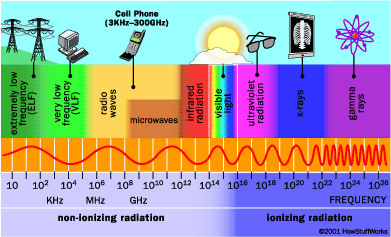
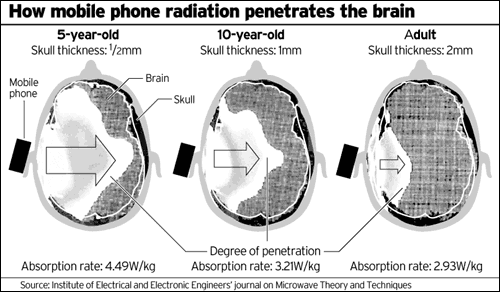
Italian study links cellphone radiation to heart and-brain tumors https://www.ewg.org/release/italian-study-links-cellphone-radiation-heart-and-brain-tumors#.WrVYStRubGgAlex Formuzis (202) 667-6982 alex@ewg.org, MARCH 22, 2018 WASHINGTON– Laboratory animals exposed to cellphone radiation developed heart and brain tumors similar to the types seen in some studies of human cellphone users, according to an Italian study published today. EWG said the findings reinforce the need for people, especially children, to exercise caution when using cellphones and other radiation-emitting devices.
The study by the Ramazzini Institute, published in the journal Environmental Research, supports the findings of the federal National Toxicology Program. Last month, the NTP reported that male rats exposed to radio-frequency radiation at levels including those emitted by cellphones had a greater chance of developing malignant brain cancer, and tumors in the heart and other organs.
The Ramazzini Institute’s research found that male rats exposed to the radio-frequency radiation emitted by cellphones using GSM networks had a greater chance of developing heart tumors and hyperplasias affecting Schwann cells, which support the peripheral nervous system. Schwann cell tumors were also observed in human epidemiological studies of tumor incidence in cellphone users, and in the NTP studies of lab animals.
“The Italian study reinforces the need for a precautionary approach when it comes to radiation from phones and other devices, especially for young kids,” said Olga Naidenko, Ph.D., senior science advisor at EWG. “Children’s bodies develop through the teenage years and may be more affected by cellphone use. As new telecom networks are built around the country, in-depth assessment of children’s health risks from cellphone radiation is essential.”
In 2011, the World Health Organization’s International Agency for Research on Cancer declared the kind of radiation emitted by cellphones a “possible carcinogen” based on human epidemiological studies that found increased gliomas and acoustic neuromas in long-term cellphone users. The data on health effects of cellphone radiation in laboratory animals collected by the NTP and the Ramazzini Institute studies support the earlier evidence from human studies that cellphone radiation increases the risk of cancer.
EWG has been at the forefront of public interest organizations raising concerns about connections between cellphone use and cancer. EWG’s 2009 Science Review on Cancer Risks and Children’s Health summarized comprehensive studies showing a variety of health harms linked to long-term cellphone use. This included increased risk of brain tumors; lower sperm counts, motility and vitality among men; neurological effects; and changes in brain metabolism.
While the public debate on cellphone radiation risks has focused on cancer, which progresses slowly in response to lifelong exposures, a growing body of research suggests that even shorter exposures could cause harm. In a study published last year, Kaiser Permanente researchers reported that pregnant women exposed to radio-frequency radiation from sources such as wireless devices and cell towers had nearly a threefold greater frequency of miscarriage.
In December 2017, the state of California issued official guidelines advising cellphone users to keep phones away from their bodies. The state Department of Public Health also recommended that parents consider reducing the amount of time their children use cellphones, and encourage kids to turn the devices off at night.
For more information about how studies on laboratory animals can help answer the questions about human health risks from radio-frequency radiation, read EWG’s Comments to the National Toxicology Program on the NTP cellphone radiation study.
France Info 21st March 2018, [Machine Translation] Sensitive information concerning the Cattenom,
Flamanville and Paluel nuclear power plants was stolen a few weeks ago in
Amnéville (Moselle). The facts go back to February 16th. On a parking lot
in Amnéville, Moselle, an employee of an EDF subcontractor had his
professional vehicle fractured. The thieves stole computer equipment
containing confidential information about the nuclear power plants Cattenom
(Moselle), Flamanville (Channel) and Paluel (Seine-Maritime). https://france3-regions.francetvinfo.fr/normandie/plans-centrales-nucleaires-paluel-flamanville-voles-1444801.html
BBC 20th March 2018, The government has been defeated twice in the House of Lords over its plans for nuclear co-operation after Brexit. Peers voted by 265 to 194 to insist the UK should not withdraw from the European nuclear agreement, Euratom, until a replacement deal is in place. They also backed a plan requiring the UK to report to Parliament regularly on its future arrangements with Euratom.
MPs are likely to try and overturn the changes to the Nuclear Safeguards Bill when it returns to the Commons. Euratom, an association which is legally separate from the EU but governed by the EU’s institutions, covers issues such as the transport of radioactive materials, including those used in medical treatments, or in nuclear power stations.
The government has said it wants to establish a new domestic nuclear regime as well as negotiate a nuclear agreement with the EU once the UK leaves on 29 March 2019. http://www.bbc.com/news/uk-politics-43476337
La Libre 19th March 2018, More than 40 scientists, intellectuals, engineers and artists: “It is time
for the political world to assume Fukushima” (OPINION).It is time for the
political world to take its mistakes and put an end to the nuclear
industry.
This is not only illegitimate, but it is also an extreme threat
to our future. On June 25 last year, 50,000 people joined hands to demand
the closure of the Tihange plant. The number of protesters surprised many.
Also notable was the lack of reaction from the political world as a result
of this extraordinary event.
There are reasons for this apparent lethargy of the leaders of this country, in the face of this popular demonstration,
perhaps starting with a feeling of guilt, which would be quite appropriate.
Indeed, what has prevailed in the implementation of the nuclear industry is
the lack of democratic debate and false state propaganda, that of an energy
that would be unlimited, cheap and safe; as we recalled the commemoration
of the seventh anniversary of Fukushima, the second accident of a nuclear
power station which has no end, after that of Chernobyl in 1986.
More serious still, in 1960, the leaders of 16 European countries, including Belgium, agreed to sign the Paris Convention which was intended to limit the financial liability of the operator in the event of a nuclear accident, no insurance company willing to cover the nuclear risk considered too high.
Without this unique Convention, the nuclear industry could never have developed in Europe.
It is worth mentioning here that a major accident in Tihange would mean the end of life as we know it and, in fact, the end of Wallonia as a region. That the cost of such an accident would amount to
several trillions of euros, without it being possible to quantify the
sanitary and psychological misery into which the Walloons, sentenced,
either to leave their country abandoning all their property – but to go
where, or to live in a contaminated territory for the poorest of them. That
on this amount, the operator, Engie-Electrabel, would have to pay only 1.2
billion, less than its profit of certain years and less than one thousandth
of the cost of the disaster. http://www.lalibre.be/debats/opinions/plus-de-40-scientifiques-intellectuels-ingenieurs-et-artistes-il-est-temps-que-le-monde-politique-assume-fukushima-opinion-5aae9319cd702f0c1a63ffda
Times 21st March 2018,Onshore wind and solar farms capable of generating more than three times as much power as the new Hinkley Point C nuclear plant could be built without any subsidy from taxpayers in Britain by 2030, energy analysts have forecast.
The plunging costs of the technologies, which were reliant on very high subsidies just a few years ago, could enable investors to build them without any government intervention by the early 2020s, said Aurora Energy Research.
The government has ended subsidy schemes for new onshore wind and solar farms, slowing their development, amid concern about their cost to consumers. Aurora, an Oxford-based consultancy, predicts that the fall in costs has brought the industry to the “cusp of breakthrough in Britain”, whereby such projects could be commercially viable even without subsidies.
It predicts that solar farms capable of generating up to 9 gigawatts and onshore wind farms with a maximum output of 5 gigawatts are likely to be built on this basis by 2030. The prediction is likely to further increase pressure on nuclear developers to show they can be cost competitive. The 3.2-gigawatt Hinkley Point C plant is only viable thanks to a subsidy contract that commits consumers to pay its developers well above the market price for power for 35 years — potentially costing tens of billions of pounds. Renewables have only been made viable by similar commitments from government. https://www.thetimes.co.uk/edition/business/wind-farms-on-course-to-be-free-of-subsidy-qfmpmm8dh
Energy Watch Group 20th March 2018, During his state visit to India, France’s President Macron agreed with
India’s Prime Minister Narendra Modi last week to sell six French EPR
reactors for the largest nuclear power plant planned in Jaitapur.
Regardless of the fact that India has not yet signed the Nuclear
Non-Proliferation Treaty. The plutonium from the reactors could be
completely used for the construction of nuclear weapons without
international control. In terms of energy, too, all EPR construction
projects in recent years are highly problematic. http://energywatchgroup.org/new-european-nuclear-reactors-prove-financial-technically-dangerous-disast
Nucnet 16th March 2018, US-based Westinghouse Electric Company has completed a decommissioning
project at the Barseback nuclear power station in Sweden that included the
underwater segmentation and packaging of the reactor vessel internals.
Westinghouse said it had also carried out upfront engineering studies, and
equipment manufacturing and qualification for the project, which was part
of the first dismantling and decommissioning of a commercial nuclear power
plant in Sweden.
Barseback-2, a 600-MW boiling water reactor unit, began
commercial operation in July 1977 and was permanently shut down in May
2005, with decommissioning work beginning in August 2016. The closure
decision, announced in October 2004, followed what the government described
as failure to reach an agreement with the power industry on the details and
timetable for a voluntary phaseout of Sweden’s nuclear facilities Its
sister unit, Barseback-1, was permanently shut down in November 1999.
Westinghouse said it is now due to begin decommissioning work on
Barseback-1, with an estimated completion date of April 2019.
With Russia building floating nuclear reactors and possibly testing nuclear-powered cruise missiles, there are good reasons for this training.The Drive, BY JOSEPH TREVITHICKMARCH 20, 2018The U.S. military, along with other federal and state authorities, has been training to respond to potentially dangerous releases of radioactive material in and around the Arctic. Though there is no clear indication of a direct link between Russia’s reported tests of nuclear-powered missiles or expanding use of nuclear power in the region, it is hard not to see these exercises in connection with those developments.
Earlier in March 2018, members of the U.S. National Guards from 10 different states arrived at the Donnelly Training Area, situated near the U.S. Army’s Fort Greely in Alaska. Alaska state authorities and members of Canada’s reserve 39 Canadian Brigade Group joined the exercise, nicknamed Arctic Eagle 2018, as well.
The drills included a number of different mock crises, including an overturned fuel truck creating a hazardous material spill, the potential for attacks on the Trans Alaskan Pipeline System, and even cyber attacks. But especially notable was a scenario involving the need to locate a crashed satellite and contain the radiological material it had deposited across a wide area as it plummeted to earth. ………
t’s definitely no secret that the U.S. military has become increasing interested in preparing for potential conflicts and other contingencies above and near the Arctic Circle in recent years. As global climate change has shrunk the polar ice cap and otherwise reduced the amount of ice buildup that occurs during certain parts of the year, the region has become increasingly important economically and various countries, especially Russia, have moved to enforce their territorial claims.
“The growing concerns regarding the increased number of nations competing for Arctic resources are well justified,” U.S. Air Force General Lori Robinson, head of U.S. Northern Command, which oversees operations in the region, and the designated “Advocate for Arctic Capabilities” within the Pentagon, reiterated to members of Congress during a hearing in February 2018. “Diminishing sea ice provides opportunities for significantly expanded access to a region that had previously been inaccessible to all but a handful of northern nations.”
…….. the idea of a crashing satellite creating a radiological disaster isn’t an entirely fictional scenario. In 1978, the Soviet Union’s Kosmos 954 reconnaissance satellite, which had a nuclear reactor as its power source, crashed into Canadian territory, touching off an international incident and prompting an expensive response and clean-up operation.
….. U.S. military and other agencies practicing specifically to handle a radiological incident in the region seems even more noteworthy in light of a number of recent events. Most importantly are Russian claims that it has been testing a cruise missile with theoretically unlimited range that uses a nuclear reactor-powered propulsion system in the Arctic. Anonymous U.S. government officials have since told various media outlets that this is true, but that the weapons have been crashing, potentially spreading radioactive material and components.
…… The Russians have also been dramatically expanding their use and plans to employ small and mobile nuclear reactors to support activities in the Arctic.
……..If any of these nuclear power systems were to fail, it could potentially cause a serious radiological incident that would impact both the United States and Canada. The same procedures American military and other government personnel have been training to employ in response to a crashed satellite would undoubtedly be applicable in those situations, too.











 nuclear-news