150 padlocks disappear from ‘cursed’ French nuclear plant, Times UK, Adam Sage, Paris, 8 May 18, The French nuclear plant touted as a model for Britain’s new reactors was under scrutiny yesterday after 150 of the padlocks protecting its command-control computers disappeared.
Electricity of France (EDF), the state electricity group, filed a criminal lawsuit over the disappearance of the padlocks from cabinets containing the computer system at the plant under construction at Flamanville in northern France.
EDF is leading the £19.5 billion project to build two similar reactors at Hinkley Point in Somerset, which are expected to supply 7 per cent of Britain’s electricity.
The company said police were investigating the incident and that it had started an internal audit. None of the computers had been tampered with.
The reactor itself had a separate system, EDF said, which remained under lock… https://www.thetimes.co.uk/article/150-padlocks-disappear-from-cursed-french-nuclear-plant-htshx8gwf
May 9, 2018
Posted by Christina Macpherson |
France, secrets,lies and civil liberties |
Leave a comment

 The Sun 4th May 2018 , Theresa May urged to come clean on ‘secret’ meeting with Hitachi boss
over £2bn taxpayer bailout for new nuclear power project. Hitachi, responsible for the £20bn new nuclear power plant in Anglesey, North Wales, said the project was unaffordable without state support.
The group is reported to have claimed the £20 billion project due to start generating in the mid-2020s is unaffordable without state support. It’s the latest blow to the Government’s energy policy after huge delays to the construction of the Hinkley Point nuke plant in Somerset.
The PM’s official spokesman would only say Mrs May was taking part in “private meetings” at Downing Street yesterday afternoon. Hannah Martin, Greenpeace’s UK head of energy, said: “The information blackout about government nuclear policy is unjustifiable.
The SNP demanded the Government rule out public money on “failing nuclear projects”. Drew Hendry, the Scottish Nationalists’ business spokesman, said: “This is yet another damning report of the UK government’s misguided nuclear obsession. “Hinkley Point is already set to cost consumers a fortune because of the appalling strike price deal the UK government made with EDF. “The Prime Minister must now categorically rule out any public bail out of this, or any other nuclear project and put an end to secret discussions behind closed doors.”
https://www.thesun.co.uk/news/6207351/theresa-may-hitachi-secret-meeting-bailout-nuclear/
May 7, 2018
Posted by Christina Macpherson |
secrets,lies and civil liberties, UK |
Leave a comment
 Times 6th May 2018 , The entire £15bn-plus cost of Hitachi’s nuclear power station on Anglesey
could land on the government’s balance sheet, even though taxpayers are expected to hold only a minority stake. The Japanese industrial giant has warned it will walk away from the 2.7 gigawatt plant at Wylfa unless it
secures UK state support.
Hiroaki Nakanishi, the chairman of Hitachi, met Theresa May and the chancellor, Philip Hammond, last week to urge progress on the project after more than two years of talks.
The final deal may see taxpayers take an equity stake in the Horizon plant, possibly as much as
33%, alongside Hitachi and the Japanese government. Direct state exposure to the construction of a nuclear plant has faced stiff resistance from the Treasury because of fears about cost overruns and the impact on government
debt.
Industry insiders said a minority taxpayer stake could result in the entire liability landing on the state’s books, despite the Japanese partners, because official statisticians now take a more conservative approach to accounting for risk where the government is concerned. In 2014, Network Rail’s debt burden of £34bn was reclassified as national debt
after an EU decree. Any state stake in Horizon would be sold on once construction was completed.
https://www.thetimes.co.uk/edition/business/taxpayers-on-the-hook-for-15bn-hitachi-nuclear-plant-qnbx0s9xm
May 7, 2018
Posted by Christina Macpherson |
business and costs, politics, UK |
Leave a comment
 Le Monde 5th May 2018 , Nuclear: EDF launches negotiations for two new EPRs in the United Kingdom.
According to our information, the French group is discussing with the British government to find a new way of financing to build reactors in Sizewell.
The possibility of sharing the cost of construction with British consumers on their electricity bills is thus under consideration. It would not necessarily be a direct payment, but rather a kind of bond that remains to be defined. For the time being, the British Ministry of Industry is simply saying that “new nuclear power plants have an important role to play
in the future of our low-carbon electricity production”.
To understand the current discussions, we have to go back to Hinkley Point. The two EPRs, whose construction in the West of England began at the end of 2016, must cost 19.6 billion pounds (22.2 billion euros), and that of the first must
start in 2025.
They are criticized from all sides. First on the side of EDF, which finances on its own funds two-thirds (the Chinese CGN brings the rest) and sees the English project plummet its balance sheet. Its chief financial officer resigned to oppose it in March 2016.
http://www.lemonde.fr/economie/article/2018/05/05/nucleaire-edf-lance-les-negociations-pour-deux-nouveaux-epr-au-royaume-uni_5294780_3234.html
May 7, 2018
Posted by Christina Macpherson |
France, politics international, UK |
Leave a comment

Reuters 3rd May 2018 , French uranium mining and nuclear fuel group Orano, formerly called Areva,
said it had signed a fuel reprocessing deal with Ukraine. Orano and the
Ukrainian utility EnergoAtom signed a contract for assessing the
feasibility of reprocessing services of spent fuel assemblies of Ukrainian
VVER-1000 nuclear reactors in Orano la Hague facility Orano said the
contract, signed in the presence of Oleksander Shavlakov, First
Vice-President of EnergoAtom and Pascal Aubret, Senior Executive Vice
President of Orano’s Recycling Business Unit, marks a new step towards
the treatment of Ukrainian used fuels VVER 1000 at the Orano la Hague site.
https://af.reuters.com/article/commoditiesNews/idAFFWN1SA18N
May 7, 2018
Posted by Christina Macpherson |
France, reprocessing, Ukraine |
1 Comment
 Keeping old nuclear reactors like those at troubled Hunterston going is “gambling with public safety”, says expert http://www.heraldscotland.com/news/16207870.Chain_reaction__Hunterston_closure_sounds_death_knell_for_more_nuke_stations/ by Rob Edwards, 6 May 18,
THE prolonged closure of an ageing and cracked reactor at Hunterston in North Ayrshire is the beginning of the end for seven nuclear power stations in Scotland and England, experts say.
They doubt whether the reactor will ever restart, and argue that proliferating cracks in other elderly reactors across the country will shorten their expected lives and lead to premature shutdowns. One expert said extending the life of troubled reactors like the one at Hunterston is “gambling with public safety”.
Hunterston’s operator, EDF Energy, however, insisted that it would be able to reopen the reactor. Its other reactors would also run for as long as planned, the company said.
But according to independent nuclear engineer John Large, the new cracks signal the “death knell” for Hunterston reactor three. “This means that reactor four is doomed to the same fate, followed by similar plants at Hinkley Point and Hartlepool, thereafter progressively followed by other advanced gas-cooled reactors,” he said.
EDF announced last week that it was extending the shutdown of reactor three at Hunterston by six months because it had discovered more cracks than expected in its graphite core. Instead of reopening early in May, it is now scheduled to reopen on November 17.
The company said it had found a total of 39 “keyway root cracks” in the reactor and they were “happening at a slightly higher rate than modelled”. The discovery of new cracks was first revealed by the Sunday Herald on April 22.
The integrity of the thousands of graphite blocks that make up the reactor core is vital to nuclear safety. They ensure that the reactor can be cooled and safely shut down in an emergency.
But bombardment by intense radiation over decades causes the blocks to start cracking. If they fail, experts say, nuclear fuel could overheat, melt down and leak radioactivity in a major accident.
Large argued that EDF’s decision to keep reactor three closed until the end of the year was prompted by the UK Government’s safety watchdog, the Office for Nuclear Regulation (ONR). “ONR’s doubts about the reactor safety have not been satisfied by this most recent inspection,” he said.
“It may simply be a way of saving face and fobbing off the announcement that the plant is to be permanently shut down.”
Hunterston reactor three, which started generating power in 1976, is the oldest in EDF’s fleet. The other working reactor on the site, number four, is 18 months behind, has five cracks and is likely to develop more.
The six other advanced gas-cooled reactor plants in the UK are also likely to crack, including the only other working nuclear power station in Scotland at Torness in East Lothian. The others are: Hinkley Point B in Somerset; Hartlepool in County Durham; Heysham 1 and 2 near Lancaster; and Dungeness B in Kent.
Large also highlighted the uncertainties in tracking cracks, which are mostly modelled rather than measured. “There is little that EDF can do to physically resolve this problem,” he said.
Meanwhile, Edinburgh-based nuclear critic and consultant Pete Roche pointed out that Hunterston is now 42 years old.
“This must surely be the end for reactor three,” he said. “We are gambling with public safety by extending the lives of old reactors.”
He expects Hinkley Point B to close “very soon”, followed by other nuclear stations in England. “Even Torness has passed the 30-year threshold, so may not make it to its expected 2030 closure date,” Roche said.
Rita Holmes, a local resident who chairs the Hunterston site stakeholder group, argued it would be very difficult for the public to have confidence in the safety of reactor three. “It has had its day and should be allowed to bow out gracefully,” she said.
Paul Mummery, a professor of nuclear materials from the University of Manchester, pointed out that the ONR would not allow EDF to restart reactors until it can be demonstrated that they are safe. “This is quite a task for EDF and not something that can be rushed,” he said.
“EDF is undertaking extensive modelling and experimental programmes to demonstrate the safety of the reactors but it will take time to generate and interpret the results. Time is against them as the reactors will continue to age during service.”
The ONR has welcomed EDF’s decision to keep Hunterston reactor three closed as “responsible, conservative, and made in the best interest of public safety”. It confirmed that the reactor could not be restarted without its permission.
One ONR advisor, professor Paul Bowen from the University of Birmingham, argued that the process showed how the regulatory system was working.
“In my technical opinion and noting that I am not at all influential in any decisions, a return to service for Hunterston reactor three will be justified,” he said.
The director of Hunterston B, Colin Weir, told BBC Radio Scotland last week that he was “100 per cent confident” that the reactor would restart.
A spokesperson for EDF said: “We are confident that we have accurately predicted the behaviour of the core and this continues to underpin the lifetime dates for all our reactors, including reactor three at Hunterston.”
A Scottish Government spokesperson said: “We expect ONR will exercise its duties diligently to ensure the nuclear industry controls its hazards effectively and maintains the highest nuclear safety and security standards.”
May 7, 2018
Posted by Christina Macpherson |
politics, UK |
Leave a comment
Meeting with May at her office in London, Hitachi Chairman Hiroaki Nakanishi requested more support from the British government, including direct investment, the sources said. ……
In 2016, Japan and Britain signed a memorandum of understanding to closely cooperate in the nuclear field, a move that would help Japanese companies build nuclear reactors in Britain.
The memorandum covers four areas — reactor decommissioning and decontamination, research and development, security and construction of new reactors. https://mainichi.jp/english/articles/20180504/p2g/00m/0bu/073000c
May 5, 2018
Posted by Christina Macpherson |
politics, UK |
Leave a comment
 Lincoln University 4th May 2018 , Researchers have secured £1.1 million in grant funding to develop
artificial intelligence systems to enable self-learning robots to be
deployed in place of humans to hazardous nuclear sites.
It is estimated that up to £200 billion will be spent on the clean-up and decommissioning
of nuclear waste over the next 100 years.
Now, a team of computer scientists from the University of Lincoln will create machine learning
algorithms to increase capabilities in several crucial areas of nuclear
robotics, including waste handling, cell decommissioning and site
monitoring with mobile robots.
Machine learning is an application of artificial intelligence (AI) which enables systems to collect data and use
it to inform automated decision-making and make improvements based on
experience without being explicitly programmed.
The Lincoln team will create algorithms for vision-guided robot grasping, manipulation and
cutting, mobile robot navigation, and outdoor mapping and navigation. The
aim is to build systems which can use machine learning to adapt to the
unique conditions of nuclear sites, including locations contaminated by
radiation.
The Lincoln project is part of the National Centre for Nuclear
Robotics (NCNR), a multi-disciplinary EPSRC RAI (Robotics and Artificial
Intelligence) Hub led by the University of Birmingham, and also involves
Queen Mary University of London, the University of West England, University
of Bristol, University of Edinburgh, and Lancaster University.
http://www.lincoln.ac.uk/news/latestnews/
May 5, 2018
Posted by Christina Macpherson |
decommission reactor, technology, UK |
Leave a comment
 UK in last ditch new nuclear crunch talks as ageing power plants falter https://www.telegraph.co.uk/business/2018/05/03/uk-last-ditch-new-nuclear-crunch-talks-ageing-power-plants-falter/ Jillian Ambrose 3 MAY 2018 Prime Minister Theresa May faces crunch talks over the future of a new nuclear power station on Thursday, as fresh faults reduce the amount of energy Britain’s ageing fleet of reactors can generate.
The Japanese conglomerate behind plans to build a new reactor at the Wylfa nuclear site in Wales is expected to call on the Government to take a direct stake in the new plant, or risk the £27bn project falling through.
The last-ditch talks between Hitachi chairman Hiroaki Nakanishi and the prime minister were scheduled for the same day that fresh cracks in one of the UK’s oldest nuclear plants underlined the need for new investment in low-carbon power.
A string of power plants, including the faltering Hunterston nuclear plant, are set to close by 2025.
Hitachi’s 2.9 gigawatt nuclear project could help to fill the gap created by the closures, but the group is not willing to take on the full risk burden without the backing of other private investors and government involvement.
The conglomerate is planning to back away from the project entirely unless the UK agrees to help finance it or take a stake in the plant alongside investments from the Japanese government, according to local media reports.
The nuclear exit would be a major blow to the UK’s struggling ambitions to build a fleet of low-carbon, nuclear power plants to replace the ageing coal and nuclear plants.
EDF Energy said the new cracks in its 42-year old Hunterston reactor mean that the plant will be closed for much of 2018, meaning more expensive gas-fired power may be required to fill the gap in the UK’s power supplies this summer. Hunterston is scheduled to shut entirely by 2023.
Number 10 has remained tight-lipped over its negotiations with Hitachi, and a spokesman declined to comment on the latest talks.
Hannah Martin, of Greenpeace, said the “information blackout” is “unjustifiable” because of the high costs to be paid by energy users to support the projects.
“The public have a right to know what the government is planning to do with their money and why,” she said.
“Major Western economies are reducing their exposure to nuclear, so why is Britain doing the exact opposite? It would make no sense to waste yet more on expensive and outdated nuclear when technologies such as offshore wind can do the same job faster and cheaper,” Ms Martin added.
May 4, 2018
Posted by Christina Macpherson |
politics, UK |
Leave a comment
Electricity generation to fall by 40% after nuclear plant cracks find, BBC News, 3 May 2018
May 4, 2018
Posted by Christina Macpherson |
incidents, UK |
Leave a comment
 FoE Japan 2nd May 2018, Urgent Joint Statement: Hitachi’s nuclear export transfers risks to both
Japanese and British people while companies get profits. Hitachi’s
Chairman Nakanishi is reportedly going to visit British Prime Minister
Teresa May on 3rd May to ask the U.K. government to take a direct stake in
Wylfa Newydd nuclear power project in Anglesey, Wales.
Hitachi’s struggle just shows the risks of the nuclear power project is simply huge. While
putting huge risks and cost onto both Japanese and British people, it is
unacceptable that companies and banks take profit. Friends of the Earth
Japan jointly with People Against Wylfa B released an urgent statement.
The report says Hitachi is going to ask not only for direct investment but also
an assurance for a power purchase agreement. Hitachi’s struggle just
shows the risks of the nuclear power project is simply huge. In February,
Mr. Nakanishi already expressed the view that the project would not happen
without government commitment and stated “Both UK and Japanese
governments understand that the project would not go on without the
commitment by the governments”.
To reduce the risk of the project, the project is said to be insured by Nippon Export and Investment Insurance
(NEXI), 100 percent Japanese government owned export credit agency. In
addition to huge construction cost, nuclear projects are associated with
various risks such as accidents, increased cost for tougher regulations,
opposition from local people, radioactive waste management and so on.
Risks are too huge to manage. Thus, it is clear that companies should decide to
retreat from the project. While transferring risks of the project to
people, it is unacceptable that the companies and banks take profits.
The Spokesperson from People Against Wylfa B, Dylan Morgan says; “Don’t pour
good money in to the bottomless black hole of nuclear power. This is an old
fashioned, dirty, dangerous and extortionately expensive technology. The
Fukushima triple explosions and meltdowns has and will continue to cost the
people of Japan greatly. There is no end in sight for this continuing
tragedy, which means that no new nuclear reactors are going to be built in
Japan. It is unacceptable that Japan wish to export this deadly technology
to another state in order to keep Japan in the nuclear club.”
http://www.foejapan.org/en/energy/doc/180502.html
May 4, 2018
Posted by Christina Macpherson |
business and costs, Japan, UK |
Leave a comment
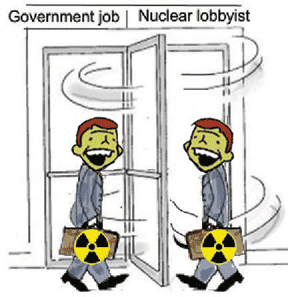 Liberation 2nd May 2018 , The practice of ” revolving doors” consisting of going back and forth
between public and private, without worrying too much about conflicts of
interest, is not the prerogative of the French elite and concerns all
sectors of the world. activity in Europe.
But according to a report to be published Wednesday by the group of Greens in the European Parliament, it
is particularly developed in France in the fossil and nuclear energy
industries. What explain a certain lack of voluntarism in terms of
ecological transition. This 82-page document entitled “Revolving Doors and
the Fossil Fuel Industry” , which Libération has procured, reviews the
“warm relations” that have developed in the main countries of the Union
between policy makers and large companies energy through these famous
revolving doors.
http://www.liberation.fr/france/2018/05/02/energie-les-portes-du-pouvoir-ouvertes-a-tous-les-vents-du-lobbying_1646907
May 4, 2018
Posted by Christina Macpherson |
France, secrets,lies and civil liberties |
Leave a comment
 Times 2nd May 2018 ,
 The boss of Hitachi is expected to meet the prime minister
tomorrow in an
attempt to secure UK government investment in its proposed nuclear plant on
Anglesey. Hiroaki Nakanishi is scheduled to meet Theresa May as the clock
ticks on the company’s deadline to agree the outlines of a financial
support package by the middle of this year.
Hitachi, the Japanese conglomerate, has spent £2 billion so far on its Horizon venture, which is
developing plans for a new power station at Wylfa. It has threatened to
withdraw funding unless it receives assurances that financial support can
be agreed. The 2.9-gigawatt power station is due to start generating in the
mid-2020s, becoming Britain’s second new nuclear plant after the £19.6
billion Hinkley Point plant being built in Somerset.
https://www.thetimes.co.uk/edition/business/hitachi-seeks-to-clear-clouds-over-horizon-hpfk9gpjd
May 2, 2018
Posted by Christina Macpherson |
politics, UK |
1 Comment
France’s Macron and Iran’s Rouhani agree to work on saving the 2015 Iran nuclear deal, CNBC, 29 Apr 18
May 2, 2018
Posted by Christina Macpherson |
France, Iran, politics international |
Leave a comment
 This has been a lone battle’: Frustration at government approach to nuclear plant plans in UK http://www.thejournal.ie/hinkley-c-power-plant-3988366-May2018/
An Oireachtas committee is planning to write a submission to UK authorities to express its concern.
AN OIREACHTAS COMMITTEE will express its concerns to UK authorities about plans to build a new power plant on the west coast of England as environmental experts here claim the government has failed to consider the possible consequences for Ireland.
Attracta Uí Bhroin, of the Irish Environmental Network told the Committee on Housing, Planning and Local Government that her intention was not to panic people or cause unnecessary concern, but her organisation wants to ensure Irish people’s rights are upheld.
Although the process for the new nuclear site at Hinckley Point in England, which is 250km from the coast of Ireland, began five years ago, it was only in 2016 that the news about the plans broke.
Hinkley Point C was given the final investment approval by French energy giant EDF, which has a two-thirds share and which is building the plant in conjunction with a Chinese company.
Speaking to TDs and senators today, Uí Broin pointed out that of the eight power plants the UK has planned as part of its energy expansion, “five are on the west coast of the UK, facing Ireland on the most densely populated east coast”.
Some of these plants are planned in locations closer than Hinkley Point C.
The potential economic impact of a nuclear leak or meltdown could be very serious, she explained. A 2016 ESRI report considered a scenario where there was a nuclear incident, but with no radioactive contamination reaching Ireland.
“Even then they estimated that impact economically could be in the order of €4 billion,” she said, explaining that an incident such as this would have serious implications for the agrifood and tourism industries in Ireland.
In the event of an incident where there is a risk of contamination, she said there are no detailed plans in place to protect Irish people, the water supply, or the country’s farm animals and produce.
“Not only would you not have fodder, you would not have livestock. You are talking about the national herd.”
She explained that the UK had made two screening determinations as part of its assessment process ahead of construction.
“There are serious questions about the adequacy of the assessment of impacts on Ireland in particular and the complacency of Ireland in respect of that assessment.”
Despite the fact that Ireland is the nearest state to the plant, Uí Bhroin said it was “entirely omitted” from the severe accident assessment.
She pointed out that other countries like Austria, Denmark and Germany had pushed back and insisted on being consulted and included in the assessment process.
Uí Bhroin was joined by Professors John Sweeney and Steve Thomas, who outlined some of the specific concerns around safety assessment and treatment of waste.
Sweeney was critical of the models used in risk assessments – some older models were used in calculations, for example, despite the fact that more modern ones exist.
Thomas spoke about some of the parts of the plant which are being made in France and which French regulatory authorities will not a clear for use in French nuclear plants.
Uí Bhroin said there was an “extraordinary level of frustration, anger and disappointment” among environmental groups at the government’s reaction to these plans.
“This has been a lone battle by Irish ENGOs [Environmental Non-Governmental Organisations],” she told the committee. She also said there had been a “lack of support and expertise from Irish bodies”.
Responding to the evidence from the witnesses, Green Party Senator Grace O’Sullivan said she was concerned about what impact the committee could have at this late stage.
“We are here not very late in the day.”
The public consultation deadline for the plans is 11 May.
May 2, 2018
Posted by Christina Macpherson |
Ireland, opposition to nuclear |
Leave a comment







 nuclear-news