High levels of radioactive Caesium in Ukraine region around Chernobyl a threat to children
 Ukrainian villages still suffering legacy of Chernobyl more than 30 years on https://www.eurekalert.org/pub_releases/2018-06/uoe-uvs060718.php UNIVERSITY OF EXETER
Milk in parts of Ukraine has radioactivity levels up to five times over the country’s official safe limit, new research shows.
Scientists from the Greenpeace Research Laboratories at the University of Exeter and the Ukrainian Institute of Agricultural Radiology sampled cow’s milk from private farms and homes in the Rivne region, about 200km from the site of the Chernobyl Nuclear Power Plant explosion in 1986. They found levels of radioactive caesium in milk above Ukraine’s safe limit for adults of 100 Becquerel per litre (Bq/L) at six of 14 settlements studied, and above the children’s limit of 40 Bq/L at eight sites.
The highest levels found were about 500 Bq/L – five times over the limit for adults and more than 12 times that for children.
“More than 30 years after the Chernobyl disaster, people are still routinely exposed to radioactive caesium when consuming locally produced staple foods, including milk, in Chernobyl-affected areas of Ukraine,” said Dr Iryna Labunska, of Greenpeace Research Laboratories at the University of Exeter.
“Many people in the area we studied keep cows for milk, and children are the main consumers of that milk.
“Though the level of soil contamination in the studied areas is not extremely high, radioactive caesium continues to accumulate in milk and other foods, such that the residents of these villages are chronically exposed to radioactivity that presents health risks to almost every system in the body – especially among children.”
The researchers say that some simple protective measures could be taken to bring radiation exposure levels below limits at a cost of less than 10 euros per person per year for the 8,300 people living in the six villages with the highest contamination.
Such measures include applying a caesium binder, called Ferrocyn, to cows, mineral fertilisation of potato fields and feeding pigs with uncontaminated fodder.
The cost of this would decrease each year as radiation levels fall – but if no action is taken, the experts warn that milk contamination will continue to exceed the 100?Bq/L adult limit in parts of Ukraine until at least 2040.
“The Ukrainian government has taken some of these measures in the past, but that stopped in 2009,” Dr Labunska said.
“Government and international monitoring needs to take place, along with help for people affected by this radiation.
“This situation should also act as a warning and a reminder of just how long the legacy of nuclear accidents can be.
“Without adequate countermeasures, what may now seem a purely historical event will remain a daily reality for those communities most impacted.”
###
The paper, published in the journal Environment International, is entitled: “Current radiological situation in areas of Ukraine contaminated by the Chernobyl accident: Part 1. Human dietary exposure to Caesium-137 and possible mitigation measures.”
Old, unproven, unreliable nuclear technology planned for Britain’s Wylfa nuclear power station
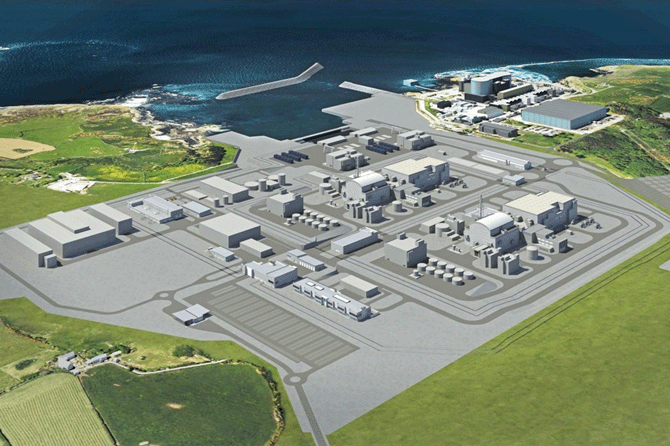 Unearthed 5th June 2018 Hitachi is seeking billions of pounds from the British government to help build a new nuclear power plant at Anglesey in Wales – but experts say the technology being used is far from proven.
Last week Hitachi-rival Toshiba confirmed that they are pulling out of a major nuclear power project in the USA which planned to use a similar reactor type to the one planned for Wylfa. Toshiba said in a press release that the South Texas
Project had “ceased to be financially viable” due to prevailing economic conditions.
The announcement leaves the UK as one of the last countries looking to build this technology, called the Advanced Boiling
Water Reactor (ABWR). Steve Thomas, Professor of Energy Policy at the University of Greenwich, said that while there are some small differences between the European reactor led by Hitachi and the abandoned US reactor
from Toshiba, the “perception that this is proven technology is not supported by the facts”.
Although there are four similar reactors that have been built in Japan, plans for construction elsewhere have seen a
series of failures. And because of the long lead-in times for developing and building nuclear reactors, power plants built today may have been designed decades ago, Thomas said
“The technology that has been built already is actually 30 year old technology, which has been updated twice
over. So the plants that are operating do not really represent what we would build, and also the performance of the plants in terms of their reliability has actually been very poor.”
https://unearthed.greenpeace.org/2018/06/05/wylfa-hitachi-nuclear-reactor-type-awbr/
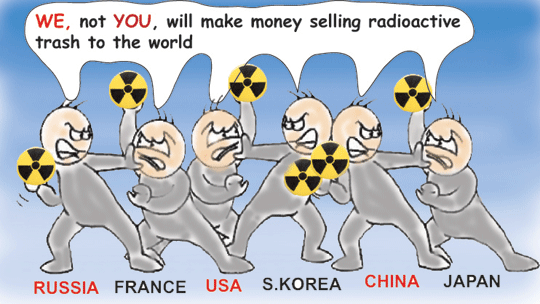
Russia, France, China compete to develop nuclear power station in Bulgaria
Bulgaria Moves To Revive Russian Nuclear Project Suspended In 2012 https://www.rferl.org/a/bulgaria-moves-revive-russian-nuclear-project-belene-suspended-2012/29279066.html
The Bulgarian parliament has approved a plan to revive the Belene nuclear power plant five years after the Russian project was suspended due to financing problems and concerns about relying too heavily on Russian energy.
The parliament on June 7 approved by 172 to 14 Prime Minister Boyko Borisov’s proposal to develop a plan to resume construction of the plant on the Danube River by the end of October.
Bulgaria had already spent around $1.8 billion on the plant when the government in 2012 put a moratorium on further workunder pressure from the United States and European Union to limit its energy dependence on Russia.
Bulgaria also suspended the joint project with Russian company Atomstroyexport because it failed to find any foreign investors prepared to shoulder its spiralling costs, estimated at about $11.8 billion in total.
The suspension angered Russia, which had hoped to use Belene as an EU showcase for its new generation of pressurized water reactors.
Sofia had to pay more than 620 million euros to Russia’s Rosatom for scrapping the project, but it also received nuclear parts for two 1,000 megawatt reactors, which were conserved and maintained.
Last week, Energy Minister Temenujka Petkova said that a campaign to pick a strategic investor for the project would be launched by the end of 2018.
Russia’s Rosatom has said it will make another bid to complete the project. Also in the running are Chinese state nuclear company CNNC and France’s Framatome, which is majority controlled by EDF.
Petkova said the government does not want to commit more public funds, extend state guarantees for any loan, or sign any long-term electricity supply deals to make the project viable.
Vadim Titov, director of Rosatom Central Europe, told a Bulgarian energy conference on June 7 that the Russian company is ready to start talks with the Bulgarian authorities on reviving the project.
The Belene plant’s two 1,000 megawatt reactors were intended to replace four old Soviet-built units that were shut down more than a decade ago amid security concerns at the only existing nuclear plant in Bulgaria, at Kozloduy.
There are still two Soviet-built operational reactors at Kozloduy, dating back to 1987 and 1991, which provide about 30 percent of the country’s electricity.
Dozens of Bulgarians protested outside parliament against the government’s plans for Belene on June 7, saying the project’s benefits were not enough to justify its costs and contending that it has been a source of corrupt practices for decades.
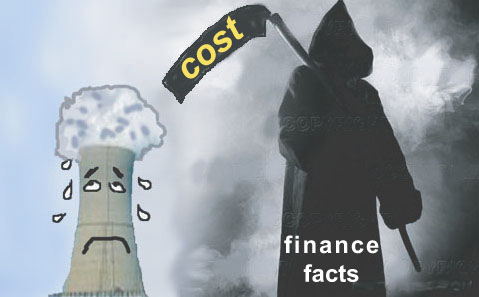
Ever multiplying financial costs for building new nuclear reactors are hitting UK, and other countries, too
 Nikkei Asian Review 6th June 2018 Britain’s move to finance much of a Hitachi nuclear power plant underscores
how such projects have grown too costly for the private sector to bear
alone, raising further questions about a key component of Japan’s ambitious
plans to export infrastructure worldwide.
The threat of electricity shortages spurred by factors including aging power plants drove London’s
pledge to loan a full 2 trillion yen ($18.2 billion) for the Japanese
industrial group’s plan to build two nuclear reactors in Wales, a project
slated to cost over 3 trillion yen.
The Wylfa saga illustrates how the expense of building nuclear power plants has become a deterrent to their
construction. Estimates for the Wales reactors have roughly doubled from
the initial outlook, owing to snowballing costs for safety and other
provisions. apart from Hitachi’s U.K. project, most of Japan’s overseas
nuclear efforts face an uncertain future at best.
Plans for new reactors are stalling around the world as countries get caught between the need for
energy security and the risks associated with nuclear energy. A Mitsubishi
Heavy Industries plan to build four reactors in Turkey’s Black Sea coastal
city of Sinop has doubled in cost to around 5 trillion yen, owing mainly to
additional precautions against earthquakes. Now the project “will not turn
a profit unless the Turkish government more than doubles the price at which
it buys electricity,” said a source affiliated with Mitsubishi Heavy.
Trading house Itochu has pulled out of the business alliance behind the
project. Toshiba’s former nuclear unit Westinghouse Electric, which was
building four reactors in the U.S., filed for bankruptcHitachi still faces
other hurdles on the Wylfa project. Lining up investors is proving
difficult on the Japanese side.
The U.K. government likely will drive a
hard bargain on power purchase prices, having drawn criticism for agreeing
to pay far above market rates for electricity from Hinkley Point C, a
nuclear power plant being built by France’s EDF and state-owned China
General Nuclear Power Group. Clarifying liability for accidents will be
another issue.
https://asia.nikkei.com/Business/Business-Trends/Hitachi-s-UK-nuclear-project-shows-heavy-risks-for-private-sector
Caroline Lucas: Backing Wylfa Nuclear Power Station Is The Wrong Move At The Wrong Time
Huffington Post 5th June 2018, Behind its shiny green veneer, this government has overseen
the funding stream for clean energy fall to its lowest levels in a decade.
The context for this public payout for new nuclear is an energy market
that’s making it blindingly obvious that renewables are the future. Solar
and wind are now the cheapest forms of new electricity generation, and new
technology means that power from the sun, sea and wind, balanced with
batteries and interconnection, are able to be the backbone of British
energy in the future.
Onshore wind – which the Government has all but
banned – could have a strike price a whopping £37.50 lower than Wylfa’s.
The frequent retort to those of us who oppose nuclear is centred on the
need for ‘baseload’ power – but such arguments are increasingly weak.
We know that battery technology is coming on leaps and bounds – and even
the ex-head of National Grid, Steve Holliday, has said that “the idea of
large power stations for baseload is outdated”, and noted that “from a
consumer’s point of view, the solar on the rooftop is going to be the
baseload”.
But it’s not just the government’s skewed financial
priorities that make Wylfa the wrong move at the wrong time. At the heart
of the problems with nuclear energy is the stark fact that there is still
no solution to the nuclear waste problem.
https://www.huffingtonpost.co.uk/entry/wylfa_uk_5b164eafe4b093ac33a17a41
UK govt’s new funding of nuclear projects contrasts with its lack of support for renewable project in Wales
NFLA 5th June 2018 , The Nuclear Free Local Authorities (NFLA) is very disappointed, but not at
all surprised, with the announcement by UK Energy Minister Greg Barker to
offer £5 billion of taxpayer money to assist with the funding of the Wylfa
B new nuclear reactor in Anglesey.
Whilst going against years of previous
government policy, it also compares unfavourably with the expected lack of
Government support of an exciting new renewable energy project in Wales –
the proposed development of the Swansea tidal lagoon scheme, and future
projects planned in Cardiff Bay and off the north Wales coast.
At present this scheme looks to be on a life support machine, though the Government
delayed the expected announcement to ditch the project and the thousands of
jobs that could be created.
http://www.nuclearpolicy.info/news/wylfa-b-swansea-bay-tidal-lagoon-developing-low-carbon-energy-solutions/
EDF looks to a profitable industry in decommissioning nuclear reactors
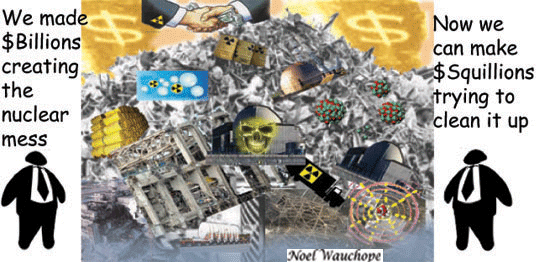
Nuclear Energy Insider 6th June 2018 , As France’s EDF expands into new decommissioning markets, learnings at the
group’s first pressurized water reactor dismantling is informing new cutting, tooling and waste strategies.
A new partnership agreement between EDF’s decommissioning subsidiary Cyclife and Sweden’s Fortum highlights
EDF’s aim to become a leader in the European nuclear decommissioning space.
Cyclife and Fortum announced May 30 they will jointly develop services in
nuclear decommissioning and waste management, focusing on the Nordic
region. European nuclear decommissioning activity is on the rise as ageing
fleets and energy policy shifts combine with stubbornly-low wholesale power
prices. By 2020, some 150 European reactors will have reached a 40-year
lifespan.
https://analysis.nuclearenergyinsider.com/edf-ramps-nuclear-decommissioning-efficiency-eyes-europe
Nuclear: Finally a parliamentary debate on the safety of fuel pools
Greenpeace Belgium 5th June 2018 , Nuclear: Finally a parliamentary debate on the safety of fuel pools.
 Greenpeace is pleased that the Subcommittee on Nuclear Safety has decided
to discuss the report “The safety of nuclear reactors and fuel storage
pools in France and Belgium and the related reinforcement measures” [1],
commissioned by the environmental protection association to 7 independent
international experts and sent last October to the competent authorities.
Only children close their eyes to remove a danger,” said Eloi Glorieux,
nuclear expert at Greenpeace and one of the three speakers of the
Subcommittee of the day. “That our MPs behave as adults and debate nuclear
security today, we can only rejoice.
It is now necessary for Engie-Electrabel to do the same and to take the appropriate measures to
better protect the power stations against external attacks. ” In October,
for security reasons, Greenpeace sent the full report only to the
Director-General of the Crisis Center, the director of the FANC and the
Minister of the Interior and Security, Mr. Jambon. In order to fuel the
public debate, the association had called for a parliamentary debate on the
content of the report. It will have taken months before it can be done,
after the members of the Subcommittee were able, under strict conditions,
to consult the report.
http://www.greenpeace.org/belgium/fr/presse/Nucleaire-Enfin-un-debat-parlementaire-sur-la-securite-des-piscines-de-combustibles/
UK government has not revealed the terms of its nuclear deal with Hitachi
 Stake in nuclear plant would be dramatic change of policy for UK, Government has not revealed terms of sensitive deal with Hitachi over Wylfa, Ft.com, 5 June 18, NICK BUTLER
Last Monday, the board of Hitachi met in Tokyo to consider the future of their proposed new nuclear power plant at Wylfa in north Wales. The Japanese company decided neither to approve nor to drop the plan but to continue the negotiations with the UK government.
As Toshiaki Higashihara, Hitachi’s chief executive, said after the meeting: “No decision has been taken.”
They were right to pause because the deal on the table was weak and inadequate as protection against the risks involved in a project of such scale. Wylfa is set to cost at least £20bn — and, given the record of new nuclear construction, that figure can only rise.
As reported by the Japanese press, at that stage the deal appeared to involve simply a UK government “guarantee” to cover the construction phase of the project, which is when the risks are highest.
But, within days, authoritative reports in the FT and elsewhere indicated that Britain had gone further and decided to make a direct investment of public money into the project.
This would be a dramatic change of policy with many implications.
First, it would mark the reversal of 40 years of a privatisation of the energy sector begun by Margaret Thatcher and Nigel Lawson. Suddenly, the state is back in business and the arguments against other proposed nationalisations, for instance of the railways or energy retailers, are undermined.
Second, taking a direct stake in one energy supplier opens up issues of competition policy. Will the government take shareholdings in other new nuclear projects including Hinkley Point C ? If nuclear, why not offshore wind or gas-fired power stations?
Then there is the question of the use of resources. There appears to be almost no extra money for anything from the National Health Service to defence and security. But suddenly several billion pounds have been found for a single nuclear power station……..
A direct shareholding will almost certainly be challenged in the courts on the grounds of competition policy and European state-aid rules. Britain is likely to be subject to EU rules at least until the end of the Brexit transition period.
And it must face scrutiny in parliament, where it will be weighed against other potential uses of the money.
Examination of this deal is likely to force a strategic review of energy policy, which would include just how much nuclear power is really needed — a question that has not been answered since 2013. In those five years, much has changed and there is a good case for a fundamental and open reappraisal.
As the Japanese will have discovered, the UK government is weak and nothing in British politics is certain. The deal is not yet done. https://www.ft.com/content/7ba55ce6-63f3-11e8-90c2-9563a0613e56
British Conservative govt overturns its previous opposition to socialising the nuclear power industry
UK takes £5bn stake in Welsh nuclear power station in policy U-turn, Ministers reach initial agreement with Japanese firm Hitachi over new Wylfa plant, Guardian, Adam Vaughan, 3 June 18,
The UK will take a £5bn-plus stake in a new nuclear power station in Wales in a striking reversal of decades-long government policy ruling out direct investment in nuclear projects.
Ministers said they had reached an initial agreement with the Japanese conglomerate Hitachi to back the Wylfa plant but emphasised that no final decision had yet been made and negotiations were just beginning.
The business secretary, Greg Clark, announcing the Wylfa agreement in the Commons, said: “For this project the government will be considering direct investment alongside Hitachi and Japanese government agencies.”…..
the use of billions of pounds of taxpayer money will be highly controversial at a time when there is pressure to increase NHS funding and alternatives such as solar and wind power are falling in cost. ……..
Caroline Lucas, the co-leader of the Green party, said: “Taking a stake in this nuclear monstrosity would see taxpayers locked into the project and paying out for a form of electricity generation that’s not fit for the future.”
Greenpeace attacked what it called a “bailout” of the project and accused Clark of being coy about what Hitachi had been offered.
UK now setting up an agreement that will replace the nuclear safeguards lost in leaving Euratom
 U.K. Reaches Draft Deal to Ensure Nuclear Supply After Brexit, Bloomberg , By Jonathan Tirone,
The U.K. reached an accord with international inspectors that will help keep the flow of nuclear materials going after the country leaves the European Union.
The International Atomic Energy Agency’s board of governors could approve the U.K.’s draft safeguards this week in Vienna, according to a statement. The IAEA deal will “replace existing agreements” between the U.K. and European Atomic Energy Community, or Euratom, that are needed for the import and export of fuel used in nuclear power plants.
Euratom’s main function is to safeguard nuclear fuel, making sure it isn’t diverted to make weapons. The U.K. will lose that service from Euratom once it departs the EU. ……https://www.bloomberg.com/news/articles/2018-06-04/u-k-reaches-draft-deal-to-ensure-nuclear-supply-after-brexit
South Africa’s Minister of Energy says that S.A. has called of the deal with Russia to develop nuclear power
SA no longer has agreement with Russians on nuclear, says Radebe, Fin 24, Khulekani Magubane Cape Town – Minister of Energy Jeff Radebe told eNCA on Sunday evening that South Africa no longer had an agreement with the Russians to procure for the development of nuclear energy for the country.
Britain’s Tories have done a complete U turn about subsidising nuclear power – the reason why
Dave Toke’s Blog 4th June 2018 , For the sake of artificially massaging down the price paid for electricity
from the proposed Wylfa nuclear plant the Government is about to commit the
country to pay for billions of pounds of almost inevitable construction
cost overruns.
In doing so the Tories will be junking their opposition to
doing such a thing. In 2010 The Conservative Party election manifesto
stated that: ‘we agree with the nuclear industry that taxpayer and
consumer subsidies should not and will not be provided – in particular
there must be no public underwriting of construction cost overruns’
There was a very good reason for this manifesto commitment. None of the nuclear
power plant currently operating in the UK were constructed according to
their original cost estimates. They were built during the time when
electricity was nationalised, and so the costs were spread around all
consumers and there was limited transparency about the economics of
building nuclear plants.
The Tories decided that there should be no more
wastage of public money on nuclear plant which soaked the public purse.
They wanted competition in electricity generation. Nick Butler in the
Financial Times has made some perceptive comments on this peculiar deal. He
is one of the few who has done some serious thinking about how it can
possibly be the case that the Wylfa project will be sold on a ‘cheaper’
price than Hinkley C despite the fact that the projected cost of building
Wylfa is actually higher than Hinkley
The remarkable thing is that despite
this effort at price fakery, the price agreed will still be a lot higher
than that available for installing large amounts of onshore wind offshore
wind and solar power.
http://realfeed-intariffs.blogspot.com/2018/06/wylfa-how-tories-are-deliberately.html
UK Tax-payer to cop huge payments for Wylfa nuclear power project, and costs may still balloon further
 Times 3rd June 2018 ,Ministers will this week reverse decades of opposition to investing taxpayer money in nuclear energy by agreeing to bankroll a £15bn-plus power station in Wales. The government will commit to taking a direct stake in the Wylfa plant on Anglesey, planned by the Japanese industrial giant Hitachi, after more than two years of negotiations.
It is understood the government will also provide the vast bulk of the £9bn debt. State equity will slash the cost of borrowing, but leave the taxpayer exposed if costs balloon or the project overruns. It has, though, helped ministers to
negotiate a strike price — a guaranteed payment for the plant’s electricity — of about £77.50 per megawatt hour. The government was determined to achieve a cheaper price than the £92.50 agreed with EDF, which is building the £20bn Hinkley Point power station in Somerset.
It is understood that this week’s heads of terms agreement with Hitachi will refer to “lessons learnt” from Hinkley. That deal was criticised by the National Audit Office for driving up the cost by piling too much risk on EDF. The deal this week has had to overcome opposition from the Treasury and will be a coup for the business secretary Greg Clark, who sees nuclear power as a key pillar of the government’s industrial strategy. Hitachi is believed to be considering increasing the number of reactors at Wylfa from two to four, with a strike price of less than £70, and to be planning a plant in Gloucestershire. Wylfa’s three shareholders — the UK and Japanese governments and Hitachi — will pump in about £6bn of equity on top of the £9bn debt provided largely by UK taxpayers.
https://www.thetimes.co.uk/article/taxpayer-bankrolls-15bn-nuclear-plant-at-wylfa-in-wales-0p7dnxfhq
Chinese firm Ocean Nuclear, links to former UK Prime Minister, on a fund-raising roadshow in London


 City AM 1st June 2018 Energy investment firm Ocean Nuclear today announced the launch of a $5bn (£3.8bn) nuclear energy industry fundraising roadshow in London. The Chinese company has negotiated nuclear infrastructure projects in more than
20 countries and will use 144 meetings at the roadshow to raise money for the programmes.
Ocean Nuclear has backing from firms including Silk Road Energy, which aims to raise $80m, and has been backed by the Belt and Road initiative, which has links to former Prime Minister David Cameron.
http://www.cityam.com/286792/chinese-firm-launches-5bn-london-nuclear-energy-industry
1 This Month

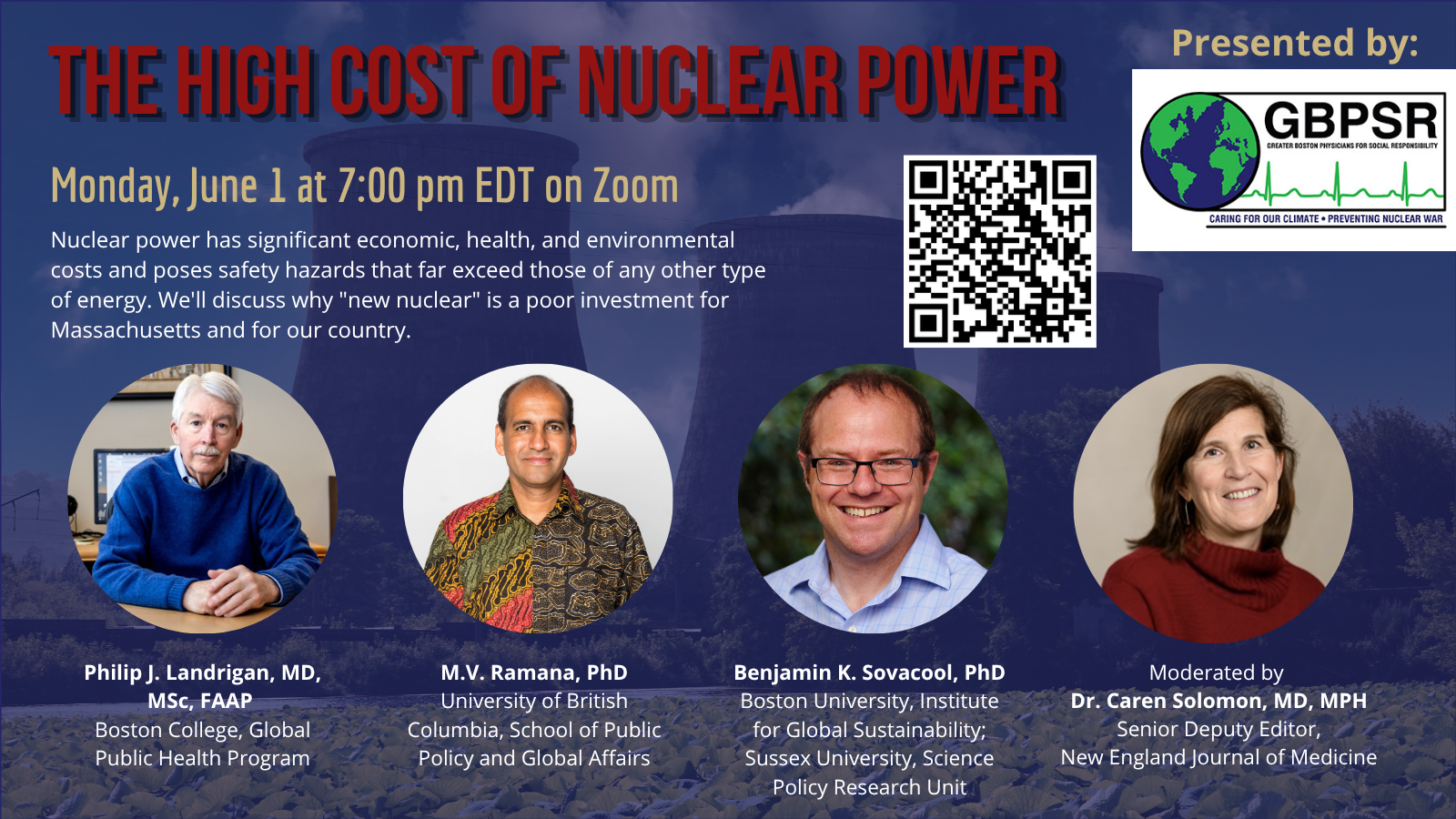
1 June Webinar – The High Cost of Nuclear Power – Register


of the week– Nuclear Reactor Information Task Force
To see nuclear-related stories in greater depth and intensity – go to https://nuclearinformation.wordpress.com
-
Archives
- May 2026 (262)
- April 2026 (356)
- March 2026 (251)
- February 2026 (268)
- January 2026 (308)
- December 2025 (358)
- November 2025 (359)
- October 2025 (376)
- September 2025 (257)
- August 2025 (319)
- July 2025 (230)
- June 2025 (348)
-
Categories
- 1
- 1 NUCLEAR ISSUES
- business and costs
- climate change
- culture and arts
- ENERGY
- environment
- health
- history
- indigenous issues
- Legal
- marketing of nuclear
- media
- opposition to nuclear
- PERSONAL STORIES
- politics
- politics international
- Religion and ethics
- safety
- secrets,lies and civil liberties
- spinbuster
- technology
- Uranium
- wastes
- weapons and war
- Women
- 2 WORLD
- ACTION
- AFRICA
- Atrocities
- AUSTRALIA
- Christina's notes
- Christina's themes
- culture and arts
- Events
- Fuk 2022
- Fuk 2023
- Fukushima 2017
- Fukushima 2018
- fukushima 2019
- Fukushima 2020
- Fukushima 2021
- general
- global warming
- Humour (God we need it)
- Nuclear
- RARE EARTHS
- Reference
- resources – print
- Resources -audiovicual
- Weekly Newsletter
- World
- World Nuclear
- YouTube
-
RSS
Entries RSS
Comments RSS
 nuclear-news