Taxpayer bankrolls £15bn nuclear plant at Wylfa in Wales
 John Collingridge The Sunday Times
 The government will commit to taking a direct stake in the Wylfa plant on Anglesey, planned by the Japanese industrial giant Hitachi, after more than two years of negotiations.
It is understood the government will also provide the vast bulk of the £9bn debt. State equity will slash the cost of borrowing, but leave the taxpayer exposed if costs balloon or the project overruns.
It has, though, helped ministers to negotiate a strike price — a guaranteed payment for the plant’s electricity — of about £77.50 per megawatt hour. The government was determined to achieve a cheaper price than the £92.50 agreed…… (subscribers only) https://www.thetimes.co.uk/article/taxpayer-bankrolls-15bn-nuclear-plant-at-wylfa-in-wales-0p7dnxfhq
The trials and tribulations of France’s Flamanville EPR nuclear reactor

Montel 31st May 2018 French utility EDF will reveal “in the next few days” whether
sub-standard welding identified at France’s first European pressurised
reactor (EPR) in Flamanville will lead to further start-up delays, a
spokeswoman said on Thursday. However, she refused to comment on Montel’s
interview with a senior official of the ASN watchdog’s technical arm –
the IRSN – who said the commissioning of the unit faced further delays
“of at leastseveral months”.
https://www.montel.no/en/story/edf-to-reveal-possible-epr-start-up-delay-in-days/905717
Jeremy Leggett 31st May 2018 French nuclear regulator fears “epidemic” safety-culture collapse at
Flamanville: disaster looms for EDF. Almost 150 more weld failures (beyond
those discovered earlier, as reviewed in the article) mean the nuclear
plant scheduled online in 2012 at a cost of €3.5bn is now delayed to
2020, probably, at a cost of €10.5bn, and counting.
Thierry Charles, deputy director general, Institute for Radiation Protection and Nuclear
Safety (IRSN), the technical arm of the Nuclear Safety Authority (ASN):
“The expected high level of quality was not specified (Editor’s note:
by EDF), the conformity of supplies to the specification could not be
attested”, plus “the qualification of the welding procedures […] ]
does not respect all the rules of art. Charles cites concerns over “other
categories of mechanical equipment” than the pipes of the secondary
circuit. He flags “human and organizational failures” and “lack of
rigor of suppliers”.
He ascribes all this to the “inadequacies of the
monitoring system put in place by EDF” to check the conformity of the
work of its subcontractors and he fears “dysfunction potentially damaging
to safety”. He has invited the ASN to summon EDF to thoroughly review its
organization “to improve the quality of realization of welds and make its
monitoring system more effective”. In a final, potentially lethal, blow
to EDF he argues that “additional controls will be requested on other
circuits of the reactor to verify that there is no epidemic.”
https://jeremyleggett.net/2018/05/31/french-nuclear-regulator-fears-safety-culture-collapse-at-flamanville-disaster-looms-for-edf/
Liberation 31st May 2018 [Machine Translation] The Flamanville EPR is likely to see its start
postponed to 2020. The weld quality problem detected on the EPR reactor
could differ by almost a year from its commissioning. The nuclear policeman
should demand that the work be redone.
A blow for EDF. A month and a half
after the discovery of new quality defects on 150 welds of the main
secondary circuit of the EPR reactor of the Flamanville power station, in
the Channel , EDF is preparing to post a further delay of several months in
the commissioning of what was to be the new flagship of the atom made in
France.
The EPR was due to start no later than early 2019. But according to
a source very familiar with the file questioned by Libération, the start
of the EPR Flamanville could outright “suffer a year late and be postponed
to the end of 2019 or early 2020” ! Severely taxed by the gendarme of the
atom, EDF would indeed be forced to resume one by one “Almost all 150
welds” whose quality is not up to what was expected by the nuclear
policeman for this type of equipment under nuclear pressure.
http://www.liberation.fr/france/2018/05/31/l-epr-de-flamanville-risque-de-voir-son-demarrage-reporte-a-2020_1655448
UK Environment Agency (EA) will let Atomic Weapons Establishment’s (AWE) release more radioactive isotopes into the air
 NIS 31st May 2018 The Environment Agency (EA) have announced that they are planning to
approve the Atomic Weapons Establishment’s (AWE) application to to
increase the quantity of volatile beta emitters that AWE Aldermaston is
permitted to release into the environment.
Beta emitters are radioactive elements that produce beta radiation. Volatile is a chemistry term which
refers to a substance that tends to vaporise and become a gas. AWE’s
application for the increase to the limit was announced in late January,
and there was a consultation on the application which ended in February.
The Environment Agency have now released a draft decision which approves
the proposed increase to the limit. Under their current license AWE are
allowed to release 4.4 megabecquerels (MBq) of volatile beta emitters into
the air as gas every year. The draft decision allows them to increase the
limit to 100 MBq a year, an increase of 22 times, or 2200%. A becquerel is
a measure of the quantity of radioactive material. One bequerel is the
quantity of material where radioactive decay will occur once every second.
A megabecquerel means one million becquerels of material. The EA is running
a consultation on the draft decision, which closes on the 6th June.
https://www.nuclearinfo.org/article/awe-aldermaston/environment-agency-plans-approve-2000-increase-awe-discharge-limit
UK wind power – much cheaper than planned Wylfa nuclear power plant
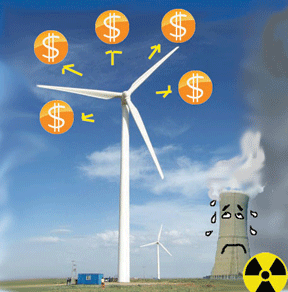
 ‘Cheap’ power at Wylfa nuclear plant blown away by wind, The Times, Emily Gosden, Energy Editor, 2 June 18 The electricity generated by the Wylfa nuclear plant could be about a fifth
cheaper than Hinkley Point’s but is likely to be much more expensive than
power from the latest offshore wind farms. It is understood that a figure
of close to £75 per megawatt-hour is under discussion as the “strike
price” that Hitachi, the Japanese conglomerate developing the Anglesey
plant, would be guaranteed by the government for the electricity it
produces. The difference between the guaranteed price and the wholesale
price — currently £50 per MWh — would be paid for by consumers through
levies on their energy bills.
Ministers are preparing to announce next week
the outline of a deal to fund the proposed Wylfa plant, which could cost in
excess of £15 billion. The twin-reactor plant could generate 2.9 gigawatts
of electricity, enough to power five million homes. It is due to start
generating in the mid 2020s. The government plans to invest directly in
Wylfa, as well as to offer extensive guarantee loans for the project. These
measures are designed to cut the cost of the project and so lower the price
that consumers will have to cover.
Critics of nuclear power are likely to
draw unfavourable comparisons with offshore wind. Two projects in UK waters
were awarded guarantees prices of £57.50 per MWh last year. Some onshore
wind and solar projects are being built without any subsidy.
https://www.thetimes.co.uk/article/cheap-power-at-nuclear-plant-blown-away-by-wind-3bzc2h5qm
Macron’s France signs up to join nuclear power partnership with Putin’s Russia!!

World Nuclear News 29th May 2018, Russia’s Rosatom and the French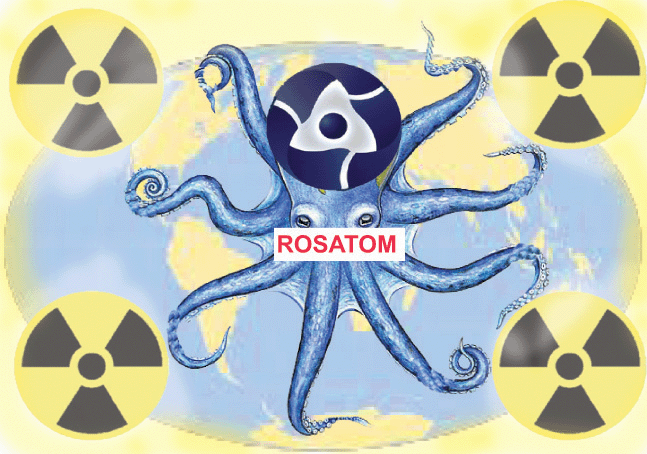 Alternative Energies and Atomic Energy
Commission (CEA) have signed a strategic document on partnership in the
peaceful uses of nuclear energy.
The agreement was signed on 24 May by
Rosatom Director General Alexy Likhachov and CEA Chairman François Jacq in
the presence of the Russian and French presidents, Vladimir Putin and
Emmanuel Macron, during the St. Petersburg International Economic Forum.
http://world-nuclear-news.org/NP-France-Russia-extend-nuclear-power-cooperation-29051801.html
France scaling back nuclear reprocessing – fears of financial disaster as with Japan’s Monju project
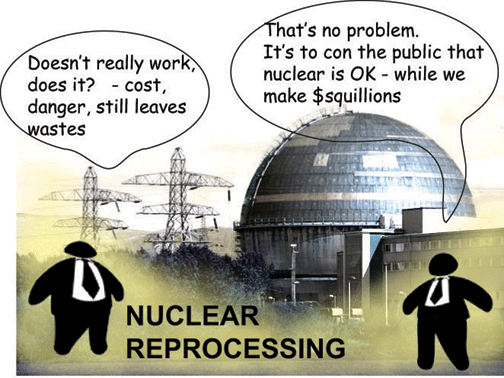 Scaling back of French reactor a blow for nuke fuel reprocessing THE ASAHI SHIMBUN May 31, 2018
Japan’s hopes of keeping its nuclear fuel recycling program alive faces another major obstacle with signs from France that a reactor project there will be scaled back because of swelling construction costs.
After the nuclear fuel recycling program suffered a heavy blow with the decision in late 2016 to decommission the Monju prototype fast-breeder reactor, government officials turned to France’s ASTRID program as an alternative information source for the fuel recycling plan.
But French government officials said the Advanced Sodium Technological Reactor for Industrial Demonstration will have its planned power generation scaled back from the initial plan of 600 megawatts of electricity to between 100 and 200 megawatts.
The major aim of the nuclear fuel recycling program is to reprocess spent nuclear fuel to extract plutonium, which would be used to create mixed-oxide fuel that could be burned in nuclear reactors.
Government officials had hoped to use various technologies emerging from the ASTRID program to eventually construct a demonstration fast reactor in Japan. But a scaled-back ASTRID would mean knowledge needed for the demonstration reactor would not be available.
According to several government sources, French government officials informed their Japanese counterparts of the planned reduction in the ASTRID power generation plan due mainly to the high construction costs.
French officials also inquired about the possibility of Japan shouldering half the ASTRID construction burden, which could run anywhere between several hundreds of billions of yen to about 1 trillion yen ($9.2 billion).
Plans call for constructing the ASTRID in France with construction to start sometime after 2023………
Even some officials of the Ministry of Economy, Trade and Industry, which has been promoting the nuclear fuel recycling program, have raised doubts about participating in the ASTRID program.
Concerns are also being raised among lawmakers in the ruling Liberal Democratic Party, with one executive wondering if cooperating with the ASTRID program could end up much like the Monju project, which wasted more than 1 trillion yen following a spate of accidents and other problems.
(This article was written by Tsuneo Sasai, Shinichi Sekine and Rintaro Sakurai.) http://www.asahi.com/ajw/articles/AJ201805310040.html
British government used pilots like ‘GUINEA PIGS’ during Cold War nuclear experiments
 MoD used British pilots like ‘GUINEA PIGS’ during Cold War nuclear experiments https://www.express.co.uk/news/uk/967466/cold-war-nuclear-experiments-MoD-radiation-RAF
THE Ministry of Defence (MoD) used British nuclear test pilots like “guinea pigs” during the Cold War, deliberately exposing them to radiation, it has been claimed By ALICE SCARSI, May 31, 2018
The shocking allegation was made by the widow of a pilot who obtained secret documents suggesting her husband took part in a life-threatening experiment.
Shirley Denson, 83, said the documentation shows her husband, Flight Lieutenant Eric Denson, was ordered to fly through the cloud of a thermonuclear explosion at Christmas Island in the Pacific.
The test exposed him to so much radiation he was left with unbearable headaches which eventually brought him to kill himself to make the pain stop, she added.
And the experiment may have affected two of the couple’s four daughters, as Mrs Denson claimed they were born with abnormalities.
The widow, who was handed the papers by the MoD while conducting research about her husband’s service, described the situation “wicked” and “evil”.
“It makes me furious to think it was done on purpose, that my Eric mattered so little to them.”
The documents revealed Fl Lt Denson had flown his Canberra B6 bomber into the mushroom cloud of a 2.8 megaton nuclear explosion on April 28 1958, with X-ray badges on the seat to measure radiation, the Mirror reported.
During the flight, the pilot would have been exposed to 65 years’ worth of normal background radiation during the six-minute flight.
British Nuclear Test Veterans’ Association chairman Alan Owen said: “This is the first time in all our years of campaigning we have ever found evidence this strong.
“Our members always believed they were guinea pigs and this appears to prove some of them were, at best, collateral damage in horrifying experiments.
“We need to know everything – now.”
The MoD denied Fl Lt Denson was purposely exposed to radiation.
The allegations caused outrage among politicians, who urged the MoD to answer the claim.
Deputy Labour leader Tom Watson described the documents as “shocking”, and said the Defence Secretary should issue an unqualified apology to Mrs Denson in the Commons.
He said: “This is a shocking document the MoD cannot wriggle out of.
“We need answers about what experiments were conducted, and how many of the 22,000 nuke vets were involved in them.”
Shadow defence secretary Nia Griffiths said the papers brought to light “deeply worrying revelations” and called for them to be investigated by the MoD.
And Shadow Health Secretary Jonathan Ashworth added: “This is an absolute scandal.”
A spokesman for the MoD rejected the claims saying: “It is not true to say these men were subject to an experiment to look at the effects of radiation.
“The British nuclear testing programme contributed towards keeping our country secure during the Cold War and regular health checks were conducted throughout.
“The National Radiological Protection Board has carried out three studies of nuclear test veterans and found no valid evidence to link this programme to ill health.”
And he exclusively revealed to Express.co.uk: “According to the information available in the Operational Record Books for the squadron, Fl Lt Denson did not fly the same aircraft in the week after his sampling sortie.
“The ‘experiments’ referred to were to determine the best possible arrangement on the body of dosemeters (devices that measure radiation) so that these mens’ exposure could be measured as accurately as possible.”
Hitachi ‘won’t pay’ for nuclear accidents at proposed Wylfa plant on Anglesey
 Times 30th May 2018 Hitachi ‘won’t pay’ for nuclear accidents at proposed Wylfa plant on Anglesey. Hitachi could seek to absolve itself of financial responsibility for any accidents at its proposed new nuclear power station in north Wales.
The Japanese conglomerate has decided to continue with work developing the planned Wylfa plant on Anglesey after progress in financing talks with the government, which Hitachi is already relying on for a package of loan guarantees, subsidies and potential direct investment to make the project viable.
However, the company wants further concessions to reduce its risks, the Japanese newspaper Nikkei reported. Reports in several Japanese media outlets have claimed that the Wylfa plant could cost as much as three trillion yen, or almost £21 billion — making it even more expensive than Hinkley Point C.
EDF decided to build Hinkley Point only thanks to a 35-year subsidy contract from the government, which locks consumers into paying a fixed price for the power it generates and has been criticised for its high cost.
The Nikkei reported that some of Hitachi’s directors also wanted “safeguards that reduce or eliminate Hitachi’s financial
responsibility for accidents at the plant”. Nuclear operators are already obliged to take out insurance to cover their liabilities in case of an accident. If they are unable to secure insurance from the market, the government is obliged to step in and provide it instead. It is unclear what alternative arrangement or safeguards Hitachi might be seeking.
https://www.thetimes.co.uk/edition/business/hitachi-wont-pay-for-nuclear-accidents-at-proposed-wylfa-plant-on-anglesey-gtm28q0k3
Persisting with the European Pressurized Reactor (EPR) has brought Franc e to a costly nuclear crisis
 Liberation 30th May 2018 [Machine Translation] “The impasse”, how the EPR sank French nuclear.
France 5 broadcasts this Wednesday night “Nuclear, the French impasse”, a documentary against the declining reign of the atom. This film investigates EDF’s crazy gamble: risking its survival on the EPR, a reactor that accumulates trouble.
Will the EPR be the Titanic of French nuclear power? This is the shocking question posed by a film investigated by director Patrick Benquet broadcast tonight on France 5 which points to the “impasse”
in which the “most nuclearized country in the world” has locked up by equipping itself with 58 reactors. the 70s-80s. A fleet of 19 aging plants, which still produces 75% of French electricity, and which EDF wants to keep at all costs by launching a new generation of pressurized water reactor:
the EPR, “the most powerful never built, able to supply electricity to a metropolis like Paris. It must have been the deadly weapon of the nuclear lobby to defend the reign of the atom undermined by the Fukushima disaster and the rise of green energies.
EDF dreamed of exporting it all over the world by selling this “new nuclear” as the best lever against global warming. But things did not go at all as planned. And today EDF is going through a crisis that threatens the very existence of the “public service preferred by the French,” says the documentary.
There are these hidden costs of the atom, put under the carpet for decades, which rise to the surface: the enormous costs of reprocessing radioactive waste, is added the bill of the “great refit”: these works of Hercules designed to extend the lifespan of aging plants from 40 to 50 years. ”
EDF promised cheap electricity, but the real cost of nuclear energy today is in the tens and tens of billions. And ultimately it is the taxpayer who will pay, announces the implacable voice off. Yet, EDF, the nuclear state in the state, will launch the EPR at all costs. By assigning a strategic mission: take over
the old reactors that will gradually retire by 2035.
http://www.liberation.fr/france/2018/05/30/l-impasse-comment-l-epr-a-coule-le-nucleaire-francais_1655363
British scientists distressed at loss of funding as Britain leaves the nuclear safety agency Euratom
 Nature 29th May 2018 , Prime Minister Theresa May conceded on 21 May that a post-Brexit Britain
was willing to pay to “fully associate” with Euratom, Europe’s nuclear agency. The details of the arrangement, similar to many that surround the controversial exit of the United Kingdom from the European Union, still have to be ironed out.
And among those watching the negotiations with mounting concern are scientists at the Joint European Torus (JET) near Oxford, UK, who currently benefit greatly from Britain’s membership of the agency. The hundreds of researchers at JET receive annual funding of around €60 million (US$70 million), because Britain is part of Euratom. As it stands, that funding will cease at the end of this year.
https://www.nature.com/articles/d41586-018-05283-x
In a drill, fake terrorists take over Russia’s Arctic radioactive waste storage site
In a drill, fake terrorists take over Arctic radioactive waste storage site
Russian officials have said they thwarted a terrorist attack at a facility storing old radioactive components from nuclear vessels located in the Arctic — but don’t worry. It was just a drill. Bellona, by Anna Kireeva
Russian officials have said they thwarted a terrorist attack at a facility storing old radioactive components from nuclear vessels located in the Arctic — but don’t worry. It was just a drill.
The simulated siege was part of a large-scale exercise called Atom-2018, and was meant to prepare workers at the Sayda Bay for the worst – an armed incursion into a sensitive facility within Russia’s vast but fragile nuclear waste storage industry, complete with bombs, hostages and political demands.
According to reports, staff at the facility were alerted to the fact that the exercise was a drill. The purpose of the fake crisis, rather than scaring workers at a radioactive materials storage site, was to prepare officials from Russia’s security services to map out countermeasures specifically designed for the Sayda Bay site.
Sayda Bay is a part of the Murmansk branch of RosRAO, the state operator responsible for the management and storage and handling of non-nuclear radioactive waste, as well as decommissioning nuclear vessels, especially submarines.
Located 60 kilometers from Murmansk, Sayda Bay is itself an old Soviet-era military base. Since 2004, it has been tasked with storing reactor compartments from the dismantled submarines of Russia’s once overwhelming Northern Fleet of nuclear submarines.
Later, facilities were built at Sayda Bay to handle and condition radioactive waste. Currently it houses about 80 single unit reactor blocks and has space for 40 more. Eventually, the site will hold the irradiated remains of the Lepse, a nuclear icebreaker refueling vessels that is carefully being pulled apart at the Nerpa Shipyard near Murmansk.
It was the radioactive waste storage facility at Sayda Bay that was targeted by the would be terrorists. According to a release on the exercise, the assailants seized the facility, took hostages from among its workers, and put forth a demand for regime change. Unless their demands were met, said the insurgents, they would detonate a bomb…….http://bellona.org/news/nuclear-issues/2018-05-in-a-drill-fake-terrorists-take-over-arctic-radioactive-waste-storage-site
Licence exists for dumping mud at North Cardiff – but they don’t need Hinkley’s suspect “mud”
Barry GEM 29th May 2018 Graham Vodden: I read with interest your article in The GEM regarding Hinkley Mud, and I have to say that I have no confidence in the National Assembly making the correct decision on this matter. I fully endorse the petition calling for the licence to be suspended to allow for a full environmental assessment before any dredging and dumping is started.
We already have a problem with excess mud coming ashore on Penarth beach because somebody decided years ago to dump local dredged mud out of Cardiff Dock entrance at the North Cardiff buoy, instead of where it used to be dumped at the Middle Pool buoy, where it would disperse and not cause any environmental problem.
The question that needs to be addressed is why does EDF want to bring this mud all the way from Hinkley beach to the North Cardiff Buoy position for dumping? The answer to that is there is already a licence issued for dumping mud or sediment here, which makes the whole process easier.
The other question which needs to be asked is why can’t they dump this sediment outside Hinkley? There is plenty of depth in that part of the channel and it would not cause any problems, it would just disperse. The answer to that is that EDF would have to go through the whole process of licence application again. My message to EDF is, keep your suspect ‘mud’ in the area of Hinkley. The last thing Penarth needs is a massive mud pollution increase on our beach.
http://www.barry-today.co.uk/article.cfm?id=119999&headline=Why%20does%20EDF%20want%20%20to%20dump%20mud%20from%20%20Hinkley%20on%20our%20coast?§ionIs=news&searchyear=2018
Wylfa Newydd nuclear plant protesters go to Japan
http://www.bbc.com/news/uk-wales-north-west-wales-44281941 28 May 18 A group of anti-nuclear campaigners have travelled to Japan to petition the government to withdraw support for a nuclear power station on Anglesey.
A petition against the Wylfa Newydd nuclear plant signed by almost 6,000 people was handed to Japan’s Ministry of International Trade and Industry.
Pawb’s (People against Wylfa B) trip comes amid reports of UK and Japanese government investment in the project.
Technological giant Hitachi said there had been “no changes to disclose”.
Hitachi’s Horizon Nuclear Power wants to start building on Anglesey in 2020, but recent reports say the British government is to offer £13.3bn to support the project.
Prime Minister Theresa May met Hitachi’s chairman Hiroaki Nakanishi earlier this month to discuss support.
Speaking to BBC Wales from Japan, Meilyr Tomos from Pawb, said: “There’s huge uncertainty. It’s a scheme that requires two governments to prop it up, so there’s no certainty on anything at this stage.
“It’s not a commercial proposition. You need the biggest bang for your buck, that’s not something nuclear can deliver, it’s far too expensive.
Britain’s “nuclear renaissance” in the balance as Hitachi ponders Wylfa nuclear project
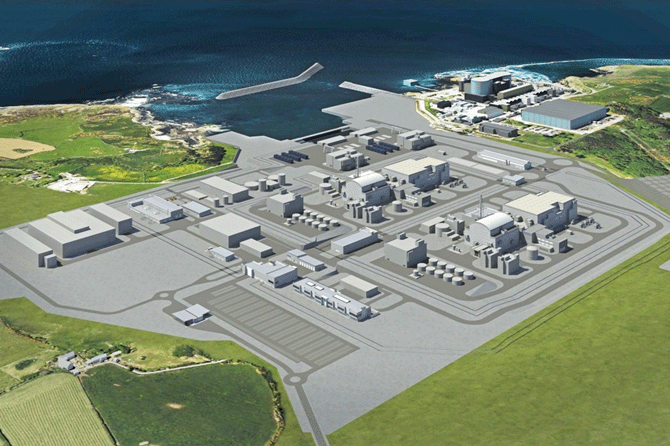 Times 27th May 2018 , The fate of a £15bn-plus nuclear power station is set to be decided this
week — and with it the future of Britain’s atomic renaissance.
The Japanese industrial giant Hitachi is due to decide Monday whether to
proceed with Wylfa. Hitachi’s decision has huge implications for
industrial collaboration between Britain and Japan and the country’s
nuclear power industry.
The project hinges on winning financial support
from Westminster. This weekend, ministers are expected to set out their
offer to Hitachi in a letter ahead of the crucial meeting. The proposal is
expected to include UK taxpayers taking a direct stake in the plant,
alongside Hitachi and the Japanese state, as well as guaranteeing loans. In
return, Westminster wants Hitachi to substantially undercut on price the
£20bn Hinkley Point plant in Somerset, which is being built by EDF.
TheFrench company struck a deal with the government for a guaranteed payment
of £92.50 per megawatt hour for 35 years. Ministers are expected to make
an announcement once they return from this week’s parliamentary recess.
They will herald it as an example of the type of post-Brexit trade deal
Britain can expect.
https://www.thetimes.co.uk/edition/business/deadline-day-for-japans-hitachi-over-wales-15bn-horizon-nuclear-plant-mdxhnj9x8
Germany is ready to support Iran in restoring its economy as long as Iran adheres to the Joint Comprehensive Plan of Action (JCPOA)
Germany to assist Iran in restoring economy while Tehran adheres to JCPOA https://en.mehrnews.com/news/134429/Germany-to-assist-Iran-in-restoring-economy-while-Tehran-adheresTEHRAN, May 29 (MNA) – Germany is ready to support Iran in restoring its economy and also, to continue bilateral trades, as long as Iran adheres to the Joint Comprehensive Plan of Action (JCPOA), said German Foreign Minister Heiko Maas.
“We will continue to make efforts to fulfill Iran’s hopes for economic recovery and good trade relations as long as Iran is ready and able to prove that it adheres to its obligations under the nuclear deal,” Maas said at the Global Solutions Summit held in Berlin, sputnik reported on Tuesday.
In a meeting with US Secretary of State Mike Pompeo, Maas has mentioned that US and Germany are pursuing “two entirely separate paths” regarding Iran’s issue.
US president Donald Trump withdraw from JCPOA on May 8 and reintroduced sanctions against Iran. This is while other signatory states of the deal including Russia, China and European countries don’t support US decision and have repeatedly highlighted their commitment to the agreement and guarding Iran’s interests.
1 This Month

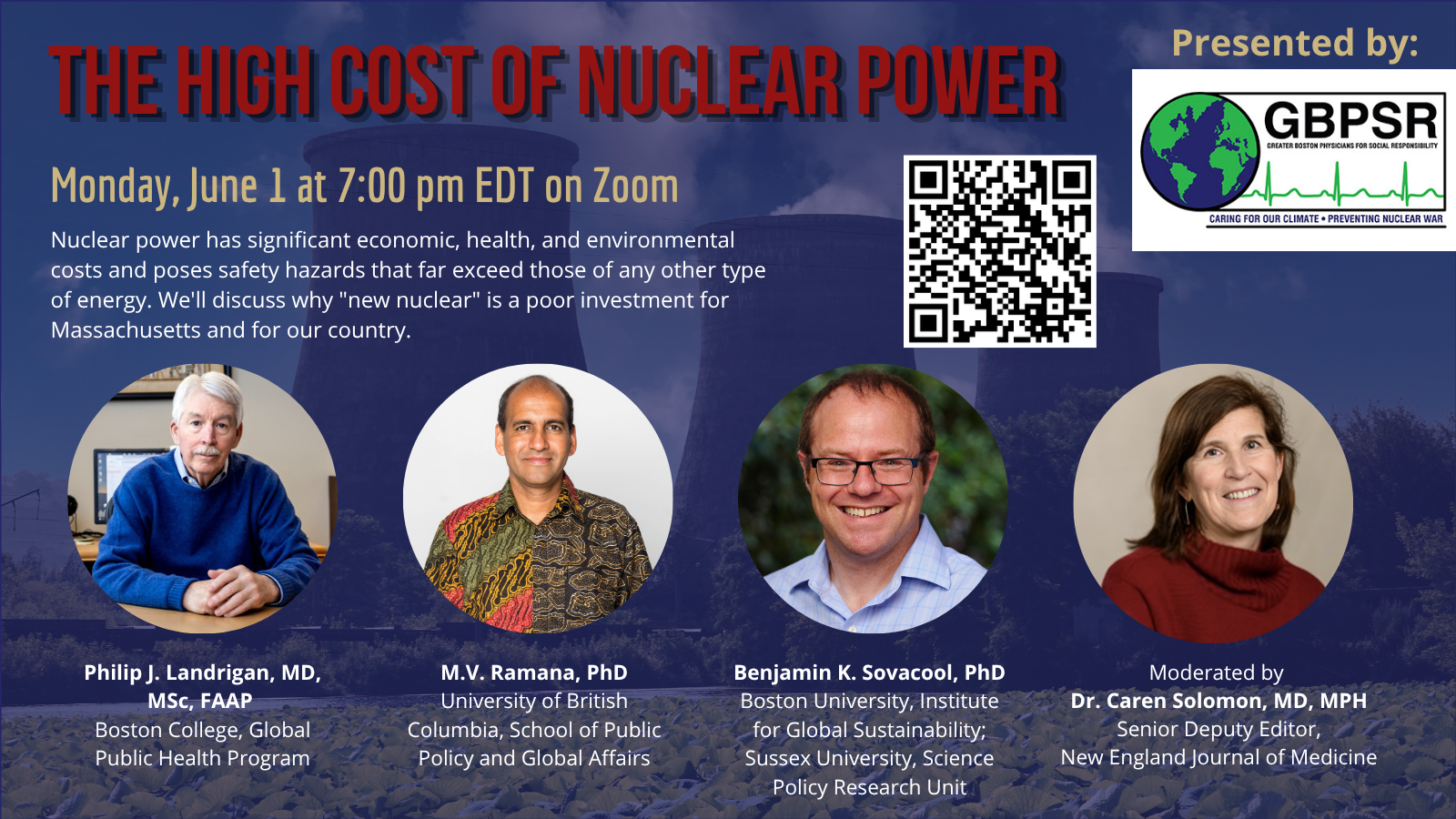
1 June Webinar – The High Cost of Nuclear Power – Register


of the week– Nuclear Reactor Information Task Force
To see nuclear-related stories in greater depth and intensity – go to https://nuclearinformation.wordpress.com
-
Archives
- May 2026 (262)
- April 2026 (356)
- March 2026 (251)
- February 2026 (268)
- January 2026 (308)
- December 2025 (358)
- November 2025 (359)
- October 2025 (376)
- September 2025 (257)
- August 2025 (319)
- July 2025 (230)
- June 2025 (348)
-
Categories
- 1
- 1 NUCLEAR ISSUES
- business and costs
- climate change
- culture and arts
- ENERGY
- environment
- health
- history
- indigenous issues
- Legal
- marketing of nuclear
- media
- opposition to nuclear
- PERSONAL STORIES
- politics
- politics international
- Religion and ethics
- safety
- secrets,lies and civil liberties
- spinbuster
- technology
- Uranium
- wastes
- weapons and war
- Women
- 2 WORLD
- ACTION
- AFRICA
- Atrocities
- AUSTRALIA
- Christina's notes
- Christina's themes
- culture and arts
- Events
- Fuk 2022
- Fuk 2023
- Fukushima 2017
- Fukushima 2018
- fukushima 2019
- Fukushima 2020
- Fukushima 2021
- general
- global warming
- Humour (God we need it)
- Nuclear
- RARE EARTHS
- Reference
- resources – print
- Resources -audiovicual
- Weekly Newsletter
- World
- World Nuclear
- YouTube
-
RSS
Entries RSS
Comments RSS
 nuclear-news