 Guardian,9 Nov 18 , Phillip Inman As Cumbria reactor plan stalls, it is clear that huge resources are needed for such projects. If the government was keen to boost Britain’s nuclear industry, it was always clear that the private market would struggle to deliver.
The decision by Toshiba to close down its UK operations is a case in point. After the deal to build new reactors at Hinkley Point with the French firm EDF, Toshiba was favoured by ministers to design and construct a smaller power station on the Cumbrian coast.
Hinkley was a deal that appeared to be with a private company but the really meaningful talks were between Whitehall officials and their counterparts in the French government, EDF’s controlling shareholder. It took years of agonising brinkmanship to conclude the talks, much of them conducted on the French side by the then economy minister, Emmanuel Macron.
Toshiba, on the other hand, is a private company struggling on its own to navigate the complex politics surrounding nuclear power in the wake of the Fukushima disaster.
In 2006 it bought the US nuclear business Westinghouse, part of British Nuclear Fuels and home to much of the UK’s nuclear power industry. With climate change creeping to the top of the agenda and demand for new nuclear plants around the world growing, it seemed like a good idea.
However, the 2011 Fukushima disaster changed all that. Governments in Japan and other countries halted the development of new nuclear plants. Last year, cost overruns on building the first new US nuclear power plants in three decades pushed Westinghouse into bankruptcy and Toshiba into financial meltdown. The future of the Cumbrian nuclear plant has been in doubt ever since.
Earlier this year Toshiba sold Westinghouse to a private equity outfit as a services provider for existing nuclear plants. The construction of new reactors was not on the agenda. To no one’s surprise, Toshiba has now confirmed it has abandoned building any new plants in the UK.
Without entering the argument about whether nuclear is a good option – and the government advisory body, the National Infrastructure Commission, is unequivocal that renewables such as wind and solar were going to be a safer, cheaper option – it is clear huge commitments of time, resources and political capital are necessary for infrastructure projects of this scale to get off the ground and through to completion.https://www.theguardian.com/business/2018/nov/08/toshibas-failure-shows-business-cant-deliver-a-nuclear-future
November 10, 2018
Posted by Christina Macpherson |
business and costs, UK |
Leave a comment
 UK nuclear power station plans scrapped as Toshiba pulls out, Guardian, Adam Vaughan@adamvaughan_uk, 8 Nov 2018 Firm’s nuclear arm to wind up next year and scrap Cumbria plant leaving big hole in UK energy plans Plans for a new nuclear power station in Cumbria have been scrapped after the Japanese conglomerate Toshiba announced it was winding up the UK unit behind the project.
Toshiba said it would take a 18.8bn Japanese yen (£125m) hit from closing its NuGeneration subsidiary, which had already been cut to a skeleton staff,after it failed to find a buyer for the scheme.
The decision represents a major blow to the government’s ambitions for new nuclear and leaves a huge hole in energy policy. The plant would have provided about 7% of UK electricity.
“This is a huge disappointment and a crushing blow to hopes of a revival of the UK nuclear energy industry,” said Tim Yeo, the chair of pro-nuclear lobby group New Nuclear Watch Institute and a former Tory MP.
Greenpeace UK’s executive director, John Sauven, said: “The end of the Moorside plan represents a failure of the government’s nuclear gamble.”
After a board meeting of Toshiba on Thursday, the company said it was winding up NuGeneration because of its inability to find a buyer and the ongoing costs it was incurring. The firm has already spent more than £400m on the project.
“Toshiba recognises that the economically rational decision is to withdraw from the UK nuclear power plant construction project, and has resolved to take steps to wind-up NuGen,” the firm said in a statement………
Some industry watchers said the collapse of the scheme should be seen as an opportunity rather than a risk, for the UK to prioritise renewables instead.
Jonathan Marshall, an analyst at the ECIU thinktank, said: “Shifting away from expensive, complicated technology towards cheaper and easier to build renewables gives the UK the opportunity to build an electricity system that will keep bills for homes and businesses down for years to come.”
The government’s infrastructure advisers recently urged ministers to rethink their nuclear plans and focus on renewables instead……..https://www.theguardian.com/environment/2018/nov/08/toshiba-uk-nuclear-power-plant-project-nu-gen-cumbria
November 10, 2018
Posted by Christina Macpherson |
business and costs, UK |
Leave a comment
 Toshiba Ditches UK Nuclear Business, U.S. LNG Operations, Oil Price.com By Irina Slav – Nov 08, 2018 Toshiba has decided to liquidate a nuclear power subsidiary in charge of a power plant project in the UK as well as its U.S. LNG operations, the company said in a statement, citing its inability to continue operating the business and its failure to find buyers for it.
Toshiba will also liquidate another nuclear subsidiary in the UK, Advance Energy UK Limited. The loss that the company will book from the wind-ups will come in at US$130 million (15 billion yen) and will be booked in its 2018/19 results………
Earlier this year, Toshiba sold its U.S. nuclear power business, Westinghouse, for US$4.6 billion to a group of investment companies led by Brookfield Asset Management. The deal puts an end to a major headache for the Japanese conglomerate, which last year warned that it might have trouble surviving if it didn’t find a buyer for the nuclear power plant constructor, which it acquired in 2006 for US$5 billion.
Plagued by project delays and cost overruns that came up to US$6 billion for two large-scale projects in the United States, Westinghouse filed for Chapter 11 bankruptcy protection last March. The business had by that time generated US$6.3 billion in writedowns for the parent company that resulted in Toshiba reporting a net loss of US$9.1 billion for 2016……..https://oilprice.com/Latest-Energy-News/World-News/Toshiba-Ditches-UK-Nuclear-Business-US-LNG-Operations.html
November 10, 2018
Posted by Christina Macpherson |
business and costs, UK |
Leave a comment
World War 3 alert: US nuclear weapon strategy will spark CATASTROPHE warns Russia, RUSSIA has warned a proposed US strategy involving the “limited” use of nuclear weapons would spark World War 3 if it is ever put into practice., Express UK, By HARVEY GAVIN, , Nov 8, 2018 |Elbridge Colby, who served as a high ranking official in Donald Trump’s administration, recently advocated the use of tactical nukes in targeted attacks to repel an attack by Russia or China. But Moscow today branded the plans “irresponsible and dangerous”, warning: “Using nuclear weapons in pinpoint attacks is tantamount to playing with the devil.” Mr Colby, a former deputy assistant secretary of defence for strategy and force development, explained the thinking behind his strategy in an article for Foreign Affairs magazine entitled ‘If you want peace, prepare for nuclear war’………
Russian Foreign Ministry Spokeswoman Maria Zakharova said any use of nukes, regardless of their size, would lead to global catastrophe.
Addressing reporters today, she said there are growing calls in Washington to “increase the role of nuclear weapons and expand the possibilities of the US nuclear arsenal” to counter the “mythical Russian threat”, according to the Moscow-based TASS news agency.
Ms Zakharova went on to demand answers on the proposed “limited nuclear operations” strategy.
She said: “I want a clarification: where would these limited operations be carried out?
“On what continent would this strategy be fulfilled, if it was fulfilled?”………https://www.express.co.uk/news/world/1042901/world-war-3-russia-usa-tactical-nuclear-weapon-strategy
November 10, 2018
Posted by Christina Macpherson |
Russia, weapons and war |
Leave a comment
BANNG 7th Nov 2018 , BANNG’s visit to the Bradwell B site (reported on in the October edition)
gave an opportunity to discuss the early site assessment undertaken by the
company.
The question in all our minds was: ‘is this a suitable site for
the Bradwell B nuclear complex?’ At this stage the developer’s answer
is nuanced: a case of we hope so but we are a long way from knowing.
The Bradwell project is currently under scrutiny by the regulatory authorities
in a process known as Generic Design Assessment. Taken together the site
assessment and the GDA provide an opportunity for BANNG to press concerns
about three key issues which, we believe, make the site wholly unsuitable
and unsustainable.
The first is the high probability risk of flooding
‘especially during the later stages of operation and decommissioning of a
potential nuclear power station’. Second, is the issue of providing the
vast quantities of water needed to cool the reactors. The third issue is
the environmental destruction this project would cause.
https://www.banng.info/news/bradwell-b-an-unsuitable-site-for-development/
November 10, 2018
Posted by Christina Macpherson |
politics, UK |
Leave a comment
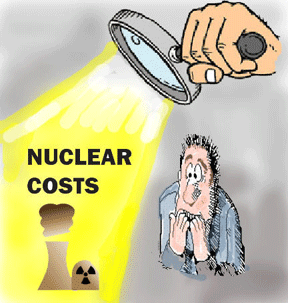 Toshiba’s failure shows business can’t deliver a nuclear future, Guardian, 9 Nov 18 Phillip Inman
As Cumbria reactor plan stalls, it is clear that huge resources are needed for such projects. If the government was keen to boost Britain’s nuclear industry, it was always clear that the private market would struggle to deliver.
The decision by Toshiba to close down its UK operations is a case in point. After the deal to build new reactors at Hinkley Point with the French firm EDF, Toshiba was favoured by ministers to design and construct a smaller power station on the Cumbrian coast.
Hinkley was a deal that appeared to be with a private company but the really meaningful talks were between Whitehall officials and their counterparts in the French government, EDF’s controlling shareholder. It took years of agonising brinkmanship to conclude the talks, much of them conducted on the French side by the then economy minister, Emmanuel Macron.
Toshiba, on the other hand, is a private company struggling on its own to navigate the complex politics surrounding nuclear power in the wake of the Fukushima disaster.
In 2006 it bought the US nuclear business Westinghouse, part of British Nuclear Fuels and home to much of the UK’s nuclear power industry. With climate change creeping to the top of the agenda and demand for new nuclear plants around the world growing, it seemed like a good idea.
However, the 2011 Fukushima disaster changed all that. Governments in Japan and other countries halted the development of new nuclear plants. Last year, cost overruns on building the first new US nuclear power plants in three decades pushed Westinghouse into bankruptcy and Toshiba into financial meltdown. The future of the Cumbrian nuclear plant has been in doubt ever since.
Earlier this year Toshiba sold Westinghouse to a private equity outfit as a services provider for existing nuclear plants. The construction of new reactors was not on the agenda. To no one’s surprise, Toshiba has now confirmed it has abandoned building any new plants in the UK.
Without entering the argument about whether nuclear is a good option – and the government advisory body, the National Infrastructure Commission, is unequivocal that renewables such as wind and solar were going to be a safer, cheaper option – it is clear huge commitments of time, resources and political capital are necessary for infrastructure projects of this scale to get off the ground and through to completion.https://www.theguardian.com/business/2018/nov/08/toshibas-failure-shows-business-cant-deliver-a-nuclear-future
November 9, 2018
Posted by Christina Macpherson |
business and costs, UK |
Leave a comment

C2I 2018: South-West Nuclear Hub delivers access to nuclear skills
The Engineer By Stuart Nathan 7th November 2018 Collaborate to Innovate 2018
Category: Academic Innovator
Winner: South-West Nuclear Hub
Partners: University of Bristol; University of Oxford; Kyoto University; Sellafield Ltd; EDF Energy; Atkins; National Nuclear Laboratory…….
Supported by a £2.5m Catalyst Fund grant from HEFCE and £5m from the University of Bristol, the hub takes advantage of its proximity to a number of nuclear operations. These include the Magnox power station at Oldbury in Gloucestershire, decommissioning reactors at Berkeley, also Gloucestershire, Hinkley Point A in Somerset and Winfrith in Dorset, and the growing construction site for the new EPR reactor at Hinkley Point. Further afield but still within reach are another decommissioning power station at Trawsfynydd in Snowdonia and Wylfa on Anglesey. It also counts the nuclear fusion research centre at Culham in Oxfordshire, the Harwell research Centre and the nuclear submarine dismantling programme at Devonport as within its catchment area.
Bristol and Oxford universities are already linked by a joint nuclear research centre (NRC) and the hub leverages this collaboration. …….Each research theme has a senior academic lead coordinating activity and identifying potential connections with other universities, including Oxford and the nearby University of the West of England…….
The Nucleate centre is to be another collaboration, with partnerships between the University of Bristol, National laboratory and EDF Energy …….
Public engagement is also a key focus of the hub. It coordinates both national and regional outreach activities, which include a nuclear seminar series of public lectures. The hub acts as an independent gateway for promoting public understanding of nuclear energy, framing it within the context of climate change mitigation……..
The Headline sponsor for C2I2018 is Frazer-Nash Consultancy https://www.theengineer.co.uk/academic-innovator-south-west-nuclear-hub/
|
|
|
November 8, 2018
Posted by Christina Macpherson |
Education, UK |
Leave a comment
 Why Europe wants to sidestep US sanctions over Iran nuclear might Why Europe wants to sidestep US sanctions over Iran nuclear might
Signatories of 2015 weapons deal disagree with Trump over the effectiveness of the pact, Guardian, Saeed Kamali Dehghan@SaeedKD– 6 Nov 2018
|
|
|
November 6, 2018
Posted by Christina Macpherson |
EUROPE, Iran, politics international |
Leave a comment
 Police investigation into overheated river at Paks NPP after report by MEP Benedek Jávor, ATLATSZO English OROSZI BABETT by Babett Oroszi Police investigation into overheated river at Paks NPP after report by MEP Benedek Jávor, ATLATSZO English OROSZI BABETT by Babett Oroszi
English version by Zsuzsanna Liptákné Horváth. 1 Nov 18 You can read the original, Hungarian-language story here. Hungarian police are investigating whether the water in the river Danube was warmer than 30 degrees at the Paks nuclear plant during the August heatwave. According to Hungarian regulations, if the water temperature reaches that point, the nuclear plant has to be shut off. It was not, but there is a suspicion that water temperature did reach 30 degrees. Hungarian MEP Jávor Benedekfiled a report at the police and now the case is being investigated.According to measurements by Átlátszó and Energiaklub, the temperature of the river Danube reached 30 °C during the August heatwave, exactly where the Paks nuclear plant’s cooling water enters the river.
According to a 2001 government decree, the Paks nuclear plant must cease operations for environmental reasons if the temperature of the Danube reaches 30 °C anywhere in the 500 meters following the point where the cooling water is deposited into the river.
The nuclear plant’s official thermometer never measured more than 30 °C in August, therefore the power plant or any of its blocks were not shut off. Concerned about the river’s ecosystem, MEP Benedek Jávor requested a police investigation.
The first step that led to the current investigation was when Átlátszó and Energiaklub, a Hungarian NGO, measured the water temperature in August. Energiaklub had requested the official data about the river’s temperature before, filing a freedom of information request. However, during the time of the heatwave Paks stopped announcing their official data. Átlátszó’s group of experts had assumed that the temperature of the water rose above 30 °C.
To prove this, and to protect wildlife in the river, we traveled to Paks and measured the water temperature. Before the point of entry of the nuclear plant’s cooling water, we measured 25-26 °C. Downstream, however, within 500 meters from the cooling water’s entry point, we measured above 30 °C at multiple locations.
We took a video of the process and published an article about our unofficial data. These show that at every single location downstream where we measured the river’s temperature, it exceeded the 30 °C.
The official numbers and Átlátszó’s findings do not match……… more https://english.atlatszo.hu/2018/11/01/police-investigation-into-overheated-river-at-paks-npp-after-report-by-mep-benedek-javor/
|
|
|
November 5, 2018
Posted by Christina Macpherson |
climate change, EUROPE, secrets,lies and civil liberties |
Leave a comment
 APAG2 2nd Aug 2018 *Fusion** The nuclear lobby claims wrongly that tritium is harmless to discharge into
the environment, and that nuclear fusion, in which tritium is used as fuel,
is safe. With this consummate manipulation, the French nucleocrats are
passing ITER the nuclear fusion reactor currently under construction at
Cadarache [Bouches-du-Rhone] a carte blanche. But it is not safe.
https://apag2.wordpress.com/2018/08/02/iter-tritium-danger-%e2%80%a8larnaque-mortifere-du-lobby-du-nucleaire/
November 5, 2018
Posted by Christina Macpherson |
France, technology |
Leave a comment

 GDF Watch 4th Nov 2018
 , The company responsible for delivering Sweden’s deep geological repository, SKB, is planning to subject their research into copper
corrosion to international peer review in the new year. SKB believe this is
the most transparent and open way in which to address concerns about the
contentious issue, which has held up final decision-making on the Swedish
national repository for higher activity radioactive waste.
Earlier this year the Swedish Environmental Court largely approved SKB’s plans for a
geological disposal facility in Osthammar. However, the Court had concerns
about the speed at which copper canisters corrode and the potential
consequential environmental impact. Conflicting scientific evidence was
presented to the Court. The Court decided that this was something the
Swedish Government needed to consider further before any approval was given
to the planned radioactive waste disposal facility. The Swedish Government
asked SKB to provide additional information by 31 March 2019.
http://www.gdfwatch.org.uk/2018/11/04/sweden-copper-corrosion-update/
November 5, 2018
Posted by Christina Macpherson |
safety, Sweden, wastes |
Leave a comment
What We Know About the Chernobyl Animal Mutations https://www.thoughtco.com/chernobyl-animal-mutations-4155348?utm_source=facebook&utm_medium=social&utm_campaign=shareurlbuttons&fbclid=IwAR0ML06KNkYYmozGbreM6e9ApQ9154nFmnYLxzZFUkK0pznLEi2X9FM-FHQ by
The 1986 Chernobyl accident resulted in one of the highest unintentional releases of radioactivity in history. The graphite moderator of reactor 4 was exposed to air and ignited, shooting plumes of radioactive fallout across what is now Belarus, Ukraine, Russia, and Europe. While few people live near Chernobyl now, animals living in the vicinity of the accident allow us to study the effects of radiation and gauge recovery from the disaster.
Most domestic animals have moved away from the accident, and those deformed farm animals that were born did not reproduce. After the first few years following the accident, scientists focused on studies of wild animals and pets that had been left behind, in order to learn about Chernobyl’s impact.
Although the Chernobyl accident can’t be compared to effects from a nuclear bombbecause the isotopes released by the reactor differ from those produced by a nuclear weapon, both accidents and bombs cause mutations and cancer.
It’s crucial to study the effects of the disaster to help people understand the serious and long-lasting consequences of nuclear releases. Moreover, understanding the effects of Chernobyl may help humanity react to other nuclear power plant accidents.
The Relationship Between Radioisotopes and Mutations
You may wonder how, exactly, radioisotopes (a radioactive isotope) and mutations are connected. The energy from radiation can damage or break DNA molecules. If the damage is severe enough, cells can’t replicate and the organism dies. Sometimes DNA can’t be repaired, producing a mutation. Mutated DNA may result in tumors and affect an animal’s ability to reproduce. If a mutation occurs in gametes, it can result in a nonviable embryo or one with birth defects.
Additionally, some radioisotopes are both toxic and radioactive. The chemical effects of the isotopes also impact the health and reproduction of affected species.
The types of isotopes around Chernobyl change over time as elements undergo radioactive decay. Cesium-137 and iodine-131 are isotopes that accumulate in the food chain and produce most of the radiation exposure to people and animals in the affected zone.
Examples of Domestic Genetic Deformities
Ranchers noticed an increase in genetic abnormalities in farm animals immediately following the Chernobyl accident. In 1989 and 1990, the number of deformities spiked again, possibly as a result of radiation released from the sarcophagus intended to isolate the nuclear core. In 1990, around 400 deformed animals were born. Most deformities were so severe the animals only lived a few hours.
Examples of defects included facial malformations, extra appendages, abnormal coloring, and reduced size. Domestic animal mutations were most common in cattle and pigs. Also, cows exposed to fallout and fed radioactive feed produced radioactive milk.
The health and reproduction of animals near Chernobyl were diminished for at least the first six months following the accident. Since that time, plants and animals have rebounded and largely reclaimed the region. Scientists collect information about the animals by sampling radioactive dung and soil and watching animals using camera traps.
The Chernobyl exclusion zone is a mostly-off-limits area covering over 1,600 square miles around the accident. The exclusion zone is a sort of radioactive wildlife refuge. The animals are radioactive because they eat radioactive food, so they may produce fewer young and bear mutated progeny. Even so, some populations have grown. Ironically, the damaging effects of radiation inside the zone may be less than the threat posed by humans outside of it. Examples of animals seen within the zone include Przewalksi’s horses, wolves, badgers, swans, moose, elk, turtles, deer, foxes, beavers, boars, bison, mink, hares, otters, lynx, eagles, rodents, storks, bats, and owls.
Not all animals fare well in the exclusion zone. Invertebrate populations (including bees, butterflies, spiders, grasshoppers, and dragonflies) in particular have diminished. This is likely because the animals lay eggs in the top layer of soil, which contains high levels of radioactivity.
Radionuclides in water have settled into the sediment in lakes. Aquatic organisms are contaminated and face ongoing genetic instability. Affected species include frogs, fish, crustaceans, and insect larvae.
While birds abound in the exclusion zone, they are examples of animals that still face problems from radiation exposure. A study of barn swallows from 1991 to 2006 indicated birds in the exclusion zone displayed more abnormalities than birds from a control sample, including deformed beaks, albinistic feathers, bent tail feathers, and deformed air sacs. Birds in the exclusion zone had less reproductive success. Chernobyl birds (and also mammals) often had smaller brains, malformed sperm, and cataracts.
The Famous Puppies of Chernobyl
Not all of the animals living around Chernobyl are entirely wild. There are around 900 stray dogs, mostly descended from those left behind when people evacuated the area. Veterinarians, radiation experts, and volunteers from a group called The Dogs of Chernobyl capture the dogs, vaccinate them against diseases, and tag them. In addition to tags, some dogs are fitted with radiation detector collars. The dogs offer a way to map radiation across the exclusion zone and study the ongoing effects of the accident. While scientists generally can’t get a close look at individual wild animals in the exclusion zone, they can monitor the dogs closely. The dogs are, of course, radioactive. Visitors to the area are advised to avoid petting the pooches to minimize radiation exposure.
References
- Galván, Ismael; Bonisoli-Alquati, Andrea; Jenkinson, Shanna; Ghanem, Ghanem; Wakamatsu, Kazumasa; Mousseau, Timothy A.; Møller, Anders P. (2014-12-01). “Chronic exposure to low-dose radiation at Chernobyl favours adaptation to oxidative stress in birds”. Functional Ecology. 28 (6): 1387–1403.
- Moeller, A. P.; Mousseau, T. A. (2009). “Reduced abundance of insects and spiders linked to radiation at Chernobyl 20 years after the accident”. Biology Letters. 5 (3): 356–9.
- Møller, Anders Pape; Bonisoli-Alquati, Andea; Rudolfsen, Geir; Mousseau, Timothy A. (2011). Brembs, Björn, ed. “Chernobyl Birds Have Smaller Brains”. PLoS ONE. 6 (2): e16862.
- Poiarkov, V.A.; Nazarov, A.N.; Kaletnik, N.N. (1995). “Post-Chernobyl radiomonitoring of Ukrainian forest ecosystems”. Journal of Environmental Radioactivity. 26 (3): 259–271.
- Smith, J.T. (23 February 2008). “Is Chernobyl radiation really causing negative individual and population-level effects on barn swallows?”. Biology Letters. The Royal Society Publishing. 4 (1): 63–64.
- Wood, Mike; Beresford, Nick (2016). “The wildlife of Chernobyl: 30 years without man”. The Biologist. London,UK: Royal Society of Biology. 63 (2): 16–19.
|
|
|
November 5, 2018
Posted by Christina Macpherson |
environment, Reference, Ukraine |
Leave a comment
https://www.researchgate.net/publication/289163143_Extreme_weather_and_nuclear_power_plants_EXWE_EXWE_summary_report
see also download at :http://safir2014.vtt.fi/finalseminar/Day_2/TR5_8_4_EXWE_SAFIR2014.pd fKirsti Jylhä
32.05Finnish Meteorological Institute, Hanna M. Mäkelä, 24.69Finnish Meteorological Institute, Ari Venäläinen
34.18Finnish Meteorological Institute, Milla Johansson, 19.57Finnish Meteorological Institute
“This research comprehensively described the occurrence of extreme weather and climate events and aspects of sea level rise that are relevant from the view point of safety of nuclear power plants.
Studies about the frequency, intensity, and spatial and temporal variation of the extreme weather events and their combinations were carried out utilising instrumental meteorological observations, a 1 200-year long preindustrial control simulation and future climate model simulations.
In addition to the role of natural climate variability, the study clarified the influence of human-induced climate change on extreme weather events and sea level values. The longest future climate and sea level projections extend to the end of the 21st century.
According to them, the daily maximum temperatures and the length of the longest hot spells will clearly increase in Finland. The largest changes, however, are projected for the wintertime minimum temperatures. During summer there will be more intensive precipitation events and during winter more frequent precipitation days. The mean sea level is projected to rise, the change depending on the location along the Finnish coastline. Uncertainty ranges in the mean sea level scenarios are large mainly due to uncertainties in the future behaviour of the continental ice sheets.” end quote. Please see original link above.
November 5, 2018
Posted by Christina Macpherson |
climate change, Finland |
Leave a comment
 Sunday Times 4th Nov 2018 Plans to build a nuclear power station to provide up to 7% of the
country’s electricity could be ditched within days after talks with a
potential buyer stalled.
The planned NuGen plant in Moorside, Cumbria, has
been in trouble since financial problems emerged in 2016 at the owner,
Toshiba, and its nuclear subsidiary Westinghouse Electric filed for
bankruptcy protection.
Toshiba has been trying to sell the project.
However, talks with South Korea’s state-owned Korean Electric Power
Corporation (Kepco) have yet to lead to a deal, and Kepco was stripped of
preferred bidder status in August.
It is thought that Toshiba’s board is
set to meet in Tokyo on Thursday, when directors will decide whether to
continue trying to find a buyer or to wind up the project, which is
believed to have been costing millions of pounds a month.
Winding up NuGen— seen as the likely outcome — would deal a big blow to the
government’s energy strategy. NuGen had been due to start powering about
6m homes from 2025. The private equity firm Brookfield, which bought
Westinghouse, was also in talks with Toshiba over the deal but it is
believed these have collapsed. China’s CGN has also been interested.
https://www.thetimes.co.uk/edition/business/crunch-talks-to-rule-on-cumbria-nuclear-plant-gvtg2ztrh
November 5, 2018
Posted by Christina Macpherson |
business and costs, UK |
Leave a comment
 Business Green 2nd Nov 2018
 The UK power market will be able to withstand huge volumes of new renewable
generation coming on line according to new research, which suggests the
country could be running solely on zero carbon power during the summer
months by 2050.
The paper, released today by Aurora Energy Research,
explores what happens to the UK power market as it transitions to a high
level of renewable power. Aurora modelled a 2050 scenario where power
demand has risen by two-thirds from today, thanks to the rise of EVs, and
the grid now boasts 130GW of nuclear, wind and solar generation capacity.
November 5, 2018
Posted by Christina Macpherson |
renewable, UK |
Leave a comment









 nuclear-news