Guardian 14th Nov 2018 Bristol has declared a “climate emergency”, with the council
unanimously backing a commitment to be carbon neutral by 2030 in an effort
to avoid catastrophic climate breakdown.
The motion put forward by Green
party councillor Carla Denyer and passed on Tuesday means the city has the
most ambitious emissions targets of the UK’s core cities group – with
radical policy implications in the coming years.
The move was triggered by
a UN report last month which said the world has just 12 years left to avoid
catastrophic climate breakdown. Denyer said: “This is a fantastic day for
Bristol and I’m delighted the council will be bringing forward its target
for making the city carbon neutral by 2030. She said the UN report made it
clear that “time to preserve Earth as we know it is running out”.
The target is much more radical than the UK government’s national target of
an 80% reduction in emissions by 2050 and comes amid growing concern about
interlinked ecological crisis, from climate breakdown to extinction. Denyer
said that the Bristol declaration could see a focus on renewable
electricity, carbon neutral buildings, congestion charges and investment in
clean transport infrastructure.
It could also have far-reaching
implications for big-ticket projects like the proposed expansion of Bristol
airport. The move was inspired by US cities such as Berkeley and Hoboken,
and the global C40 cities which have all set ambitious emissions targets.
Jonathan Bartley, the co-leader of the Green party, said Bristol’s
decision – which won cross-party support on the council – had set “a
gold standard on climate action”. “With the UN warning we have just 12
years to limit climate catastrophe this is the common-sense policymaking we
need to face the future.”
https://www.theguardian.com/uk-news/2018/nov/14/bristol-plans-to-become-carbon-neutral-by-2030
November 17, 2018
Posted by Christina Macpherson |
climate change, UK |
Leave a comment
BBC 14 November 2018 Reprocessing of spent nuclear fuel from around the world has ended at Sellafield.
November 17, 2018
Posted by Christina Macpherson |
reprocessing, UK |
Leave a comment
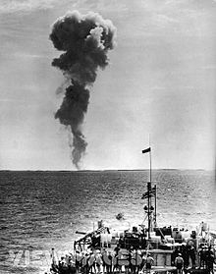 Britain’s nuclear bomb test legacy of early deaths and deformed children, Mirror, By Susie Boniface 14 NOV 2018
The horrific story behind the UK’s nuclear experiments have been told in full for the first time. After the horrors of the Second World War, it was deemed necessary for Britain to have a weapon that could unleash hell.
When atom bombs were dropped on Japan in 1945, LIFE magazine reported: “People’s bodies were terribly squeezed, then their internal organs ruptured…….
Of the 22,000 scientists and servicemen who took part in radioactive experiments in Australia and the South Pacific, just a handful are alive.
Their families report cancers, rare medical problems, high rates of miscarriage – and deformities, disability and death for their children – and their grandchildren.
Now, the full story of Britain’s nuclear experiments has been told for the first time in a new Mirror website that details not only the scientific, military and political battles, but the human fallout.
DAMNED features top-secret documents, eyewitness accounts and searing testimonies.
The site takes its name from an editorial written in 2002 by Mirror editor Richard Stott, who thundered: “How many more generations of the damned will our politicians allow to suffer before they accept the calamities of their predecessors and the consequences of their own cowardice?”
In May, the Mirror called for an award for the veterans and Defence Secretary Gavin Williamson has ordered a medal review.
DAMNED begins with Operation Hurricane in 1952, when Britain exploded its first atomic bomb, covers the Minor Trials in South Australia, which left the landscape littered with plutonium debris for decades, and reports on Operation Grapple in 1958 when the UK detonated its biggest weapon.
It also details the human cost and shows how every other nuclear nation on Earth came to accept and recognise their nuclear heroes – leaving Britain the only one to deny a duty of care………
In May, the Mirror called for an award for the veterans and Defence Secretary Gavin Williamson has ordered a medal review……….
DAMNED has a memorial section with the pictures and health problems of every veteran from our archives. Some of their stories can be read here: …… https://www.mirror.co.uk/news/uk-news/britains-nuclear-bomb-test-legacy-13590455
November 15, 2018
Posted by Christina Macpherson |
health, UK, weapons and war |
Leave a comment
Court forces VA to reveal extent of veterans’ contamination in Spanish nuclear disaster https://www.militarytimes.com/news/pentagon-congress/2018/11/14/court-forces-va-to-reveal-extent-of-veterans-contamination-in-spanish-nuclear-
By: Leo Shane III WASHINGTON — An appeals court will force Veterans Affairs officials to identify how many troops may have been exposed to radioactive debris from a 1966 plane crash, a move that supporters hope will be the precursor to
a class-action lawsuit against the department for overdue benefits.
On Tuesday, the U.S. Court of Appeals for Veterans Claims made the unusual ruling demanding the records’ release six weeks after VA lawyers argued the information is nearly impossible to obtain, given aging and missing military records from the accident.
But the court, by a 6-3 ruling, gave the department 30 days to determine the number of military personnel assigned to the accident clean-up, the number of veterans who have applied for benefits connected to the event, and the number who have been denied compensation. That information will be used to decide how a lawsuit on the benefits denial may proceed.
Veterans involved in the accident have been unsuccessfully petitioning VA on their case since the mid-1970s, after a host of strange cancers and other illnesses began appearing among individuals involved.
In January 1966, seven airmen were killed and four more injured when a B-52 crashed into a KC-135 during a refueling mission off the coast of Spain. The B-52 was carrying four nuclear weapons at the time of the accident, and two of them exploded near the town of Palomares, spreading radioactive plutonium over hundreds of acres.
U.S. officials quickly ordered military personnel into the area to collect contaminated debris, crops and soil in an effort to repair the damage. But veterans involved in that cleanup say they were given no protective clothing or respiratory devices, and told very little about the potential long-term health effects from exposure to the nuclear material.
Earlier this year, the appeals court ruled in a separate case that veterans can file suit against the Department of Veterans Affairs as a class rather than individuals, in limited circumstances.
Since then, legal experts have been monitoring a host of lawsuits before the court to see which could be the first class recognized, a move which will set important precedents for future legal cases.
The three judges who argued against the records request in the Palomares lawsuit said the move would effectively force VA to justify the need for a class-action lawsuit against itself, and that the majority ignored concerns that Defense Department records for the incident may not exist.
But the majority opinion noted that no final decision on whether to recognize a class of Palomares has been made, and data on the denied benefits is the sole property of VA, inaccessible in any way for outsiders.
Plaintiffs in the lawsuit have contended that more than 1,600 veterans should be eligible for disability benefits related to the toxic exposure, but VA thus far has denied their requests because not enough scientific evidence exists to classify all of the health problems as service-related illnesses.
November 15, 2018
Posted by Christina Macpherson |
health, incidents, Legal, Spain, USA |
Leave a comment
 US energy secretary In Prague to lobby for nuclear industry, WP, By Associated Press, November 14 PRAGUE — U.S. Energy Secretary Rick Perry has been lobbying in Prague for the U.S. civil nuclear industry as the most suitable to develop the Czech nuclear program……..Perry warned against cooperation with Russia, saying it has used energy “as a political weapon. https://www.washingtonpost.com/business/technology/us-energy-secretary-in-prague-to-lobby-for-nuclear-industry/2018/11/14/61409b2e-e826-11e8-8449-1ff263609a31_story.html?noredirect=on&utm_term=.ba83c6382a8f
November 15, 2018
Posted by Christina Macpherson |
EUROPE, marketing, USA |
Leave a comment
Russia reveals nuclear spaceship that will fly to Mars ‘in very near future’, Fox News, By Sean Keach, Digital Technology and Science Editor, 13 Nov 18 Russia has revealed a “spacecraft of the future” that could one day put humans on Mars.
Roscosmos showed off concept designs for the sci-fi spacecraft – but failed to say exactly when it would launch.
The spaceship is currently in development at Russia’s Keldysh Research Centre, which is racing to create the nuclear propulsion engine……..
According to Russia’s TASS news agency, Vladimir Koshlakov, head of the Keldysh Centre, believes that a flight to Mars using a nuclear propulsion engine is “technically feasible in the near future”. …. https://www.foxnews.com/science/russia-reveals-nuclear-spaceship-that-will-fly-to-mars-in-very-near-future
November 15, 2018
Posted by Christina Macpherson |
Russia, technology |
4 Comments
 WYG points finger at government for Toshiba nuclear decision, Building UK, By Dave Rogers12 November 2018 Consultant forced to take £3m loss on business it bought for Moorside development. Consultant WYG has criticised the government for not being clear enough in its support to build a nuclear power station in Cumbria.
Publishing its annual results in June, WYG said it was forced to book a £3.2m cost on closing a business that it bought because of the work it expected to be carried out at the Moorside plant.
Land and property firm North Associates was snapped up in 2015 but delays on the plant forced the firm to shut the Carlisle-based business in March.
Last week Toshiba said it would wind-up its NuGen business which had been slated to carry out work building the plant at Moorside……….
Toshiba spent 18 months trying to sell NuGen but failed to find a firm willing to invest in the nuclear project. It said winding up the company would cost it £125m.
Engie walked away from NuGen, leaving Toshiba to try and sell the vehicle after posting a $8.4bn (£6.4bn) loss for the year ending 31 March 2017.
South Korean state-owned Kepco was chosen as preferred bidder over China General Nuclear in December last year but lost its preferred status in August after protracted talks hit delays – including a change of chief executive and a new government in Seoul. https://www.building.co.uk/news/wyg-points-finger-at-government-for-toshiba-nuclear-decision/5096491.article
November 13, 2018
Posted by Christina Macpherson |
business and costs, UK |
Leave a comment

 Dave Toke’s Blog 11th Nov 2018 ,Greg Clark looks likely to go down in history as the Minister who signs off
on a nuclear construction deal with Hitachi for the proposed Wylfa power plant that led to a stupendous loss for the taxpayer. That loss might be £20 billion or more.
Clark has apparently put no discernable effort into the objective of securing ‘subsidy’ free contracts for onshore wind and solar. However, he has been spending a lot of time concocting a plan to finance the Wylfa nuclear power plant that will, on the basis of past performance, generate huge losses for the public purse years down the line.
All the talk from BEIS (the energy ministry) is of the new ‘Regulated Asset Base’ (RAB) financing of nuclear power plant. Except that what’s really happening is not really an RAB model at all. It’s a piece of brownwash to obscure the reality of Government blank cheque to cover whatever it costs to build the nuclear plant. That’s because the whole plan hinges on the constructors being able to pass on cost-overruns onto the Government.
And that’s the point. Nuclear power stations being built in the west have almost always tended to have large cost overruns. Recent ones have ALL suffered horrendous cost overruns – in the USA (4), France (1) and Finland (1).
Yet, some otherwise sensible, financial analysts seem to ignore this fact as they extol the virtues of RAB financing. They implicitly assume that Wylfa will proceed precisely on target, in which case, they say the Government will deliver the project at a ‘cheaper’ price than Hinkley C through the provision of Government loans with low interest rates.
Sure, the headline price that will be paid by the electricity consumer, over 35 years, will be a bit cheaper. But that’s likely to be at one hell of a cost to the taxpayer.
http://realfeed-intariffs.blogspot.com/2018/11/how-greg-clarks-hitachi-deal-could-lead.html
November 13, 2018
Posted by Christina Macpherson |
business and costs, politics, UK |
Leave a comment
Times 12th Nov 2018 , David Lowry 12 Nov 18 Alistair Osborne is correct in his acute analysis of the financial failure of new nuclear in the UK (“No surprise Toshiba went cold on idea”,Times, Nov 9), except for one important matter: he conflates energy with electricity.
The planned output capacity for the doomed Moorside nuclear plant would not have provided “7 per cent of our energy needs”, but of the UK’s power generating capacity, which is the equivalent of about only 2 per cent of current national energy demand. Conflating the two inflates the importance of nuclear to UK energy balance, thus distorting its political salience.
https://www.thetimes.co.uk/edition/comment/brexit-and-the-value-of-a-second-referendum-dk8fgmw6w
November 13, 2018
Posted by Christina Macpherson |
spinbuster, UK |
Leave a comment

 Times 10th Nov 2018 Consumers face a multimillion-pound bill for work carried out in preparation for the proposed Cumbrian nuclear plant that may never be built.
National Grid said that it had spent tens of millions of pounds planning the 100-mile power line to connect Nugen’s Moorside plant to the electricity transmission network. Much of the cost is expected to be recovered from households and businesses via levies on their energy bills for decades to come. John Pettigrew, chief executive, said that work on the Moorside line had cost “tens of millions” of pounds and that there was a “regulatory process” to recover the costs.
Nugen is obliged to cover some of the cost, but one industry source said that it was on the hook for a little more than £10 million, while National Grid’s expenditure was thought to be in the high double digits. National Grid is expected to submit a claim to Ofgem, the energy regulator, to recoup the rest from consumers.
The regulator can refuse to allow expenditure it deems inefficient, but the rules are thought likely to allow the company to recover at least half of its costs. The eventual £2.8 billion proposal included £1.9 billion of “measures to reduce its impact on people, places and the environment”, including burying the lines through a 14-mile stretch of the Lake District and a 13-mile tunnel under MorecambeBay.
https://www.thetimes.co.uk/article/f1630fa6-e458-11e8-9838-efa7e96cbe2b
November 12, 2018
Posted by Christina Macpherson |
business and costs, UK |
Leave a comment
Times 11th Nov 2018 The business secretary Greg Clark held a crunch meeting with Hitachi in Tokyo last week over its planned £15bn Welsh nuclear power station, as a rival Japanese project collapsed. Toshiba killed off its NuGen power station plan in Cumbria last week after the ailing industrial giant struggled to find a buyer – denting Britain and Japan’s nuclear ambitions.
Toshiba’s exit leaves Britain’s nuclear power renaissance reliant on France’s EDF and Japan’s Hitachi. Clark is understood to have attended a dinner with the Hitachi chairman Hiroaki Nakanishi during a visit to Japan, where they discussed sealing a deal on Hitachi’s Horizon power station on Anglesey by Easter.
The British and Japanese governments are expected to take equal equity stakes in Horizon alongside Hitachi. Whitehall is also expected to provide all the debt for the 2.7 gigawatt project, which would be sold once it has started generating power. Clark agreed to help bankroll the Horizon project in June, marking a departure from previous policy.
Ministers want Horizon and Hinkley to replace a string of ageing coal and nuclear power plants that are due to close over the next decade. Under pressure from ministers, Hitachi is considering using a different form of financing – a regulated asset base – for future reactors on Anglesey and in Gloucestershire.
However, that risks further controversy as it would mean households fund the project before it has been completed. Clark’s latest visit also reflects growing tension between Tokyo and London over Brexit.
https://www.thetimes.co.uk/article/97c7a1de-e514-11e8-aa8a-1a554b586cbd
November 12, 2018
Posted by Christina Macpherson |
business and costs, politics, UK |
Leave a comment
When America lost a nuclear bomb, Fosters.com, By D. Allan Kerr news@seacoastonline.com 11 Nov 18, In January 1966, an American B-52 bomber collided mid-air with a refueling tanker off the coast of Spain. The resulting fiery crash claimed the lives of seven crew members.
While the loss of life was devastating, there was potential for even greater catastrophe – the B-52 was carrying four fully-loaded hydrogen bombs.
Three of the bombs were located within 24 hours, in the vicinity of a Spanish fishing village called Palomares. The fourth was nowhere to be found.
With the Cold War mired in a deep chill, the United States dispatched an entire Navy armada to try to locate the missing bomb, which was believed to have gone into the Atlantic Ocean. Among those involved in the search was a 23-year-old Navy officer named Donald Craig.
Craig was an ensign at the time, having graduated the previous year from Officer Candidate School at Newport, Rhode Island. He was serving aboard his first vessel, the minesweeper USS Sagacity (MSO 469).
As it happened, Sagacity was near Barcelona, Spain, on a Mediterranean cruise when the tragedy occurred. The minesweeper was dispatched to the scene and over the next several weeks took part in the massive search for the missing nuke.
Craig is now 76 years old, retired, and a longtime resident of Kittery Point, Maine. He still recalls the hunt for the missing nuclear bomb, and the race to get to it before the Soviet Union.
He also remains frustrated on behalf of fellow veterans who say they are dealing with adverse health effects from radiation exposure during the incident – with no assistance from the government that sent them there.
“We knew nothing,” Craig said recently of the possible aftereffects. “We were just out there doing our job.”
A disaster begins
It should have been a routine operation…………
At one point the Navy lost the bomb again in the process of bringing it to the surface, and it sank even deeper into the ravine. Eventually, the bomb and an unmanned vehicle, which had become entangled in its parachute lines, were hauled onto the deck of the submarine rescue ship USS Petrel nearly three months after the initial tragedy.
But then the United States government had to deal with a whole separate controversy – the environmental repercussions of an unleashed hydrogen bomb.
Plutonium blowing in the wind
Members of the U.S. Air Force and residents of Palomares were all exposed to radioactivity from the two bombs that had broken apart on land. Craig recalls winds of about 30 knots at the time.
“Plutonium was blowing in the wind, it was all over the place there,” he said. “They (Air Force personnel) were sitting on the edge of the crater eating their lunches.”
An area of about one square mile was contaminated, including the village’s tomato crop. American servicemen removed this soil and brought it back to South Carolina for disposal.
But in a rather bizarre attempt to show there was no danger, the U.S. government fed the contaminated tomatoes to our troops for “breakfast, lunch and dinner,” according to a June 2016 New York Times article. The U.S. ambassador to Spain and the Spanish minister of tourism swam at a nearby beach in front of a crowd of reporters to prove the waters were safe.
“If this is radioactivity, I love it!” Ambassador Angier Biddle Duke told the media.
Somehow, no civilians on the ground were seriously harmed by falling debris from the aircraft collision. America pledged to the Spanish government the site would be cleared of contamination.
“The main objective here is to leave Spain as we found it,” Duke told LIFE magazine back in 1966.
But as recently as 2015, then-Secretary of State John Kerry and Spain’s foreign minister agreed to negotiate a binding agreement to resume cleanup efforts and further removal of contaminated soil from the site. While no substantive findings have verified serious health issues among the villagers, studies of wildlife such as snails have turned up high radioactive levels.
Craig, however, is particularly outraged by the treatment of Air Force veterans who took part in cleanup efforts at Palomares and now say they are suffering ill health effects as a result. The 2016 Times article featured several former servicemen now suffering from cancer and other ailments.
The Air Force has long insisted there were no serious adverse effects from the incident, so these conditions are not covered under Veterans Administration benefits. An estimated 1,600 veterans took part in the cleanup.
“That shouldn’t happen. They should absolutely be taken care of,” Craig said. ”(The government) did not look after their safety, and there are a lot of people suffering for it now.”
Last year, a number of veterans filed a lawsuit in Connecticut over disability benefits they were denied because the Pentagon refused to release records and reports related to the incident………….
D. Allan Kerr is the author of “Silent Strength,” a book about the 1963 loss of the nuclear Navy submarine USS Thresher. http://www.fosters.com/news/20181111/when-america-lost-nuclear-bomb
November 12, 2018
Posted by Christina Macpherson |
history, incidents, Spain, USA |
Leave a comment
World War 3: Russia to arm an ‘INVINCIBLE’ nuclear weapon by 2019 says Putin https://www.express.co.uk/news/world/1043374/world-war-3-vladimir-putin-latest-nuclear-weapon-ww3-russia
RUSSIA is finalising a nuclear weapon capable of wiping out an entire city by descending on Earth “like a meteorite” at 20 times the speed of sound, Vladimir Putin has claimed, sparking World War 3 fears. By ALICE SCARSI, Nov 9, 2018 Tensions between Washington and Moscow reached a new high as the Russian President claimed he has a weapon that can resist any anti-missile systems, making it almost invincible. Mr Putin said: “We know for certain, it’s an obvious fact and our colleagues realise it, that we surpassed all our competitors in this area. “Nobody has precise hypersonic weapons. Some plan to test theirs in 18 to 24 months. We have them in service already.”
Called Avangard, the weapon will go into active service by next year with the Red Banner Missile Division, based in the Urals, according to a Russian defence industry source.
Speaking to Russian news agency TASS, they said: “The scheduled period for placing the lead regiment on combat duty is the end of 2019.
Initially, the regiment will comprise at least two systems but eventually their number will rise to their organic quantity of six units.”
According to the claims made by Russia, the Avangard is an hypersonic glide vehicle, a spacecraft which is lofted into the atmosphere atop an intercontinental ballistic missile, such as the Satan II, to then glide down at hypersonic speed.
Being 20 times faster than the speed of sound means the Avangard could travel as fast as at 6860 m/s.
November 12, 2018
Posted by Christina Macpherson |
Russia, weapons and war |
Leave a comment
Cumbria Trust 11th Nov 2018 , The Committee on Radioactive Waste Management (CoRWM) which advises BEIS on dealing with nuclear waste, has recently published a paper which Cumbria
Trust believes calls into question their independence. They are supposed to
act as an independent body, but some of their recent actions suggest to us
that they are too close to BEIS and failing to adequately perform their
advisory function and to challenge poor decision-making. A government
department which surrounds itself, and only listens to people who agree
with it, is at significant risk of repeating past mistakes. Cumbria Trust
have written the letter (below) to CoRWM expressing our concerns.
https://cumbriatrust.wordpress.com/2018/11/11/has-corwm-lost-its-independence/
November 12, 2018
Posted by Christina Macpherson |
UK, wastes |
Leave a comment








 nuclear-news