Countries going into deep nuclear debt to Russia; Hungary the latest victim of this political blackmail
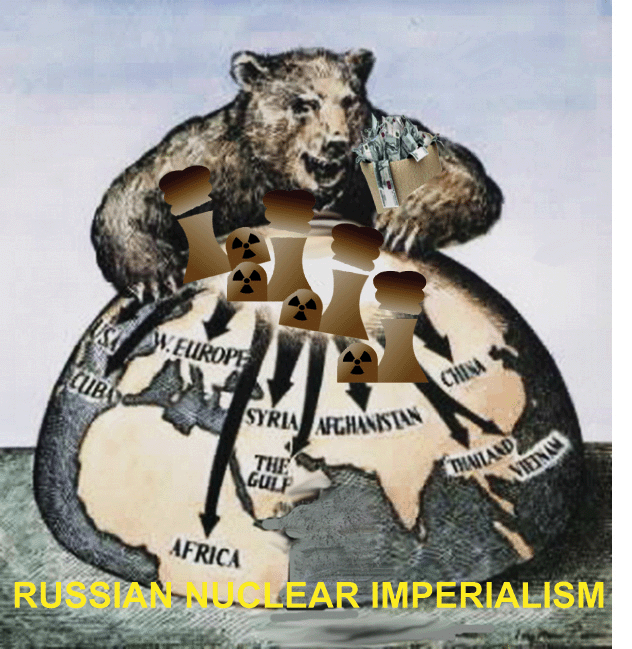
Hungary seeks to postpone loan payback to Russia for Nuclear power plant: What will the final cost be?Bellona February 1, 2019 by Charles Digges Budapest is seeking to modify the terms of a loan it must repay to Russia for building two new VVER-1200 type reactors that will eventually replace Hungary’s Paks nuclear power plant, according to a report from Reuters.
The reactors, which will constitute a plant called Paks II, will be built by Rosatom, Russia’s state nuclear power company, at a cost of 10 billion euro ($12 billion), and will replace the older Soviet-built nuclear plant that supplies half of the country’s electricity.
Rosatom’s construction contract, which includes the loan for Paks II, was the subject of a hotly-debated probe by the EU’s Organization for Economic Co-Operation and Development, which investigated whether the Russian bid violated European competition statutes.
At the time, EU officials and commentators viewed the deal as a Trojan Horse to help cement Moscow’s influence over the right-leaning, rabidly anti-globalist government of Hungarian Prime Minister Viktor Orban.
The EU eventually dropped its investigation in 2017 and granted Hungary permission to build the reactors – partly in an effort to entice Orban, who was insistent about contracting Rosatom, back into the democratic fold. Now Budapest is citing the delay caused by the competition review as reason to renegotiate when it begins paying Rosatom back.
Hungarian financial authorities plan to ask Moscow to postpone collecting on the debt until after the new reactors begin to generate electricity – but it is as yet unclear whether Rosatom will accept new terms. The plant’s construction, meanwhile, is running late. The build was supposed to begin last year………
While the terms of the Paks II loan remain in the shadows, other financing arrangements Moscow has made for building nuclear reactors in other countries suggest that the interest alone could prove to be very expensive for Budapest.
An $11.4 billion, 30-year agreement Rosatom signed with Bangladesh to build the Roopur nuclear plant will net Moscow $8 billion in interest. A $25 billion deal Rosatom is pursuing with Egypt to build that country’s Dabaa plant could, over the 35-year term of that loan, swell to $71 billion.
Another enormous $76 billion deal between Rosatom and South Africa was eventually thwarted by environmentalists when it was revealed the project had been secretly negotiated. Had the deal held it would have siphoned off a quarter of South Africa’s gross domestic product before the reactors even began operation.
Terms like this could spell trouble for Hungary in light of Moscow’s tendency to be a kneecapping creditor when it comes to energy projects – especially when Russia sours on the politics of its debtors.
In 2014, at the height of East-West tensions over Russia’s annexation of Crimea, Kremlin officials threatened to cut nuclear fuel supplies to Ukraine’s Soviet built reactors – which would have interrupted their chain reactions and likely caused a catastrophic accident.
Rosatom eventually walked the threat back. But the lurid message in Moscow’s head-fake toward igniting a second Chernobyl was clear: Russian-built reactors are a useful new tool for political blackmail………..
Many in Europe – Hungary included – subsequently sought to diversify their energy supply in favor of nuclear. Yet, in a devious twist, Rosatom has emerged as the most stable and eager nuclear builder on the international market.
For now, Rosatom can afford to offer risky loans thanks to the enormous state subsidies it receives. These subsidies can be funneled into more loans, and the loans then boost the company’s profits on paper. But for the past several years, it has become clear that these subsidies to the company will likely decrease or dry up altogether in 2020.
As a result, Rosatom is amassing so-called memorandums of understanding from any country vaguely interested in nuclear power. The company says is currently has dozens of these MOUs amounting to more than $130 billion in incoming business.
But that claim should be viewed skeptically, as many of the countries for which Rosatom is promising to build reactors – countries like Jordan, Algeria, Nigeria, the Republic of Congo and Bolivia – won’t have the infrastructure to support nuclear power for decades.
For now, it’s not difficult to imagine Moscow extending the terms of its loan to Hungary for as long as Budapest likes. It will, after all, remain profitable on paper. But in the end, Budapest will be left holding the bag for Rosatom’s over extended balance sheet. But so long as Orban’s government continues it rightward lurch, Moscow is unlikely to call in its marker. http://bellona.org/news/nuclear-issues/2019-02-hungary-seeks-to-postpone-loan-payback-to-russia-for-nuclear-power-plant-what-will-the-final-cost-be
China urges dialogue, as Russia and USA ramp up nuclear weaponry, pull out of weapons treaty
Russia withdraws from Cold War-era nuclear weapons treaty with US https://www.abc.net.au/news/2019-02-02/russia-withdraws-from-cold-war-era-nuclear-weapons-treaty/10774536 Russia has suspended a Cold War-era nuclear weapons treaty, President Vladimir Putin said, after the United States accused Moscow of violations and said it would withdraw from the arms control pact.
 Key points:
- Russia will start work on new missiles, including hypersonic ones

- US and Russia both allege the other has violated the INF treaty
- China urges dialogue amid fears of nuclear arms race

The Intermediate-range Nuclear Forces (INF) Treaty prevents the two superpowers from possessing, producing or test-flying ground-launched nuclear cruise missiles with a range of 500 to 5,500 kilometres.
The United States announced it will withdraw from the INF treaty in six months unless Moscow ends what it says are violations of the pact, but Russia denied violating the treaty.
“The American partners have declared that they suspend their participation in the deal, we suspend it as well,” Mr Putin said during a televised meeting with foreign and defence ministers.
Mr Putin said Russia will start work on creating new missiles, including hypersonic ones, and told ministers not to initiate disarmament talks with Washington, accusing the United States of being slow to respond to such moves.
“We have repeatedly, during a number of years, and constantly raised a question about substantiative talks on the disarmament issue,” Mr Putin said.
“We see that in the past few years the partners have not supported our initiatives.”
The US alleges a new Russian cruise missile violates the important pact, signed by former leaders Ronald Reagan and Mikhail Gorbachev in 1987.
The missile, the Novator 9M729, is known as the SSC-8 by the North Atlantic Treaty Organisation (NATO).
Russia said the missile’s range put it outside the treaty, and accused the US of inventing a false pretext to exit a treaty it wants to leave anyway so it can develop new missiles.
Russia also rejected the demand to destroy the new missile.
During the meeting with Mr Putin, Russian Foreign Minister Sergey Lavrov accused the US of violating the INF and other arms deals, including the non-proliferation treaty.
Mr Putin said Russia would not deploy its weapons in Europe and other regions unless the US did so.
Fears of new arms race
The row over the INF treaty is yet another twist in Russia’s worsening relations with the United States and the West, with tensions over Russia’s annexation of Crimea from Ukraine as well as allegations of it meddling with the presidential election in the US and being behind a nerve agent attack in Britain.
The treaty’s suspension has drawn a strong reaction from Europe and China.
European nations fear the treaty’s collapse could lead to a new arms race with possibly a new generation of US nuclear missiles stationed on the continent.
In a statement, China’s Ministry of Foreign Affairs said the bilateral treaty was important to maintain “global strategic balance and stability”.
“China is opposed to US withdrawal action and urges the United States and Russia to handle their differences properly through constructive dialogue,” the statement said, warning that unilateral withdrawal could trigger “negative consequences”.
Russia also to withdraw from Intermediate-Range Nuclear Forces (INF) treaty, weakening weapons control
Nuclear arms control is increasingly strained as Russia steps back from treaty, Quartz, By John Detrixhe, February 3, 2019 The nuclear arms controls that have been in place since the end of the Cold War appear increasingly strained. The US said yesterday (Feb. 1) that it will withdraw from a landmark treaty for such weapons that it signed with the Soviet Union in 1987. Russia responded today by saying it will also suspend its obligations under the agreement.
The US is pulling back from the treaty with the backing of its NATO allies because officials say Russia has built a cache of missiles and refuses to destroy them. Vladimir Putin, who claims his county is in compliance, has likewise complained that the Americans are potentially in breach of the agreement, which banned the use of short- and medium-range missiles by both countries. The Russian president said his country will begin developing new missiles.
“Our American partners announced that they are suspending their participation in the treaty, and we are suspending it too,” Putin said, according to the BBC.
The breakdown follows several years of failed negotiations. Carl Bildt, co-chair of the European Council on Foreign Relations, said on Twitter that the end of the treaty would allow Russia to deploy cruise missiles from ground launchers that would quickly threaten Europe. He says both sides should commit to not deploying new weapons, then address Russia’s controversial 9M729 missile systems “in detail.”……..
Under the terms of the treaty, it will take six months for the agreement to dissolve. The US has given Russia six months to return to compliance with the treaty, and all parties should make the most of that window to find a resolution….https://qz.com/1541032/russia-withdraws-from-inf-treaty-amid-fears-of-nuclear-arms-race/
UK’s ageing nuclear power stations are likely to close early
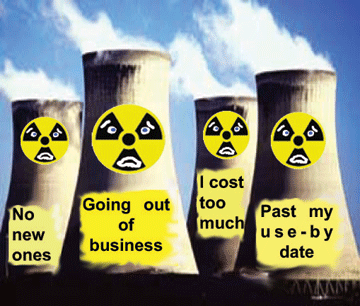
After 12% drop in generation, experts say existing nuclear plants are likely to close early Britain’s nuclear power stations recorded a 12% decline in their contributions to the country’s energy system over the past month, as outages raised concerns over how long the ageing plants will be able to keep operating.
Prospects for new nuclear projects have commanded headlines and government attention in recent weeks, with Hitachi and Toshiba scrapping their plans for major new plants.
But the fate of the existing plants, which usually provide about a fifth of the UK’s electricity supplies, has been pulled into focus by outages due to safety checks and engineering works running over schedule. Nuclear outages also push up carbon emissions because any capacity shortfall will typically be replaced by fossil fuel power stations
Seven of the power stations use an advanced gas reactor (AGR) design, the oldest of which is 43 years old and the youngest 30 years .
Most were built with a lifetime of about 35 years in mind. All are due to be closed in the 2020s after owner EDF Energy extended their lives, but there are now fears that ageing infrastructure may reduce their output or even lead them to shut early.
Iain Staffell, lecturer in sustainable energy at Imperial College, which compiled the nuclear output data, said: “Just as Toshiba and Hitachi have pulled out of building new reactors, we have one third of the existing nuclear capacity unavailable either for maintenance or because their maximum power has been reduced as they get older.
“Many of our reactors were built in the late 70s, and like your typical 40-year-old they aren’t in peak physical condition any more.”……… https://www.theguardian.com/environment/2019/feb/03/fate-of-uks-nuclear-power-stations-in-doubt-over-ageing-infrastructure
Czech industry minister: nuclear reactor tender not realistic in 2019
PRAGUE, Feb 3 (Reuters) – The Czech Republic is unlikely to be ready to hold a tender to build new nuclear reactors this year, given the financing structure has still not been decided, Industry Minister Marta Novakova said on Sunday.
The government and electricity producer CEZ, which is 70 percent owned by the state, have been locked in a debate over how to finance the construction of new nuclear units……..
Builders for nuclear power plants from countries including Russia, China and the United States are all set to vie for the Czech deal. (Reporting by Robert Muller; Editing by Susan Fenton) https://www.reuters.com/article/czech-uclear/czech-industry-minister-nuclear-reactor-tender-not-realistic-in-2019-idUSL5N1ZY0AN
Russia’s Plan to Solve the North Korea Nuclear Crisis?
Does Russia Have a Plan to Solve the North Korea Nuclear Crisis? https://nationalinterest.org/blog/buzz/does-russia-have-plan-solve-north-korea-nuclear-crisis-43022 2 Feb 19, Some think so. by Stratfor Worldview
What Happened: The Russian government reportedly made a secret proposal to North Korea in the fall of 2018 to construct a nuclear power plant in the country in exchange for North Korea dismantling its nuclear weapons and ballistic missiles, The Washington Post reported Jan. 29, citing unnamed U.S. officials. The Russian envoy to North Korea, meanwhile, denied the report.
Why It Matters: Russia’s alleged offer would imply attempts to insert itself into the negotiation process over North Korea’s nuclear program. U.S. President Donald Trump is slated to hold a second summit with North Korean leader Kim Jong Un in late February.
Background: Kim placed a significant emphasis on rectifying North Korea’s electricity problems during his New Year’s speech. Meanwhile, Russian Deputy Foreign Minister Igor Morgulov received a delegation from North Korea’s Foreign Ministry in Moscow on Jan. 29.
India’s Kudankulam nuclear power station means big debt to Russia
Kudankulam: Nuclear power utility struggles to repay Russia for supplies https://indianexpress.com/article/india/kudankulam-nuclear-power-utility-struggles-to-repay-russia-for-supplies-5563744/ The sanctioning of lower than requisite funds comes at a time when NPCIL’s budgetary support requirement has gone up in light of the utility taking up 10 new projects that had been cleared by the government in May 2017. by Anil Sasi |New Delhi February 1, 2019 Inadequate budgetary support to the strategic nuclear energy sector over the last two financial years has squeezed funds earmarked under the investment head for the Nuclear Power Corporation of India Limited (NPCIL), resulting in India’s frontline nuclear utility slipping back on its repayment obligations to the Russians for equipment supplies to the Kudankulam nuclear project.The sanctioning of lower than requisite funds comes at a time when NPCIL’s budgetary support requirement has gone up in light of the utility taking up 10 new projects that had been cleared by the government in May 2017.
The problem of non-payment of Russian credit on account of a reduction in the provision for Russian credit to NPCIL was discussed before a parliamentary panel, responding to which the Department of Expenditure in the Finance Ministry subsequently “conveyed” the concerns to the Budget Division of the Department of Economic Affairs in the same Ministry for “further necessary action”.
Under a credit arrangement between the governments of Russia and India, as soon as equipment leaves Russia for Indian projects such as the nuclear station in Kudankulam, that much money is released by the Russian government to the suppliers, which then becomes a loan on the Government of India. This loan is then supposed to be routed to NPCIL by way of a budgetary provision. Against that, the same money would be given back to the Government of India so that it becomes a loan on NPCIL.
This arrangement has come under strain due to the reduction in budgetary allocation under the ‘investment in PSUs’ head, which has affected the loans payable to NPCIL towards ‘Russian credit utilisation’ that is outstanding in the books of the Controller of Aid Accounts and Audit. The CAAA is the division within the Department of Economic Affairs entrusted with the responsibility for withdrawal of loan and grant proceeds for all official development assistance where India is the recipient.
While the extent of the slip-up in the payment obligation to the Russians could not be ascertained, the trend was seen as serious enough for the Parliamentary Standing Committee on Science and Technology, Environment and Forests to flag this an issue to which the Ministry of Finance responded in the affirmative, a senior government official involved in the exercise confirmed. Queries sent to K N Vyas, Secretary of the Department of Atomic Energy and Chairman of the Atomic Energy Commission, did not elicit a response.
According to official estimates, while budgetary support to NPCIL had gone up from Rs 370 crore in the budget estimate for 2017-18 to Rs 1435 crore in the revised estimate for the year (entailing a total of Rs 685 crore under the investment head and Rs 750 crore as loan), the actual requirement in form of budgetary support submitted by the DAE was thrice that amount — Rs 4305 crore. The higher amount, official said, was primarily on account of a shortfall of earlier years in receipt of equity to the tune of Rs 402 crore and obligations under the Russian Credit of Rs 3,903 crore.
For 2018-19, while the allocation was hiked to Rs 1,665 crore in the budget estimate, it still left a funding gap of around Rs 2,870 crore, according to DAE estimates. The situation was exacerbated by 10 new projects based on the indigenous 700 MWe (mega watt electric) pressurised heavy water reactors (PHWRs) that had been sanctioned in mid-2017, due to which budgetary support requirement had also increased.
NPCIL is currently operating 22 commercial nuclear power reactors with an installed capacity of 6,780 MWe, while it has another eight reactors under various stages of construction totaling 6200 MWe capacity.
Russia and India had, in 2015, agreed to actively work on projects deploying 12 additional Light Water Reactor (LWR) nuclear reactors, for which, the localisation of manufacturing in India under the NDA government’s flagship ‘Make in India’ initiative and the commencement of serial construction of nuclear power plants was flagged as a joint initiative.
In this context, the Programme of Action for localisation between Russian state-owned utility Rosatom and the DAE was finalised during Prime Minister Narendra Modi’s Moscow visit in 2015. At the Kudankulam site, where the two Russian-designed VVER-1000 series reactors have being installed, nearly 100 Russian companies and organisations are involved in documentation, supply of equipment and controlling construction and equipping process. At the same site, four more Russian reactor units are slated to come up in the coming years.
UK’s Energy and Climate Intelligence Unit’s under-reported analysis – renewables cheaper than new nuclear
 Forbes 31st Jan 2019 , Under-reported analysis by the UK’s Energy and Climate Intelligence Unit
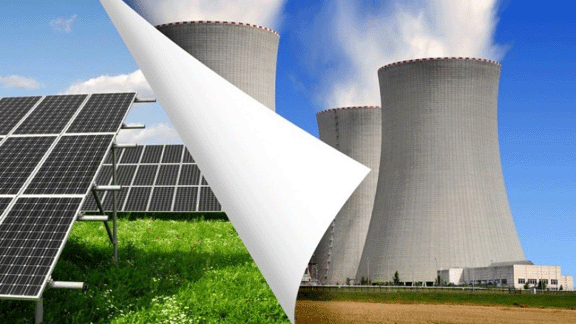
(ECIU) has shown that filling the gap left by the abandoned nuclear projects is not just feasible but better value. The government’s own National Infrastructure Commission (NIC) is minded to agree. Jonathan Marshall, head of analysis at the ECIU said: “In recent years Governmenthas quietly cut back its expectations for nuclear new-build, and that’s
looking more and more realistic as the price of renewable generation falls and the benefits of the flexible smart grid become more apparent.
Filling the nuclear gap with renewables would indeed require an increase in rollout, but one that is well within UK capabilities. “With enough focus on smart low-carbon energy, there’s no reason why Britain shouldn’t achieve all its energy objectives despite the cancellation of these nuclear stations,” added Marshall.
The ECIU analysis found that an additional 11.3GW of onshore wind, 5.7GW of offshore wind and 20.8GW of new solar capacity would be sufficient to fill the nuclear gap. Those figures are eminently achievable.
https://www.forbes.com/sites/johnparnell/2019/01/31/mind-the-gap-as-new-uk-nuclear-projects-fold-renewables-can-fill-the-void/
Anniversary of the momentous Cumbria County Council “no to a GDF” decisio
Council halted the search for a site to bury the nation’s nuclear waste
in Cumbria. In a impassioned speech, Council Leader, and now Cumbria Trust
Director, Eddie Martin refused to let the Managing Radioactive Waste (MRWS)
search process continue, recognising the overwhelming level of local
opposition and Cumbria’s unsuitable geology, amongst a number of other
reasons.
have already started to hold meetings behind closed doors to discuss
joining the new process. As well as sidelining the county council, the new
process also ignores public opinion. The first and only opportunity the
public will have to stop the undemocratic process is after 20 years, during
which time the area will be subjected to intrusive investigations and
significant blight.
https://cumbriatrust.wordpress.com/2019/01/30/anniversary-of-the-momentous-cumbria-county-council-no-to-a-gdf-decision/
Russia secretly offered North Korea a nuclear power plant: officials
SMH, By John Hudson and Ellen Nakashima, 30 January 2019 Washington: Russian officials made a secret proposal to North Korea last northern fall aimed at resolving deadlocked negotiations with the Trump administration over its nuclear weapons program, said US officials familiar with the discussions.
In exchange for dismantling its nuclear weapons and ballistic missiles, Moscow offered the country a nuclear power plant.
The Russian offer, which intelligence officials became aware of in late 2018, marks a new attempt by Moscow to intervene in the high-stakes nuclear talks as it reasserts itself into a string of geopolitical flash points from the Middle East to South Asia to Latin America. Its latest bid is expected to unsettle Chinese and US officials wary of granting Moscow an economic foothold on the Korean Peninsula.
As a part of the deal, the Russian government would operate the plant and transfer all byproducts and waste back to Russia, reducing the risk that North Korea uses the power plant to build nuclear weapons while providing the impoverished country a new energy source……. https://www.smh.com.au/world/north-america/russia-secretly-offered-north-korea-a-nuclear-power-plant-officials-20190130-p50ufz.html
UK Chancellor Philip Hammond looks to ‘ alternative financing model’to save Wylfa nuclear project
It had been in talks with the UK government since June about funding for the project, which was being built by its Horizon subsidiary.
Mr Hammond said an alternative model was being worked on.
“Obviously we are disappointed by the decision of Hitachi to suspend work on the Wylfa project, but we haven’t given up hope,” he told the House of Commons.
“They retain the site and we hope that the work that we’re doing on a possible alternative financing model may yet allow the project to go ahead.”………
If the Wylfa Newydd project is scrapped, it leaves the Hinkley Point power station in Somerset as the only new UK reactor still being built.
There are plans for new plants at Bradwell and Sizewell, but neither is currently under construction……https://www.bbc.com/news/business-47041043
Protests over inaction on climate change – in Belgium and France
“Young people have set a good example,” protester Henny Claassen said amid banners urging better renewable energy use and improved air quality.
“This is for our children, for our grandchildren, and to send a message to politicians.”
The march ended at the headquarters of the European Union. The 28-nation bloc has been leading global efforts to counter climate change but still came in for the protesters’ criticism.
“Society as a whole could do a lot more because they’re saying ‘Yes, we’re doing a lot,’ but they’re doing not that much. They could do a lot more,” demonstrator Pieter Van Der Donckt said.
Citizen activism on climate change Sunday was not limited to Belgium.
Thousands of people made human chains or held other climate events around France.
In Paris, there was a debate inspired by a recent petition for legal action to force the government to set more ambitious goals for reducing carbon emissions that create global warming.
President Emmanuel Macron sees himself as a climate crusader, but suffered a serious setback when fuel tax increases meant to help wean France off fossil fuels backfired dramatically, unleashing the country’s yellow vest protests now in their third month.
Time for UK to stop the welfare payments to the collapsing nuclear industry
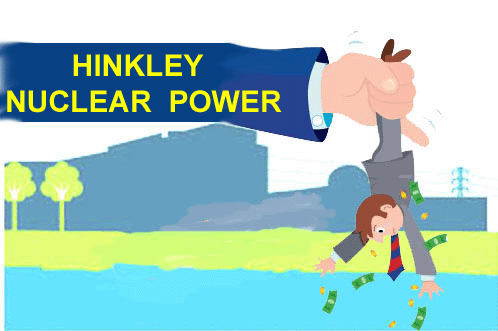 Stop Hinkley 29th Jan 2019 UK Energy Policy is at a tipping point. Following the withdrawal of two
Japanese giants – Toshiba and Hitachi – from nuclear projects at Moorside
in Cumbria and Wylfa on Anglesey – it is now clearer than ever that it
would be cheaper to build new renewable capacity rather than continue
building Hinkley Point C.
It’s now time to cut our losses and abandon the
Hinkley Point C project altogether. Even Business Secretary, Greg Clark has
recognised that “The cost of renewable technologies such as offshore wind
has fallen dramatically, to the point where they now require very little
public subsidy and will soon require none.” And the cost reductions for
offshore wind are far from over.
Stop Hinkley spokesperson Roy Pumfrey
said: “It is time to scrap the welfare scheme for the dying nuclear
industry called Hinkley Point C. Business Secretary Greg Clark has
virtually admitted that nuclear power is past its sell-by-date. If Hitachi
can’t make a profit with ‘significant and generous’ financial support
from the Government, – its share price went up by 10% when Wylfa was
suspended – and even EDF is getting cold feet despite the prospect of a
£50bn bung from consumers – it must be time to get out of nuclear, cancel
Hinkley and stop coming up with new ways of fleecing taxpayers and
consumers to fund new reactors.”
http://www.stophinkley.org/PressReleases/pr190129.pdf
France’s new president of the Nuclear Safety Authority concerned on safety of aging nuclear reactors
president of the Nuclear Safety Authority. The new president of the Nuclear
Safety Authority, Bernard Doroszczuk, is worried about the aging of the
park and the loss of skills.
https://www.lemonde.fr/planete/article/2019/01/29/l-etat-des-installations-est-un-vrai-sujet-de-preoccupation-selon-le-president-de-l-autorite-de-surete-nucleaire_5416128_3244.html
France’s government snidely changes law to avoid paying compensation to Polynesian victims of atomic bomb testing
 Dismay in Tahiti over changed nuclear compensation law https://www.radionz.co.nz/international/pacific-news/381065/dismay-in-tahiti-over-changed-nuclear-compensation-law French Polynesia’s nuclear test veterans organisations are dismayed to find out that a planned change to the compensation law for test victims was quietly altered last year.
It emerged that in the finance act passed in France in the week before Christmas, a provision of negligible exposure for compensation claimants was included.
This was against the recommendation of a commission set up in 2017 which advised for the reference to negligible risk to be removed as a way to improve the 2010 compensation law.
There had been widespread clamour to change the law because most applications had been thrown out.
The head of the Moruroa e tatou organisation Roland Oldham told the public broadcaster that the situation was simple.
He said the French state refused to compensate the test victims by playing for time.
Father Auguste Uebe-Carlson of the Association 193 also condemned this change, saying the fight was continuing.
The 12-member commission which advised the French legislature was headed by a French Polynesian Senator Lana Tetuanui, who is yet to comment.
France tested 193 nuclear weapons in the South Pacific over a 30-year period, with some of the atmospheric blasts irradiating most islands.
1 This Month
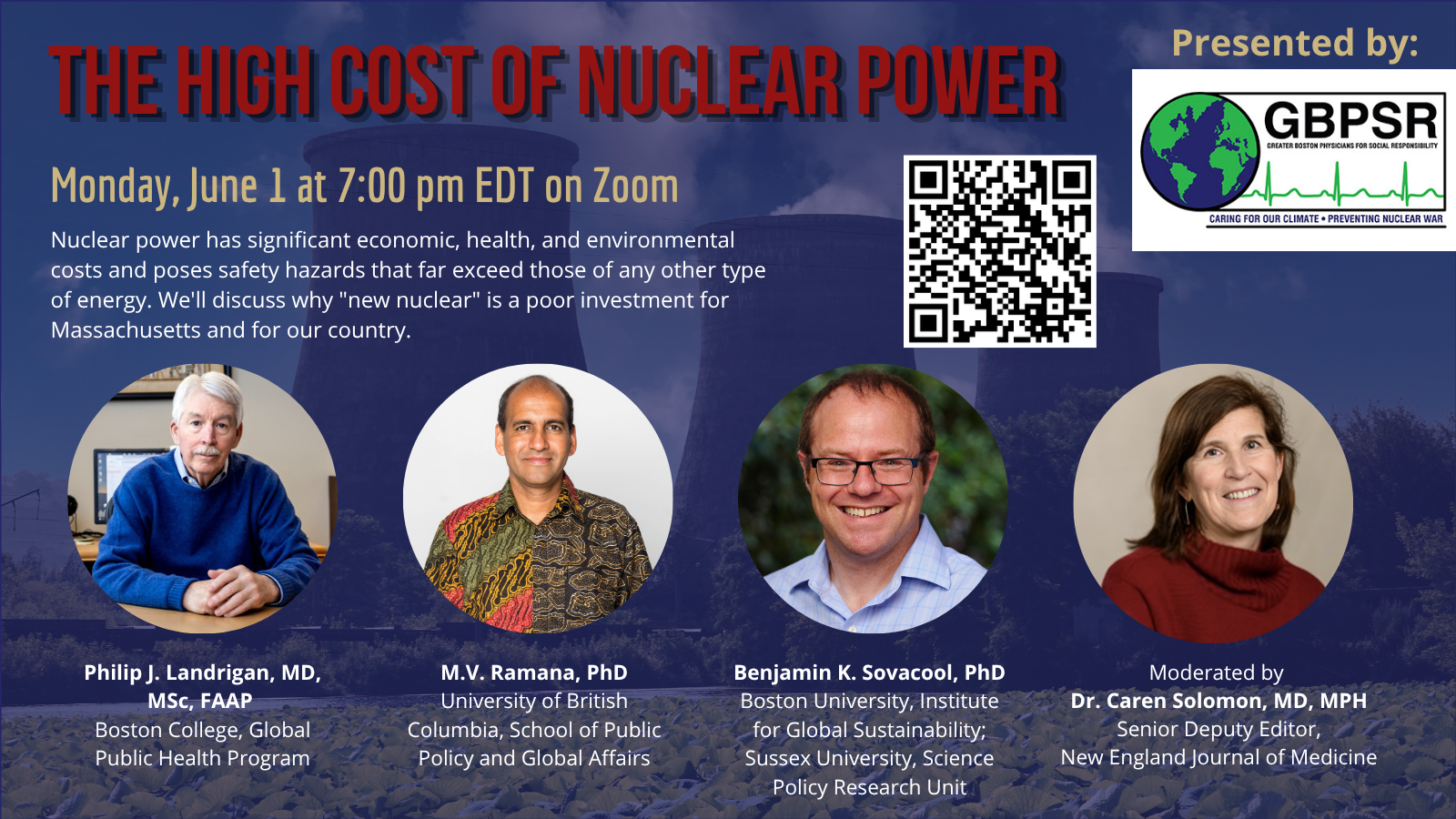
1 June Webinar – The High Cost of Nuclear Power – Register


of the week– Nuclear Reactor Information Task Force
To see nuclear-related stories in greater depth and intensity – go to https://nuclearinformation.wordpress.com
-
Archives
- May 2026 (262)
- April 2026 (356)
- March 2026 (251)
- February 2026 (268)
- January 2026 (308)
- December 2025 (358)
- November 2025 (359)
- October 2025 (376)
- September 2025 (257)
- August 2025 (319)
- July 2025 (230)
- June 2025 (348)
-
Categories
- 1
- 1 NUCLEAR ISSUES
- business and costs
- climate change
- culture and arts
- ENERGY
- environment
- health
- history
- indigenous issues
- Legal
- marketing of nuclear
- media
- opposition to nuclear
- PERSONAL STORIES
- politics
- politics international
- Religion and ethics
- safety
- secrets,lies and civil liberties
- spinbuster
- technology
- Uranium
- wastes
- weapons and war
- Women
- 2 WORLD
- ACTION
- AFRICA
- Atrocities
- AUSTRALIA
- Christina's notes
- Christina's themes
- culture and arts
- Events
- Fuk 2022
- Fuk 2023
- Fukushima 2017
- Fukushima 2018
- fukushima 2019
- Fukushima 2020
- Fukushima 2021
- general
- global warming
- Humour (God we need it)
- Nuclear
- RARE EARTHS
- Reference
- resources – print
- Resources -audiovicual
- Weekly Newsletter
- World
- World Nuclear
- YouTube
-
RSS
Entries RSS
Comments RSS
 nuclear-news